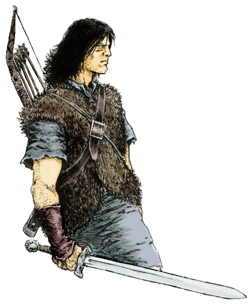
 Thorgal is one of the most popular bande-dessinée comics in France. I had seen references to it and the albums several times, but I was wary of it and only started reading it in a roundabout way. I had read two other series by the same author (those reviews will come later) and really enjoyed them. But I saw Thorgal as a poor European rip-off of Conan. He has long black hair, is generally shirtless and is in a fantastic semi-medieval setting (though actually it's more of the Viking period). It also has a similar black and white style to many of the Savage Sword artists.
The similarities are valid and the French are quite familiar with the comic world of Conan the Barbarian, but thinking of it as a weaker version was profoundly wrong. Thorgal rocks! This is a fantastic book. The first book I got was the Intégrale 1 (intégrales are what they call collections of the albums) that contained the first four albums. What first grabbed me was that the story had some really wild space/fantasy elements, but delivered with some gravity and expressing interesting themes and thus keeping it from being too far out.
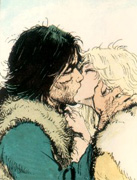
 It's about a young man, a member of a tough viking tribe, but not actually of them. Though he is one of their best warriors, he is treated as an outsider because he was found on the beach as a baby. His origin is a fundamental part of the overall story arc of the series and as we learn more about it as we follow him through his adventurers. He falls in love with Aaricia, a daughter of the tribe's king (and this, of course, does not work out easily) and most of the book is about him and her trying to live peacefully away from the violence and machinations of man. It's a great theme and the love between them is really compelling, because, as you can well imagine, he is consantly getting drawn into shit and separated from his wife. Or she is taken from him, or their son is taken and they both have to go kick some ass. Along the way, Van Hamme and Rosinski create a great cast of secondary characters as well as amazing worlds of wondrous fantasy. Thorgal travels to underground dwarf tunnels, other dimensions, lost islands, aztec kingdoms ruled by space gods, nowhere (the land between heaven and earth) and I've only read 17 of 28 albums!
 One of my quebecois friends and I were discussing comics and I told him I was reading Thorgal. He said, with great enthusiasm "des belles histoires, des belles histoires." And it's true, at the level of each album, which in most cases is a self-contained story and at the greater level of the overall series, these stories are tight and engaging, always fundamentally connected to the themes and the characters. I have yet to find a moment that was a little lame, a little inconsistent.
 And Thorgal is full of great ass-kicking moments. Later in the series, Thorgal makes friends with Pied d'Arbre (Foot of Wood, or I guess, Pegleg) a one-legged weapon-maker. He fashions a powerful bow, with two curves that can only be pulled back by an exceptionally strong person. Pretty standard stuff for a fantasy book, really. But when it gets exploited it's just one of those "Hell yeah!" moments. A bunch of bad vikings have done all kinds of bad stuff to Thorgal and his wife. Five of them are pursuing a wounded Thorgal. When they finally catch up to him, he's stopped and facing them across a plain. "Why did he stop?" asks the leader. "I don't know. He's just out of arrow range. I guess he thinks he's safe." "Ha ha, the fool," the leader laughs grimly. "As long as our arrows can't reach him, his can't-URK!" and suddenly there is an arrow in his chest. I can't really do it justice, (if I can get it out of the library again, I'll scan it in), but there are tons of great moments like that.
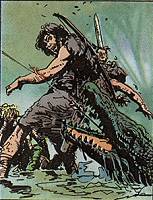 The art is beautiful. At first I found it a bit too sketchy, but as I got into the comic more I appreciated some of the more interpretative lines. There is a great image of a horizon filled with oncoming Viking ships. They are just little squiggles on a black line, but somehow it works. Rosinski clearly has the skill to detailed, tight lines. He demonstrates it constantly on the close up shots. I read later that he deliberately keeps things open-ended, allowing the reader's imagination do the work. It is very effective. He captures the action of combat, the stillness of emotion and the fantasy of another world equally well. I actually prefer the black and white of the intégrales to the colour in the individual albums. It allows you to see Rosinski's lines much better.
I see that a lot of these were published in english by a company called Ink Publishing. I've seen them on eBay, but I imagine they are quite hard to come by. If you find one, check it out. My life is much better now that I have read Thorgal.
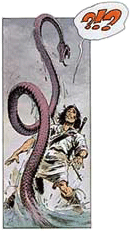
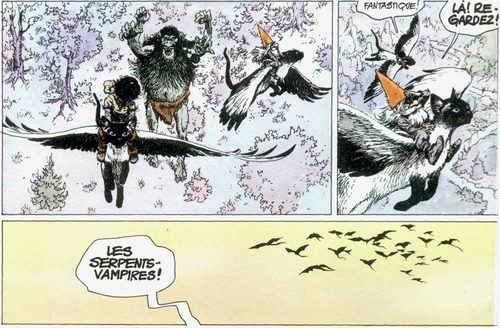
I'll leave you with a couple of frames from a story of Thorgal's childhood when he has to help a dwarf find the metal that does not exist in order to prevent the dwarf kingdom from being taken over by the evil serpent Nidgard. This story is one of the more fantastic, almost like a children's story. Check out the winged cats! The little dwarf rocks. He has a pick with which he is quite handy!

 Okay, this snuck in during my french BD reading because I had it reserved at the library before I started the comics project and it became available during. I couldn't pass up the opportunity.
 To my legion of readers, I would like to explain why I have suddenly stopped posting. The truth is that I have also suddenly stopped reading books in english. I started a new job in March in a french office. This is wonderful and I'm loving it, but I found quite quickly that my french was not going to improve simply by me going to work. I need to buckle down, practice and drill on my own, listen to french and read french. I am therefore trying to immerse myself as much as possible in the french language and one of the first things that had to go was all the english reading I was planning on this year. This saddens me a bit, as I do love reading in my mother tongue. But there will always be a chance to read in english.
  For the sake of an introduction, the bande-dessinée (which means "drawn strip") is considered in Europe and especially in french-speaking europe (Belgium is the primary source) as an aesthetic medium as relevant to art and literature as the film or novel. Comics cover a wide-range of subjects and are aimed at all different demographic groups (though there does seem to be a preponderance of books for young, male readers). They tend to be large format, hardback bound and 64 pages in length, generally of quite nice quality. They are also serialized in magazines that collect a bunch of different comics and then bound together later in complete volumes. Outside of Europe, the best known are Asterix and Tintin and if you've ever seen those, you will get an idea of at least how they are presented physically. Those are both great books, and both are responsible for significant trends in the medium, but they should not be taken as truly representing the incredible range of comics that exist today.
  I can't say a whole lot more than that, as I don't know much more. But I hope to be able to share with you some of that incredible range in this blog. I have already learned a lot in the last month and I hope I can start to put together some ideas, theories and overall descriptions of la bande-dessinée. It's also a great opportunity to add lots of cool images! Very few of these comics are translated into english and I have yet to find a good web site for the anglophone, so we're kind of on our own here. Which is great. Stick around...


 Posts
Posts


