Wednesday, January 30, 2019

10. Maneater by Ted Willis

What a find!  Man, 2019 has started out with a bang for my bookhunting.  I found the pulp haul at The Bookmark in Oakland right after New Year's.  I stumbled on this book at the free shelf on St-Viateur.  Man-Eater checks off so many of my reading preferences: 70s British manly adventure, beautiful Pan paperback, animals fighting for freedom against civilization and I've never heard of it or the author before!

The story starts off immediately, with an unnamed man driving a truck off the road into the moors, where he releases two lifelong circus tigers from their cages.  You don't know why except hints that he was as caged by their existence as they were by man's.  Then the fun starts.  An older man and a younger woman are parked near the forest for some illicit nooky.  When he goes out to take a piss, he doesn't come back and she freaks out and drives away.

The story then opens up into a wider investigation and exploration into the small villages in the county and how they are impacted by the escaped tigers.  We also go back to the tigers every few chapters, to see their perspective and how they are getting on in their new found freedom.  There are sort of two main protagonists. The first is the competent young Chief-Inspector Charles Gosford, who leads the investigation.  The second is David Birk, hunter and assassin on mental leave from his day job at the agency.  He's just chilling in his little hamlet off the beaten path next to the moors, tending his garden, taking tea when he hears the unmistakable call of the tigers.  He was raised in India with a famous hunting father and, though it is almost unbelievable, he knows exactly what he hears.

This is what I particularly love about these books.  The British are so good at understated competence.  There is always a great game recognizes game moment in the best British adventure books.  Here is one of the lieutenants describing Birk to his chief after Birk comes to the station to warn them that somehow there are tigers on the moors:
"Doesn't look like a crank either, sir.  On the short side, actually, but rugged, nose a bit squashed as if it had been broken some time.  Very sharp, bright blue eyes—first thing you notice about him almost.  Knocked around a bit, I'd say.  Odd manner, too.  Sort of detached, as though he was telling all this as a favour, wanted nothing to do with it himself."
And then later when Gosford first meets him:
He could see what Miller meant about this man's detachment; there was a curious air of completeness about him, as of a man able to stand alone, without the need of social crutches on which other men prop up their lives.  There was a calmness there too—no, thought Gosford, correcting himself—it was a sort of stillness, a poised, brooding stillness, like the moor, as if he were waiting, listening...
I love the use of "knocked about a bit" to mean super bad ass man-eating tiger hunter and world-weary elite sniper for dying empire still trying to punch above its weight in the world.  And of course, the stillness.  This is the impression I try (with minimal success, I suspect) to impart when going on job interviews or meetings with vendors.

The first half of the book is fantastic, capturing the district and a diverse range of characters and moments as the fear (and attacks) of two tigers on the region creates chaos.  Unfortunately, it doesn't quite live up to its potential as many of the storylines are abandoned or resolved too presumptorily and everything wraps up way too quickly given the scope of the chaos.  One is left slightly unsatisfied. It kind of feels like it should have been another hundred pages longer.  I can only speculate.  Still, a really enjoyable read and definitely a prized keeper for the shelf.  I will be looking for Ted Willis' other books.


9. Queenpin by Megan Abbot

This was an interesting (and good read.  It's noir, pulp, hard-boiled, etc. but a modern simulacrum.  It's like somebody perfectly rebuilt an old car but there were some modern parts hiding under the hood.  It's tight, tough and entertaining.  If it had come in fake dressing with dates from the late 60s I might have thought it was real, though little hints would have nagged at me.  It's the story of  a young, smart, working-class girl who does the books for a cheap bar.  She gets noticed by an older, glamourous woman who works for the mob, Gloria Denton.  Denton takes her under her wing and mentors her to be her sidekick.  This is the kind of book that was sort of predictable, or at least you weren't worried so much about where the narrative led as you knew right from the beginning it was ultimately going to be a power struggle between the girl and her mentor.  So it is safe to say that the girl sort of fucks up or sort of deliberately does what she wants by hooking up with a low-life, charming hopeless gambler.  Shit goes wrong in a deliciously brutal way.

Smarter people than me will be able to do a better analysis of this book.  On the one hand, you can at the very least, credit Abbot for wrtiing a near diamond perfect pulp book.  However, I suspect there is also a lot deeper shit going on here with the role reversals and how she plays with the power dynamics between the two women and the men in the world.   Or perhaps it can be criticized for being too much of something the male gaze would want?  I don't know, will go read up and will also keep her earlier pulp works in mind.  She has also gone on to a successful career writing "literary" fiction, some of which look promising and interesting as well.

Monday, January 28, 2019

8. The Innocent Mrs. Duff by Elizabeth Sanxsay Holding

I found this at the Grande Bibliothèque here.  It's actually a different double reprint of two of Holding's books (back-to-back so you flip the book over to read the second book).  The Innocent Mrs. Duff is from 1947, which would be a bit later in her career (though she wrote 4 books after it before dying in 1955).  I have to say that either I didn't get this book or that it is not one of her better efforts.  It did help me to identify some recurring themes in her work.

The story is about Jacob Duff, a wealthy New Yorker out in the suburbs.  His wife had died and he recently remarried a younger model.  They have been married for a year when the book starts and he is already clearly exasperated by her.  His distaste is all centered around class, somehow she can't do anything right, though she seems honestly to be making an effort.  He also is struggling with alchoholism, though in total denial about it.  As the book goes on, you realize he is an absolute drunk and that his life is spiralling out of control.

However, right from the beginning, I couldn't get a handle on his character.  His alcoholism accelerates so quickly.  I couldn't tell if it was him being an unreliable narrator or just that was the way Holding thought alcoholism works (which doesn't seem likely as the rest of portrayal is quite accurate).  It threw me.  Furthermore, the guy is just completely stupid, almost addled to the point where you wonder if he is being drugged by someone else.  Basically, he just gets more and more confused and paranoid and ruins his life.  There is some hinting at a mystery but there really isn't one in the end.  The narrative does careen forward and is entertaining and almost funny.  At one point he goes to the office to try and type up a fake ransom letter.  The secretary wants to do it for him but he can't let her see what he is typing.  He sits at the typewriter and keeps screwing it up and then stuffing the erroneous pages in his pocket, all the while the secretary is standing there waiting for her typewriter.

An odd story, kind of fun, but ultimately left me a bit puzzled as to what story she was trying to tell.  The late, great Ed Gorman writes a much more positive (and better) review that does make me realize this book is very well regarded by those whose opinions on these things count (Raymond Chandler said it was the best book about alcoholism).  He paticularily appreciated the portrayal from the drunk's perspective and the constant sense of dread that forces you to turn the pages.  I can attest that these things are very good in the book.  I just felt unsure of the foundation I was on from the beginning.

Friday, January 25, 2019

7. Binti by Nnedi Okorafor

She calls it a novella, but really it is a short story so I feel a bit cheap considering this as a single book.  I did purchase it new and separately, so economically it is quite definitely a book and I'll take that.  Anyways, I have been wanting to read a book by Okorafor for a while now. I thought Binti was the one you are supposed to read but I think I probably should have started with a real novel such as Who Fears Death.  She writes in a lot of different forms with novellas and sort-of series and some books for young adults, so it is difficult to find a clear entry point.

The story is about a gifted young girl who comes from a tradtional desert people and is running away off-planet to go to university, the first of her people to do so and against her family and community's wishes.  En route, the ship is attacked by Meduse and she by the luck (or perhaps her special technological skills) of a piece of ancient tech that she found and keeps as a good luck charm, she is spared.

I am reluctant to be overly critical as this is really a short book.  The protagonist is really cool, as is the setting.  It's written directly and enjoyably.  I gobbled it up.  It just felt a bit thin for me (again, the size so not a real criticism).  I feel that this could easily be a young adult novel (and perhaps that is a large part of its audience).  The resolution is very quick and things work out way too well (given humans), but again this is probably a function of the form of the story.

More disappointing, is that the progressive, racial themes were basically analogous to our own social issues, almost simplistically so.  It is like a 101 of post-colonial tropes.  The girl comes from a minority, dark-skinned tribe that wash, dress and decorate themselves very differently than the light-skinned majority on her planet.  The conflict that triggers the attack is because of a body part stolen for research and kept in a university museum.  I suspect this book informed some of the writing in Black Panther. 

I like these themes and recognize that their absence in sci-fi and fantasy are not an absence but rather due to the dominance of the white male viewpoint.  It's just that I wished they had been incorporated here in a way that didn't keep reminding me of the real world.  That being said, the final part of the book, where the heroine is transformed physically and makes a connection with the meduse suggests the setting will get more complex and take me to a new place without sacrificing the impact of those real-world issues on the narrative.  I do have the next one, so that should be interesting.

Despite my nitpicking, a good start.  I just want to go deeper.

Thursday, January 24, 2019

6. The Wild Party by John McPartland

Interesting, I just realized I read two books in a row with "Wild" in the title.  I have mixed feelings about The Wild Party and those feelings went up and down as I read the book.  It's jazz or trying to be jazz. Sometimes it succeeds and you feel the rhythm of the writing and the situation.  At other times, it becomes pretentious, annoying and trapped in its time.  I, feel, on balance that the ending unfortunately swung it just a bit into the latter, with a failed attempt at making some big theme about one of the characters instead of justing ending the narrative.

The set-up is great.  You start in a dingy jazz bar in LA and immediately get to know 4 pretty low characters.  Big Tom the brutal ex-football player and the leader of the gang.  Gage, the psychopathic knife-wielder, Kicks the loser pianist and Honey the wasted college drop-out.  They are broke, futureless and looking for money and trouble on a Saturday night.  Each has their own motivations and Tom is the uncontested alpha male of the group.  Right away, the dialogue and the inner thoughts are all hep jazz lingo.  I have always found this particular period of American culture to be profoundly annoying and it is on full blast here: weird pseudo-poetic incomplete sentences, lots of pre-60s labelling of various social roles and so on.  Fortunately, it doesn't seem to be McPartland's actual narrative voice most of the time and much of the objective voice it is straightforward and clear. 

They hatch a plan to send Gage, who is also good at looking and acting above his class, to a fancy motel to see if he can pick up a mark.  He falls upon this perfect couple, the navy pilot on leave and his debutante fiancĂ© who is into jazz (or "progressive" as they call it which I guess is the more freeform jazz of the time) and a slight yearning for excitement.  They get led out to this dingy bar where shit gets scary quickly. 

The trap and tension is very well put together.  It is hard to blame the victims here, beyond their mistake of going out with Gage to the bar in the first place.  Every step they take gets them closer to a terrible situation but the gang is shifty and savvy enough that there are no obvious outs for them.  There is a ton of psychosexual interaction.  Tom is portrayed as a kind of ur-man that is so sexually potent and masculine that he just takes women whenever he wants and women fear him and yet realize that he may offer them some transcendant manliness that speaks to them on some primal level.  This is probably all nonsense, but is deeply rooted even today in our gender relationships and so is impactful in the book. 

I generally avoid narratives where rape or the threat of rape is a central theme and I was hesitant to pick this book up.  It was just too beautiful of a paperback to resist.  It is pretty nasty in the threats and the thinking and writing behind them.  That theme is a big part of the story but it is more about these lost lives and the desperation of all the people who are caught up in the extreme, unfettered aggression of Big Tom's insane masculinity.  In some ways, he reminds me a lot of the character of McQuade from The Spiked Heel (written around the same time).  This conflict between civilized and animal masculinity may reflect some of the tensions in post-WWII society with GIs trying to live the straight life.  Where the book over-reached was in the psychological justification for the various characters' behavours.  It is based on simplistic and overblown ideas relevant at the time.  This was especially true with Honey, who was like 20 and supposedly had been a popular cheerleader type girl until she encountered jazz and men and pot and then somehow becomes a complete wastoid with zero confidence or future.

At other times, though, this book is tense and hard as fuck, quite scary and short.  So a good read, just undermined slightly by the need to try and be deep and jazz.

I am reminded of this classic comedy moment:


Tuesday, January 22, 2019

5. The Wild Shore by Kim Stanley Robinson

I noticed this sitting on one of the many piles hiding the front counter at Dark Carnival while having my big post-xmas book haul being rung up.  On a whim, I threw it on the pile.  I had initially thought my nephew might enjoy it, but he found enough books of his own and I ended up keeping it for myself.  It's a nice 80s paperback that I banged up too much.  I really don't like these designs, but age and rarity have made it much more appealing to me and I regret somewhat my rough handling, but it had to be read.

This is Kim Stanley Robinson's first published novel.  I don't know if this was the first place it was published, but it is part of a revival of the Ace Science Fiction Specials with an introduction by Terry Carr.  He talks more about the science fiction genre in the early '80s than the book itself, complaining about the popularity of generic sci-fi using rehashed plots.  It doesn't go into any depth, but is nonetheless an interesting glimpse into the ongoing tension between art and commerce in the genre at that time.

The Wild Shore is definitely a post-apocalyptic novel, and has many of the themes and situations that I enjoy in the genre. It takes place in southern California 60 or so years after a major nuclear attack reduced America to rubble and the remaining Americans to a hardscrabble frontier existence.  The community of Onofre works hard at fishing, farming and surviving after having built up a small foundation of civilization.  They also trade with neighbouring communities, including the gypsy-like scavengers, who choose to survive by living off the ruins.  There is a twist, though, we learn about a third of the way in.  America was actually the loser in the war and the rest of the world may be going on in its modern way, embargoing and quarantining the United States.  The Japanese control Catalina and patrol the coast, sending misilles from satellites anytime Americans build up too much infrastructure.  Japanese adventure tourists may be smuggled on shore and hosted by the scavengers.  This the young man Henry learns when he meets two travellers from the much larger San Diego to the south, travellers who also tell of the resistance.

It's a cool concept and it gets explored in the book, though not thoroughly.  The Wild Shore is more about a young man faced with difficult choices and making some bad ones and about the community around him and how it works together and deals with these changes.  Normally, I would prefer to stick with the setting and adventure stuff, but everything seems very realistic here and I got caught up in it.  Likewise, Robinson's style can be too straightforward and at first there seemed to be a lot of telling but as the novel progresses, you realize there are layers to the narrative.  It is also about writing itself, especially at the end.  I found some very inspiring passages that really captured the pain and magic of trying to write.

There are two other books that follow this one, though I felt that this one was wrapped up very nicely.  I will keep an eye out for them, but don't feel the need to read them to find out anything more that happened.  It might even spoil some of the magic of this book.

Wednesday, January 16, 2019

4. The Hermit of Peking: The Hidden Life of Sir Edmund Backhouse by Hugh Trevor-Roper

My friend lent me this book with a strong recommendation.  We both got our bachelor's in history but he kept with it more than I and said this one was really good.  He was not wrong.  It was also nice to be reminded of how funny and rich history is, both the content itself, but also all the crazy back and forth between historians.  I am glad I never went into it professionally as it can be painfully petty and vicious, but from afar it is quite entertaining.

The Hermit of Peking is a really interesting book because the story itself is interesting, but perhaps even more so it is the way that Trevor-Roper structures it that really captivates the reader.  There is a prologue where he explains how he knew of Backhouse but hadn't really thought much beyond his generally understood reputation as an eccentric and scholar living through the most disruptive times in China.  A Swiss diplomat contacted him saying he had an interesting manuscript by Backhouse but one that was quite offensive and he wasn't sure what to do with it.  They meet at an airpot where the manuscript is handed over.  It turns out to be Backhouse's biography but basically x-rated (at least for the 1970s).  This spurs Trevor-Roper to really dig into Backhouse's life. As we go through his research and archival detective work, we learn more and more about Backhouse's life and work.  Each chapter peels away another layer of the onion and things that seemed true and straightforward in early parts get exposed in an entirely different way as you learn more and more.

I won't go into the actual story, as Trevor-Roper does the job extremely well and the fun is in the reading.  To give you some tantalizing hints, Backhouse was seen as a historian and connected diplomat to the Chinese court.  He donated extremely valuable documents to a library in Oxford.  He also lied and forged and pulled several long cons all of which ultimately failed.  Yet he is not outwardly evil, but rather sad and lost (though ultimately a survivor).  Trevor-Roper does an amazing job.  I have two criticisms of his analysis.  Both are probably ones that I am only able to make because of the time period I am in.  First, there is a subtle but nevertheless omnipresent revulsion against sexuality and particularly homosexuality.  It's not hardcore, but rather the slight contempt of the supposedly objective protestant.  Trevor-Roper talks a lot about what a great and creative storyteller Backhouse is, but dismisses his autobiography as basically pornography, with terms like "revolting" to describe the explicit text.  Second, there is zero critique in this book of colonialism.  I mean ultimately, Backhouse could have only pulled off the stuff he did because of colonialism.  It is unstated, but this book really reminds you that the British presence (and the other foreign nations) in China was basically all criminal (and that is putting it mildly).  They destabilized a polity in order to rob it blind and that went on at the governmental level and at the individual level.  For decades, other Europeans bought into Backhouse's lies, partly because he was so good at it, but also because of racism.  They were all too quick to assign any failure or contradictions on Backhouse's part to wily Chinese machinations.  I guess I benefit from decades of post-colonial theory to be able to see those failings so acutely (this book was written in the 1970s).  He isn't excusing of the behaviour of the colonial powers, but also kind of glosses over it all. 

Great book, though.

Thursday, January 10, 2019

3. Ride the Pink Horse by Dorothy B. Hughes

Dorothy B. Hughes, I am learning, was one of several popular and succesful female mystery writers from the middle of the 20th century.  It is extremely difficult to find her books today, though there are a few reprints and my library had a volume of three of her books.  Even though my on-deck shelf is full, I took it out out of fear they would get rid of it soon if it showed little activity (the english fiction shelves have limited space).  Now that I finished Ride the Pink Horse, I will return it and take it out again for each subsequent novel in the volume.  I wish I could do it on somebody else's library card.

Ride the Pink Horse takes place, I believe in Santa Fe.  It's some American city close to the border of Mexico on the weekend of a big festival called the Fiesta.  Sailor has arrived on the bus from Chicago in a hunt for The Sen, the corrupt politician/syndicate boss that plucked him out of the south side and trained him to be a smooth gangster.  As Sailor struggles to find a room (he had no idea about Fiesta), we slowly learn of the background of his beef with the Sen.  There is also a high-ranking homicide detective in town (he got a room), friendly with Sailor because he knew him also from the old neighbourhood.  The three of them circle a narrative around the murder of the Sen's wife, but really the story is about Sailor, who he is and what choices he has made and will make.

This is very much existentialist noir.  It is almost surreal, with the Mexicans and Indians representing other worlds, other histories and the Fiesta making all the scenes crowded and frenetic.  Sailor befriends the fat old man who cranks the merry-go-round the kids love to ride, who himself has had a violent path but now seems perfectly content to make the fun ride for the kids and sleep in the park.  These characters and others force Sailor to confront who he is and the journey and what holds you to the book is to see what he learns.

I tend to not go for the symbolic and prefer a concrete mystery (and there is one here).  In this case, the writing and the very real-seeming background of Sailor were strong and compelling and I thoroughly enjoyed the book.  This is literature folks and there is absolutely no reason on that merit alone that this book should not be seeing endless reprints as we see today for Chandler, Hammett, etc.  It's a shame.

Tuesday, January 08, 2019

2. The Shadow of Suspicion by Emilie Loring

The cutoff top is the book, not my photo
Part of the really great pulp haul from the Bookmark in Oakland, this was really not a very good read.  The premise is cool and it had some potential, but was ultimately undone by obvious plotting, inconsistency and a pretty insipid and uninspiring female protagonist.  It's about a young woman who goes to Maine to support her widowed aunt who must stay in her lumber camp to ensure they cut down enough wood to pay off the debts her husband incurred.  There is trouble at the camp, unrest among the men and other more mysterious whisperings.  The previous manager who was well-liked was killed in a hunting accident (this is the first of the bad plotting: he was shot in the head and it was dismissed as an accident even though they never discovered who did it).

So that all sounds good, but because this is 1955 there has to be some steely-eyed, firm-jawed dude who is actually going to do all the investigation and commanding and stuff.  His character also had potential, a Korean vet who had been imprisoned and now was on the hunt for a commie traitor he had discovered while being released.  He accidently discovers that the traitor may well be at the lumber camp. He is supposed to be this totally awesome dude "whose manners are invariably charming" except when he spazzes out and accuses the heroine of having fallen in love with the dude who drove her up to the camp.  That's like 20 pages in!  I am familiar with the sexual conventions of books of this period, but there is a subtlety even within those restrictions. This book was just weird, with her immediately falling in love with this guy and he obviously in love with her and yet not consummating for no reason other than stilted conversations.  His eyes are always flashing and her cheeks blushing. It's just badly constructed and leaves the reader with zero emotional romantic feelings about them.

I read up on Emilie Loring and she was really prolific.  She also died in 1951 and her family kept publishing under her name using a ghost writer and scraps of her remaining writing.  They did not do a very thorough job here.

Most interestingly, check out this list of other books at the back. This is like an excellent survey of the very specific nurse/female doctor romance/thriller sub-genre from the mid-50s.  You can just feel the tension between the conflicting cultures of traditional female domesticity competing with the dawn of the professional woman ("Has a dedicated nurse the same right to happiness as other women?" "Her ideal of nursing conflicted with her fiancĂ©'s ideas of the duties of a wife", "Dr. Gail Benton's rise in the medical profession is threatened by the imperious demands of her woman's heart")


Monday, January 07, 2019

1. Kolymsky Heights by Lionel Davidson

I have been looking for a book by Lionel Davidson for quite a while now.  I did not note it down, but I believe that I heard his name the first time via Kenneth Hite (gaming luminary and a genre fiction reader of impeccable taste) in the fantastic Ken and Robin Talk about Stuff podcast.  I finally stumbled upon Kolymsky Heights at Moe's. I see now that this was his last book and the first one he had published in over 16 years, so I clearly still have some searching to do.

I sort of wished I was reading this in the summer, as it takes place mostly in Siberia during winter and you really do feel the insane cold there.  I read it in Berkeley and Montreal in the winter and I still think it helped, as it made me not feel so bad about it being -7 and somewhat windy here.  I am not actually sure it is truly possible to do a lot of the things that happened in the book when it is in the -30s and -40s (like could you really even tighten bolts in that temperature?  Spend the night, even in a super awesome sleeping bag?  Wouldn't you just die?).

The premise of the story is a bit preposterous, even slightly science-fiction.  In a hyper top secret chemical laboratory in Siberia, an old scientist discovers a perfectly frozen cavewoman.  Because of the security levels, he has committed to spend the rest of his life there (as have all the staff, except the native Chukchis who help with some external work because the authorities know they will only return to their reindeer herds).  He manages to sneak out a message to an old colleague that he has important scientific info to share and that he has a way of getting that info out.  He just needs someone to come to him. This someone is Dr. John Porter, academic, eccentric and (as we learn) total badass First Nations dude from northern Manitoba.  Because he is indigenous to Northern Canada as well as being a languages expert, he is the only person who can possibly sneak into the region and somehow access the top secret base.  It also turns out that this guy is super skilled at all kinds of things.  He can fight, he can act, he knows a wide range of industrial manual labour skills (can load merchant ships, drive winter trucks, fix vehicles).  It's all very understated and the details of his actual background are never revealed (he says once he is used to living rough).

What makes the book work are the subtle and complex details of all the spy stuff. How he gets his various identities, how he gets into (and around once there) the region, are interesting, well thought out and really fun to read about.  The location itself is really cool.  I really knew next to nothing about Siberia and here you get a nice look at the industrial and economic engines that drive it, some of the history (how much of it was settled by ex-prisoners of Stalin's camps) and the insane geography and cold.  In the summer, you have to fly everywhere because it's all mushy permafrost.  It is only until winter that the trucks start rolling, across frozen river beds often!  Finally, there are several groups of indigenous people who are integrated into the world there and Davidson portrays the relationship between the Russian state and them in an interesting way.  I don't know how much of it is true or accurate but as a broad portrayal, it certainly made me interested.

I suspect he has better books in him, but this was entertaining and innovative.  Lionel Davidson stays on the hunt list.

Saturday, January 05, 2019

2018 Year-end Wrap-up and Berkeley book haul

Here is what is awaiting me for 2019

Here is what I wrote for my 2018 objectives in my 2017 wrap-up post:  "My fundamental goal is to read 50 books in 2018.  My secondary goal is to try and get past that to whittle away at my deficit.  We shall see!"

I am very glad to be able to write that I did indeed achieve both goals.  I read 57 books in 2018 and have reduced my deficit  down to 63 (that is how many books I am behind to achieve an annual average of 50 books a year).  Though I am crowing now, things did not look so rosy halfway through 2018.  My reading was way down.  I only read a single book in February (probably due to Assassin's Creed: Origins). Surprisingly, I also only read a single book in each June and July.  Once again, it was my August vacation to Vancouver that kicked off the reading.  And then I just started surging.  My new job is going great (I used to be in charge of everything now I am responsible for three things and sharing that responsibility).  My daughter is in school and logistically that is going really well.  Google+ is shutting down and I pulled myself away from that and Twitter big time in the second half of the year.  I basically fell in love with reading again this fall.  I just really got into going through the books on my on-deck shelf and seeing that size reduce to the point that I had to actually find some books to add to it near the end.  Extremely satisfying!  I used to have to hem and haw over whether I should get a book.  Now I go to a bookstore and need to find something. This allowed me to go hogwild in my book buying over the holidays and now my on-deck shelf is full of interesting books I really am excited to read.

Again, my reading went across a wide swath of genres and periods, though mainly anchored by my interest in crime fiction from the 20th century.  I read 15 books by female authors, up from 2018, but still showing a preponderance of white males. I learned a few things: Anthony Trollope is great but not as perfect as I first found him, my tepid opinion of Alistair Maclean did not change after reading two of his books, and my random old paperback purchases were often though not always more enjoyable than I think they will be in the actual reading.  15 of the books I read in 2018 were old paperbacks by authors completely unknown to me, that I found intriguing.  More than half of them were really quite good and only one mediocre (Takeover Bid, which had the coolest cover).

There were no major highlights for me this year, but I have to recognize Daniel Suarez for the contemporary techno-action fun he delivered for me in three books.  I also got deeply sucked in to God Is an Englishman, so much so that I almost wished I had ended the year on it. I would love to find another book by Rosemary Kutalik or even find out more about her.  I hate even to mention it here, but a major lowlight was the piece of shit State of Fear by Michael Crichton.  Fuck that guy.

I was going to say that it was a rocking year of music but that isn't totally accurate, as it was really more like a rocking half-year.  I hope in 2019 to be a bit more steady, consistently reading every month so that I don't have to rush at the end of the year if I really do pick up momentum.  My objectives in 2019 will continue to be to read at least 50 books, to cut into my overall deficit and a new addition, to read at least 3 books a month.

Fortunately, I have a refilled on-deck shelf, with only a couple books that weren't added this december in the very rich book haul I added over the holidays.  Check them out:

Top 3 are from Moe's, bottom 3 from Half-Price Books:

Bookmark Bookstore (run by Friends of the Oakland Public Library):  A Peter Rabe, a Mary Stewart and two Parker paperbacks!  I am joining up as a FOPL.


 And finally the inestimable Dark Carnival:


Sunday, December 30, 2018

57. The Gradual by Christopher Priest

This was a dreamlike, slightly disconnected yet ultimately intriguing and pleasurable read to end the year.  I actually had a tough time transitioning out of God Is an Englishman, it was such an absorbing epic and I didn't have any sense of what kind of book I was ready to read next.  So I think it took me a while to give The Gradual my full attention.  My partner found it for a buck at the Oakland Library bookstore (more on that haul).  The beginning of the book is slow and it takes a while to tell you where it is going (and even then you don't know the full journey to the end).  Things got interesting after the first third.  Priest constructs a mystery about the setting itself and once it gets going it really draws you in.

The protagonist is a musician in a desolate industrial city who had grown up under a military dictatorship in constant, but distant war.  He is invited to do a musical tour of the nearby vast archipelago of islands, neutral in the war and inspirational for his own compositions.  The islands are beautiful, but complex and alien. At every landing, they have to give these rods to an agent, who interrogates them, but otherwise life is much freer than home.  However, when he returns, he finds he has lost almost two years of his life.  His wife left him, his apartment was in arrears.  He tries to figure out what to do with his life all the while thinking about the mystery of the islands.

Priest weaves several other interesting narratives, including his brother drafted to the war and now fate unknown, the development of his own music and how it is received.  By the end, the disconnected style is overcome by the complex elegance of the plot and the rich sense of place.

Tuesday, December 25, 2018

56. God is an Englishman by R.F. Delderfield

Wow, I don't know how many of these epic, engrossing 672-page romantic histories I have in me.  I have to admit, it was enjoyable for the most part.  I wish I could have read it at a bit more relaxed pace, but its length made me feel pressured to not lose pace.

The story starts out in colonial India, at the end of some battle as mutinies are flaring up. Adam Swann, a commissioned soldier is brought down, but survives and discovers a ruby necklace of great value.  He decides to leave soldiering and return to England to use the rubies to stake some kind of new venture back home.  Upon arriving, he already sees the impact the railway is having on industrializing England.  He decides to take a horse across the land to see what he can learn.  He learns lots about the cotton mills and how England is changing.  He meets and marries a feisty beauty, Henrietta, running away from her avaricious merchant father and he decides to set up a business running freight via coaches between railway depots and cities not fed by the railway. 

Those two storylines, his marriage and family and the development of his business, interweave with in-depth forays in one or the other at certain crisis periods.  You also follow the paths of all his lieutenants and the regions they manage.  These are great opportunities for local mini-adventure vignettes, like the depot manager who catches an escaped lion, or the welshmen who provides the wagons that get the pump to a submerged mine.  They all are defined by their British gumption, common sense and basic decency, despite a range of political and socioeconomic backgrounds.  These passages were all quite entertaining and emotionally satisfying.

The marriage storyline is interesting and while weird does give a lot of time to the female perspective (as well as a second female character, one of his lieutenants with romantic tension).  There are quite long parts that dragged on where they get all introspective about how they learn from each other and go to other levels, etc.

I have to say that overall this book succeeded in taking me out of my world. I started reading it at the beginning of xmas vacation and I finished it on xmas day.  I sort of felt like I had my regular family vacation as well as another vacation in 19th century England, it so absorbed my consciousness.


Wednesday, December 19, 2018

55. Great Detective Feats by Leonard R. Gribble

I found this at the street sale on Rachel along with two other really enjoyable old mystery paperbacks (Darkness of Slumber and Map of Mistrust).  It was the least interesting and the least attractive aesthetically.  I don't know what 2/6 means in British currency (and what it's value was relative to the time), but given the cheap printing and the back being only ads for other books, I suspect this was an inexpensive read.  None of the names meant anything to me either.  It is a collection of 5 short detective stories.  I guess Gribble was well known for his Inspect Slade series (at least that's what it vaunts on the inside back cover).

Likewise, as I started reading the first story, I was worried it was going to be a slog to get through.  The premise itself was good, a restauranter in France (sometime in the late 19th century) finds a leg wrapped up in the well in his backyard.  The prose style and the way the story was laid out was very odd. It took me until about halfway through the second story to realize there was no dialogue.  These are basically narrated retellings with some embellishment but all done in the omniscient third person.  I think that all the stories may actually be real.  Once I cottoned to this, I enjoyed the book much more.  The crimes are all quite mundane and the detective work realistic (going through files, sending out letters, canvassing hundreds of people) and it made for some fairly enjoyable and interesting reading.  The morality is very black and white, but not vociferous.  The stories take place in a variety of times and places.  I was pleased to see the last story takes place in Berkeley in the 30's and is about a chemist who was working on an artificial silk when his lab in Walnut Creek blew up.

I think this book is the equivalent of one of those true crime books, but a lot less lurid (at least in the telling, the crimes themselves are quite nasty, though never sexual).  Solidly moral with constant applauding of excellent detective work but ultimately selling because people want to read about the crimes.

There was also this great passage, a little British dig at American law enforcement:
He was what is termed on the western side of the Atlantic a tough guy. Men like him and of his calibre created Chicago's dark history.  As a matter of fact, in features Kennedy was not unlike the celebrated Irish Chicaglo gangster overlord, Spike O'Donnell.  In the metropolis of the Middle West Kennedy would have flourished.  In England he did not flourish--Scotland Yard saw to that.


Tuesday, December 18, 2018

54. Valérian l'Intégrale volume 2 by Christin and Mézieres

This volume comprises the fifth, sixth and seventh books in the series and here we get more into the episodic visiting of different worlds.  There is so far not a longer narrative through line other than ValĂ©rian and Laureline's teasing, platonic banter.  Here they end up on a different world in each book, have to resolve a social/technical problem as well as save themselves.  One thing that is not entirely clear is the tone of these books.  The two chrono agents never seem truly threatened.  They do have highly advanced technology at their fingertips, but sometimes they lose their ship and all their stuff and yet seem to float above the risks and dangers of the people they are trying to rescue.  I am not against it, as it makes the reading a lot more fun.  But I wonder how much of it is an artifact of the style of bandes-desinnĂ©es of the period they were created in, the tendency for the french to always go slightly goofy.  We shall see how it evolves.

Le Pays sans Étoile - Here they arrive on a far outpost that has recently got itself established enough that they don't need help from the tempo-spatiel chrono agents.  ValĂ©rian and Laureline are just here to say goodbye.  Unfortunately, they also discover that another planet, off its orbit and hurtling towards this solar system, risks to destroy the new settlements.  They go to this barren rock to discover that it has a world inside of it, a world with two city-states, at perpetual war with one another.  One of the city-states is run by decadent men and the women are all slaves and the other is run by decadent women and the men are all slaves.

Bienvenue sur Alflolol - This story takes place back at Technorog, a resource treasure for the vast Terrien galactic empire.  It is here that the fuel and technology that ValĂ©rian and Laureline depend on is produced.  On their way in, they discover a lost ship of weird, fun-loving aliens who turn out to be the original inhabitants of Technorog (known to them as Alflolol).  Because the earth empire follows a Prime Directive type of rule, these natives must be allowed to return home and settle where they want.  This causes a massive disruption in Technorog's production capacity and conflict with the leaders there.  This was light-hearted in treatment (and in its resolution), which undermined a bit the power and pain behind the theme.

Les Oiseaux du MaĂ®tre - Their ship sucked into a planet with a bunch of other trapped ships, they tempo-spatiel agents find themselves in a land where a civiliization of other crash survivors all work to provide food for the master. They are driven by flocks of poisonous birds that make you go crazy if they bite you.  Over the centuries that this has been going on, the people have become fully enslaved to the master.

One interesting commonality between the first and third stories is that in both cases, V and L join a caravan at the beginning and travel across this strange land to the narrative goal.  In the first one, they join a migrant tribe who role is to mine the explosive eggs the two cities use as weapons and a lot of the first part of the book is them on a great route to one of the cities.  In the third book, they fall in amongst the people who strip the ocean of seaweed to add to the extravagant meals of the master.  They too walk along a major trail, joining up with other food providers (farmers, livestock raisers, etc.) who are all heading to the place where the feeding of the master happens.  Not sure if this is anything but a coincidence, but an interesting early pattern to keep an eye out for.

Monday, December 17, 2018

53. Bury your Dead by Louise Penny

I got this one out from the local public library after a recommendation from somebody.  I am generally leery of contemporary mysteries, but this one is set in Quebec and the author lives outside of Montreal, so I had to give it a try.  For some reason, I had it in my list that this was the first book in the Inspector Gamache series and I specifically was looking for it.  As I was reading it, it seemed less and less like a first book (or one with a ton of backstory that takes place late in the protagonist's career).  It turns out that it is like the 5th book in the series.  I am hoping it is representative of it as a whole, though I wished I could have started with something where the plot was not quite so ambitious and wide in scope (this one has a plotline involving a major terrorist attack).

Anyhow, an interesting read.  It is very well put together and the intrigue is imaginative and well-plotted.  Perhaps almost too well-plotted.  You actually get 3 mysteries in one here.  Something terrible happened in the past when one of Inspector Gamache's men gets kidnapped and we follow that flashback storyline.  At the same time (as the reader), Gamache who is recovering in Quebec City from his wounds mental and physical is investigating the murder of a Samuel de Champlain fanatic found murdered in the basement of the English Literature and Historical society.  Finally, Gamache's lieutenant, inspector Beauvoir, who is also recovering is sent back to the small town of Three Pines to re-investigate the murder of a hermit who had a cabin full of priceless antiques (they had caught and convicted a murderer, but Gamache has doubts).  So, yeah, a lot going on.  Honestly, I would have been perfectly fine with only one of these storylines.  I'm not sure why so much has to be packed into this book.  Is that the appetite of today's mystery reader?  Especially considering that in the flashback storyline, the kidnapping is actually part of a plot line that would fit better in a Tom Clancy novel.  Despite the quantity, they were all engaging and well-crafted storylines, though at times the suspense is a little arbitrary (like just tell us what happened).

The physical portrayal of Quebec City was great and reinforced my desire to do a family trip there.  It's a well-written page-turner and I can see why her books have been so succesful.  I would definitely pick up another one if I stumbled across it, though will probably not seek them out.  Not a criticism of the books, but just not quite in my wheelhouse.  I would like to see how she handles Montreal itself one day.

I do have one concern, though.  This is a delicate topic and I may come off sounding extremely nerdy or snobby here.  I had thought that Louise Penny was an anglophone Quebecer, but as I read this book I became less and less sure of it. There is a lot in here about Quebec and french that feels off.  Many of the protagonist's names are french from France, not Quebec.  I have never met anybody named Armand or Émile. Likewise, the food (which is often detailed) seems way more french than Quebecois.  Finally, there is an anglophone character whose french is really bad, but the way it is portrayed is that she says things that francophones understand in a completely ridiculous way like "have a nice strawberry".  It is supposed to be a humourous point about the character, but it just makes no sense.  If somebody speaks bad french, they will simply be not understood.  Nobody is going to mistake have a good night with have a good strawberry ("bonne nuit" vs. "bonne fraise"?!).  They sound completely different. This happens a bunch of times and I'm too lazy to find the actual text.

Going further, the political views of the francophone Quebecers rang oddly false to me.  They seemed to be stuck in the past and coming from an anglophone perspective.  The question of Quebec sovereignty in character's inner thoughts and dialogue is treated as this heavy thing, with this suggestion of menace around the more extreme separatists.  I find that to be a real anglophone view of the situation, informed by our own anxieties and the shit media coverage and propaganda outside of Quebec.  Even in 2010, sovereignty is not a major issue for most Quebecers.  The language is, the culture is and especially anxieties around immigration, but sovereignty for most people is kind of in the past now.  It's also not some heavy big thing.  People will talk about it.  It's not treated like some delicate subject you have to tiptoe around.

After I read the book, I read up on Louise Penny.  She's from Ontario but worked and lived in Quebec for decades.  She currently lives in the Eastern Townships.  It's not clear how good her french is nor how integrated she is in to francophone society here.  She clearly knows her stuff and does a lot of research for her books.  It could be she sees a side of Quebec that I don't see (I am pretty limited to Montreal most of the time), but honestly at times this book felt like cultural tourism.  I don't know if that is a good or bad thing and I suspect that her translated books do well and are well received here (will do a bit of research on that myself).  Quebecers love mysteries, homegrown ones especially.  I was just hoping for someone who really knew Quebec from the heart but wrote in english for my lazy ass and I am not sure I got that here, at least on the portrayal of francophone Quebec.
Saturday, December 15, 2018

52. Swallowdale by Arthur Ransome

This is the second book of the Swallows & Amazons series about little British children on holiday in the country in the period between the two world wars.  I was not so enthusiastic about the first one that I immediately wanted to read the next (it didn't quite grab me as it had a child, though I enjoyed it).  This was such a beautiful copy that I picked it up.

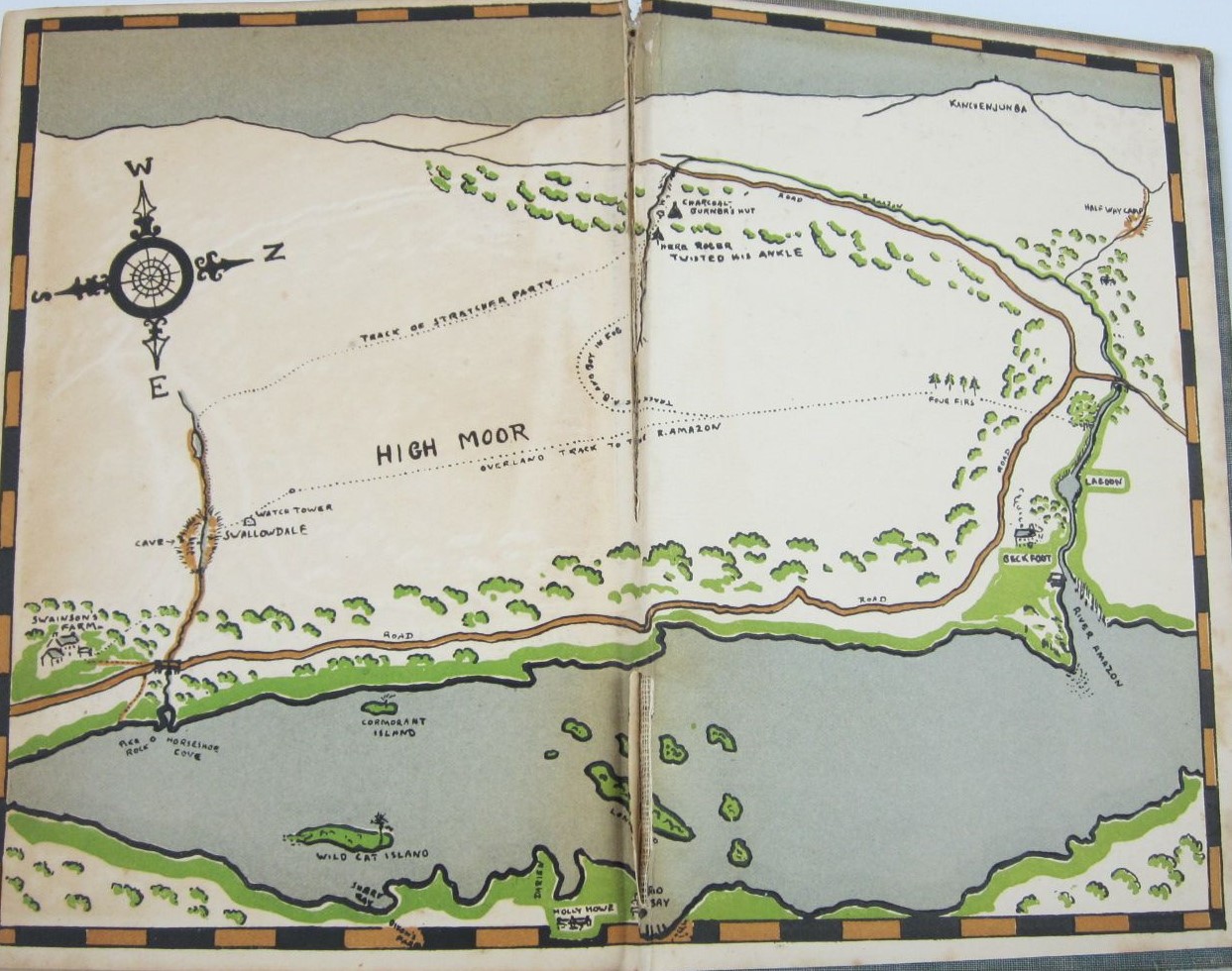
I am really glad I did, because this one did really grab me.  First, I needed something well written and real and honest after the pollution that was State of Fear.  Swallowdale was the perfect antidote.  Second, early on in this book, they crash the Swallow, their little sail boat and it has to go in for repairs.  This means that the bulk of the adventure and exploration takes place on land.  I do like the sailing stuff but the technical language loses me and I get disconnected.  Here, they are following the little river up to a cool, hidden valley and exploring outwards on the moors.  There is a really great map that goes with this one as well.  Finally, we have a real antagonist here, in the form of the Amazon's Great Aunt, who is staying with them and bringing with her a reign of terror of visits and outings in proper dresses and reading poetry and so on.  Nancy and Peggy and even their Uncle Jim have to sneak and plot in order to even get out of the house for some adventure.

With Swallows & Amazons, the first book, I theoretically enjoyed it.  Swallowdale satisfied my love of adventure and exploration in fiction so well that I am back on board and looking forward to finding the third book.  I am also going full-on prosletyzing and will be sending these books to the various children in my life that are the correct age.  It demonstrates to me how powerful the themes of exploration and adventure can be on their own. They don't need tension or character development or arcs or any of that American university creative writing dogma to be entertaining.  Even when you can see the map and know some of the events that are coming, Ransome is so good at capturing the feeling of climbing up over a ridge to see what is on the other side that you still feel excited.


Sunday, December 09, 2018

51. State of Fear by Michael Crichton

State of Shit
Writing this post will be a ceremony of cleansing, to help put this awful book behind me.  State of Fear is the worst book I have read in a long time, quite possibly one of the worst I have ever read.  The problem with bad books is that it is much harder for them to be good bad than a cheezy movie.  There was nothing good about this book, the whole thing was painful to get through.

Let's pretend first that it isn't basically a giant piece of shitty propaganda, an alt-right consNERDative screed.  I will just ignore the pages and pages of "conversations" where a naive liberal who has never had their assumptions challenged is slowly convinced that global warming is a giant scam perpetrated by super-rich environmental groups fronted by Hollywood elite.  These "arguments" literally contain graphs and footnoted references to real scientific journals.  If you flipped it so that it was corporate drones being convinced that global warming is real, it would be just as bad.  It is probably about 1/3 of the book when all added up.  Everytime the characters get on a flight to travel somewhere (and that is often), it's an excuse for another multi-page "dialogue" of badly constructed logic, straw men arguments and cherry-picked facts.  This would completely disrupt any rhythm or excitement the book had generated, it if it had ever actually generated those things.  Nevertheless, let's just cut all that bullshit out and focus on the narrative the remains

It is supposed to be the story of extreme environmentalists being funded by a major non-profit environmental org (who is in turn mostly funded by a rich donor) who are plotting to trigger a series of natural disaster to increase funding for their global warming campaign because they have discovered that the statistics are disproving man-made climate change.  Seriously.  Though that idea actually could be a lot of fun.  Here it is thoroughly confused and uninteresting.  There is a layer of story that takes place for the first quarter of the book, I guess establishing the arbitrary and boring (and unrealistic) characters before you can even tell what this is about.  Other than it just being a structural mess, here is a list of the other flaws in the book.
  • The characters are almost empty.  There is just nothing there besides their job.
  • The characters are unrealistic.  Like Tom Cruise in Vanilla Sky level of artificial constructs.
  • Nobody is competent.
  • The big cool agent guy who knows everything never will tell anybody anything but for no reason.  They get on a plane.  "Where are we going?"  "I can't tell you.".  Two chapters later, "we are going to Vanatau" "Okay cool, why?"  "I can't tell you." and so on.  It's just for fake suspense but there is no reason for it in the story.
  • The main character is a young lawyer who has never done anything tough.  He gets dragged along to everything for no reason.  These super elite agents who refuse to tell him anything also include him in every plan.
  • Each chapter is headed with a location and a time and all that.  Which is stupid because after the first quarter, the narrative always follows the same characters who are all together doing the same thing. So you have chapter after chapter with the same location on it.
  • The action sucks.
  • Heavy-handed use of italics "Evans glanced over his shoulder.  Sanjong was not behind him."
This book sucks.  It's for stupid smart people, I guess.  Fisher-Price: My First Thriller Book.  In college, for our final Humanities 110 project, one of the options was to write a dialogue with Socrates. My friend's dormmate wrote one where he and Socrates argued.  At the end, he wins the argument and Socrates apologizes and acknowledges that the dormmate was a superior rhetorician.  I kept thinking of that when reading this book.  Any dashed-off pulp book is going to be more entertaining and better put together than State of Fear. I am really glad that I have finished it and never have to think about it again.  Ugh.

Wednesday, December 05, 2018

50. Map of Mistrust by Allan MacKinnon

Dr. Cameron, I presume.
I found this one at the same garage sale on Rachel where I discovered Darkness of Slumber.  Map of Mistrust is sort of the British equivalent of Darkness of Slumber, a standard but enjoyable murder mystery in the classic mold.  This time, Anthony Carne, competent young lecturer with wartime espionage experience finds himself finishing up a fishing trip in Scotland when one of the lodgers is found dead on a mountain path.  It looks like an accident, but also may have been foul play.  As he is leaving, he gets a call from his old spy boss who wants him to investigate.  The dead man was the British voice of Nazi propaganda in WWII who was thought to have long fled England.

His first stop is to Doctor Cameron, who discovered the body and thought it wasn't accidental (though the official coroner ruled it so).  What a shock when old Dr. Cameron says it wasn't him who stumbled on the body but his attractive, redhead daughter who was outside gardening and who is also a doctor!  Somehow, because of her youth and beauty, Carne understands why the coroner couldn't have taken her diagnosis seriously.  They get off on the wrong foot, but it is soon patched as she not only demonstrates that she is a capable doctor, but also very competent in everything else, especially spycraft.  She cottons on quite quickly that he is investigating something and he is convinced against his better judgement to let her help him.

This is a pretty entertaining read, though the central mystery itself is not all that intriguing.  There is a lot more adventure and excitement as Carne ends up being suspected himself and has to go on the run.  It has a bit of The 39 Steps feel to it and there is a pretty good chase and hiding sequence in London.  I also appreciated that despite the sexism of the time, Dr. Sheila Cameron is indeed competent and is never used as a threat or risk for the protagonist.

This was the Canadian White Circle Pocket edition from 1950 and there were quite a few typos.  I don't know how printing worked in those days.  Would it have been the same typeset that was used for all editions or did they reset them to be printed locally?

Also, the title comes from a neat little bit of writing when Carne is reading the newspapers and lamenting the state of the post-war world:
Briefly, he scanned the lesser headlines.  Anti-British demonstrations here... Anti-American demonstrations there... Formal protest to the authorities somewhere else... There was a neat little map of the world, variously shaded to illustrate an article on the suggested zoning of the planet's air routes. It might equally have served to illustrate the grouping of incompatible ideologies, of war-time friends who were friends no longer.  Map of Proposed Spheres of Control, they called it, but it was more than that.  It was a map of mistrust, of suspicion, of downright jealousy and fear.  The United States and Britain, he reflected, for all their differences and brotherly abuse, still shone like twin headlights through the international night.  But the slightest knock to either lamp might start a divergence in the beams, a divergence that would grow with every successive jolt.  And heaven knew that jolts were not far to seek...  He sighed and turned to the crossword puzzle.
Indeed!  This is the kind of stuff I like in my British spy thrillers.

This is not the book I read, but I wish my version had that sweet map.  There are a lot of cool lochs and mountains that I would have liked to have referenced.


Monday, December 03, 2018

49. The Grey King by Susan Cooper

This is the fourth and penultimate book of The Dark Is Rising sequence and so far my favourite.  It still suffers from the arbitrary magic and vagueness of the Dark as antagonist.  However, the bulk of the story is anchored in the real and the setting, always a strong point in this series, is better integrated into the themes and plot points.  This time, Will is sent to his aunt's farm in Wales after a serious bout with hepatitis.  Though still an old one, the little boy that he is is physically quite weakened.  Of course, it also turns out that his aunt's farm is a valley in Wales that rests at the foot of the mountain of the Grey King, the site of the next step and confrontation in the quest to prevent the Dark from rising.

Will meets another lad his age, an albino whose aura he can't read.  The land is pleasant and the people rough-hewn but warm, except for asshole farmer neighbour Caradog Prichard, who has a hate-on for the other neighbours dogs, accusing them of killing his sheep.  As Will explores to fulfill his quest, a conflict with Caradog threatens, its tension mounting with the machinations of the Grey King.  I still don't get why Will spends most of the time being in a weak position, but then can cast quite powerful spells.  And I am never clear what the Dark actually is made up of.  Nevertheless, the story of the neighbour farmer was quite gripping and there are some great countryside wisdom and morals subtly portrayed here.  This was a good one and gives me some momentum for the home stretch of this series.

Saturday, December 01, 2018

48. Freedom by Daniel Suarez

The paperback is an odd shape,
1/2" taller and 1/4" narrower
than a standard paperback
Freedom is the sequel to Daemon, where a techbro turns himself into a decentralized algorithm on the internet and basically takes it over.  Most of the Daemon was about the investigation into his death and seeing the effects of the daemon as it slowly implemented its master plan.  It was mostly a murder mystery with a cool internet concept behind it (Ready Player One but the AI is evil).

In Freedom, we get a much broader scope.  The subtexts of daemon (multinationals being out of control, decentralized vs centralized control over information, old versus new) are pretty much the main substance of Freedom.  There is definitely a story here, but it feels like Suarez main motivation was to share his ideas about how the internet can change the world for good or evil.  I am usually turned off when authors of fiction spend a lot of time explaining, but here he is preaching to the converted and doing it in a pretty entertaining way.  I can imagine some would grow a bit weary of scenes like a Laguna Indian woman (who is a 22nd level tech shaman in the Darknet) explaining the high tech self-sustaining community they are developing on their reservation or the salt of the earth farmer lamenting how he became a slave to agribusiness and the evil of the global supply chain.  I gobbled them up.

And that's what is really fun about this book.  It was written in 2010 and while some of the details already seem obsolete in the age of fakenews, he is nevertheless broadly quite accurate in seeing how the man will use technology to suppress. It's not always totally coherent, but basically the good guys are the people who have signed on to the daemon's Darknet.  They all walk around in glasses with virtual reality HUDs so they can see the Darknet around them.  People and locations who are part of the Darknet have callouts that show their level, their value, etc.  The decentralized production method that helped them develop deadly weapons and extort opponents of the daemon in the first book is now being used to transform America's blighted economy, especially in the rural midwest into self-sufficient community cells.  The bad guys are the corporate and military elite who want to destroy the daemon that has infected their network and eliminate this new culture that is undermining the structure that keeps them in power.

It gets a bit cartoony and the storylines of the various characters are inconsistent.  As my wife pointed out, particularily glaring is the one female character's utter lack of doing anything ever than just being ferried around from place to place, told things and then fulfilling her romantic quest from the first book (with one of the main male protagonists who gets a lot more actual action).  None of the stories of the characters from the first book really get played out fully satisfactorily.  I think it was a deliberate choice, to keep the book small and more digestible so I am not totally critical.  Just wish they had at least included one of the women's stories and made it richer and more interesting.

Fun stuff, though, I am on board.

Wednesday, November 28, 2018

47. Whore by Nelly Arcan

I have been reading so much that my on-deck shelf is actually starting to need to get refilled!  I have gone through and organized all my various book search lists and may even now purchase some new books!  In the meantime, I also started going through my wife's collection, which is quite interesting.  She has many female genre authors that I don't know so there is a lot of potential there.  For now, I jumped on Whore because I remembered when Nelly Arcand died it was quite a sensation here in Quebec.  It is also a far departure from British YA fantasy, which I need right now.  I do feel a major shame in reading this book, to the point that I kept it hidden at work.  Not because of the title, but because I am reading the english translation.  It's really not that long and is a true Montreal and Quebec book so I should have buckled down and read the original version.  In the end, I am glad I did not because I never would have finished it.  There is a lot of repetition in the language and endless sentences (seriously, each section is 1-5 pages long and is a single run on sentence).

It is ostensibly the semi-fictional story of a young woman from rural Quebec and a very Catholic upbringing who moves to Montreal to study while working as a prostitute.  It's really more like a long, poetic screed about sex and being a woman and family all from the mind of a very damaged person, but damaged in a weirdly rational way once you get stuck in to her mindset.

I have mixed, complex feelings about this book.  On the one hand, it feels like a ton of self-generated, pretentious pain.  For the first part of the book, I felt a lot like Terry and Dean at the beginning of FUBAR when they are watching the director's deeply personal short film.  I have learned now that it is thanks to my privilege as a white male, but I have trouble sympathizing and even caring about the main character in this book whose major issue was that her dad was no longer sexually attracted to her mother when she was a child.  Everything is extreme.  All women are either sexual daughters minutes away from turning old and becoming sexless, bloated mothers.  All men are cocks just wanting to come all over everything all the time.  There is some truth to this worldview and her insanity is richly complex and revealing, but it is also wildly reductivist and feels angry for no reason I can really put my finger on.  She comes off as one of the hot chicks in high school that we are supposed to feel sorry for because she is attractive and put her on the same level of dysfunction as children who come from abusive backgrounds.  Also, deep down, though this book was scandalous and shocking in its use of raw taboos, the morality underlying the shock is deeply conventional and judeo-christian.  The fundamental notion of this book is that there is something broken about being a sex worker. 

On the other hand, it does hold a certain savage light to modern gender relations and makes one think.  It's also quite funny in parts. Men who come see her in the day are always just coming from or going to chair meetings.  I am not quite capturing it as well as her language but she mocks everything important in our bourgeois world and I enjoyed that.

So not my style and I don't really buy the justification for the mania, but an interesting, thought-provoking book that moves forward quite aggressively in a way I enjoyed.  And I should add that while I say I didn't buy the justification, I cannot deny that whatever the source of her worldview, it did seem to be authentic.

Tuesday, November 27, 2018

46. Greenwitch by Susan Cooper

Greenwitch is the third book of the 5-part well-regarded Dark Is Rising Sequence, a fantasy story in modern England where a family of children get involved in the war between the Dark and the Light.  I have to start this post with a complaint.  For some reason, it is extremely difficult to figure out the order of these books.  None of the versions I have found ever clearly show which books is which in the series.  It's maddening.  Just put a frickin' number somewhere!  Because of this, I have owned The Grey King for over a year now and never would have picked it up in the first place had I realized it wasn't the next one in the series.  I am sure I am just old and the kids that read this stuff have no problem figuring it out.

The last book had a really cool weather sequence, but I struggled to get into it.  I tried this time to really focus.  It's hard when the characters all have names like Will and Bill and Simon and Jane and because some characters are themselves in the modern world but also some older magical being, they may have several names, and different people use different names with them.  Furthermore, Cooper has this habit of having characters speak or appear in rooms where it hadn't been clearly established in the beginning that they were in the scene.  So again, I struggled with staying focused.

There are some real narrative issues as well, that I think contributed to my lack of interest.  First of all, there is no clear protagonist nor perspective.  The two brothers and sister, who were the heroes of the first book, join together on holiday with Will, who was the hero of the second book. Nobody gets central billing and we flit from character to character without any real structure.  More damning, the children really have zero agency and the reader has no real idea of what is going on.  We just wait for the old Lords of Light to tell us that something is going to happen but not say what and then we get to watch it happen.  It feels very passive, what we call deprotaganization in the tabletop RPG world. It's a bad thing.

There is some cool traditions of the Cornish town and the way they are woven into the overall narrative is quite clever.  I am hoping the flaws here may be most pronounced in the middle book.  I am reluctant to continue to read this series, but will plow forward.  I am still debating whether to jump into the next book right away or take a little break.