Wednesday, February 02, 2022

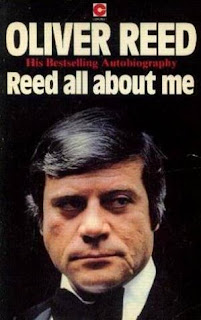
3. Reed all about me by Oliver Reed

I'm not normally a big fan of celebrity autobiographies but this is a coronet and come on, it's Oliver Reed.  I am not a huge fan, but have seen him in several of his earlier Hammers and The Devils.  I started out this book with low expectations and they fell even lower in the first chapter.  Like the bad title, it is full of bad puns and a particularly British male upper-class humour that is just annoying. Fortunately, it settles down into the actual narrative in the second chapter and his backgrounds is actually quite interesting.  He comes from an upper-class ancestry (his grandfather started the Royal Academy of Dramatic Arts) and his uncle was the director Carol Reed).  However, by the time he was born, his parents had been disconnected from any wealth so he was raised with a peculiar mix of upper class culture and working class means.  He also was dyslexic which didn't exist as a concept in British education at the time, so he failed out of school after school.

His narrative is of the self-made actor, who rejected formal training and the theatre for the school of life, learning, he claims, his skill in the army and at pubs, just watching people.  There is no doubt if you see him in anything that he is intensely charming and charismatic as well as quite a skilled actor (could do accents, all kinds of stunts and fights).  Hard to know how much of that was innate and how much from the aforesaid school of life.  He has the reputation of a wild man and heavy drinker, but it does seem that on set he was disciplined and hard-working and the length and output of his career seems to attest to that.

After we get through his background, he shares a lot of stories about other directors and stars, life on the set and his various hijinks.  One gets the sense that though a wild man, he genuinely seemed like a decent person.  He loved animals and ended up despite all kinds of mistresses being in 2 steady long-term relationships (including his second wife who was 26 years his junior).  The one area where he really is not good is his misogyny.  He doubled down constantly on the gross anti-feminism of this period. It sucks in the book and it sucks when he talked about it live.  He actually was generally decent to the women in his life, so it sucks that he was so ignorant and nasty when it came to women actually trying to fight for equality.  A gross stain on his otherwise well-earned reputation for being a great actor and character. 

Wednesday, January 19, 2022

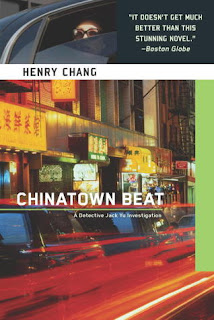
2. Chinatown Beat by Henry Chang

I had this one on my list for a while and found it at Moe's in Berkeley.  Chinatown Beat is part of the new woke pulp and while for me certain elements and tones didn't work, it was still a really good read.  The milieu of NYC Chinatown is excellent, complex and rife with characters.  There is a lot going on and it just skirts the edge of plot complexity that satisfied me while only briefly confusing. 

The strongest part of the book is the setting.  Chinatown was my favourite neighbourhood when I lived in NYC.  I hung out there a lot, but mostly as an outsider, a consumer with some minor insider knowledge.  This book let me see behind the closed doors, into the rich criminal culture I always fantasized about. The plot is a classic noir, centered on the trapped mistress, but there are so many other tentacles wrapped around this core story that it seems much richer.  The protagonist is the detective, Jack Yu, and he is a bit of a bummer.  At times, it felt like the noirishness was laid on a bit thick.  Likewise it gets a bit preachy about anti-Chinese racism.  There was enough "show" of the long, quiet discrimination against Asians, that I didn't think we needed so much "tell" to give the reader the message. There is a subplot of a child rapist that felt out of place and excessively nasty.  I'm not sure what was the point of it, as it never intersected with the main plot.

So I had quite a few misgivings, but they were minor and in the whole, it was a good read.  I will grab the other Jack Yu novels if they cross my path.

Friday, January 14, 2022

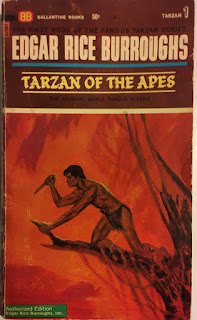
1. Tarzan of the Apes by Edgar Rice Burroughs

I've been meaning to read Burroughs for a long time now, though was hoping to stumble on the first John Carter of Mars.  Instead, I found a cheap copy of this at the great (and thank god still alive) Moe's on Telegraph in Berkeley.  It won't be a big surprise to tell you that this book is racist.  But damn, it's not just racist from 1913.  It's got levels and at times can be kind of difficult to read.  I like to think I'm pretty woke, but also able to recognize historical context and actually read the content.  There is some shit in here though that made me feel uncomfortable, particularily the portrayal of Jane's maid Esmerelda, who I guess was supposed to be a humourous character.  It's the worst stereotype with her eyes rolling around, fainting at every shock and talking in colourful, goofily erroneous language.  Oddly, there is a contrasting moment where the suitor to Jane compliments her and agrees on her calling the jungle lonesome.  Despite that and even though there are super racist portrayals of the African tribespeople (cannibals with sharpened teeth) and even more insane ideology of genetic aristocracy (Tarzan's lineage makes him a gentleman by nature despite his upbringing), it is the portrayal of Esmerelda that I found the most cringey and painful. 

I do understand and even appreciate the core tenet that makes Tarzan so appealing.  It is the fantasy of the shedding of the protective veneer of civilization.  All the scenes of him swinging through the jungle and fighting beasts are pretty exciting (though fuck can we stop killing lions, already!).  I do feel like he doesn't milk it (and none of the movie do either) enough.  When he does return to civilization, he demonstrates his badassedness only twice and they aren't very satisfying.  In the first, the victim is a drunken black guy (racistly described of course), whose wrist Tarzan breaks and then sends packing.  It is described after the event so there is no real thrill.  In the second, he shows a bunch of white hunters how to hunt for real and that is cool, except for the gratuitous lion slaughter.

I am tempted to keep reading them, especially with the truly surprising failure of the romantic ending where he doesn't get Jane.   I also am intrigued by the world building.  I may at least keep an eye out for the second one, but review I read say they get pretty formulaic.  I think this is do for a modern "woke" anti-colonalist re-interpretation.

Thursday, January 06, 2022

2021 Year-end Wrap up

I don't have a whole lot to say about my reading in 2021.  I am suffering from a bit of reading malaise right now and I feel it is biasing my look back at last year.  Also, as I went through the books I read, it feels like each one reminds me of different stages of dealing with covid, as it is so dominating everything these days.  I am proud that I read 74 books but it feels like somehow there was a lot of struggle.  I am not honestly sure how I read that many books as much of the time it felt like I was barely reading or pushing myself to get reading.  I guess the mantra of just getting started and keeping a book open will eventually get the books read.

I read 21 books by women (I thought it was a lot more lol).  This stat was bolstered by great female sci-fi and fantasy authors such as N.K. Jimesen and Robin Hobb (as well as some good old classic mystery authors like Ngaio Marsh, Agatha Christie, Charlotte Armstrong).  I also discovered Georgette Heyer this year (thanks Romance twitter) which is a gift that will keep giving.  Still just over a quarter of my reading being by women needs improvement, despite my excuse that my genre of mid-century paperbacks is male-dominated.

Only 10 books by African-American authors (and 5 of those were by N.K. Jimesen so doing double duty on my diversity goals).  Definitely needs improvement, though two strong highlights there with The Spook Who Came in from the Cold and Razorblade Tears.

In terms of paperback collecting the huge find was Where the Money Was by Willie Sutton.  The Q Document, though of no real value, was one of my favourite looking paperbacks that will get a warm welcome on my shelf.

Highlights for me for actual reading were the first two Trickster books by Eden Robinson (the only books I read by an indigenous author).  These are outstanding, a wonderful mix of shit-kicking, B.C. urban grittiness with rich and intense fantasy mythology.  Just excellent.  I also really enjoyed Razorblade Tears.  Both are examples of good old genres being injected with new life and creativity by non-white male authors who are also just damned good writers.  Their existence is heartening to me, to know that the basic tenets of the genres I love are not dependent on old cultures of white male dominance.  Also, they are just hell of fun to read.

I also finally got to some classic authors such as Rex Stout, Earle Stanley Gardner and Daphne duMaurier.  The first two were enjoyable but didn't really stay with me but duMaurier demands that I seek out her other works.

No real lowlights except that god-awful Walker Percy mess.  A workmanlike year.  My on-deck shelf overfloweth, so I must read on!

I hope all of you are well and enjoying your reading.  Here's to a better 2022.  Maybe the shitbirds in power will realize that we need long-term investment in the education, health care and the planet instead of production of consumer goods.


Friday, December 31, 2021

74. The Ruby in the Smoke by Philip Pullman

Happy new year!  I found this in a free shelf in Berkeley and thought it would be a nice pallet freshener after the last read.  It indeed was.  This was the rare ocassion when I was glad to learn this was part of a series, as it comes in at an efficient 230 pages and leaves you wanting more.  It's very much in the vein of revisionary British period adventures like Fingersmith (though without the sexuality).  16 year-old Sally Lockman is left orphaned when her father dies at sea.  She later receives a strange warning and in following it, goes on a pretty fun London adventure, with an extended colonial backstory that would fit nicely in a Holmes case.  There is a side plot as well of her finding her way as a strong, practically-educated girl in Edwardian London, making friends and running a business.  I found the ending to be particularly touching, as it involves the love of a father for his lone daughter.  I will be looking for the rest of this series.

Wednesday, December 29, 2021

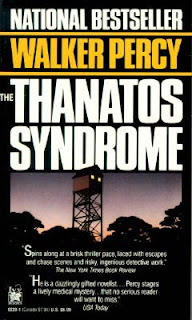
73. The Thanatos Syndrome by Walker Percy

Jesus, talk about a contrast.  After the find of the decade, I thought I would push my luck and grabbed this supposedly "brisk thriller".  I'd read The Moviegoer as a young man stupidly in love with the wrong girl who recommended it and found it okay.  I was hoping for an intelligent, interesting adventure book.  Instead, it delivered on neither the cover promise of a thriller nor the intelligent observations of a respected "literary" author.  The base plot was convoluted, unrealistic, uninteresting and false at its premise.  The literary observations were incoherent and vague, basically the empty, malformed musings of some old white guy who people told was smart too many times.  It's worse than just being empty and pretentious and boring; much of his musings range from cringey to mildly offensive to just gross.  There are multiple (and all unecessary) graphic descriptions of child pornography.  The racial politics are basically racism disguised under the veneer of the informed, yet wryly realistic liberal.  His female characters are ungraspable, especially his wife who is only described, has little or no dialogue or activity.

The plot, as it is, involves a doctor returning to his small Louisiana community after being in jail for 2 years.  There are lots of oblique hints as to why he went to jail, leading the reader to believe a full and interesting backstory will be revealed. This never happens. He soon discovers that his few remaining patients have radically different behaviours and personalities.  We eventually learn of a "conspiracy" to put some radiated sodium in the water that makes people less prone to criminal behaviour or something.  The whole thing is preposterous and boring and somehow connected to a school of pedophiles, which gives Percy his excuse to describe it all.  What's super fucking weird and creepy is that the abusers are all re-integrated into society and given jobs at the new institute for the dying (to replace the euthanasia centers; don't ask) which the protagonist puts together in the denouement.

The worst book I've read in a long time.  Took me almost two weeks to get through.  Feels like the editor said to him or herself "well this sucks but I can just stick Walker Percy on the front and we should sell enough."  The reviewers who said shit like "laced with escapes and chase scenes and risky, ingenious detective work" need their license  pulled.  

Friday, December 17, 2021

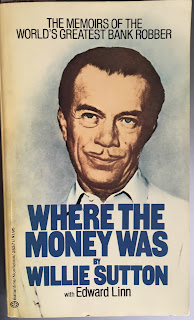
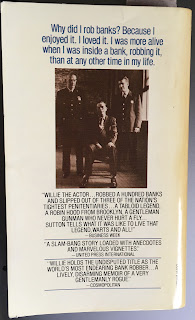
72. Where the Money Was by Willie Sutton

The paperback find of the year, arguably of the decade!  I've been scouring little libraries and book stores during these covid times, mainly in Montreal and Berkeley and it has been fun but no real mind-blowing  find until this one.  It was at the free shelf outside of Latina  on St-Viateur among a few older true crime paperbacks.  I have had this one on my list since I started the blog after reading that it was a big influence on Westlake's Parker character.  That is an exciting and satisfying moment when you finally stumble upon a real treasure.  One does a slow motion doubletake in one's head, "is this really what it looks like?  IT IS!!!"

I'm happy to report that the book itself is an enjoyable read.  It's surprisingly long.  Sutton spent most of his life in jail so this book actually has more prison escapes than bank robberies.  In the last third, as he gets older and sicker, he uses legal techniques to try and get out of jail.  This part drags a bit but you are invested so much at this point, that you want to find out what happens.  The best part for me are the bank robberies at the beginning.  It does seem like Sutton was brought into this world to heist banks.  He is like the Michael Jordan of bank robbery.  Beyond the anti-authoritarian appeal of the bank robber, Sutton never used violence and was a charming and stylish guy so he became pretty famous (which helped to get him out of jail early).

The description of the prisons are very informative about the corruption and cruelty at that time and how easily the prison-guard relation can turn into (or maybe always is) abuse.  It was just known that when you got arrested in Brooklyn, you were going to get a serious beating as part of your "interrogation".  When Sutton finally gets arrested the beating is insane (the cops are extra mad because he made them look bad).  Was painful to be reading the descriptions of the brutality in Attica and Sing Sing at the same time that Eric Adams just announced he is going to reinstate solitary in Ryker's.

As I say, I am more of a heist guy than prison escape guy, but the escapes in this book are wild.  There is a failed one trying to find the exit of a sewer tunnel that had me almost nauseous with stress.  Sutton just had no fear!  He goes through a 38" wide tunnel that slowly gets higher and higher with shit and piss and medical waste naked carrying a flashlight and a metal pole.  When there is only like a few inches of clearance and he still hasn't found the exit, so he ducks down and tries to swim for it!  

This book needs a reprint.  Still very relevant today for both fiction and non-fiction reasons.


Tuesday, December 07, 2021

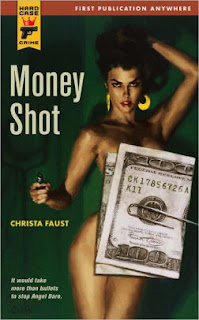
71. Money Shot by Christa Faust

I actually "discovered" (sounds weird, thus the quotations) Christa Faust on twitter via some other film noir fans.  Turns out she is an author of several books and graphic novels, aside from having excellent taste in movies.  I found this Hard Case paperback at S.W. Welch (7$!) and jumped in, needing some good old pulp fiction after the my recent fantasy binge.

I am happy to report this is the kind of excellent updating of classic pulp that we are getting more and more of.  It's basically a revenge story set in criminal L.A. except the protagonist, Angel Dare, is a woman, an ex-porn star and now talent manager.  She gets suckered to come in to do a shoot as a favour to an old director friend, ends up getting sucker punched and thrown in a trunk. We start in the trunk. You keep turning the pages.  I won't go into the plot any more than to say broadly that she has to figure out why this is happening to her, get out of it and then go hunt down the people responsible.  

This book is pretty rough, with sex violence and sexual violence.  Punches are not pulled.  What I really enjoyed beyond the basic ass-kicking premise is that you get a realistic, non-moralistic insider's look at the porn industry. It turns the book from what would otherwise still be a pretty entertaining pulp read into an informative and interesting expose as well  Lots of great (in the book, generally quite seedy and depressing in real life) locations, a wide range of colourful and often fucked-up characters all with realistic little details that lets you feel that Faust knows of what she writes.

I don't know what to say about what a book like this says about pulp and gender.  A smarter person than me should do a side-by-side analysis with Megan Abbott's Queenpin.  For me, it is just refreshing to read this kind of fiction from a female perspective where the women have agency and sexuality that is their own.  Good stuff.

Oh snap, there's a sequel with the same character!  I loved how this one ended, without a big explanation, but the nerdy part of me did want to find out how it all played out.  Very happy to add Choke Hold to my shopping list.

Friday, December 03, 2021

70. The Obelisk Gate by N.K. Jemisin

I had to rush out and buy book 2 I so much enjoyed the first one.  I don't have a lot to say to add to that review.  This one gets deeper into the magic and history and we get a clear track on the big picture plot. I had a couple of plot issues around the way they defended their geode home from the colonizing Sanzed (why didn't they just go full orogeny from the beginning and why was the attack of the stone eaters seen as some big surprise?).  I also found more reliance on unsourced anger as a conflict-creating/story-prolonging device wearisome at times.  If Alabaster and Essun would stop arguing and just talk, we would have had most of the mystery revealed in a few days instead of having all this fake anger and not communicating normally.  When the story picks up in the last third, we don't have time for the anger and again it gets really kickass.  Going to take a short break but will probably pick up the third soon.

Friday, November 19, 2021

69. The Fifth Season by N.K. Jemisin

I found this in the free shelf at the same time as I found The Inheritance Trilogy.  I chose to read the latter first because all three books were in one physical volume (and I could get a 3 for one on my 50 books count ;) ).  I didn't love The Inheritance Trilogy and it put me off of reading this one, even though everybody said it was way better.  I finally took the plunge and I am glad to say everybody was right.  The Fifth Season had all the good stuff that was in the Inheritance Trilogy (excellent worldbuilding, really cool powers and characters) and kept it at the character level, so you got almost all the good stuff.  The power levels get quite high here but the characters are always human and grounded so you can relate.

It takes place on some planet (perhaps ours) that is fundamentally tectonically unstable, with earthquakes, rifts, volcanoes and other fun stuff happening all the time, sometimes enough to destroy almost everything.  There are certain people with powers to control the earth's energy.  Despite and because of their powers, they are feared and loathed, usually killed when discovered or often sold to The Fulcrum a special school for them where they are disciplined and trained and then used as weapons/tools to protect the land from the earth.  There is a lot more going on that I won't get into here, entire histories of various peoples, other creatures and even giant crystal obelisks that hang in the sky.

The book is three narratives, following three different storylines that slowly weave together towards the end.  Like Anne Leckie, this trilogy deals with contemporary issues such as slavery and colonialism (what I endearingly call "woke sci-fi") and integrates them skillfully into the setting and plot, so that you are thoroughly entertained while subtly questioning our own reality.  This is what science fiction is supposed to do.

It's not perfect.  The Syen character has that "angry" trait that I see with a lot of authors where they lean on simplistic anger to add conflict to situations where it doesn't feel natural.  It starts to get annoying in the early and middle parts of the book, where she is always snapping and sarcastic even though anybody at that point would be more resigned and just live with the situation (of being with somebody they don't like).  So much emphasis is put on this anger that when the expected evolution comes (she learns to like and even love the guy), albeit quite novel and interesting, it's not very satisfying or convincing.

All that being said, I still walked to the bookstore and bought the second book so I can find out what will happen next.

Sunday, November 14, 2021

68. Sweet Death, Kind Death by Amanda Cross

Another free shelf find that I had hoped would be an easy 80s mystery read.  It ended up being that, but the first few chapters were a real slog.  The mystery takes place in an academic world and the book was written by an academic for academic-types to read.  There are quotes at the beginning of every chapter and the language is relativel dense, with fairly high vocab for a book of this type.  It takes a while for the situation and plot to coalesce and while we are getting there, there is a lot of discussion about the role of middle-aged women in society that comes in the form of witty, erudite banter between the characters.  I had a hard time getting through this first part.

The protagonist is a New York professor who I guess has a knack for also solving mysteries.  In this case, she is contacted by two men who are writing a biography of a feminist author and professor who killed herself at the lake of the private liberal arts college where she taught.  There was some suspicion that she was murdered, because though she had written and talked of death (including her own), none of her close friends felt it made any sense that she would have done it then.  So the detective/professor goes to Clare College (some conservative amalgam of Bard and one of the other new england women's colleges), ostensibly to head up a task force on whether or not they should have a gender studies program, but really to investigate.

The college set up is really fun.  Though a woman's college, the school is deeply conservative and pretty damned sexist.  Most of the other professors hated the victim because of her independence from the constraints of traditional roles for women.  This book was written in 1984.  I went to a liberal arts college a few years after that which was the peak of the wave of feminism that was the really suppressive anti-sex one.  I was generally supportive of that movement and understood broadly the reasons for its expression.  Reading this book, it really exposed how fucking awful even that late in the game, the patriarchal power structure was.  The arguments against the gender studies program sound so similar to the same bullshit we hear being trotted out in response to the Black Lives Matter movement or climate change.  People in unequal power making any convoluted argument no matter how illogical as long as they can find justification so they get to stay in unequal power.  

Ultimately, the mystery part got all a bit crammed up at the end.  It was kind of fun but we never really got to see the culprit enough to really hate them and thus didn't get much satisfaction at their comeuppance.  This milieu is not really my jam, so I probably won't read any more, but if this one is any indication, it is a well-written and enjoyable series for people who appreciate American academic cozies.

Friday, November 12, 2021

67. Razorblade Tears by S.A. Cosby

I had Cosby on my list but was not in a rush as he is so contemporary, I knew one of his books would come my way.  And indeed it did, as my mom passed his latest to me, including a great article about the author my dad had cut out.  I read the article after having finished the book.  Cosby has a great backstory and his own route to getting published is inspiring.  

He still had a day job at the time of the article, as the handyman at his wife's funeral parlor. The main character in Razorblade Tears is an ex-con who runs his own landscaping business. Cosby puts his knowledge to good use as yard tools and equipment feature heavily in the action. And there is a lot of action. It reminded me a lot of the Spenser books where he and Hawk have to go full commando.  It's a great set-up. Ike Randolph's gay son (whom he rejected due to his own homophobia) and his husband are brutally murdered and he and the husband's white trash dad (who also has his own roughneck past) pair up to get revenge.  They are a great buddy duo, both can fight and do crime and their banter is a mix of well-written repartee and heavier shit as they get to know and appreciate each other.  The bad guys are also a great mix.  He sets up a world that you don't want to end.  I'd love a series with these two.

It's well constructed with an excellent forward pace and fun writing.  I had one annoyance with a plot development where I felt the characters acted out of character and did something stupid (going to the burning house for those who have read it), but otherwise was thoroughly enjoying the ride.  Cosby does a genius trick here by putting forth a classic masculine badass revenge story yet wrapping it around today's social reality.  Homosexuality, homophobia and racism are big themes here, at times ever so slightly veering into the speechifying but otherwise essential elements to the narrative.  He proves that shit can be woke and badass.  The badass is really good, so that helps.  Just some great, creative fight scenes.

Very pleased to see this kind of book coming out today.

Monday, November 08, 2021

66. The Gotland Deal by N.J. Crisp

I found this while vacationing in the lovely and interesting Eastern Townships.  As all Canadians learn, this is where the United Empire Loyalists moved to after the American revolution and thus it has a multi-generational anglophone community.  I was hoping this history would lead to lots of excellent english language used bookstores, but alas I was only able to find one:  Black Cat Books in Lennoxville.  I took a daytrip down there and found it to be a really lovely little store with a nice selection, though not the treasure trove of mid-20th century genre fiction of which I had dreamed.  I still found a few little gems, including this one which I picked up purely on the lovely Penguin design.

It's a solid little thriller, with a setup that I particularily enjoy: the competent tough working urban detective who gets mixed up in politics and espionage that is supposedly out of his league.  I realize now there is a class element here as well, along with the classic appeal of the underdog story.  Sidney Kenyon is the said detective and though definitely on the side of order, also demonstrates a certain human sympathy for the criminals he catches.  The book begins with a seemingly open and closed murder case of a pimp (called a "ponce" here) who murders his girlfriend when he finds out she was selling her services on the side.  This is followed up by an irritating call where Kenyon has to humour an attractive, educate woman who is convinced she is being followed and that somebody broke into her nice apartment to search it.  Kenyon is very cynical at first, but is also attracted to her.  So against his better judgement, he starts digging and of course things get interesting.

It's written in a direct and economic style and keeps moving forward.  Near the end, when we start to get the big picture, it expands into large-scale international politics to a point that was a bit fantastical to me compared to the street-level investigation that went on before.  It never delivered the final bang of the working class cop taking it to the fancy boys at higher-level agencies.  Nevertheless, it was a solid, enjoyable read.


Thursday, November 04, 2021

65. The Parasites by Daphne du Maurier

I found this beautiful first-printing hardcover (sadly without a slipcover, but check out the type and colour below) in the fecund free shelf on St-Viateur.  I had really dug the horror short stories of du Maurier and was hoping a book called The Parasites was also going to be a horror story.  Well it was pretty dark and disturbing but of the purely non-supernatural realm.  This is a well-written character study of three broken children of successful performers.  I'm not really sure what the point of it all was as two of them were hateful and the third maddeningly pathetic.  du Maurier is just such a good writer that it was easy to keep reading.  The locations and situations of pre and post-war Europe (mainly London and environs) were richly and entertainingly portrayed but god the people were such spoiled and self-centered shits.

Niall, Maria and Celia are raised by a famous dancer (mom) and a famous singer (mom).  Both are parents to Celia and one each is a parent to older Niall and Maria.  They are left to run wild as children, with the distant mom and the loving but distracted dad.  They grow up accordingly with each inheriting a strong talent (Maria for acting, Niall for piano and Celia for drawing) as well as a deep malaise and inability to live in the world in a happy, positive way.  The book is centered around Maria's aristocratic and old school husband finally getting sick of them (calling them parasites) which triggers reminiscences, sending the reader back in time so we see how they got that way.

It's mostly quite melancholy and kind of depressing.  There are some bright moments, such as when the family first goes to the manor of Maria's new husband (named hilariously "Coldhammer") and commit all these hilarious faux pas.  As I say, very well written, so if you like rich studies of broken, spoiled people, this will be for you.

 Postscript: did a bit of reading and see that The Parasites is considered a bit of an outlier in her work and is broadly autobiographical (she had a clinging actor father and a distant mother).  That makes a lot more sense as to the purpose of the book.


Friday, October 29, 2021

64. Dead Low Tide by John D. MacDonald

Dead Low Tide is the penultimate book in the list of non-Travis McGree JDM's recommended by the still missed Al Gorman.  I found them all in Vancouver many years ago and have been slowly working my way through them. I'm trying to take my time now that I am near the end, but felt vaguely dissatisfied after Holy Fire and needed some good hard-boiled manliness.  Dead Low Tide reads quickly and mostly enjoyably as all JDM books, but unfortunately was possibly one of the weakest so far.  It had several forced situations to drive the plotline that were real groaners and had a lot of excessive JDM moralizing.  I can't tell what he hates worse, greasy spoons or pornography, both of which got a multi-paragraph haranguing.

The narrator is Andy McClintock, office man for a Florida developer in the middle of building an ambitious suburb on a key.  His boss is a strong, bullheaded self-made man who has been giving McClintock the run-around about a promised promotion to do actual on-site work.  The boss's somewhat scrawny but also sexually alluring (of course) wife comes to McClintock and asks him to snoop around and try and find out what is wrong with her husband, as he has been suddenly distant.  McClintock refuses but does decide to confront his boss about the promised promotion. Instead of stalling, the boss gives it to him and reveals a weird fatalism in doing so.  Soon after, he commits suicide by shooting himself in the neck with McClintock's spear gun (that he finds later stolen from his garage).

So of course this leads to McClintock being accused of the murder (also having been spotted hanging out with the wife plus the new contract).  It looked promising but we had several of JDM's weird asides about love and female sexuality.  McClintock lives in a humble rented cabin and his neighbour is an attractive, huskily healthy midwestern divorcee.  They respect and like each other, had a brief fling, but decided mutually to keep things in the friend zone. There is a very abrupt "plot twist" that felt unfair to the reader (which I've never experienced with JDM before) that sort of makes their relationship a major plot line.  The bad guy turns out to be none of the characters established in the beginning, so there is no mystery for the reader to solve, though it appears to be set up as if there is.  And there is a very unrealistic escape that allows McClintock to be the hero even though that all doesn't really make sense.  It is somewhat redeemed by an incredible climax where he literally fishes the badguy off a boat.  That was fun, but leading up to it I was pretty disappointed.


SPOILER ALERT (for my own future reference):  The healthy midwestern girl gets murdered about halfway through the book, giving McClintock his revenge drive.  He realizes that he loved her after all, that she was the one under his nose all this time and now she is dead.  He does the detective work (and the details here are well done) to find the killer who is a wandering psychopath.  The cops catch him and to get him to confess suddenly reveal that McClintock's love interest is not dead after all.  They faked it the entire time to draw the killer out!  It's weak on several levels, because it implies the fat, narrow-minded police chief actually wanted McClintock's meddling, which just didn't ring true given all their previous interactions.  It also feels like a forced way to make a satisfying love triangle.  Then the psycho escapes and manages to evade a vast dragnet, double back and of course catch McClintock and his new love in a vulnerable position, which does lead the incredible fishing revenge moment (which I will paste as an image below).


JDM would not have been a fan of PornHub

I feel like he does a disservice to what is now a touchstone of American culture


Monday, October 25, 2021

63. Holy Fire by Bruce Sterling

I've never read a Bruce Sterling book, which is sort of a big omission since I am of the cyberpunk generation.  Neuromancer blew my mind at 15.  Found this in the free shelf on Waverly and thought it would be a good opportunity to rectify that omission. I don't really know how I feel about this book.  It's not bad, but I didn't really get the point of it.  It doesn't follow the typical narrative structure of a novel, which is not a bad thing at all.  There just wasn't enough in it for me to really get caught up in the storyline and the main character.  That being said, there were several neat ideas and moments that gave me things to ponder in an enjoyable sci-fi way.  

It takes place at the end of the 21st century, about a hundred years from the 1990s when it was written.  The idea is that medical advancements have gotten humanity to be almost immortal. The world is run by the polity who maintains health and order.  The idea is that the old people stay in control and the world cannot really evolve culturally anymore.  It's a post-scarcity society but the young people all feel trapped and limited.  I didn't really feel convinced by this.  The protagonist is Mia an old civil servant who has always played it safe.  She gets a radical new treatment that makes her young again and then decides to break free, flees to europe and joins various culture and fashion groups and does somewhat wild things.

So you learn about the dissatisfaction of the youth from her meetings with said youth, but you don't really get to see it.  Mia's rebelliousness is also inconsistent.  Part of it is that you don't know how much of her behaviour is because of the treatment and how much is just her.  That is okay but none of it really amounted to anything. There is a lot of discussion about art.  She becomes a hit fashion model, then tries to be a photographer.  There is also a side story of a virtual castle that is bequeathed to her by an old boyfriend that doesn't really go anywhere.  Now that I think about it, it feels like this book was more a collection of ideas and semi-stories that never got held together fully. I wonder which is the Bruce Sterling I should read?

Note to self: be wary of books with review blurbs using the words "haunting", "lyrical" and "triumph".

Friday, October 15, 2021

62. Perry Mason Solves the Case of the Nervous Accomplice by Erle Stanley Gardner

When I was a kid, the Perry Mason TV show seemed to be on fairly regularily.  I didn't love it but would watch it on the general principle at the time to watch whatever was on TV whereever I was given the opportunity since we did not have a TV at home.  I remember vaguely being able to follow the plot and the legal twists that came up. This is the first time I have read one of the books and two things stood out me and surprised me somewhat.  

First, Perry Mason seems completely without morals and his legal ethics seem super questionable.  In this book, he gets his client to hail the same taxi she took the night before (where the driver recognized her which would put her at the scene of the murder) which investigator Paul Drake tracked via radio and then take the exact same trip at the same cost but with a new outfit and a friend to later use that to make the taxi driver look unreliable on the stand.  That can't be allowed, can it?  And the crazy thing is at that time, Mason himself wasn't convinced that his client was innocent.  It surprised me to see such a cynical take on legal procedure from the early 50s but I guess lawyers have been gaming the system since they were released on the world.

Second, Hamilton Burger, the prosecuting attorney and I guess regular foil for Mason is comically stupid and always and obviously two steps behind.  Every objection he makes he uses the same phrase "objected to as incompetent, irrelevant and immaterial." Ultimately, Perry Mason does perform some clever tricks to expose the truth, but he is just so clearly superior to the opposition that it seems to steal any tension from the story.  Maybe that was intended.  

There was a dry patch before the trial started where I started to lose interest, but the initials set-up was enjoyable with some depressing sexual politics of the time thrown in. He is hired by a wife who knows her husband is having an affair. Instead of busting him, she wants Mason to help her with a scheme to turn the mistress from fantasy escape lover to annoying dependent, while she plays the positive one. It's actually probably a good strategy but depends on the woman accepting that she loves her husband or wants to keep the marriage no matter what. The ending was somewhat fun too and the solution to the murder more or less solid, though with some sketchy ballistics.  I found this in a box on my street and there was another one so I'll read that at some point.  It is unlikely I will make this series staple reading but glad to have finally been exposed to it.

On a sad note, in order to read this book I had to turn the pages, which separate them from the glue to the binding.  It always pains me and I'll try everything to give a book a chance to get another read, but this may be one paperback whose life has come to an end.

Monday, October 11, 2021

61. Wilt: Just Like Any Other 7-Foot Black Millionaire Who Lives Next Door by Wilt Chamberlain and David Shaw

Somebody has been slowly dropping off a large collection of 60s and 70s hardback non-fiction biography and autobiography books in the St-Viateur free shelf these last couple of weeks.  It's mostly Canadian and British political figures (you know you are getting old when you feel a teeny but quickly suppressed inkling to read a Joe Clark biography) so I was quite excited to stumble upon Wilt's autobiography.  I've educated myself on the hoops of the 60s and 70s with some recent sports journalism reads, so I was psyched to find an actual primary source on the subject.

A lot of this book is Wilt, coherently and convincingly, arguing against the consistent criticisms he faced throughout his career.  When you are exposed to the absolute insanity of his career stats (he led the leg in at least one of scoring, rebound or assists each of his 14 seasons) that go beyond his most famous exploits (10,000 women, 100 point-game), it does seem to suggest that people sort of had it out for him.  The two biggest critiques of him were: 1) that he wasn't actually that skilled or worked hard, just really big and 2) that he couldn't win when it counted.  Both are bullshit. There was a lot of tension and drama around Wilt and the other big men.  He and Russell went at it as did he and Kareem.  His supporting of Nixon is really an excellent example of a smart person being blinded by his wealth and privilege (comparably to some of these anti-vaxxer players today) and is for me Wilt's second biggest actual flaw.  

The biggest flaw is that, at least the way he tells it here, he is a little bit boring.  He seems like a really cool, intelligent life winner who isn't actually all that interesting, though probably a lot of fun to hang out with.  In some ways, he is kind of a superman who kind of transcends race and class at the time (relatively speaking).  He is certainly very outspoken about racism which he recognizes and calls out fairly frequently in the NBA and NCAA, but he seems to have mostly avoided actual ill effects by dint of his innate physical superiority and coolness.  So he doesn't play it safe, but somehow it all comes off very rational and even-keeled.  He goes through all his seasons and the playoff endings in some detail, which while interesting for a hoops nerd like me also makes the book unthrilling.

Wednesday, October 06, 2021

60. Vintage Murder by Ngaio Marsh

Discovered this, plus another Ngaio Marsh and two Perry Masons in boxes of free stuff just down the street from me!  They were already beat up and then got some water damage from a light rain that had happened over night and that only freed me up to not have to worry about taking care of them.  My love for paperbacks started this way, back in the naive and carefree days when we did not think of them as collectibles but something cheap and portable.  It's nice to have a book every now and then that you can just throw in your bag and stuff in a pocket and not worry about keeping it in pristine condition.  After hearing how Eric from Paperback Warrior got a severe and weird lung infection, possibly from sitting amongst moldy books, I left these outside for a few days and took care to fan the pages and blow as much dust and whatever from them.

The book itself was another solid murder mystery from Marsh.  What made this one stand out was the nice (but sad because it was shattered by the murder) portrayal of the traveling theater company as well as the great look at New Zealand, Marsh's homeland.  Inspector Alleyn is supposed to be on vacation but of course gets mixed up in a murder. On the boat to New Zealand, he falls in with a theatre company. There is a minor kerfluffle on the train when the co-owner is almost kicked off the viewing platform.  His fate is sealed for good later when an elaborate birthday surprise for his wife and lead actress goes horribly wrong.  He had intended to lower a giant bottle of champagne, but somebody removed the counterweight and it smashed his head in. Bonus points for the Fontana photo cover which actually shows this (right down to the jeroboam larger-size champagne bottle).

Marsh is just a great writer.  I enjoyed this book more for the interactions and rich characters, especially the interesting insider writer writing as outsider visitor to New Zealand, than the mystery itself.  The Maori doctor is really great.  I almost wish he had a series of his own.  Fun read.

Thursday, September 30, 2021

59. Cybernia by Lou Cameron

This is another one that I picked up on a whim at Zoinks Music and Books in Toronto.  The design of this book hits my sweet spot.  I love the wacky but clear illustration and the choice of typeface and colours works for me.  The weird three (or maybe four) -eyed surveillance signpost on the cover even caught my daughter's eye, who asked me twice what it was about.  The image only symbolically represents anything that happens in the book as there is no Ridge or Centre streets, nor a signpost with a rubbery sphere with humanoid eyes atop it in the story.

The premise quite good.  A small town nestled in the remote forests of Norther New Jersey is run entirely by computer.  It does the maintenance, much of the security and manages all its own billing and paperwork. The protagonist, Ross MacLean is called there by his friend, who is starting to get paranoid that the town is out to get him.  Quite soon after the arrival, the friend is indeed killed in a freak accident.  I was hoping for some combination of The Demon Seed and The Corbin Affair but the book never really goes there.  There is a lot of early '70s engineering nerdiry that seems specific enough to suggest the author knew what he was talking about, but any science specifics are undermined by the inconsistent plotting.  It can't decide if it wants to be a thriller or a mystery and the one blocks the other, where we are guessing when it doesn't advance the story and everything is revealed too quickly and then we don't care.  There is also a lot of really dumb sexism which I can usually accept as an artifact of the time. Here the author seems to want to make a point of how woman can only push buttons and not understand any theory. It's honestly offensive. He also has to make a weird point of heterosexuality.  At one point, the town's elderly founder, a well-known theorist, invites Maclean to stay at his place, since he needs a place to stay and says "Don't worry, I'm heterosexual."  WTF early 70s?

There is a little bit of mayhem at the end where the programming of a sex robot gets wire-crossed with the town alarm system while all hell is breaking loose that is fun.  I also enjoyed learning about the Jackson Whites, but overall not a great book.  Too bad, because it sure looks beautiful!

I have found that Lou Cameron was an extremely prolific pulp author and comic book artist, who wrote the Longarm series (basically sex-western series, that I learned about from Paperback Warrior).


Saturday, September 25, 2021

58. Spook Country by William Gibson

I found the hardcover, first edition (from 2007 so not a huge deal, but still) of this for $1 at Value Village on Bloor St. West in Toronto.  My nephew expressed zero excitement when I gleefully showed him that it was signed.  William Gibson is probably one of my favourite authors.  Neuromancer was a massive influence on the way I see the world and love science fiction today.  I suspect it hit me at such a vulnerable age that some of his style and outlook imprinted on me so that today I may lack a critical eye on his work.  All that is to say I really enjoyed Spook Country.  

I actually haven't read Gibson since I think Virtual Light, when it came out, though I have a vague memory of having also read All Tomorrow's Parties as well.  Now that I have been re-introduced to him, I am going to have to keep an eye out for his other books.  Spook Country is a moden-day spy story from 2007 where the tech is actually outdated today.  Despite that, Gibson delivers all the tech theory stuff in a really interesting way that makes this book a marker of that time with some interesting thoughts for the present.

Ultimately, it's just a cool spy story, not particularily epic in nature, but the cool characters and intriguing set up keeps you turning the pages.  It has 3 main characters, each their own storylines that will of course eventually collide.  Milgrim is the educated addict kidnapped by a mysterious operative who makes him translate intercepted Russian text messages.  Hollis is the ex-lead singer of a semi-popular '90s band turned journalist hunting down a virtual reality designer.  Tito is the young member of a Cuban-Chinese espionage/crime family trained by Castro's KGB allies.  The last is really cool, a migrant parkourist and expert in systema, the family's anti-surveillance technique, who is basically kept in the dark until his skills are needed.

It doesn't quite end as satisfyingly as one would like, given how compelling their set-ups are.  The world and the characters are so enjoyable that you nevertheless don't want it to end and can forgive the mellow conclusion. 

Friday, September 17, 2021

57. The Moving Toyshop by Edmund Crispin

This was the Edmund Crispin that came so highly recommend.  I think by Kenneth Hite, but I can't remember exactly.  I actually bought this new at one of the big bookstore chains.  I like but did not love the other Crispin I had read, so approached this with moderate hopes.  After having read it, I better understand his deal now.  These books are supposed to be funny, which I don't think I fully appreciated with The Case of the Gilded Fly.  The Moving Toyshop is not a masterpiece.  It goes on too long and the interesting part of the mystery is revealed early on.  I think it's main raison d'etre though, is not so much the mystery but to showcase the town of Oxford and the kinds of characters that live there.

The book starts with Cardogan, a poet (clearly of the upper classes because though he struggles with money he somehow has a home and a servant) who feels like he wants adventure in his life.  He also wants to avoid a poetry tour of America that his editor is pushing on him.  He goes to Oxford but has to hitch a ride and then walk in late at night.  Passing a toy store with a door ajar, he decides to go in.  Upstairs, he discovers the body of a woman and is then knocked out.  When he wakes up, he is in a closet at the back of the building, which no longer houses a toy store but a grocery shop and the proprietor and the cops think he may be suffering from delusions due to the concussion.

Enter Gervase Fen, literature professor and don.  This begins a madcap adventure of deduction and college hijinks, much of which is quite funny.  I will not seek out Crispons book, but I may well take the next one I stumble upon. 

Saturday, September 11, 2021

56. The Q Document by James Hall Roberts

I found this book at the super cool Eyesore Cinema on Bloor in Toronto.  My nephew and I were tooling around the streets as we are wont to do when we get together and found it open.  We had come here a couple years ago and seen a backroom late-night screening of The Howling II so I had always wanted to stop by.  I was quite pleased to see they have a small bookshelf of paperbacks for sale. I first thought this was some bad non-fiction exposé that was some actual substantive origin of the nonsense behind those qanon fucks.  My nephew, in his teenage certainty was like "No, it's fiction." and he was right.

It is a bit hard to categorize this book.  It's sort of a thriller but not really thrilling.  The story is about, Cooper an academic living in Japan in the early 60s who has recently lost his wife and daughter in a fire.  He now translates ancient documents for a brothel owner with a side business in trafficked antiquities.  The brothel owner brings him a strange set of documents that were smuggled out of China and appear to be quite valuable.  As Cooper digs into them, he discovers that they seem to be proof that Jesus Christ was just a charismatic rebel who died and was never resurrected.  At the same time, he gets connected with an 11-year old girl who was sold into the brothel and then escaped.    

So the existential theme here is can Cooper take the responsibility of verifying the document that disproves Christ, thus destroying Christianity.  The more practical matter is protecting the girl.  The two become opposed.  

It's a very well-written book and I found myself absorbed in the narrative.  The descriptions of Japan, including lots of train scenes and a ski lodge, were enjoyable and seemed to be fairly accurate.  There is a lot of reflection by Cooper and the Pulitzer prize winning war journalist who has lost her mojo that he alllies with.  I usually don't go for that kind of wanking but for some reason it worked here.  Finally, the bad guy, the brothel owner is just a great character.  Always super polite and verbose, while being weirdly clean and yet also somehow kind of disgusting.

The big reveal that resolves all the conflict felt a bit cheap, as the author breaks some basic premises established earlier in the book so you couldn't have figured it out yourself. Despite that, I put it down satisfied.  Not a masterpiece or anything, but a nice obscure find and a good read.


Tuesday, September 07, 2021

55. Kent State: Four Dead in Ohio by Derf Backderf


A friend lent me this graphic novel (same person who lent me Trashed and possibly even the Dahmer one; an excellent resource).  I plowed through it overnight.  It is thoroughly researched and does an excellent job of capturing what life was like on campus and in the town of Kent in the days leading up to the murder of 4 students by the National Guard in 1970.  It's really infuriating to read. Both because of the ignorance and authoritarianism of the time but also to know that the same kinds of assholes still have power and voices in America today.

Emotions aside, a graphic novel was an excellent way to enrich and remind me of the details of what went down.  It also really captures the horror of what it must have like to first have your campus taken over by redneck soldiers led by armchair fascists and then to have them actually open fire and gun down fellow Americans.  It is a period from which I have absorbed a lot of cultural and historical material, but now that we are living in a similar time of rupture, I realize that I had always treated it with some distance.  It's very scary to see your society fall apart and this comic captures that well.  


Monday, September 06, 2021

54. The Galton Case by Ross Macdonald


I think I haven't been fair in my own mind about Ross Macdonald.  It's not his fault that his name remains as a pillar of the detective genre while his wife, whom I consider a better writer, is only remembered by a minority of genre fans.  I am also tainted by the last book of his that I read that I found to be overly melancholic.  I found The Galton Case at Valu Village in Toronto for a buck so had to take it, especially with this cool cover.  This is a paperback on its last legs, with pages ready to fall out, but it got one more read out of me and my friend wants it afterwards.

And I am glad I did read pick it up because it was really good and reminded me why Macdonald has his reputation.  There is a lot of detecting in The Galton Case!  Macdonald is hired by a lawyer to find the long lost son of the elderly matron of a vast fortune.  The investigation takes him up and down California, from hipster jazz bars and seedy hotels in San Francisco to new housing developments in mid-coast towns.  The first half of the book is a very enjoyable hunt for this missing man.  Once he is sort of found and a rough narrative of what happened to him becomes clear, we then move into another mystery of what did actually happen to him and if the newly discovered grandson is indeed who he says he is. There is even a strong Canadian connection, with Macdonald maybe even making a brief detour back to his own personal background.

This is pretty much a classic P.I. book, with the obligatory beatdown and unconsciousness (Archer actually gets knocked out 3 times in succession, which really can't be healthy), multiple twists that of course bring it all back home and just a lot of great dialogue.  The way that he talks to people to get information from them is particularly well done here.  Great stuff, I am glad to have re-opened my reading to Ross Macdonald.


Friday, September 03, 2021

53. StreetLethal by Steven Barnes

I found this in the very pleasant Zoinks Music and Books on west Bloor street in Toronto.  I liked this store because it was small and open but the shelves were stocked with a nice selection of used paperbacks in sci-fi, fantasy and crime.  It wasn't trying to be anything fancy while remaining easy browse with a good selection.  I grabbed StreetLethal because of the trashy 80s cyberpunk cover. 

It was the kind of read I was looking for, a gritty urban dystopic sci-fi with lots of action.  Unfortunately, it is kind of a mess.  The story contains too much so that much is left poorly explained and narratives die off.  It starts off with Aubry Knight, a weightless boxer, who I thought was just a contender, getting  betrayed and sent to a maximum security prison underground in Death Valley.  This was all really cool, the scenes of future LA and the idea of the prison itself.  But even early on there is a lot of time spent on Aubry's psychology, which is really unclear.  Somehow he is a total badass, yet also a rube and underling in the criminal organization that betrayed him.  He escapes, which was also cool, and meets a prostitute with a plastiskin implant that also makes her somehow unique, yet she too is sort of on the skids.  

He goes for payback against the gang and they end up in an underground society of scavengers and a much grander plotline involving a new drug that works with couples.  This is where the story really started to drag for me as there is a lot of time spent on their relationship most of which was neither compelling nor convincing.  They are both supposed to be damaged and need to learn to love themselves, each other, the Scavenger society but they are fighting and then not.  Then the drug is introduced and turns them into total junkies in about two pages.  It all got quite tiresome.  The bigger problem was that I never really felt a foundation of either of their personalities or backgrounds, so their struggles which were already somewhat incoherent, held no weight for me.

There was some cool ideas here and the cyberpunk ideas and locations were quite interesting at times.  One really impressive thing was that the future tech rarely felt dated, which is tough to pull off. It also had some decent fight writing.  It's too bad some of the major elements were not well thought out, especially the drug, which was either socially devastating and yet also going to bring love into the world.  The acknowledgements section suggests that Barnes was quite connected, perhaps in LA, as he drops some big martial arts names (Danny Inosanto for one) and sci-fi authors.

Damn, I just realized after reading some reviews that the cover art depicts a white guy but Aubry in the book is black.  White supremacy, indeed.

Saturday, August 28, 2021

52. Greenmantle by John Buchan

I am writing this review a few weeks after actually having finished reading the book.  I was having some trouble typing for long stretches so had to take a break.  I've read a few John Buchan books and it is only now that I am starting to understand the culture from which he comes that makes some elements of his book really weird.  It's not that complicated.  It's basically imperialistic jingoism but of a very specific period before we fully appreciated the enormity of World War I, so not always easy to parse for this modern reader.

Greenmantle is at its core a straight ahead espionage story.  Richard Hannae and a few of his other public school colleagues (and a rough-hewn Afrikaaner tracker) are sent into middle Europe in disguise to discover the source of rumours of some kind of prophet who will  unite the Moslem allies of Germany and turn the tide of the war.  There are several really exciting sequences such when he is on the run in the German countryside or trying to maintain his identity while being heavily scrutinized by an enemy agent.  There are also several really weird sections made weirder by the war is glory/just good sport that all men long for propaganda.  The reaction of the heroes to the female antagonist is also really twisted and full of bizarre sexual dread.  There is a very good piece here on the book that goes into in much better depth that is worth reading if you are interested.

One of the things that I found particularly difficult to swallow was how all these various British public school boys could not only go completely undercover in Arabic cultures, but also end up as their spiritual leaders.  It really is the stupidest kind of colonial "privilege".  Still, most of Greenmantle is really fun, just keep your critical monocle on as you read it.

Saturday, August 14, 2021

51. Shoedog by George Pelecanos

Found in one of the many free little libraries in the residential stretches that grid Toronto.  While I love living in a bilingual world, it is nice to have only english books to choose from. On the street I was staying there were three free book boxes alone (although it was the longest block in Toronto).I've read quite a few of George pelecanos novels and always enjoy him. However I feel I have a pretty good sense of his style and I'm not always interested in checking any of his newer books out. I am not sure what compelled me to take this one but I'm glad that I did.

This is a standalone crime novel about a young drifter who gets picked up by an older drifter slash criminal. At first it seems like they're just going to ride together to the South but then the older guy has to stop off to pick up some money. The place they stop at it's a big well secured house in the middle of nowhere outside of Washington DC with a big doberman in acage. Instead of the money the two of them get caught up in a double heist of liquor stores in Washington.

There is a secondary character, an African American shoe salesman in DC who also participates in the heist. The Narrative goes back and forth between the initial Drifter and the shoe salesman (who has the nickname Shoedog, thus the title).  What was cool about this book is that it really was a self-contained heist novel.  There are even parts that felt a lot like a Richard Stark book and I wonder if Pelecanos' had that in mind when he wrote it. However there's a lot more introspection and feelings about the characters than would ever occur in a Parker novel.

The drifter character felt very much like a young white male fantasy of the criminal life. He comes from a lower middle-class background with a mother dead of alchoholism and a disciplinarian, unfeeling father..   instead of going to a good college as his father had hoped he joins the military where he learns how to kick ass and shoot guns and then spends much of his life travelling all over America and the world working in restaurant and having sex and sometimes cool conflicts. Where the novel begins he is as aimless as ever and maybe looking for something but all that really seems to get him off is that buzz when he starts to do something Criminal. So the job is very appealing to him.

The shoe dog character on the other hand is more grounded. He's a Black guy who is one of the best salesmen at the shoe store and augments his income by doing heist jobs on the side and other crimes. He's basically an honourable fellow and you want him to succeed.

It's a fast-paced easily digestible crime novel with some cliches that were well portrayed and wrapped up in a unique enough exterior that they were never annoying. I would also add that if you are a car person there are several a detailed descriptions of very specific old style hot rods that you might find enjoyable. This is a great read for the summer.


Friday, August 06, 2021

50. Double for Death by Rex Stout

I have been looking for a Rex stout book for quite awhile as I am a fan of the Nero Wolfe old time radio shows. So I was quite happy to discover this book in the free box in my neighborhood. However when I got it open and started reading it I discovered it wasn't actually a Nero Wolfe book. I was mildly disappointed but soldiered on. 

The protagonist here is Tecumseh fox and his setup was equally as cool as that of Nero Wolfe. Tecumseh fox lives in a beautiful old estate in upstate New York with a diverse mix of querelous servants and helpers. His driver and dogsbody for instance has the title of vice president of his company and he also has a housekeeper and cook with whom they seem to have a slightly tense relationship. He also has various guests who stay with him in times of need. He just seems to be the gentleman detective who has enough money to lead a very pleasant lifestyle not far from New York City and indulge in exciting investigations in and around New York City with a panoply of resources both financial and social.

I later read that this was the best of the Tecumseh fox stories the other ones were not quite as interesting and I think were even considered sort of boring but I may be wrong about that I just went read one review. The setup itself ended up being more entertaining than the mystery which involved a wealthy man who was murdered in his secret cabin that nobody but his manservant knew about. Well almost nobody has the uncle of a young woman in distress who's come to Tecumseh had happened to sneak up to the cabin at night to try and beg the man to give him his job back. There is a switched identity and a lot of procedure around trying to find a missing man which was somewhat interesting and gave you lots of looks into New York City during this time. It's a decent novel but won't blow you out of the park I liked it mainly for Tecumseh Fox's world. I will continue to look for Nero Wolfe books.

I am not sure how the publisher convinced Bob Newhart to do this cover photo; maybe they were old friends or maybe Bob needed the money at this stage in his career.

Wednesday, August 04, 2021

49. Trickster Drift by Eden Robinson

This is the second in the extremely readable Trickster trilogy.  I just keep enjoying these books more and more.  Among the many things I like about them, I particularily appreciate the way that they are structured.  It doesn't feel like it has to achieve some epic conclusion.  The structure feels much more like real life.  There are two broad stories going on here.  The first and the biggest in this book is just Jared Martin navigating his move to Vancouver, dealing with family and friends and enemies and school.  The second storyline is him being the Trickster's son and the risks and weirdness that comes with that.  It sounds fairly banal written like that, but Jared's life is so full of craziness that it is never boring.  I found the pace steady and engaging.  It never feels like you are being dragged into some "quest", rather you are just following along this young man as he tries to stay out of trouble and stay out of any kind of dependence on other people.

Given that he is a poor First Nations kid from Kitimat on a small scholarship to BCIT, he is actually relatively quite privileged.  His aunt is a successful author and activist. He has one grandmother who is super wealthy and another one who knows magic really well.  Despite this, Jared is super guarded and won't put his trust in anybody. People are also just really mean to him.  Felt very B.C from back in the day where everybody has to act super hard-bitten and people who are happy and confident are to be suppressed and distrusted.  It does become frustrating in the beginning.  The few people who are nice, Jared constantly pushes away and the rest who are total dicks, he just passively accepts.  The richness and realism of the people and the world of First Nations Vancouver that Robinson so well portrays pushes you past the frustration and when the supernatural part of the story explodes, it's just so insane that you are fully on board.

And the supernatural storyline, which hovers around and remains interesting but seems secondary for most of the book, really does explode at the end and really is bonkers with real ramifications for all the characters.  Robinson doesn't pull any punches.  It's an amazing mix of science fiction and indigenous mythology, which can be quite nasty.  I loved it and am using strong self-discipline to wait before jumping into the third.