Monday, February 06, 2023

12. The Asphalt Jungle by W.S. Burnett

A small note that I put inside this book says that I purchased it at The Monkey's Paw bookstore in Toronto in August '12!  I feel that has to be a mistake on my part as I do remember finding this there and buying it but it can't have been over ten years ago.  I have no record on my blog of the purchase that I can find from that year.  I'm starting to think that I may have transposed the numbers and it was actually the summer of 2021 when I got it (and I was in Toronto then).  

Anyhow, on to the book.  I actually was going to read this phat phantasy novel that I had bought for my brother-in-law for xmas and which he had rejected because he couldn't get into the prose.  I too found it a terrible slog and had to abandon it about 50 pages in.  I have not done that in ages, if ever!  Very discouraging.  So I was very happy to jump into The Asphalt Jungle, which begins with a pretty clear situation and solid prose.  A large midwestern city (which I assumed to be Chicago but then one of the characters runs away to Chicago later in the book) is rife with corruption and has just brought on a new, no-nonsense commissioner who is going to clean it up. The framing device is an old, cynical journalist who decides to give the commissioner a chance. Soon, though, we zoom in to the real story.  An unassuming, German-American, master criminal has just been released from jail with a promising big heist already planned.  He just needs a string and a sponsor.  

Burnett does a fantastic job of bringing us into the milieu and the people of the criminal underworld (and not so "under" with most of the cops on the take and semi-legitimate bookies operating almost in the open).  The hub is a little greasy spoon counter and magazine stall run by Gus, a tough, connected well-respected hunchback (and driver when needed).  He leads Riemenschneider to a great cast of characters, Louis the tool guy trying to go legit, Cobby the money man who is also connected to a big-time defense lawyer Emmerich who has the real money and finally Dix Hendley, the hard southern hick tough who is wavering about his career and his feelings for Doll, the aging nightclub girl.

The entire middle of the book is just clean, efficient criminal machinations as they plan the heist and execute it.  It's great.  Of course, it goes pear-shaped for a variety of reasons and we watch as each character meets their fate.  The bigger idea is that each guy had a flaw that brought them down, but what actually happens is a bit more complex and therefore more interesting. Ultimately, the main thread is competent Dix who really just wants to get back to his family's farm.  This gets a bit heavy and maudlin at the end, but still moved me.  


Saturday, February 04, 2023

11. Sackett's Land by Louis L'Amour

I have never read a Louis L'Amour book but always felt I should.  I am just not that into westerns, so when I heard the Paperback Warrior podcast's Eric vote Sackett's Land as his #1 book for 2020, I thought that would be a good entry point and added it to my hunting list.  I found a nice paperback somewhere (maybe another freebox in Berkeley?) and devoured it in a day.

This one is not a western, so perhaps not indicative of L'Amour's style.  It's a bit preposterous, somewhat light but mainly a lot of fun.  I prefer my adventure books to have a bit more subtlety and be slightly harder on the hero than what we have here. Sackett's land is basically an empowerment fantasy.  The hero, Barnabas Sackett is a poor man of the fens (these cool marshes) who is seemingly at the very bottom of the pecking order of life (and England).  Yet, he is incredibly strong (can wrestle two men), skilled in hunting, fishing, fighting with sword, gun and bow and sailing.  Furthermore, though of the lowest class, his father was a soldier who saved the life of a nobleman and though Barnabas never met the nobleman, he is looking out for him and wants him to be his heir.  So he even cheats class restrictions.

Despite his layers of privilege, Barnabas starts out in a bad way, having accidentally insulted a dick Earl who is now out for his death.  Despite my critiques above, there is a ton of cool adventuring in this book. I especially enjoyed the description of the cultural and geography of the labyrinthine fens in the beginning.  He meets a diverse case (except all male but one the love interest) of cool other adventurers, all down in their luck but ready to latch on to a strong leader.  We get a moor, a continental soldier, an Italian and my favourite, Jeremy Ring, a sailor looking for work.  All are good men, chafing under the oppression of English class hierarchy and criminal scoundrels.

The bulk of the story takes place in the new world, involving a battle between the good ship and the bad ship (which the evil earl has also paid to get rid of Sackett).  Everything moves quickly, a bit too easily despite many battles and setbacks (like these guys are good at making bows and arrows!) and yet somehow all very satisfying and moving.  I'm definitely putting the next book in the Sackett series (To the Blue Mountains) on my list. 


cool insert offer for books by mail


Friday, February 03, 2023

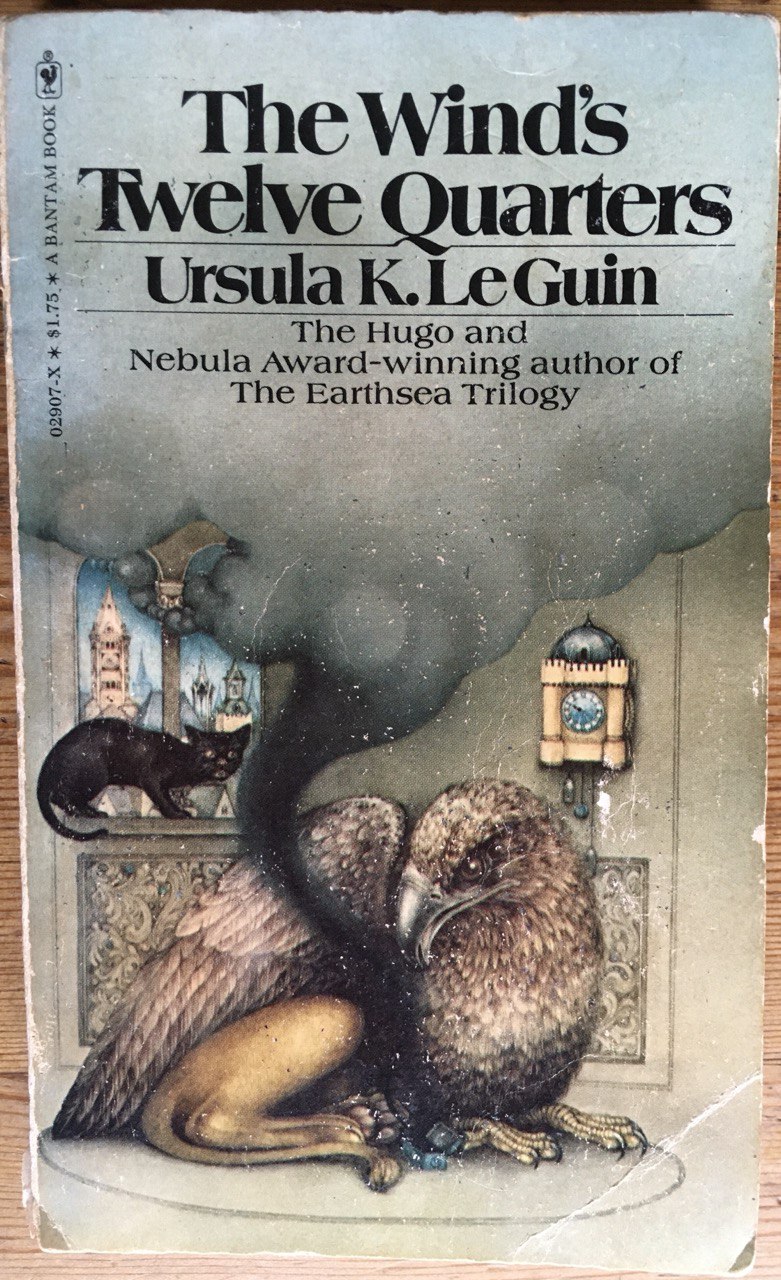
10. The Wind's Twelve Quarters by Ursula K. Legion

I am not a fan of short stories.  Either they don't really work or I want more.  I also find they slow down my reading because I need time to transition from one book to the next.  My plan here was to read a few at a time, but I ended up plowing through.  I have written specific notes about each story below.

Overall, these stories reminded me of what a great writer Le Guin is.  Among other things, she is a master of setting and evocative details that pull you in.  Unfortunately for me, she is also to smart and too driven by real issues to leave it at that.  I wish she would write a simple adventure book with wizards fighting each other, but her stuff always goes deeper and way darker which is why I take a long time between books.  In this collection we get both the fun and the deep, with a few misses along the way to remind us that she is indeed human.

Each story has a nice little intro by Le Guin, which helps to put them in context and get a sense of playful personality (as a writer at least) in 1975.

Semley's Necklace - interesting study of alien life forms, time passing too long

April in Paris - time travel via an old apt in Paris

The Masters - intolerance of science in a post "Firefall" world where everything is done by rote and a builder starts to figure out how numbers and algebra work and gets his hands smashed in punishment

Darkness Box - neat story about a magical world where time is stopped - one brother with a hypogriff goes and fights his invading brother on the beach over and over --  and a little boy gives a box of darkness that starts time.

The Word of Unbinding - really cool in the Earthsea archipelago world, a wizard is attacked from behind and imprisoned from some rumoured invading and destroying wizard and he uses all his magic to get out and defeat him.

The Rule of Names - another really cool won in the Earthsea archipelago world about an island with a kind of weird, incompetent wizard (every island should have one) who turns out to be a powerful dragon on the dl.  These two stories remind me of how good LeGuin is at fantasy world building and details and how great Earthsea is before it gets so dark.

Winter King - from the same universe as The Left Hand of Darkness, a cool mini-saga about a good young king (a she) who is kidnapped and mindmolded so that she will become a tyrant, her only choice is to abegnate and leave the kingdom to her son.  Wish it had been expanded into a novel.

The Good Trip - ambiguous and not very good description of an acid trip that wasn't or maybe it was.  Had an unconvincing back story of a wife lost to depression.

Nine Lives - very cool story about a team of ten elite clones on a distant planet working with two normal, flawed humans on a mining project.  When nine of the clones are killed in an accident, how does the tenth now respond?

A Trip to the Head - a surreal experiment, I guess that helped her to break through writer's block but it's a mess and not enjoyable. LeGuin says in the intro that the only drug she has done is tobacco and I believe her because whenever she tries to go trippy, it's bad.

Vaster than Empires and More Slow - a really cool story about a group of deep space explorers all with various mental issues (because nobody else would volunteer for a program where they come back hundreds of years later) who land on a planet that is all grasses and plants.  One of the members, Osden is an extreme empath who is a total asshole.  As his behaviour starts to make the rest of the team fall back into their own various pathologies, he is sent out to explore on his own.  He is attacked and the group all start to fear that something is out there, though their instruments show no sentient life.  This is a really neat examination of isolation versus connection and how knowing everyone else's feelings could create negatively spiralling resonances. 

The Stars Below - an astronomer is burnt out of his home and observatory for heresy and is hidden in an abandoned mine by a sympathetic noble.  There he discovers a small group of ex-miners who befriend him and he learns to look downward for the stars.  A neat, tight little tale that highlights one of Le Guin's many strengths: her ability to elicit rage in the reader at the forces of social repression.  Fuck those priests!

The Field of Vision - A trio of astronauts return from a trip to Mars where the discovery of some rooms appear to have killed on, rendered another deaf and unresponsive and blinded a third (though sort of the opposite; everything is too bright).  It seems that they have seen god, the room was a kind of proselytizing space.

Direction of the Road - another really innovative and tight piece told from the perspective of a tree. The conceit is that it believes it is moving towards and away all the things that come to it.  Very anti-car.  I like.

The Ones who Walk Away from Omelas - a political parable (that she calls a psychomyth) about a near utopian society whose happiness and existence is dependent on an abused child kept in a locked room.  Definitely a critique of liberal complacency and moves neatly into the last story...

The Day before the Revolution - kind of an origin story of the world of The Dispossessed, it looks into the final days of Odo who was the leader of the Revolution that led to the anarchic world of Odo.  It's more about getting old but neat to see some of the ideas that are more fully fleshed out in the novel.


Monday, January 30, 2023

9. Nightmare Alley by William Lindsay Gresham

This is the one I found
I have had Gresham on my hunting list for a long time to no avail.  Though this movie tie-in edition is really quite unattractive and a terrible size, I do appreciate its existence both because I found it in a free box and because it is uncensored which I gather a lot of later editions were.  I saw the original movie and quite enjoyed it and was excited for the del Toro remake but the reviews deflated my enthusiasm so I haven't seen it yet.  My patience and interest in movies has really dried up in recent years.  All I seem to be able to watch these days are Indian action blockbusters and old 80s episodic series like The Equalizer.  Anyhow, people rave about this book so I was pretty excited to get into it.

It lives up to the hype.  I really wish I had read it before seeing the movie.  I suspect that the inevitable ending would have revealed itself to me anyways, but since I knew what was going to happen to our carny turned con artist spiritualist preacher friend it informed my reading especially near the end and made me somewhat conscious of the plot and pages left.  I think if you come at this book for the first time, with its original plotting and excellent twist (which totally threw me in the movie), you would be pretty blown away.

The story is about the rise and fall of charismatic runaway Stanton Carlisle who joins a travelling carnival and starts to learn the tricks of the trade.  He has a few magic skills, but soon realizes his potential for charm and fast-talking as well as a sharp mind to memorize codes to use as you take questions from the crowd for the medium.  His lack of morality is apparent early on as he gives alcohol to the geek husband of Zeema to get him out of the way so they can get it on.  He doesn't realize it, but it's wood alcohol and this kills him. His stress at the guilt is soon masked by his burning ambition and he absconds with a younger, more attractive woman to the big city to start plying a trade as a spiritualist to rich widows.  The narrative is a struggle between building up to his biggest scam and his own internal stresses and this race leads him to one of the greatest femme fatale characters in the history of noir, psychologist Lilith Ritter.  She takes Carlisle under her wing was they work together to con a rich industrialist, whose guilt over the abortion death of a girlfriend in his youth is the key they use to catch him up.

This is definitely adult material and while the original movie gets pretty dark, it eludes and even cuts out the harshest stuff, especially around sex.  I was reading this on the plane and gasped aloud when Lilith explains what role Molly (the pretty young one Stan took from the carny) will play in their con.  Great stuff.

This one's going for $150!


Sunday, January 29, 2023

8. Sing Down the Moon by Scott O'Dell

My daughter chose this as the next one for her bedtime reading.  The Island of the Blue Dolphins was subtly sad, only really if you understood the context and read the afterword which she refused to do (though the attack on her people at the beginning by the Aleuts was pretty rough).  This one was brutal!  I feel like it may be better appreciated by an older child of maybe 12 or 13.  Nevertheless, my 10-year old got a pretty direct lesson in the horrors of colonialism.  To top it off, my father had died on the night that we read the harshest chapter where the shitfuck white man drives the Navajo off their land and destroys  their crops and homes.  We were both pretty bummed but it led to a good discussion of whether it is better or worse to read something as dark from history as this while you have your own sadness in life.

This is another fictional retelling of the real history of what is known as The Long Walk, where white settlers drove several tribes of indigenous people from their lands to what is now known as the four corners in the middle of the country.  It is told from the perspective of a young girl who is just taking on the responsibility of shepherding the family's sheep.  The first section is about her getting kidnapped by a Spanish soldier and then her escape, where the reader gets a brief break from the sadness before "the long knives" as they call the settler soldiers come and force them to march from their home lands in Arizona to eastern New Mexico, where their descendants live today.  I don't know what the Navajo people feel about a white settler descendant writing about their history, but this book is straightforward and very affecting.  


Friday, January 27, 2023

7. Poets and Murder by Robert van Gulik

I had heard about Judge Dee over the years, but assumed it was a kind of mystery Charlie Chan series.  I did see at least one of the Tsui Hark Judge Dee movies, which was tons of fun.  However, recently I saw some pulp mystery fans on social media speaking highly of Judge Dee and then found this in a free box in Berkeley. It was surprisingly good!  I appreciate that it is an extreme case of what I believe is called "Orientalism" and I was happy that the portrayal of Tang dynasty China seemed respectful and well researched (there is an afterward where van Gulik explains the setting and the research he did).  More importantly, the story itself was really cool. It had an enjoyable mix of interesting characters in a rich setting with a touch of mysticism (the overall theme was fox spirits).  Judge Dee's style and methodology were particularily good.  He does a lot of research via the empire's bureaucracy and culture of record-taking.  I guess this may seem boring but I found it to be a neat twist on procedural investigation.  I also enjoyed the culture of politeness that makes Judge Dee very careful in how he approaches people and works on his investigation.  Finally, there was a humanity to the entire proceeding that I enjoyed.  I hope Poets and Murder is indicative of the series because if so I will keep an eye out for others.


Monday, January 23, 2023

6. A Stranger in my Grave by Margaret Millar

Again, I have the ghostly feeling that I have read this book before, pre-Fifty Book Challenge.  It's worth a reread (and now I own it in paperback), so no harm done just wish I could confirm it.  This is a rich thriller with multiple layers of narrative and theme going on, all of which get unraveled at an increased pace.  The surface plot is about Daisy Harkin, a young married woman who lives with her successful husband and mother.  From the beginning, she is clearly unhappy, though putting on a smile each morning to keep her husband and mother from worrying about her.  This does not last long as she has a vivid dream about seeing her own gravestone with a specific date from four years earlier.  Convinced that she herself may have died, she starts to obsess about it, not being helped by her supportively denying husband and mother.  We learn that her father ran off years ago only communicating via letter from time to time when he needs money.  He comes back into town again, calling her to pay off a bail bondsman who is also a detective.  This man, Stevens Perata, is also a detective and she hires him to investigate the date on the gravestone in her dream.

At first, she really seems neurotic, although quite firm and clear in her communications with Perata and her mother and husband.  The main plot seems to be about the difficulty of investigating a day in the past (especially pre-computers).  However, some articles from the newspapers microfiche article triggers a denial in Daisy and Perata starts to suspect she isn't just a neurotic housewife with too much time on her hands.  

The plotting in this book is quite a trick as several really interesting and eccentric characters' (Daisy's romantic, con artist dad; Juanita the promiscuous mother of 6; her strict and religious mother, Perata himself) stories start to gradually reveal their connections.  We don't see them all until the final page, literally the last words of the book.  I won't say anymore because the enjoyment is in finding out, but it gets deep and touches on some progressive social themes that are still relevant today.

Here is a review that captures the qualities of this book better than I can.


Friday, January 20, 2023

5. A Law for the Lion by Louis Auchincloss

My sister gave this quite beat up copy as a gift for xmas.  She and her son had both read it and thought I might enjoy it.  We discussed whether this type of novel was part of a genre, which would also include books like The Best People (which I passed on to her because of the real estate angle).  I think generally these books are what we call today (and perhaps in the past?) "literary fiction", meaning it isn't lofty enough to make it as "literature" but not so low to fall into the gutter of "genre" such as crime and romance.  I like the term "social fiction" in that the story, conflicts and satisfactory resolution take place in the realm of humans interacting socially, especially around class and status.

This is quite an early one, having been written in 1949.  The protagonist is Eloise, a good wife of a successful and climbing lawyer, whose uncle is the even more successful senior partner of their firm.  The initial conflict is the return from Europe of Eloise's wayward and much divorced mother, Irene, who gave up her daughter at a young age to live with her uncle.  She drinks excessively, speaks directly, has "European" values and is constantly at the risk of creating a scandal in this white-shoed New York City, summer house on Long Island community.

Irene only causes a minor scandal but her presence triggers Eloise to examine her own life more aggressively which leads to a friendship with a young author, at first platonic.  We also get a side narrative of her adult stepdaughter, Hilda, as rigid and proper as her father who falls for a charming but too festive lawyer.  It all leads to conflict and then resolution, centered around Eloise taking a stand against her role and the social mores that confine her.  I have to say that I found it very satisfying, with a gentle balance of things going bad and then righting themselves that I was caught up but rarely stressed. There is one harsh but brief scene of adultery exposed by private detectives.  Other than that, everything is dialogue and inner thoughts.

My mother remembered the author's name, so I guess he was fairly well known back in the day.


Wednesday, January 18, 2023

4. Blacktop Wasteland by S.A. Cosby

I read Cosby's second book, Razorblade Tears, last year and given his success, knew I would run across a copy of his first book eventually.  I found the paperback in a free shelf in Berkeley.  I loved the first one, where Cosby manages to make a hardcore yet work hard-boiled crime book.  Really impressive.  Blacktop Wasteland was equally enjoyable, though more straightforward as a crime novel.  It still gets innovation credit for being from a modern African-American perspective (though I know there is a significant literary community of Black crime writers who are read mainly by other Black people; so maybe I should qualify Cosby's innovation as having succeeded in poking into the mainstream, white reading crime-reading public).  

The story here is about Beauregard "Bug"  Montage, a father and husband in Virginia who runs a struggling garage with financial pressure all around him.  He wants to be legit, but his past in the Life becomes his only option.  He is also a really good driver and has a bad ass souped up duster.  Against his better judgement, he takes on an escape job for a diamond heist at a local jewelry store.  Of course, shit goes pear-shaped (why would a strip mall jewelry store be holding millions in uncut diamonds?) and Bug has to bring all his skills to save himself and his family.  

At first, I was questioning my enjoyment of these kinds of books.  I was so sympathetic with Bug and stressed about how it was going to go bad for him, that I couldn't really enjoy the heist.  One of Cosby's skills, though, is developing the American criminal milieu in the globalist era.  Once the heist goes down, we start to see all the machinations behind the jewelry store and get a bunch of scary higher-level bad guys up to all kinds of shenanigans.  This is fun.  Furthermore, like a getaway car, the story keeps accelerating.  I stayed up way past my bed time finishing the book. 

Sunday, January 15, 2023

3. Pale Grey for Guilt by John D. MacDonald

I am pretty sure I have read this one, but it would have been before the Olman's Fifty era, so I couldn't find it listed.  I generally avoid the Travis McGee's because they tend to have too much of JDM's run-on sentencing philosophizing about love.  They really feel like a big part of their selling point was as escapist fantasy for Mad Men era middle managers and suburban dads who want to read about swinging girls on houseboats.  I get it, but it's really not my fantasy at all and the lamenting about the super hot but silently troubled beach babes gets me down.  There is much of that in this one, as well as a financial pigeon drop revenge plot whose accounting details were too complicated for me.  I was hoping for some pure fun after the history of the world but found this more of a slog to get through.

The plot here is that McGee's old high school buddy who runs a houseboat rental gets squeezed by developers on either side of him, squeezed so much that he supposedly kills himself by dropping an engine block on his head.  It stinks to McGee and he starts poking around, uncovering an all-too common scheme between local government, small-time scammers and big-time developer scammers.  McGee fucks all their shit up.

Thursday, January 12, 2023

2. Masters Of Deceit: The Story Of Communism In America And How To Fight It

I found a copy of the original paperback at a free book box in Berkeley in quite decent condition.  Unfortunately, I damaged it somewhat in reading.  I can't imagine it is worth too much but as a cultural artifact, I consider it a lucky find.  Jesus what a fucking douchebag was J. Edgar.  I took this just to keep and perhaps give as an ironic gift, but then felt I should actually read it.  I really went through a range of emotions getting to the end of this book: smug contempt, ridicule, a lot of boredom but ultimately a growing sense of horror.  

Let me be straight, I am no fan of the USSR and while I consider myself progressive on many issues and I fucking hate this version of late-stage consumer capitalism we are in, I'm doubtful even a "good" form of communism would be an effective way to govern human society.  I have always been critical of those leftists who slavishly looked to Russia and their communism for leadership (I mean some of these people were still defending it even after the reality of Stalin's terror was fully revealed).  I also recognize that the U.S.S.R. was up to constant shenanigans worldwide and in the U.S. and Canada with a destructive espionage regime.  Fuck those commie spies.  Putin today is continuing a long, long tradition of Russian authoritarianism and imperialism.

As bad and dangerous as the Russkies were, the red scare of the fifties was clearly exaggerated and blown out of such proportion that its excesses got the US to be almost as bad as the communist regime it so feared.  Furthermore, fear of communism was ultimately a propaganda tool to attempt to maintain suppression of labour and black people.  Reading this book strongly reinforces that theory.  Hoover takes great pains to talk about "good" labour and civil rights organizations but basically lays out an argument that any movement that is critical of the government was already infiltrated by communism and therefore it was acceptable for the FBI to go after them.  It's a sinister model and one that has been used by governments over the years to suppress dissent.  It's particularly egregious and hypocritical here because the whole point of America is freedom.  A good example in this book is here the way her refers to the Rosa Lee Ingram case as a woman murdering her neighbour and not a Black woman who had been sexually harassed and assaulted repeatedly by her neighbour finally defending herself.  Read her real story in the link and then compare that to the propaganda from Hoover below:


what a giant shitbag

There are many points in the book where Hoover uses an example of Commie infiltration and then you do a bit of wikipedia research and see how people's rights and liberties were trampled, their lives destroyed, labour unions and civil rights initiatives ruined.

There is entertainment here, especially at the beginning, before you you get sick of Hoover's paranoia.  He relies on anonymous anecdotes telling crazy stories of safe houses and families ripped apart.  One of his favourites is when the party orders members to sell their house or divorce their wife for the cause. None of it is substantiated.  I'd love to read a thoroughly researched critique of Hoover's claims of communist party behaviour in America. He loves describing women's clothes in great details in stories about a member dodging a tail or going underground.  There is some good material here for a period thriller.  Unfortunately it all deteriorates in repetition after a while.

What's really crazy or rather just depressing is that there are still many people alive today who still believe this shit.  Really, once you read this, the anti-vaxxer movement doesn't seem that surprising any more.  People with a strong ideological agenda to defend their perception of the world will quickly and easily move to finding a fake enemy and using that to further their agenda.  I think the part that would have Hoover twisting in his grave (next to his longtime male lover, btw) would be where these "Freedom" fucks are pro-Russia.  Strange times.

Look at this asshole on the phone


Friday, January 06, 2023

1. The Penguin History of the World (third edition) by J. M. Roberts

Whew!  For those of you wondering (i.e. nobody) where I have been for the last two months with no books reported except ones I read with my daughter, I can now tell you: deep in the 1,109 pages of the history of the world.  Please let me know if you have any questions about the history of the world, as I now know everything about it. :)  I picked this up at the thrift store on Gilford.  It's mostly french books but every now and then you can find some decent english language used books there.  I have long wanted to better understand how we got from ancient Greece and Rome to the Middle Ages.  Honestly, though, I bought this book on a bit of a whim (and probably need to satisfy consumerist impulses) with no real intention or belief that I would actually read it.  When I had surpassed 50 books and was feeling tired of all the genres of fiction awaiting me on the on-deck shelf and still had two months left in the year, I thought why the hell not?

It was a good choice, though I really wished I had been able to finish it before the xmas holidays as it became quite a slog at a time with lots of family interaction and domestic holiday labour when I would have preferred a nice easy detective novel or escapist sci-fi or fantasy book.  Reading this book was extremely rewarding on two fronts.  First, it gave me a good overview of what actually happened in the world since the beginning of civilization.  Though I will (and have already) forget a lot of the details, I do now have a broad overview on the thread of the growth of human society on this planet.  I went to a very academic and intellectual liberal arts college and majored in history.  I learned a lot, but I always felt there was a snobbish (and typically rigid academic post-modern hatred of "objectivity") and deliberate exclusion of taking the time to just go through what actually happened before delving into the theory and arguments and all that.  Reading this book filled all that in nicely.  Second, reading history like this at such a high level, where major events like the Russian Revolution are summarized in a few pages genuinely provides the reader with a calming sense of perspective on current events.  It certainly doesn't make you any less pessimistic, but it does turn down some of the hysteria that the news media amp up and one internalizes while reading about the resurgence of pseudo-populous fascism in democratic countries. Understanding the roots of American democracy makes one realize that the current conflicts in congress are all part of a conflict that existed from the very beginning and not necessarily the signs of the end.

There is probably a ton of stuff to freak out about in this book from a more leftist perspective.  I broadly commend its approach and mostly agree with it.  His biggest thesis is that the history of the world is ultimately dominated and guided by the history of Europe and  the social principles that evolved out of that history.  I think that broadly speaking that is mostly true.  And though Roberts is mostly neutral about it (e.g. he's not saying European culture is better or superior, just that they were technologically advanced and their ideas had ways of sticking onto their conquests), it still feels like he is arguing that the very nature of capitalism and democracy are somehow fundamentally European.  It's an existential argument at this point, but I would have liked to see more information on non-European trends in thinking and backgrounds that we are today seeing start to seep into the west via consumer culture.  

Another big takeaway from me from the early part of the book, which just confirms my existing bias, is how much Christianity was just such a huge bummer.  Putting aside the atrocities committed under its aegis, it is also just super boring.  I still don't understand how it came to dominate and spread within the Roman empire (not a fault of the book as I am pretty sure there is an entire area of history just devoted to figuring the spread of Christianity out and arguing about it) but I do know it took a very rich and adventurous era with diverse civilizations and cultures and lots of cool exploring and adventure and somehow morphed it into centuries of boring doctrinal rigidity, religious semi-homogeneity (that got more and more homogenous as its power advanced, despite the splits between the Catholic churches and later the Reformation) and boring stupid wars between one stupid monolithic religion and another.  And it is still plaguing us to this day.  So boring!

The book ends roughly in 1990 and he starts to get things wrong at the end, understandably.  He sees space exploration as a huge inflection point, completely missing the turn inward to the internet (though he does recognize the potential danger of it in one brief phrase).  He also missses the resurgence of Chinese power and the challenges of globalization, being a little bit stuck in the self-satisfaction of the 90s.  This is nitpicking and not fair on my part, but am sharing it because it did make me think that the beginning of the twentieth century may well indeed be seen as an inflection point.  I also give him points for his strong emphasis on cares about the environment being a major historical trend at the end of the twentieth.  Anyhow, epic read.  It has definitely returned my appetite for fiction, but I also now have several branches of non-fiction and history into which I would like to delve.  Read on!

Sunday, December 18, 2022

59. Runaway Ralph by Beverly Cleary

We got these Cleary books before our daughter was born and she never showed any interest in them.  She resisted having non-picture books read to her until she was 9 but I finally got us into a pattern of reading text-only books.  Since the last father daugher read, The Call of the Wild, was quite brutal (and also had a lot of difficult sentence structure and obscure vocabulary), we wanted something a little happier and lighter.  So she accepted going through her bookshelf and we ended up compromising on this one, that had been sitting there since she was born.  The lesson for us parents is patience.  

I think this may be the second Ralph book.  Here, Ralph is a young man mouse who yearns to ride his motorcycle freely but instead is forced to entertain his younger siblings.  When he gets a chance to run away, he takes it and ends up at a kids' summer camp and gets captured by one of the campers.  We follow two storylines, Ralph's attempts to escape and avoid the camp cat and indirectly the shy and estranged boy's integration into the camp.  It's tight and fun, though lacks some of the personality of the Ramona books.  We'll keep an eye out for the first book and I hope we can read it before my daughter ages out of interest in books about intelligent animals.

Wednesday, November 30, 2022

58. The Call of the Wild by Jack London

I chose this one to read with my daughter, as I loved it when I read it and thought she would enjoy the story and learn a bit of history from it as well.  I'm counting it as another book read, even though I already have it noted on the blog from 2014.  Mainly, though, I anticipated that she would like the transformation of the dog.  The thing was, I read it in my 40s when my friend Mike recommended it to me.  I was far from being a parent at that point and somehow completely eluded in my memory how brutal this book is.  It also has a theme of 19th century simplistic Darwinism, that I also appreciated less in my 50s than in my 30s.  The black dog who has a racist name also didn't help.  Nonetheless, it's still a gripping and rich book but I think better appreciated by adults or children who have already absorbed a bit more of the darkness of the world (12 years old might be the youngest) and can handle the rich vocabulary, idiom and complex sentences of the 19th century.  If you are an adult who likes adventure fiction and haven't yet read The Call of the Wild, it's a classic for a reason.  Read it.  It's short.

Thursday, November 03, 2022

57. Island of the Blue Dolphins by Scott O'Dell

I read this to my daughter who is now 10.  It's one of my wife's favourites and the nice Laurel-Leaf paperback was the one she read as a girl.  It is a great little book that lives up to its reputation. What works here is the Robinson Crusoe fantasy, but done with an adolescent girl. Also, it is sort of the opposite in that she is not shipwrecked on an island but accidentally abandoned as her community all flee after a fight with Otter hunting Aleuts leaves them vulnerable.  Because she is a girl, she doesn't have the hunting and building skills that the men had and has to figure them out on her own from what she saw growing up. This was one element that my daughter heavily criticized and also made me suspect may be historically inaccurate.  Or at least O'Dell never checked.  My understanding was that a lot of the west coast people were matrilineal, though I don't know how that would impact education and it may have varied a lot depending on the region.

Still, her teaching herself fishing and canoe repair is a cool part of the story.  Despite not having all the skills, she is tough and non-emotional when she has to be.  It makes for a good protagonist for girls and boys.  I don't have a whole lot to add, just to say if you are looking for a good read for your tweener and even teen child, I can recommend this one.  Sadly, the real story is quite dark.  All her people were taken to Santa Barbara and died there of disease.  When she did get found, she too was sailed to Santa Barbara, where she could speak to nobody but 3 of the remaining people.  She died 7 weeks later and was the last of her language group.  It sounded like her life wasn't too bad in those last 7 weeks, that she was excited to have different kinds of food and see the world.  The book hints at this at the end, making it ultimately quite sad.


Tuesday, November 01, 2022

56. Dance of the Dwarves by Geoffrey Household

I took this mainly for the cover.  I like but don't love Household's work, though he is often quite interesting.  This one is quite odd.  I found the reading of it to be a bit slow and even trying at times.  This was partly because not much goes on and it is indeed slow, but also because I was never sure of the mission here.  This is not a "masterpiece of the macabre as the cover says.  It is neither a masterpiece (and I didn't expect it to be) nor macabre.  I did expect it to be macabre and it wasn't until the final third that I realized this is more of a semi-realistic speculative fiction for hunting nerds. It is basically about an amateur hunter discovering and researching a previously unknown predator species at the edge the South American jungle.  If you are really into hunting narratives, this might be your jam.  There is a weird and questionable romantic storyline as well that sort of brings everything together.  Ultimately, though, this feels like it had enough content maybe for a short story.

The story takes place in a remote area between plains and jungle in Colombia, where an Argentine born and raised Brit, Owen Dawnay, is researching soils and planting techniques.  It is truly desolate.  He lives in an abandoned estancia a few hours walk from a tiny "town".  The book is framed with a preface explaining how Dawnay's body was found in the estancia, presumably murdered by some leftist revolutionaries.  Then later a diary is discovered, which makes up the rest of the book.  It is all very well-written and the description and portrayal of the region, both the physical environment and the small world of the locals (mainly natives, itinerant cattlemen, the Spanish guy who runs the store and the aforementioned revolutionaries who show up from time to time to be intrusive and self-righteous and implicitly criticized by locals and Dawnway) are thorough and realistic.  The problem is that really not much happens.  There are visits and eventually he is gifted a young native girl from Bogota.  This whole storyline is incredibly problematic to say the least, though also probably realistic for the time.  She becomes his love and sort of daughter (she may not yet be even 15) and as the book moves on, he does fall in love with her.  He treats her quite well but the whole thing is quite tough to read and exposes Household's colonial perspective in about a dark a way as possible.  She is often referred to as an object and he is pleasantly and wondrously surprised when she demonstrates the smallest hint of an actual personhood.  Yikes!

The other storyline is that of the "duende", supposed magical and evil dwarves that come out for humans at night.  Other than Joaquin, the local shaman, nobody else will explicitly mention them.  They do however refuse to travel in certain areas at night, get scared when Own tries to play the guitar and they shut all the doors and gates the estancia each night.  Own gets interested and much of the second half of the book is him tracking these duende, which he discovers may be some kind of relative of the stoat, based on their hunting technique, but much larger and with a weird bouncing gate that makes them look like little dwarves.  They are actually quite dangerous and stalking and hunting them puts Owen's own life at risk.

So yeah, it's a kind of cool idea and I was absorbed with the setting, but I'm still not sure what the point of it all was and I found myself having to push to get through to the end.  And since I knew what was going to happen, though not precisely how, I wasn't all that interested to get there.  It was sort of satisfying how it all wrapped up.


Tuesday, October 25, 2022

55. Murder in the Madhouse by Jonathan Latimer

This is the second book by Jonathan Latimer that I have picked up in search of the coveted Solomon's Vineyard, which ranked high in Paperback Warrior's top ten one year, I think even number 1.  The opening is fantastic, with detective (though you don't know it at the time) William Crane, handcuffed in the back of an ambulance being driven to a fancy asylum for the wealthy.  The driver and the orderly are passing a bottle of homemade applejack (I really want to try this one day) back and forth and getting drunker and drunker.  It gets even more fun, as Crane almost immediately starts causing trouble when he does get checked in, busting the stuffy (and clearly suspect) head doctor of messing around with the nurse and then kicking another doctor in the head before the orderlies can get him into the detention room.  It's quite satisfying and fun right away.

He has been sent to investigate the theft of Mrs. Van Sant's metal box with $400,000 of bonds and a key to a safety deposit box with even more money.  Quite soon after Crane's arrival, the murders happen.  Latimer has a sparse writing style which is constantly moving forward, sometimes even skipping over details that you have to pick up on your own.  It's quite enjoyable to read.  Furthermore, there is no false modesty or bourgeois sensibilities covering up the behaviour of the characters.  They are direct and like to party.  Crane seems to drink as often as possible, often passing out in the middle of the day.  The men are hitting on the women and the women are no saying no.  I think this must be that depression-era prohibition culture and that Latimer hits the notes often because that's what people wanted to read.  Unfortunately, he also hits the murder and sleuthing notes often, to the point where it gets kind of absurd.  After the first body, two more are killed in fairly quick succession.  An idiotic sheriff comes with his deputies (one of whom is his son) and is absolutely clueless and arbitrary.  As it says on the back cover, it gets "daffy".  I still had a lot of fun reading this and will definitely pick up more of his books.  I just need to go in not expecting a whole lot in the execution of the plot and to remember that the tone is both hard-boiled and comic.

Note: the image above is not mine but it is the edition I found.  It's from Library of Crime Classics line by International Polygonics ltd. New York City.  Quite the amateur layout, but it captures all the key elements: a madhouse, a fountain (crucial to the plot in a not clever way) and boobs!

Monday, October 24, 2022

54. Total Chaos by Jean-Claude Izzo

Beware the trade paperback hyped by mainstream newspapers!  I exaggerate for effect.  I have been keeping an eye out for the Jean-Claude Izzo Marseilles trilogy for a while. I can't remember where I first heard it recommended but judging by the pull quotes on the copy I did find at Pegaus books, the hype reached a fever pitch amongst the literati.  Everybody was saying how hard-boiled his work was.  It's tough and there is some pretty harsh stuff here (unfortunately some of it the tired victimized women to motivate lone wolf male hero who can't make love work troope), but this is not what I call hard-boiled.  From the intro, I guess it is an evolution of the french neo-polar such as Manchette, where the world of crime is also intensely political.  There is a lot of poetic prose, which works okay in english and probably quite better in french as well as many very specific food and wine references.  It's all too flowery to make this book be hard-boiled, no matter the bleakness of the content.

Stripping away the hype and the mislabelling, this was a decent modern crime/mystery novel.  It begins with a man Ugo, returning from 20 years (in jail we presume though it is never explicitly mentioned) to avenge the murder of his criminal buddy, Manu.  An older criminal figure who is well connected points him to a high-ranking crime lawyer, whom Ugo shoots down. He is then gunned down by the police.  This is really just the inroduction to the main story and protagonist, sidelined cop Fabio who was the third friend.  His unofficial investigation into his friend's murder quickly dovetails into several other investigations (including the rape and murder of Leila an Algerian immigrant's daughter with whom he almost had a relationship) which then lead into the complex politics of the Marseilles underworld.

The descriptions of day-to-day life in Marseilles are juxtaposed with more expository (but brief) explanations of the tangled criminal networks in this central port city.  The latter is quite cool, but also often told rather than shown and at such a high scale that I sort of got lost and a bit disconnected.  It all does come together a bit quickly at the end and a bit too satisfyingly.  I accept that I am contradicting myself here, generally wanting a satisfying ending but not too satisfying.  This almost felt pat and a bit too easy after the convincing portrayal of the flexible power of the corruption between organized crime, business and politics in Marseille.

So I am glad that I have read the first book, but I do not feel a strong urge to continue with the trilogy.  I also am happy that Mediterranean Noir is supposedly a thing now and would be interested in other examples.

Saturday, October 22, 2022

53. Ora:Cle by Kevin O'Donnell, Jr.

Ora:Cle was recommended by a colleague who is an old school nerd with some interesting and intelligent perspectives, so I thought I would take him up on it.  It was an interesting read, hampered for me somewhat for being the kind of theoretical sci-fi that prefers ideas over narrative, but ultimately sticking the landing.  It takes place roughly 200 years in the future when everybody is forced to stay inside in order to protect what little organic life remains in order to maintain the C02 levels.  Further keeping people inside, a fleet of pteradactyl like aliens, the Dac, hover near the moon, sending down ships of who appear to simply be trophy-hunting humans.  Any attempt at fighting back has led in the past to massive retaliation by the Dac such as destroying an entire city.

Our hero Ale Elatey makes his money as a Seeley, basically part of an online group of researchers who will answer any question in their field of knowledge.  Their "internet" is Ora:Cle.  There is lots of fun tech in this future world, remotely-controlled repair bots, medics and police.  Everything is brought in to the homes via matter transmitter.  It's funny to have such advanced technology next to artifacts from the period it was written (1984) such as a box of floppy disks.  Also, the general size of the data is still so small (measured in megabytes) compared to the scale of digital junk we are hoarding in the cloud today.  Sadly, the gender politics are also as archaic.  Ale's wife is smart and tough and hard-working but also represents the shrill, overly-emotional foil who wants Ale to not take any risks that would upset their domestic peace.

The big idea or ideas here are who controls the information and whether it should be controlled or not.  Because all the action takes place in Ale's apartment, we have a lot of world-wide power struggles going on  via a telescreen, which felt unrealistic and took me out of the narrative.  There is a global security group called the Coalition that first came in place in response to the environmental crisis but now stays in place to deal with the Dacs.  The main conflict in the book is about them trying to kill Ale and gain control over Ora:Cle to control the dissemination of news to the world.  There are some prescient and interesting ideas that are relevant to today's challenges but it's only at the very end when a big secret is revealed that they coalesce into something interesting.  Is it acceptable to censor information from the public if that information would put the world at risk if it were available to the public?


Wednesday, October 19, 2022

52. The Furies by Niven Busch

My friend who was clearing out some of his old DVDs gave me this Criterion DVD and book set because he thought I might be interested in the book.  I was expecting a western noir.  From the beginning, the richness of the prose and the slowness of the pacing made me realize I was in for something more baroque.  I guess you could call it a western melodrama maybe?  The story centers around the Jessup family and particularly the relation between uber-patriarch and cattle baron T.C. and his daughter Vance.  She is a great character, right from the beginning.  You have this feeling that she is going to get screwed, as she is already sleeping with a Mexican cowboy (with a good but unrecognized lineage).  Instead, she is pretty kickass right from the beginning.  Her flaw is not one of weakness but rather she is too like her hardass father.  A lot goes on in the book with her character, ultimately revolving around her relationship with her father.  It's extremely Freudian and epic.  I appreciated that while she suffers a lot, none of it is in the cliched vein of the victimized woman.  Rather, it is the result of her power struggles with her father.  Everyone in this book turns out to be the person others are warned about.  The warning for T.C. is that he will use anybody to his own ends and this is indeed the case.  Despite that and the terrible things he does, in his limited way he loves and respects his daughter.  He is just a driven, self-centered son of a bitch.

It's an enjoyable, rich read.  The prose style is too baroque for my tastes, but you get a great sense of the plains and mountains, of the people and the cattle on these western lands.  It doesn't feel entirely authentic and I was not too surprised to learn that Busch was a wealthy new englander, well-connected to get a starting job at Time magazine and then plumb screenwriting connections with Walter O. Seznick's son.  He even married Teresa Wright!  Nevertheless, he is a good writer and this is a sprawling page turner.  I am looking forward to watching the movie.

Monday, October 17, 2022

51. Died in the Wool by Ngaio Marsh

Okay, it took this book to finally nail home my lesson about Ngaio Marsh.  Her books are not relaxing, escapist fare!  I brought this with me on a work trip, thinking I could use it in my free moments and on the plane to kill time.  Instead I struggled with the opening, barely able to get through a page, sometimes even a paragraph before I got distracted or nodded off.  This shit requires serious focus.  You spend the whole opening on trying to understand the layout of a New Zealand sheep farm and manor (impossible for me to visualize and no map provided) and once you have given up on that, it's page after page of who went where among 6 different characters (at least there was a cast of characters, though only with their formal names and not all the different nicknames and titles that are used in the book and no relationship map which was also needed; which nephew!?) while they were looking for a lost brooch.  What really made all this sleuthing nerdery even more difficult to follow is that none of the relationships or the setting and situation are established, so you have no context for any of it.  For front-loading the mystery minutiae at the beginning I am going to have to blame the author.  In general, though I just have to remember that Ngaoi Marsh's books though also including fun characters studies and interesting situations are still ultimately whodunnits of the highest order and require a level of concentration that I cannot bring to a book.

So basically, this set me back almost two weeks of reading.  I finally got hooked in once I got back from my trip and actually finished it on another plane flight.  There was some good here, the portrayal of the New Zealand mountains and the sheep farm (and the process and locations for the shearing) were really interesting and kept the pages turning.  The slow revelation of the victim, the farm matriarch and local MP, who goes from strong, inspiring woman to quite nasty, even abusive manipulator is well done.  It gets particularly dark with the story of the local lad with musical talent that she took under her wing.  The murder is gruesome, or rather the disposal of the body, which is stuffed into a bale of wool and then compressed.  In the end, the revelation, though, left me a bit cold.  I think I am done with Ngaoi Marsh for a while.

Saturday, October 01, 2022

50. The White South by Hammond Innes

Look at this beauty!
For some reason, I had never read anything by Hammond Innes before this.  Somewhere online (Paperback Warrior?), somebody recommended him and gave a list of his best works.  I also can not remember where I found this copy, which is right in my perfect nostalgia period of Fontana paperbacks.  I grew up on the Desmond Bagley's with the white background and great realistic illustrations.  This one was in great condition, possibly never even read.  I felt bad opening it up.  I spoke with my dad who was the one who turned me on to this genre and he too had never read any Hammond Innes.  Odd, feels like an error on our part now that I have finished The White South.

It's not a mastperiece, so I'll get some of the minor flaws out of the way first.  The antagonist is great in concept, the sociopathic failson who wants to take full control of his father's whaling business.  In execution, however, he is just so extreme and his threat so obvious and the protagonist so dumb and stubborn to not deal with him earlier, that reader frustration deflates a lot of the potential conflict and excitement.  Fortunately, the situation itself, being trapped on an ice floe in Antarctica, is the real conflict.  The descriptions of the ice and the environment are incredibly well-written. I've read the Shackleton book which is bonkers.  Innes really amps it up here.  As a reader, you get these incredible combinations of human  stamina and will confronting the craziest ice and winter phenomena.  I will resist sharing any specifics because that really is the fun of the read.  Suffice it to say that it goes far beyond just having to survive in the cold.   There is some great action against the elements here.  I don't know how much research Innes did, because some of it is so wild it almost seems fantastic, but never unbelievable.

Another great element, which keeps the beginning moving forward, is the detailed description of the horrible enterprise of industrial whaling.  I somehow had it in my naive head that whaling was still just one ship with a harpoon.  Of course, humans with technology will always invent the most extreme and efficient way to destroy the planet and here we have a fleet with explosive-headed harpoons that then drag the whales to what is basically a floating processing factory.  It is fascinatingly horrific to read about, both for the individual horror of murdering a fellow (and basically superior) species on this planet and the collective horror of seeing how efficiently we killed them in entire pods.  Innes describes it all clearly and almost matter-of-factly (he doesn't impose the moral outrage I do here).  Likewise, he does a good job of portraying the labour relations, though in the best colonial practice, the bosses here also do get their hands dirty.

Definitely going to keep an eye out for more of these early Hammond Innes.


Friday, September 23, 2022

49. Deathworld 3 by Harry Harrison

The third Deathworld had some cool action and adventurous moments, but the overall appeal of this series is somewhat lost on me by this point.  The main idea that drives it seems to civilize the uncivilized so we can exploit their resources, which is colonialism as far as I can tell.  Here, Jason is getting bored and desperate with the planet Pyrrus as the city's population is slowly but inexorably reduced by the constant attacks by the planet.  He comes up with a plan to take a giant starship to an abandoned mine and I guess make a ton of money so they can find a new place to live.  The mine planet has a really cool geography; the mine is on the north side of giant cliffs that split the long narrow sole continent.  This is an arid, mountainous land of savage barbarian nomads (who drove away the original mine owners).  Jason's plan is to infiltrate them and then somehow take over and change their culture so they will accept the presence of offworlders exploiting their natural resources and disrupting their migratory culture.  By the end, he succeeds but in a much more destructive way involving helping the north invade the more advanced south.  Really quite horrible in a certain sense, but it is all presented as an intellectual challenge and a clever victory for narrator Jason DinAlt.  I think Harrison was a pretty progressive guy for the time.  This book feels much more in line with nerd individualism fantasy.  Despite the questionable morals, the middle of the story is as fun as the first two, with a cool, well thought-out setting.  There are also some well-told battles and cool tech.  It feels like Jason DinAlt did not really justify a series and it petered out on its own.

Tuesday, September 20, 2022

48. The Kappillan of Malta by Nicholas Monsarrat

Monsarrat continues to deliver.  He is making a place for himself in my pantheon of favourite writers.  I haven't read a dud by him yet and he works in a range of genres.  The Kappillan of Malta is the story of a priest in what was known as Fortress Malta during WWII.  It's also a story of Malta itself.  The book opens in the 60s (contemporary from when the book was published) with a narrator taking a touristic trip to Gozo, a smaller island to the north of Malta.  There he encounters a massive funeral for a priest and he meets an old giant pushing a one-legged dwarf in a wheel chair. This odd pair relates the story of Father Salvatore.  This is the bulk of the book, with Father Salvatore dealing with his aristocratic family (and supporting his mother who barely holds their estate together), the judgemental church elders and his flock sheltering in giant catacombs as Malta is blockaded and bombed.

The book is structured around the historical sermons that the priest delivers to lift morale.  These are interludes that allow Monsarrat to relate several important chapters in Malta's history where they dealt with war and invasion and survived.  Each was a great little mini-fictionalized history, informative and entertaining.  I learned a lot about Malta, of which I was almost totally ignorant.  It's also quite moving, with many great characters, especially Nero the super positive dwarf.  His introduction, as the only voice of spirit during a boat ride after the first bombing, is particularly compelling. "Nero wheeled round, and began to run and jump and skip up the street, as if he could not wait to confront his next problem."  There are no direct antagonists, but the two most hateful characters: manipulative and small-minded monsignor Scholti and traitorous brother-in-law Lewis Debrincat are extremely effective.  There is also a romance between his niece and a cliched but still well-drawn rakish British pilot.

It has a relaxed narrative, confident that the situation itself is compelling, not needing forced conflicts.  I found myself caught up in Father's Salvatore's various plights and problems, even his spiritual agonizing.  Great read.


Tuesday, September 06, 2022

47. The Heroes by Joe Abercrombie

I found this, if my memory serves, in the big dump of smokey, food-stained nerdy paperbacks and other belongings from some poor soul living in the rental apartment down the street from me.  I had it on my on-deck shelf for when I was ready for a nice, absorbing vacation read but ended up grabbing it now at the end of the summer just because it is thick and I need room on my on-deck shelf!

What can I say here of any depth, beyond that it delivered exactly what I had anticipated.  Another easy to read, enjoyable, funny and brutal fantasy novel.  The Heroes is fun because it is very focused, unlike the epic First Law trilogy that precedes it.  It all takes place in three days in a single location.  The story is entirely about a battle between the "barbarians" of the North and the civilized Union of the South.  Not only do we get a beautifully illustrated map of this pastoral valley, but each of the three sections of the book updates the map with the various military positions at the end of each day.  This was all super helpful for me to picture the action and be clear on what was going on, though I suspect that Abercrombie's writing is clear enough that one could still figure it out without the maps.

Many of the characters from the First Law trilogy show up here and some of the lesser ones get a full expansion.  We also have some new ones.  As usual, we get all the wide range of grim, cynical and funny characters that make the other books so enjoyable.  If you are more into the fantasy and politics and less the fighting and Named Men, you may not love this one.  However, if you are into crunching medieval combat and rich, funny brutal warriors, this is the book for you.  He even has an annoying warrior keener, in Whirrun of Blight, who loves to fight and is always super enthusiastic, a hilarious counterpoint to the mostly grim and weary members of his dozen.

Just a lot of fun and it reminded me how much I enjoyed The First Law.  There is another trilogy taking place the next generation down that I will be keeping an eye out for, but will have to save it for later is it will always be readily available and I have an overflowing on-deck shelf to deal with now.

Thursday, September 01, 2022

46. The David Bowie Story by George Tremlett

I am not interested at all in music journalism, nor particularly in David Bowie's story.  I took this book almost purely on aesthetics alone.  Look at that cover!  It's really not a good book, though I am glad I read it as it spurred me to go back and listen to Bowie's earlier music.  It's funny that this book was published in 1974 and honestly the text itself implies that his story is over more or less at the time of publication.  This book really should have been subtitled: "The Kenneth Pitt story, my good friend who is also very cultured unlike most music agents and how David Bowie made a terrible mistake in not listening to Kenneth which ended up delaying his success by two years!"

Seriously, the bulk of the first half of this book is a fawning apologia to Kenneth Pitt who was indeed Bowie's first agent and whom Bowie dismissed after a few years.  The tone has a slightly moralizing, superior air, chastising Bowie for not doing things the way Pitt and a traditional pop star should and elaborating on all the ways Kenneth Pitt (and his lovely house in the country) is a decent and cultured man, not at all like most music agents.  I almost suspect the author and Pitt were lovers.  We do get some actual facts about Bowie's upbringing, though even there it veers into how not only did Bowie not invite his own mother to his wedding, he didn't invite Kenneth!

The second half is a bit more informative, with a fairly detailed narrative of Bowie's tour in the United States, his growing relationships with other celebrities at the time and his own struggle with early fame.  When you peel away the inconsistent structure (he jumps around a lot in time and often repeats the same message in slightly different ways), though, there is a nice history here that gives some insight into Bowie's mercurial creativity and the scene he came out of.  I always respected Bowie's work, but it never grabbed me and I think a big part of that is because he is really an experimental artist who was constantly trying everything within the framework of popular music and culture.  I am guessing that some have accused him of simply being a chameleon, but reading this book did make me feel that he was genuine in his artistic exploration (unlike say the more cynical Madonna) and definitely a truly talented and charismatic performer.