I picked this one up on the library, looking for a book by a different Dyer. It had Canadian in the title and a cool red cover with a skull on it. It was published in 1961, I guess as a mystery and perhaps the only book by this author. It's about a woman who gets murdered on a park bench that is somehow connected with a terrible veteran's hospital, where they patients are treated like crap by the doctors and orderlies.
The portrayal of the hospital is heartfelt and disturbing. I get the feeling that the author had very personal reasons for portraying the hospital in such a bad light. The mystery itself is complex and kind of compelling. But it seems as if it was written by a computer or a really organized 8th grader. Every single person talks in this direct and mannered way, just like the narrator, with no contractions, just like a robot. And the town, though in Canada, is in some bizarre, unnamed province that bears no resemblance to any Canada I've ever heard of.
Really a strange book, and I'm surprised it got published at all. But it was earnest and has a cool title.
Thursday, November 10, 2005

Wednesday, November 09, 2005
37. Hyperion by Dan Simmons
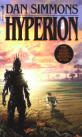 There is a decent english science fiction section at La Bibliotheque Nationale here and I chose Hyperion simply because it had a cool cover and I felt pretty sure it was popular. I'm trying to catch up on my sci-fi.
It's about 7 people who come together on a remote planet called Hyperion that is just about to be the site of an interstellar battle between the dominant human Hegemony and an outcast society called the Ousters. For various reasons not made clear at the beginning, Hyperion and some ancient tombs on it are extremely important to the fate of the galaxy. Because of the war, and because of a mysterious and viciously deadly monster called the Shrike who has somehow been released from the tombs, everyone is fleeing Hyperion, except for the 7 pilgrims.
I know it all sounds kind of complicated and at first it is, but what's really great about this book is the structure and the way it unfolds the backstory. Each of the 7 pilgrims has a reason connected with the tombs and the Shrike for coming to Hyperion. And they decide that they should tell each other their story as they make their journey to the tombs. The book, then, becomes a collection of stories, each framed on top of the journey. Each story reveals a little bit more about the galaxy and man's development in space. It also reveals more and more about the nature of the Shrike and the tombs and the war. Into this mix is a rich future history that explores man's relation with computers (the AI's play an important role) and the destructive nature of colonialism.
The writing is solid and entertaining and the setting and science fiction concepts are rich and imaginative (there are a people who float around space in giant space trees). My only real complaint is that by the time you get to the last pilgrim's story, you realize there just can't be enough pages left to complete the larger story. And it doesn't end. I picked this book up because it didn't appear to be necessary to read the sequels. But I see that was just because the copy I got was printed before the sequels came out. It's definitely a part of a series, something I'm trying to avoid. But I'm hooked and I'll at least give the next book a read to see how the pilgrims' progress turns out.
Sunday, November 06, 2005
36. Brighton Rock by Graham Greene
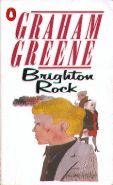 I've read a couple Graham Greene books in the past (Ministry of Fear, the End of the Affair) but I don't think I was really old enough to appreciate them at the time. I was looking for good english crime and he is good at that, but his books also have so much more going on that I found myself a bit distant from the narrative the first time around.
Brighton Rock was on a friend's top 11 list and because I had a sense that I had not given Greene a real chance, I picked it up. I'm glad I did. From the first sentence that I was in good hands:
"Hale knew, before he had been in Brighton three hours, that they meant to murder him."
That's how you start a book.
The story revolves around a young psychopath who has elevated himself to the top of his small and small-time gang. There are several narrative threads going on, around and through the anti-hero, but the book concentrates on his own crazy mind and the actions that he does. This is an extremely dark book. Brighton is portrayed as a desperate, tawdry middle-class vacation spot where there is no success and less hope. Every metaphor is brutal, waves hitting pilings are like punches to the face, a shop window is a future of despair. The characters are confused, driven by fear or hatred.
The Boy (as the young gangster is referred to) is Catholic and has a twisted view of sexuality (and pleasure of any kind). Trying to close the trail of clues to several murders, he makes acquaintances with a young waitress and ends up having to marry her, which fills him with constant dread and disgust. It's almost funny (but it's so dark that it's not funny at all) the agony he goes through just trying to respond to her requests for a kiss.
Brighton Rock is a rich and disturbing study of a people, a place and a time. It's so tortured and painful that I can't say it's the most enjoyable read, but it is convincing and interesting and extremely well-written. Read this if you're feeling dark and mysanthropic.
Friday, November 04, 2005
35. Earth Abides by George R. Stewart
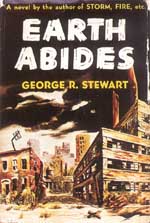 Well I jumped on the bandwagon with this one, following in the footsteps of the Mt. Benson report as well as the Crumbolst response. Unfortunately, June 23rd accidently erased his archives, so I can't compare his reaction to the others. I do know that he is using the book in his 9th grade humanities class, which will be very interesting to hear about.
It took me a while to realize how different this book is from the rest of the Post-Apocalyptic genre. As the previous readers mentioned above have noted, it is the grand-daddy of the genre, since it was written in 1949 and it really does avoid the standard tact of some kind of conflict after the fall. Rather, the nature of the apocalypse is relatively gentle. Almost everybody dies from a disease. But there is no horror of violence and fear. It all happens very quickly and society is very ordered about their response, right up into the end. So for the protagonist, who was up in the mountains, it's more like the world just emptied out all of a sudden. We get to see the slow degradation of what man has left behind, as some animals die out and others multiply. Building begin to collapse, forest fires rage, the roads deteriorate. The first third of the book is a thorough and delicious exploration of this slow reversion to nature.
The rest of the book then deals with society as the narrator finds a wife and a few other people and they start a little community. There are conflicts, but only one major one and it is not the point of the narrative. The narrator is much more concerned with the graual detachment from the traditions, behaviours and learnings from the past and how this affects the older people (who were around in the past) and the younger ones differently.
By the end of the book, the narrator is old and feeble and the last person around before the disease came. Society and mankind look like they are going to begin again, but down a very different path, semi-primitive but perhaps socially more sophisticated and maybe freer.
Overall, I'm not sure if this is a pessimistic or optimistic vision. It almost seems more like a very indifferent anthropological study, as if the author just wanted to explore "what would happen". The main character is a geographer and is constantly positing himself as a researcher, just on the outside of society.
I have two points of disagreement with the author. First, he makes a huge distinction between intelligent people and stupid people. I don't know if this is because of the period, but he seems to be making eugenic assumptions. There is a half-wit girl who (thought treated with kindness by the tribe) is treated as basically a non-human. There is no sense at all that she might have something to offer. All the children are considered unteachable because they came from "unintelligent" parents. He theorizes that the reason their parents survived the shock of the post-disease world was because they were not intellectually sensitive enough to appreciate the horror of it. I found this to be a limiting scope on the study of how man would react to such world. That kind of thinking was quite common at the time.
I found that it played into his views on education. The narrator just gives up on teaching the kids because they (except one) don't have the bright eyes and natural desire for learning. Well what kid does? If all kids wanted to learn, we'd all be teachers (or we wouldn't need any). It's the same with how sort of lame and pathetic the first wave of survivors were. He tried to suggest that it was because they could just scavenge, but I have a more optimistic view of human nature (at least in this context). We are a busy and progressing species. Even if we could just scavenge for food, there would be so many other projects that people would undertake. It could be that this took place in America. The people almost seemed like the cast of Survivor. Perhaps had it been Canada, some serious shit would have been getting done.
Overall, a really enjoyable book, though I found the prose a bit too lyrical at times. It does make you think about how humans would rebuild and paints a rich and detailed, though in my opinion, fundamentally flawed, picture of this process.
Tuesday, November 01, 2005
34. Fargo Rock City by Chuck Klosterman
 I found out about Chuck Klosterman after reading an email exchange between him and Sports Guy (Bill Simmons, whom I would consider one of the funniest and liveliest collumnists today) that was quite entertaining. After a bit of research, I realized Klosterman is a fairly well-known music and social critic. This was the only one of his books I could find at the library.
It's a bunch of semi-chronological essays about his love for heavy metal, a love he developed as a teenager in the midwest of America. I myself was a hater of heavy metal, seeing it as the enemy music of all the trendoids in my own small town. Klosterman sees himself and his fellow metalheads as outsiders as well, which seems weird to me. Maybe things are different in North Dakota, but in Lantzville, the headbangers were the dominant, aggressive musical force and if you dressed differently or listened to different music, you were often victimized by them.
Because of this, it's taken me years to appreciate the musical qualities of metal. I do appreciate them today and can often be found rocking out to Sweet Leaf in the kitchen. But Klosterman is really pushing the envelope. His book is an appreciation of the most poppy glam metal bands like Mötley Crüe, Warrant, Guns and Roses, KISS, Def Leppard. He makes a strong case for all of them, and though I don't buy his arguments enough to make me really like those bands, I do believe that his love for them is real and that they do deserve some level of respect.
Arguments aside, Fargo Rock City is an excellent informational overview to the whole genre. Read this, with iTunes nearby to listen to the many songs and albums he describes, and you will be comfortable having an intelligent discussion with a fan of 80s glam metal. Some of Klosterman's analysis is a bit meandering and uninspired but there are nice ideas and it doesn't really get boring.
If you do want to learn more about 80's metal, than you should definitely read this book. If you want some insightful social commentary from our generation, you might want to try some of his other books (which I'll probably pick up at some point in the future).
Sunday, October 30, 2005
33. A House for Mr. Biswas by V.S. Naipaul
 This book was recommended to me by the Dean of the University of Crumbolst during a discussion about Time Magazine's 100 best english novels written after 1929. I asked people for recommendations from that much-maligned list because I was in need of some new reading material, outside of my comfort zones (which had clearly stagnated in the last month as you can tell by the few books that have been read) and that might add some prestige to me, either in cocktail party conversations or when visibly seen reading at a café.
A House for Mr. Biswas is a great book. It's the story of one man's life, beginning with his birth (after a brief prologue at his death) and going through his entire life until he dies. Mr. Biswas is a poor Brahmin, part of the Indian diaspora living in Trinidad. His life is defined by a lack of power and freedom and his constant, often aggravating, often self-defeating, struggle against the things that oppress him. The progress of his struggle is his domestic situation, most of the time under the roof of his wife's (whom he also married against his will) family home, a sprawling, female-dominated network that is almost a society in and of itself.
Mr. Biswas is not a likeable person. He treats his wife terribly, constantly attacking her family (because he's too scared to confront them directly), belittling her, ignoring her, trying to escape from her. The first half of the book is a bit trying just because Mr. Biswas is so difficult. But the rich descriptions, both of the physical and social environment, and the steady layering of character development (of really engaging, interesting and often eccentric characters) keep you reading. By the time Mr. Biswas starts to develop some character, you've suffered with him so much, that you have total sympathy for him.
Most of the time, he is either thinking about a future house, worrying about his current one, or hating it. The house and the freedom and independence associated with it is the central theme, from beginning to end. And even though you know, in outline, what happens to Mr. Biswas by the end of his life, the story is so rich and engaging that you really want to find out how and why it all turns out.
By the end, you close the book feeling like you have a deep and intimate connection with a single man and the family around him. I strongly recommend this book.
Saturday, October 22, 2005
32. Killy by Donald E. Westlake
 I actually read this almost a month ago, but since I'm getting back on the book-reading wagon, I realize I'd better start keeping track.
This is an early Westlake, about a young man who gets an intern job at a union headquarters. He works for a man named Walter Killy. Their job is to encourage unionization. At first it's all presented as business-like and professional, creating PR and publicity and talking with people who are interested. But when they go to a single-factory town where some of the men want to unionize, things get ugly really fast.
Most of the book is an interesting look at how the unions operate in situations like this. As it moves forward, it becomes more about the narrator and his growing confidence in the position. It foreshadows Westlake's study of the psychology of jobs and workers which we see more of in The Axe and is always an undercurrent in most of his books.
Watching the union respond to the locked-down town, the corrupt cops and the plant owners is really cool and worth the read alone. The ending is a bit abrupt and not totally satisfying, mostly because the protaganist is a bit soulless. Enjoyable, though.
Wednesday, September 07, 2005
31. Concrete Island by J.G. Ballard
 I'm sort of surprised at how much Ballard I've ended up reading this past year or so. I always had a negative feeling towards him. Not based on anything substantial but just because his name came to me surrounded by all that "alternative" hype when ReSearch published The Atrocity Exhibit and Crash the movie came out (which I kind of enjoyed). Now I've read enough of his early work to feel that I have a decent handle on his style and some of the themes he deals with.
Concrete Island is the story of a succesful London architect who loses control on the freeway and drives his Jaguar over the edge, crashing in an isolated island underneath a huge interchange. He is mildly injured and in a bit of shock (or perhaps insane; it's often hard to tell with Ballard's characters) but it's not a big deal until he tries to get off of the island. It turns out that he's trapped. There's no obvious way out and on the only road he can reach, the motorists are driving too fast and won't stop. He acts a bit rashly, makes some mistakes and ends up looking pretty disheveled, which makes people even less likely to stop.
It is of course a metaphor for the isolated modern man as well as a condemnation of society's separation (or, considering Ballard's morally neutral tone, a confirmation of man's nature). The storyline does get more complex, but ultimately he's addressing many of the same themes he deals with in his first four apocalypse novels: man's psychological distance from civilization, the flimsiness of bourgeois trappings, etc.
It's a quick read, very dark, even cruel at times. His description of the island (it's fairly complex, being the remains of an old neighborhood) is excellent. It's a small study and engaging, but it will not make you very happy.
Monday, September 05, 2005
30. Ghost Story by Peter Straub
 My S.O. picked this one out from the library. She'd heard a good recommendation a while ago and had wanted to read it. I was dismissive at first. I read The Talisman that Straub wrote with Stephen King and really enjoyed it, especially the pulp narrative elements, but I sort of considered Straub to be a "mainstream" horror author and most of those that I have tried to read, I've found pretty boring.
 But I got stuck bookless and read the first chapter and found the writing style to be rich and entertaining, with some depth there. My S.O. had a bit of trouble getting started but then after the first third, she blazed through it, barely able to put it down. So I erased my previous uninformed opinion and read the book.
It's a story about a small town in upstate New York and 4 old, succesful men who have a dark secret in their past and are starting to have all kinds of freaky nightmares. They get together regularily and tell each other ghost stories, stories that they won't admit to each other seem to come from out of nowhere. The plot sounds a bit hoary, especially the dark past, but it becomes much more complex and multi-layered with all kinds of things of gripping stories going on in an interconnected web. Even better, the evil (and I don't want to be precise because the fun is in the discovery) isn't just some vague menace, but has methods and characteristics that make it quite interesting.
Also, as I found on my first read, the writing is good. There are many well-developed and varied characters. Even better, he captures the claustrophobia of a small town. In the few times I've spent in small towns in upstate New York, they all had this old, sort of closed-off feeling, like an unopened chest of drawers in an attic somewhere. He really conveys that feeling, of nostalgia and innocent times past mixed with fear and social segregation and cheating and all the usual small town evils. In some ways, the town itself is almost evil by definition and the evil that comes to it secondary.
This book is not perfect. There are some inconsistencies in the plot and one of the major protagonists has a questionable presence in the story at all, but it's thoroughly entertaining and quite dark and creepy. It's a great summer time read and definitely the kind of book that deserves to be a bestseller in that it appeals to the masses without being stupid and easy. Quite fun, I recommend it.
Sunday, August 28, 2005
29. Freaky Deaky by Elmore Leonard
 My girlfriend took this out of the library and I wanted to get another taste of Elmore Leonard. The only book of his I can remember reading is Mr. Majestyk, which I picked up for cheap right after seeing the movie with Charles Bronson (there's a great scene where the badguys shoot his watermelons).
 It's quick reading, with many different characters revolving around each other in a moral morass of cons and backstabbing, with a thick strain of romance for the protagonist driving the whole thing forward. Some ex-radicals from the '60s decide to try to extort money from a rich friend of theirs who has become basically brain dead through excessive partying. He's like Ozzie and he has this ex-Black Panther as his manservant who is also scamming him. An explosives expert who just left his department and then gets suspended gets involved to help a woman who'd been sexually assaulted by the wasted millionaire. I think these are classic Elmore Leonard plots (think Get Shorty or Jackie Brown) and they are entertaining in their convolutions. They also make people look pretty morally fallible.
Ultimately, though, this one just didn't grab me. The style is not sparse enough to be really tough (like Richard Stark), though that's the milieu he's aiming for, nor is it wacky enough to be truly fun (like Carl Hiaasen). So it basically boils down to a small crime story with decently portrayed but not all that interesting characters. It was okay and I'd grab other Elmore Leonards if I was desperate, but I won't be picking up any more in the near future.
Saturday, August 27, 2005
28. Breakout by Richard Stark
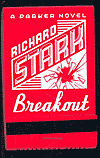 Richard Stark is my favorite author. He is the pseudoym of Donald E. Westlake who has written all kinds of crime and mystery novels, including the screenplay for The Grifters. The Stark books were a series of caper novels, written in the early '60s and early '70s starring a tough, methodical and cold-blooded thief named Parker. They kicked ass. He wrote the last of the series "Butcher's Moon" in 1974 and it was a perfect ending to the series. For whatever reasons, he started writing Parker books again '97 and sadly they just weren't as good. The plots weren't as tight, Stark had trouble fitting Parker into the '90s and Parker just wasn't himself. He talked way too much, put on disguises, things like that. In the original series, there was no fooling around. It had lines like "Parker shot him." or "Parker hit him twice." or "Parker waited."
The basic structure of the Parker books is four parts. Part I Parker plans a job or gets involved in one. Part II we see the behaviour and personalities of some of the other characters, often involved tangentially or on the victim side of the job. Part III the job goes sour. Part IV Parker deals. There were some variations, and the overall story arc is really great, with Parker taking on the mob, but the real enjoyment of these books is a super-efficient character cleaning up the mess of life's screw-ups in order to save his own ass.
Anyways, I picked up the latest in the second iteration of Parker books, Breakout, at the new Bibliotheque Nationale here in Montreal. This time, Parker gets caught on a job and goes to a holding facility, where he decides to break out rather than wait for the cops to connect the identity he gave them to the real him and thus expose all the crime he's done over the years and finish his career for good. There is a pretty cool heist and the way things go sour are cool. It's all a bit implausible and it kind of lacks punch, but Westlake is such a good writer that he is always enjoyable to read. It's a quick and decent read, but I would only recommend it to completists. What I would recommend is you start reading the original Parker series, which starts with The Hunter (or Point Blank as the movie of it was called) and go from there, in order if possible. They will kick your ass.
Thursday, August 25, 2005
27. Dark Mirror by Diane Duane
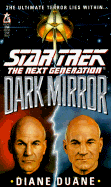 Okay, I just crossed a threshold to a higher levil of nerdiness. I just read a Star Trek novel, Next Generation at that. The author was recommended as one of the better of the series. I have nothing to compare it with, but Dark Mirror was entertaining and fun to read, but probably would appeal mainly to those who were familiar with the TV show. I watched the first few seasons of Next Generation and quite enjoyed it when it stayed on strategic and exploratory subjects. It started to get more and more soap-operaesque as the seasons went on and I dropped it.
The Dark Mirror crew deals with a parrallel, evil universe, the same one that the original Star Trek crew encountered (with Evil Mr. Spock, one of the most bad-ass concepts in the history of character development). This time, the evil universe has figured out how to pull things from our universe and they pull the good Enterprise into their universe in an attempt to take it over, send it back and infiltrate then conquer our universe.
Duane does a great job with the original characters and a pretty good job of developing the future history of the evil universe, where humans have conquered, destroyed or enslaved everything in the galaxy. Her portrayal of the evil counterparts is mixed. They were interesting, but not quite evil enough. The whole book is kind of G-rated, which is not inappropriate for the source material, but makes it difficult to portray real evil.
I think I may turn off this road now, but if I come upon some other Diane Duane star trek's for cheap, I may pick them up.
Wednesday, August 24, 2005
26. Flic Story by Roger Borniche
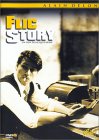 They have a giant used book sale at this Arena in Rosemount every year. I think most of the books are the ones the libraries are getting rid of. I picked this book up there, on a whim. It was a hardback missing the dust jacket, so pretty anonymous but the age and quality of the paper and binding caught my eye. It was written in 1973, originally in French, and is the true story of a french cop hunting down criminals in Paris in the period after the end of the Second World War. The author is the cop (flic is slang for cop in France) and he prefaces the book with a bit of bitterness, suggesting that all the books about crime are written from the criminals perspective and he wanted to show what it was like to be a cop.
The translation is a bit awkward, especially considering that a lot of the dialogue is in gangster jargon and french underworld sland. Also, the book moves forward jerkily, sometimes going to the past, sometimes changing perspectives (Borniche often narrates the criminals behaviour as if he were part of it, without any explanation of how he knows the things he knows. But once you get a quarter way through the book, the stories (and the main story, his attempt to collar France's enemy #1 of the period) really pick up momentum and those things stop bothering you. You also get the feeling that he really wrote this book on his own and his writing, though not the best, is honest and filled with real detail. He has a humble and sardonic voice, and though it is often marred by the translation, when he talks about trying to afford a new stove for his mistress (this means girlfriend in the context; he isn't married), it's endearing.
The french criminal scene of the '40s and '50s, at least according to this book, seems as cool as it is portrayed in movies like The Red Circle and Touchez Pas au Grisby! The gangsters (and the cops) are constantly stopping what they are doing to get something good to eat (and describing it in sophisticated detail), drinking wine, champagne and pastis (pernod mixed with water, turns all milky) and smoking cigars and black-market american cigarettes. They cops and robbers always seem to be hanging out in the same place. You get the feeling that Paris was a small place or that the culture was just very consistent.
I'm really glad I found this book. Besides being fun to read, filled with great heists, collars and characters, it also gave me a much stronger and more authentic sense of the french postwar criminal world. I'm also happy to discover they made a movie of it with Alain Delon.
Monday, August 15, 2005
25. Feersum Endjinn by Iain M. Banks
 This is another one of Banks' Culture novels, a collection which I've really loved. He is a great moralist, great in the sense that his books are powerfully moral without ever being preachy or getting in the way of the story. Feersum Endjinn concerns the earth far in the future. The technological and social situation is quite complex, almost too complex to describe here, but basically the future earth is in danger of "The Encroachment" a wave of black dust that may block out the sun and thus freeze the solar system. Instead of working together to address the problem, the leaders are fighting a civil war. Everyone lives in the ruins of giant statues and castles and have access to a virtual reality called the Crypt, all of which was left by a previous society. They don't know much about them, but suspect they have a way to fight the Encroachment. The book traces the paths of the various characters whose actions will impact the plot.
 As usual, with the Culture books, there is awesome technology as well as really amazing descriptions and locations. His presentation of the Crypt as a kind of advanced internet in which people can exist for millenia as avatars (or copies) of themselves is thought-provoking and a reasonable guess as to the future of our own data net. So for sci-fi nerds, it's a great read. I think it may be a bit obscure if you're not familiar with Banks' style and the Culture books. For instance, there is a character who can only think and express himself phonetically and there are chapters and chapters written phonetically, which is tough at first (though once your brain is able to read it quickly, it's amazingly well-written).
I think it is quite obviously a metaphor for global warming in our own time and from that perspective, this book actually lacks some of the moral depth and complexity that his other books have. It all ends kind of abruptly and easily, suggesting there is some deus ex machina solution to human stupidity and selfishness that will save us all in the end.
I'm not really able to do justice to the fantastic and rich world that Banks has created here. He really is a master. I strongly recommend any of the Culture books (most of which aren't for sale in the States, or weren't), the listing of which can be found at his website.
For you Culture geeks out there, Feersum Endjinn takes place on earth and only gives very teeny hints to the origin of the Culture and the future of the humans who left the planet (referred to as the Diaspora). The only direct link to the Culture is, I believe, a tiny ant, but I'll need to dig a little deeper to confirm that.
24. A Conspiracy of Paper by David Liss
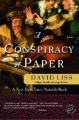 My dad lent me this because he wanted to know what I "thought about it." This worried me, but he assured me that it was an entertaining read and he was correct. It's kind of a heroic adventure (almost pulp) novel taking place in early 18th century england, when the modern notion of money and markets was just starting to develop. The hero is a jewish ex-boxer who has set himself up as a sort of Rennaisance bounty hunter, hunting down criminals and returning stolen material. It's a great idea, because the period is full of fantastic adventure potential. From the perspective of an entertaining read, it's pretty well executed. The plot is engaging and the characters, especially the hero, are well drawn out. There's lots of satisfying butt-kicking and revenge-getting. The plot becomes a bit overly complex and its mystery dependent more on many others holding out information rather than any real detective work. The author did some study in the field and knows the period well, but the language, the thinking and a lot of the goings-on in the book seem just a bit too contemporary. Probably it had to be done to make a rollicking adventure, but I guess I would have liked just a bit more detail and period verisimillitude. Compared, for instance, to Neal Stephenson's portrayal of the same period in his recent trilogy, A Conspiracy of Paper seems simplified, as if written for a poorly educated audience (i.e. the American book-buying public). Still, tons of fun and I'd definitely recommend it for a vacation read.
23. Buddha's Money by Martin Limón
 Buddha's Money was discovered, reviewed and lent to me from the good folks at Mount Benson Report. I generally agree with most everything written there. The book starts out with some action and keeps delivering, which makes for a quick and entertaining read. It does go a bit astray at times and because of its pacing nothing is ever that deep. My favorite aspect of the book (and probably the element presented with the most depth) is the setting itself. I don't know much about Korea or Korean history (which is interesting in and of itself in that I know a fair amount about Chinese and Japanese culture and history) and Limón does a great job of describing that halfway world created by the impact of a foreign army on the local culture. I would like to get a better sense of the two main characters, though the thoughtful Chicano with a respect for history and the violent black GI are a pretty good team for investigating this kind of mayhem. One other thing to note is that it is quite brutal. So violent and cruel at times that it actually made me go and check when it was written. It was 1998 and the more grisly elements seem to come from someone writing something today rather than in the '50s or '60s, which is when I had originally thought they were published.
Wednesday, July 27, 2005
22. The IF Reader of Science Fiction edited by Frederik Pohl
Though a collection of short stories by different authors, it was bound in book format and was book length, so I'm counting it! The IF Reader is an anthology of the best stories of 1962 from IF magazine. They represent many of the major authors of the period, A.E. Van Vogt, John Brunner, Fritz Leiber, Fred Saberhagen. They were all fairly light, better read for their speculations and concepts than an involving story or deep theme (though, as always in sci-fi, many interesting human themes were present, just not touched on in depth in short story format). All pretty fun and light. Glad I passed the time with it. Probably, if I knew more about the history of science fiction literature, I would be able to put these stories in context better.
Thursday, July 14, 2005
21. The Golden Spruce by John Vaillant
Non-fiction book #2!
This is the true story of a giant golden spruce in the Queen Charlotte Islands, a genetic freak, tourist attraction and sacred symbol to the Haida people, that was cut down by an ex-logger turned environmentalist. Grant Hadwin's story is the center narrative for an excellent history of the region and logging and wood production in the world.
It's not totally clear why Hadwin cut the tree down, but part of it was his outrage that this tree was protected while the rest of the Queen Charlottes was basically clearcut. He was angry about the little symbolic patches of trees that the big logging companies saved to show their concern for the environment. He didn't seem to know the power that the symbol held for the Haida people (who basically want to kill him now) and showed signs of mental instability.
It's an interesting and sad story, but it's the incredible greed and waste that surrounds the story, and the strong sense of the power of human consumption, that makes this book so compelling. I know this is my opinion already, but when you read about how the region was first completely raked clean of sea otters (for their fur), then of species after species of tree (starting from the best and biggest, to the smaller and lower quality), it really drives home how incredibly out of control we are as a species and how terribly we handle the planet. We are like rats that have taken over the house, are reproducing out of control and consuming anything and everything in our path. Foul creatures.
We can write some good books, though! And I strongly recommend the Golden Spruce.
Monday, July 11, 2005
20. The Three Stigmata of Palmer Eldritch by Philip K. Dick
 Found this one in a box on the street. I've read Do Androids Dream of Electric Sheep? and Ubik, but years ago, so I was curious about getting a better sense of Dick's writing.
 My first reaction after finishing it was further annoyance at these snobby pseudo-intellectuals (like Margaret Atwood) who make this forced distinction between Science Fiction and Speculative Fiction, the former being considered adolescent and the latter somehow literature, because they supposedly deal with complex human themes that the former doesn't touch. All of the science fiction books that I have read this year have been very philosophical, with explorations of god, man's perception of himself and the meaning of existence.
The Three Stigmata of Palmer Eldritch starts out in a future world where the earth is overheated to the point that living things can't go out in the day without dying. The wealthy take evolution therapy and the poor are slowly recruited to be colonists on distant planets. The colony effort is basically to get the people off of earth and is considered a punishment. Physical survival is not an issue, but morale is as most of the colonists just sit around and mope on their bleary, depressing planets. Their only escape is a drug called Can-D that puts them into an alternate fantasy earth reality. However, for the drug to work they need to have precise miniatures of the world they are going to enter. The biggest industry on Earth is the production of these miniatures and the drug.
That's the setting. The plot is quite complex and very open to interpretation. I think it's about an invasion of a single, powerful alien being in the personification of Palmer Eldritch, a space explorer who is trying to set up a new drug called Chew-Z that's supposedly way better than Can-D. The book is about the employees of the Can-D company trying to stop him. But because it's constantly dealing with alternate realities, it's difficult to figure out what's real and what's in the drug world and by the end, the two have blurred together. Plus, many of the colonists equate the use of Can-D with a religious experience, so there are all kinds of discussion of translation and transubstantiation.
It's quickly paced and has some interesting ideas. Dick does have a strong sense of the malleability of our reality and he plays well with that in his writing. He is also able to create a future with some big, crazy ideas and not get caught up in the tone and culture of the time he's writing in. I'll pick up another one of his novels in a bit.
Wednesday, July 06, 2005
19. Stranger in a Strange Land by Robert A. Heinlein
 It's obviously a science fiction classic and one that I've been meaning to read for a long time. I have to say that I really didn't like it very much. I'm sure there is a lot of contextual information of which I'm ignorant that would help me appreciate the book more and I'm also sure that it hasn't aged well (which is not necessarily a valid criticism of a work of art). I found it to be inconsistently structured, with long passages of conversation that were basically philosophical musings interspersed with short narrative steps forward. The philosophy was very annoying for me because most of it was relayed through the voice of Jubal Harshaw who talked like Travis McGhee. He had that early 60s american hip style where nobody can seem to say anything in a straightforward manner. There always has to be some clever little joke, exaggeration or sarcasm. And since all the philosophy was about human sexual relations, it didn't help that it was totally sexist. This free love perfect world seemed based on the idea that all the women were young and beautiful, playful and willing to do anything the men asked. They still cook the dinner even though all you have to do is push a button! And Michael's perfect world of free love, which all the characters in the book perfectly accept, had absolutely no room for homosexuality. Very convenient, indeed.
Perhaps this book was a real wake-up call to audiences of the late '50s. But today, it seemed like unsophisticated and self-indulgent rambings about north american sexual mores.
Subscribe to:
Posts (Atom)


 Posts
Posts


