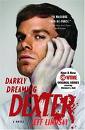
I'm really not a big fan of serial killers as a literary genre. The first few times it was okay, I guess, but they always risk the temptation of self-indulgent, titillating sexual sadism and they usually succumb to it. Even worse, though, is the power creep. In real life, serial killers are screwed-up losers who eventually get caught because they generally aren't that smart. In order to make a serial killer book last, you have to have one who is really hard to catch. Since the detective is usually someone who is super smart, you have to make a super smart serial killer. Eventually, you get into Jeffrey Deaver territory where the serial killer is the smartest guy in the world and a Casey Ryback level ex special forces guy. They are more badass than the goofiest Pierce Brosnan Bond villain. At that point, it's just stupid. Yet, for whatever reason, ever since the overrated Silence of the Lambs, the crime genre in print and in film is inundated with serial killers.
Despite my lack of interest in the sub-genre, I did give the first Dexter novel a try. I had watched the first season of the television series and had quite enjoyed the concept. If you're not familiar, Dexter is a sociopath who was trained by his adoptive cop father to satisfy his murderous urges by hunting and killing only criminals. It's a clever idea because you get the cool technique, but done by a good guy against other bad guys that you want to die. It's kind of a procedural vengeance situation. I didn't totally love the series because it didn't spend enough time on Dexter getting the baddies. Instead, there was a lot of unresolved soap opera stuff. It was decently done, but in this case, wasn't satisfying the potential that I had hoped for. The real deal-breaker for me (and the reason I didn't bother with season 2) was the portrayal of the female characters. They were to a woman shown to be constantly stupid and irrational, especially his sister.
So, anyways, back to the book at hand. It is original and entertaining. Dexter is haunted by a serial killer whose skill and artistry blows him away. He also has to help his sister improve her reputation on the force (even though she is stupid, shrill and has no sense of politics; she really shouldn't be promoted). I really wasn't too engaged in the story, because it lies heavily on the serial killer as artist angle, which is boring. And the portrayal of the sister was not much better than the show. However, Dexter himself is quite funny, in his ironic asides and his backstory is engaging. I think I would have gotten into it more if I hadn't seen the tv series, as then it would have been all new.
So in summary, an okay light read, but I wouldn't bother unless you are really into serial killers and want to see a new twist.

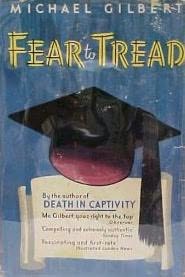 This all started because I went to the library. I have an on-deck shelf that is threatening to fall of the edge of the chest of drawers it is on. There are a lot of good books there I want to read. I only went to the library to return Daughter Fair before my trip out west. But I decided to take a little browse down the english mystery and sci-fi shelves. And just couldn't help take out a few books, which will do nothing to bring down the width of my on-deck shelf.
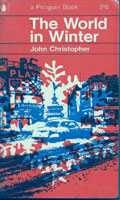
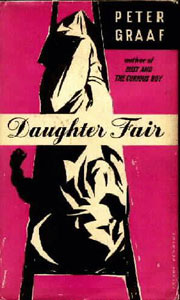 Dug this one up at the National Archives of Quebec, through the Bibliotheque Nationale. They had it in their computer system and I had to order it. I wonder who was the last person to read it? John Christopher, whom you've read so much about here, wrote at least two detective novels under the Peter Graaf pseudonym. The detective is Joe Dust, an unlikely American living in London in the '50s. I think that's sort of the point here, to juxtapose the cliched, wisecracking American private dick against the more procedural, proper British context. It's an interesting experiment, at least in this novel, with mixed results.
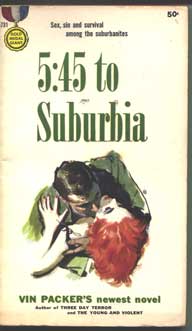 I snagged this one in a box of super-cheap paperbacks at one of the larger used bookstores on Bloor street in Toronto (the one that is open quite late; the bookstore scene in Toronto is quite thriving, it seems). I got it mainly for the cover, which as you can see is quite awesome. The back cover blurb reminded me of a John D. MacDonald novel, without the violence. The lack of violence is usually a deal breaker for me in a book, but something about the set-up, with the guy commuting from the suburbs into the the city in the '50s called to me.

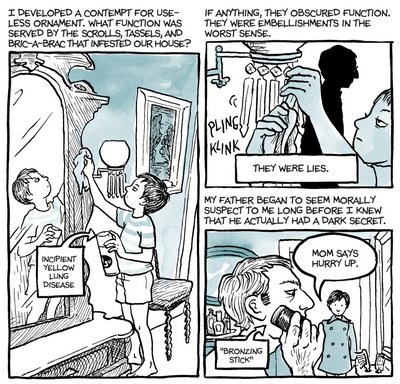
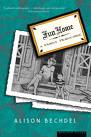 My sister strongly recommended this graphic novel to me and judging by the high-level accolades on the cover, she is not alone. This was the hot comic of the year and I completely missed it. It's the biography of a girl growing up in rural Pennsylvania in the 60sand 70s. Her father is gay and she figures out pretty quickly that she is too. Their relationship is complex and difficult. The book is structured in a very complex way as well, as Bechdel jumps back and forth in time, revealing different things here and there, going back to already revealed incidents and adding layers of understanding to them. It makes for a very fulfilling read because by the time you get to the end of it, you really get the "ah, yes" sensation where everything comes together in a rich and real way. The ending isn't necessarily happy. The family difficulties are not solved or absolved, but you as the reader get a sense of really understanding the situation, even being a part of it. This is why sometimes comics are better than books.

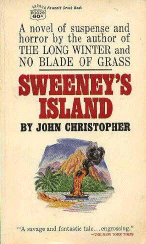 From the few biographical snippets I've read about John Christopher, he was a very prolific writer in the early part of his career. It really was a career for him and until the success of the Tripods trilogy, he had to write as much as possible. He cranked out several books a year, in several genres. He also never did any rewriting beyond the first chapter, supposedly. I don't know, his books read pretty well to me. Sweeney's Island is one of those, written in 1964. It's about a group of London bourgeois hangers-on of a very wealthy and connected guy named Sweeney. During one of his cocktail parties, Sweeney asks them to stay after where he proposes an impromptu trip on a new yacht he has just bought. He has clearly planned this very carefully, knowing that each of them either is dependent on his future generosity or is free enough to be able to just take off for a few weeks of ocean paradise.
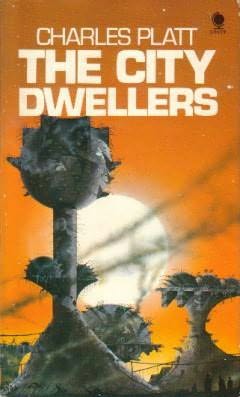 Found this one at a crazy, disheveled used bookshop way out on Mont-Royal. In the basement floor they had a few bins of english books, mostly crap from the late 80s and 90s, but I found this old british sci-fi book. It was thin and nicely yellowed, perfect for my travels to come. I didn't really know much going in, beyond that it was about characters in growing and dieing cities and it had some nice written language at the beginning.
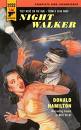 I have toyed with Donald Hamilton in the past. It was a reading encounter with great promise that led to a real deflating letdown. He is best known for the popular Matt Helm series of manly paperbacks found in drugstore racks in the 60s and 70s. His early books were also said to be a big influence on the Parker books (written by Donald Westlake under the nom de plume Richard Stark), otherwise known as the best crime books ever. There were one or two books in particular whose titles I forget that I did read and they really did kick ass. I was so psyched because Hamilton had written so much more and they are so easy to find. I even had hope that the Matt Helm series might be competent. Unfortunately, something happened to Hamilton along the way and the other books I read by him had lost the tight, cold intelligence that had attracted Westlake. They were, instead, pandering to the audience (obvious macho tropes) and, far worse, demonstrated inefficient and emotional character behaviour. So I had to let the other Hamilton books on my on deck shelf and let go of that relationship.
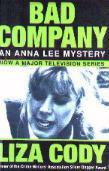 I picked this one up at the Kitsilano branch of the great Pulp Fiction bookstore in Vancouver. The British packaging caught my eye and the blurbs made it sound like it might have the right stuff. The protagonist is a female private investigator in contemporary London. Bad Company might not have been the best place to start since the heroine spends the whole time kidnapped, but it was an entertaining and well-written read nonetheless. The London underworld is richly portrayed and the lowlifes, from the stupid, inexperienced thugs who pull off the kidnapping to the serious hard and well-dressed ones who are trying to stop them as well fit well into the British empirical mold. The ending was a bit anti-climactic, but I think realistic. I'll be keeping an eye open for other Liza Cody books.
 This is a short (as many of his novels are) H.G. Wells novel that I found somewhere while traveling. It has a hilariously wrong yet accurate cover of a man and woman fighting off a dog in some ruins. It's wrong because though this scene actually happened, the picture looks like a Vallejo-esque barbaric fantasy. In the book, it is two wimpy future city-dwellers who, dissatisfied with modern life, make out for the country. At one point, they do get attacked by dogs, but the scene emphasizes how hopelessly unprepared they are for life outside of the city. I really should have scanned that cover, but I left it in the free bookshelf in the laundry room of my mom's apartment. Somebody took it so maybe it got read again, which would make it worth it.



 Posts


