Friday, August 29, 2008

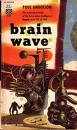
36. Brain Wave by Poul Anderson

Brain Wave pictureAll this classic science fiction reading going on over at Buzby's Life got me motivated to pick up this old paperback I've had sitting on my on-deck shelf for quite some time. Brain Wave is classic golden age science fiction in the most speculative vein. What would happen if everybody in the world suddenly became super-intelligent? This question is answered in an interesting and entertaining manner, for the most part. It is burdened slightly by some of the psychological assumptions of the period and some stilted overly theoretical dialogue (external and internal)

"God!" Corinth's fists doubled. (If we could only learn more about ourselves! If we had a workable psychiatry!)

but those are classical tropes of the genre and did not overwhelm the book. As a bonus, on the plus side, there also was a really great animal-oriented side story that really pushed my buttons.

There are a few stories going on, but the principal narrative follows a young physicist and his happily homey wife. When the intelligence hits, which is the result of the earth passing out of a neuron-suppressing field it had been in for millenia, the world goes through a tremendous upheaval. Though people become more intelligent, they don't get any wiser and the same prejudices and fears that dominate their personalities remain intact. Ultimately, however, reason bears out. But the process to get there involves uprisings, a breakdown of the economic and political system, a lot of people going insane and all kinds of other mayhem that is quite fun to read about.

After the survivors manage to get past all this, we move into the more speculative part, where the humans reach for the stars and start figuring out how they are going to live. The human part of the story concerns the physicist and his wife. She can't handle the new intelligence and starts becoming more and more neurotic and depressive. A certain part of our humanity is lost with the intelligence and some people, Poul posits, can't handle this. Those who are used to looking outward and thinking hard and deeply about external subjects, e.g. scientists, were better equipped seems to be his argument. The dated part is that the latter group in the book is almost all men and the former represented by the wife. It's still an interesting idea and he does a good job of postulating what might happen.

The really cool side story, though, for me is about a simpleton farmhand. At the beginning of the book, he is mentally deficient, but strong and kept on the farm and basically adopted by its kindly owner. He's not allowed to drive, for instance. But when the change comes, he too starts to become intelligent. Only because he was behind to begin with, he only reaches up to a normal IQ. Everybody else is in super brain world and basically bail on the farm. He is left with the animals, who have also become more intelligent and thus extremely dangerous. Fortunately, he has an awesome dog with him, who remains man's best friend. The pigs cause the first problems, escaping and then hiding in the forest making attacks on the grain. Then the bull. It finally reaches a crisis point when he returns from town (the first time he'd left the farm since the change) and gets ambushed. Another bull takes the truck out and his faithful dog is trapped, wounded, on the roof.

All seems lost when there is suddenly a shotgun rings out. It's the calvary. In the form of two chimpanzees riding an elephant who had escaped from the zoo! (He'd been warned about the zoo breakout when he went to town.) After the chimps and the elephant take out the bull and chase away the pigs, there is a nervous moment when the farmhand isn't sure about their intentions. Then the chimp approaches him and tugs on his jacket. The chimps can't handle the northeasterly climate and need his help to survive outside the protected environment of the zoo. An alliance is made and the chimps and the elephant join him to run the farm! Most awesome. I love shit like that.

His farm ends becoming what is one of many "moron communes" (really, that's what they call them), places for the non-super brainy humans to live. This is an important part of the speculation, actually, as the two societies ultimately separate, with the smart ones heading off planet to become custodians of the universe.

Sunday, August 24, 2008

35. Dark Harvest by Norman Partridge

Dark Harvest pictureExcept for Stepen King, I was never a huge fan of horror. But in recent years, with the influence of Meezly, Fantasia and other friends, I'm getting more and more exposed to it. One of those friends, Jocelyn, whom I met through gaming, is quite into it. He ran a very fun Unknown Armies, (which would some would say is the RPG that epitomizes contemporary horror) campaign that I played in and he lent me Dark Harvest. I have no idea how Norman Partridge came onto his radar, because I've never heard of him before, but if this book is indicative of his skill and style, he's good.
Dark Harvest is a tight little read. It's about a small, isolated midwestern town in the early '60s. Every year, since as long as anyone can remember, the tradition is to lock up all the boys of the ages of 15, 16 and 17 years old for the three days before Halloween and starving them. They are then released on Halloween night, while the rest of the town locks itself away (except for those left to guard the food sources). The boys' goal is then to hunt down and kill a living Jack-o-lantern before it enters the town church. The boy who does this is allowed to leave town and his parents get a new house and a car. I've already told you too much, though most of this is laid out in the first few chapters. It's just that the unfolding of the story is a big part of the fun of this book. Don't worry, though, as there is a lot more to be revealed and I found the revelations to be quite delicious.

It's a grim, brutal tale. The town is closed and scary. The kind of place anyone would want to get away from. But nobody can in the way many people don't get out of a small town. But here it is even more sinister than that. What I particularly enjoyed was the way the plot unfolds. Partridge doesn't hold back any secrets in order to artificially maintain suspense. He's got such a great set-up that he doesn't need to. Secrets revealed just lead to more conflict and greater connection to the plot and the protagonists, making you want to turn the pages. It's a dark tale and he doesn't pull any punches, but it's not unnecessarily brutal or sadistic, a rare combination. Furthermore, it's all story, one that keeps moving forward, another thing that is hard to pull off.

It's a short read, really almost a novella. Highly recommended.

Wednesday, August 20, 2008

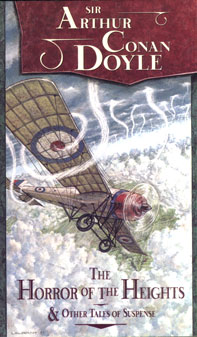
34. The Horror of the Heights and other stories by Sir Arthur Conan Doyle

Dark Harvest pictureI have to admit that I didn't read all of this book in 2008, and in doing so, reveal a little strategy I use to give me a slight boost towards reaching the goal of 50 books a year. I don't like buying books of short stories, even if I am a fan of the author, because I can rarely get through them. Every now and then, in the case of great authors (such as Doyle and Howard), I can not resist. My trick is that in between every book that I finish, if I don't immediately go on to another novel, I'll read a short story or two. Eventually, I'll complete the entire collection and get to add it to my list. Such was the case with Howard's Blood of the Gods as well as today's review, a fun little collection revealing Doyle's early interesting in mysticism and the supernatural.
I got this book through a bit of serendipity. I went to S.W. Welch's, a great little bookstore and a Montreal landmark not too far from my house. It used to be right on The Main, across the street from Schwartz's, but the owner, in a savvy move, found a new place in the growing Mile End neighbourhood just before they started a two-year construction project on St. Laurent that killed several businesses, including the maternal clothing store that replaced the old Welches. I sold some books and after, noticed this book on the feature table and said "Oh, I'd like to throw that in," or words to that effect. I had meant that I wanted to buy it and have him take the difference out of the cash he was giving me. The owner thought I was bargaining and said "sure" giving it to me for free! It was only 7 bucks, but I felt like it was a sign of respect (probably my own fantastic imagination, that) and a cool move by the Mr. Welch himself. I do go in there and chat with him and the other employees on a semi-regular basis. He knows his stuff and the other employees are quite cool (including the hilarious and talented Howard Chackowicz of Wiretap fame). A good used bookstore. Visit it if you come to Montreal.

The Horror of the Heights are all on the subject of the supernatural, written in Doyle's rich and evocative Victorian language. He's not the tightest of writers from this period, but he captures the comfortable and slightly wry British mentality of that period well. I always love passages like these:

Hastie was a good fellow, but he was rough, strong-fibered, with no imagination or sympathy. He could not tolerate departures from what he looked upon as the model type of manlinesss. If a man could not be measured by a public-school standard, then he was beyond the pale with Hastie. Like so many who are themselves robust, he was apt to confuse the constitution with the character, to ascribe to want of principle what was really a want of circulation.

and

There was one little indulgence which Abercrombie Smith always allowed himself, however closely his work might press upon him. Twice a week, on the Tuesday and the Friday, it was his invariable custom to walk over to Farlingfod, the residence of the Reverend Plumptree Peterson, situated about a mile and a half out of Oxford. Peterson had been a close friend of Smith's elder brother Francis, and as he was a bachelor, fairly well-to-do, with a good cellar and a better library, his house was a pleasant goal for a man who was in need of a brisk walk.

How that makes me long for a brisk walk upon the moors!

It saddens me that in his later years, Doyle got way into the whole mysticism and spiritualism phenomenon that made its rounds among the upper classes at that time. He engaged in some public debates on this issue and got taken in by some charlatans (whom they all were) and it is a smudge on his reputation. One would not think that the creator of the most rational detective of all time would succumb that kind of flim-flam. But he got rich and old.

These stories, from, I presume, his younger years, show a lighter and more entertaining interest in the subject. The intent is to thrill, not to convince. They seem rather light in comparison to contemporary horror, but they don't lack imagination or impact. There is often a real sense of fear and dread in these stories.

It's a nice volume, but I wish they would have shown the original source and dates of the stories. I imagine they were mostly published in the Strand, where all the Sherlock Holmes stories were published. It would be nice to know how they fit into the chronology of his more famous work.

Saturday, August 16, 2008

33. Soucouyant by David Chariandy

Soucouyant pictureCanLit time people! My boss passed me down this book while we were working together in Vancouver. Normally, I have a hard time reading these kinds of books, but it had a glossy cover and nice large margins, so I figured I could handle it. It's the story of a young black man in Ontario dealing with his mother's dementia. You can see why I might have normally hesitated! Sometimes, though, when someone random lends me a book, I'm quite motivated to read it. Can't explain it, but there it is.
It actually is quite a good book, very moving and touches upon a lot of things that I saw in my own life. I think I am more or less a contemporary of the author. I certainly didn't experience the things he did, but I saw it going on around me in my own Canadian small town. It's written so that the reader starts out pretty much in the dark. Basically all you know is that the author is of Caribbean descent, but was born in Canada, had left his mother alone in her dementia and then out of guilt or something came back. There is a nurse or assistant there who helps out, but her role and legitimacy aren't totally clear and she treats the author with a lot of contempt, possibly because he abandoned his mother.

What makes this book so successful is that there is actually a very complex story behind the situation at the beginning of the book. As the story moves forward, the backstory is slowly revealed. We learn about how his mother first came to Canada (and it's pretty harrowing; a lone, black woman in small town Ontario in the 50s), how she met his father (of Indian descent), the father's struggles to keep jobs in the factories that are laying people off, the author and his brother's struggles at school and in the town (not just being black, but having their mom be the town crazy person) and the mother's descent into dementia. It goes even deeper than that, revealing who the girl is who is helping the mom and the mom and her mother's story on the islands. It ends up being a rich and moving tapestry and a very satisfying read.

My only complaint is there is some "poetic" writing in there, little phrases of imagery, sometimes even incomplete sentences. I find these annoying. You can just see some literature professor lecturing on how the "bitter" orange peels staining the piece of paper in the kitchen garbage can represents the stain of colonialism or something like that. Fortunately, those little snippets are rare and most of the rest of the book is solid, clear writing.

I believe this book falls under the heading of "Post-Colonial Literature". Ultimately, it's about how the installation of an army base in the author's family's home island uprooted the people there, removed them from their traditional livelihoods and forced them to adapt to other means of survival (such as prostitution). This in turn led to opportunities or at least the choice to emigrate which led to strangers in strange new lands and the damage that can do to the people who lack the psychological resources to survive such changes. It all shakes out in the wash and here we are today, with a much richer, more complex and aware society (though with plenty of prejudices still remaining) so that the son of such a chain of events can be a successful author and professor at a good Canadian University. But the path there is a painful one and this book illustrates that masterfully.

I won't be leaping back into post-colonial canlit soon (there just isn't enough overall ass-kicking for my tastes), but this was a good little side trip. If you are still single and looking to pick up chicks in hipster cafés in liberal parts of town, you could do a lot worse than sit there with Soucouyant in your hands and you'd have a good read while you are at it.

Thursday, August 14, 2008

32. Hilmar and Odette by Eric Koch

Hilmar and Odette pictureThis was sitting on my friend's desk when I was crashing at his secret mountain getaway, nursing a sprained ankle and moping regretfully about the plastering I wasn't able to do. The premise intrigued me. Plus, it was fairly large in print with wide margins, so I knew I could get through it before I left.
The author discovered that there was an illegitimate child on each side of his Jewish German family, both of whom had grown up in Nazi Germany. They had each been given up for adoption into non-Jewish families. One was identified as being at least half-Jewish (Hilmar, the boy) and the other wasn't (Odette, the woman). Koch, upon discovering this, tracked them back and tried to find out as much as he could about their two stories. Hilmar lived a difficult life, not being able to fight for health reasons and being identified as a half-Jew. He struggled with an impoverished and crazed adoptive mother (the one who turned him in initially) and the increasingly desperate situation around him until he finally ended up in the concentration camp. He actually survived until the arrival of the American forces, but died in a military hospital a few days later he was so sick and malnourished. Odette, on the other hand, never even knew she was Jewish and ended up marrying relatively high into Nazi society. She came out unscathed and even rubbed shoulders with high-ranking members of Goebbel's propaganda team at some social events.

Both of their stories are fascinating and I'm sure there are thousands of others that are equally fascinating. That period was just so crazy and made more so by the extremity of it's culmination. We look back today and it seems hard to understand why young Hilmar didn't just take to the hills the first chance he had. But I believe that just underlines how crazy the situation was. Very few people in it could really believe how far it would go. This book wasn't great in the way it was written, but it did not fail to remind me of the enormity of Nazi Germany and that there really is no limit to human cruelty. It's something that most people seem to have already forgotten today in our wealthy, comfortable and relatively free society.

My complaint with the writing was that it is done in a breezy, almost conversational style. It communicated a certain lack of respect for the reader. I felt like he was writing it for his own family, which is fine in and of itself, but not so good when you are going for a general readership. That was mostly in the beginning and end parts. The main story itself was well told, so it's a minor complaint. The research and effort made to construct the story more than makes up for it. A quick and engaging read which, as I said, reminds us once again of a frighteningly recent period in our history.

Tuesday, August 12, 2008

31. A Little Yellow Dog by Walter Mosley

A Little Yellow Dog pictureI like Walter Mosley and grab his books when they are cheap (a quarter outside of Pulp Fiction in Vancouver) but I don't follow too closely or remember the exploits of his protagonist, Easy Rawlins.
In this one, he is trying to go straight, working as a custodian at a public school in LA. He comes in early and ends up having classroom sex with a sultry teacher who is in some kind of trouble. Easy has all kinds of romantic complications, but getting laid is not one of them. I'm never sure if this is supposed to reflect the genre and the culture or if he is just super attractive, but I never find these sex scenes that believable (though they are pretty enjoyable to read). The trouble expands, gets more complicated and obviously catches Easy. Bodies show up at the school. Suspicious cops and principals harrass and hover.

It's a quick, mostly enjoyable read. What I didn't enjoy so much is that characters kept coming in who were part of Easy Rawlin's great story arc and each one would get a page or two about everything that had happened to them up to that point. I don't mind that stuff so much but it kind of seemed a bit forced to me in this book.

In general, there is something unreal in Easy Rawlins' world. Mosley is supposed to be this authentic voice but I'm a bit suspicious. I like his world but I wonder if he is getting a bit distant from it's source. There is nothing wrong with that, because the characters are interesting and situations are rich, but it clashes a bit with expecations. I'm sort of talking around my complaint here and not being very direct. Is this a hard-boiled mystery? Is it about the black urban experience in the 60s? It's completely fair that it be about both, but somehow the combination of the elements from each works out to a whole that isn't entirely satisfying and seems somehow a bit unreal and thus distancing for the reader.

Sunday, August 10, 2008

30. The Little People by John Christopher

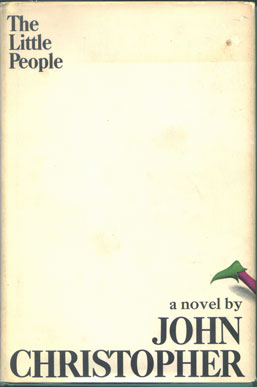
The Little People pictureI found two more John Christopher books at Pulp Fiction when I was in Vancouver, both first edition hardbacks for $7.95. Now that I think about it, that's actually a pretty good deal, when standard used paperbacks are going for $4.95 these days.
The Little People is from 196?, still part of Christopher's working period as an author but later into it. Though there is a slight deviation from form, it quite quickly assembles itself into a structure very similar to The Possessors, Sweeney's Island and the other books from this period. A group of flawed people (though in this case, there is only one englishmen; the rest are european, scottish and american) assemble together in a remote location and encounter weirdness. In this case, it is a remote Scottish castle, that a young, competent woman inherits. She decides to try and run it as an inn, emphasizing the remoteness.

The first half of the book describes the interesting collection of guests, the bitter and fighting american couple, their silent daughter, the guilt-ridden german husband and his jewish wife, the innkeeper's english fiancee who thinks her decision to run the inn is mad, the scottish hyper-catholic young lawyer who has a crush on the innkeeper. Christopher slowly lays out their back stories, while revealing small hints of weirdness in the lodge. Strange small things are sighted moving in the bog. Useful household items get stolen. The distant uncle who left her the place had spent most of his time locked in the now closed tower, where there was a collection of well-made dollhouses and small cages.

In the second half of the book, the little people are actually discovered, as is their history. I was a bit disappointed at first, because it all was revealed a bit quick. But I should have had some confidence in Christopher's ability to keep the reader guessing, as things get weird fast and suddenly it is very unclear who are the victims. As I've said, all of these psychological thrillers of John Christopher's have a similar setup. Where they differ is which aspect they fall on. Whereas in the Possessors, the fight for survival took primacy (the "thriller" aspect), here it is the effect the situation has on the people and their relationships that is emphasized (the "psychological" aspect).

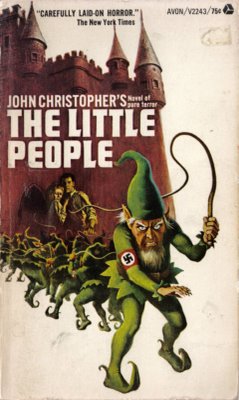
The cover above is the hardback I found. Quite elegant and probably better catches the actual mood of the book. But check out the wacky cover below. I saw it in this blog here and though it really does not represent the story, it is truly awesome.

The Little People picture

29. The Scorpio Letters by Victor Canning

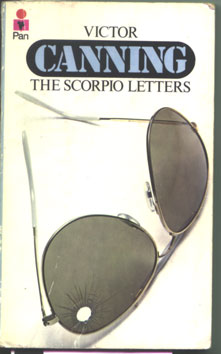
The Scorpio Letters pictureI found a great used bookstore in Vancouver (ABC books on W. Broadway near Granville, right by the bus stop). Whoever is buying books for this place knows their stuff. They had such a good and organized collection that I was drawn to some of the recommended or featured books. There was a stack of paperbacks by Victor Canning, that had cool looking covers, classic '70s and 80s British crime editions from houses like Pan. I grabbed the one with the bullet-holed aviator glasses on the cover and wasn't disappointed.

The Scorpio Letters starts out with a description of a well-dressed man in a richly decorated office in a villa somewhere on the coast of Italy. He is going through a series of files and writing a letter for each one. All the letters sealed and addressed, but then put into a single, larger envelope in which they are mailed to England. There, a working class Italian immigrant posts the letters. That middleman dies by accident with the letters still in his pocket. The police deliver the letters by hand to each of the recipients to find out what they can. Everyone denies they know anything about it and take the letters.

Enter our hero, a young, adventuresome British guy. Ruggedly handsome, good with his hands and with an independent streak, George Constantine is cut right out of the Desmond Bagley mold ("He was thirty, a big man, built like a full-back, sandy-haired with a sun-burnt, square, almost pugnacious face."). He is back in England, visiting his adoptive parents. It turns out his adoptive father is one of the letter recipients. He admits that he has been expertly blackmailed for over a decade, since a brief affair as a young man. He finally reveals this info because he believes the death of the letter-posting middleman means the end of the blackmail. Our hero suspects a more sophisticated operation and decides to follow up.

Trouble, of course, ensues. He meets an attractive young woman whose mother was also being blackmailed. The two of them bicker lightly, become attracted to each other and follow the trail of the letters through France to Italy.

Canning doesn't have the subtlety and depth of character that Gilbert can command, but the story is strong and moves forward well. He builds a cool criminal network and populates it with some interesting, realistic baddies. The hero relied on luck too many times to get out of deadly situations. I would have liked to have seen a bit more application of specific skill (which you do get with Bagley), but there is enough here that I'll definitely be checking out some more Victor Canning books. An excellent discovery.

Tuesday, July 29, 2008

28. To Marry Medusa by Theodore Sturgeon

To Marry Medusa pictureThe only other Theodore Sturgeon book I read, The Dreaming Jewels, I really enjoyed, so I keep an eye out for his other work. There is a lot out there, but it seems the bulk of his work was short stories and novellas. It's hard to find actual novels by him, but To Marry Medusa was one (though it's almost a novella).
It's the story of a loser alcoholic whose mind gets invaded by an alien collective entity. This isn't just a single species either, but a conglomerate of civilizations all of which have been absorbed by single initiating species. Their home world was destroyed and so they travelled through space looking for a new host. However, they exist in a single, collective form and can't conceive of separation, so when they take over the drunk's mind, they have a hard time figuring out how humans work.

As you read the above narrative, chapters are interspersed with a whole bunch of different stories of people all over the planet: a little girl who gets separated from her family, an emotionally disturbed vandal, a prim old maid, etc. None have anything directly to do with the main alien story, at least at first.

For the first half, I felt a bit removed, especially with all the different, unconnected storylines. But Sturgeon has a plan and when it all comes together, it's actually quite cool. This is a classic science fiction book in that it seems to have come from a single idea or question: what would happen if all of humanity were to be suddenly, psychically collectivized? The answer, in the context of an attempted alien takeover, that Sturgeon provides is entertaining and insightful. Worth the read.

Sunday, July 27, 2008

27. Darkly Dreaming Dexter by Jeff Lindsay

Darkly Dreaming Dexter picture
I'm really not a big fan of serial killers as a literary genre. The first few times it was okay, I guess, but they always risk the temptation of self-indulgent, titillating sexual sadism and they usually succumb to it. Even worse, though, is the power creep. In real life, serial killers are screwed-up losers who eventually get caught because they generally aren't that smart. In order to make a serial killer book last, you have to have one who is really hard to catch. Since the detective is usually someone who is super smart, you have to make a super smart serial killer. Eventually, you get into Jeffrey Deaver territory where the serial killer is the smartest guy in the world and a Casey Ryback level ex special forces guy. They are more badass than the goofiest Pierce Brosnan Bond villain. At that point, it's just stupid. Yet, for whatever reason, ever since the overrated Silence of the Lambs, the crime genre in print and in film is inundated with serial killers.

Despite my lack of interest in the sub-genre, I did give the first Dexter novel a try. I had watched the first season of the television series and had quite enjoyed the concept. If you're not familiar, Dexter is a sociopath who was trained by his adoptive cop father to satisfy his murderous urges by hunting and killing only criminals. It's a clever idea because you get the cool technique, but done by a good guy against other bad guys that you want to die. It's kind of a procedural vengeance situation. I didn't totally love the series because it didn't spend enough time on Dexter getting the baddies. Instead, there was a lot of unresolved soap opera stuff. It was decently done, but in this case, wasn't satisfying the potential that I had hoped for. The real deal-breaker for me (and the reason I didn't bother with season 2) was the portrayal of the female characters. They were to a woman shown to be constantly stupid and irrational, especially his sister.

So, anyways, back to the book at hand. It is original and entertaining. Dexter is haunted by a serial killer whose skill and artistry blows him away. He also has to help his sister improve her reputation on the force (even though she is stupid, shrill and has no sense of politics; she really shouldn't be promoted). I really wasn't too engaged in the story, because it lies heavily on the serial killer as artist angle, which is boring. And the portrayal of the sister was not much better than the show. However, Dexter himself is quite funny, in his ironic asides and his backstory is engaging. I think I would have gotten into it more if I hadn't seen the tv series, as then it would have been all new.

So in summary, an okay light read, but I wouldn't bother unless you are really into serial killers and want to see a new twist.

Saturday, July 19, 2008

26. Road to Ruin by Donald E. Westlake

Road to Ruin picture
Richard Stark is one of my all-time favourite authors. Stark is one of the many pseudonyms of Donald E. Westlake. As Westlake, his best known creation is probably the Dortmunder books, a series of comic crime capers starring a sad-sack heister and his crew, whose jobs always go hilariously wrong. At their worst, the Dortmunder novels are light fun with an old school New York twist. A few of them are near masterpieces of crime comedy (Drowned Hopes comes to mind). Road to Ruin falls closer to the former category.

The plot setup is a good one. A formerly powerful executive gets busted for ripping off his shareholders and is basically confined to his compound in rural New Jersey. He still has tons of money squirreled away in offshore bank accounts that the Feds can't get at, plus a massive collection of collectibles, including fancy cars. Because he is so hated (his case was a big media splash), he can't get anyone to work for him. Dortmunder and crew conspire to get hired by him in order to steal his cars. At the same time, two different groups (bilked angel investors and angry union members) are plotting to exact their revenge on the executive. The characters are funny and there is a lot of entertaining stuff going on. Unfortunately, it never comes to quite the head it could and instead of exploding in the glorious chaos that often characterizes the end of a Dortmunder book, it all kind of fizzles out. It's a quick and enjoyable read and Dortmunder fans will be happy to be back in his universe. But I'd recommend some of the earlier Dortmunder's if you are only going to read a few.

Thursday, July 17, 2008

25. Fear to Tread by Michael Gilbert

Fear to Tread pictureThis all started because I went to the library. I have an on-deck shelf that is threatening to fall of the edge of the chest of drawers it is on. There are a lot of good books there I want to read. I only went to the library to return Daughter Fair before my trip out west. But I decided to take a little browse down the english mystery and sci-fi shelves. And just couldn't help take out a few books, which will do nothing to bring down the width of my on-deck shelf.
One of those books was Fear to Tread by Michael Gilbert. I have read this book (and all of Gilbert's books) several times. But it hasn't been since college and I just thought I'd take a look, see how his prose held up. Reading the first couple paragraphs in the library was enough to suck me right back in. His solid prose, his subtle, pithy characterization, his profound love for the english character and lower-middle class London, his sensible conservatism, it was all there in the first few pages where he describes the protagonist, a principal of a large public (in the North American sense, as in state) school in a working class district of London.

Fear to Tread takes place in the early '50s, as Britain is recovering from the war. The principal, Mr. Wetherall, a stubborn and benevolent figure, stumbles, through a series of minor events, on a complex syndicate that is overseeing the stealing and redistribution of goods. Foodstuffs are still scarce and there is a thriving black market for coffee, meat, alchohol, cigarettes and other common but quality goods.

Quite early on, Wetherall, comes right up against real danger. I realize now, one of Gilbert's skills is the way he structures his book. A lot of subtle things happen, so that you don't really know what is going on, but you are intrigued. However, at the same time, he somehow lays out the situation quite cleary in the first few chapters. So from my description, it sounds quite straightforward, idealistic principal goes up against smuggling mob, but when you are reading it, there is so much other stuff going on that you don't really realize how straightforward the overall story is. That "other stuff" involves the many side characters, interesting locations and minor conflicts that might not have anything to do with the main plot. They are all so steeped in the richness of the milieu and the britishness of Gilbert's world, that they are just pleasing to read. Furthermore, he is also a master at the subtle, but totally satisfying resolution moment, where some nasty gossip or manipulative council member suddenly gets theirs.

I really can't do justice to Michael Gilbert's skill. He doesn't get much recognition in North America and I wouldn't be surprised if you don't hear about him much in Britain these days. But he is truly one of the greats. Check out any of his books. You won't be sorry.

Sunday, July 13, 2008

24. Daughter Fair by Peter Graaf (John Christopher)

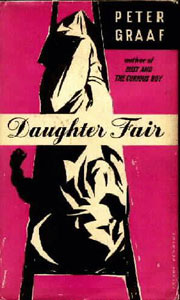
Daughter Fair pictureDug this one up at the National Archives of Quebec, through the Bibliotheque Nationale. They had it in their computer system and I had to order it. I wonder who was the last person to read it? John Christopher, whom you've read so much about here, wrote at least two detective novels under the Peter Graaf pseudonym. The detective is Joe Dust, an unlikely American living in London in the '50s. I think that's sort of the point here, to juxtapose the cliched, wisecracking American private dick against the more procedural, proper British context. It's an interesting experiment, at least in this novel, with mixed results.
In Daughter Fair, Dust is hired by a wealthy, eccentric to find his favorite, youngest daughter, who has disappeared from the estate while on sick leave from her private school in Paris. The estate itself is a viper's nest of aristocratic weirdos. The rich guy's other two daughters live (and are trapped) there with their two husbands, all dependent on the patriarch, forced to follow his rules and lacking the money and balls to leave.

The Joe Dust character is always wisecracking, to the point of being rude. It's just slightly off. If it had been written by an American at the time, I suspect the american character would have been a little more circumspect and less arrogant. Dust's behaviour reflects the British post-war insecurity towards America's growing success and power. Even weirder, about halfway through the novel, a British inspector shows up, one who has had a history with Dust. They get along fine, in the traditional begrudging relationship of the cop and P.I., but it is the inspector who really seems to figure everything out and do all the right stuff, whereas Dust just seems to hang around and get on everyone's nerves. Daughter Fair is almost like a passive-aggressive version of Conquest in California, where the American is placed as the hero, but ends up ultimately getting shown up by good old fashioned British police work.

The mystery itself was actually quite clever and I enjoyed it's unfolding. All the simpering, dissipated upper class characters were also well drawn out and deliciously contemptible. If there has been one theme throughout Christopher's wide range of books, it's a constant critique of the aristocracy.

Monday, July 07, 2008

23. 5:45 to Suburbia by Vin Packer

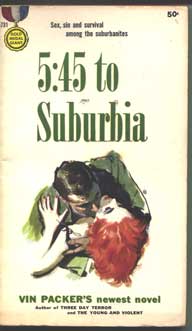
5:45 to Suburbia pictureI snagged this one in a box of super-cheap paperbacks at one of the larger used bookstores on Bloor street in Toronto (the one that is open quite late; the bookstore scene in Toronto is quite thriving, it seems). I got it mainly for the cover, which as you can see is quite awesome. The back cover blurb reminded me of a John D. MacDonald novel, without the violence. The lack of violence is usually a deal breaker for me in a book, but something about the set-up, with the guy commuting from the suburbs into the the city in the '50s called to me.

This book is what you'd call a "novel", you know, one of those books that isn't really about anything, where nothing actually happens, but they aren't classics by recognized names where you can at least pretend that there is some kind of "theme" to pull out of them, the kinds of books grown-ups used to read for reasons that were unfathomable to me at the time (the time being most of my life). My aunt flipped through it and aptly labelled it a "Harlequin romance for men".

The protagonist is the second-in-command of a magazine publishing house in New York. He was the right hand man to the president, but his position of power is threatened by an aggressive young newcomer who uses cheap psychology and modern methods in a bid to reshape the company and take power for himself. Another important character is an older, single, female executive (a "C-cup bitch" as the bad guy labels her) who had her day in the company but has now become an alchoholic and is in the upstart's sights as dead wood to be cleared away. She and the protagonist had also had a long-running affair.

That's the basic plot structure, but a lot of the book concentrates on the protagonist's emotional history, his humiliations in high school, his first love in college, the early years of his office affair, his relationship with the boss. It is actually a fairly thorough and believable portrait of a middle-aged, upstate New York, white guy in the '50s. The book overall was quite enjoyable. I got caught up in it and found the resolution very satisfying. The conclusion was a bit on the easy side, but done in an intricate and intelligent enough way that it wasn't until you got there that you realized it was all going to work out in a cool way. So I guess it was kind of a male Harlequin romance. I don't think I need many more of them, at least not with some good punching and shooting in between, but it kept me happily reading for a few days.

I also note that this book would have made a perfect storyline for the current hit TV series about '50s ad executives, Mad Men, an episode of which I happened to watch with the same wise aunt the week before.

Saturday, July 05, 2008

22. Scapa Ferry by Antony Bridges


The cover style and blurb "qoute" made me think this was going to be a WWII nautical adventure book, which it is, in a sense. But I thought it was going to be a fictional story about a single adventurous enterprise. It doesn't say it's a true story anywhere, but I'm pretty sure it's actually a real-life account. It's about a guy who loved sailing and wanted to join the navy, but because of a slightly bum leg, was not able to. Instead he set out, with his wife, to contribute however he could, which he found out was to set up a charter boat to ferry supplies back and forth across the Scarpa Firth, a treacherous piece of sea between the northern tip of Scotland and the Orkney Islands. The British were building a naval base there at the beginning part of the war (if you look at a map, you can see that the Orkneys are strategically very important) and getting supplies to keep the construction moving was difficult due to lack of resources, skilled manpower (everybody was being sent to fight) and lack of mobilization of existing local freight and fishing vessels.

So this guy and his wife buy a small sailboat, make their way up the coast (dangerous in itself), deal with the bureaucracy of the British government and military (even though they were trying to help, they keep getting stopped for not having the right paperwork) and set themselves up to take dynamite and blasting caps between Scranton Scrabster and Lynness and a few other points. It's really more of a chronicle.

What it really is, is some hardcore sailing porn. And because of that, I'm putting this one in the mail immediately to Jarrett, owner of the Redwing. I suspect this will keep his mast upright long into the night. For me, it was really tough going in the first half because I barely understood half of what was going on, there is so much specific vocabulary. There are of course tons of things on the boat that are named and not described. There are also actions of the boat and weather behaviours. I slowly picked up some stuff and there was enough characterization and funny human anecdotes along the way, that I stuck through. There also is a ton of geography, and I did have to take some google maps research breaks to figure out where they were, though there also were some cool little maps and diagrams in the book itself. By the second half, once they get established in Scranton, the story and struggles of their daily lives came to the forefront and I really got into it.

See, one of the things I love about these British adventure authors from the 60s and 70s is their attitude. It's that classic stiff-upper-lip, let's be sensible and not cause a big fuss but do what we have to do attitude that is so lacking in everything and everyone around me these days. Though not being a fictional adventure, this book is full of that attitude. At one point, early in the book, his wife loses the top of her left index finger in the middle of a harrowing attempt to untangle their anchor from another boat in a bad storm. She doesn't even mention it until they get out of the situation and then it's simply and quietly bandaged. Later, he mentions that he realizes it was quite lucky to only be her finger, that the whipping cable could have badly injured or even killed her. But there is no unnecessary histrionics or drama and his wife's stoicism only reminds him of what a good egg she is.

I struggled through the first half, but it ended being worth it. A very satisfying read which reinforced some of my own personal values.

Monday, June 30, 2008

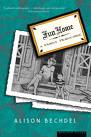
21. Fun Home by Alison Bechdel

Fun Home pictureMy sister strongly recommended this graphic novel to me and judging by the high-level accolades on the cover, she is not alone. This was the hot comic of the year and I completely missed it. It's the biography of a girl growing up in rural Pennsylvania in the 60sand 70s. Her father is gay and she figures out pretty quickly that she is too. Their relationship is complex and difficult. The book is structured in a very complex way as well, as Bechdel jumps back and forth in time, revealing different things here and there, going back to already revealed incidents and adding layers of understanding to them. It makes for a very fulfilling read because by the time you get to the end of it, you really get the "ah, yes" sensation where everything comes together in a rich and real way. The ending isn't necessarily happy. The family difficulties are not solved or absolved, but you as the reader get a sense of really understanding the situation, even being a part of it. This is why sometimes comics are better than books.
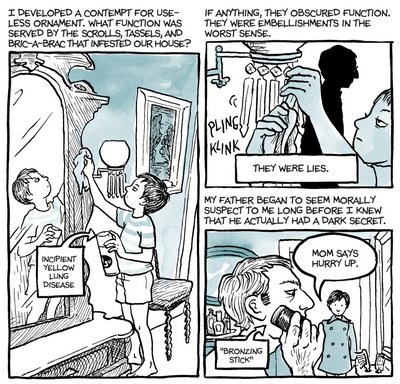
Despite my appreciation of the structure, the subject matter is not the most endearing to me. It's very academic and intellectual, with heavy references to Proust and Joyce. If you had studied them, I imagine the book would have even more depth, but I don't have so much time for that kind of literature of melancholy. The same goes for the struggles of the young lesbian, several of which I experienced first hand in liberal arts school (most whom lasted a few years before the inevitable defection to heterosexual marriage and procreation). In this case, the struggle seems genuine, but it just doesn't interest me all that much (compared to say something interesting and straight like one man trying to shoot or stab another man). But those are my personal preferences and should not detract in any way from what is a really engrossing and satisfying graphic novel.
Fun Home picture

Sunday, June 29, 2008

20. Trunk Music by Michael Connelly

Trunk Music picture
Grabbed this thick paperback for a loonie at the thrift store near our house. Michael Connolly delivers solid procedurals based on a career as a crime journalist in Los Angeles. He knows his stuff and spends most of the time on the crime and the investigation. This leads to lots of good interaction with a range of mostly dark and corrupted characters (in and out of the force) and excellent locales.

Here, Harry Bosch, the LAPD detective who is effective but generally in trouble with the brass investigates the murder of a succesful B-movie producer. He is found in the trunk of his Rolls with a single bullet hole in the back of his head. The trail is long and windy, passing the wife, his stripper girlfriend, the mob, the FBI and a few others. It's mostly solid and enjoyable. There is a section where Bosch hooks up with a past love that I found a bit forced and thus distracting, especially since her presence was used as a minor red herring. But it's a small part and the rest of the book chugs along. Perfect for a train ride to Toronto.

Wednesday, June 25, 2008

19. The Prestige by Christopher Priest

The Prestige picture

I am not a big fan of the unreliable narrative or whatever it's called. Christopher Priest writes such enjoyable prose (I might call it modern Victorian, or would that be post-modern?) and his stories so engaging that I excuse him. But it was tough reading this book, because I was constantly weighing my suspicions of the narrative against the very narratively solld (and clever) screenplay of the movie version of The Prestige. It's almost always tough following a movie with the book, but it was especially distracting for me in this case as there are some significant mysteries in the movie that are fully resolved. The story in the book has a lot of differences and I kept wondering whether Priest was going to resolve the mysteries in the book. I had this constant concern in the corner of my vision most of the time I was reading.

All that individual context aside, the story is a really cool one. It's the narrative of a career-long rivalry between two Victorian stage magicians, framed by their modern-day ancestors who stumble upon each other and try to solve the various mysteries their legacies left behind. The world of Victorian stage magic is so richly drawn and the pursuit of the two rivals careers so enjoyable that this part of the book is worth the read alone. The twists, tricks and mysteries Priest perpetrates on the reader (which are not anywhere near as open to interpretation as The Separation thus making The Prestige a much more satisfying read for unsophisticated empiricists like me) are extremely well-crafted (not unlike the stage props the magicians use) and move this book from good to great. Priest is a smart fucking guy and he does his work. I'd love to read about his technique because the structure of his books is so solid, from the whole down to the smallest detail. The Prestige could be annotated (not profusely; maybe a note or two every few pages). It would make for a very interesting read because you know that Priest hides little clues in the tiniest details. Sometimes they are facts in the narrative themselves. Other times, they are textual tricks in the grammar or use of certain words. These "annotables" do not get in the way of the narrative. They just add to the depth of the experience and the feeling that you are in the hands of a real craftsmen. I really enjoyed the movie, but you should definitely read the book first.

Monday, June 23, 2008

18. The Possessors by John Christopher

The Possessors Island picture

That's right, we're all John Christopher, all the time here at Olmansfifty. Actually and sadly, this is the last John Christopher book (at least in english) in the Bibliotheque Nationale. There is a mystery of his written under a pseudonym that is stored off-site and which I have ordered as well. I'll scour the tattered remains of the english library system in Montreal, but my initial searches were fruitless. He also hasn't shown up in used book stores here or Toronto. Even the tripod trilogy is not all that easy to find.

The Possessors is the story of a group of people snowed into a Swiss ski lodge in the early 60s, who are slowly taken over by an alien parasite. It starts off in a very similar way to Sweeney's Island, with a group of mostly British bourgeoisie. It looked like Christopher was going to savage them in a similar way and I was a bit concerned that we were heading into repetitive territory. Both The Possessors and Sweeney's Island were published within a year of each other. Happily, The Possessors veers away from such a similar theme of social critique (which was good in Sweeney's Island, good enough that I didn't need it a second time) and heads towards a straight-up alien invasion thriller. And it was a really good one. A nice balance of character-driven behaviour and general efficiency. People who made mistakes did so because it made sense based on who they were, not just because they were stupid. The stakes are high and the challenges higher, so you are sweating for the protagonists. And they figure out the general outline of the situation quickly enough without spending a lot of useless time not believing. Tight and gripping, The Possessors is a great little novel of alien invasion. Snag it if you find it.

Saturday, May 31, 2008

17. Sweeney's Island by John Christopher

Sweeney's Island pictureFrom the few biographical snippets I've read about John Christopher, he was a very prolific writer in the early part of his career. It really was a career for him and until the success of the Tripods trilogy, he had to write as much as possible. He cranked out several books a year, in several genres. He also never did any rewriting beyond the first chapter, supposedly. I don't know, his books read pretty well to me. Sweeney's Island is one of those, written in 1964. It's about a group of London bourgeois hangers-on of a very wealthy and connected guy named Sweeney. During one of his cocktail parties, Sweeney asks them to stay after where he proposes an impromptu trip on a new yacht he has just bought. He has clearly planned this very carefully, knowing that each of them either is dependent on his future generosity or is free enough to be able to just take off for a few weeks of ocean paradise.

However, it becomes apparent that Sweeney's plans are a little more elaborate than that when the ship ends up going into untrafficked routes far into the Pacific and then stops at an uninhabited tropical island far from any shipping lanes. Well, seemingly uninhabited. There are signs of previous habitation and even surprisingly organized agriculture. A constant cloud hangs over the islands larger two peaks, hiding it from view and there are other disturbing signs which I won't reveal.

The core of this book is about the people, the power and personality struggles that arise among them. Normally, I am not so interested in that path being emphasized but Christopher takes things to a pretty awesome extreme here. Shit gets really twisted. In some ways, this is very much like a Lord of the Flies with adults. Or more specifically, Lord of the Flies with british bourgeois adults from the mid-60s, a social group that Christopher rips to pieces in this book. Very satisfying.

I really enjoyed this book. The element of isolation and the social hierarchy reshaping itself once released from the strictures of authority and civilized society put this very much in the Post-Apocalyptic tradition, even though there isn't actually an apocalypse. Even if that genre isn't interesting to you, this is still a really entertaining and enjoyable book. It's turned up the intensity of my appreciation of John Christopher. I was at first only interested in checking out his PA books, but now I'm grabbing anything I can get my hands on.