Another find from the hospital haul, The Secret under my Skin hit upon several of my areas of interest: young adult dystopic fiction pre-Hunger Games written by a woman. I was not disappointed. On the contrary, this reinforced my belief that the 80 and 90s (and in this case as late as 2000) produced quite a few interesting works in this genre that are in many ways superior to today's boom of series (I have only read Hunger Games; the rest of this judgement is based on movie trailers so take that for what it's worth).
This book takes place in 2354 long after environmental degradation brought civilization down. Society is now in a semi-feudal state, governed (and dictated) by an authority called the Commission who uses the fear of technology and environmental dangers to maintain its control. The heroine is a young girl called Blay who starts out in a work camp where kids are forced to mine ancient dumps to find resources. We learn that she was orphaned at 2 during the "Technocaust" an event where the Commission and fearful citizens rounded up anybody who was using technology or rational knowledge and put them in concentration camps. Blay is chosen to be the assistant to the Bio-Indicator, a young person who is especially sensitive to radioactivity or pollution and now plays a ceremonial role in ensuring that places are not toxic. She is then brought into the household that is training the Bio-Indicator and from there discovers a new world of resistance as well as conflict with the spoiled, frightened Bio-Indicator.
The big difference between this period of YAPA and post Hunger Games is that the earlier books usually finish in a single book or two (the Tripods being the exception). That is good and bad. This book is a really great read and the world is revealed at just the right pacing up until the final act, when the narrative need to come to a conclusion quite quickly reveals the big picture as well as making major societal changes in a few pages. I am glad that it is a single book, but honestly, this could have very easily been turned into a trilogy or even a series*. It would have allowed much more depth and steadier, more involving pacing.
I can't really fault the author for what was most likely a publishing constraint. This book is still more nuanced and more moving than The Hunger Games and even Harry Potter. It doesn't need some excessive and simplistic bad individual, nor does it need histrionic individual rivalries. The characters are real and complex and the challenges of adolescence and the struggle of living without love and family are movingly and realistically portrayed. The geography and the local culture are compelling and mysterious (I think this is supposed to be somewhere in a real location in Ontario**) and the conflict between repressive ignorance and democratic knowledge are very relevant today. This was a really good book and I will be keeping it for my daughter.
*Addendum 1: there is a sequel: The Raintree Rebellion. Added to the list.
**Addendum: totally wrong about that, it's actually a place in Newfoundland!
Saturday, September 08, 2018
Saturday, September 01, 2018
19. Takeover Bid by Sarah Gainham
This was a decent, respectable novel that disappointed me because it didn't live up to the promise of its more suggestively sordid cover. It's not totally inaccurate as the basic plot involves a seductive, manipulative woman who sleeps her way into the bed of a powerful business leader. However, she is not counter-culture at all and ultimately the story is about the business leader and his deteriorating psychology, rather than her otherness destroying the establishment.
I did a bit of reading on Sarah Gainham who had an interesting and succesful career as a journalist in post-war Vienna and then as a novelist with Night Falls on the City being her huge hit. Her personal life was fairly rock and roll and sounds a lot like the girl in the novel (who loses agency but gains in sympathy as the book goes on).
The story is told from the point of view of the head of the Brussels office of a major American company trying to impose its machinery patents on the European market. This waif comes in as a junior typist (and the description of her look in the first few pages is amazingly well-written; read them below) and quickly seduces him right in the office. While he struggles with his guilt, desire and logistical complications (he is happily married), she moves on to the big boss, who is coming to town following rumours of erratic behaviours. Turns out this once all-powerful leader of men has fallen into a spiral of booze and pills. He is no match for the seductress.
The industrial politics machinations and the class anxieties around them that follow were quite entertaining for me. However, the book also veered more and more into bad psychological analysis of the chief and a poorly illustrated conflict between the protagonist's view and that of the other business leaders and doctors on what to do with him. It's unclear ultimately what is wrong with the chief as the author tries to add meaning to his addictive behaviours, meaning that falls short because we don't really know the character from before and because there is a ton of 60s psycho-babble nonsense. And the ending is just kind of a cop-out.
Here are the opening lines of the book:
That's good stuff!
I did a bit of reading on Sarah Gainham who had an interesting and succesful career as a journalist in post-war Vienna and then as a novelist with Night Falls on the City being her huge hit. Her personal life was fairly rock and roll and sounds a lot like the girl in the novel (who loses agency but gains in sympathy as the book goes on).
The story is told from the point of view of the head of the Brussels office of a major American company trying to impose its machinery patents on the European market. This waif comes in as a junior typist (and the description of her look in the first few pages is amazingly well-written; read them below) and quickly seduces him right in the office. While he struggles with his guilt, desire and logistical complications (he is happily married), she moves on to the big boss, who is coming to town following rumours of erratic behaviours. Turns out this once all-powerful leader of men has fallen into a spiral of booze and pills. He is no match for the seductress.
The industrial politics machinations and the class anxieties around them that follow were quite entertaining for me. However, the book also veered more and more into bad psychological analysis of the chief and a poorly illustrated conflict between the protagonist's view and that of the other business leaders and doctors on what to do with him. It's unclear ultimately what is wrong with the chief as the author tries to add meaning to his addictive behaviours, meaning that falls short because we don't really know the character from before and because there is a ton of 60s psycho-babble nonsense. And the ending is just kind of a cop-out.
Here are the opening lines of the book:
She was a thin, narrow girl who stuck her feet and legs out at odd angles from her skimpy, washed out, straight dress. This was very much in the style that soon became fashionable and it was, as I only afterwards realized, very much part of her talent that she incorporated this by no mean unimportant part of the Zeitgeist-that is, the appearance of women--before it was quit obvious as a trend. The thing was to be emaciatedly thin, flat, exiguous in outline, untidy. In expression vacant, lost and melancholy, like a small girl dressed up in her brother's clothes which she has a little outgrown, making passes at her uncles without knowing-- but very much wanting to find out--what in fact she is doing.
That's good stuff!
Monday, August 27, 2018
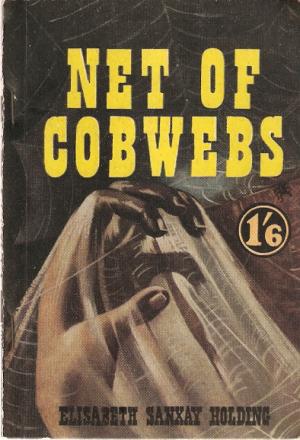
18. Net of Cobwebs by Elizabeth Sanxsay Holding
This is the second Elizabeth Sanxsay Holding I've read, from the two-book volume put out by Stark House and written later in her career, 1945, than The Death Wish (1934). It's the story of a young man, Malcolm Drake, living with his upper class family while recovering from shell shock due to his time in the navy during the war. He is already all up in his head and addicted to pills, interacting in a paranoid way with his aunt, sister, brother and his borther's wife. Again, it has that weird disassociated perspective that I found in The Death Wish that kind of distances me from the material, though in this case it fits better as the character himself is struggling mentally. I won't get into the plot here beyond that his Aunt dies and then other people die and except that he is the viewpoint of the book it is entirely possible that Drake himself is the killer.
This is solid, disturbing and entertaining. I will keep looking for her books. None of the covers below are the one I have, but I like to imagine the time when you could easily see this book in a bookstore and one of her novels was sort of mainstream and well-respected.
Sunday, August 19, 2018
17. The Postman by David Brin
The Postman has been on my post-apocalyptic to read list for a long time. I never made a strong effort to find it because I knew it is not that hard to find. I finally pulled the trigger at a nice used bookstore in downtown Nanaimo. I had often wondered why it never seemed to get much recognition among the PA classics. I suspect that part of it is that it came out in 1985, a bit later than when the sub-genre was really peaking and also that the name evokes the much-panned movie. Having read the book, and especially having got to the end, I can also understand why it doesn't have a bigger footprint. I'll get to that in the review.
It starts out in the way that I love for PA fiction. Lone survivor in a crappy situation that just got way worse, with little tidbits of the current situation and how we got here. Rather than a single major disaster, the downfall is the result of many things, including limited nuclear war that caused economic breakdown which led to social breakdown. The sub-theme of the disaster (and the book) was that the real collapse was the result of far right extremist survivalists, whose aggression and worldview brought down the remaining pockets of civilization and governance that could have led to re-building civilization.
So our hero gets caught at the foot of the Rockies by a small gang of bandits. He escapes with his life but most of his precious equipment. He hides out in an abandoned vehicle that contains the skeleton of postman, with his uniform and bag of mail preserved. He takes the clothes and equipment because it is useful, but in another pinch, lies about who he is to be allowed into a stockaded town. The surprisingly positive reception to his lie that he is an official representative of a provisional surviving US government operating out of Minnesota leads him to continue the lie which leads him to a role of travelling from town to town in the Pacific Northwest delivering mail and setting up a new mail service in each town.
This part of the book is really cool. I know some of this region okay and Brin's conversion of it to this recovering and surviving future is convincing and fun to read. There is a lot of variety in how different communities survive as well as tantalizing hints of larger regional conflicts, particularly in the south.
Unfortunately, the ending, when these regional conflicts come to the fore as the survivalists make a push from the south and the sub-theme that these assholes are the real problem in the first place also comes to the fore. It's fascinating and prescient to see how Brin portrays these people in 1985 seen through the lens of 2018 where they have coalesced under the Alt-Right banner and really do present a threat to the American empire. However, in terms of enjoyable fiction, this is reified into an epic battle between what was initially two side characters and it all very much took me out of the world and the story. There is also a ton of preaching in these last pages and it became a real slog. It feels like what happened here is that Brin couldn't figure out a way to finish the story he started in a structurally acceptable way (in terms of how we expect fiction to work). I get that because really it's a story that can't and shouldn't end, not unlike the Walking Dead. Also, there may be some liberal preaching coming from Brin. Either way, I just got really disconnected.
I would say if you are a fan of the genre, this is definitely worth a read. Just be prepared that the pleasure of the first two-thirds may not last for you.
I also thought I should watch the movie after reading the book, but now I am even more hesitant than ever. The hero does a lot of acting and emoting (before he takes on the postman role, he survived by telling tales and doing one-man plays). I really struggle to see Kevin Costner doing this stuff in a way that would not be almost painfully cringeworthy.
Sunday, August 12, 2018
16. Change Agent by Daniel Suarez
Also found this in the same communal bookshelf at the Vancouver apartment. There is a lot of mainstream junk in there and older semi-academic stuff, but almost always several readable books and even a good find from time to time. This one falls under "readable". I resisted at first, having finished Suarez' Daemon on the same trip. Again, easy digestibility tipped the scales and I jumped right in.
Change Agent was published 11 years after Daemon and it does seem that Suarez skill as a writer has evolved and improved. This one has the same fun energy and nerdy tech info, but unlike Daemon, it is structurally more sound and the overall resolution of the novel more satisfying.
The novel takes place in the future where genetic engineering has become mainstream, fundamentally altering the world. Other than the changes to society (which are richly and interestingly portrayed), Change Agent portrays the biggest change as economic. Silicon Valley gets caught napping and China and Southeast Asia takes the lead in this technology, which wipes out traditional silicon technology and creates massive unemployment and migration from the west.
The protagonist is an analyst for the US security agency responsible for policing genetic engineering. There are a list of allowed pre-birth changes and striving parents and criminal organizations trade on a black market the illegal manipulations that will give their children the advantages needed to maintain their economic status. On the trail of a black market genetics kingpin, our hero gets attacked early on in the book and wakes up in the hospital to find that he has genetically become this kingpin, at least physically. His brain and personality remains his, but nobody believes him. Forced to escape, he goes on the run to try and figure out what happened to him, why and what he can do about it.
It's a great premise and the adventure that follows is a really cool journey through biopunk Southeast Asia. Many of the themes are super contemporary to us today (economic anxiety in the west, fake news, return to aristocratic relations between the rich and poor) and I suspect may seem dated even 5 years from now. Nevertheless the portrayal of the massive refugee camps, the working poor and the new elites in the steaming jungles and dense cities of Thailand and Malaysia are really cool. The technology as well and its evolution/development during the book is creative and will stimulate your nerd world-building synapses.
There is one big flaw that also exists in Daemon and it's again these super smart FBI agents who form an opinion about the situation that is harmful to the protagonist (and necessary to the plot) and just become utterly dogmatic and small-minded. It is again not realistic and kind of weakens the reader's willing suspension of disbelief. I just can't believe that anybody at this point, especially specialists in the field of a certain technology, would not be able to entertain the idea that the technology has moved beyond their previous conception of it.
Still, a really enjoyable tech sci-fi thriller. Check it out.
Thursday, August 09, 2018
15. Where'd you Go Bernadette? by Maria Semple
It is rare for me to read a contemporary trade paperback but this one was strongly recommended by my aunt (and previously by her daughter-in-law). I like books that get passed around the family and my aunt has very good taste, plus it looked very easy to consume, so I took it on.
It is about an eccentric family in bourgeois Seattle and in particular the mother, a once-powerful architect in LA now sort of hiding in the world of schools, neighbourly conflicts and parenting. The book is structured as a series of letters, diary excerpts and other actual textual material (I am sure there is some term for this). It is quite cleverly done and very fun to read especially in the early part of the book which deals with school and parental politics at the elite but progressive private school the daughter attends as well as conflicts about overgrown blackberry bushes invading the neighbour's property. These are truly contemporary issues for upper middle-class urban elite white people in the 21st century and it also told with a rye and amusing distance that I found very entertaining.
The main drive of the narrative is that the mom is slowly getting unhinged and behaving more and more erraticly. Her extreme behaviours and conflicts with other parents (plus a misunderstandings and things getting blown out of proportions due to the husband and wife not communicating) get to the point that the father decides on an intervention and possibly to have the wife committed. She disappears. The storyline drives away from the petty squabbles into the wife's past and into her and her daughter's relationship. It ends up being very literary fiction. In this case, it could have been satisfying (and I did like the independence of the daughter and mother from society's norms and the way in which the dad character is shown to be totally lame), however a lot of the plot tension orbits entirely around a missed letter, which weakened it all for me. The idiosnyncracies of the mother which reach alarming levels in the first half, are ultimately deflated as her disappearance all gets washed away in a big misunderstanding.
Wednesday, August 08, 2018
14. Rat Race by Dick Francis
Back in my teens, Dick Francis was a staple. We had tons of them lying around the house and they could be found in any hotel lobby or waiting room in the western world in those days. There were several of the older paperback versions in the basement communal bookshelf of an apartment we were staying at and knowing I needed something easily digestible to keep my reading pace going, I grabbed this one. Interestingly, when I went to return it, somebody had taken all the original Pan copies and left any of the more recent versions. I guess there may be another collector lurking in that building.
Not much to say here about this book that hasn't been said before about Dick Francis's books. He was the biggest mystery author of his time but I wonder how long his literary legacy will last. Rat Race has all the classic elements, lone male hero of good heart and skill but bearing a guilty burden even though he didn't actually do anything wrong (so much shame in England at that time). Good, solid tension and intrigue with nasty bad guys and often realistically unsensational crimes. The one new thing I observed at this age is how detailed and technical the stuff about flying and air communications is in the book. I did a bit of research and of course it turns out this was all his wife's work, who herself was a pilot as well as the researcher for all his books. He later basically came out and said that he goes by the name Richard in real life and that Dick Francis was really he and his wife. I think there is a book here about so many succesful genre authors who when you dig a little deeper could only have been succesful because of their marriage to a woman who worked as hard if not harder and was also a crack writer. Try to find me one of these dudes who didn't have such a wife.
Wednesday, August 01, 2018
13. Daemon by Daniel Suarez
Meezly had been encouraging me to read this one for a while and the only reason it stayed on my on-deck shelf for so long was because it was a really good condition first edition hardback. I took it on vacation and only read it when indoors so it made it back unscathed.
Daemon is a really entertaining tech thriller that is over the top but still close to being plausible. Near the end, it bogs down a bit in excessive emphasis on inventive hardware and videogamey action. The story is basically Ready Player One except the dead tech genius is totally malevolent, which is a great concept. He's an Elon Musk/Jeff Bezos type character who sets up redundant, autonomous daemons all over the internet to make the world the way he wants it to be after his death. Significant mayhem and society changing trouble ensues. The worldbuilding/though exercise is really well done. Some of his IT jargon is laughable (he comes from the industry and gets the big picture, but I question how much work he actually did in the trenches as some of his low-level details sound like he copy and pasted them from bad documentation), but the overall idea of a world controlled via a ghost in the internet is quite compelling and rich and honestly a bit frightening.
The other flaw in the book is that some of his characters believe things they are told immediately and react to them with complete conviction even though these are otherwise skeptical tech people and/or law enforcement. The protagonist is messily framed and everybody just hates him all of a sudden. That was a bit difficult to maintain my suspension of disbelief.
Still, a really fun read and a darker anodyne to Ready Player One's simplistic optimism of the individual.
Wednesday, July 25, 2018
12. Jack Carter and the Law by Ted Lewis
![]() |
| Boring cover, too |
I haven't read the first book, but I really want to now. The Carter here is very much like Michael Caine's Carter in the movie, tough and independent. We follow him around 60s criminal London to nightclubs, apartments, backroom card games, shady retail establishments. The milieu and the poetic snakey way we explore it with Carter makes for some very satisfying reading. The criminals and the crimes they commit are also very entertaining. I thoroughly enjoyed this.
Tuesday, June 19, 2018
11. The Gingerbread House by Maeva Park Dobner
![]() |
| That house is looming! |
The beginning of the book was really engaging and I was quite psyched. The portrayal of the various families on the block was rich and intriguing. Sara exploring the house, making friends with the cook and starting to just notice some curious things really drew me in. Unfortunately, the sense of menace and mystery is popped early on as two children are kidnapped at Halloween, having last been seen going into the Bufords.
I was a bit bummed at this point, but the narrative moved into more straight-up adventure mode with Sara in a serious pickle and it was done well enough that I got back into it. Some of the plot was a bit flimsy, with people several times finding complex inner reasons why not to call the police when they saw something suspicious. But the bad guy was really well portrayed and there is a light dusting of the supernatural and spiritual that made it fun. It was a definite page-turner to the end for me.
Thursday, May 31, 2018
10. The Best People by Helen Van Slyke
I couldn't resist picking up this book with that amazing cover. And subject matter intrigued me greatly, a story of an exclusive Park Avenue cooperative. I thought it was going to be about people trying to get into a snooty apartment and it was, but not quite how I thought. It's more of a Mad Men vs. housing discrimination when an advertising firm tries to woo a crucial client, a Jewish shoe magnate, by attempting to secure an apartment in this super waspy building.
I love books that describe an enclosed milieu and this one did a solid job of portraying the history of the building, its current residents and the dynamics of the all-important board. You get a strong sense of its clean quiet hallways and explicit description of the many rooms and dimensions. The disappointment for me is that the protagonists, a super waspy but progressive couple, totally luck into the sick apartment. Their struggle is to get the apartment for the client and they risk alienating their neighbours, but they already got the place and ultimately do not seem all that threatened. The book's conclusion, which hinted at some colour with the exiled Austrian noblewoman who harboured a dark secret, ultimately falls back on safe drama. Overall an enjoyable read. I think this one is going on the shelf for its style alone.
Tuesday, May 15, 2018
9. The Valley of the Dolls by Jacqueline Susann
One more decent find from my hospital bookstore discovery. I am really glad I read this. At parts, it dragged a bit for me but overall was really entertaining and a great historical read. The impact of this book has faded somewhat today, but it broke all records when it came out and still pretty high up there on the best seller list with 31 million copies. I imagine that in the 60s if you were on the subway, everybody would be reading a copy. People today act like Mad Men was some deep revelatory exploration into show business and advertising in the early 60s but they were all talking about the same shit back then and Valley of the Dolls can really be considered the ur-text for that period. It is at once commenting on the time but also very much of it.
Sorry I'm rambling because most info about the book, its history, impact and analysis are very much available online. It's the story of three young women coming to New York and becoming stars. The dolls are what they name the various pills they all get hooked on to one degree or another. They are a central element, but more like a background to the stronger narrative about their love lives, their struggles to succeed and ultimately how shitty men are. Punches are not pulled for women either but wow this book is cynical. I think ultimately what made me appreciate this book was how dark and hard it was. Even the main love narrative with the character who is the most solid and makes it to the end mostly unscathed is slowly revealed to be a complete disaster and the man a monster.
I'm psyched for the movie now.
Tuesday, April 24, 2018
8. The Way to Dusty Death by Alistair Maclean
![]() |
| I found the worst cover ever for this book |
I have avoided Maclean's books simply because they were too popular. This is not just elitist snobbery on my part (though that is a factor), but generally massive mainstream sellers in any genre tend to be the most dumbed down of that genre with bad writing (cough cough Kathy Reichs cough Jeffrey Deaver cough and on and on). What surprised me about this book was how shoddy it all was. I don't know what period of his career it took place or what was going on then, but this book feels like it was cranked out overnight and not edited at all. There is just a lot of really awkward language and scenes where you actually can't quite tell what is going on. The plot is also badly constructed and when the reveal happens, it's super lame and not thoroughly explained. Despite all that, the initial setup is quite gripping and there is some minor masculine heroic behaviour that is satisfying (although the protagonist is a total machine and fundamentally superior to everyone around so that there is little suspense once you figure that out).
The story starts out in medias res with the flaming wreckage of an ugly Grand Prix crash. The protagonist is the best driver who was thrown from his car and watches in a daze the burning body of the guy he just knocked off the road. We learn quickly that his brother died a month ago and that he has become reckless and may even be drinking (this is a big deal in Gran Prix driving, I guess). The first chapter portrays him as a total wreck, but there are weird little tells, such as him washing his mouth out with whiskey in his hotel room later then spitting it out. Soon after, he is seen spying on the team owner and the mechanic while they check out his car and you realize that there is a greater game afoot. (This scene is one where I didn't even realize he was supposed to be hiding at first because of the weird way it was written so though the other two characters knew he was in the room.) This part is cool and you definitely want to find out what's going on.
If you have read my reviews, you know my taste and that I am very patient with certain kinds of clichés and silliness in men's action fiction. Look, I get chills watching the trailer for The Equalizer 2. I'm an easy mark. I gotta say, I was really not impressed with Maclean with this book. Desmond Bagley crushes him. Yes, he has a similarily macho simplicity, but his characters make sense and they get really challenged, plus he writes well, clearly with punch. Maybe this was on the lower end of Maclean's massive output. They are easy to read, so I will give him another try.
Monday, April 16, 2018
7. Hit List by Lawrence Block
I had actually read Hit List many years (decades, actually) ago as well as its predecessor Hit Man. That was back when we were way into Richard Stark/Donald Westlake and one of my fellow Stark fans discovered the Keller books. Block was a close friend of Westlake. They played in a regular poker group and discussed and shared writing ideas. You can see it in the style of Hit List, though very hard to tell how much of that is just that both of them were deep New Yorkers from that time period. Much of Hit List's style comes from the very New York City quirks of Keller. I'm rambling but my point here is that there may be a tendency to feel that Hit List derives a bit from Westlake's Dortmunder/Parker novels but given that I haven't read anything else by Block, I suspect that is not fair and that Westlake probably was influenced just as much by Block's style. Block may have actually been a better seller than Westlake in his lifetime.
Keller is a professional hit man who behaves and thinks about his job the way a garbageman or accountant might think about his. He is concerned about doing his job correctly and some elements of it are unpleasant but there are various ways to deal with them to help you get by. He has a broker/boss named Dot who lives upstate and finds him jobs. Hit List begins like a series of short stories, with each assignment being a story. As it moves forward, we begin to see longer narrative arcs: his relationship with Dot, his relationship with a few civilians and the possibility of another hitman who is eliminating other hit men to limit the competition. There is also underneath it a very slight shadow of Keller struggling with his conscience, especially when Dot pressures him to eliminate any "loose ends" which may include a woman he had been seing.
It's all very banal and normalized. Keller collects stamps. He frets about taking first class and enjoys local cuisine. Each assignment has an interesting wrinkle, some of which are quite enjoyable to read in a dark way.
I suspect that part of the charm of Hit List is lost today, when assassination and killing have been portrayed in such over-the-top cartoony ways in popular media. When Hit List was published in 2000, we still didn't have headshot ballets like John Wick 2. Despite its impact being somewhat lessened, I would classify the two Keller books as a must-read for anybody interested in the hit man genre and an enjoyable read for fans of crime in general.
Tuesday, March 20, 2018
6. The President's Plane is Missing by Robert J. Serling
I had to go the emergency room because of a "mallet finger" I got playing basketball. It was an extremely negative experience except that I discovered the Montreal General has a book shop in the lobby. It's called the Book Nook and was filled with paperback and hardcover anglo fiction from the 60s, 70s and 80s. It was quite exciting but because of the terrible emergency room service, I couldn't check it out despite being stuck at the hospital for 8 hours (you can't leave the room or you'll miss your appointment that you have no idea when will come). However, I did have a follow-up appointment with the doctor at the hospital and I made it a point to come in early to look for books.
Well the haul wasn't mind-blowing but it was still a good vein with potential for the future. The most exciting find was a first American edition hardcover of Jack Carter and the Law by Ted Lewis (the U.S title for Jack Carter's Law), the prequel to Get Carter. Very psyched about that find.
The President's Plane is Missing has about the most boring cover ever (although I do like the fading letters). The story itself is not boring, but the cover does represent well its straightness. This is a very mainstream (for the time) political thriller. Despite it being slightly vanilla, it is actually quite a gripping and suspenseful story and I stayed up an hour past my bedtime to finish it. It has a cast of characters most of which are focused around a small newswire bureau in Washington. The president is like the best president ever, but he is tired. He is embarking on a much needed week long vacation where he has made special requests to not be disturbed. This extends to his time on Air Force One, where he makes plans to spend the flight reading in the back room. The flight takes off fine and once in the air is flying smoothly. Ground Control calls to tell them that there is a storm ahead of them. The pilot requests permission to fly above it and permission is granted. Shortly after, the plane simply disappears from the radar.
The rest of the book is about trying to figure out what happened, while following the political repercussions. The weak and henpecked vice-president is the protagonist in this storyline. His character is unrealistically insecure and you know he is going to cause trouble in some way or other. I won't say anything more because it honestly was quite gripping the story behind everything is solid and well thought-out.
Ah cool, I see they made a TV movie out of this! And it got some decent reviews. To the internet!
Monday, March 05, 2018
5. Paper Money by Ken Follet
Picked up this workmanlike paperback in decent condition at Chainon. It's Ken Follett's first book and was originally published under another name (and didn't sell very well). I found it to be quite enjoyable and fun to read. The milieu is the highs and lows of wealthy financiers and cockney hoodlums in London in the 70s, with the reporters of a daily newspaper in between. Several storylines including a financial deal, a heist, policy announcements, blackmail and so on quickly and efficiently converge together by the end. The portrayal of the milieu and the characters, especially the villians (term used in the book by the villains themselves) is rich. It came at a good time as I am once again struggling to read steadily.
Tuesday, February 27, 2018
4. Fool's Puzzle by Earlene Fowler
Picked this up at Chainon just because it is getting so hard to find paperbacks that I can actually carry around with me. I was hoping for a decent mystery from the 90s along the lines of Sue Grafton and that's what I got. It's a bit more weighted towards long-term narratives and romance than I had wanted, but was overall quite decent. It all takes place in a central california town that was once very rural but slowly being transformed by LA money. The heroine is recently widowed and works at the local art center. There really is nothing about her situation that would lead to investigating, except her own dogged personality. When she discovers one of the artist's body just after seeing her irresponsible niece flee the scene, she gets involved. The temporary police of chief is always on her ass for getting in the investigation but of course that tension hides an underlying spark between them...
I see now that this is the first book in a long series and though Benni Harper is the name on the series, I suspect the appeal is as much about all the other characters in the town, who are richly portrayed. I could see how people could get into this but it's not enough of my style to continue it.
One interesting thing is the sexual politics. They have changed a lot even from 1994, or at least my perception of them has. I believe that Fowler intended to portray the budding romance between the chief and Benni Harper as an appealling love connection. It just rings really odd today. The chief is a total dick at first, always yelling at her and just really not nice or respectful. I think that part was a bit of a trope where the gruff guy and pissed-off lady actually have lots of sexual tension. Okay, but he still was really quite jerky. But the real weird thing was how he crossed tons of borders that I don't think would be considered at all romantic today. He puts her in jail. He grabs her and kisses her. He stays overnight at her house twice against her will and takes her car keys away. He braids her hair against her will (he is of course an expert french braider because he had 3 younger sisters). At the end, when they decide to start a relationship, it just feels not really well-earned on his part. It's like just by dint of being super aggressive all the time, she decides he is worthy of being her first love since her husband died 9 months ago (!).
I do like these paperbacks from the 90s that I can just beat to hell and not have to worry about preserving.
Saturday, January 20, 2018
3. Branded Woman by Wade Miller
Holy shit, I had already read this book and completely forgot. Yikes. I am losing it for real now. Interesting that my read in 2009 was much more enthusiastic than in 2018. I did enjoy it, but it lacked the intensity of The Big Guy and tended to meander.
Here is my original review.
Wednesday, January 17, 2018
2. The Death Wish by Elizabeth Sanxay Holding
![]() |
| I would cross some serious moral lines to get my hands on this copy |
Here is a much better review and appreciation of Holding.
I was not disappointed. It was not entirely what I expected, though what I expected is hard to say as I tried to keep an open mind. The story takes place in a small wealthy town somewhere in the Northeast, limited to a very small group of neighbours: a super wealthy family, a wealthy but striving couple of whom the jealous older wife holds all the money and a bohemian couple. A young friend of the wealthy family comes to stay and starts to have an affair with the artist husband of the bohemian couple, who is painted very clearly as a self-indulgent lazy ass. His wife drowns. Trouble ensues.
The protagonist/investigator is a unique character. He is the young, attractive, athletic and independently wealthy nephew of the rich couple who has come for a weekend visit. He is almost Randian in his self-awareness (though not in a dickish way). He prides himself on a kind of Platonic approach to life where he asks questions and trusts his own judgement. It feels very proxy-ish and I kept wondering how much Holding was project her own fantasies on this very masculine character.
She is similar to Millar in her unsparing look at her characters without being as mean as Highsmith (you can see where my unconscious expectations seep in when reading a new female thriller writer). She seems to really like all the characters and kind of feel sorry for them. There are some strange notions of love and romance here, particularly in the way the nephew seems to idealize the young women who comes off as a complete nightmare. There is also a very good twist that I suspected was coming but it caught me off guard.
I really enjoyed this book and it left me with many questions about Holding and her work. I will be reading more in the hope for enjoyment and answers.
Thursday, January 04, 2018
1. The Eskimo Solution by Pascal Garnier
A quick and mindless little read that didn't start the new year off with the bang. Garnier has a nice writing style and I can see how the reserve and distance could suggest comparisons with Simenon. I find there is too much disdain here. Simenon is bleak but he doesn't seem to necessarily dislike his characters. Here, there is a lot of self-loathing and loathing in general and it ended up not going anywhere interesting for me.
The base story is of a french writer at a beach house in Normandy writing his novel and being decadent. This narrative alternates with the actual story he is writing, which is about another decadent single french male who kills his parents to get their inheritance and then starts doing it for his friends (sans consultation). It's a neat base idea, but it's all done very breezily and off the cuff, so you don't feel much connection for anybody. I'd give him another shot, as I'm not sure The Eskimo Solution is truly indicative of the range of his work.
Subscribe to:
Posts (Atom)