
Philip Atlee's Joe Gall series is quite well respected by fans of manly spy and crime fiction from the '60s and '70s. I read The Canadian Bomber Contract, which I took a little less seriously as the anachronisms and cultural assumptions hit a bit closer to home for me (it took place in Montreal). It was also later in the series and I think was getting a bit more over the top. Also, The Green Wound was recommended as one of the better in the series. For whatever reason, I approached this one a bit more seriously.
Atlee is a good writer with some great turns of phrase. He uses some colloquial language of the time but it rarely becomes so pervasive that it is annoying. Rather it fits in with the rest of his style and gives the book a slightly poetic prose that can be quite entertaining to read. He also has some great locations and situations. Here, the bulk of the book takes place in a small southern town that is basically under the control of one man and fairly stable. No problems really, but another plot thread leads the CIA to send Gall here to check some suspicious stuff out and he undercovers a plot to overthrow the power structure by secretly enfranchising the black population and voting in black leaders. A pretty neat idea and the way it goes down is quite cool. Of course, the actual power behind this move is not some civil rights organization, but an evil external force that wants to bring down the U.S. and this is just the beginning of a larger campaign of destabilization.
The problem with this book, though, is that the main plot, which I just described only makes up about 60% of the book. There is all this complex and unnecessary cruft of Joe Gall's past and the machinations of the intelligence organizations in the government and Washington and it's all very roundabout so you have no idea of where the book is going until about two-thirds of the way in. And then when you do have a better picture of what the main story is, the situation in the town is suddenly broadened into a much bigger conspiracy involving white slavery and the caribbean islands and the reader is jumping from place to place chasing after the big baddie. It all felt a bit disjointed and unsatisfying. I think maybe that readers of the time, especially ones who followed Gall in a series enjoyed that kind of stuff, but it was just distracting to me. I would have much preferred it focus on the story in the town and the local politics. The description of the black side of town and the way the power structures were laid out and the riot that followed the election were all really top-notch. Atlee has it in him, he just didn't seem to be motivated to focus his skills into a single superior story. But that may have been a factor of what the audience wanted at the time.
Not a terrible book by any means and if I were stuck in an airport or some remote hotel I could do a lot worse than have a Philip Atlee book at hand.

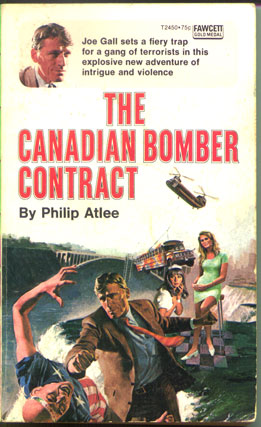 I found this little gem at Nerman's in Winnipeg. It was in the Action section (the existence of which gives me hope for the world) among a bunch of other Philip Atlee books featuring Joe Gall. I was only aware of them because Lantzvillager had asked me to find a specific one (The Green Wound Contract, which I later did find, but in the Vintage section and under the title The Green Wound). All the covers looked interesting, but I picked this one because of the Canadian content. Hell, the inner blurb reads "


 Posts
Posts


