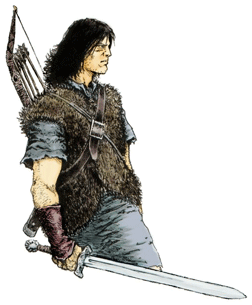
 Thorgal is one of the most popular bande-dessinée comics in France. I had seen references to it and the albums several times, but I was wary of it and only started reading it in a roundabout way. I had read two other series by the same author (those reviews will come later) and really enjoyed them. But I saw Thorgal as a poor European rip-off of Conan. He has long black hair, is generally shirtless and is in a fantastic semi-medieval setting (though actually it's more of the Viking period). It also has a similar black and white style to many of the Savage Sword artists.
The similarities are valid and the French are quite familiar with the comic world of Conan the Barbarian, but thinking of it as a weaker version was profoundly wrong. Thorgal rocks! This is a fantastic book. The first book I got was the Intégrale 1 (intégrales are what they call collections of the albums) that contained the first four albums. What first grabbed me was that the story had some really wild space/fantasy elements, but delivered with some gravity and expressing interesting themes and thus keeping it from being too far out.
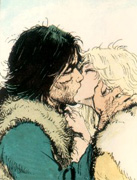
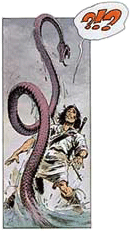 It's about a young man, a member of a tough viking tribe, but not actually of them. Though he is one of their best warriors, he is treated as an outsider because he was found on the beach as a baby. His origin is a fundamental part of the overall story arc of the series and as we learn more about it as we follow him through his adventurers. He falls in love with Aaricia, a daughter of the tribe's king (and this, of course, does not work out easily) and most of the book is about him and her trying to live peacefully away from the violence and machinations of man. It's a great theme and the love between them is really compelling, because, as you can well imagine, he is consantly getting drawn into shit and separated from his wife. Or she is taken from him, or their son is taken and they both have to go kick some ass. Along the way, Van Hamme and Rosinski create a great cast of secondary characters as well as amazing worlds of wondrous fantasy. Thorgal travels to underground dwarf tunnels, other dimensions, lost islands, aztec kingdoms ruled by space gods, nowhere (the land between heaven and earth) and I've only read 17 of 28 albums!
 One of my quebecois friends and I were discussing comics and I told him I was reading Thorgal. He said, with great enthusiasm "des belles histoires, des belles histoires." And it's true, at the level of each album, which in most cases is a self-contained story and at the greater level of the overall series, these stories are tight and engaging, always fundamentally connected to the themes and the characters. I have yet to find a moment that was a little lame, a little inconsistent.
 And Thorgal is full of great ass-kicking moments. Later in the series, Thorgal makes friends with Pied d'Arbre (Foot of Wood, or I guess, Pegleg) a one-legged weapon-maker. He fashions a powerful bow, with two curves that can only be pulled back by an exceptionally strong person. Pretty standard stuff for a fantasy book, really. But when it gets exploited it's just one of those "Hell yeah!" moments. A bunch of bad vikings have done all kinds of bad stuff to Thorgal and his wife. Five of them are pursuing a wounded Thorgal. When they finally catch up to him, he's stopped and facing them across a plain. "Why did he stop?" asks the leader. "I don't know. He's just out of arrow range. I guess he thinks he's safe." "Ha ha, the fool," the leader laughs grimly. "As long as our arrows can't reach him, his can't-URK!" and suddenly there is an arrow in his chest. I can't really do it justice, (if I can get it out of the library again, I'll scan it in), but there are tons of great moments like that.
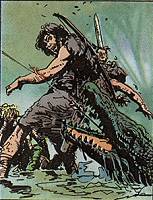 The art is beautiful. At first I found it a bit too sketchy, but as I got into the comic more I appreciated some of the more interpretative lines. There is a great image of a horizon filled with oncoming Viking ships. They are just little squiggles on a black line, but somehow it works. Rosinski clearly has the skill to detailed, tight lines. He demonstrates it constantly on the close up shots. I read later that he deliberately keeps things open-ended, allowing the reader's imagination do the work. It is very effective. He captures the action of combat, the stillness of emotion and the fantasy of another world equally well. I actually prefer the black and white of the intégrales to the colour in the individual albums. It allows you to see Rosinski's lines much better.
I see that a lot of these were published in english by a company called Ink Publishing. I've seen them on eBay, but I imagine they are quite hard to come by. If you find one, check it out. My life is much better now that I have read Thorgal.
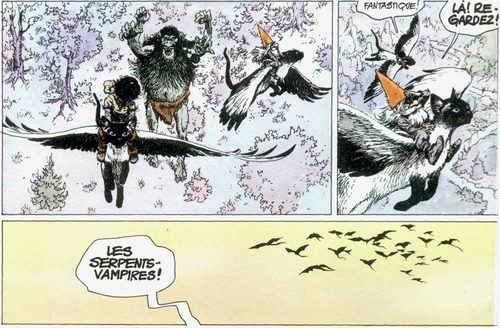
I'll leave you with a couple of frames from a story of Thorgal's childhood when he has to help a dwarf find the metal that does not exist in order to prevent the dwarf kingdom from being taken over by the evil serpent Nidgard. This story is one of the more fantastic, almost like a children's story. Check out the winged cats! The little dwarf rocks. He has a pick with which he is quite handy!

 Okay, this snuck in during my french BD reading because I had it reserved at the library before I started the comics project and it became available during. I couldn't pass up the opportunity.
 To my legion of readers, I would like to explain why I have suddenly stopped posting. The truth is that I have also suddenly stopped reading books in english. I started a new job in March in a french office. This is wonderful and I'm loving it, but I found quite quickly that my french was not going to improve simply by me going to work. I need to buckle down, practice and drill on my own, listen to french and read french. I am therefore trying to immerse myself as much as possible in the french language and one of the first things that had to go was all the english reading I was planning on this year. This saddens me a bit, as I do love reading in my mother tongue. But there will always be a chance to read in english.
  For the sake of an introduction, the bande-dessinée (which means "drawn strip") is considered in Europe and especially in french-speaking europe (Belgium is the primary source) as an aesthetic medium as relevant to art and literature as the film or novel. Comics cover a wide-range of subjects and are aimed at all different demographic groups (though there does seem to be a preponderance of books for young, male readers). They tend to be large format, hardback bound and 64 pages in length, generally of quite nice quality. They are also serialized in magazines that collect a bunch of different comics and then bound together later in complete volumes. Outside of Europe, the best known are Asterix and Tintin and if you've ever seen those, you will get an idea of at least how they are presented physically. Those are both great books, and both are responsible for significant trends in the medium, but they should not be taken as truly representing the incredible range of comics that exist today.
  I can't say a whole lot more than that, as I don't know much more. But I hope to be able to share with you some of that incredible range in this blog. I have already learned a lot in the last month and I hope I can start to put together some ideas, theories and overall descriptions of la bande-dessinée. It's also a great opportunity to add lots of cool images! Very few of these comics are translated into english and I have yet to find a good web site for the anglophone, so we're kind of on our own here. Which is great. Stick around...
 In 1971 a group of men chartered an old fishing boat, the Phyllis Cormack, rechristened the Greenpeace, to take it to Amchitka island, on the far side of the Aleutian chain to protest a planned nuclear test by the American military. Though they never made it to the island and the test went off (it was the last test done there, however), their trip created a wave of publicity and they formed the Greenpeace organization upon their return. Robert Hunter, the author of this book, was on the boat and was one of the founding members of Greenpeace. It's his memoir, written almost immediately after the trip, though unpublished until a few years ago. He put the manuscript away because he had made a pact to show a unified face to the world, to hide the many internal divisions that plagued the birth of Greenpeace.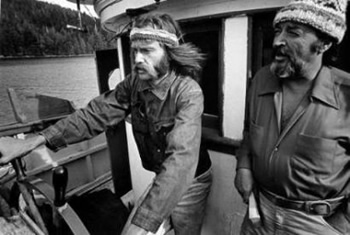
 I found this book at a giant municipal book sale they have every year in Montreal. It's held in a hockey arena and is mostly old library books. It's a large format hardback by two of the journalists working the story of the standoff at Oka in 1991. There are quite a lot of photos and I have to credit Robert J. Galbraith who was the photographer (I didn't want to make the title of this post too long).
 The momentum from the beginning of the year has started to dissipate. I've been very distracted these last couple of weeks, and though I can point to a number of valid explanations (new job, two new volunteer projects, three deaths, Diplomacy) I have spent way too much time futzing around on the internet, doing nothing of significance. That thing is becoming like television to me. That's bad.
 Well, I'm going in to this post forewarned by jarrett's comment in the last post. I'm very curious to hear why he was so dissapointed by Fatherland. I found it to be a well-written, thoroughly researched and entertaining historical (or faux future-historical) detective story. I'd go so far as to say that the ending actually had some emotional impact.
 This is the second book taking place in Herbert's Con-Sentiency world and a sequel of sorts to
  What a fantastic book. I'd of course heard about the movie, but it was
 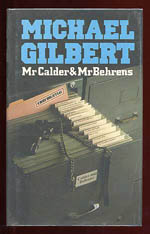 This is at least the third time I've read this book. The first was at some point in my teenage years, working my way through my parents collection of Michael Gilbert paperbacks. When I moved to New York, I would pick up any of his paperbacks I found, building up my own collection and reading them. This was my mid-20s. Sadly, I am motivated to re-read at least one of Gilbert's books now in honor of his
  Got a nice old paperback copy of this as a birthday gift. I've read Dune and quite enjoyed it but didn't have much of an overall understanding of Frank Herbert. Whipping Star started out like a classic of 60s sci-fi (silver age?), with a lone male character in a situation, using a language style very much from that period. However, quite quickly, it heads into a pretty bizarre metaphysical direction. It spends most of the time there. There is a plot about the end of all living creatures and it does come up with some narrative tension at the end, but really most of the book is about species trying to communicate with other species whose perspectives and existences are so different that they barely have a frame of reference to compare anything.
 Lucky Jim is one of my favorite books. I've tried to read a few other of Kingsley Amis's books, The Green Man, Stanley and the Women, The Girls and none of them even came close to the acerbic wit, careening narrative trajectory and total satisfaction of Lucky Jim. I found Take a Girl Like You for 50 cents at the local thrift store. It had a neat cover so I picked it up.
 Stop reading now. Put down your book this moment. It's a terrible habit and can only get worse, leading to not just any reading but reading genre books like Sci Fi and you all know where that leads, sitting in a movie theatre before the movie starts, overweight, popcorn and sno-caps in lap, open sci-fi paperback in hand.
 My SO
My SO  I wish I could say I had read this in french, but then I would probably be posting this in the middle of the summer. The translation is a bit stilted and kept me a bit distant from the material and I can just tell that in french it's probably even more ferocious. My dad recommended it to me. I guess it had a strong impact on him when he was a young man. It's basically the life of a poor but educated french guy in the early twentieth century. The story takes him through the horror and disillusionment of the first world war, to work in french colonial Africa then as a doctor in poor, suburban Paris and finally as an assistant to the administrator of an insane asylum.
  Now that the furor caused by my year-and summary is over, I'll start the 2006 50 books challenge with book #1, Maelstrom by Peter Watts. The second in the series that started with
  I probably should have waited a little while longer before picking up my second novel by Gilmour, (
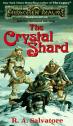 The Crystal Shard is the first book in the Icewind Dale trilogy of the Dungeons & Dragons based series that takes place in the Forgotten Realms campaign setting. Geeked out yet? Good, because this was the book that sent
 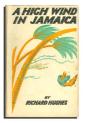 This was on my parents' bookshelf for as long as I can remember and my dad mentioned it several times as one of his favorites. It's about a group of english children who get kidnapped by pirates when leaving Jamaica for England sometime around the turn of the century. It's an amazing book, all told from the voice of an adult who sees things the way the children do. It has a similar tone to some of the english children's adventure books like Box of Delights or Swallows and Amazons but you as the reader can tell the whole thing is totally grounded in reality. It's the way the kids see the world that makes it all so fantastic and dreamlike.


 Posts
Posts


