Friday, January 26, 2007

9. The Big Blowdown by George P. Pelecanos

The Space Machine cover pictureI can't remember when George P. Pelecanos' name first hit my consciousness. I think that the Mt. Benson Report might have told me about the "washington quartet" when he was living out there. I saw his name on the credits for The Wire. My interest was definitely sparked when listening to an interview with David Simon, the head writer for the Wire, when he said that he hired writers who were genre writers and wrote about cities in the northeast U.S. rather than TV writers and he specifically mentioned Pelecanos. So he was on my list and how pleasantly surprised was I when Meezly gave me the four of his books that make up the Washington Quartet for my birthday!

I have to admit to feeling a bit overwhelmed getting 4 books, all by the same author. I am obsessed these days with getting my on-deck shelf narrowed down and this just re-widened it! However, once I jumped into The Big Blowdown, my worries went away, because I tore through that book. I could barely put it down. I found myself going to the bathroom unnecessarily in order to get some more reading in.

After, a brief intro during the depression and then the war itself, the rest of Big Blowdown takes place in the poor immigrant section (centered particularly around the Greek community) of Washington, D.C. after the Second World War. It's the story of a young man who has some guts and some character, who gets trapped between the crime community that seems to be his default career path and a more normal life that is also a possibility. It isn't a morality tale, though. The plot careens forward and there isn't a lot of hand-wringing or moralizing. The main character makes his choices and is well aware of them. This is not one of those books where the characters do stupid or weak things and that is used to make the plot move forward.

The setting is so rich and detailed, both at the surface level and the deeper historical trends, that the narrative seems natural and inevitable. The character constantly remarks on how much he loves the city and it is obvious that the author does too. I never considered Washington, D.C. to be interesting but Pelecanos has changed my mind about that. What a world! Nightclubs, diners, butcher shops, all kinds of immigrants making their way, slowly accepting or running away from the growing black community. The characters in these locations are real as is the language they use. Very cool stuff.

I see now that the Big Blowdown is a backstory about, I believe, the father of one of his later regular characters. It's a cool way to start and I am really psyched to see how he writes D.C. in later periods. I'm not worried so much about the impact of these books on my on-deck shelf. Rather, I am going to have to pace myself if the other 3 in the quartet are as interesting as this one.

Thursday, January 25, 2007

8. The Space Machine by Christopher Priest

The Space Machine cover pictureFound this one in a used bookstore in Berkeley. I really enjoyed Fugue for a Darkening Island and always keep my eyes open for anything by Christopher Priest. The Space Machine is a "re-creation of the Victorian scientific romance" (from the back blurb) and Priest's hommage to H.G. Wells. It's about a young salesman in Victorian england who, when trying to sell driving goggles to the female assistant of a well-known inventor, ends up becoming romantically entangled with the woman. This all happens in the very beginning of the book.

The real story starts when they decide to take the inventor's time machine out for a spin. 10 years in the future, the hero sees the woman he has just fallen in love with being burned to death by a flame-ray coming from the sky. In his shock and horror, he tries to prevent them from returning to the past in order to avoid her fate. He messes with the controls on the machine and sends them spinning out of control.

Where they end up totally surprised me. I am not going to get into any spoilers beyond saying this book expertly fits its narrative between The Time Machine and the War of the Worlds. The two protagonists are not the most efficient and sometimes do some really stupid things, but it seems appropriate for their age and upbringing. Christopher Priest is a very talented writer, capturing the late-nineteenth century language with sentences like "The enormity of my situation was without parallel" (referring to being in a woman's room in a traveller's hotel!). The concept and backstory that he comes up with is also really cool. It's interesting because I never considered the War of the Worlds beyond its original presentation but in the last couple of years I re-read the original book and now two novels that go a long ways towards positing explanations for the martian invasions. Good stuff.

Fugue was great, but for some reason it didn't start me on a real interest in Priest's works. I see now that he is capable of a wide range of good writing. Seeing blurbs for some of his other books, with equally intriguing plots, furthers my interest to really start reading his stuff. And then check out this picture here. That's a good look for a British sci-fi author.Christopher Priest picture

Monday, January 22, 2007

7. Spock's World by Diane Duane

Spock's World cover pictureSomewhere in my nerdly wanderings in the digital realm, I gained the recommendation that of all the Star Trek novels, there were two by Diane Duane that were particularly good and worth reading. I had already read and enjoyed Dark Mirror when I found Spock's World for a quarter at the local thrift store. It's been sitting on my on-deck shelf for quite some time now.

I am a huge fan of the original Star Trek series. As a kid, it was the show and, since we didn't have a television of my own, was a motivating factor in many social visits in my life. I would hang out, but I was always plotting to get Star Trek on. I recently watched the first and half of the second seasons of the series on DVD and it holds up. Kirk's delivery has been so lampooned that it is easy to forget how well-written the shows were. The charactarizations were strong and rich. The shows were exciting. Mr. Spock was and remains a role model for me (one that, sadly, I seem to be getting farther and farther away from the older I get).

I give you this info so you can understand that I am a bit sentimental to the Star Trek universe. The first few chapters of Spock's World do a great job of capturing the inner thoughts, the on-deck banter and the personal lives of the characters that I love so well. So I was pretty psyched. I can see how if you were a real geek and didn't want to be away from the Star Trek universe, you would read all the novels (and there are tons, at least 50 concerning the original series alone).

The story starts out with the Enterprise docked in orbit around earth for maintenance and the crew all on vacation. They get called back because of an important vote that is going to happen on planet Vulcan, Spock's homeworld. A majority of Vulcans have called for a vote to secede from the Federation (the UFP, United Federation of Planets, the political entity that governs the Enterprise) and sever their ties with humanity. Kirk and Spock are called to testify (Spock is half-human, half-Vulcan and both of them have a history on Vulcan, particularly the episode Amok Time where Spock is supposed to go back to Vulcan and get married; awesome episode). So the enterprise is sent back into space. This is also an excuse for the reader to get a history of Vulcan. Every other chapter is an important segment of that planet and specie's development, starting from their savage stage to when they first discovered space.

I was hoping more for a episode-like adventure. Spock's Planet is more of an excuse to give us a ton of backstory on Vulcans and their history. That was okay, but it didn't seem very rigourously thought out to me. The history was cool and there were a lot of pseudo-science that explained a lot of things. But at the same time, their development seemed all too human. The main story as well, the plot about the secession, was kind of soft, with it basically being a move by some corrupt Vulcans. I just didn't get a good sense of the mysterious and powerful other as it was so well portrayed by Leonard Nimoy. So overall, despite some good moments, I was dissatisfied with Spock's World and will let the background of the baddest of badasses remain a mystery, with only subtle hints here and there, in my imagination.

[addendum:] I was quite surprised to see the author herself post a comment to this blog (and a funny one). I went back and re-read my review with the thought that it had been read by the author. With this new perspective, I found my review bit dismissive. I still stand to my overall opinion of the book, but I would like to add that there are many very good elements in the book that made it an enjoyable read overall. Sarek's backstory and his relationship with Amanda, his human wife is well done. The structure of the history of Vulcan, which just captured slices of different eras rather than trying to show all the big moments, was very effective and interesting. The explanation of the development of Vulcan attributes (such as their mind meld and the neck pinch) was also well thought out. Dr. McCoy's personality is enrichened and deepeened while maintaining the crusty exerior that we all know from the TV show.

What kept bugging me was the constant suggestions of Vulcan emotion. T'pring's resentment and jealousy didn't seem Vulcan at all. Also, the constant reaction from the audience, during various people's speeches (especially the laughter) seemed very un-Vulcan. This might not be Duane's doing, as the later iterations of the series got mushier and mushier (and lamer and lamer; call it the Guinan infection) and for all I know it could now be canon that the vulcans are actually very emotional. But the Spock I know and love only laughed when some evil flower sprayed its emotion dust in his face.

But I know that the writing and ideas in Spock's World come from a place of love and respect so I don't want to come down super hard on these disagreements of interpretation. I'm glad I read this book and it has given me some depth and insight into Vulcan but I will still keep most of that backstory at some distance from my imagination.


Evil Spock cover picture


"It is only logical that I will kick your ass."

Friday, January 19, 2007

6. The Business by Iain Banks

The Business cover pictureFor those of you who don't know, Iain Banks has a great thing going on. He writes science fiction (generally taking place in the universe of The Culture) under the name Iain M. Banks. He also writes "contemporary" (for lack of a better word) fiction under the name Iain Banks. I believe that The Wasp Factory may be the best known. In Britain, they publish both lines beautifully, each with a distinct look. The non-M books all have very stark, modern black and white covers (like the one pictured here). The M books (the sci-fi ones) are in colour, each one with a specific dominant colour. (Oh, well, going to his website, I see they have updated the line. They still are different, but not so distinctly now. They sure do look cool, though. They know how to make books look cool in England. Check them out: fiction and science fiction).
Anyhow, I'm not sure how I feel about the business. I read the Wasp Factory a long time ago and enjoyed it but it didn't totally grab me. The Business reminded me a lot of a few other sci-fi classics: Gibson's All Tomorrow's Parties and Stephenson's Cryptonomicon. The protagonist is a high-powered businesswoman working for a giant, ancient company that is more like a meta-company, so big it is considering taking over a small country so it can get a seat on the United Nations. Most of the book, though, deals with the heroine's personal concerns, her role in the company, her unrequited love and sex life and her travel (every flight and car ride is rated and detailed). Eventually, a large plot comes in to view, involving her being sent to a small himalayan kingdom to see how the people would react to the Business coming in and taking over (their monarch is favorable to the idea and there would be a lot of benefits for the country, but obviously it is a mephistophelean deal).

Banks is a solid writer and a complicated, intelligent person. There are very interesting ideas swimming around under the surface of this novel. The construction of the the Business (as it is known) was interesting, though didn't reach the detail of the Cryptonomicon. There was so much emphasis on the trappings of life at the top (the lear jets, the communication devices, the exotic locales) that I felt I could never really get at what Banks was trying to communicate. I wondered what we were doing, where we were going at several points. In the end, there was a semi-satisfying conclusion, but it came rushed and I feel lacked the power that this story had potential to have.

Does anybody have a particular Iain Banks novel to recommend? I find them all so intriguing, but they just don't blow me away like some of the Iain M. Banks books have done.

Wednesday, January 17, 2007

5. Rendezvous with Rama by Arthur C. Clarke

Rendezvous with Rama cover pictureWow. Rendezvous with Rama is one of the few books labelled "sci-fi classic" that I have actually found to deserve the accolade. Jarrett recommended it to me. I found it for a buck and yet I was still wary. It sat on my on-deck shelf for almost a year. But I finally picked it up, with my new resolution to get through some classic sci-fi. I am very glad that I did.

The story takes place late in the 22nd century. Man has colonized several of the planets. One day, a strange object appears in the telescopes. It is a giant cylindrical vessel, heading obliquely towards the sun. Judging by its route, the earth forces decide that there is only a few weeks to study it and the nearest ship is sent. The book is mostly about the exploratory ship and what they learn as they slowly explore this foreign vessel.

A fantastic book that restored my faith in clear, classic science-fiction. Several times I exclaimed out loud, "Cool!"

**WARNING SUBTLE SPOILERS BELOW-If you are planning on reading Rendezvous with Rama, I recommend you don't read any more.**

What first struck me about this book was how clear the physical descriptions were. My nerdy brain is so filled with other worlds that I have very little attention span left to dedicate to a new one. I get distracted easily and completely fail to grasp the fantastic extra-terrestrial image the author is trying to impart to me. Somehow, Clarke describes the ship in such a way and with such plain language that I had a clear image of the structure in my head the whole time.

The second good thing was that about halfway through I started to get the idea that this book was populated with mostly reasonable people. Nobody was going to do anything stupid or crazy or emotional that would cause a "conflict". I am growing more convinced that the necessity of conflict in modern narrative is a false construct created by a divergence of undergrad literary and writing courses and capitalism. Too often, a writer uses arbitrary human frailty to drive a story forward. Clarke is confident enough of the coolness of what he is showing the readers (and the richness and complexity inherent in life and humanity itself) that he doesn't need to rely on any of that.

And Rendezvous with Rama truly delivers a sense of wonder and mystery. Each chapter (and they are quite short) delivers a new wonderful surprise, slowly unravelling the layers of mystery surrounding another life form Behind it all, is a solid internal logic, so that even though very little is actually discovered, the reader is left feeling very satisfied.

A classic.

Monday, January 15, 2007

4. The Closers by Michael Connelly

The Closers cover pictureThis #1 New York Times bestseller was another xmas gift. I've never heard of Michael Connelly, but I'm sure I must have seen his books on some shelves in the airport. I am very suspicious of best-selling american modern crime and mystery novels. The few I have read have been poorly-written at best, stupid and obvious, usually with some form of extreme and titillating violence or a completely preposterous serial killer as the bad guy (James Patterson, Jeffrey Deaver are two prime examples of this). I now avoid them as a rule.

The Closers stars detective Harry Bosch, who retired from the LAPD for two years and then decides to come back again. His old partner uses her connection to the new police chief, who is portrayed as someone who really cares about bringing down crime, to bring Harry back. They are assigned to the newly revitalized unsolved crimes (thus, "the closers") unit and start on a case involving a young girl who was taken from her bed and killed in the forest 17 years before. A DNA match from a bit of flesh on the gun (matches that were not technologically possible when the case was first investigated) is the clue that jump starts the dead case. As they dig deeper, the crime reveals itself to be potentially very complex, involving racial politics and potential police corruption.

The Closers is definitely a step above the books I mentioned above. It is a solid and complex police procedural. Most of the book is the two detectives investigating. Asking questions, going over old evidence, doing research and slowly the layers of the case are revealed. There are a couple of false notes, particularly with the vague antagonist, in the form of a high-ranking officer (though I suspect his character played a bigger role in past Bosch books, if they exist). At the sentence level, it is competently written, though a bit clunky at times. The overall structure is excellently organized, delivering just enough information and pacing to keep you hooked in and able to remember what is going on. The case itself is really interesting, woven tightly into LA city politics and culture, but able to stand on its own. There is lots of great detail and info about police procedure and culture in LA.

I probably won't seek out another Michael Connelly book. But if I'm stuck in the airport with nothing to read, I would go to him before most other bestselling authors.

Monday, January 08, 2007

3. Lord of Light by Roger Zelazny

Lord of Light cover pictureIf you look down the left hand side of this page, you may have noticed that Lord of Light has been on my to read list for quite some time. The only other book by Roger Zelazny I read was Donnerjack, giving to me by a fellow teacher a while back (thanks, Pete!). I loved it and after doing a bit of research, saw that Lord of Light is considered one of Zelazny's best books. Well, I searched far and wide for a used copy of it, but they weren't to be had in any of my bookhunting jungles (Montreal, Toronto, New York, Vancouver and finally the east bay) until I found a used copy of a re-released trade paperback. It was $6, which is more than I had hoped to find it for, but the only other time I had even seen it was a brand new version of the same trade paperback, so I picked it up.
It took me a while to get into it. Partly it's because I was flying and distracted when I started it and partly because the opening tells the story in a very oblique way. It was only due to the blurb at the back that I had an inkling of what was going on. As you get about a quarter of the way through, you start to figure out what the hell is actually going on and then it gets really interesting and really cool.

It is some future far-off planet that humans, escaping their own dying earth, colonized long ago. To colonize it, they used their technology to destroy or contain the existing creatures and then reproduced themselves to create a human population. They had the power to transfer their beings into new bodies and were thus effectively immortal. As their world grew, the first arrivers turned themselves into gods. Their colonization exploits and their internecine struggles become the myths of their human offspring.

Lord of Light follows the half-epic, half-mundane story of one of the first who decides to destroy the gods and allow their powers (i.e. their technology) to be spread to the rest of the world. The book is about his strategies, alliances and battles.

There are a lot of characters and it gets more confusing because when a named god dies, another character may take over his role and thus his name. It also jumps around in time a bit (though actually the structure is fairly straightforward once you figure it out). So I found myself a bit distanced from it all.

Nevertheless, it is a really cool book. The way the gods manifest themselves, their powers and tools is a clever and original blend of technology and magic (it's hard to tell where one begins and the other leaves off) and the world is rich and full of adventure potential. I think it either demands a re-read or careful concentration when you are reading it. It's an easy read and entertaining, but if you take it lightly you will miss some of the depth and connections and get a bit confused. So I recommend it, but read it when you have a chunk of time to dedicate to it.

[note about the rapidity with which I got the first two books down: it's entirely due to me being at the parents house for a couple of days after the new year. One can really focus in that environment. I hope I can keep it up, but as you can see, #3 took a lot longer than the first two!]

[note about my reluctance to pay $6 buck for this book. Yes, it's a decent price and yes I'm a cheap bastard, but as you can see it's just not a very inspiring cover. Take look at some of the other original paperback editions of the book and you can see what I was hoping to find in some dusty sci-fi shelf of a used bookstore.]

Wednesday, January 03, 2007

2. No Country for Old Men by Cormac McCarthy

No Country for Old Men cover pictureI got this one from my parents for xmas. I have read All the Pale Horses and while there were elements that I quite liked, the whole thing didn't jibe for me. A major strike against Cormac McCarthy is that he doesn't seem to think that he has to use quotation marks when people speak. I think the goal is to create a more flowing text or something, but it just comes off as pretentious and annoying (at least for me).

The cover of No Country for Old Men has a quote that says "...McCarthy's most acccessible work!" which I guess was a way to try to get it to sell more mainstream. If by accessible, they mean tons of action than that is very true. This is a violent book. Pale Horses had moments of extreme violence, but they were punctuations amidst pages and pages of thoughtfulness and human longing or something. This book is the opposite, brief moments of human exploration that punctuate pages and pages of serious ass-kicking.

The story takes place in Texas around the Mexico border. It's about a hunter who stumbles upon a drug deal gone bad in the desert and takes the cash left over. He is hunted. The main protagonist, though, is an old sheriff whose county this all takes place. He represents the voice of the older generation that wondered what the hell happened to the world. The story is great and there are some serious kick-ass characters. The theme of a society falling into chaos and evil is well presented through the voice of the sheriff. It avoids an easy narrative, which seemed right, but at the same time the ending kind of meanders away. Nevertheless, this is a very satisfying and enjoyable read. Quick and intense. I would recommend it.

I'm suspicious of McCarthy, though. I suspect the voice he writes with is not his own and it doesn't quite ring 100% authentic. It's incredible craftsmanship, for sure, but sometimes it has the sound of an extremely talented upper middle class intellectual acting country and with the people. I know nothing about the author as a man, so I could be wrong.

Tuesday, January 02, 2007

1. Lemons Never Lie by Richard Stark

Lemons Never Lie cover pictureRichard Stark is now well-known nom de clef of the well-known mystery author Donald E. Westlake. As Stark, In the 70s, he wrote a series of heist books starring an efficient criminal named Parker. These are my favorite books in the world and I've read the entire series three times now and will continue to read them. One of the side characters and heisting allies of Parker was a guy named Grofield. A little more intellectual and less brutal than Parker, Grofield was nonetheless a pro. He had people skills, lockpicking and disguise. His deal is that he's an actor and has his own summer stock theatre, that is constantly running out of money. Stark wrote three side novels about Grofield, The Dame, The Damsel and Lemons Never Lie. The first two were okay, but a bit light and funny and didn't capture the diamond-hard intensity of the Parker books. I could never find Lemons Never Lie (if you ever see it in old paperback, grab it), but fortunately for readers everywhere, Hard Case Crime just re-released it in a nice small paperback with a beautiful painted cover, in the best pulp tradition.

I am very pleased to report that Lemons Never Lie is up there with the better Parker books. It's a straight-up heist, Actually, straight-up is not a good word to describe the jobs that go down because they always end up getting complicated, usually through human foibles. In Lemons, Grofield gets asked to join a job in Vegas, decides the guy who is running it, Myers, is an idiot and backs out. Myers is an idiot, but a ruthless and psychopathic one and he retaliates, causing a chain of events that chase Grofield throughout the novel until it goes too far and Grofield has to start doing the chasing.

Lemons Never Lie is an integral part of the Parker arc. And a great book. There are two heists, tons of fighting and scamming, great underworld locations and characters (the scene where they buy the stolen semi is fantastic) and important advice. Reading the entire Parker line is a requirement for a career in heisting. For example:

"The best driver for anything, including going quickly away from where you no longer want to be, is not the guy who will kick the car across the state, the guy who love speed—the best driver is the guy who loves cars. He'll get more out of the car, and he'll live longer."

Sunday, December 31, 2006

2006 wrap-up and looking forward

Well I did not make the 50 books this year, barely made 32 considering that most of the "books" I read this year were actually comics (albeit fairly long ones; I read up to Thorgal #27). But I have my excuses. My french comprehension has improved a lot and my love for bandes-dessinées even more, so I will definitely continue to delve into the comic section of the library. But I am also inspired to continue my catch-up on classic sci-fi (thanks in no small part to an excellent xmas present from the Mount Benson Report). There have been several books that I am interested in on other 50 book blogs as well. So I am going to shoot for 50 books this year, both french comics and english regular books. I may try to see how long it takes to read a Maigret in french as well.

The overall blog posting has slowed down this year among our little group, as I am sure it has across the internet. But keep posting and keep reading everyone. Your updates give me great pleasure. Good luck for '06 everyone!

32. The Corner: a Year in the Life of an Inner-City Neighborhood by David Simon and Edward Burns

The Corner cover pictureI took this fat hardback (576 pages) out of the library to read during the xmas holidays. I am totally hooked on the Wire (without a doubt the best show on television), but what blew me away was an interview with David Simon where he just tears into America. It's a podcast on the HBO website. They start out by asking him a question about his "passion" and he says "I don't think it's about passion. I'm angry." and then he proceeds to rip into the government, bureaucracies, and us, criticizing the current situation in America with such vigour, honesty and intelligence that I was wondering if he was really American. He mentioned his book "Homicide" as if it is was well known, where he says some of these ideas are discussed. So I went to look for it and came away with his newer work, "The Corner" instead.

The Corner is an amazing work of journalism. Simon and Burns (an ex-cop and current teacher) spent four years just hanging out in the worst drug corners of inner-city Baltimore. They and their involvement are almost entirely transparent in the course of the book, but they explain their process in detail in an epilogue. The Corner follows the lives of a shattered family, a husband and wife who are both junkies and their son, a sometime dealer and street tough. Each has a distinct personality and a distinct role in the shooting galleries and corners of West Baltimore and through their roles we get a look at the drug market, the community of addicts, the schools, the hospitals and the cops. The majority of the book takes place in the world of addicts, hanging out in abandoned rowhouses, scoring and shooting, recuperating, hunting out scams for a bit more cash to score and shoot again.

If you watch the Wire, this is Bubbles' world. And even then, it is far less glamourous than anything in the show. The violence, when it occurs, is workmanlike. The dealers come off more like fast food employees (though they make a lot more money), basically working hard every day, serving customers. And the addicts scams and money-making schemes are small-time, pathetic, industrious like rats at best. They strip copper wire from old houses, switch vials of heroin for ones filled with water, borrow and beg from relatives. Lying and scheming is a given.

The book is so thorough and treats the main characters with such depth and care, that as you work through it, learning about the drug trade, about the failure of institutions at every level (driven by our unwillingness to see the problem as a human one), you really get into the story of the family. It's so sad because the patriarch was one of the thousands of black men who came to the north after the war with nothing in his pocket and was able to find good work, marry a woman, buy a nice house and become part of a poor but warm and thriving community in Baltimore. Now he and his wife are surrounded by dealers, fearing getting shot or having the house burn down because of the abandoned building next door, cops breaking the door down looking for their grandson.

I could write about this book for a long time. For me, it did nothing to change my opinion because I share the opinion of the authors. I taught at a school with some kids from disadvantaged backgrounds, but it seemed like Mayberry compared to this book. Just getting these kids to even come to school is basically impossible. But for anyone else who is still labouring under the withering american myth that everybody has an opportunity to succeed if they only work hard and apply themselves, The Corner should be mandatory reading. Simon and Burns pull no punches. If you grow up in this world, you are fucked. And we don't care. He compares convincingly our attempts to solve the problem with our strategies to win the Vietnam war, and he predicts (so far correctly) that we will fail. Except this time, the enemy is us.

A great book. I'm definitely getting Homicide as soon as I can lay my hands on it.

31. What the Dormouse Said: How the 60s Counterculture Shaped the Personal Computer Industry by John Markoff

Dormouse cover pictureI bought this book for my dad last xmas, after hearing a great interview with the author on the podcast Berkeley Groks. My dad liked it so much, he pressed it on to me to read, which I did on the way home for the holidays. I've read the two other classics of computer history "The Soul of a New Machine" by Tracy Kidder and "Hackers" by Steven Levy and my father was on the peripheries of it while it was going on, so I have a decent general idea of the history. What the Dormouse Said makes explicit and emphasises the idea that the radical changes in society and thinking that transformed America in the 60s strongly informed the ideas of the people who started the computer revolution as well.

It's an interesting idea. Markoff lays it out by going through the lives and personalities of many of the important players, first showing the development of their ideas and values and then their impact on the computer world. Most of the action takes place at Stanford's SAIL laboratories and later at Xerox PARC. He has done excellent research and tells a fascinating story. These engineers and programmers really were freak. Even the earliest pioneers, the 50s guys wearing black ties and white short sleeve shirts, were participating in organzed LSD experiments while building some of the earliest network machines whose software backbone (ftp for instance) and hardware concepts are still with us today, buried deep in the structure of the internet.

I have trouble reading histories that have a lot of players and particularly during the first half of the book, I got kind of confused. The organization becomes clearer in the second half as it focuses on fewer characters. Things also get really wilder at that point, as the 60s heat up with social and political conflict reaching a head. The programmers found themselves caught between the angry forces of the anti-war movement and their own desire to change the world through technology, technology which was generally funded by the military-industrial complex. At the SAIL labs, things were really crazy. Programmers were smoking dope downstairs while engineers were working on helicopter bombing simulations for the Vietnam war upstairs.

What the Dormouse Said is a rigorous book. Markoff doesn't pull punches and isn't afraid to show where mistakes were made. In fact, one of his stronger theses is that no matter how succesful a wave of technology is, there is always another one on the way that will completely undermine the previous one and cannot be predicted by the riders of the previous one. The leaders at PARC were driven by the idea of shared computing. They thought the idea of an individual personal computer was frivolous (though they were all aware of Moore's law at the time). The guys at Xerox Parc were a little more hip to it, but it was individual hobbyists who blew the whole thing wide open. They borrowed lots of tech and ideas from their predecessors (the mouse, windows) but ended up going off in an entirely different direction, leaving Xerox's entry into the computer industry as a famous failure. Interestingly, today, we are seeing the pendulum swing back, as the internet and shared apps start to take hold. Who knows where we will go from here, but Markoff's emphasis on the poor judgement of contemporary pundits on the future is a lesson we should not forget.

This book is an important read. The irony of the computer revolution is how so many of its leaders were against corporations and capitalism and were looking for ways to make the world a better place through radical social change (obviously, this doesn't include Bill Gates). They ended up creating the wealth engine of the 20th century. I still believe that there is a role for technology to help make the world a better place beyond just increasing production and trade, but we humans need to get past our short-term greed and social fear for that to happen. The tools are there and this book is a reminder that some very smart and hard-working people created these tools so we could attempt to do that.

30. Red Lights by Simenon

Red Lights cover picture
As Buzby, who lent me this book, predicted, I read it in one day. It's almost a novella, but I see that a lot of Simenon's books were short like that. Makes me feel guiltier for not reading him in french. Red Lights takes place in Long Island on the eve of a long weekend. A bickering husband and wife drive out to pick up their daughter from camp. The husband keeps sneaking drinks, first at home and then at rest-stops. The tension in the car explodes into a marital spat and the wife walks out of the car. The man continues on his drunk and bad things happen.

I was expecting a more drawn out story, more of an adventure and perhaps some mystery. But the events are actually revealed and wrapped up quite quickly. I realize looking back that the story climaxes with the husband's bender. While I was reading it, I was thinking that was the build-up, so I was off the rhythm a bit and it seemed to end abruptly.

Despite my expectations, it was a great read. Simenon captures the combination of hospitality and guardedness of 1950s northeastern America. The sense of forward motion, of darkness, of highways full of closed cars all going in the same direction is palpable. Finally, he digs right into the flawed heart of a weak man and it is quite painful.

Judging from Red Lights, Simenon is a great writer and I will definitely be reading more of his books.

Saturday, December 30, 2006

29. Les Enragés by David Chauvel and Erwan Le Saec

Les Enragés is the story of a retired professional hitman who against his better judgement comes back to do a final job. Of course he gets screwed by his employers and while on the run, crosses paths with a tough Chicano gangbanger who is also over his head in his own crime world. They are joined by a young woman killer who was sent to get the original hitman. The three of them travel across America, escaping from the badguys, fighting with each other and eventually coming to respect one another.

Les Enragés is very much in the french tradition of respecting and emulating the American gangster genre. The portrait of the ghetto and the cops all has a slightly off feel (though this may be emphasised because they are speaking french). But it's not off in a bad or obviously false way, just sort of foreign. Both the hitman and the young gangster are pretty badass characters. The story overall is also really cool. It's a testimony to outsiders and you root for them the whole way.

Les Enragés cover picture

Friday, December 29, 2006

28. Les Maitres de l'Orge by Jean Van Hamme and Francis Vallès

I read this BD at the beginning of the year and it was actually one of the titles that inspired me to really dig into the Belgian comic scene. I saw it on display at the library and it really blew me away. As you can see from the cover, the subject matter appears to be about as far from the expected contents of a comic book as you could imagine. It looks more like a european telenovela. And in fact, that's basically what it is, albeit epic in scope (running through 3 centuries and several generations) and a bit more sophisticated, with its inclusion of history and economy.

The title translates into "The Masters of the Barley" and the arc of the story follows a small Belgian brewery that grows into a vast multinational beer empire and the family, the Steenforts, that runs it. Each of the 7 albums is centered around a single character, representing that generation of the family. You can see the covers in order here. Each album starts with an intro page that has a précis of the history of that generation and the current state of beer development and the beer industry. It also has a two page spread showing the town where the Steenforts live (and their main brewery is found) from the air. Each album, you can see tiny changes in detail (as well as large ones) as development and history changes its geography. It's quite fun to look around and see the changes that actually happened in the previous album.

It is a rich, complex story, starting with the extreme poverty of the mid-nineteenth century. The man who becomes the patriarch of the Steenforts breaks away from indentured labour in another brewery and slowly struggles to start his own. Eventually the new brewery takes hold, using new processing techniques. There are conflicts, romances, thefts of trade secrets, conspiracy and all that good stuff. It is definitely a big soap opera, but one that maintains its narrative integrity. There are no strong themes, besides the importance of beer and the foibles of human weakness. It is very clear that the author loves and respects beer. Perhaps this reflects a Belgian characteristic. If this were translated into english (which it should be), it be a fantastic gift for the beer aficionado in your life (and I can think of one brewmaster who would appreciate this).

A great, rich, engrossing comic.

Les Maitres de l'Orge cover picture

Thursday, December 28, 2006

27. L'Echangeur by Marc Vlieger

L'Echangeur is a single volume bande dessinée, much more in the format of a graphic novel as we in the west know them. I don't know if it was ever published in the more traditional BD form, or serialized. It's the story of a giant apartment complex in France that is just up the hill from a gas stop on a major autoroute. These are the projects of France, a little farther out of town than the banlieu that exploded in riots last summer, but peopled with the same population: North African immigrants and their children. The drawings are clean and open, almost dusty, reflecting their empty surroundings.

The story is about the prodigal son returning home, a favorite uncle and son who managed to break free from the constraints of race, class and poverty. All that is known about him since he left are the series of exciting postcards he sends home, from all over the world, each one relaying all kinds of adventures. His young nephew idolizes him and is totally overjoyed when he comes back again. Why he has returned home and what he has actually done is a mystery, but he is still full of life and energy and crazy stories of adventure.

The cracks first start showing when the nephew, by bragging, gets his uncle caught up in a drag race with the local drug dealers. The reader begins to see that the uncle may have exagerated his driving skills and experience. Things get even more tense when a couple of toughs from Paris show up, looking for the uncle. In a rousing scene, that shows the unity of the projects, despite the earlier menace of the racing drug dealers, the Paris toughs are set upon, beaten up and driven out of town.

As the story progresses, and the uncle's lies slowly become more apparent, L'Echangeur portrays the life and struggles of his nephews, their dreams and desires and how they both thrive and are suprressed by their environment. The comic becomes a lot more benign and touching than it initially promised. The truth of the uncle's life is almost comical when it is finally revealed. Despite the change of tone, or maybe because of it, L'Echangeur ends up a profound and moving portrayal of an underclass community.

L'Echangeur cover picture

Wednesday, December 27, 2006

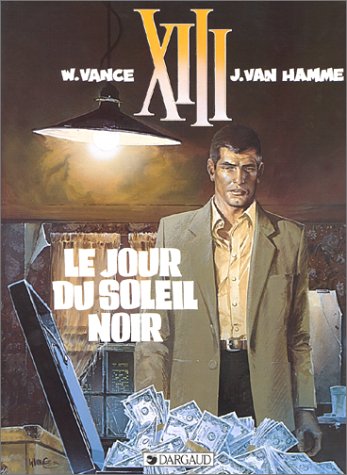
26. XIII written by Van Hamme drawn by Vance

XIII is one of Van Hamme (and Europe's) most succesful bande-dessinées. It is a story about a young man who wakes up on a New England beach with no memory, except for a fine physique, extreme skill at kicking ass and a tatoo of the roman numeral for XIII. It takes place during the 60s, mostly in the United States and each album peels back another layer in a conspiratorial onion surrounding a complex plot to assassinate the president. XIII is Van Hamme's fantastic interpretation of the Kennedy assassination.

XIII left me a bit cold. It has some cool storylines and captures that pre-Nixon paranoia quite nicely, but the conspiracy is so deep that it just started to become a bit preposterous. The main character, XIII, finds out that he is actually a totally different person than he previously thought he was at least 4 times! It's quite clever the way it all works, I think, because it seemed to hold together. But it just became too confusing and I started to stop caring, after the the third badguy leader of the conspiracy was revealed and vanquished.

They made a video game out of XIII and I think there might be a movie. If you are interested in the period and the conspiracy genre, than XIII definitely has to be included in your research. As a comic, I found it below the level of Van Hamme's best work such as Thorgal and Les Maitres de l'Orge.

XIII cover picture

Tuesday, December 26, 2006

25. Les Voleurs d'Empires by Martin Jamar and Jean Dufaux

Voleurs cover picture
I found this bande-dessinée in a version intégrale. It came out originally in a six-volume series that ran from 1993 to 2002. It takes place in the late 19th century France, during the downfall of Napoleon III, the Prussian invasion of France and the Paris Commune. The history of this period is the foundation of the story and plays a significant role in driving the events, but the primary narrative is a tale of supernatural horror.

At the beginning of the comic, a young girl waits by a tree in a field for a skeleton in a napoleonic officer's uniform. She swears her love and allegience to him and he sends her off to do his bidding. I don't know if I am missing some backstory or mythology, but the skeleton seemed to be the devil or at least some form of evil. The main story then begins, which takes place in a fancy boarding school in the country that has been taken over as a residence for Prussian officers. The boys are still there and supposed to be going to school, but they chafe at the invaders. The matron of the school is trying to hold all this together. The wrinkle is that the girl who met the devil is living upstairs in her apartment and is a total psycho, doing all kinds of freaky shit. Her wealthy parisian parents pay a hefty sum for the matron to take care of her, but she is making friends with rats, sewing medals onto corpses, seducing the prussian officers and generally behaving in a pretty disturbing manner.
small skull picture
The story is complex, with some of the students escaping the school and making their way to Paris. All of the other significant characters whose paths crossed at the school also end up in Paris, including the psycho girl. It is a winter of terrible famine as the Prussians hold the city in siege. I am still not sure exactly what the role of the devil girl is but I think the idea was that evil thrives off of human chaos and this period was a fecund one. The story climaxes in the attack on the Paris Commune.

This was a significant event in French history, one that I always knew was considered a cornerstone of modern Marxist theory and many historical arguments on the French Revolution. Unfortunately, my oblique and precious liberal arts education never actually directly explained what the hell actually happened. During the Prussian siege on Paris, the citizens living in the heart of the city set up their own militia and government, a relatively democratic one. After an armistice with Prussia, the communcal government didn't want to give up the power and the royalists eventually attacked them, in a very bloody way. It's a very interesting history and you can read more about it at the Wiki page for actual facts and details.

I found Les Voleurs d'Empires to be engaging and genuinely horrifying at times. It is a good adventure, with strong characters that you care about in exciting situations. It is the supernatural element and the portrayal of the history that make this bande-dessinée stand out. Again, the horror here is really horrific. Punches are not pulled. It is the same with the history. The authors do a fantastic job of showing a city under siege and the profound conflict between the classes that ripped Paris apart. I wish I had understood the backstory of the devil and his mistress, but I am not sure if it was meant to be fully explained.
Largo Winch cover picture

Thursday, December 21, 2006

24. Largo Winch

Get ready for an onslaught of last minute updates!

Largo Winch cover picture
Largo Winch is another very popular bande dessinée by Van Hamme. It's also as I have come to see with Van Damme's work, another story centered on an attractive white male who is disconnected from his roots. (Thorgal is the only other example I've posted so far here, but you will see others; it's definitely a major theme in Van Hamme's oeuvre).

Largo Winch is probably the lightest and most fantastic of them all, in the sense of adolescent wish fulfillment. It is a long-running series, structured in episodes of two albums. In the first two albums, it is established that Largo is an orphaned adventurer, a long-seasoned traveller who is actually the long-lost heir to a vast corporate empire, Winch Industries. The CEO and Winch's long-lost father (although the background to their relationship is much more complex and convoluted) has himself killed (or maybe doesn't; as I say it's complicated) and leaves his empire to Largo, who happens to be traipsing around Istanbul without a penny in his pocket, completely ignorant to his destiny. Of course, there are usurper's to the throne who want Largo out of the way and the hunt is on.
Largo mugshot picture

After his legitimacy is established, Largo takes the reins of power and the strength of his character, despite his total lack of business experience, proves him to be a natural, if unorthodox, business leader. From this point on, every two albums is a new adventure in which, in the first album, some problem arises which Largo, and a few recurring characters, then solve in the second album, all the while visiting exotic locations. blowing things up, showing off their ass-kicking skills, embarrassing uptight rich people and getting laid in the process to a series of comic-book hot secretaries, stewardesses, heiressses and sometimes villainesses.
Winch hottie picture
There is an ongoing story arc, although it imposes itself rather lightly on the serialized adventure structure. It involves the various factions of the vast empire of Largo Industries, many of whom are often working to unseat or disgrace Largo. There are great board meetings, where Largo whips out his knife and demonstrates his knife-throwing skill at some executive who tried to buy him out. I think it is this fantasy element, the street and life-trained individual bringing his skills to bear against slimy, but smart capitalists whose only game is in the office that makes Largo Winch more than just an extended adolescent fantasy. It does become a bit repetitive after a while, but for short bursts, it is really quite fun. I would say that Largo Winch is probably Van Hamme's least interesting work (that I've read so far), or perhaps the most self-indulgent, but compared to most adolesecent male power fantasies, it is still very effectively done, with funny and engaging secondary characters (the old maid secretary, the apache-pilot buddy, the uptight bureaucrat second-in-command) and really over-the-top adventure situations. Van Hamme puts his characters in serious jams.

So, good stuff but it doesn't last long.

Monday, September 11, 2006

20, 21, 22, 23. English novels read while in B.C.

[I read four english novels while I was in B.C. for a family wedding and then 2 weeks of work on the Excelsior Club in Golden. I had a 10-hour bus ride and really had no access to french comics.]

20. Slam the Big Door by John D. MacDonald
John D. Macdonald (along with Patricia Highsmith, who you'll see next) have become my two favorite cheap paperback authors. You can always find their books in a used book store for cheap and both were prolific (especially MacDonald). Slam the Big Door is a non-Travis McGee, but still contains all the classic elements: decadent establishment types in the height of the sexual revolution, spoiled, sour marriages, drinking, levels of toughness. This one was entertaining but meandered a bit at the end, not sure of where it was going and thus not totally delivering.

21. The Cry of the Owl by Patricia Highsmith.
She really was a disturbing genius. Her books look with depth and detail at the lives of normal people, people with weaknesses, and what happens to them when things start to go wrong. In this one, a recently divorced man who moves out to upstate NY accidently comes between a nice but quirky girl and her petty resentful boyfriend. The protagonist is really the good guy, but he's just slightly off, a little weird and this dooms him. He meets the girl by sneaking up to her house and watching her through her window. But he's not a pervert. He's sad and lonely and watching her quietly and happily living her life makes him happy. He didn't even want to meet her, but he does and she starts to like him. He is constantly trying to hide from the rest of the town that he was looking through her window (she caught him and didn't mind; that's how they met) and when the shit hits the fan (the jealous boyfriend tries to kill him and then disappears, putting the suspicion on him) this one weird thing starts to make everybody suspicious of him. It's a dark book and fascinating. Very hard to put down because of the narrative and the character study. Good stuff.

22. A Passage to India by E.M. Forster
A funny and complex look at the relationship between british and indian society as the Jewel in the Crown starts to lose its shine at the beginning of the twentieth century. It's much more about the characters than the politics (unlike the movie). It made me extremely interested in the history of India and how it was colonized in the first place. An excellent book and I won't say more about it here because it's all been said by smarter people.

23. A Long Finish by Michael Dibdin
Dibdin is one of the better current mystery writers. His Aurelio Zen books portray a hyper-cliched, but rich enough to probably be realistic Italy and they do it well. The protagonist is very likable, with an excellent toughness of style. He's no big fighter but he knows how to play the game of politics and culture and it makes him very cool. This one is about the murder of a local vintner and has a lot of stuff about regional wine politics and truffle hunters. Great side characters and great locations. Recommended.