![]() |
| Kudos to a cover that shows an actual scene from the book |
Monday, May 30, 2022
24. The Feud by Thomas Berger
Wednesday, May 25, 2022
23. The Protector by David Morrell
Morrell seems to have made a niche for himself as extreme researcher of cool ass shit. In this case, he goes deep on the elite protection industry. Cavanaugh is an ex-Navy Seal who runs a small team that protects and hides people under extreme threat. Here, he is hired to protect a scientist who is already holed up in a warehouse hideout. When he goes there, the shit hits the fan and Cavanaugh learns that the guy discovered the ultimate drug (instantly addictive) and that the cartel is after him. There are several twists that weren't too hard to predict (even too easy, at a couple of points I found Cavanaugh to be stupid to not cotton to what was going on), that of course lead to Cavanaugh on his own, on the run.
There was another early plot point error that surprised me, where they sent the client out to get his fake ID created before the plastic surgery they were planning and I was off on the wrong foot. Once we get into the main plot, it's pretty cool. Morrell's research comes into play and we get lots of cool techniques for going undercover on the lam, armouring vehicles (and how to knock other vehicles off the road), making fake wounds and all kinds of cool little details. The bad guy is a real hateful prick too. A bit shakey at the beginning but ended up being as I had expected a quick fun read.
Monday, May 23, 2022
22. Understanding Korean Politics: an Introduction edited by Soong Hoom Kil and Chung-in Moon
I think it is probably worth studying why Korea has remained so quiet in the west, considering that it's history is quite wild. Not only did it have a miraculous economic growth, it did so through three dictatorships and some serious political craziness (including the president being assassinated by the head of the Korean CIA in 1987!). Why does Korea get so little play in the west? This book did not go into that, but it was a solid and sometimes interesting overview of Korea's political history, coming out of WWII being basically occupied by the US and USSR, getting split after the Korean War and then developing from a US-dependent military dictatorship to an independent, democratic economic powerhouse.
Though a bit dry and basically undergrad poli-sci with some of the nonsense that brings (academics still struggle with arguing over which theoretical lens is best and then concluding oh yeah we can use many), this book was divided into digestible chapters, all of which were really well-researched and directly presented. What I found particularly interesting is how the dictatorships had such control until, in each case, they went too far and popular protest ended up bringing them down. I'm over-simplifying but there seems to be something in 20th century Korean history where the people are unified enough (and having the threat of North Korea is a major factor here) that they can exist with a dictatorship and yet also bring it down. It bums me out that in their last election, they chose a populist asshole (though barely, but isn't that how these fucks get in power everywhere?). I hope Korean cultural and political unity can withstand the dividing power of today's internet.
Monday, May 16, 2022
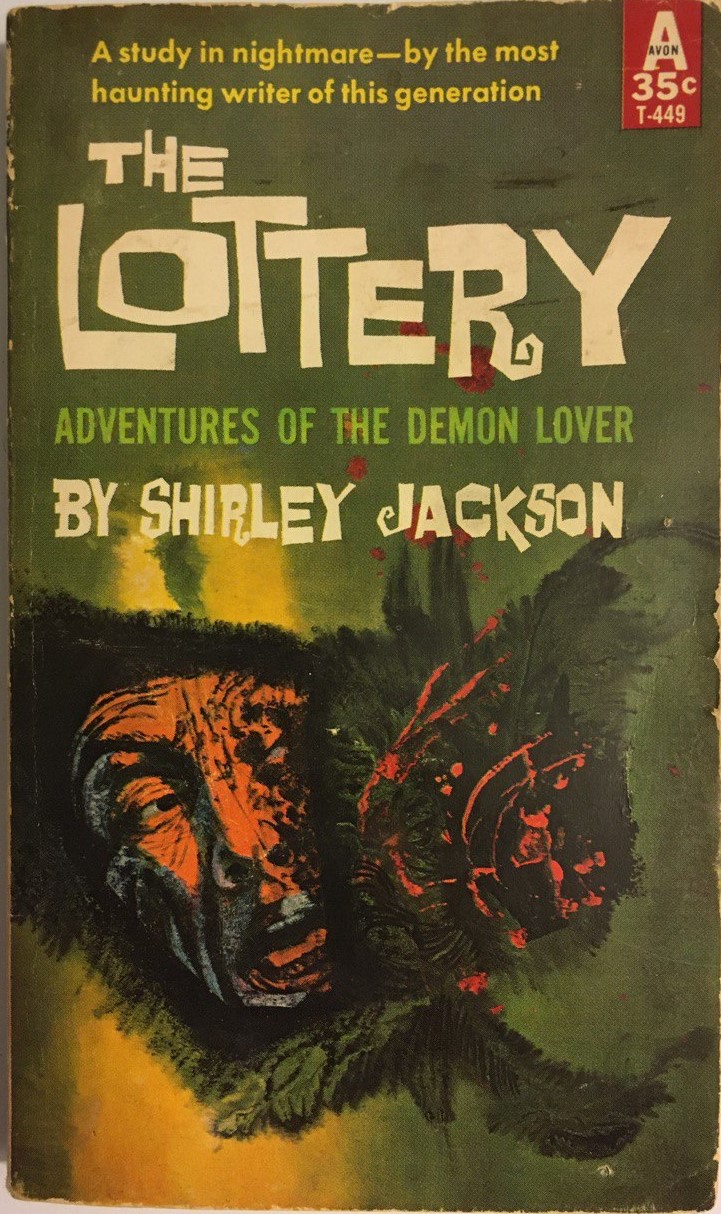
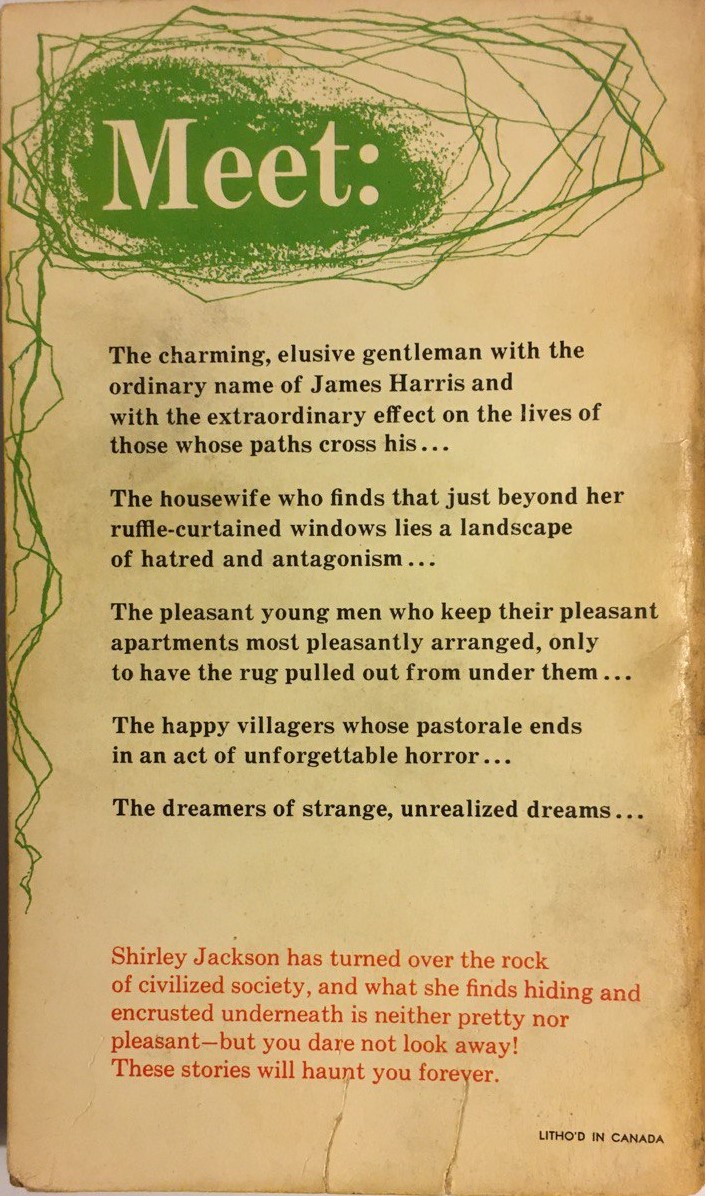
21. The Lottery: Adventures of the Daemon Lover by Shirley Jackson
An aside, reading this book did just give me a clear notion of the definition of "genre". This is my own way of understanding it (and may well be utterly not original and probably thought over with much more depth by much smarter and more patient people). Basically, in genre fiction, the primary objective is to tell a story. Ideas and concepts are delivered with the story, but tend to not be the main focus. Literary fiction can be story-driven but generally it is the ideas and concepts that are the main objective. Obviously there is a spectrum and lots of exceptions but broadly speaking this is why I personally prefer genre fiction.
The above notion crystallized in me while reading these short stories because many of them have only the most minimal story structure. At first, I was mildly annoyed, because despite my objective tone above, I am really not down with the New Yorker/liberal arts university creative writing course mode of trying to impart a feeling or some shit. However, Jackson is such a skilled writer and the stories so tight and short (and effective) that I got over my irritation. Many of the stories deal with the anxiety of women in this time period in the northeast, usually with an absent or oblivious husband and a contrast between the city and the country. There are a couple of stories here that really capture the fear that New Yorkers have of the country and close proximity to the rural working class. This has been going on for a long time!
My favourite story is The Dummy about two catty women who see a ventriloquist show and react to the dummy. Really, nothing much happens, almost the small incident one might see going out in NYC that would be a funny anecdote, but it made me laugh and she captures the women's dialogue so well.
I'm glad I read this (and later read up on Jackson's life) because I had only read The Haunting of Hill House, which is good but doesn't give you a good sense of where she is coming from. I will have a better appreciation of her work now.
Friday, May 13, 2022
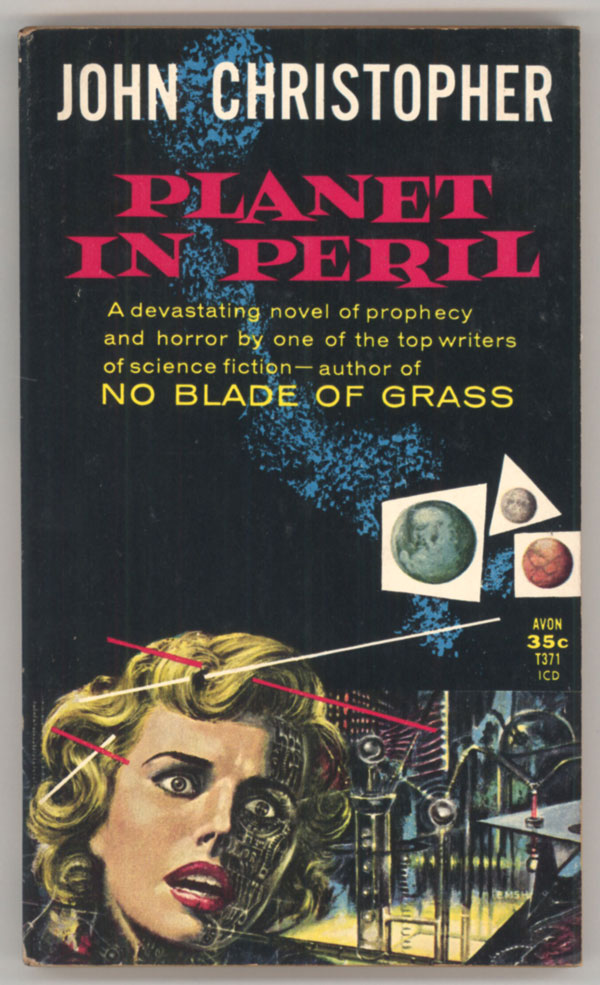
20. Planet in Peril by John Christopher
The story is that the hero after years working quietly in the same lab, suddenly gets transferred and promoted to a location where his predecessor disappeared in a sailing accident. When he gets to the new office, he meets the resentful assistant, who is also attractive and they hit it off. Then there is a lot of intrigue that you really don't care about, culminating in the possibility of Siraq invading the rest of the world with flying soldiers using heat rays generated from a new diamond energy that only the protagonist was somehow capable of inventing (except the Siraqis already invented).
There were a couple of good bits, such as the airspheres, giant bubbles you can fly around in the clouds, which was very well described and enjoyable to visualize. There are nice, subtle descriptive moments that remind you what a good writer Youd was. Overall, though, a dud.
Friday, May 06, 2022
19. The Big Brokers by Irving Shulman
The premise is great. Three young toughs (and one's moll) are sent by their boss to take over a failed resort and casino investment in Las Vegas. They proved themselves well on the streets to their boss, kindly but tough and scheming Itzik Yanowitz (a great character!) but it is a bit of a stretch and a risk to ask them to take over a hotel where the previous scrammed with the money and left to ruin. The book has an interesting pattern of weaving between sections of great detail, focusing on getting the casino set up for instance, then accelerating ahead to the next phases and challenges in their existence. It makes it somewhat uneven in feeling. Is it a procedural or an epic? In the end, it goes for the latter and I have to say does also succeed in giving us a lot of really entertaining procedure, both with how the criminals work and how a resort casino was run in that period.
Another element that makes the book somewhat uneven is the writing style. It's not bad, actually quite readable and the content is so rich that I found myself easily turning the pages. Shulman jumps around from perspective, not just from the characters' minds but going from a detailed description of the muscles on their faces to their thoughts and then to a more objective perspective. It also gets a bit melodramatic and maudlin at times. He really bears down on the stress and anxiety and the generally unpleasant price one pays to avoid the rat race and live large as a gangster. It gets rough at times too, there are two particularly brutal beatings that are hard to read.
It's interesting to read this book written in 1959, written 10 years before The Godfather and yet containing so much material that is now considered the sole domain of Scorsese. I wonder if he read this book, because half of Casino is in here. This one is going on the book shelf.
Thursday, April 28, 2022
18. The Seven Pillars of Wisdom by T. E. Lawrence
![]() |
| I got the book from the library |
It is Lawrence's ambivalence or rather disgust with his own role that removes the book from pure colonial adventurism. He ascribes no ambition or idealism on his part but rather it just seems to flow out of his job working for a branch of British intelligence in Egypt that he heads south to Arabia and starts working with the Beduin. Once there, he realizes how effective they could be in the fight against the Ottaman Empire. He uses the promise of Arabian independence to motivate and unite the disparate and often conflicting groups of desert people against the Turks and he hates himself for this.
He also underplays his own suffering and toughness. He is a small guy and admits to being at a disadvantage in hand to hand combat, but holy shit does he seem tough and stoic. The list of things I can't and don't want to do are manifold: riding for days without sleep on a camel, suffering through intense heat, walking barefoot on skin-cutting muddy ice (and dragging a camel), all kinds of horrible insect bites, riding into machine gun bullets, getting tortured and raped by a Turkish officer and his men. It is all kind of written about with a matter of fact tone.
I'm not sure I would recommend this book to anyone but a student of the Middle East campaign of the First World War. I did learn a lot and have a better understanding of the geography, but it was a long sometimes repetitive read, although indeed very well written.
Wednesday, April 06, 2022
17. Hammer's Slammers by David Drake
This is tough reading and I am still not sure about how I feel about its politics. The first few stories are not super well-written. The battle descriptions (not my strong point as a reader, I admit, so combat nerds may have a better informed opinion) confused me and didn't do a lot to move the plot or characterization forward. There is a lot of cyan and a lot of bodies getting splattered (which was kind of grimly entertaining). As the stories move forward, though, they get better and better written, with some interesting situations. It is not a novel per se, but a series of situations that happens to this intergalactic squad of super tank mercenaries with little informative essays in between. It does build a picture of a galaxy at constant war and the hierarchical social structures that push poor planetary settlers to join Hammer's crew. Ultimately, from what I could gather, the main argument here is that humans are going to go to war all the time and that war is hell and the only good thing is the camaraderie and loyalty generated by being part of a politically neutral, highly skilled and powerful military team. The glee of Pournelle's essay is not here, though. Rather it is all just grim with genocide, rape and environmental destruction (including wiping out a complete ecosystem). The only bright spots are brief moments of individuals distinguishing themselves by showing a toughness and inhumanity that means they can be a part of the Slammers.
Despite the cynicism, the situations are quite clever and the various worlds have interesting geography, flora and fauna and civilizations, all presented with just enough info to get the context to make the story work. The final story, The Tank Lords, which was added to this later addition, is much richer and enjoyable and I think probably demonstrates an evolution in Drake's writing. I get why young military nerds would enjoy this stuff. I am curious enough to want to check out one of the full length novels that take place in the "Hammerverse".
Thursday, March 31, 2022
16. Dead Calm by Charles Williams
It starts with honeymooning couple way out in the Pacific on a sailboat in a dead calm. He's an experienced sailor and she is learning. They notice a boat out on the horizon and then soon a single dinghy coming in fast. They pull in a hysterical young man with a story of a terrible botulism accident, which the reader and soon the man suss out as fishy. I thought we were going to head into a long period of tension and suspicion, with the couple in conflict. Instead, Williams delivers action a few chapters in when the man goes to the stranded boat and discovers a couple locked in the cabin. He races back in the dinghy to his boat, but the kid has already started the engine and taken off with his wife. A great setup.
The rest of the book is a back and forth between Ingram trying to figure out what happened and get the boat moving so he can follow his wife and his wife trying to deal with this psycho kid. It's more psychological than action and very tense. I really am not comfortable on boats and out in the ocean and this book stressed me out. There was a bit too much technical sailing language, but that is a fault of my ignorance than the book. Great, fast read. This is what pulp fiction should be. I understand there is a prequel that narrates the adventure that brought the man and woman together, which I really want to read now.
Tuesday, March 29, 2022
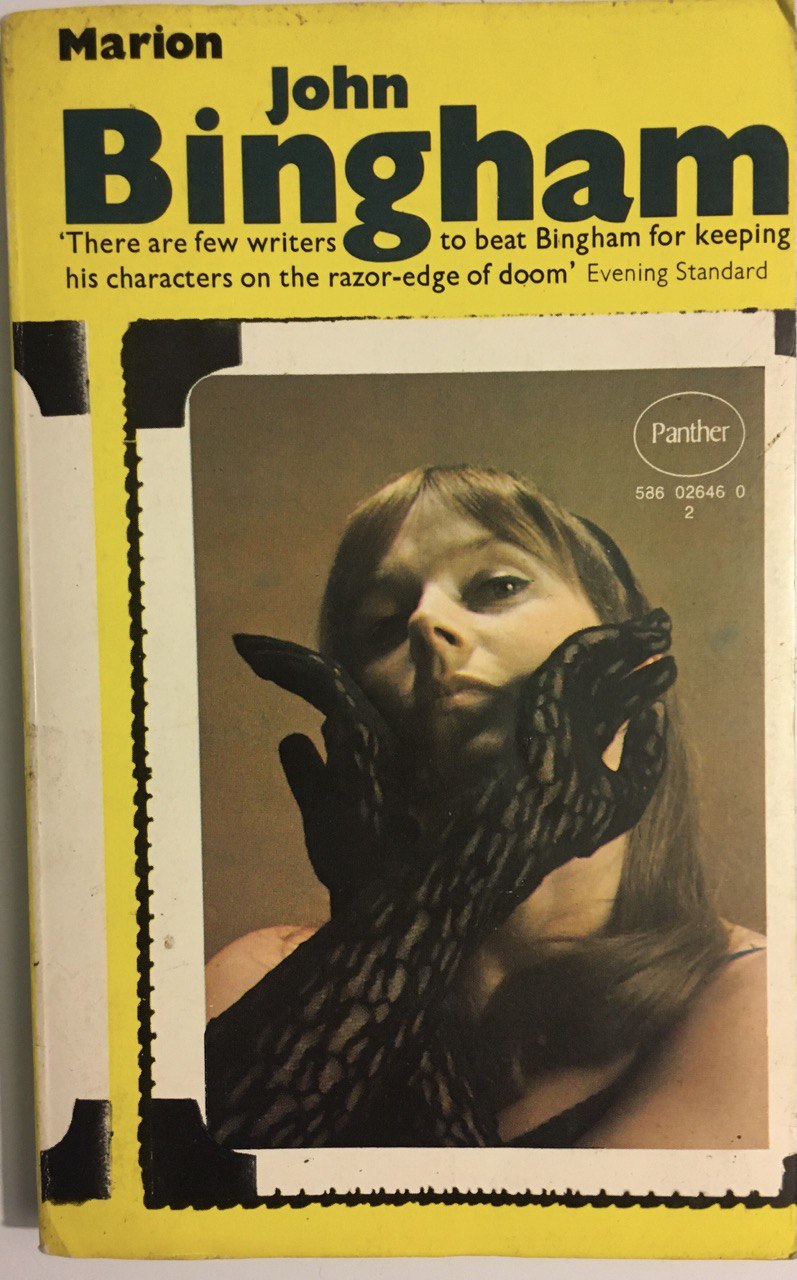
15. Marion by John Bingham
Turns out it was not a great read. It's competently even well-written, as so many of these mid-century journalists turned thriller writers were definitely professionals. It's just that most of the book (as the title states) focuses on his relationship with his wife (Marion) whom he discovers to have lied completely about her past and is a total philanderer. There is a thriller plot, but it is bookended and just not all that exciting. I also felt there was a very real plot flaw with the timing, but was too lazy and uninterested to go back and doublecheck. The book is written from the future and jumps around in time (as if the author is recounting the story, telling us where he went wrong). At one point, the various time narratives cross over in a way that made no sense, so that the discovery of his wife's infidelity happens before another major plot point that is dependent on him not knowing her infidelity. I can live with that and I may have misread, but though the backstory revelation of how he discovered his wife's true nature was kind of neat (he goes to her hometown to deliver flowers to her father's grave who isn't actually dead), I was just not that interested in his processing of the end of his marriage. There was also some weird class resentment thrown in that never got developed.
Looks like Bingham was one of these upper class WWII intelligence blokes who turned to writing. Maybe this was one of his lesser works.
Monday, March 28, 2022
14. The King's General by Daphne du Maurier
At first, I was bewildered by the context and all the characters. The opening chapter had me quite discouraged. Fortunately, it was deliberate, one of those openings where the character gives hints of the conclusion because they are now looking back on their past. Once the main narrative begins, du Maurier sets the stage with skill so that the reader internalizes the characters and their relations to each other. It takes place in Cornwall in the early middle of the 17th century. Honor Harris is the youngest daughter of a less arisocratic family. The antagonists at first seem to be their neighbour the Grenvilles, in the form of their beautiful avaricious daughter who weds Honor's oldest brother and then ruins and discards him. Things get complicated and romantic fast though when the youngest Grenville with the terrible reputation (debt and a lack of honour), Richard, woos our protagonist. On their weddding day, she is crippled in a riding accident brought on by his sister (who could have prevented the accident).
One of the main things I enjoyed about this book is that while there is much danger and threat and bad behaviour, throughout the entire story Richard and Honor's love is true. He is a ruthless, irresponsible bastard who is also an incredibly skilled soldier and competent general. He's a real dick, but in a cool ass way and you can't help but respect him for his constance. It makes for a subversion of the genre, as despite her crippled and childless state, he truly loves her. And despite his rash and cruel behaviour, she still loves him. It's a good romance.
I read that there were criticisms of the book at the time it came out in that it portrayed the language and behaviours of the people in a contemporary way. I have no way of knowing if this nerdy criticism is accurate or not, but at least the geography and politics are descriptive and accurate to paint a strong picture of what the civil war was like for the people who lived through it. The afterword reveals that the locations and the secret chamber were actually real, which is super cool. du Maurier's pedigree is bonkers. She basically leased and restored this sick castle because the family that owned it resided in some other manor. Nobless oblige indeed! Really enjoyable read.
Saturday, March 19, 2022
13. John Adams by David McCullough
At first, I was disappointed. Though extremely well-researched and constructed, it begins with way too much fawning. There was an unquestioning acceptance of the American experiment, the greatness of the principles of the founding fathers and non-stop admiration for Adams' frugal, hard-working Puritan New England values. I believe this is what they call a hagiography. I was appreciating the facility of learning history through the framework of a biography, as it does make it easy to absorb as you follow a person's life. However, too much of the early history felt very simplified and often unquestioned. I only have a bachelor's in history, but it is enough to recognize when conclusions are presented that lack nuance. It also just made the early days of Adams' life kind of boring to read. I am quite ignorant of the details of the American revolution, though, and this book helped fill in a lot of the early days. I was not aware of the moral furor, contempt and animosity the British felt for the Americans and I better understand now why the great Kenneth Hite always refers to them as "the hated British".
Fortunately, the second half, when Adams returns to America and starts his time first as vice-president and then president, the politics and history, though still surface, are treated with much more ambivalence. The book became much more engaging and McCullough's mission of making Adams out to be a hero much more successful. What I learned here, aside from the politics of federalism vs. republicanism in the first few presidencies of America, was that the country truly was divided from the beginning. It is both somewhat reassuring but also deeply unsettling to know that the same broad divides that exist in the U.S today were there from the beginning and that the shitty media worked as hard as possible back then like today to make them seem worse.
In the end, I put down this book quite convinced. I had been skeptical at the beginning, even somewhat sneering of it as a biography for the masses and that it may be, but by the end, it made me respect Adams and his wife Abigail even more. She in particular seemed incredibly strong and smart. A big throughline of the book is both the Adams' relationship with Jefferson and she is the one who really tears into him at the end, never forgiving him and telling him directly what a dick he had been when her husband was president, while John himself lets it slide. Impressive.
I haven't seen Hamilton so it may be more nuanced, but if that musical makes him out to be a hero, this book certainly portrays him as a manipulative, selfish asshole who tried on several ocassions to undermine the new nation. Jefferson comes off even worse and this was before his reputation was recently re-trashed with confirmation that he had several children with his slaves. All this filled in a lot of gaps in my own grade school and Schoolhouse Rock knowledge of American history.
Thursday, March 10, 2022
12. The Ship that Died of Shame by Nicholas Monsarrat
There were three longer stories that were all good adventures. The title story about a languishing WWII vet who hooks up with his old shipmate (and their old boat) in a smuggling venture had some neat details about cross-channel contraband practices and a cool, slightly superstitious moral theme (as hinted at the title). The Thousand Island Snatch takes place in Canada (where Monsarrat was stationed* as a diplomat for 14 years) and is a great brains vs. brawn tale of a scientist outwitting kidnappers and sparing his masculinity in front of his fiancee. Licensed to Kill is a bittersweet tale, again of post-war ennui. This time it is the tale of the man hunting the killer he trained in WWII who has lost his mind and putting his skills to practice in peacetime. There are several shorter clever stories that were easy to read that give a fun insight into Monsarrat's worldview. I especiallly enjoyed his pro-tax dig at British celebrities trying to avoid paying their fair share, "Oh to be in England!".
*Here is a fantastic exit interview by Maclean's where he is quite spot on about Canada:
Monsarrat: Canadians are always astonished that anyone likes their country at all. I’m always being asked, “Why do you live in Canada — why don’t you live in Paris, or New York, or London?” But the only people who ask me are Canadians themselves — no one else. I mean, an Englishman knows instinctively why I live here, which is because 1 like it. It’s a big country, lots of elbow room, not too many people, taxes are a little . . . uh, things like that.
Turcotte: Do all Canadians have this attitude?
Monsarrat: I think it’s predominantly the English Canadians. It’s a curious thing, but the French Canadians whom I’ve met and talked to and traveled about with seem to have much more confidence in themselves as Canadians than the English do. It’s the English Canadians who are asking all the questions and in many cases it’s the French Canadians who are giving the answers — and the latter have much more of a sense of being at home in this country and its future than the English. I don’t know why that is.
Tuesday, March 01, 2022
11. Charlie and the Great Glass Elevator by Roald Dahl
Monday, February 28, 2022
10. Sea Jade by Phyllis A. Whitney
I guess the appeal of these books to readers is the weakenss of the protagonist. I don't know, I really struggled with it. I get it at first that she is at a total disadvantage and is forced to marry Brock MacLean, the bitter, stormy yet of course oddly attractive heir apparent (and son of the murdered third business partner) as well as put up with his complete bitch of a mother and the totally rude and inappropriate housekeeper (who is bitter at Miranda because her mother was working class and married into her "betters"). But when in the big early twist, she is awarded complete control of the shipbuilding business and thus has power over all of them, instead of whooping ass on them all, she is super apologetic and cedes everything to Brock and tries to make diplomatic overtures to the two uptight women. I want a book where she slaps the shit out of her mother-in-law and stabs the housekeeper in a hand with a fork until she apologizes and gets dinner on the table fucking pronto.
Worst of all, though, is the romance. Brock is just an asshole. He's not straight up cruel, but treats her like a nuisance and patronizes her about almost everything even though she is usually the one on the right track. There is nothing inherently appealing about him yet somehow she falls in love. And all the mysteries, once resolved, are just not that satisfying. Finally, these books always have unreliable narration so you are never sure until the very end who is bad and who is good. I guess they are written that way deliberately so you can't guess by clues in the text, but it means that when you do find out the truth, it's not convincing because you don't feel confident about any of the heroine's interpretations that led up to it.
Friday, February 25, 2022
9. To Die in California by Newton Thornburg
Normally, a book like this would annoy me, as it is basically a genre revenge thriller gussied up with literary pretentions. It's written well enough that I got quite into it. Its literariness was not too pushy and its flaws were those found in thrillers of the period, mainly around the sexual politics. The book starts out with David Hook, a successful midwestern farmer at the funeral of his eldest son. Though we get the premise right away, it takes a long time to get to the details. This is where the literariness gets in the way of the efficiency one appreciates in a good action book from this time. It's not too annoying because the writing is so good and it does help establish Hook's character. His son was a great kid, who was going off to college before the draft and then coming home to take over his father's farm. However, he wanted to travel for a few months and met his end in California, supposedly killing himself by jumping off the cliff of a wealthy young woman's house in Santa Barbara.
The plot and premise reminded me a lot of The Limey, where the protagonist comes out to California to trace his child's death and learns more than he bargained for. It's pretty clear here, though, that the son truly was a good kid and really did love his father (and Hook is a tough guy but not a criminal himself). We meet a great cast of early 70s decadent Californians: the upcoming political star, his ugly mannish PR exec, his slutty aristocrat girlfriend, the ex-jock bodyguard and lots of extreme hippies. Though ostensibly liberal and meant for a liberal audience, this book has the ongoing self-loathing of the coastal elite that we see so prevalent in American culture today. The progressive politician is a sociopath hypocrite. All the hippies and gays are hopelessly doped up and lost. It's the good old salt of the earth family man who is the only real one (and maybe the vet cop).
I was actually quite into this book in the first half. It has a very satisfying slow burn where you are psyched for him to head out to California and avenge his son. When you get into the actual plot of figuring out the situation the son got into and trying to reveal the truth, that is also intriguing. The middle bogs down a bit when the principle characters are established and the reader has a pretty good sense of who the bad guys are. Here we also fall into the classic establishment fantasy trap of the older man having great sex with a super hot younger woman. I get the fantasy, but at this point it is just so cliched and sad that it really does undermine anything "literary" in this book. It's particularly egregious here when he picks up a prostitute and suddenly is able to last super long and surprises her by making her have an orgasm and then she wants to spend the night with him and give him a freebie in the morning. Insert rolleyes emoji here.
I quite enjoyed it and it was a real page-turner up until the end when it really does get quite depressing. Though flawed, it will stay with me. And I'd like to visit Santa Barbara one day.
Did a bit of research and Thornburg was quite successful in his day and ended up dying not very well remembered. Man, writing is brutal.
Tuesday, February 22, 2022
8. A Battle is Fought to be Won by Francis Clifford
I sympathized with Gillings to a degree. The fear and panic seemed completely reasonable, especially after the super nasty shit the Japanese do to prisoners (to break the morale of the enemy). However, his anxiety around his relationship with Nay Dun made him very unsympathetic. It did seem realistic and perhaps was the subtle real sub-text of the book: the alienation of colonialism. But if homeboy just chilled out a bit and tried to relate instead of being obsessed with his authority and being a leader, he would have seen the ironic twist that we all saw coming, that Nay Dun actually respected him. So a frustrating read, at times harrowing, overall really well-written. Not sure if the style is something that will motivate me to seek Clifford out, but I won't say no if another of his books falls into my lap.
Sunday, February 20, 2022
7. The Shooting Party by Isabel Colgate
Friday, February 18, 2022
6. Charlie and the Chocolate Factory by Roald Dahl
Almost everybody knows this book of course, but I would recommend you read it again if you haven't since childhood. It's so well-written, so impactful in its own little world and just so much crazy fun. The whole first section with starving, freezing Charlie and the starving, freezing Bucket family is so painful that it is almost unbearable and it makes the joy of the turn (when Charlie discovers the ticket), so great. My daughter was guessing what was going to happen (she is really not into intrigue and mystery; just wants to know what is going to happen) and mostly accurately. It's not that hard the way the book is structured, but I also feel it is such an ur-narrative of privation and humility followed by reward that it is almost natural to know and feel what is going to happen next. I'm no expert on the trends of children's lit but Charlie and the Chocolate Factory must be massively influential in the (excessive in my opinion) abundance of narrative that is drowning children in our post-Harry Potter world.
Wonka's refreshing lack of caring about the well-being of the bad children was written, I suspect, as a tonic against over-protective parents of the early 60s when it was written. Man, if Roald Dahl could see the parents of today with their leashes and anti-bacterials sprays and arranged playdates. We are living close to disaster in Wonka's world and it's fun! Smarter people have written smarter stuff about this book. I am grateful that I got to re-read it as an adult.
Wednesday, February 16, 2022
5. Strip by Thomas Perry
It starts out great. A guy who seems to be the protagonist is hiding out in the high cabin on a crane on a major high-rise construction site. We don't know much about him except that he is on the run and hiding and is capable of breaking into constructions sites to sleep in crane cabins while learning how to operate them solely by reading the manual. Though the action here was way over the top (he defends himself against 4 thugs and two SUVS with the crane), the writing had a nice stripped-down style with evocative suggestions of skill that I enjoy. I got a little ahead of myself thinking I had discovered a new Richard Stark, but the beginning had that hardness.
The premise is that this guy, Joe Carver, is new in town and was spending a lot of cash in strip clubs and was thus fingered as the stick-up man who robbed the owner of those clubs. Quite quickly, the narrative threads spin off in several directions and we follow the quite a few storylines, so many that it is not really clear until the end who is the actual protagonist. As well as Joe, we follow the story of the savvy and hard but older strip club owner, his driver, the detective investigating and the real guy who did the stick-up. So what starts out as a focused idea of the innocent badass trying to get the badguys off of his trail and then having to turn to ass-kicking morphs into more of a broad crime mosaic, focused ultimately on the club owner. It was all fairly enjoyable, though at times quite implausible, especially the recurring ease with which guys got laid by hot and interesting but complicated (putting it mildly) women.
I found the ending somewhat dissatisfying. It felt mean-spirited from what came before and also had a specifically nasty touch that I also felt didn't quite belong. So I would have to say from a critical pespective that the book doesn't succeed in landing all the planes it launched and it may have been better to have started out with fewer take-offs. The Joe Carver character, though he has a partial backstory is almost a maguffin, which is confusing as he starts out the book. Despite that, it was quite fun to read and a real page-turner. I also appreciated the detailed view on the backroom workings of strip clubs, felt very realistic. I will definitely pick up his other books, when I run across them.