Wednesday, February 29, 2012

10. The Words of my Roaring by Robert Kroetsch

I cannot even remember why I picked this book up.  I think it was early on in our Maritimes trip and at one of the first used book stores in PEI, so I was a little overeager (like women or fish, you need to let them come to you).  I was interested in it because it was Canadian and looked like a fun read.

It's a story of a man, Johnnie J. Backstrom, running in the Prairies during the Depression and a drought, running for office. His main opponent is an old doctor, who is also his mentor and father figure.  Backstrom himself is quite reckless and irresponsible, constantly drinking, spending money he doesn't have and neglecting his pregnant wife.  The whole story is told from his perspective and I guess we are supposed to sympathize with him.  His big move is to spontaneously predict that it will rain the day of the election and then he spends the rest of the book wrestling with the attention and potential success this gives him, while getting drunk and sleeping with the doctor's hot daughter back from an eastern college.

It's an enjoyable read, but doesn't really resolve itself in the end.  It seemed a bit of a celebration of masculine excess, without excusing it, but just lacked a concrete narrative for me to really like it personally.

One thing to note is the sticker with the author's name on the lower-right-hand corner.  Wow did somebody fuck up the printing of this book!  How pissed would you be to have been that author?  I can only imagine the conversations that went on behind the scenes when this book hit the shelves.

Sunday, February 26, 2012

9. The Hollow Hills by Mary Stewart

This is the sequel to The Crystal Cave and while I had been initially reluctant to continue on with the series, I found this nice coronet version that compliments my copy of the first one.  It arose next in line on my on-deck shelf and I dove in.

To my good fortune, I would add.  I loved this book. The first was very enjoyable (my reluctance to not continue is due to the vast number of books I still have yet to read and thus not ready to commit to multi-series books unless I really have to), but this one surpasses it in my opinion. It's about Merlin's quest to protect and raise young Arthur so that he shall be ready to become king when the time comes.  What I loved about this book is that Merlin just kicks so much ass, but he does it almost entirely without using force or violence.  His tools are wisdom, strategy, diplomacy, guile, discourse, negotiation, charisma and his reputation, all slightly enhanced by his magic.  I found it absorbing throughout with several tense, gripping moments.  Arthur's importance is that he is foreseen to properly unite Britain, and though subtle, there is also an inspiring undertone of British patriotism throughout the book that is also quite moving.

One element that troubled me was the portrayal of Morgause, who in Stewart's telling, is the evil sorcerous who may be Arthur's eventual undoing.  I'm sure feminists have dealt with the character in the myths.  Here she is given no mercy, shown to be utterly corrupt almost from the get-go.  All the elements from his lineage that mix to make greatness in Arthur, mix into his sister to make evil.  Given that Mary Stewart is a woman, most of whose novels I believe have a female protagonist, I wonder if it is okay to question her portrayal of Morgause as a missed opportunity.  If you care about those kinds of things.  As a potential antagonist (her role is revealed late into the book), she is pretty scary.

Great stuff and now I'll definitely read the third one when a nice Coronet version crosses my path.

Monday, February 20, 2012

8. Fireball by John Christopher

I'm less enthusiastic about John Christopher's young adult stuff.  It's not that it's not good (the opposite in fact, it ranks among the classics), but it lacks the underlying anxiety that I enjoy so much about his earlier, adult fiction.  The YA books are also quicker reads, with simpler, condensed narratives.  They are not totally fulfilling for me as a reader.  As a collector, though, I have decided with the conclusion of Fireball that I will definitely be keeping an eye out for his YA fiction to add to my bookshelf.  When I finished Fireball, I thought it was a one-off (like Wild Jack) but it turns out to be a part of a trilogy as well, though one, I suspect, that wasn`t originally planned, as the three books are so far apart and the stories so different.

The basic premise is two cousins, one American the other British are spending the summer in the english countryside when they see a fireball floating in the air.  They go to it and the next thing they know (after some discovery) they are in an alternate earth where the Roman Empire never declined.  They become involved in a Christian revolution and when that turns sour, they head with some new allies to the New World.  I kind of got into it, especially the exploration of the world.  The coda is their voyage to the new world and that is the part that really intrigued me (thus my interest in picking up the sequel, New Found Land).  There was also some stuff at the beginning that suggested that their world was not in a great state ("the television news had been on, showing yet another scene of mob violence somewhere").  I'm curious to see if they get back to their world and any of those hints are played out.

Christopher's adolescent protagonists are often kind of whiny pills.  The American cousin, Brad, is superior to the British kid, Simon, in the ways that matter to teenage boys.  He is also more idealistic and moral.  At times, though you are in the thoughts of Simon, one finds him a bit of a pill.  There isn't a whole lot of arc for him either, at least in the first book.  He just kind of ends up following Brad's lead, after initial resistance, because Brad is usually right.  British inferiority complex on the part of Christopher or a sucesful technique to appeal to the minds of his readers?  It's hard to say, but it is noticeable.  I'm also interested in seeing if this dynamic develops in the later books.

Thursday, February 16, 2012

7. Flight into Danger by Arthur Haley and John Castle

This is another book I picked up in the Maritimes.  I've learned since finishing it that it is the novelization of the teleplay of a very succesful 1956 TV movie on CBC that launched Arthur Haley's career.  I don't know if this is the first, but it certainly strikes me as the classic tale of the amateur or retired pilot forced to land a passenger airplane.  Here, a severe case of food poisoning in the salmon that is served for dinner jeopardizes the health of many passengers as well is incapacitating both pilots.  Luckily, there is a doctor on the plane and even more luckily, George Benson, a truck salesman who flew fighter planes in WWII.  This is a very straightforward, tight and exciting little thriller.  There is no bigger plot or unexpected twists, no real drama among the passengers or the ground control.  Just a man who hasn't flown for 13 years and only flew single-engine fighters when he did being coached from the ground by an expert pilot while passengers are slowly dying and the odds of him actually landing the bird are extremely low.  I found it quite thrilling and tore through the second half.  The lesson here is that you don't need a lot of bells and whistles if the story is exciting and you can tell it in an effective way.  Good stuff.

(Note, while I found several images online of the same cover, they were from Pan books.  This Totem imprint was published by Collins and sold, I believe, only in Canada.  Here is the little blurb from them on the inside back cover (backispiece?):

Wednesday, February 15, 2012

6. The Fiend by Margaret Millar

Ah yes, the great Margaret Millar.  I felt like a bit of a fiend simply reading this book in public.  How freaky is that cover!  I'm a huge Patricia Highsmith fan, but I'm believing more and more that Millar belongs in her class and is maybe even superior in some respects.  Millar is less clinical.  She seems to have some affection for her characters, though she is absolutely unsparing in the way she exposes their weaknesses and flaws.  It gives a bit of warmth to her books that make them perhaps a richer read.  Boy is she unsparing, especially towards women (another similarity to Highsmith).  A smarter person than me with more time should dedicate at least a long article, if not a book on comparing the two authors and their works.

The Fiend is ostensibly the story of a mentally damaged individual, Charlie Gowen, who lives with his older brother.  There was an incident with a child that happened in his past, sent him to a ward and made him the town pariah.  Today, though, at least on the surface, he is more or less coping and the few people he does interact with consider him more or less "fixed", if they are even aware of his history.  His brother, though, has basically sacrificed his life to take care of him and he is highly attuned to any potential weirdness or strayings.  And Charlie is straying.  He has noticed a particular little girl, Jessie a little daredevil, and is started to become obsessed with her safety.  He wants to "protect" her.  Millar draws out his pathology very gradually (as well as the details of his original crime), so you never really know how far he will go or the exact nature of what it is he will ultimately do.  It's nerve-wracking!  The question of whether he can exist in society is on the table and you do feel some sympathy for him.

Charlie's story is actually the center of a much richer plot, involving the little girl's parents and the two other families that are close to her: the childless couple of whom the wife is obsessed with Jessie and the bitter, misandrynist divorcĂ©e who is the mother to Jessie's best friend.  It is in the portrayal of these people where we start to see the real human ugliness.  It would be simplistic to pit the seemingly normal people against Charlie, but that isn't what Millar does here.  Everybody gets their brain opened equally and revealed to the reader.  Charlie's is just much more inconsistent and difficult to figure out.  But they are all pretty messed up in one way or another.

I suspect that a professional psychologist would probably find some of the analysis of Charlie's mind possibly a bit dated or erroneous.  There were some parts that seemed a bit facile (though a lot of those came from the perspective of a character, so it's hard to say if Millar was reflecting her own take or what she thought the character would think).  There was also a small side development between the divorcee and her lawyer that seemed forced and unnecessary.  But otherwise this is a pretty excellent book that keeps you hooked right to the end.

Monday, February 13, 2012

5. The Lady in the Car with Glasses and a Gun by Sebastien Japrisot

Finally starting to get my reading pace back again.  Still not quite where I was last year, but I am feeling that joy of really getting into a book.  I apologize for my lameness in not getting back to those of you who have so kindly commented (and often quite wittily) in a timely manner.  I hope that my growing reading energy will also translate to more responsible blogging behaviours.

I'm quite happy with my good luck in my recent cheap and free book finds.  Quite often when you take a flyer on an author or book you've never heard of, you can suffer.  I am not able to not complete a fictional book once I've started it and because of that have suffered through some painful reading in the past (The Folly by David Anne is a recent example).  That's the fear that is nestled in your head when you are staring at a cool-looking cover.  Sometimes I'll buy the book but then keep on putting off reading it, so that it is always staring at me from my on-deck shelf, making me feel guilty and questioning whether I have the intestinal fortitude to be a true book nerd.

 The Lady in the Car with Glasses and a Gun is an example of a complete guess.  I found it at the S.W. Welch sidewalk sale for 50 cents.  It looked very intriguing and had a cool cover.  I'd never heard of Japrisot and was mildly concerned that it was a translation. 

It turned out to be a very good read.  It felt a bit like The Red Right Hand as if it had been written by Simenon.  It's the story of a neurotic young Parisian woman who gets asked to drive her boss and his wife to the airport in their fancy Thunderbird.  Instead of returning it to their house as she is supposed to, she decides on a whim to take it on a holiday drive.  Her head is full of her own neurotic and insecure thoughts.  She is a weird girl, seemingly attractive but isolated and in the habit of lying to her work colleagues about her life (and particularly her vacation plans).  As she travels through the outskirts of Paris and the small towns along the vacation route, things start to get weird.  Someone attacks her in a gas station bathroom and when she comes to, her hand is injured and she isn't sure for how long she had been out.  Even weirder, people start acting like they had already come across her.  The reader as well as the heroine are really not sure what the hell is going on.  Is she insane?  Is she the victim of some bizarre, improbable plot?  It's a compelling journey across the social and physical landscape of late-60s France, with lots of amoral people at every stop.  As the mystery gets weirder and more convoluted, we also learn more about the girl. 

Worth checking out.  I'd read another of this guy's books for sure.

Thursday, February 09, 2012

4. The Tango Briefing by Adam Hall

I had what I believe was the first Quiller book on my shelf for years and I finally gave it away.  I couldn't remember why I never got into it. I found this one in a pile of recycling and refuse at the corner of the school near my house.  It was being thrown out with a bunch of other books from the library.  I started reading it and I think I know now why I never got started with the other one.  If The Tango Briefing is any indication of the Quiller series, it is some pretty hardcore nerd-espionage.  Nothing can be simply done without Hall explaining in insider espionage language the background, the ramifications, the various potential outcomes, several other instances of the same maneuver having been done (generally unsuccessfully) and how it will impact the behaviour of the "opposition".  It's kind of like reading about a football game where each play is prefaced with a litany of statistics and comparisons.  It's cool if you are into that sort of thing, but can be a bit trying for the reader that just wants some football action.  In case you think I'm exaggerating, the act of flicking a lit match into a car's gas tank takes over two and a half pages of explanation!

Furthermore, he writes in an almost poetic style at times, using incomplete sentences and jumping around in time without being really explicit about it.  So if you aren't paying close attention, it can be easy to get lost and not even be clear where the protagonist is geographically at any given point.  This reader was not paying close attention in the first third of the book or so.  However, once I did finally get an understanding of his style and once I got caught up in the story, I did pay closer attention and actually got quite into.

My critique above are not really criticisms, because Hall is a skilled writer and the story that goes down was really cool.  It's simply a question of personal preference.  You see some popular modern writers try to write like this (Jeffrey Deaver comes to mind and Lee Child as well).  Once you read a Quiller book, their efforts seem sort of cartoony and overblown.  The Tango Briefing was intense.  The story centers around a mysterious marking in the middle of the Algerian desert, some kind of aircraft, discovered by British surveillance.  Quiller is sent out to establish a base and make his way to the aircraft without being discovered.  Unfortunately, when he gets to Algiers, he finds that two previous agents ("executives" as they are called) have already been compromised: one killed and the other a broken, nervous wreck after having been followed by a sniper for several days.  Just the process of setting up a way to get to the aircraft in the desert takes up about half the book, with Quiller negotiating every step to lose "tags" (people following him) and avoid alerting listening posts and other sensitive alerts that make up the world espionage network. The "opposition" is so faceless that it might as well be a computer network.

When he does get to the desert, he has to find the wreck, discover what is so special about it and get out.  The whole section in the desert is really intense and believable.  It gave me a strong feeling of how frightening it would be to be exposed in the middle of the sahara where even if you had enough water, you couldn't drink it fast enough to prevent the evaporation from your body.

I'm not sure if I will rush after any more Quiller books.  They are a little too detailed and complex for my simplistic mind.  I would, however, strongly recommend them to anyone who considers themselves a hardcore espionage fiction enthusiast.

Friday, February 03, 2012

3. The Friends of Eddie Coyle by George V. Higgins

The Friends of Eddie Coyle definitely lives up to its reputation as a classic.  It's the story of a lower-echelon mafia guy juggling a mix of gun-running and informing while trying to navigate his way between the law and his colleagues in crime.  It's told almost entirely in dialogue, though the crisp, intense bank robberies are narrated.  It's the kind of book you should really try to read without a lot of breaks.  Due to the dialogue and the lack of clear identification of some of the speakers at the beginning part of the book, the reader can get a bit lost (or at least this distracted reader).  But once you start to grasp the overall form of the narrative, the story flows forward and you can't stop turning the pages.  This is a dark, realistic and gripping read.  Strongly recommended.  I am looking forward to checking out the movie now.

Wednesday, January 25, 2012

2. The Lost World by Arthur Conan Doyle

Note to self:  continue to read non-Sherlock Conan Doyle books.  The Lost World was really awesome.  I found it at a bookstore with the Lantzvillager, who recommended that I get it.  It was a good recommendation as I thoroughly enjoyed this book.  The adventure to the lost world plateau in the heart of South America was great, but I loved the public spectacle of scientific controversy in Edwardian London that bookened it even more.  Good stuff.

Thursday, January 12, 2012

1. The Diamond Smugglers by Ian Fleming

I don't know what's up with me this year, but I just can not get motivated to write my blog posts.  Perhaps I pushed myself too hard last year, perhaps it's bigger issues.  It's bizarre and I can't figure out what is going on (which is also bizarre).  I do not want to lose track, though, so I will continue to log the books I've read and put up their covers.

I found the Diamond Smugglers in the Maritimes.  It was in terrible condition, but had such a cool cover that I picked it up.  It assembles a series of articles Ian Fleming wrote for a Sunday paper where he interviews a top agent working against international diamond smuggling.  There were some neat anecdotes and a fascinating picture of the diamond industry and black market in the world after WWII.  There were some very disturbing and damning assumptions made about who had the native rights to the diamonds that reflect an ongoing colonial mindset.  Neat book.

Saturday, December 31, 2011

61. Without Drums or Trumpets by Alec Le Vernoy

Another succesful random book find closes out my 2011 year of reading.  Without Drums or Trumpets was one of the books I found in a dusty box in a top shelf of a work closet.  I had actually not taken it the first time through because the cover and title combination was so uninspiring (I thought it was a treatise on peace).  I had a second opportunity to go through the box and gave this one a closer look, thus realizing that it was actually a cool-sounding WWII narrative about a french guy who got into all kinds of adventures.

At the start of the war, Le Vernoy was a young outdoorsman, who loved the mountains.  There is a brief prologue of him with some friends on a trek and then we launch into the invasion of France and Le Vernoy's crazy story.  He fights briefly with the French army before the capitulation.  Instead of surrendering, he continues fighting and fleeing, making his way to North Africa.  There he tries desperately to join the British with a couple of insane kayaking and sailing episodes to Gibraltar.  He finally succeeds but instead of getting sent to fight, he is placed by British intelligence back in North Africa where he does a bunch of spying and then sabotage missions with the local french community in occupied North Africa.  I throw that off in a sentence, but this section alone is full of incredible episodes of tension and violence.

He eventually gets captured and spends time in a Tunisian prison.  When Nazi rule in North Africa starts to collapse, he is shipped to Germany with a bunch of other important prisoners where he ends up in a concentration camp.  The narrative here turns from the adventurous to the truly dark.  No matter how many different perspectives and narratives I encounter about those concentration camps, I am still surprised once again by the incredible horror of what went down there.  I guess the mind just sort of blocks it out.  In Le Vernoy's case, he was one of the POWs in the camp so it gave a different perspective than from the Jews who were for the most part sent specifically to be murdered.  All the other prisoners were basically being worked to death, so it wasn't much better, but it is just interesting to read about the experience from someone who actually saw families still carrying their suitcases being driven to the gas chambers, not realizing what was going to happen until the last minute.  He also writes an extremely effective passage where he describes the horrific philosophy of production behind the way the camp was being run.

Aside from being incredibly resourceful, he can also speak German and was a medical student, skills which get him into slightly less deprived positions in various prisons and which also allow him to find means of escape, which he does.  Most of his war, in fact, is him on the run, which leads to a lot of frustration for him, as his main goal is simply to get out and fight. He also has a lot of criticism for the majority of his own people, the french who collaborated or just remained passive.  The times when he goes from door to door, desperate for a bit of help, and is categorically refused by his own people are maddening and an important reminder for us all.

As a book, the translation from the french is a bit rough (but makes it feel that much more authentic) and as a personal narrative it lacks a consistent structure.  Those are minor concerns, though, as the guy's story is just so crazy and entertaining (and informative) that you can't stop turning the pages.

I was reading the end of this book while flying home.  The in-seat entertainment device was playing 24 channels of broadcast television and I kept getting distracted and flipping through the channels.  It was new year's eve and so we had all these countdowns and summaries of 2011.  Except for the brief actual news events, it was all so much irrelevant horseshit.  It just saddened me that a guy like Alec Le Vernoy, who had all of his fingernails peeled back slowly one by one because he wouldn't inform on his fellow prisoners, is mostly forgotten while our most powerful media voices spend vast resources celebrating nobodies who have done nothing.  Is this what guys like m. Le Vernoy sacrificed for?

Tuesday, December 27, 2011

60. The White Rajah by Nicholas Monsarrat

First of all, a minor pat on the back for myself as this 60th book brings up my "lifetime" (well since 2005) 50 books average up to 50 books per year.  This was my goal and though I flagged in the second half of this year, I have achieved it.  So that is quite satisfying.  Now I shall try to maintain this average in the years to come.

I picked up the White Rajah early on in my trip to the Maritimes this summer almost entirely on the strength of the author's name.  I had only read The Cruel Sea and really enjoyed it.  The White Rajah sounded like a very different kind of book with an adventurous, possibly swashbuckling premise.  It also had a cool map of some south seas island.  As you can see, those elements were strong as they outweighed the super cheesy cover.

It's the epic story of Richard Marriot, younger brother of an artisocratic family in the 18th century who is left nothing but a globe and a pair of pistols by his wealthy father.  The book opens at the day of the funeral when Richard's stuffy older brother basically throws him out of his newly inherited estate.  After this dramatic chapter, we jump forward 10 years when Marriott is a pirate captain, sailing the exotic oceans.  He stumbles upon the island nation of Makassang and finds himself in an advantageous position, where he can upset the balance of power in a struggle between the ruling Rajah and the resentful buddhist priests.  Marriot is soon inculcated into the royal family and the bulk of the book follows the political struggles and his efforts (and lack thereof) to take control and help move the island from its savage state to a more politically enlightened place, with the help of the Rajah's beautiful daughter.

It was a really enjoyable read that suffered in the end by moving away from the adventure and intrigue towards political moralizing.  It wasn't heavy-handed, but instead of a tense narrative, Marriot's struggles are sort of undermined by a semi-deus ex machina ending (that also all too easily waves away all the narrative potential of the conflict between Richard and his brother, who is instrumental in the deux ex machina ending).  Another problem was the protagonist himself.  He is portrayed as a lusty, headstrong young man whose natural energy and charisma (which are wild and out of control when he is a young lord in England) are honed in his years as a south seas freebooter.  When he gets to Makassang, he becomes seduced by the easy living and grows soft and oblivious to the dangers around him.  It's a great theme, but I felt that it went on for way too long, with the dangers being so obvious and Marriot himself being so lame that I grew frustrated with him.  So instead of personal growth and a kick-ass return to form, we get lots of lots of him being passive while worse and worse shit goes on around him until finally the situation is intolerable, at which point a British gun ship comes out and saves the day.  He is never really given the agency that would pay off all the built-up potential and so the reader is left a bit unsatisfied.

Still, the first half of the book is gripping, the situation and location are exotic and richly developed and portrayed.  It was an enjoyable read and I would keep an eye out for any other Monsarrat books.  He is very skilled at telling a story, enough so that I am not ready to say that some of the choices he made in this book reflect an actual flaw in his skill as an author. 

Thursday, December 15, 2011

59. The Folly by David Anne

My copy does not have the yellow graphic on it.
I stumbled upon this book in a big ripped open garbage bag of books in my own back alley.  At first, I thought I had stumbled upon the mythical motherlode.  They were all paperbacks, all in read but decent condition and looked to be from the time period that I am interested in.  But as I started to root around, I saw sadly that whoever had owned these books had the worst taste.  It was all that late 70s, early 80s garbage like Lawrence Sanders.  Ugh.  I did manage to salvage an Ed McBain and this british horror novel which looked promising.

According to the inside cover, it is David Anne's second novel and his first was a best-seller.  The cover I got off the net here also suggests that The Folly was also a best-seller.  I find it a bit hard to believe.  This book is not terrible, but it's pretty bad, awkardly and obviously structured without any real suspense.  It does have a few moments and ideas of horror that are okay, but otherwise it feels like the book equivalent of the TV movie of the week.

It takes place in the countryside and the events surrounding Sir Mark Hatrell's lands and the ancient tower called the Folly.  People in the surrounding countryside are getting savagely attacked and eaten by some creatures.  [spoiler here] It turns out that sir Mark, with a crazed scientist he hired, have turned the Folly into a secret lab and are experimenting with rabbits and myxomatosis.  I guess that was a real virus that killed tons of rabbits in the english countryside.  Their goal is to get rid of rabbits, which eat the crops, once and for all.  To do this, they need to create a rabbit that is immune to the disease (yes, this makes no sense and doesn't in the book).  They end up creating giant carnivorous rabbits.  We get lots of semi-gruesome eatings of various people, an intrepid journalist who is having an affair with sir Mark's wife (and an even more convoluted backstory involving sir Mark's first wife, whom he stole from the journalist then turned into a junkie—I guess to give the journalist some more motivation but it really has little role in the book) and a small cast of other characters, including a police sergeant and a gamekeeper.

When the gamekeeper was first introduced early in the book (he is resistant to Sir Mark's aggressive plans to modernize his farms), I had high hopes that he might be the protagonist.  Unfortunately, he ends up being a secondary character.  Even worse, he makes a stupid blunder that is clearly put in place to create some action.  He and the journalist hide out in a blind with a recently killed lamb to attract the rabbits.  Their plan succeeds and they finally observe the rabbits in action, but when they go out to inspect the shredded carcass, the gamekeeper trips and shoots the journalist in the leg!  This is an obvious device to get the rabbits to come back (they are attracted by the smell of blood) so we get an action scene.  So retarded. What kind of gamekeeper would ever trip in a hole in a site they had carefully prepared and even worse would have their gun unbroken or the safety off so they would shoot a compatriot in the leg.  This scene offended my sensibilities to the point that I almost stopped reading the book.  If you can't write a thriller with everybody being efficient, just don't bother, okay.

Friday, December 09, 2011

58. Deadly Welcome by John D. Macdonald

Courtesy of Vintage Paperbacks
This was one of the paperbacks I found on a weekend trip to the Laurentians this summer.  I've read a lot of John D. Macdonald's, both from his Travis McGee series as well as his stand-alone thrillers.  I love his books, but a writer as prolific as he, with such a strong style, can tend to become a bit repetitive if you read too many too close together.  Also, his books are very easy to find, used and cheap.  For these reasons, I tend to not buy his books any more, preferring to hold them back in case of emergency.  In this case, it was the original paperback and thus probably has some value (except the guy stuck a $3 price tag with masking tape on the cover-Argh!) and it has been quite a while since I last read a John D. Macdonald (according to this blog, not since May 2007!).

The story here is about an agent who is pulled from his Venezuela post to go back to his own small Florida town to try and convince an old scientist to get out of his funk and get back in the game working on the weapons research that he abandoned for a beautiful young woman who was recently murdered.  The agent has a rich and troubled past with this small town and the murdered woman as well, so his espionage assignment also includes his own personal challenges.

Macdonald is excellent at creating corrupt small Florida towns and that was one of the things in the blurb that attracted me to this book.  I wasn't disappointed. The psychotic sheriff was particularly well (and disturbingly) portrayed.  He rules the town with expert and scientifically sexual beatings with his billy club, breaking the spirit of anyone who might be a troublemaker.  He gives the agent a solid working over his first day in town and that becomes motivation for the reader and the agent to get their own back.

Unfortunately, it never really builds up into a rich climax.  Instead of the whole town being corrupted, the sheriff is really the sole bad guy.  There is also not a lot of mystery around the murder of the woman, though it is drawn out for quite a while.  The atmosphere and the characters are quite good, but  I suspect it's the mix of the espionage side with the personal history side that didn't quite gel.  It might have been better had it been one story or the other (which Macdonald later did do).  So all in all not terrible, but not one of his best.

Wednesday, November 30, 2011

57. Cinema Sewer Volume III by Robin Bougie

Just a little example of where Bougie's sick head is at
I already blogged about this book earlier in the month when I first received it.  I did so because I wanted to share some of the Robin Bougie goodness with the world and I didn't think I would "finish" it any time soon.  Cinema Sewer is a magazine and these collections are just that, a collection of past issues. So it has tons of short articles and I tend to read them jumping around (often when on the can) never really sure if I've read the entire thing or not.

However, for whatever reason, I started out doing that and then just ended up reading it straight through, skipping the few articles I had already read (and reading some twice in a few cases).  So I get to count it as a completed book for the year.

As always, if you enjoy the combination of degenerate smut, lost popular culture and general weirdness, then Robin Bougie is your man.  This guy is an expert in the history of pornography, women in prison movies, 80s action flicks, weird Japanese perversion movies and so on.  His writing is enjoyable for two major reasons: 1) he drops tons of knowledge which for the nerd and student of history is like a big bowl of ice cream and 2) he has so much enthusiasm for the subject.  His love of what the info he is sharing with you is just so contagious that almost every article makes you think "holy shit I need to go hunt [obscure bizarre crazily enjoyable sounding movie or series of movies X] down right away and dedicate the rest of my weekend to watching it!"

Actually, I should add that his writing style, technically and creatively is impressively skillful in and of itself.  He's raunchy but direct and punchy, so you want to keep reading.  And he has some hilarious turns of phrase, particularly when he is describing the sex act and element thereof and when aggressively pushing you to go watch the movie he is talking about.  Most nerd preachers can be very annoying (and you know that Robin can go down that road with the hilarious cartoons from the great Colin Upton—who is also Bougie's long-suffering neighbour—about being forced to watch some profoundly disturbing movie by Bougie).  But somehow, at least in print, Bougie is so positive and enthusiastic that he doesn't have to be pushy.  He has already convinced you that you want to watch the movie.

I have one minor problem with the text in these books and it is a typographical one.  Bougie hand writes all the text in all caps.  It's a strong, steady and actually quite readable lettering, except for the punctuation.  The first letter is the same size as the rest of the letters in the sentence and the period is easily overlooked so that I often found myself getting confused about a sentence only to realize that I was mixing two sentences together.  Just a minor quibble and probably nothing that can be done about it now, especially given the tremendous amount of physical labour that goes into these books (and the overall look is quite beautiful), but just thought I should share.

I also found this third volume a bit too consistent in content as compared to the first two.  It was almost entirely movie reviews and biographies of porn stars.  All were good and interesting, but it felt like the first two volumes had a greater variety: more guest writers and artists, articles about a wider range of topics and some rich and challenging opinion pieces as well.  On the other hand, the opening essay of this volume "HOLY SHIT!  PORNOGRAPHY!" was powerful, compelling food for thought, a strong argument that our current moral perception of art is something quite new in the history of civilization.  I would have liked to see a bit more of that kind of thing in the overall volume.

Generally, though, another excellent addition to the Cinema Sewer oeuvre.  Robin Bougie is doing western civilization a huge service by his hours of research, drawing and writing.  I would subscribe to the magazine, but I just can't keep things in that physical format around, so I will wait patiently for volume IV and maybe this time I'll get a raunchier dedication drawing!

You should get this and the first two.  Also great xmas present for the movie nerd in your life who may be ready to take the next step towards the dark side.  You can do all that here.

Tuesday, November 15, 2011

56. Airs Above the Ground by Mary Stewart

I first discovered Mary Stewart thanks to my friend (sadly not blogging about his books and probably not reading much anymore due to a good case of the triplets) who is a huge fan of her Arthurian trilogy.  I read the first one and really enjoyed it (and have the second one from the same publisher on deck).  I did not realize, though, that Stewart was a succesful and well-established author of the genre people credit her with creating and mastering, the thriller-romance, long before she did the Arthurian trilogy.  I learned this by discovering Airs Above the Ground in a very full used bookstore in Moncton and then doing a bit of follow-up research on the web.

The book started off in a very promising way.  A young woman is bummed out because she and her husband had a big fight just before he left on a business trip.  They were supposed to meet up for a holiday after, but now it is all up in the air.  During a lunch with an older family aquaintance, she gets roped into chaperoning the older woman's son to Vienna where he is hoping to stay with his father.  At first, the heroine is really not interested, but what clinches the deal is when she sees a newsreel talking about a deadly fire that took place in a circus travelling through Austria.  She glimpses a man who looks just like her husband standing next to an attractive woman in the crowd outside the ruins of the fire.  It's an intriguing premise and definitely makes you turn the pages.

Even more fun, the boy, who is 17 and at first full of resentment at being chaperoned, turns out to be up to his own little game (he hasn't actually told his father he is coming) and quite capable (he speaks german, knows all about horses).  So both characters have their own little secrets (she doesn't tell him her suspicions about her husband) and as they travel, they start to reveal them and team up.  Of course, they do end up chasing after the circus and that's when the intrigue starts.

Unfortunately, the premise was much better than the payoff.  I found the first half to be really enjoyable and gripping, but when the reveals start happening, they are all pretty banal.  Her husband turns out to be a super spy and the boy just tags along for the ride.  All the potential tension is taken out of the relations between the characters and instead we get a super-safe, British old boys (but with a keen girl) crime-stopping caper.  There is some interesting sub-text about men and women and the role of the male protagonist in the genre, but Stewart plays it very safe.  It's not bad, but once I knew there were going to be no twists and that the good guys were truly good and decent, I wasn't so motivated to keep reading and it took me a while to finish it.  I had been hoping for something a bit more acerbic along the lines of Highsmith or Millar.  Maybe in her later books, she pushes things a bit, because she was certainly talented and intelligent.  And the Crystal Cave definitely had a darker side.

Sunday, October 30, 2011

Cinema Sewer volume III - my own personalized copy has arrived!

Got my personally dedicated copy of Cinema Sewer Volume III in the mail this week!

I used to be sort of scared of Cinema Sewer.  Robin Bougie does not hesitate to go into some of the nastiest corners of the grade B movie world.  On the contrary, he jumps in with both feet.  Some of the movies he talks about are way too harsh or gross for even my depraved tastes.  But I finally broke down when I found Volumes I and II at some great discount while waiting in line at Fantasia.  Once I started reading them, I realized what I had been missing:  tons of awesome information on all kinds of crazy movies delivered with a rocking attitude and beautifully laid out and designed.  Since I devoured the first two volumes, I've been following Robin's awesome (and definitely NSFW) blog and waiting impatiently for volume III.

Robin also has a tradition of doing a dedicated drawing to each person who buys the book directly from him.  His pictures are bonkers, possible quite offensive even.  You can see them over at his blog.  I was quite excited to get my own dedication drawing.  The drawing itself showed up on his blog this summer, but it wasn't until last week that I got the actual book. Wow is it ever gorgeous.  And just so stuffed with info.  Bougie hand-letters each page himself and there is a ton of text.  When I first looked at it, I was sort of intimidated by the amount of text, but once I got into it I am having a hell of a time putting it down.  This is the kind of book you want to just sort of jump around from article to article, but it's so engrossing that I am almost tempted to just start at the beginning and read it straight through (it does have a great opening essay on the origins of obscenity).

I have mixed feelings about the dedication drawing I got. On the one hand, I really appreciate the effort that was put into it and in real life, the quality of the art is really impressive.  It's just that I think I may have gotten the tamest image of them all!  It's an elegant little piece, but it feels almost absent when you see the insane robots and aliens and amputees in dripping, stretching sexual acts that everybody else got!  It is entirely possible, though, that I may have asked for him to not go too gross on mine when I ordered my book.  Nevertheless, I treasure my dedicated drawing and am just loving the book itself.  I already read a great piece on "southern discomfort" movies by contributor Don Guarisco (who has his own SchlockMania blog here) that led me to Race with the Devil which we watched last night as part of a Halloween double feature.

Thanks Bougieman!

Thursday, October 27, 2011

55. Eighty Million Eyes by Ed McBain

I literally found this book in a pile of garbage in an alley here when walking the neighbour's dog.  It wasn't total "garbage" but a bunch of stuff left over from someone who had moved out.  This happens often here in Montreal, people move out and then just dump all the shit they didn't want to take with them into the alley or the street in front of their apartment.  It can be a disgusting mess but you can also find some cool stuff (I've found several beautiful old tools in the past).  In this case, there were several garbage bags filled with old paperbacks!  I really thought I'd hit the motherlode.  When I started to go through it (and I was not the first, so maybe somebody got to the good stuff), I realized that whoever owned these books had the worst taste.  It was almost entirely terrible 80s schlock.  Thick wannabee bestsellers with embossed and fold-out covers.  Crap like Lawrence Sanders and a bunch of those epic romances.  I did find this one McBain book and even though the cover is super 80s, I felt I needed to find something.  McBain, in my experience, pretty much always delivers.  He's not awesome, but he is solid and you get a great look at police procedure in the city.

Eighty Million Eyes is two simultaneous and unconnected investigations.  One is about a really scary psycho guy who is stalking a woman.  The other is about a successful comedian and talk-show host who dies mid-show of poison.  Both were compelling and the one about the stalker was actually quite brutal and scary.  It had one part that I would almost say fell into the exploitative, but just by a smidgen.  It definitely freaked me out as I was in the middle of biting into a mayonaissey burger at the time of reading and it was all about a woman who after being brutally beaten discovers an even more horrible thing on her stomach.  Yuck!

This book also had cool artifacts, like an actual sketch drawing of the suspect, a classified ad (faked by the cops to draw the suspect out) and a complain report.  I guess that gave it more of a realistic, procedural feel.  I wonder if McBain did that stuff himself or if he had people lay it out for him.


Monday, October 24, 2011

54. The Freebooters by Robert Wernick

I picked this one up warily, early on in my Maritimes trip.  I hadn't yet really made any great finds, so was a bit less choosy.  I loved the cover and it was in beautiful condition, but it looked more like one of those literary-type war books rather than one with lots of ass-kicking.  Well it turned out that my hunch was correct, but it was nevertheless kind of an enjoyable read.

It takes place near the end of the war, immediately after the allies have liberated Paris.  The narrator is one of those too intelligent, too cynical soldiers who spends most of his time drinking wine and reflecting on humanity and doing it in that weird pseudo-beat, pseudo-hemingway writing style which seems affected and mildly annoying in the gleaming of the noonday light against the metal ashtray while a prostitute screams from above.  Fortunately, this style was applied relatively lightly so it never became cloying.  The book details his adventures with a special unit.  Unfortunately, these adventures never involve actual combat, but because he and his two partners are fairly crazy, they keep getting into all kinds of romantic or criminal trouble.  The book flows from one weird post-war situation to the next.  Seeing the locations and the characters was quite enjoyable and somehow it all flowed together, even ultimately I couldn't really get the point of the book or care about anybody.

So a nice-looking cover and an okay read, but not one I would strongly recommend except for readers particularly interested in philosophical post-WWII books.

Thursday, October 20, 2011

53. The Break in the Line by Berkely Mather

My reading consumption has slowed down to a trickle, thanks to a major renovation project I am overseeing at work.  This will kill what was going to be a record-breaking year, but I still have a book going at all times.  This is an important lesson.  Even if you get swamped and barely have any time to read, don't stop reading altogether.  You'll be surprised how many books you get through without even really realizing it during very busy periods.  The trick is to pick books that you can pick up and put down without forgetting too much of what is going on or which character is which.

The Break in the Line attracted me because it is one of the Fontanas with the same look to the Desmond Bagley's I first saw as a kid.  I particularly like the use of the green in the cover title.  Berkely Mather had a whole series and I guess was a well-enough respected military espionage writer that his name got to be much bigger than the title.  

The story takes place in cold war southeast Asia.  The protagonist, cynical and self-effacing, screws up what was supposed to be a pick-up mission upriver into Burma.  He sort of hopes he'll get fired and can get out of the game altogether.  Instead, his superiors corner him into taking a more risky job (both personally and professionally) of following a double agent from Calcutta far to the north, across the Himalayas (dangerous) and into China (super dangerous) in the hope of finding "the break", the point where the Chinese were meeting with their agents.

It was a gripping story, especially when they get into the mountains.  Both the espionage stuff and the outdoor adventures stuff was good.  The former had lots of tense stops at small mountain villages where they had to try and not stand out too much (or be hidden entirely by allies).  There is a cool part in Tibet where the monks are basically fascist thugs, no friends to the Chinese (though possibly with informers among them), but very scary to anyone else.  My only complaint was that the protagonist had that tendency to be a dick to everybody as well as constantly down on himself.  You see this in these British books of the 60s and 70s and I've never quite understood the appeal.  It makes them not likable at all, which I guess was part of the point.  Ultimately, the portrayal of the political reality of his situation makes it quite believable that he would be a stressed-out dick, so at least it wasn't forced. 

Another funny thing happened when I was reading this.  There is a map at the beginning (which I always appreciate), but it's weirdly oriented and badly labelled.  It's a section of southeast Asia, centered around the northeast corner of the Bay of Bengal.  What was driving me nuts was that it showed Pakistan to be south of Bhutan and east of India!  I couldn't believe that they could have made a mistake so I finally started looking into it and it turned out that there used to be two Pakistan.  Rather, Pakistan was divided into two after Indian independence, I guess because there were Muslim communities on either side of India.  Eastern Pakistan felt neglected by their more powerful western counterpart and eventually there was a war of independence and eastern Pakistan became Bangladesh in 1971.  The Break in the Line was published in 1970.  Kind of cool that it caught that little geo-political window in history where Bangladesh was part of Pakistan.  


Thursday, September 29, 2011

52. Semi-Tough by Dan Jenkins

Not good.  Probably the biggest disappointment since I've started doing this blog.  It's not like I had super high expectations, but I like football and I like the early '70s and the combination of the two is a great little slice of American culture that I've always enjoyed (Hunter S. Thompson talking with Nixon about football on the campaign trail is a great example of this).  I guess Dan Jenkins is a well-respected sports writer and Semi-Tough was quite successful, critically and commercially.  But it sucked.  I don't even really get what the point of it is.  About three-quarters of the book is the narrator, the star running back for the New York Giants, saying all this stuff that is supposed to be shocking: casual racism, sexism and drug use.  Whoopee-doo.  Maybe for people in the '70s this was some titillating, shocking revelation.  Even if it was, do we need a hundred pages of it, and always in this self-congratulatory tone?  The whole thing is narrated before a Super Bowl, though the game itself is an afterthought.  The climactic scene seems to be a big party the night before the big game where two women strip naked in front of the party.  Whoop-dee doo.  Even lamer, the whole thing ends with a weak romance.  There was just nothing here and it was boring.

I had kind of wanted to see the movie, but it sounds even stupider.

If you want to read a half-decent book about football in the '70s, go read Jack Tatum's biography "They Call me Assassin."

Wednesday, September 07, 2011

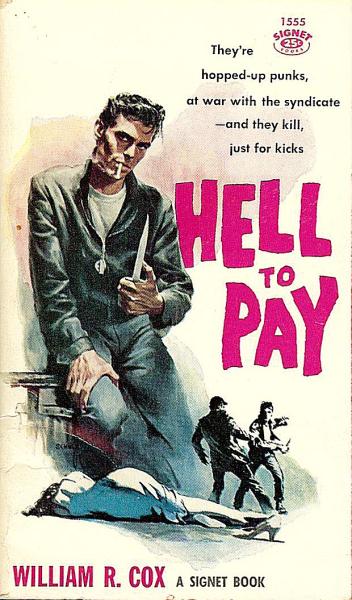
51. Hell to Pay by William R. Cox

We went up to the Laurentians for an overnight stay at a lakeside hotel with some friends during the Labour Day weekend and during a lunch stop at tourist town St-Agathe, wouldn't you know it, there was an outdoor book sale!  Most of the tables were french or local authors or recent best seller paperbacks in english, except one where the guy had an amazing collection of paperback pulps from the 50s for reasonable prices!  Unfortunately, I felt some social pressure and we hadn't eaten lunch, so I ended up only getting three and regretting not scooping up the others when I had the chance.  Turned out the seller had once own a bookstore and this was left over from his remaining inventory.  He had inherited most of the inventory and didn't know much about old crime paperbacks. The previous owner had, but also had some ridiculously marked-up prices (this one for instance, had $26 pencilled in the inside front cover).  I was actually reading another book, but Hell to Pay starts off so well that I couldn't put it down.

It's the story of  a succesful Manhattan gambler, Tom Kincaid, who is connected to the Syndicate and underworld but manages to maintain his autonomy (to everyone's displeasure).  He keeps the balance until a brief altercation at a dice game with a young punk suddenly puts him in the middle of what appears to be a generational gang war between the Syndicate and these crazy, hopped-up greasers who seem to like violence for its own sake.  The plot is much more complicated than that, with lots of twists and turns.  Right up until the end, there is a mystery as well, which is why the protagonist is so much in the middle of everything.  The reveal was pretty cool and definitely surprising, but that part of the story was not super convincing and it came out a bit soft in the end.

What was convincing and really well done, was the milieu.  This is Richard Stark's syndicate, with big, older men with last names only from out of town meeting in fancy residential hotel rooms.  All the locales—the restaurants on Broadway, the garages, the underground dice games and high-roller card games—were richly portrayed and interesting as hell.  The violence, also was compelling and intense ("Like in the Islands during the war, I kept moving, firing").  The cover over-hypes the young punks theme, but it is the central theme and they are truly hateful.  Hell to Pay echoes the conservatism of the genre, but from a strange perspective, because basically everybody is a criminal.  It's just that the older criminals have a code and are doing it for the money and the control, while the young ones are just irrational, cruel and destructive.

For some reason, the language of the action scenes reminded me of The Big Blowdown, when they corner the extortionists in the garage.  Wonder if Pelecanos has read this one?  Anyhow, despite a bit of an easy ending that didn't really fit in with the grit, tension and brutal violence that went on before, this was a solid, satisfying crime novel.

Friday, August 26, 2011

50. Operation Stranglehold by Dan J. Marlowe

My reading and posting has slown down somewhat and probably will continue to be slow until early October as I am overseeing a fairly large renovation project at work (large for my normal job, anyhow) and it is taking up a lot of my time.  I'm going for the short, punchy books that don't demand a lot of my memory or commitment but deliver the cathartic savagery a working man needs in this world of law where you aren't allowed to break someone's fingers for sticking gum on to to front railing.

Operation Stranglehold is apparently the first Dan J. Marlowe book I've read, at least since I started the 50 books project.  While I was reading it, I had him mixed up in my head with Donald Hamilton.  That is cleared up now and it sounds like Marlowe had an interesting life history.  Operation Stranglehold is part of the ongoing series of Drake books ("The man with nobody's face").  If this one is representative of the series, it is pretty standard mass paperback espionage fare of the period.   I suspect he has better books in him.  In this one, he has to rescue the son of a powerful politician from a spanish jail before the arrest can be used to make the politician look bad.  Also, Drake's mentor or sometime partner had been sent out to do the job and got caught himself.  So Drake and his super-hot girlfriend (who is also rich) go out to Spain and get involved in a decent little adventure.

It's not a great book and a bit of an inauspicious choice for my 50th, but it was competent enough and had some good little details about trying to get through the authorities in rural spain, some nice stuff on a train. It just had no real bite or thrill.  There is one really weird thing and that is the conceit of the book, that Drake has had extensive plastic surgery and thus looks really weird and anonymous.  He has no hair on his head at all, wears wigs and has to wear make-up in the sun!  How the hell does he get a super-hot babe girlfriend?  Doesn't everybody think he looks like a disturbing weirdo?

Note, this cover is not my own.  I've got the same one, but there are no scribbles on it.  I picked it up in my Nova Scotia trip.  I'll scan mine when I can find it again (told you I was busy!)

Tuesday, August 23, 2011

49. Virginia's Thing by Henry Woodfin

Picked this up for a buck during our vacation in Nova Scotia, though I can't remember exactly which book store. Maybe the one in Lunenburg? You can see by the cover why I picked it up. I'm always interested in portrayals of the '60s in crime fiction. I love the crazy naîveté of the period, especially juxtaposed against the hard reality of the investigator.

The book is much calmer and less over the top than the blurb on the back suggests. It's a basic detective story, starting with a job. The sensible and independent daughter of a union boss has been missing for two weeks. He wants her found as quietly as possible as he is participating in a tight election. The job sends the detective to the campus of the state university, where he encounters the diverse society that is the intellectual left, focusing especially on a professor couple. Slowly, we learn more about the girl and more about the people around her.

It's interesting and engaging, but we don't learn anything that helps us with what actually happened to her until quite near the end. So the mystery itself seems a bit rushed when it gets wrapped up. The emotional impact doesn't though, and the message of this book is pretty establishment all the way, though in a sensible, quiet sort of way. The academics with their extreme, absolutist views, are made to look obsessed, weak, soulless and basically evil. At the same time, there is a certain sympathy for the more sensible liberal elements (interracial marriage is strongly approved of). Though it's a savage portrayal, the author suggests that living with their own conscience is punishment enough for their sins. All in all, it's that kindler, gentler conservatism from folks who fought in the war. I wish we had more of that around today.

 Other than the pacing of the mystery itself, this was quite a good read. I was caught up in the characters and felt a certain bit of satisfaction with the way it all concluded. I can't find a single other book by this author. It was from Pyramid books, who bothered to credit the cover artist (D. Greene - I wonder what Louis XIV knows?)


Saturday, August 20, 2011

48. The Big Guy by Wade Miller

Was this ever a cool book. The opening lines were enough to sell me: "Joe Drumm glanced dispassionately at the blood on his knuckles.  It was not his own blood."  Well the rest didn't disappoint.  I read this book pretty much non-stop, including staying up way past my bedtime to finish it. So I am happy to say that it lived up to my expectations, even exceeded them.

It's the story of a heartless and aggressive thug who rises to power and then succumbs to it. Joe Drum is a brutal man, animal-like in the way he approaches the world. Early on in the novel, he and a partner stumble upon a bunch of cash while doing a strong arm job for the big boss in town. They use it to leverage a higher position in the organization. From there, Drum sees all the weaknesses and attacks until he is the kingpin. Then things start getting interesting.

The first half of the book, chronicling Joe's strategies and conflicts on his way to the top, is enjoyable but not uncommonly good. We've read this kind of stuff before. The second half, where we learn through Drum that power does indeed corrupt, is uncommonly good. It is structurally satisfying as well.

I really want to talk about the sexual relations in the book, but doing so will mean revealing some pretty major spoilers. Put short and as vaguely as possible, The Big Guy subverts that tradition in crime novels of this era where the dudes either stalk or sexually assault the women who then fall in love with them. Great read. One of the best of this genre I've read so far. Great language, rich crime milieu, lots of creative action, decadence and sex, what's not to like? A nasty and smart little book.

Here's a link to a good review with some interesting info about the author (authors actually as it was "a couple of high school buddies who teamed up to write mysteries all their adult lives").  He doesn't like their other books, but many people do in the comments below.  I'll keep my eyes open.

Okay, now here is the motherload:  MysteryFile has pretty much everything you ever wanted to know about Wade Miller.

And here is a little Westlake reference :  "More recently, Mr. Wade was given the 1998 City of San Diego Local Author Achievement Award.  Still an active octogenarian, he writes a monthly mystery wrap-up column called “Spadework” for the San Diego Union Tribune.  From this vantage point, he can survey past and present crime writing.  He has praised such crime authors diverse as Martha Lawrence, Robert Crais, Rochelle Krich, Sue Grafton, Donald Westlake, Marianne Wesson, and Janet Evanovich."

Wednesday, August 17, 2011

47. Lucifer's Hammer by Larry Niven and Jerry Pournelle

When I was younger, though some of my friends were reading the books of Larry Niven and Jerry Pournelle, I always thought they were going to be too hard and dry, so I never read them.  Perhaps Lucifer's Hammer is not totally representative, but if it is, it's a shame, as I would have loved it as an adolescent and the simplistic politics would have mostly gone right over my head.  The authors do have the reputation of being hard sci-fi authors, but I think that must have been a title that was easier to learn back in the 70s as the science in Lucifer's Hammer seems to be about as good as all these reports debunking climate change.  And it reads like a giant soap opera with lots of crazy action.

It's the story of an asteroid that hits earth and it centers around a large cast of characters in southern California.  It takes place in the mid-70s and it shows.  The first quarter of the book feels like a written version of Knot's Landing or some boring "adult" novel from that period.  It isn't until society starts getting a bit freaked out about the comet that things get interesting.  Then the comet hits and the fun starts.  The middle section is very satisfying as we get to see all the various forms of destruction it causes and the various characters trying to save themselves.  The last part of the book is those characters trying to rebuild a society and struggling against the challenges of resources and the destructive factions, notably an army of cannibals.  The super blatant theme of the book is that science and technological progress is good and any form of resistance to that is bad and naive.  This is sprinkled lightly throughout the book at the beginning and then made obvious at the end and finally basically shoved down the reader's throat in a final secondary climax that kind of ruins the satisfaction of the ending.

I've run into many nerds in my travels who espouse this kind of faux-tough, pseudo-science based anti-environmentalism.  This position disguises itself as a rational, political stance when it is primarily an emotional one.  The basic tenets are that 1) environmentalists are naive and their ideas would never survive a second in a non-civilized world and that 2) science and technology will always find a solution to man's needs.  There is a lot to both of those tenets, but there is also a lot to question there.  Of course, the nerd anti-environmentalist position leans heavily on the logical fallacy of the excluded middle.  And ultimately what it really is is a justification for one being allowed to do whatever one wants without any kind of interference or having to make an effort to think about how your behaviour may impact the rest of society, the planet and the future.  It's a kind of technological libertarianism and very appealing to the male adolescent who can't get laid.

Here, for example, is a throwaway line when the reporter decides to get some stuff ready for hammerfall (the name given to the time when the asteroid hits, even though it is not predicted to hit):

Solar heat: the simples and most efficient solar system known to man.  Hang your clothes out to dry, rather than use an electric or gas dryer. Of course, not many "conservationists" did it: they were too busy preaching conservation.
Have you never read the Whole Earth Catalog, Jerry and Larry?  This kind of nonsense is peppered throughout the book but really gets retarded when, in the final pages, after the organized good people have beaten off the cannibals and are celebrating.  The team that was sent to protect a surviving nuclear power plant comes back with the bad news that the remnants of the cannibal army are in a position to destroy it.  This sets up an impromptu debate with all the main characters deciding whether they should hunker down, enjoy their win and survive the winter or go and save the nuclear power plant to ensure a long-term future.  What is so stupid about this, in the context of the book, is that this argument was already had and won by the long-term faction, which is why the team was sent out to protect the nuclear plant in the first place.  So not only are you thinking, "okay, yeah, yeah, we get it, having power is awesome and the future of mankind" but you are also trying to figure out why the pivotal character who comes in and forces the trip out to the nuclear power plant is suddenly nowhere to be seen in this final debate.  Oh yes, we also learn that not only is chemical warfare necessary, but it (and the bodies of its victims) are excellent fertilizer.  And for a supposed hard science book, there is some shocking ignorance about nuclear power (such as blowing up a nuclear power plant is not the same as a nuclear bomb so therefore there won't be any radiation or fallout).

I'm harping on the political stuff, but the bulk of the book is actually just people surviving the craziness and that stuff is quite enjoyable, once you get past the stupid '70s soap opera crap.  (Just for one example, the main character goes out to the country in one early episode to interview a senator at his ranch and ends up hiking with his hot daughter. when they get home, she offers to make him dinner and I kid you not suggests microwaving the steaks and this is treated like some awesome advancement; this probably offended me more than any of the nerd politics. How utterly retarded were the 70s.)  Lucifer's Hammer felt like a mix of a bunch of post-apocalyptic classics.  You've got your Alas, Babylon, your Earth Abides, The Postman, even The Stand comes to mind at points (which came out a year later).  It's good fun for the most part with a couple of really cool characters (Harry the country mailman who never gives up doing his rounds and ends up as a messenger in the post-hammerfall world and Dr. Forrester who lovingly wraps up all his books and buries them in the front yard).  I guess I would consider it a best-seller type of PA book, kind of a mess, but quite entertaining for the most part.  If you are a fan of the genre, you need to read it at some point.

Wednesday, August 10, 2011

Looking for others on Google Plus

Hey, I'm over at Google+ and I'm finding it difficult to connect with other people there who are interested in the same kind of books as I am.  I'm sure they are out there and it would be fun to have the kind of short-term discussions and sharing of neat stuff that goes on on G+ with them.  So if you are on google+, find me at Olman Feelyus and add me to your book circles or whatever.  If you want to be on, let me know in the comments and I'll try and send you an invite.

It's weird, because I already have lots of people I already know as well as tons of people from the tabletop RPG community in my circles.  But I can't figure out a way to search people by interest and thus find discussions about other subjects (mainly books and movies) that I am interested in.

(I'm going to post the same thing over at Briques du neige, but over there I'll be looking for movie geeks and Montreal and Canadian issues nerds.)

Friday, August 05, 2011

46. Bloody Sunday by Frank Scarpetta

Okay, now we're talking!  No more of these sensitive chick books!  What a breath of fresh air to finally wallow around in the mud of good old fashioned killing of mafia and hippies and balling young hippie chicks.  Bloody Sunday was weirdly really good in parts, appropriately pornographic in others and basically workmanlike in its ensemble.

We start in medias res, with no real back story or history for the protagonist, Magellan.  He has been shot in the shoulder after wiping out a nest of mafia scum in one city and ends up in another.  An old woman finds him in the alley and takes him home.  She is originally from the country and one of the few good people in the bad part of the city.  Turns out she had 12 sons, only 2 of whom are still alive and the last one got killed trying to find out what happened to his daughter.  What did happen was that she had been sent to an apartment as a replacement stenographer for a meeting with some big time businessmen.  The meeting turned into a party and they wanted her to join along.  She didn't want to party and they threw her out the window.

So though we are almost already halfway through the book (he also dispatches the local enforcer and his superiors who are extorting the old lady), Magellan now has his new mission.  The second half of the book is him hunting down each of the four businessmen, figuring out how to get to them, getting to them, killing all their men and then torturing them to death after letting them know why. This is really the porn here.  There is some sex (and I have to say it wasn't bad, especially the lead-up stuff; I guess I'm becoming the perverted middle class, middle-aged white male demographic Scarpetta is targetting) but it's the descriptions of the exit wounds and the bodies spinning and the long-drawn out final torture (which really is gruesome) that push this book into pornography.  But hey, I'm not really complaining!  Those scumbags had it coming to them.

Parts of this book, though, were actually quite well-written.  There are way, way too many adjectives and lots of run-on sentences, but otherwise it's sparse and direct and at times even quite effective.  The final torture scene takes place on a field of cows and the whole thing is punctuated by the cows themselves, who at first nervously hover around and then, when the torture really gets going, totally freak out.  It worked very well to ramp up the tension and horror of the scene.
There was a small, squat structure a few yards from the feeder.  Several of the cattle snorted with fright and raced away again as he walked toward it, their tales whipping as their hooves thudded against the ground.  They lumbered around and crashed through the brush to circle and come back in their agony of terrified fascination with him and the break in the monotony of the long night of their lives.
During my vacations I took a walk that passed several fields of cows and I have to say that "their agony of terrified fascination" perfectly describes their reaction to me.  It was rather unsettling.

I have learned through this post on the Glorious Trash blog, that Bloody Sunday is actually The Marksman #20, part of one of the many series in this sub-genre.  I'd love to find out the history behind the series, who were the real writers, who was behind the publishing.  Probably some good stories behind that history.


Wednesday, August 03, 2011

45. Memoirs of a Lighthouse Keeper's Son by Billy Budge

This book was published locally in the Maritimes.  I learned about it thanks to the recommendation of the good innkeepers of the excellent Four Mile Beach Inn at the north end of Cape Breton Island in Nova Scotia.  It's a region of Canada that has a lot of history and they are quite proud of it.  I was happy to find this book in one of the little road side stops and to learn that there is a small but going press that produces a lot of interesting books from and about the Maritimes.  

This is the story of Billy Budge, whose father got a job being the lighthouse keeper in lonely St. Paul's island, a rock off the northern tip of Nova Scotia that was known (and still is today) as the Graveyard  of the Gulf.  It's a short, directly told and quite engaging tale.  The family (Billy was 5 at the start, his little sister, their mom and their Newfoundland, King) stayed there for 5 years and had many interesting and challenging interactions with the tough environment as well as the isolation.  It's a great read, very positive but also realistic.  It's one of those books that reminds you that life can be really rich and fulfilling without a lot of stuff and society as long as you have a purpose and interesting things to do. 

What I found a bit surprising is that the challenge for the author was not going out to the island and being separated for everybody.  His real difficulty came when he had to return 5 years later and go to school.  Either it was because of his age during his time on the island or his personal make-up, but he really preferred the loneliness and difficulty of his life on St. Paul to the crowded world of the mainland and it took him some time to re-adjust. 

Check out St. Paul's Island:


View Larger Map