Monday, November 05, 2018

37. The Pride of Chanur by C.J. Cherryh

I picked up this very nice hardover in Nanaimo.  I think it's a first edtion, but don't know how to tell for sure [editor's note: it's not.  It's a book club edition, story of my life].  I quite enjoyed her book Cyteen, enough that I wanted to try out her more popular Chanur series. It took me a while to find the first one and I am glad I didn't give up the search.

The Pride of Chanur demonstrates Cherryh's strong handling of emotional interactions and complex political and commercial intrigue.  Unlike Cyteen, this one takes place in a really far flung universe with several alien species, some of them so alien that they can't even really understand each other (though they trade).  The protagonist is Pyanjar Chanur, the female Hani captain of the merchant ship The Pride of Chanur.  The Hani (actually hani as none of the species are capitalized here, I guess like the way we use the word humans) are lion-like creatures, bipedal with claws, manes and expressive ears.  Only the females venture out in space, as the men are too volatile and remain back at their home planet protecting their holdings from each other and their own sons who come back and try to take power.

The book begins with the Pride docked at Meetpoint, a trading station, when a strange fugitive creature runs aboard their ship.  It takes a while for the reader to realize it is a human and we learn that it escaped from the kif, a nasty, thieving species that all the others hate and fear.  It sounds a bit simplistic from my description but in the book it quite works.  These are really unlikable creatures.  Pyanjar cannot in her conscience return the human once she realizes it is sentient (though they cannot communicate at first) but by keeping it, she risk stirring up major inter-species conflict.  And that's what happens.

A lot of this book is a really cool space chase, with the Pride at a major disadvantage.  It is Pyanjar's experience and character that is put to the test in such overwhelming odds and we the readers are right there cheering for her and her crew (and the human dragged along).  There is lots of cool space combat and tense strategy and trickery as well.  All very enjoyable stuff for me.

There are 5 books in the series, which I think make up two overall narratives.  I will definitely keep my eye out for the second one.

Sunday, November 04, 2018

36. Red Ketchup Intégrale Volume 2

This is a collection of books 4, 5 and 6 of the Red Ketchup series.  The first three books are some of my all-time favourite comics, a beautiful combination of Hergè-like art and Wonder Warthog style anarchy and chaos.  Red Ketchup is an unkillable psychotic FBI agent, existing solely on handfuls of pharmaceuticals, driven by an 80's American distilled Rambo fascism.  He is also not bright at all and ends up achieving his mission through sheer destruction and the wild coincidences and machinations of the characters swirling around him. His boss at the FBI is constantly trying to take him out of circulation which leads to him causing greater destruction.  It's all a hilarious critique of American exceptionalism and the fantasy of violent victory over bad guys that dominates American comics.  Réal Godbout and Pierre Fournier are highly recognized in the BD field for this and their other great series Michel Risque (where Red Ketchup first appeared as a side character).  The books are also physically beautiful published by La Pasteque, such that I made an exception to my usually going to the library and actually started buying them.  They are translated into english and you should get them.

I sat on this Intégrale for quite a while because I wanted to savour it.  Ironically, when I did finally start reading this one, I got bogged down and abandoned it.  Book 4 Red Ketchup s'est échappé!  (Red Ketchup Got Away!) is actually very talky and starts out with tons of dialogue.  Ketchup who has been sent up to space by his bosses decides he has finally had enough.  He returns to earth (ignoring the burning up as he goes through the atmosphere), resigns in a huff and moves to LA to open up his own private detective agency.  This one really lacks the chaos of the preceding three volumes and I found myself worried that Godbout and Fournier had lost their way as perhaps there is only so much you can do with the concept.  Particularly frustrating is that Ketchup is constantly constrained throughout the book while surrounded by the kind of sleazeballs whom he usually destroys.  Likewise, while much of this takes place in the Hollywood film milieu, the satire is applied rather lightly.  There are the characteristically funny touches along the way, especially in the advertising for American products you can see in the background.

The second volume, Le couteau aztèque (The Aztec Knife), gets interesting again, though this time it is a trippy time travel adventure.  Red Ketchup's sister and brujo Juan Two-Tree chase Red through history (and he chases himself through his own abusive past) as he inserts himself into various conqueror's and completely rewrites the past.

LOL!
The third book, L'oiseau aux sept surfaces (The Seven-Surfaced Bird) brings Red Ketchup fully back to form.  I burst out loud laughing several times so much that my daughter kept asking me what was so funny.  The story here is an hommage to manga and kaiju, as Red Ketchup is sent by his bosses on a false investigation of the disappearing turkey population ("if the turkey disappears, what will happen to democracy!?") to get him out of the way.  After a hilarious investigation in supermarkets, Turkey farms, processing plants and finally a country fair where he slaps a turkey (this is what cracked me up first), Ketchup goes to Japan where it turns out his old enemy Docteur Künt is developing a gigantism gene. Chaos ensues.  This one was fucking awesome.

Now I have 3 more volumes left. The intégrale hasn't come out yet and I am debating whether to get them individually or just wait.  Either way, I am going to savour again.


I mean look at that.

Friday, November 02, 2018

35. The Moonbeams by R. Vernon Beste

I quite like the sombre colours and purple edges of this paperback.  It was in very good condition when I got it, perhaps only read once by the previous owner.  Two days of reading by me has left it in a much more "used" state.  I was pretty careful but I guess just the age of the paper and glue means that any movement creates lines and little degradations.

I thought it was an American crime novel when I picked it up, but it's actually a British WWII spy novel, specifically about agents working the ground in rural occupied France near the end of the war, allying with the resistance and communists.  The protagonist, Maltby, is cynical and bitter, but also kind of lost.  The book begins with him back in London after a debilitating ulcer forced him out of the France where he had worked with a small team of 5 other spies, blowing up industrial sites and spying on the Nazis.  Although he could have had his "ticket" to take the rest of the war off, his own anxiety about who he is allows him to be convinced to return.  His handlers learned that one of his crew was a double agent, working with the gestapo and was getting ready to blow up the entire extended network.  They send Maltsby back to find out which one was the traitor and also to blow up some crucial and irreplaceable machinery (because it was manufactured in Britain before the war) in a ball-bearing factory.

This is really more of a war book than an espionage book, though technically it's all part of espionage.  Most of the narrative takes place in France in this one region where Maltsby has been operating.  I found the detail of the way they managed themselves and planned their actions to be really interesting.  I don't know how realistic it is (there seemed to be quite a few englishmen who could succesfully pass as working class or peasant frenchmen, but perhaps to the Germans such a disguise would be more effective).  It was also near the end of the war and German forces were weakened, distracted and low on supplies.  There is also some really interesting social exploration, as Maltsby gets to know each of his fellow spies in a new way now that he suspects them of betrayal.  In particular, he discovers that one them is homosexual and he is disgusted but doesn't want to be, as his own innate prejudice clashes with his theoretical liberal values.

Though I am always a sucker for the happy ending, given the darkness and anxiety that makes up most of the book, I found the way this one concluded a bit pat.  Likewise, I guessed the traitor quite early on and found Maltsby's mistake somewhat difficult to believe. These are minor complaints about what was otherwise a solid and engaging story set in a well-portrayed and complex milieu.  Basically a really good resistance story.


Love those purple edges!

Thursday, November 01, 2018

34. Without a Trace by Background GmBH

I can't even remember where I found this book now, possibly in a box of books on the sidewalk.  It's a guide to police detection techniques written in 1977 by a far-left radical group in Switzerland. The version I have is a reprint by Partisan Press in Seattle 3 years later.  I was interested in it mainly for the time period and some insight into policing methods that would be relevant to the genre of books I tend to read.  I had been putting off reading it for some time along with the few other non-fiction books on my on-deck shelf but with my current spurt of reading energy decided finally to take it on.

At first it was really quite laborious.  I really struggle reading non-fiction. On top of it, the intro is dripping with the vocabulary of late 20th century intellectual left dogma.  I consider my politics to be fairly left-leaning (what we would call "progressive" today) and even quite radical in some areas.  But god do I balk at the nerdy rigidity of this particular form of thinking where everybody is a comrade and the bourgeoisie are this evil force.  It is probably the biggest failure of the left (and most ironic), its insistence on verbal conformity and taking itself so seriously, an issue we still see with us today in the internet sphere of leftist politics, though the language has varied.  Anyhow, I digress (and probably have already labelled myself as some kind of traitorious middle-roader).  My point is that I was having a hard time with the lack of narrative and feeling annoyed by the rhetoric.

As I progressed through the book, however, I began to enjoy it more and more.  The bulk of it is straightforward and well-written.  It is a broad survey of the various techniques that police forces use to investigate crimes.  The word they use the most is "trace" but I think they meant "clue".  They explain how detectives can find clues in voice recordings, typewriters, handwriting, explosion and arson scenes, guns and bullet wounds, fibres and materials.  It's a fascinating look at the state of forensic analysis and tools at this time period.  Much of the techniques are pretty outdated today, though probably form the foundation of many current techniques.  It is amazing the detailed work the cops go through and how difficult it is for "criminals" (a bourgeois label filled with bias) to neutralize the evidence.  There is an afterword where the writers mockingly explain what they went through to ensure that they could not be identified by this booklet (the original one), buying paper in small batches from several producers, destroying all the identifiable parts of the offset printing press that made it and so on.

And it is at this point by the end that this book got really entertaining.  They editorialize much more and there is some hilarious stuff.  Here is a paragraph from a section on ordering helpful material directly from book publishers and dealers.

Many or most of these works are written by and for the police, military, and intelligence communities, which has both positive and negative aspects.  On the one hand, frequently the practical and theoretical expertise of the authors cannot be questioned, despite the political despicableness of the presentation.  On the other hand, because many of the books are written for the ignoramuses who staff these government agencies, they are frequently boring and unenlightening for the intelligent reader.

That immediately made me think of the narcs and DEA agents pissing in their boots while on stake out in the Freak Brothers comics.  The bibliography at the end is gold.  There are several books that I need to add to my list that I discovered here, including Operation Ogro by Julen Agirre about the assassination of the Prime Minister of Spain and Franco's right-hand man and The Final Score by Emmet Grogan.

It's also a very revealing look at the mentality of the time and how much more freedom (at least of thought and expression)we have achieved since that time in the West.  Or perhaps how much more information we have access to and can share because of the internet.  Also a warning in these darkening times that extreme repression is always lurking.

As I read the book, it basically fell apart at the spine.  I was planning on recycling it but think I may now get it repaired and keep it on the shelf.

Tuesday, October 30, 2018

33. The Salamander by Morris West

Another find from the hospital used book store, The Salamander has the look of the classic 70s bestseller.  It even has a quote from Cosmpolitan on the cover, so I guess they felt it would attract both men and women readers.

It's an odd mix of genres.  It starts out as a detective story and then morphs into a much larger-scale political thriller about halfway through without adding any new characters.  I guess one might say that the biggest character in the story is Italy herself.  Throughout the narrative, all the characters and the protagonist are constantly talking about the history of Italy, the political culture of Italy, the Italian character, how Italians are just so different from everybody else.  This is not an original refrain and I suspect there is some truth to it, but it is really hammered home here and I'm not sure how authentic any of it is.

The story starts with Inspector Matucci of the internal intelligence agency the SID, responding to the death of a very powerful general who was in line to possibly be the next leader of Italy, possibly through extra-legal means.  He finds a clue leading to The Salamander.  The first half of the book is this investigation.  It's fairly cool.  There's lots of rich locations and interesting methodology of a secret police inspector who is relatively morally good.  As the investigation broadens, it becomes less about what actually happened to the general but rather what conspiracy of a fascist takeover is brewing.  We do meet The Salamander and he turns out to be a good guy, working inside the world of power to prevent this coup d'etat.

The Salamander takes Matucci under his wing and the second half of the book concentrates on their relationshipo and Matucci's makeover from disgraced inspector to slick political spy, also playing the game at the highest levels.

It was entertaining and had some nice relationships.  I enjoyed the machinations of the various agencies and bureaucracies as well as the intermingling of society, money and military powers. It was all, I suspect, a bit unrealistic and simple and ultimately lacked a true edge that would have distinguished it from a mainstream bestseller of its time.

Monday, October 29, 2018

32. Valérian - L'Intégrale Volume I by J.C. Mezieres and Pierre Christin

In the past, I would only count a comic book (or bande-dessinée) if I had read the entire series.   Well desperate times call for desperate measures and I am changing that policy to consider an "intégrale" of a series (usually a collection of 3-4 of the books) a book in my 50 books counting.  I believe this policy choice is defensible, as they are written in french with a lot of text and tend to be as much effort and take me as long to read as a short crime novel.  I also tend to avoid french comics and non-fiction and several of these have been sitting on my on-deck shelf for a while.  Over the weekend, I went hard on that shelf, culling out books I wasn't going to read and re-organizing it to take advantage of my current reading energy.  My plan is to alternate fiction with french comics and non-fiction until I have emptied that shelf!

Valérian and Laureline is an all-time classic of the french language bande-dessinée world.  I knew about it for a while but was motivated to read it after the Luc Besson movie came out.  The movie is not as terrible as some would have led you to believe.  It's not great either but had enough of a cool space sci-fi vibe that I wanted to check out the source.  That led to an impassioned 20-minute discourse by the comic book store guy and a recommendation to get the first volume of l'intégrale which is made up of the first 4 books. Interestingly, he recommended that I skip the very first one, which he said was not indicative of the rest of the series.

I have to say that while so far really cool and enjoyable, the series so far hasn't quite lived up to his hype.  It's not quite Thorgal level of connection and emotion for me.  At least not yet, I can see the potential is there.  Even with what I have read, I can also understand why Valérian is so well respected. It is not unlike the original Star Trek. Valérian and Laureline are spatio-temporal agents from the 28th century where almost everybody on earth sits around connected to dream boxes.  This pinnacle of leisure society is thanks to the time-space technology allowing humans to go anywhere anywhen.  The space-time agents are the only people doing anything productive and their main thing is to just make sure nothing goes awry.  The first 3 books are sort of origin stories where you get some insight into what happened to earth since the 20th century.  The 4th book, the Empire of a Thousand Planets, I suspect will be more indicative of the series, where the agents go visit some new civilization and have to deal with a problem there, a lot like Star Trek, but with time involved.

And this is where some of the qualities of this series come in.  This some trippy space shit!  The art starts out in that very traditional slightly goofy style of the 60s and 70s (à la Lucky Luke), but the exaggerated features and floppy hair calm down.  The places and the concepts even in these early albums are really cosmic and imaginative.  They also have a great voyage through the United States being ripped apart by cataclysmic weather effects (Manhattan is drowning, the Rockies exploding in volcanoes).  There is also a strong anti-authoritarian vibe running through the stories.  While the main evil is defeated at the end of each of the stories here, there is also a rebel group left who will be shaking up that society going forward.

Like Star Trek, there is a code of not messing with the local societies.  It doesn't have it's own name but Valerian mentions it twice.  Like Star Trek, he and Laureline don't seem to follow it too closely.  Again, I suspect this will all tighten up and get more complex and interesting as the series evolves.

Good news for us all and especially those of you who don't read french, almost the entire series has been translated into english.  Ask your local comic book store!

 [Link to article on the order of books in the series]

Saturday, October 27, 2018

31. Do Evil in Return by Margaret Millar

I had a bit of a hiccup on my fall 2018 reading resurgence.  Was 18 pages into a nice '70s Eric Ambler paperback when I realized I had already read it.  This threw me off and left me feeling that the other books on my on-deck shelf were not appealling.  I decided to go with a sure thing and pick the last Margaret Millar on the shelf.  Even then, I was doubtful about my ability to keep up the pace.  Until I started reading. It helped that this is a short one, around 120 pages.  More than that, Millar just sucks you right into the uneasy world of post-WWII, Truman-era central west coast America and all its hidden darkness.

The first thing I really like about Evil in Return is the protagonist.  Charlotte Keating is a doctor, a general practitioner, competent, strong and capable of separating her emotions from her work.  She keeps them perhaps a little too separate, as her affair with a married man starts to seem like real love.  The story starts with her meeting a desperate young woman from Oregon who wants an abortion.  She had a fling in a hotel room with a traveling businessman and now her abusive husband wants nothing to do with her.  Keating refuses, but is sympathetic and later goes to track her down at the boarding house where she is staying.

There things gets seedy and complicated and lead of course to murder.  Again, I got caught up in Millar's delicious trap, enjoying the characters, the situation and unsettled unease around everything and trying to figure out who these characters really were.  I was actually almost disappointed until she slapped me upside the head hard with her incredibly tight plotting.  She's just a master.  Again, she was well recognized in her time but seems to have disappeared today.  If you find this one, get it and read it.

Here's a better review with some great covers, especially the back cover of the Dell Key edition with the awesome map and illustrations.

Friday, October 26, 2018

30. The Meandering Corpse - A Shell Scott Novel by Richard S. Prather

This is the first Shell Scott novel I have read, though I have been vaguely aware of the series for a while.  The Meandering Corpse is roughly mid-point in the series so I guess it is pretty indicative.   It starts out with Scott going to a bar to watch a torch singer and scout out some new thugs in town.  We get a brief flashback where we learn that the daughter of LA's current top mob boss had come to his apartment and threatened to claim he raped her unless he took on a job for her.  The job was to take down this new mob that had already killed her father's bodyguard.  Kind of a decent opening and I was ready to get into it.

What I didn't know is that these books are goofy as hell.  There is a lot of editorializing in between the action.  So much that maybe the author should be named Richard S. Blather.  Parts of it were funny but I just didn't really care much about what was going on because it took so much time to get from point a to point b.  Every time Shell Scott does something (or gets ready to do something), we have to follow many paragraphs and even in some cases several pages of verbose, jargon-filled reflection.  This also happens with scenes of dialogue.  If Richard Stark had written this book it would probably be 40 pages long.  A lot of this read like the kind of dialogue that you would get in a rat pack movie, but way more of it.  I can see the appeal of these books in their day to some degree, but everything just took so long!

And the events in the book get fairly wild as well.  Scott is saved from execution by two lions and a bear.  He breaks up a funeral to drag the body out of the chapel because it's potbelly is filled with dynamite.   At a police raid, he is responsible for signalling the go order to start the charge but forgets to press the button on the walkie-talkie and ends up running in alone (the whole lead up to the button-pressing takes multiple pages).  The funeral scene was actually fairly clever and could have been fun if the whole thing hadn't been padded with so much internal monologue.

So glad I read it and the cover is pretty great, but that's probably the end of the road for me and Shell Scott.

Here is a very good overview and appreciation of the series.

Thursday, October 25, 2018

29. Heir Apparent by E.L. Withers

I found this book at the weird Mile End blanket sale.  I can't find any reference to the author online.  It's a decent WWII thriller, made particularly interesting because the protagonist is an old lady.  She is the marquessa of the island of Marabello off the coast of Naples, being used as a base for injured soldiers by the Nazis.

At the beginning of the book, she is basically whiling away the days, most of the time in bed, with one remaining servant and her children back in Rome.  She is stoic but also basically neutral.  The Nazi colonel, with class aspirations, treats her with simpering deference.  Things change when her old friend on the island requests her help to hide a 7-year old girl, an Italian princess the only remaining member of her family murdered by the Nazis and also the grandchild of the Marquessa's childhood friend.

This is a classic WWII thriller with lots of hiding and running and a nice range of evil Nazis.  Some of the bad guys are a bit simplistically written but the narrative delivers some pretty good craziness and evil by the end.  I quite enjoyed it and found myself moved at the end.


Tuesday, October 23, 2018

28. Horse Under Water by Len Deighton

I picked this one up mainly for aesthetic and collecting reasons. It is a second printing of the original Penguin paperback with all the hyperbolic promotional text on the back from the period.  I am not against Len Deighton and my mom even has a couple of his original cookbooks, which I delved into once or twice.  He was always just a little too mainstream and pure espionage for my tastes.  So this was a good excuse to give him a try.

I have to say I was quite surprised by how poetic his writing is.  The chapters are short, like 3-5 pages long, each with a vaguely suggestive, sometimes punny title.  There is a lot of wry humour as well. Many of the chapters end on a pithy one-liner.  I found myself quite caught up in the style of it all. It wasn't until about 2/3 of the way through that the narrative revealed itself to be pretty traditional in structure, which is fine.  There is a bit of sound and fury here, signifying nothing.  You come away enjoying yourself and getting a bit of a fictional education on the details of spycraft (there are appendices with details on how to tap phones, real or fictional episodes and characters) but mostly not with any strong feelings.

Here the protagonist spy whose name I already have forgotten is sent to Portugal to search for counterfeit bills in a sunken German U-boat.  This money is going to be used to cheaply support an insurrection against the Spanish government.  Things are not what they seem and a cast of weird expats gather together on the coast and do expat/spying things.

Again, his language is quite creative and effective and you can see the appeal in these books to the British public who longed for exotic vacations abroad and culture.  There is a strong old boy element as well, especially in the relationship between the spy and his superior, Dawlish, who remains at home battling the bureaucracy. There is a backstory about one of the antagonists, who went over to the Nazis in WWII, that is actually quite touching and makes complex and sympathetic the reasons one might betray one's country in a time of war.

A good read.  I will keep my eye open for the earlier books by Deighton.

I'm going to take several photos of the interior pages so you can get a sense of how these books were marketed at the time (1965)


Thursday, October 18, 2018

27. Wine of the Dreamers by John D. MacDonald

Another nice little find from the Nanaimo used bookstore, this is a reprint of one of MacDonald's rare forays into sci-fi.  He writes in an afterword that he was pleasantly surprised to find after not having read it for 14 years that it wasn't as bad as he feared and despite some stilted dialogue, he found the story moving forward at a nice pace. I have to agree with his assessment.  I was quite pleasantly surprised to discover this is a pretty cool concept with a nice, advancing story.  I was worried it would be Travis McGee in space, but I think if you didn't know he wrote it, you would have had a hard time identifying the author.

 The story has two threads.  The first is a scientist and a psychologist working together on a major space flight project who also have potential feelings for each other, kept in check by professionalism and the shared belief in making the project the top priority.  The problem is that one of their top people suddenly went crazy, took an iron bar and smashed up the control room, setting them back months and giving fuel to the skeptical military bureaucracy and politicians that fund the project.  There are hints in the background of people just doing senseless things in society in the news and so on, which give it somewhat of a sci-fi feel but also may be just a reflection of reality.

The second thread takes place in a society of humans who spend their entire lives inside a building that they think is the whole of existence.  Once they turn adult, they spend most of their time in dreaming chambers where they can inhabit the minds and bodies of people in three different worlds.  It is not clear why they do this, but they must.  It is the dogma of their society, as is the belief that there is only the structure they live in.  The dreams are fun and they seem to take the most pleasure in taking over dream people and wreaking havoc in their worlds.  One of these people begins to question as he makes his way up to unused upper chambers and discovers a window (there is a suggestion that the population of these people is shrinking).  His discovery leads to other knowledge and ultimately of a very different understanding of the dreaming, that maybe they are actual worlds and not just dreams.

And so both sides struggle against the fear and limited imagination of their superiors while moving forward in a way that will bring them together.  It's a very interesting commentary on human conservatism and a novel way to try and explain our extreme behaviours.  A good read and I will look for his other sci-fi novel, Ballroom of the Skies.

Saturday, October 13, 2018

26. Rapt in Glory by Edwin Silberstang

I can't even remember where I found this book.  I was very hesitant to read it as it seemed like it had never even been opened before, the sides were so firm and straight.  It was published in 1964.  In the end, I reminded myself that despite the physical beauty of these paperbacks, they were ultimately written and produced to be read and so that's what I did.

The story takes place in New York City in 1950 and follows a few different characters around the main story arc leading up to a hold-up of a pharmacy in Brooklyn and the aftermath.  The main characters are a struggling attorney living at home with his bitter wife, his disaffected war hero younger brother, a resentful two-bit bruiser and an up-and-coming detective.  The first three are Italian and very much of their neighbourhood, while the cop is an Irishman.  Ethnicity is big in this book.  The casual racism seems very realistic, though jarring for the modern reader.  It's the younger brother who is the focal point of the story.  He saw serious action and is clearly suffering from it, but it takes a while for the reader to find out the details.  He is the one who plans the robbery.

This is a really solid, well-written book, actually quite great in parts.  People are pretty poor in this book and don't have a lot of options and you really feel it.  The writing style is steady, with lots of attention to detail that never feels superfluous.  Once it got moving, I had a hard time putting it down.  It lost a bit of its steam in the final section, which focuses on a trial and I guessed the final supposed surprise ending.  Still, a really solid moving book and a fantastic portrayal of New York City as it transitioned into the social change of the '60s.

Did a quick search on Edwin Silberstang and turns out he was best known for his books on gambling but most proud of his fiction, which based at least on this book (his first), he should have been.  This is why I keep doing this!

Thursday, October 11, 2018

25. Caravan to Vaccares by Alistair MacLean

I've probably already said this but I avoided MacLean for a long time.  His popularity made me suspicious of his quality and I am disappointed to say that my instincts were correct.  This is the second book of his that I have read and in terms of plotting, characters and structure he is generally a bit too sloppy and simplistic for my tastes.  In Caravan to Vaccares his writing style is downright goofy at times and the behaviour of the male lead so fantastical that there was very little tension or suspense, given the stakes of the situations.  Furthermore, there are just some embarrassingly bald exposition passages.  I know the entire genre is pretty boyish and simplistc but this one reads like it really was intended for British schoolboys from the 19th century, except without the rich language.

It's not un-fun, though, and I will read more of his books if choice is limited.  It's just that compared to writers like Desmond Bagley and Duncan Kyle, he is second-tier, which is depressing that of course he is the most succesful of the genre, sales and popularity wise.  "Why oh why must the sub-elites have such poor taste?!" as a friend of mine once lamented.  Indeed.

Here we start out at a resort in a valley in France along the caravan path of gypsies who end in the Carmargue which I guess was some exotic place that was in vogue at the time, because I had never heard of it before. It does sound really cool.  Maclean does a great job with location, both natural and civilized, I have to give him that. The reader benefits from a pleasant escapism.  The story involves gypsies up to no good and the devil-may-care but morally rigid englishman who is investigating them.  He is called Bowman and is an utter cypher except he is a total badass, to the point that you wonder why he didn't just beat the shit out of all the bad gypsies right from the beginning and force them to reveal their plan.  There is also a lovely young woman on holiday with her friend, who gets mixed up with Bowman's troubles and soon they are working together and he is constantly joking about how they are going to get married.  It's weird.  One really good character is the Duc de Croytor an outsized aristocrat with massive appetite who is ostensibly studying gypsy culture but is clearly involved in the game in some way.  He was actually quite fun, though his actual role in the plot was fairly goofy as well so that the strength of his character felt deflated to me by the end.

Thursday, October 04, 2018

24. Donovan's Brain by Curt Siodmak

I finally had my fill of men's adventure fiction and felt like a move over into some science fiction.  I picked up this beauty at a difficult to walk to bookstore in Nanaimo while there.  He actually had a quite a decent collection of 80s sci-fi paperbacks, but I only picked up this one.  The guy was also re-organizaing a shelf of VHS and seemed confident they would move.  Interesting.

Also interesting is that in many ways, Donovan's Brain is as much a detective/crime story as it is science fiction.  The premise is very scientific but most of the narrative is about the protagonist going around LA and dealing with a weird cast of characters as he tries to uncover a mystery.  Said protagonist is Patrick Cory an obsessed scientist living in the desert with his neglected, supportive wife while he works on trying to understand the power of the brain.  Because the local doctor is a drunk, Cory gets called when a plane crashes in the forest.  While trying to resuscitate one of the victims, he realizes that while his body is done for, his brain is still living and he takes the opportunity to steal it for his experiments.

He also discovers that the brain he stole is that of W.H. Donovan a famous tycoon.  We don't learn much about Donovan at this stage of the book, though his character becomes very important as the story goes on.  Cory plugs the brain in and starts trying to communicate with it.  Things get interesting.

This is a real page-turner.  The characters and situation is interesting and it's the mystery of who Donovan was as well as the slowly increasing connection between Cory and Donovan's brain that really grabs the reader.  I can't do much analysis on the book without giving away a lot, so I won't (plus I'm lazy), but I do think Donovan's Brain is worthy of such analysis.  There is a lot going on here beyond just the entertaining narrative.  Very cool and fun book.

Tuesday, October 02, 2018

23. Assignment-Mara Tirana by Edward S. Aarons

Serious 1960s babe right there,
also this happened in the book
I just realized upon starting to write this post that I have never actually read an Edward S. Aarons book.  They are staples of the manly fiction collecting world and I have come across them many times, including a massive collection at a used bookstore in Winnipeg.  I guess partly because of their ubiquity, I never felt the need to actually read one.  Probably part of me was being a bit dismissive, assuming that they couldn't be all that good given the quantity of output.

Well times are desperate for this paperback book hunter and I found this on a blanket in Mile End or the hospital used book store and picked it up.  It's actually very well written.  It suffers from some of the tropes of the time and genre, particularly the sexual and romantic relationships and the portrayal of women.  The story is grim and mostly in the realm of the realistic (though the commie bosses are portrayed as pretty brutally evil, without any real motivation beyond ideology and crushing the west) and the locations are captivating and evocatively written.  I stuck with it to the end and quite enjoyed it.

In this one, Sam Durell discovers that the woman he loves and had to abandon because of his job, has followed one of his brutal compatriots to Vienna to try and help rescue her new love, an American astronaut who has crash-landed in the mountains behind the iron curtain.  Durell goes to rescue her, against the wishes of his CIA superiors.  There is a lot of hand-wringing about him not following procedure because of love, but we never spend too much time on that.  Furthermore, we get storylines of the other spy as well as the crashed astronaut that are all pretty fun to follow.  There are several interesting side characters, including a Hungarian partisan, a village police chief, a spoiled actor brat younger brother.

I'm very glad to know that these are decent reads.  I won't be collecting them but will keep an eye out for them in my future hunts. 

Saturday, September 22, 2018

22. Ransom for a God by Tony Foster

This was a fortunate find from the weird blanket booksale on Bernard where I found the previous read, Chip Harrison Scores Again.  I have never heard of Tony Foster and though written in 1990, Ransom for a God is a solid adventure novel right out of the classics of the 70s.  It does take place in 1976, so perhaps it was actually written back then.  I am not sure but Foster is worth a read if this book is any indication.

It is a somewhat convoluted story with several characters and their own storylines.  It starts as high espionage with a plot to discredit the Chinese and sow conflict with their Russian allies by stealing a giant solid gold statue of the Buddha from a temple in Bangkok.  Most of the book though, gets down to ground level, following ex-con and Vietnam veteran pilot Mike Carson who is slumming in Bangkok, drinking away his PTSD.  He ends up getting the job of actually flying the statue out after the heist.  There are corrupt Thai officials, subtle Chinese spies, incompetent DEA agents, decadent American bureaucrats, diplomats, politicians and military officers.  As you can see by that last group, this book has a decidedly anti-American spin, very much in the post-Vietnam sentiment.  

As I say, it's a bit convoluted, perhaps even slightly preposterous at times, but it is a lot of fun, the characters are interesting and the action quite well done, never overblown.  Really a solid adventure find.

Ah I see, Tony Foster is Canadian!  Nice, added bonus.  I'll have to check his stuff out some more.

I think this is him, though the writer of this laudatory obit did not do his research on Foster's books.

Saturday, September 15, 2018

21. Nick Harrison Scores Again by Lawrence Block

This was a strange read.  It started with its purchase.  I picked it up from a guy selling books on a blanket in Mile End in a place where people don't usually sell books or anything.  It was weird because he had like 40 books, all paperbacks from the late 80s.  He also didn't have change and seemed more interested in the graphic novel he was standing and reading than in actually selling the books.  From afar, the blanket looked really promising and I did find one or two gems but mainly I got the books because they were in that rare zone of being readable for me but not collectible so I can take them with me and not worry about damaging them.

I like Lawrence Block but don't love him.  He is a solid, engaging storyteller with a very similar cultural perspective as Westlake (with whom he was close friends).  Both share that slight distance from their material but somehow Block's feels slightly farther than Westlake and I don't totally connect with the characters.

The cover has the subtitle "Another Chip Harrison Mystery".  This is false advertising.  There is no mystery.  It is, I discovered, the follow-up to a first Chip Harrison novel.  The conceit of this one is that Chip Harrison is the author, as he was of the first and you learn this early on.  There is a lot of asides and talking to the audience and bald hommages and references to other authors.  It's all a bit meta.  At the same time, very readable and the story flows.  Chip is hanging around in New York City in the 60s, hanging with Bohemians but eventually running out of money.  Through a convoluted path, he ends up with money from a bus ticket that he uses to guide him in his next steps, which is to get on a bus and head to this random town.  He ends up in a small town in the south, living and working at a small brothel at night, helping an elderly preacher in the day and balling his daughter during lunch hour.

There is a lot of sex in the book.  At times, it almost feels that it is supposed to be a sex novel, either for sales or because Block wanted to try it out.

It's enjoyable and it flows, but it's kind of weird in its overall purpose.  I enjoyed being in the world of a young unfettered wanderer in 60s America, but wasn't sure what I was doing there as a reader.

Saturday, September 08, 2018

20. The Secret under my Skin by Janet McNaughton

Another find from the hospital haul, The Secret under my Skin hit upon several of my areas of interest: young adult dystopic fiction pre-Hunger Games written by a woman.  I was not disappointed.  On the contrary, this reinforced my belief that the 80 and 90s (and in this case as late as 2000) produced quite a few interesting works in this genre that are in many ways superior to today's boom of series (I have only read Hunger Games; the rest of this judgement is based on movie trailers so take that for what it's worth).

This book takes place in 2354 long after environmental degradation brought civilization down.  Society is now in a semi-feudal state, governed (and dictated) by an authority called the Commission who uses the fear of technology and environmental dangers to maintain its control.  The heroine is a young girl called Blay who starts out in a work camp where kids are forced to mine ancient dumps to find resources.  We learn that she was orphaned at 2 during the "Technocaust" an event where the Commission and fearful citizens rounded up anybody who was using technology or rational knowledge and put them in concentration camps.  Blay is chosen to be the assistant to the Bio-Indicator, a young person who is especially sensitive to radioactivity or pollution and now plays a ceremonial role in ensuring that places are not toxic.  She is then brought into the household that is training the Bio-Indicator and from there discovers a new world of resistance as well as conflict with the spoiled, frightened Bio-Indicator.

The big difference between this period of YAPA and post Hunger Games is that the earlier books usually finish in a single book or two (the Tripods being the exception).  That is good and bad.  This book is a really great read and the world is revealed at just the right pacing up until the final act, when the narrative need to come to a conclusion quite quickly reveals the big picture as well as making major societal changes in a few pages.  I am glad that it is a single book, but honestly, this could have very easily been turned into a trilogy or even a series*.  It would have allowed much more depth and steadier, more involving pacing.

I can't really fault the author for what was most likely a publishing constraint.  This book is still more nuanced and more moving than The Hunger Games and even Harry Potter.  It doesn't need some excessive and simplistic bad individual, nor does it need histrionic individual rivalries.  The characters are real and complex and the challenges of adolescence and the struggle of living without love and family are movingly and realistically portrayed.  The geography and the local culture are compelling and mysterious (I think this is supposed to be somewhere in a real location in Ontario**) and the conflict between repressive ignorance and democratic knowledge are very relevant today.  This was a really good book and I will be keeping it for my daughter.

*Addendum 1: there is a sequel: The Raintree Rebellion.  Added to the list.
**Addendum:  totally wrong about that, it's actually a place in Newfoundland!

Saturday, September 01, 2018

19. Takeover Bid by Sarah Gainham

This was a decent, respectable novel that disappointed me because it didn't live up to the promise of its more suggestively sordid cover.  It's not totally inaccurate as the basic plot involves a seductive, manipulative woman who sleeps her way into the bed of a powerful business leader.  However, she is not counter-culture at all and ultimately the story is about the business leader and his deteriorating psychology, rather than her otherness destroying the establishment.

I did a bit of reading on Sarah Gainham who had an interesting and succesful career as a journalist in post-war Vienna and then as a novelist with Night Falls on the City being her huge hit.  Her personal life was fairly rock and roll and sounds a lot like the girl in the novel (who loses agency but gains in sympathy as the book goes on).

The story is told from the point of view of the head of the Brussels office of a major American company trying to impose its machinery patents on the European market.  This waif comes in as a junior typist (and the description of her look in the first few pages is amazingly well-written; read them below) and quickly seduces him right in the office.  While he struggles with his guilt, desire and logistical complications (he is happily married), she moves on to the big boss, who is coming to town following rumours of erratic behaviours.  Turns out this once all-powerful leader of men has fallen into a spiral of booze and pills.  He is no match for the seductress.

The industrial politics machinations and the class anxieties around them that follow were quite entertaining for me.  However, the book also veered more and more into bad psychological analysis of the chief and a poorly illustrated conflict between the protagonist's view and that of the other business leaders and doctors on what to do with him.  It's unclear ultimately what is wrong with the chief as the author tries to add meaning to his addictive behaviours, meaning that falls short because we don't really know the character from before and because there is a ton of 60s psycho-babble nonsense.  And the ending is just kind of a cop-out. 


Here are the opening lines of the book:

She was a thin, narrow girl who stuck her feet and legs out at odd angles from her skimpy, washed out, straight dress. This was very much in the style that soon became fashionable and it was, as I only afterwards realized, very much part of her talent that she incorporated this by no mean unimportant part of the Zeitgeist-that is, the appearance of women--before it was quit obvious as a trend.  The thing was to be emaciatedly thin, flat, exiguous in outline, untidy.  In expression vacant, lost and melancholy, like a small girl dressed up in her brother's clothes which she has a little outgrown, making passes at her uncles without knowing-- but very much wanting to find out--what in fact she is doing.

That's good stuff! 


Monday, August 27, 2018

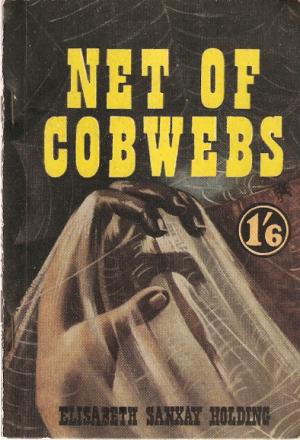
18. Net of Cobwebs by Elizabeth Sanxsay Holding

This is the second Elizabeth Sanxsay Holding I've read, from the two-book volume put out by Stark House and written later in her career, 1945, than The Death Wish (1934).  It's the story of a young man, Malcolm Drake, living with his upper class family while recovering from shell shock due to his time in the navy during the war.  He is already all up in his head and addicted to pills, interacting in a paranoid way with his aunt, sister, brother and his borther's wife.  Again, it has that weird disassociated perspective that I found in The Death Wish that kind of distances me from the material, though in this case it fits better as the character himself is struggling mentally.  I won't get into the plot here beyond that his Aunt dies and then other people die and except that he is the viewpoint of the book it is entirely possible that Drake himself is the killer.

This is solid, disturbing and entertaining.  I will keep looking for her books.  None of the covers below are the one I have, but I like to imagine the time when you could easily see this book in a bookstore and one of her novels was sort of mainstream and well-respected.


Sunday, August 19, 2018

17. The Postman by David Brin

The Postman has been on my post-apocalyptic to read list for a long time.  I never made a strong effort to find it because I knew it is not that hard to find.  I finally pulled the trigger at a nice used bookstore in downtown Nanaimo.  I had often wondered why it never seemed to get much recognition among the PA classics.  I suspect that part of it is that it came out in 1985, a bit later than when the sub-genre was really peaking and also that the name evokes the much-panned movie.  Having read the book, and especially having got to the end, I can also understand why it doesn't have a bigger footprint.  I'll get to that in the review.

It starts out in the way that I love for PA fiction.  Lone survivor in a crappy situation that just got way worse, with little tidbits of the current situation and how we got here.  Rather than a single major disaster, the downfall is the result of many things, including limited nuclear war that caused economic breakdown which led to social breakdown.  The sub-theme of the disaster (and the book) was that the real collapse was the result of far right extremist survivalists, whose aggression and worldview brought down the remaining pockets of civilization and governance that could have led to re-building civilization.

So our hero gets caught at the foot of the Rockies by a small gang of bandits. He escapes with his life but most of his precious equipment. He hides out in an abandoned vehicle that contains the skeleton of  postman, with his uniform and bag of mail preserved.  He takes the clothes and equipment because it is useful, but in another pinch, lies about who he is to be allowed into a stockaded town.  The surprisingly positive reception to his lie that he is an official representative of a provisional surviving US government operating out of Minnesota leads him to continue the lie which leads him to a role of travelling from town to town in the Pacific Northwest delivering mail and setting up a new mail service in each town.

This part of the book is really cool.  I know some of this region okay and Brin's conversion of it to this recovering and surviving future is convincing and fun to read.  There is a lot of variety in how different communities survive as well as tantalizing hints of larger regional conflicts, particularly in the south. 

Unfortunately, the ending, when these regional conflicts come to the fore as the survivalists make a push from the south and the sub-theme that these assholes are the real problem in the first place also comes to the fore.  It's fascinating and prescient to see how Brin portrays these people in 1985 seen through the lens of 2018 where they have coalesced under the Alt-Right banner and really do present a threat to the American empire.  However, in terms of enjoyable fiction, this is reified into an epic battle between what was initially two side characters and it all very much took me out of the world and the story.  There is also a ton of preaching in these last pages and it became a real slog.  It feels like what happened here is that Brin couldn't figure out a way to finish the story he started in a structurally acceptable way (in terms of how we expect fiction to work).  I get that because really it's a story that can't and shouldn't end, not unlike the Walking Dead.  Also, there may be some liberal preaching coming from Brin.  Either way, I just got really disconnected. 

I would say if you are a fan of the genre, this is definitely worth a read.  Just be prepared that the pleasure of the first two-thirds may not last for you.

I also thought I should watch the movie after reading the book, but now I am even more hesitant than ever.  The hero does a lot of acting and emoting (before he takes on the postman role, he survived by telling tales and doing one-man plays).  I really struggle to see Kevin Costner doing this stuff in a way that would not be almost painfully cringeworthy.

Sunday, August 12, 2018

16. Change Agent by Daniel Suarez

Also found this in the same communal bookshelf at the Vancouver apartment.  There is a lot of mainstream junk in there and older semi-academic stuff, but almost always several readable books and even a good find from time to time.  This one falls under "readable".  I resisted at first, having finished Suarez' Daemon on the same trip.  Again, easy digestibility tipped the scales and I jumped right in.

Change Agent was published 11 years after Daemon and it does seem that Suarez skill as a writer has evolved and improved.  This one has the same fun energy and nerdy tech info, but unlike Daemon, it is structurally more sound and the overall resolution of the novel more satisfying. 

The novel takes place in the future where genetic engineering has become mainstream, fundamentally altering the world.  Other than the changes to society (which are richly and interestingly portrayed), Change Agent portrays the biggest change as economic.  Silicon Valley gets caught napping and China and Southeast Asia takes the lead in this technology, which wipes out traditional silicon technology and creates massive unemployment and migration from the west.

The protagonist is an analyst for the US security agency responsible for policing genetic engineering.  There are a list of allowed pre-birth changes and striving parents and criminal organizations trade on a black market the illegal manipulations that will give their children the advantages needed to maintain their economic status.  On the trail of a black market genetics kingpin, our hero gets attacked early on in the book and wakes up in the hospital to find that he has genetically become this kingpin, at least physically.  His brain and personality remains his, but nobody believes him.  Forced to escape, he goes on the run to try and figure out what happened to him, why and what he can do about it.

It's a great premise and the adventure that follows is a really cool journey through biopunk Southeast Asia.  Many of the themes are super contemporary to us today (economic anxiety in the west, fake news, return to aristocratic relations between the rich and poor) and I suspect may seem dated even 5 years from now.  Nevertheless the portrayal of the massive refugee camps, the working poor and the new elites in the steaming jungles and dense cities of Thailand and Malaysia are really cool.  The technology as well and its evolution/development during the book is creative and will stimulate your nerd world-building synapses.

There is one big flaw that also exists in Daemon and it's again these super smart FBI agents who form an opinion about the situation that is harmful to the protagonist (and necessary to the plot) and just become utterly dogmatic and small-minded.  It is again not realistic and kind of weakens the reader's willing suspension of disbelief.  I just can't believe that anybody at this point, especially specialists in the field of a certain technology, would not be able to entertain the idea that the technology has moved beyond their previous conception of it. 

Still, a really enjoyable tech sci-fi thriller.  Check it out.

Thursday, August 09, 2018

15. Where'd you Go Bernadette? by Maria Semple

It is rare for me to read a contemporary trade paperback but this one was strongly recommended by my aunt (and previously by her daughter-in-law).  I like books that get passed around the family and my aunt has very good taste, plus it looked very easy to consume, so I took it on.

It is about an eccentric family in bourgeois Seattle and in particular the mother, a once-powerful architect in LA now sort of hiding in the world of schools, neighbourly conflicts and parenting.  The book is structured as a series of letters, diary excerpts and other actual textual material (I am sure there is some term for this).  It is quite cleverly done and very fun to read especially in the early part of the book which deals with school and parental politics at the elite but progressive private school the daughter attends as well as conflicts about overgrown blackberry bushes invading the neighbour's property.  These are truly contemporary issues for upper middle-class urban elite white people in the 21st century and it also told with a rye and amusing distance that I found very entertaining.

The main drive of the narrative is that the mom is slowly getting unhinged and behaving more and more erraticly.  Her extreme behaviours and conflicts with other parents (plus a misunderstandings and things getting blown out of proportions due to the husband and wife not communicating) get to the point that the father decides on an intervention and possibly to have the wife committed.  She disappears.  The storyline drives away from the petty squabbles into the wife's past and into her and her daughter's relationship.  It ends up being very literary fiction. In this case, it could have been satisfying (and I did like the independence of the daughter and mother from society's norms and the way in which the dad character is shown to be totally lame), however a lot of the plot tension orbits entirely around a missed letter, which weakened it all for me.  The idiosnyncracies of the mother which reach alarming levels in the first half, are ultimately deflated as her disappearance all gets washed away in a big misunderstanding. 

Wednesday, August 08, 2018

14. Rat Race by Dick Francis

Back in my teens, Dick Francis was a staple.  We had tons of them lying around the house and they could be found in any hotel lobby or waiting room in the western world in those days.  There were several of the older paperback versions in the basement communal bookshelf of an apartment we were staying at and knowing I needed something easily digestible to keep my reading pace going, I grabbed this one.  Interestingly, when I went to return it, somebody had taken all the original Pan copies and left any of the more recent versions.  I guess there may be another collector lurking in that building.

Not much to say here about this book that hasn't been said before about Dick Francis's books.  He was the biggest mystery author of his time but I wonder how long his literary legacy will last.  Rat Race has all the classic elements, lone male hero of good heart and skill but bearing a guilty burden even though he didn't actually do anything wrong (so much shame in England at that time).  Good, solid tension and intrigue with nasty bad guys and often realistically unsensational crimes.  The one new thing I observed at this age is how detailed and technical the stuff about flying and air communications is in the book.  I did a bit of research and of course it turns out this was all his wife's work, who herself was a pilot as well as the researcher for all his books.  He later basically came out and said that he goes by the name Richard in real life and that Dick Francis was really he and his wife.  I think there is a book here about so many succesful genre authors who when you dig a little deeper could only have been succesful because of their marriage to a woman who worked as hard if not harder and was also a crack writer.  Try to find me one of these dudes who didn't have such a wife.

Wednesday, August 01, 2018

13. Daemon by Daniel Suarez

Meezly had been encouraging me to read this one for a while and the only reason it stayed on my on-deck shelf for so long was because it was a really good condition first edition hardback.  I took it on vacation and only read it when indoors so it made it back unscathed.

Daemon is a really entertaining tech thriller that is over the top but still close to being plausible.  Near the end, it bogs down a bit in excessive emphasis on inventive hardware and videogamey action.  The story is basically Ready Player One except the dead tech genius is totally malevolent, which is a great concept.  He's an Elon Musk/Jeff Bezos type character who sets up redundant, autonomous daemons all over the internet to make the world the way he wants it to be after his death.  Significant mayhem and society changing trouble ensues.  The worldbuilding/though exercise is really well done.  Some of his IT jargon is laughable (he comes from the industry and gets the big picture, but I question how much work he actually did in the trenches as some of his low-level details sound like he copy and pasted them from bad documentation), but the overall idea of a world controlled via a ghost in the internet is quite compelling and rich and honestly a bit frightening.

The other flaw in the book is that some of his characters believe things they are told immediately and react to them with complete conviction even though these are otherwise skeptical tech people and/or law enforcement.  The protagonist is messily framed and everybody just hates him all of a sudden.  That was a bit difficult to maintain my suspension of disbelief.

Still, a really fun read and a darker anodyne to Ready Player One's simplistic optimism of the individual.  

Wednesday, July 25, 2018

12. Jack Carter and the Law by Ted Lewis

Boring cover, too
This was a huge find at the hospital used bookstore. A first edition hardback of the US version of the sequel to Get Carter (okay, it's not the magna carta, but I was quite excited).  I was not disappointed.  Jack Carter is back at his home base, working for two bosses and demonstrating his panache and experience in the London underworld.  One of his colleagues gets picked up by the cops (the "filth" as they call them) and Carter learns that he is getting ready to spill the beans on their entire operation.  Carter's bosses skedaddle and he is left to deal with the problem, try and discover where the guy is being held and who else is behind this conspiracy (the police are so corrupt that a move like this could only be engineered by a rival). 

I haven't read the first book, but I really want to now.  The Carter here is very much like Michael Caine's Carter in the movie, tough and independent.  We follow him around 60s criminal London to nightclubs, apartments, backroom card games, shady retail establishments.  The milieu and the poetic snakey way we explore it with Carter makes for some very satisfying reading.  The criminals and the crimes they commit are also very entertaining.  I thoroughly enjoyed this.

Tuesday, June 19, 2018

11. The Gingerbread House by Maeva Park Dobner

That house is looming!
This was another great pick-up from the hospital used bookstore haul.  Like The Best People which I just read, this also protrays a closed milieu, the families of Orchard Street, a residential neighbourhood in an unnamed east coast city but somehow isolated from it.  At the end of the cul-de-sac is the old Gingerbread House where young Sara, newly out of the hospital for a breakdown after having been raped, arrives to be the new maid to Mr and Mrs Buford.  Things start out very well, almost too well, with the friendly confines of the neighbourhood harbouring some subtle malevolence.
The beginning of the book was really engaging and I was quite psyched.  The portrayal of the various families on the block was rich and intriguing.  Sara exploring the house, making friends with the cook and starting to just notice some curious things really drew me in. Unfortunately, the sense of menace and mystery is popped early on as two children are kidnapped at Halloween, having last been seen going into the Bufords.
I was a bit bummed at this point, but the narrative moved into more straight-up adventure mode with Sara in a serious pickle and it was done well enough that I got back into it.  Some of the plot was a bit flimsy, with people several times finding complex inner reasons why not to call the police when they saw something suspicious.  But the bad guy was really well portrayed and there is a light dusting of the supernatural and spiritual that made it fun.  It was a definite page-turner to the end for me. 

Thursday, May 31, 2018

10. The Best People by Helen Van Slyke

I couldn't resist picking up this book with that amazing cover.  And subject matter intrigued me greatly, a story of an exclusive Park Avenue cooperative.  I thought it was going to be about people trying to get into a snooty apartment and it was, but not quite how I thought.  It's more of a Mad Men vs. housing discrimination when an advertising firm tries to woo a crucial client, a Jewish shoe magnate, by attempting to secure an apartment in this super waspy building.

I love books that describe an enclosed milieu and this one did a solid job of portraying the history of the building, its current residents and the dynamics of the all-important board. You get a strong sense of its clean quiet hallways and explicit description of the many rooms and dimensions.  The disappointment for me is that the protagonists, a super waspy but progressive couple, totally luck into the sick apartment.  Their struggle is to get the apartment for the client and they risk alienating their neighbours, but they already got the place and ultimately do not seem all that threatened.  The book's conclusion, which hinted at some colour with the exiled Austrian noblewoman who harboured a dark secret, ultimately falls back on safe drama. Overall an enjoyable read.  I think this one is going on the shelf for its style alone.


Tuesday, May 15, 2018

9. The Valley of the Dolls by Jacqueline Susann

One more decent find from my hospital bookstore discovery.  I am really glad I read this.  At parts, it dragged a bit for me but overall was really entertaining and a great historical read.  The impact of this book has faded somewhat today, but it broke all records when it came out and still pretty high up there on the best seller list with 31 million copies.  I imagine that in the 60s if you were on the subway, everybody would be reading a copy.  People today act like Mad Men was some deep revelatory exploration into show business and advertising in the early 60s but they were all talking about the same shit back then and Valley of the Dolls can really be considered the ur-text for that period.  It is at once commenting on the time but also very much of it.

Sorry I'm rambling because most info about the book, its history, impact and analysis are very much available online.  It's the story of three young women coming to New York and becoming stars.  The dolls are what they name the various pills they all get hooked on to one degree or another.  They are a central element, but more like a background to the stronger narrative about their love lives, their struggles to succeed and ultimately how shitty men are.  Punches are not pulled for women either but wow this book is cynical.  I think ultimately what made me appreciate this book was how dark and hard it was.  Even the main love narrative with the character who is the most solid and makes it to the end mostly unscathed is slowly revealed to be a complete disaster and the man a monster.

I'm psyched for the movie now.