Wednesday, June 22, 2022

30. Partisans by Alistair Maclean

Don't judge a book by its cover
I really need to stop reading later Alistair Maclean's. Perhaps I should just stop reading him altogether, which was my previous policy for most of my reading life.  I got sucked into this one because of the awesome 80s Fontana wrap-around cover.  It was a tough read.

The main problem is that despite a great setting (Italy and Yugoslavia in the height of WWII), nothing really happens. Maclean puts a bunch of mainly uninteresting characters together and I guess thought that was enough to keep the reader interested.  Ostensibly, elite Yugoslavian soldier spy guy Peter Petersen gets the assignment to escort a spoiled and naive brother and sister radio operators and their equipment to some unkown place in the Yugoslav mountains.  It's not clear why and right from the beginning there is all this distrust and doubletalk which I think was supposed to be suspense and spycraft, but was just confusing and boring.  It's all made worse by having all the good guys act like British public school boys despite supposedly being Yugoslavian and the women all portrayed as righteous, erroneously moralistic spazzes.

The main character is particularly annoying as he seems to already know everything and we keep either getting him, the other characters or the author himself pointing out how smart and great he is (often to undercut the women's outrage that he has duped them once again).  I am fine with the elite male protagonist kicking ass, but in Partisans he doesn't actually do anything all that cool.  It's all tell and no show.  

In the end, there is some big reveal that we all saw coming a mile away (spoiler, the protagonists are not actually German-allied royalists but partisans!!!).  Just really not great. 


Wednesday, June 15, 2022

29. I, the Jury by Mickey Spillane

This was part of the great June paperback book find here in Montreal.  I have read at least one Mike Hammer but it was long in the past and it was high time that I properly educated myself.  I started with the first one, though I am not sure it is the best.  I hope not, because it was not great.  

I am aware that there is already a lot of infighting about Spillane's work both from the literary and political perspective.  I would say it is fair to critique the Mike Hammer books as fascistic, but I can handle a little fascism in my manly adventure books.  Unfortunately, as a mystery and detective thriller, I, the Jury is just not great.  Again, I want to be respectful and also remain mindful of how new this book was at the time it came out (and how I have a legacy of hardboiled detective and crime fiction in my own brain that owes much to Spillane while also skewing my perspective).  It's just that there are so many flaws that I was kind of rolling my eyes throughout and somewhat distanced.  

First, the tone is very inconsistent.  It starts out with a super intense anger as Hammer stands over the gutshot body of his war buddy as he fantasizes about revenge.  I'm a big fan of righteous revenge. I suspected that the white-hot intensity of the opening could not be sustained and the book loses much of its driving energy as the investigation gets underway and maintains a more mechanical pace with no solution to the mystery, nothing to generate emotion in the reader.  We get further removed with a bizarre falling in love with the hot psychiatrist.  There are also several three stooges level goofy asides, where Hammer bonks two wiseguys heads together at a bar for saying "hey hey" to his girl and dumps a pitcher of water from his upper story bedroom window on a couple of hair pulling "faeries".  These moments are actually kind of funny and suggest that Spillane wasn't entirely taking himself too seriously.  He just doesn't manage to balance these tone shifts in a way that kept me engaged.

SPOILER ALERT

Finally, the biggest flaw is that the plot itself has no real mystery or suspense because it was immediately obvious who the killer would be about a third of the way through the book.  And not because of any easy clue since there is no actual way for the reader to put anything together.  It's just you can guess by the stupid, simplistic mores of the book and the bizarre way sex and love are handled that it just had to be the femme fatale.  I guess in 1947 it was the peak of this misogynist trope or maybe Spillane took it to the next level, I don't know but it reeks to me of laziness and pandering to the readers at the time.  The finale where he finally gets his revenge is so rich with sex and woman fear that it must have been analyzed thousands of times by literary types.

Despite my negativity, the book was not unenjoyable.  I like the locations, characters and some of the crime backgrounds, though fantastic were imaginative (the procurer for brothels who enrolled at a different university each semester to seduce, impregnate and then drive these sinning women to vice was kind of a wacky twist on the pimp).  It's pretty fast moving and has some fun writing.  I hope that Spillane honed his craft in later books and I will try to find out which is considered his best.


Sunday, June 12, 2022

28. Hammett: A Life on the Edge by William F. Nolan

Took this ex-library hardcover on a whim from the free shelf in the middle of Esplanade (it is a half-block after the big free closet shelf thing outside Latina so I make both stops on my way back from the Y).  I am not particularily interested in Hammett's life but this looked readable, I just made that big paperback haul and am listening to the old-time radio series Sam Spade right now, so it seemed thematically appropriate.

On the positive side, this was a well-researched and easily readable, thorough walkthrough of Hammett's life and work.  He had a really interesting life and it was enjoyable and sometimes moving to read about it.  I hadn't known that he was hounded by McCarthy and his fuckstick anti-communist dicks in the 50s nor how resistant he was to their bullshit. I also didn't realize the full extent of his fame while he was still alive.  I knew he partied pretty hard but didn't realize how much of it was as part of the Hollywood elite.  Damn, they drank!

Unfortunately, this biography is also once again a hagiography and it really harms the material.  Nolan is just too keen to reinforce and remind us how Hammett was both a superior writer and a superior person,  even though at times for the latter his actual behaviour actively contradicts such a characterization.  He did do a lot of good and did seem to have a very strong will and idealism that is impressive and respectable.  But he also was a terrible drunk who did a lot of damage to himself and at times to the people around him.

There is a nerdy trope in  the crime fiction world that bugged me the first time I encountered it and still bugs me today, though I sort of agree with it more than I did initially: the Hammett is a real hard-boiled writer while Chandler is a flowery romantic.  Nolan just has to throw that one in this book and it's just nerdy and lame.  He also does a drive-by against the guy who is considered the first hard-boiled detective writer (now totally forgotten), simply it seems to ensure that though this guy's stories were there first, Hammett's are the real ones.  It's annoying as hell.

Wednesday, June 08, 2022

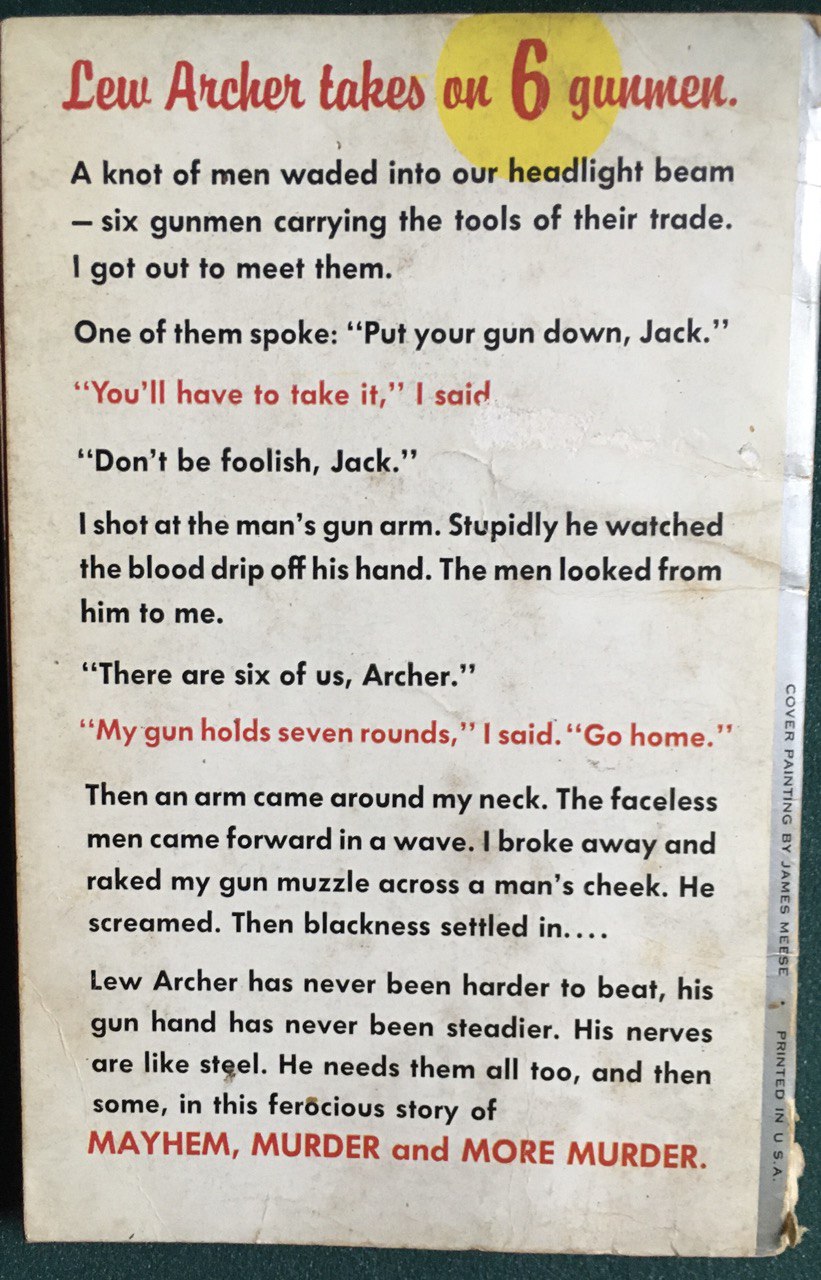
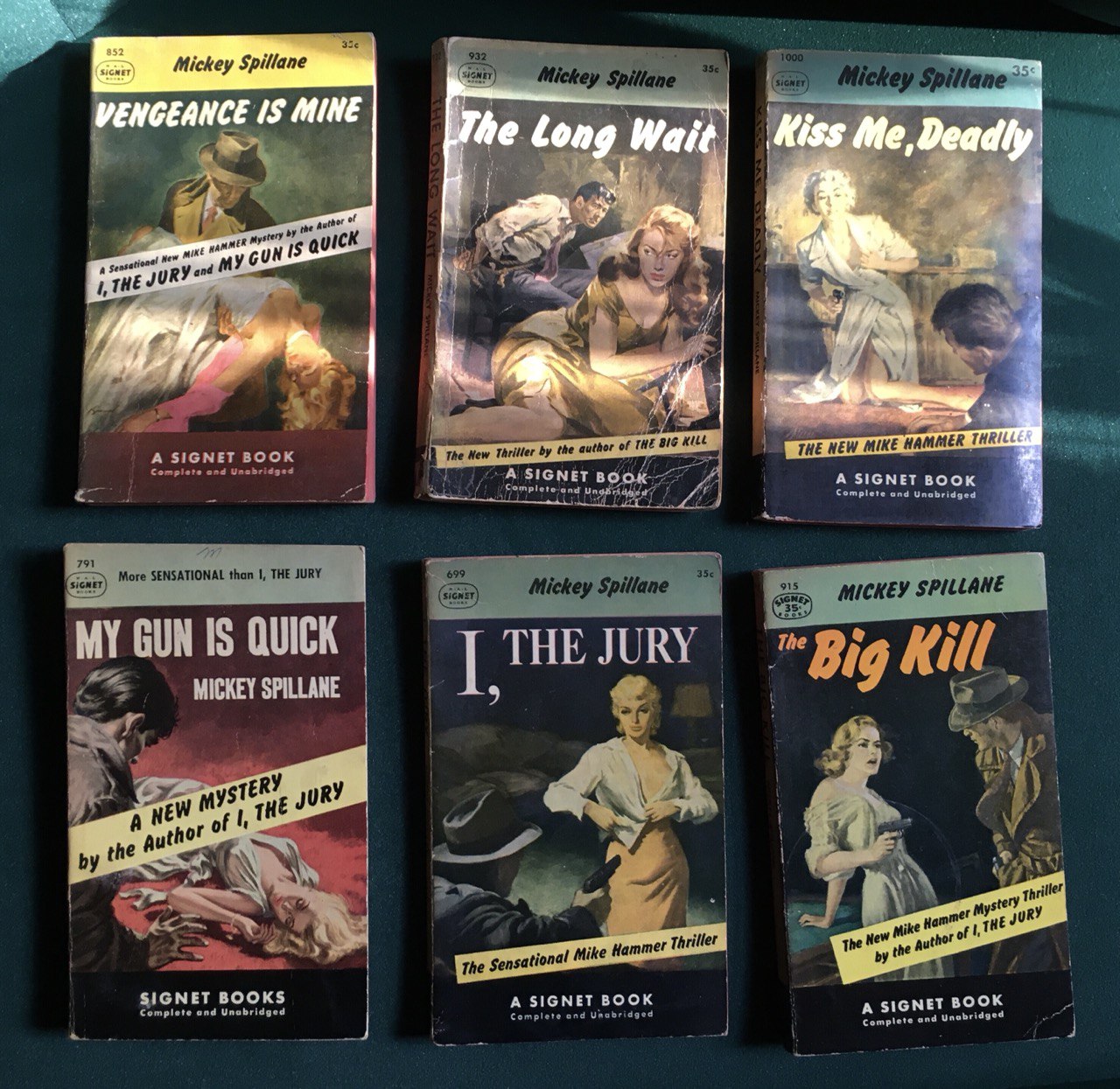
27. The Drowning Pool by John Ross MacDonald (and major paperback haul!)

Hoo boy the beginning of this novel is just scathing.  Archer gets hired by a woman to follow up on a blackmail letter.  She is hesitant and will tell him almost nothing and he sort of forces her to let him come to her small coastal town outside of LA.  There, he spies on her little scene of local bourgeois.  He first watches her husband rehearse his lead performance at the local theatre (and also witnesses a kerfluffle between his daughter and their chauffeur). Later, he goes to a small dinner party the husband hosts.  MacDonald is at is nastiest, best here with Archer barely able to contain his contempt for this lost, pretentious group.

The story gets complicated quickly, involving a controlling mother, the wayward daughter, potential oil wells and the neighbouring oil boom town (very nicely described).  There is some good tailing and detecting and quite a lot of action including a nasty hijacking.  I got a bit lost at one point where Archer seemed to teleport from the small town back to LA but maybe they weren't as far apart as I had thought.  The narrative got a bit crazy and somewhat lost me near the end, with a crazy yet very enjoyable scene in a water-based sanitorium run by the nasty "Doctor" Melliotes (hydrotherapy; where Archer floods the room in which he is imprisoned).  However, when the full backstory gets revealed, it is rich and interesting enough to redeem the rest of the narrative. Not my favourite Lew Archer, but solid.


I'm burying the lead, though!  This beat-up and beautiful paperback was one of an incredible find.  I was walking to the park with some friends of my daughter's and passed this record store that I have been meaning to check out as I had noticed a bookshelf previously. From the window, it looked to be mainly music-themed books and indeed it was, but on the ground there were three boxes.  I took the liberty of opening them up (could be a no-no in some stores).  The first box was typical liberal arts classics (though some nice editions) with that nice Bowie biography being a minor gem.  The next two boxes though were like opening up a treasure chest!  More good stuff just kept coming out.  I appreciated the theme of 50s youth anxiety.  A few real classics here, including this great copy of The Amboy Dukes (I wonder if it is edited at all?) and another edition to the Amboy Dukes universe that I am looking for.

There was some brief sweating when the books weren't priced and we had to wait for the owner to show up. He ended up giving me a decent deal (he divided them into 3 piles of $3, $4 and $5).  I am not a huge Mike Hammer fan so hope to be able to pass these on to somebody with more of an appreciation.  The rest are mostly keepers.  The owner also said that he had gotten these from an older fellow who had moved into a nursing home and that there were more boxes to come.  I hope the gentleman is in relatively good health and spirits.  I hope to find some more of his books to give a good home.


Monday, June 06, 2022

26. Fer-de-Lance by Rex Stout

Shall we read a Nero Wolfe, how about two?!  I was so into the Nero Wolfe/Archie Goodwin world after The League of Frightened Men that I felt like going back and reading the first one in this same double volume (with the bonus of being able to get this thick book off my on-deck shelf, freeing up much needed space).

This is the first Nero Wolfe book, though you wouldn't know it without the helpful introduction.  It refers to past cases and mentions that Archie Goodwin has been living with Wolfe for the past 8 years.  The interplay between the two seems as rich and ripe as ever, which is kind of amazing.  Stout was a good writer.  I enjoyed the mystery in this one a lot more than in The League of Frightened Men.  We start out with a banal case, that Wolfe almost rejects.  A woman's brother has disappeared.  Then it gets connected to the heart attack death of a wealthy college president on a golf course and things get interesting.  Unfortunately for the mystery it gets solved almost halfway through the book and when it should have ended we get another brain-off between Wolfe and a superior criminal.  The ending wasn't super satisfying either, but quite dark (Wolfe has some questionable ethics which I enjoyed).  Still, the lead-up was good enough that I was happy to keep reading.  

My Rex Stout goal has been achieved.  I am now happy to have his other books ahead of me to grab when desperate.

Friday, June 03, 2022

25. The League of Frightened Men by Rex Stout

I've been on the hunt for an easy find of some classic Nero Wolfe and alighted upon this two-fer (which I later realized was in large print format) of the first two, with some nice introductions and afterwords (including a map of Wolfe and Goodwin's digs).  Because I am perverse, I went with the second one first (actually I just preferred the title and only realized afterwards that this was indeed the first two Nero Wolfe books chronologically).

It did not disappoint.  I get why this series is considered classic.  I have listened to many of the Old Time Radio plays of Nero Wolfe and enjoyed the banter, but the language and interplay between Wolfe and Archie Goodwin in the books is a richer and more pure delight.  There is something about two men of extremely different personalities, united and perhaps trapped by work, who can be wittily candid about each other's perceived failings that is enjoyable to read.  It helps that Stout really is great with character and language.  Furthermore, the dressing around their relationship (Fritz, the elite french chef; the various helper detectives that Goodwin bosses around, New York City and environs) contribute to make this book a true escapist fantasy for a certain kind of reader.

My interest in the mystery itself waxed and waned, though the conclusion was quite satisfying.  A group of Harvard graduates come to Wolfe because two of their number have been murdered and they are receiving threatening letters from the person they know did it.  In their college days, a hazing prank went wrong and they crippled a freshmen. They had tried their best to make it up to him, paying for his care, supporting him to the point that he became a successful writer and befriending him but they all suspected that he still secretly hates them and, without incriminating himself, he makes it clear that he does.  As a group of clients, they are challenging as some of them still feel guilt for what they did and don't want him punished.  He comes off as twisted psychologically (perhaps even before the accident), kind of a psychotic mastermind against which Wolfe must pit his own genius.

Lots of fun. I am looking forward to reading the first one.

Monday, May 30, 2022

24. The Feud by Thomas Berger

Kudos to a cover that shows
an actual scene from the book
I found this nice 1983 first edition hardback in the free shelf outside of Latina.  I knew nothing about it or the author and thought the premise seemed interesting enough that I should give it a try.  It was enjoyable but I am still left a bit puzzled about what the overall mission was for this book.

It takes place I guess in the 50s in two small contiguous towns somewhere in America.  In the opening scene, a father from one town is buying paint stripper in the hardware store of another town.  The son of the proprietor working the counter expresses some attitude and this turns into a full-on conflict (the hardware store burns down that night and the father gets blamed).  The story of the feud is really the vehicle to deliver a somewhat light comedy of manners about dumb hicks.  I couldn't figure out if the author was sympathetic to the characters or poking fun at them and that is what left me feeling puzzled and slightly unsure of my ground while reading it.

There are several sympathetic characters, especially the two sons of the father at the heart of the conflict.  At the same time, almost all the characters, especially the men, are deeply flawed.  Weak of will, emotionally immature, corrupt and dishonest almost all of them.  We get snippets of real affection among them that are somewhat moving and nothing is treated with real heaviness (for instance, one of the sons punches the police chief of one town, who deserved it and his real punishment is that he can't go back to that town).  At the same time, everyone seemed so ignorant and selfish that the portrayal feels a bit like a caricature.

It is well written and the story moved along nicely.  There are some funny bits and the interaction among the teens and their sexual fooling around was well portrayed.  I am still not sure what the point was though.  Here is a much better review that puts The Feud into some context (and summarizes it better), but still doesn't succeed in explaining why we would want to read it.

Wednesday, May 25, 2022

23. The Protector by David Morrell

Here in Montreal, we have two library systems, the local municipal libraries (of which Mordecai-Richler I frequent often) and the BANQ which is the provincial system (as well as being the official archive for the province).  The BANQ has a really beautiful building downtown which I used to go to a lot, especially when I was studying.  However, since the pandemic and the efficiency of the municipal inter-library loan system, I hadn't been in a few years.  I volunteered to go with my child's school trip, renewed my card and in the few minutes I had to spare between corralling and shushing rugrats, I snagged this David Morrell.  I am actively hunting for his medieval mysteries, but he is always competent and this looked like a fun, quick read.

Morrell seems to have made a niche for himself as extreme researcher of cool ass shit.  In this case, he goes deep on the elite protection industry.  Cavanaugh is an ex-Navy Seal who runs a small team that protects and hides people under extreme threat.  Here, he is hired to protect a scientist who is already holed up in a warehouse hideout.  When he goes there, the shit hits the fan and Cavanaugh learns that the guy discovered the ultimate drug (instantly addictive) and that the cartel is after him.  There are several twists that weren't too hard to predict (even too easy, at a couple of points I found Cavanaugh to be stupid to not cotton to what was going on), that of course lead to Cavanaugh on his own, on the run.

There was another early plot point error that surprised me, where they sent the client out to get his fake ID created before the plastic surgery they were planning and I was off on the wrong foot.  Once we get into the main plot, it's pretty cool.  Morrell's research comes into play and we get lots of cool techniques for going undercover on the lam, armouring vehicles (and how to knock other vehicles off the road), making fake wounds and all kinds of cool little details.  The bad guy is a real hateful prick too.  A bit shakey at the beginning but ended up being as I had expected a quick fun read.

Monday, May 23, 2022

22. Understanding Korean Politics: an Introduction edited by Soong Hoom Kil and Chung-in Moon

Shit is getting wild around here at Olman's Fifty!  Not only reading non-fiction but actual academic books.  Crazy.  I grabbed this one after several moments of hesitation from the free little library on Esplanade.  I have a decent understanding of Chinese history and an okay knowledge of most of the rest of Asia, but beyond that Japan was quite horrible to it, my knowledge of Korean history was almost zero.  Like so many others, I have been introduced to Korean culture through movies and food in the last 20 years and I've long felt I should have at least a broad grasp of its history.  This book is more based around political science, but you can't do a survey of the country from the end of WWII to 2000 (when this book was published) without some history and I got what I wanted from this book.

I think it is probably worth studying why Korea has remained so quiet in the west, considering that it's history is quite wild.  Not only did it have a miraculous economic growth, it did so through three dictatorships and some serious political craziness (including the president being assassinated by the head of the Korean CIA in 1987!).  Why does Korea get so little play in the west?  This book did not go into that, but it was a solid and sometimes interesting overview of Korea's political history, coming out of WWII being basically occupied by the US and USSR, getting split after the Korean War and then developing from a US-dependent military dictatorship to an independent, democratic economic powerhouse.

Though a bit dry and basically undergrad poli-sci with some of the nonsense that brings (academics still struggle with arguing over which theoretical lens is best and then concluding oh yeah we can use many), this book was divided into digestible chapters, all of which were really well-researched and directly presented.  What I found particularly interesting is how the dictatorships had such control until, in each case, they went too far and popular protest ended up bringing them down.  I'm over-simplifying but there seems to be something in 20th century Korean history where the people are unified enough (and having the threat of North Korea is a major factor here) that they can exist with a dictatorship and yet also bring it down.  It bums me out that in their last election, they chose a populist asshole (though barely, but isn't that how these fucks get in power everywhere?).  I hope Korean cultural and political unity can withstand the dividing power of today's internet.

Monday, May 16, 2022

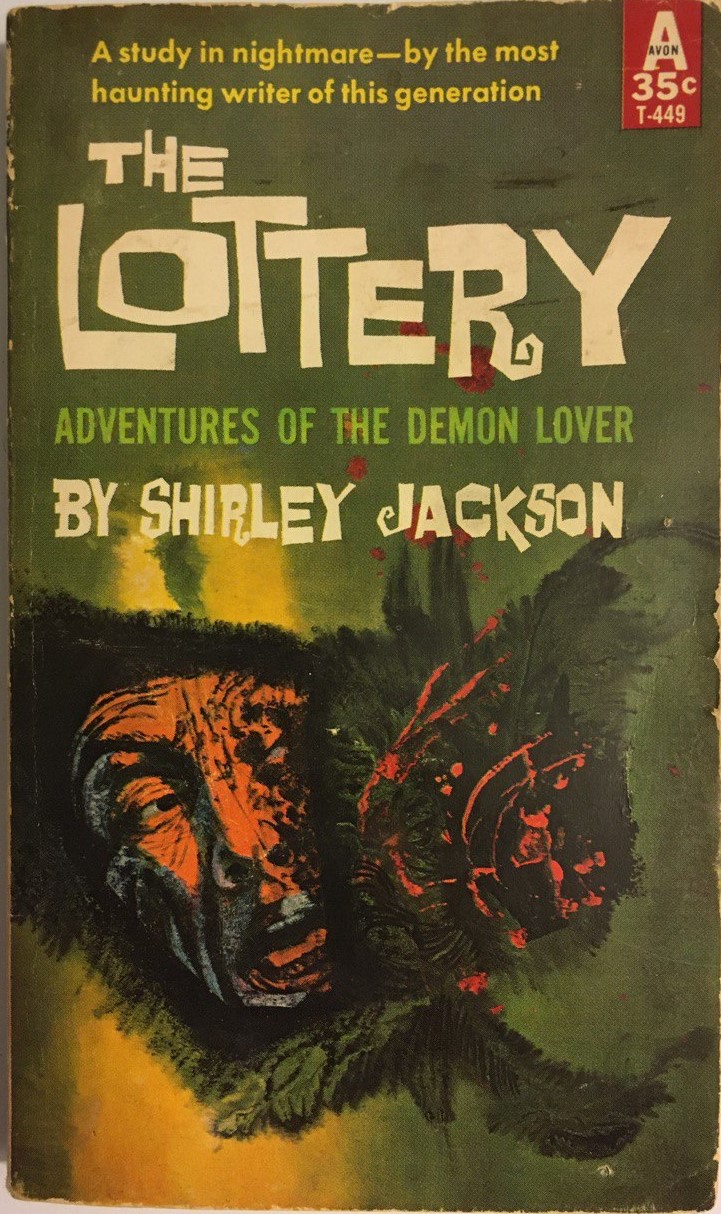
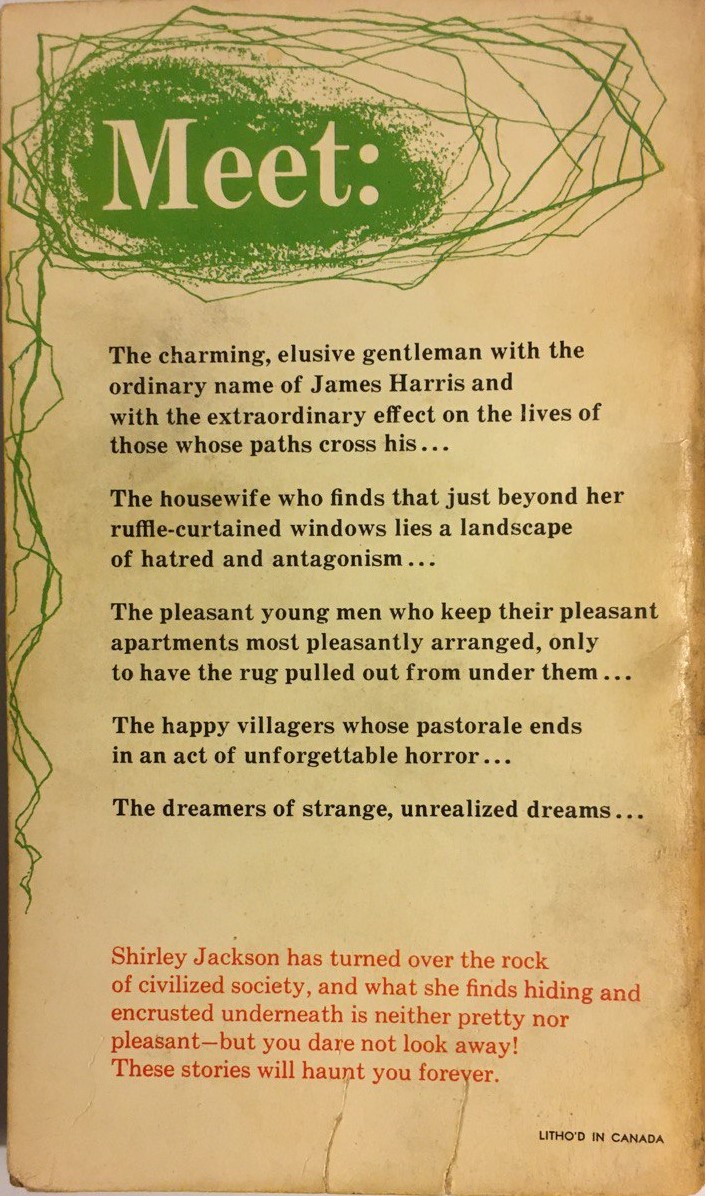
21. The Lottery: Adventures of the Daemon Lover by Shirley Jackson

I found this at the great traveling vintage sale that has started to come to Montreal.  They have very few books, more cloths, furniture and other antiques but this was a nice little find. It's a 1949 paperback original of her collection of short stories and was quite a good seller at the time.  The cover and subtitle is misleading, as if they were trying to sell it to sci-fi and horror fans rather than a more literary set.  The stories themselves are pretty literary, though definitely as unsettling and thought-provoking as those genres.

An aside, reading this book did just give me a clear notion of the definition of "genre".  This is my own way of understanding it (and may well be utterly not original and probably thought over with much more depth by much smarter and more patient people).  Basically, in genre fiction, the primary objective is to tell a story.  Ideas and concepts are delivered with the story, but tend to not be the main focus.  Literary fiction can be story-driven but generally it is the ideas and concepts that are the main objective.  Obviously there is a spectrum and lots of exceptions but broadly speaking this is why I personally prefer genre fiction.

The above notion crystallized in me while reading these short stories because many of them have only the most minimal story structure.  At first, I was mildly annoyed, because despite my objective tone above, I am really not down with the New Yorker/liberal arts university creative writing course mode of trying to impart a feeling or some shit.  However, Jackson is such a skilled writer and the stories so tight and short (and effective) that I got over my irritation.  Many of the stories deal with the anxiety of women in this time period in the northeast, usually with an absent or oblivious husband and a contrast between the city and the country.  There are a couple of stories here that really capture the fear that New Yorkers have of the country and close proximity to the rural working class.  This has been going on for a long time!

My favourite story is The Dummy about two catty women who see a ventriloquist show and react to the dummy.  Really, nothing much happens, almost the small incident one might see going out in NYC that would be a funny anecdote, but it made me laugh and she captures the women's dialogue so well.

I'm glad I read this (and later read up on Jackson's life) because I had only read The Haunting of Hill House, which is good but doesn't give you a good sense of where she is coming from.  I will have a better appreciation of her work now.


Friday, May 13, 2022

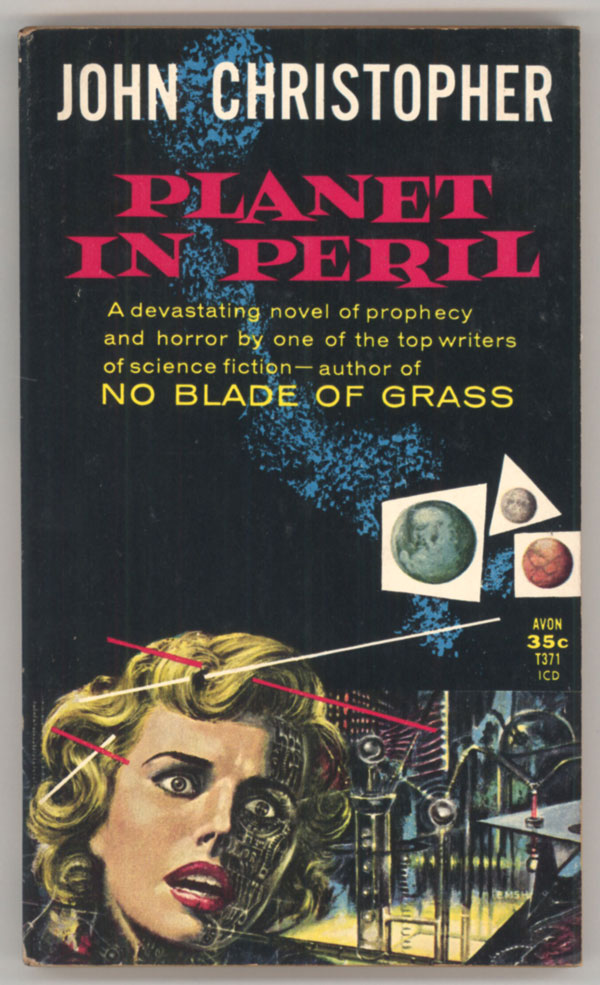
20. Planet in Peril by John Christopher

I found this on the shelf at Welch's (I still habitually look for Christopher despite not having seen any of his books for ages) and thought it a nice find.  I guess it was, in that Planet in Peril is quite possibly the worst John Christopher. I don't know what drove him to write it.  Was he trying to emulate some of the succesful American sci fi that dealt with a future of alternative political systems?  Right from the beginning, one is uninterested.  It takes pages to establish any kind of plot and though we are clearly in some future America where a great disruption has ended with a new social and political system called "Managerialism" none of it is explained with any depth and what is explained is not interesting or compelling at all.  It seems that all the world but a small (I guess Arabicish) part called Siraq is organized into different gigantic companies/government departments like Atomics, Agricultural, etc.  The protagonist is somehow also part of United Chemicals.  These managerials compete against each other and there are hints of decay.  Also there is a comet, but it's barely mentioned.  

The story is that the hero after years working quietly in the same lab, suddenly gets transferred and promoted to a location where his predecessor disappeared in a sailing accident.  When he gets to the new office, he meets the resentful assistant, who is also attractive and they hit it off. Then there is a lot of intrigue that you really don't care about, culminating in the possibility of Siraq invading the rest of the world with flying soldiers using heat rays generated from a new diamond energy that only the protagonist was somehow capable of inventing (except the Siraqis already invented).

There were a couple of good bits, such as the airspheres, giant bubbles you can fly around in the clouds, which was very well described and enjoyable to visualize.  There are nice, subtle descriptive moments that remind you what a good writer Youd was.  Overall, though, a dud.

Friday, May 06, 2022

19. The Big Brokers by Irving Shulman

I picked this up mainly for the cover and because I thought it would have some cool writing about organized crime of the period.  I enjoyed The Amboy Dukes, but more as a historical, culturally important book in the genre and was not necessarily looking to read more of Shulman's work.  I am glad I did take it because it was a better book than I expected, on its own merits, as well as being indeed a great look into the syndicate in the late 60s.  Even more fun, the outfit in The Big Brokers that we see is mostly Jewish and this gives it a distinct feel as well as some good background on how these guys came up.  Finally, this is actually the follow-up to the Amboy Dukes as it continues the story of that street gang and how they grow up to become big-time mobsters.

The premise is great.  Three young toughs (and one's moll) are sent by their boss to take over a failed resort and casino investment in Las Vegas.  They proved themselves well on the streets to their boss, kindly but tough and scheming Itzik Yanowitz (a great character!) but it is a bit of a stretch and a risk to ask them to take over a hotel where the previous scrammed with the money and left to ruin.  The book has an interesting pattern of weaving between sections of great detail, focusing on getting the casino set up for instance, then accelerating ahead to the next phases and challenges in their existence.  It makes it somewhat uneven in feeling. Is it a procedural or an epic?  In the end, it goes for the latter and I have to say does also succeed in giving us a lot of really entertaining procedure, both with how the criminals work and how a resort casino was run in that period.

Another element that makes the book somewhat uneven is the writing style. It's not bad, actually quite readable and the content is so rich that I found myself easily turning the pages.  Shulman jumps around from perspective, not just from the characters' minds but going from a detailed description of the muscles on their faces to their thoughts and then to a more objective perspective.  It also gets a bit melodramatic and maudlin at times.  He really bears down on the stress and anxiety and the generally unpleasant price one pays to avoid the rat race and live large as a gangster.  It gets rough at times too, there are two particularly brutal beatings that are hard to read.

It's interesting to read this book written in 1959, written 10 years before The Godfather and yet containing so much material that is now considered the sole domain of Scorsese.  I wonder if he read this book, because half of Casino is in here.  This one is going on the book shelf. 


Thursday, April 28, 2022

18. The Seven Pillars of Wisdom by T. E. Lawrence

I got the book from the library
A friend recommended this and his enthusiasm and the title misled me somewhat.  He was blown away by the quality of the writing and I was expecting a book with much more history and philosophy and meditations on Arabic culture.  This book really is a long war journal with small smatterings of those previously mentioned things scattered through out.  The bulk of it is a log of Lawrence meeting up with x tribe of y leaders, journeying for days and sometimes weeks in the desert to find a Turkish-controlled train station or bridge and blowing it up.  I'm still trying to figure out why he is such a big deal in our culture.  I am guessing that his book at the time fit neatly as an adult and more sophisticated and questioning equivalent of a British Boys Own type of colonial adventure.  I don't mean to belittle it, because it's a remarkable story on many levels and far from a celebration of colonialism.  I am just trying to understand why it looms so large culturally, beyond that the film is much loved by film school types of the past.

It is Lawrence's ambivalence or rather disgust with his own role that removes the book from pure colonial adventurism.  He ascribes no ambition or idealism on his part but rather it just seems to flow out of his job working for a branch of British intelligence in Egypt that he heads south to Arabia and starts working with the Beduin.  Once there, he realizes how effective they could be in the fight against the Ottaman Empire. He uses the promise of Arabian independence to motivate and unite the disparate and often conflicting groups of desert people against the Turks and he hates himself for this.

He also underplays his own suffering and toughness. He is a small guy and admits to being at a disadvantage in hand to hand combat, but holy shit does he seem tough and stoic.  The list of things I can't and don't want to do are manifold:  riding for days without sleep on a camel, suffering through intense heat, walking barefoot on skin-cutting muddy ice (and dragging a camel), all kinds of horrible insect bites, riding into machine gun bullets, getting tortured and raped by a Turkish officer and his men.  It is all kind of written about with a matter of fact tone.

I'm not sure I would recommend this book to anyone but a student of the Middle East campaign of the First World War.  I did learn a lot and have a better understanding of the geography, but it was a long sometimes repetitive read, although indeed very well written.

Wednesday, April 06, 2022

17. Hammer's Slammers by David Drake

I'd heard about this book at the edge of radar for a while now and stumbled upon it at the Renaissance on Bernard so thought I should probably add it to my reading list.  I believe it is considered somewhat of a classic of military science fiction.  It's a very odd book and I went through a range of reactions as I was reading it.  Unfortunately, I believe the introduction by Jerry Pournelle coloured some of my thinking and I wished I had read it at the end.  He put forth the simplistic, nerdy faux-tough argument that somehow our. soft liberal society has lost the recognition for the professional soldier.  I have always hated the conservative position that by being selfish assholes they are somehow harder and more "realistic" than the progressive position.  I especially hate it when it comes out of the nerd world and it rings gross as fuck right now as we read about atrocities committed by Putin in Ukraine.  That followed by several quite brutal stories that had a similar subtext (war is hell and wimpy civilians and ecosystems need to accept that) made me think Drake was taking a pro-war position.  By the end, though, it gets more nuanced and I also read that Drake himself served in Vietnam (as an interrogator!) and that this book was partly his way of working through his own reaction to his involvement in that war.

This is tough reading and I am still not sure about how I feel about its politics.  The first few stories are not super well-written.  The battle descriptions (not my strong point as a reader, I admit, so combat nerds may have a better informed opinion) confused me and didn't do a lot to move the plot or characterization forward.  There is a lot of cyan and a lot of bodies getting splattered (which was kind of grimly entertaining).  As the stories move forward, though, they get better and better written, with some interesting situations. It is not a novel per se, but a series of situations that happens to this intergalactic squad of super tank mercenaries with little informative essays in between. It does build a picture of a galaxy at constant war and the hierarchical social structures that push poor planetary settlers to join Hammer's crew.  Ultimately, from what I could gather, the main argument here is that humans are going to go to war all the time and that war is hell and the only good thing is the camaraderie and loyalty generated by being part of a politically neutral, highly skilled and powerful military team.  The glee of Pournelle's essay is not here, though.  Rather it is all just grim with genocide, rape and environmental destruction (including wiping out a complete ecosystem).  The only bright spots are brief moments of individuals distinguishing themselves by showing a toughness and inhumanity that means they can be a part of the Slammers.  

Despite the cynicism, the situations are quite clever and the various worlds have interesting geography, flora and fauna and civilizations, all presented with just enough info to get the context to make the story work.  The final story, The Tank Lords, which was added to this later addition, is much richer and enjoyable and I think probably demonstrates an evolution in Drake's writing.  I get why young military nerds would enjoy this stuff.  I am curious enough to want to check out one of the full length novels that take place in the "Hammerverse".

Thursday, March 31, 2022

16. Dead Calm by Charles Williams

I picked up this trade paperback new at Dark Carnival, because I have yet to find an actual used Charles Williams paperback in years of searching.  I chose to read it now because I was confident it would at least be competent and I needed something good after the lacklustre Marion.

It starts with honeymooning couple way out in the Pacific on a sailboat in a dead calm.  He's an experienced sailor and she is learning.  They notice a boat out on the horizon and then soon a single dinghy coming in fast.  They pull in a hysterical young man with a story of a terrible botulism accident, which the reader and soon the man suss out as fishy.  I thought we were going to head into a long period of tension and suspicion, with the couple in conflict.  Instead, Williams delivers action a few chapters in when the man goes to the stranded boat and discovers a couple locked in the cabin.  He races back in the dinghy to his boat, but the kid has already started the engine and taken off with his wife.  A great setup.

The rest of the book is a back and forth between Ingram trying to figure out what happened and get the boat moving so he can follow his wife and his wife trying to deal with this psycho kid.  It's more psychological than action and very tense.  I really am not comfortable on boats and out in the ocean and this book stressed me out.  There was a bit too much technical sailing language, but that is a fault of my ignorance than the book.  Great, fast read. This is what pulp fiction should be.  I understand there is a prequel that narrates the adventure that brought the man and woman together, which I really want to read now.

Tuesday, March 29, 2022

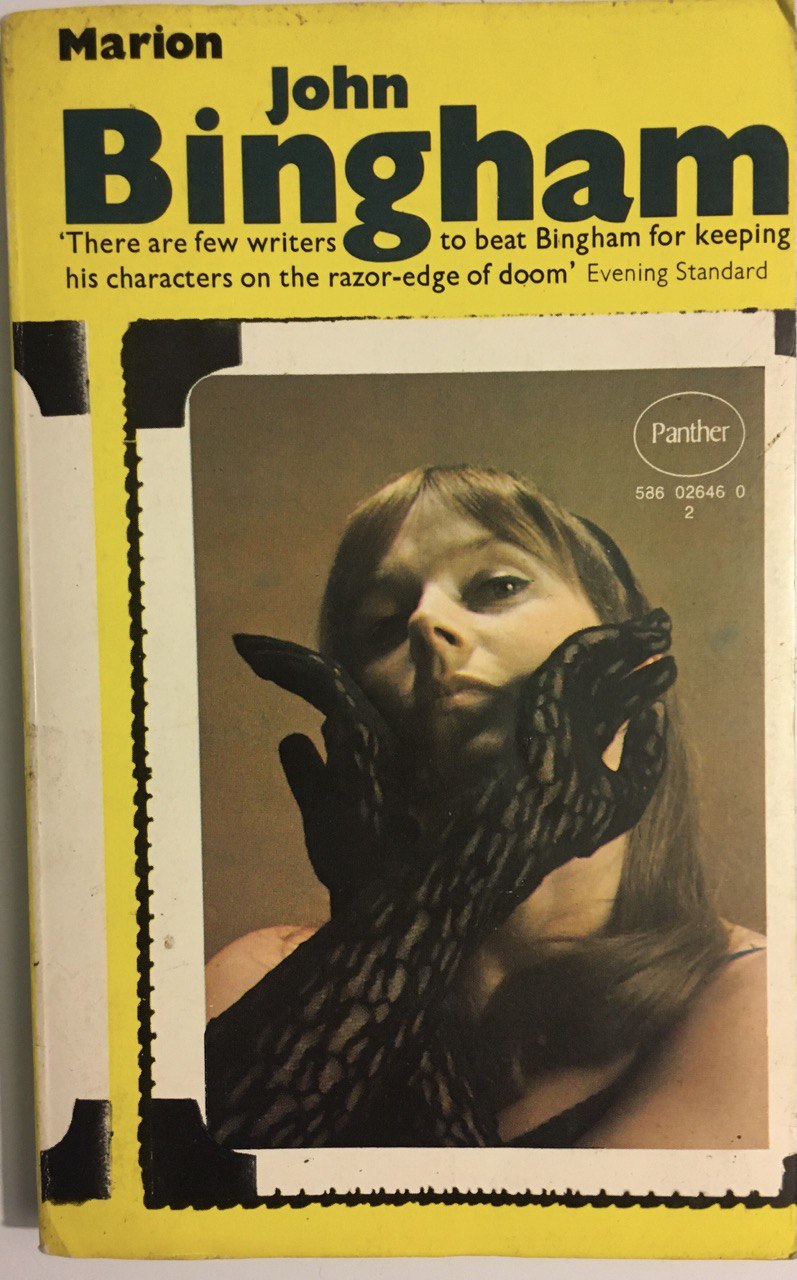
15. Marion by John Bingham

I found this in my nice little haul of obscure mediocrity (or mediocre obscurity) at Urban Ore.  I sure love the object, though did not have super high expectations.  There was a lot of marketing hype by publishers back then and most of it on the cover itself.  Here we have relatively unknown author John Bingham getting a way bigger font than the actual name of the book.  My daughter thought the book was called "Bingham". 

Turns out it was not a great read.  It's competently even well-written, as so many of these mid-century journalists turned thriller writers were definitely professionals.  It's just that most of the book (as the title states) focuses on his relationship with his wife (Marion) whom he discovers to have lied completely about her past and is a total philanderer.  There is a thriller plot, but it is bookended and just not all that exciting.  I also felt there was a very real plot flaw with the timing, but was too lazy and uninterested to go back and doublecheck. The book is written from the future and jumps around in time (as if the author is recounting the story, telling us where he went wrong).  At one point, the various time narratives cross over in a way that made no sense, so that the discovery of his wife's infidelity happens before another major plot point that is dependent on him not knowing her infidelity.  I can live with that and I may have misread, but though the backstory revelation of how he discovered his wife's true nature was kind of neat (he goes to her hometown to deliver flowers to her father's grave who isn't actually dead), I was just not that interested in his processing of the end of his marriage.  There was also some weird class resentment thrown in that never got developed.

Looks like Bingham was one of these upper class WWII intelligence blokes who turned to writing.  Maybe this was one of his lesser works.


Monday, March 28, 2022

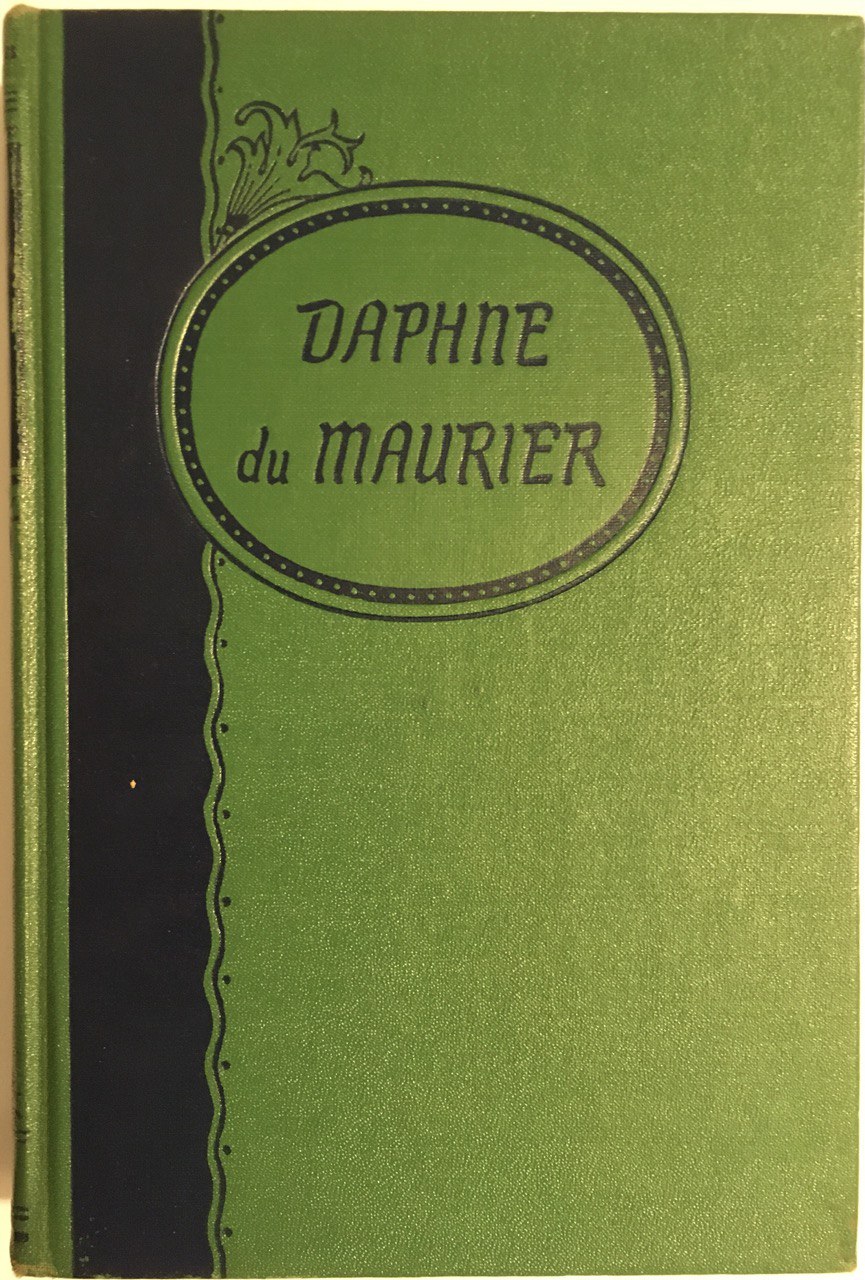
14. The King's General by Daphne du Maurier

I am really getting back into the history these days. I found this on a free shelf somewhere and kind of took it because it is a beautiful first edition hardcover (though missing the slip case), kind of because it's du Maurier whom I am discovering and partly because it takes place in the British civil war of which I wanted to learn more.

At first, I was bewildered by the context and all the characters.  The opening chapter had me quite discouraged.  Fortunately, it was deliberate, one of those openings where the character gives hints of the conclusion because they are now looking back on their past.  Once the main narrative begins, du Maurier sets the stage with skill so that the reader internalizes the characters and their relations to each other.  It takes place in Cornwall in the early middle of the 17th century.  Honor Harris is the youngest daughter of a less arisocratic family.  The antagonists at first seem to be their neighbour the Grenvilles, in the form of their beautiful avaricious daughter who weds Honor's oldest brother and then ruins and discards him.  Things get complicated and romantic fast though when the youngest Grenville with the terrible reputation (debt and a lack of honour), Richard, woos our protagonist.  On their weddding day, she is crippled in a riding accident brought on by his sister (who could have prevented the accident).

One of the main things I enjoyed about this book is that while there is much danger and threat and bad behaviour, throughout the entire story Richard and Honor's love is true.  He is a ruthless, irresponsible bastard who is also an incredibly skilled soldier and competent general.  He's a real dick, but in a cool ass way and you can't help but respect him for his constance.  It makes for a subversion of the genre, as despite her crippled and childless state, he truly loves her.  And despite his rash and cruel behaviour, she still loves him. It's a good romance.

I read that there were criticisms of the book at the time it came out in that it portrayed the language and behaviours of the people in a contemporary way.  I have no way of knowing if this nerdy criticism is accurate or not, but at least the geography and politics are descriptive and accurate to paint a strong picture of what the civil war was like for the people who lived through it.  The afterword reveals that the locations and the secret chamber were actually real, which is super cool.  du Maurier's pedigree is bonkers.  She basically leased and restored this sick castle because the family that owned it resided in some other manor.  Nobless oblige indeed!  Really enjoyable read.

What's crazy is that du Maurier was rumoured to have had a lesbian affair with Doubleday's wife!


Saturday, March 19, 2022

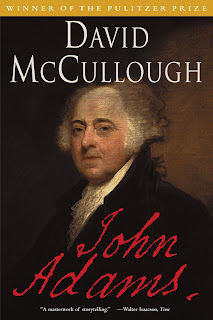
13. John Adams by David McCullough

I had the good fortune to go on a real vacation recently and wanted something long and absorbing and somewhat serious that I could sink my teeth into.  One of my friends (whose 50th birthday was the impetus for the trip) had mentioned this book and he had it on his shelf, so I borrowed it.  There was a very funny moment on the trip when I came out on the patio with this one and another friend was sitting there with his equally large biography of Ulysses S. Grant.  We definitely were living up to our image of middle-aged white males.

At first, I was disappointed.  Though extremely well-researched and constructed, it begins with way too much fawning.  There was an unquestioning acceptance of the American experiment, the greatness of the principles of the founding fathers and non-stop admiration for Adams' frugal, hard-working Puritan New England values.  I believe this is what they call a hagiography.  I was appreciating the facility of learning history through the framework of a biography, as it does make it easy to absorb as you follow a person's life.  However, too much of the early history felt very simplified and often unquestioned.  I only have a bachelor's in history, but it is enough to recognize when conclusions are presented that lack nuance. It also just made the early days of Adams' life kind of boring to read.  I am quite ignorant of the details of the American revolution, though, and this book helped fill in a lot of the early days.  I was not aware of the moral furor, contempt and animosity the British felt for the Americans and I better understand now why the great Kenneth Hite always refers to them as "the hated British".

Fortunately, the second half, when Adams returns to America and starts his time first as vice-president and then president, the politics and history, though still surface, are treated with much more ambivalence.  The book became much more engaging and McCullough's mission of making Adams out to be a hero much more successful.  What I learned here, aside from the politics of federalism vs. republicanism in the first few presidencies of America, was that the country truly was divided from the beginning.  It is both somewhat reassuring but also deeply unsettling to know that the same broad divides that exist in the U.S today were there from the beginning and that the shitty media worked as hard as possible back then like today to make them seem worse.

In the end, I put down this book quite convinced.  I had been skeptical at the beginning, even somewhat sneering of it as a biography for the masses and that it may be, but by the end, it made me respect Adams and his wife Abigail even more.  She in particular seemed incredibly strong and smart.  A big throughline of the book is both the Adams' relationship with Jefferson and she is the one who really tears into him at the end, never forgiving him and telling him directly what a dick he had been when her husband was president, while John himself lets it slide.  Impressive.

I haven't seen Hamilton so it may be more nuanced, but if that musical makes him out to be a hero, this book certainly portrays him as a manipulative, selfish asshole who tried on several ocassions to undermine the new nation. Jefferson comes off even worse and this was before his reputation was recently re-trashed with confirmation that he had several children with his slaves.  All this filled in a lot of gaps in my own grade school and Schoolhouse Rock knowledge of American history.

Thursday, March 10, 2022

12. The Ship that Died of Shame by Nicholas Monsarrat

I found this in the english language used bookstore Black Cat Books in Lennoxville, in the Eastern Townships in Quebec this summer. I normally avoid short story collections, but the cover design of this Pan was just too attractive.  It ended up being a very enjoyable read.  None of the stories go deep, but Monsarrat has a style that is direct and engaging, so they were quite easy to get into.  What I really appreciated was the postscript where he gave a brief history and background to each of the stories.   This was invaluable and made the whole book much more rewarding.  It should be required of all short story collections.  I thank Monsarrat for his thoughtfulness.

There were three longer stories that were all good adventures.  The title story about a languishing WWII vet who hooks up with his old shipmate (and their old boat) in a smuggling venture had some neat details about cross-channel contraband practices and a cool, slightly superstitious moral theme (as hinted at the title).  The Thousand Island Snatch takes place in Canada (where Monsarrat was stationed* as a diplomat for 14 years) and is a great brains vs. brawn tale of a scientist outwitting kidnappers and sparing his masculinity in front of his fiancee.  Licensed to Kill is a bittersweet tale, again of post-war ennui.  This time it is the tale of the man hunting the killer he trained in WWII who has lost his mind and putting his skills to practice in peacetime.  There are several shorter clever stories that were easy to read that give a fun insight into Monsarrat's worldview.  I especiallly enjoyed his pro-tax dig at British celebrities trying to avoid paying their fair share, "Oh to be in England!".  

*Here is a fantastic exit interview by Maclean's where he is quite spot on about Canada:

Monsarrat: Canadians are always astonished that anyone likes their country at all. I’m always being asked, “Why do you live in Canada — why don’t you live in Paris, or New York, or London?” But the only people who ask me are Canadians themselves — no one else. I mean, an Englishman knows instinctively why I live here, which is because 1 like it. It’s a big country, lots of elbow room, not too many people, taxes are a little . . . uh, things like that.

Turcotte: Do all Canadians have this attitude?

Monsarrat: I think it’s predominantly the English Canadians. It’s a curious thing, but the French Canadians whom I’ve met and talked to and traveled about with seem to have much more confidence in themselves as Canadians than the English do. It’s the English Canadians who are asking all the questions and in many cases it’s the French Canadians who are giving the answers — and the latter have much more of a sense of being at home in this country and its future than the English. I don’t know why that is.


Tuesday, March 01, 2022

11. Charlie and the Great Glass Elevator by Roald Dahl

I did not have high expectations for the sequel to the fantastic Charlie and the Chocolate factory and they were met.  It's a weird, bifurcated story whose flaws my daughter keyed in on about halfway through: "this book should be in the elevator for the entire story".  I don't know if I quite agree with her on that, but it does feel like Dahl did not have a strong premise or idea for this one. The first storyline is about them interacting with the US government while in space and while parts of it are quite wacky and fun, much of it feels like an aimless Dr. Strangelove, with much goofy commentary on various members of the US executive branch and military. It's not that funny for adults and kids don't get it.  The second two-thirds deal with Charlie's obnoxious grandparents taking too many youth pills.  It does allow us to see more of the factory but the whole problem could have been easily avoided if Willy Wonka had just doled out the pills in moderation.  His being neutral works perfectly with spoiled kids, but with people in their 90s it feels like he is being the irresponsible one.  It just may be that Charlie and the Chocolate Factory should not have a sequel. 

Monday, February 28, 2022

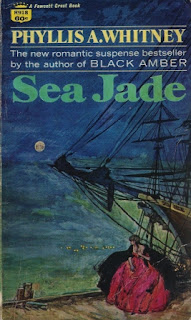
10. Sea Jade by Phyllis A. Whitney

This is the gothic romance/thriller that made me have doubts about the genre.  I am hoping that this was a badly formed example rather than just me not liking the tropes.  It was quite maddening.  Miranda Heath, young woman recently orphaned returns to her father's business partner's mansion in New England against his wishes because she is economically desperate.  Though old Captain Obadiah Bascombe welcomed her, when she arrives, everybody else, including the huge dog and the ragamuffin girl all seem to hate her.  She has to unravel the mystery of her own past, defeat her numerous enemies with demure yet firm niceness and discover which brooding, inscrutable male she actually loves.

I guess the appeal of these books to readers is the weakenss of the protagonist.  I don't know, I really struggled with it.  I get it at first that she is at a total disadvantage and is forced to marry Brock MacLean, the bitter, stormy yet of course oddly attractive heir apparent (and son of the murdered third business partner) as well as put up with his complete bitch of a mother and the totally rude and inappropriate housekeeper (who is bitter at Miranda because her mother was working class and married into her "betters").  But when in the big early twist, she is awarded complete control of the shipbuilding business and thus has power over all of them, instead of whooping ass on them all, she is super apologetic and cedes everything to Brock and tries to make diplomatic overtures to the two uptight women.  I want a book where she slaps the shit out of her mother-in-law and stabs the housekeeper in a hand with a fork until she apologizes and gets dinner on the table fucking pronto.

Worst of all, though, is the romance.  Brock is just an asshole.  He's not straight up cruel, but treats her like a nuisance and patronizes her about almost everything even though she is usually the one on the right track.  There is nothing inherently appealing about him yet somehow she falls in love.  And all the mysteries, once resolved, are just not that satisfying.  Finally, these books always have unreliable narration so you are never sure until the very end who is bad and who is good.  I guess they are written that way deliberately so you can't guess by clues in the text, but it means that when you do find out the truth, it's not convincing because you don't feel confident about any of the heroine's interpretations that led up to it.

Friday, February 25, 2022

9. To Die in California by Newton Thornburg

I actually saw this book in a free shelf in Berkeley but decided against it as my on-deck shelf is so full.  A few days later, my sister brought it home as a joke for me.  I'm glad she did because it ended up being quite a good read.  I wonder if this falls under the category of forgotten book?  It appears to have been quite a big success but I had never heard of it nor of the author.

Normally, a book like this would annoy me, as it is basically a genre revenge thriller gussied up with literary pretentions.  It's written well enough that I got quite into it.  Its literariness was not too pushy and its flaws were those found in thrillers of the period, mainly around the sexual politics.  The book starts out with David Hook, a successful midwestern farmer at the funeral of his eldest son.  Though we get the premise right away, it takes a long time to get to the details.  This is where the literariness gets in the way of the efficiency one appreciates in a good action book from this time.  It's not too annoying because the writing is so good and it does help establish Hook's character.  His son was a great kid, who was going off to college before the draft and then coming home to take over his father's farm.  However, he wanted to travel for a few months and met his end in California, supposedly killing himself by jumping off the cliff of a wealthy young woman's house in Santa Barbara.

The plot and premise reminded me a lot of The Limey, where the protagonist comes out to California to trace his child's death and learns more than he bargained for.  It's pretty clear here, though, that the son truly was a good kid and really did love his father (and Hook is a tough guy but not a criminal himself).  We meet a great cast of early 70s decadent Californians: the upcoming political star, his ugly mannish PR exec, his slutty aristocrat girlfriend, the ex-jock bodyguard and lots of extreme hippies.  Though ostensibly liberal and meant for a liberal audience, this book has the ongoing self-loathing of the coastal elite that we see so prevalent in American culture today.  The progressive politician is a sociopath hypocrite.  All the hippies and gays are hopelessly doped up and lost.  It's the good old salt of the earth family man who is the only real one (and maybe the vet cop).

I was actually quite into this book in the first half.  It has a very satisfying slow burn where you are psyched for him to head out to California and avenge his son.  When you get into the actual plot of figuring out the situation the son got into and trying to reveal the truth, that is also intriguing.  The middle bogs down a bit when the principle characters are established and the reader has a pretty good sense of who the bad guys are.  Here we also fall into the classic establishment fantasy trap of the older man having great sex with a super hot younger woman.  I get the fantasy, but at this point it is just so cliched and sad that it really does undermine anything "literary" in this book.  It's particularly egregious here when he picks up a prostitute and suddenly is able to last super long and surprises her by making her have an orgasm and then she wants to spend the night with him and give him a freebie in the morning.  Insert rolleyes emoji here.

I quite enjoyed it and it was a real page-turner up until the end when it really does get quite depressing.  Though flawed, it will stay with me.  And I'd like to visit Santa Barbara one day.

Did a bit of research and Thornburg was quite successful in his day and ended up dying not very well remembered.  Man, writing is brutal.


Tuesday, February 22, 2022

8. A Battle is Fought to be Won by Francis Clifford

Oof, this is a real war novel.  It felt quite realistic and was stressful and tense to read.  It takes place in Burma during the Second World War and follows a platoon of Karen soldiers led by a British ex-civilian, Captain Tony Gilling.  They are tasked with holding off the Japanese for a day along a strategic road.  It's a short read, basically taking place across two days. Aside from the main conflict with the Japanese, who are ferocious and scary, the big theme in the book is Gilling's weird insecurity around his second-in-command, Nay Dun, a super efficient, inexpressive Karen career soldier.  Under the stress of war, Gilling is convinced that Nay Dun is mocking, contemptuous of him and wants to take over. Gilling is scared and inexperienced and he makes a few blunders, but as you read on his actions belie his self-doubts.  Though he is freaking out the entire time, he does a lot of brave things, prioritizes his soldiers and the wounded and makes the right tactical decisions to delay the Japanese.  

I sympathized with Gillings to a degree.  The fear and panic seemed completely reasonable, especially after the super nasty shit the Japanese do to prisoners (to break the morale of the enemy).  However, his anxiety around his relationship with Nay Dun made him very unsympathetic.  It did seem realistic and perhaps was the subtle real sub-text of the book: the alienation of colonialism.  But if homeboy just chilled out a bit and tried to relate instead of being obsessed with his authority and being a leader, he would have seen the ironic twist that we all saw coming, that Nay Dun actually respected him.  So a frustrating read, at times harrowing, overall really well-written.  Not sure if the style is something that will motivate me to seek Clifford out, but I won't say no if another of his books falls into my lap.


Sunday, February 20, 2022

7. The Shooting Party by Isabel Colgate

I can't even remember where I found this or why I picked it up.  It's about a shooting party at a British country estate in 1913 just before the beginning of the First World War and the beginning of the end of the landed aristocracy.  This is clearly part of a literary sub-genre and one that was once quite popular.  I remember my parents talking with their friends about Upstairs, Downstairs.  What I appreciated about this book, that it really mostly was about a shooting party and went into enjoyable detail about both the characters and the actual work behind the setting up of the shooting (not as much as the masterful The Gamekeeper).  It has a minor and sad climax that moves the book towards its denouements, but otherwise doesn't really beat you over the head with end of the era doom and gloom.  It's just all very well-written and engaging.  I particularly enjoyed the character of Sir Randolph, the Baronet who is organizing the hunt.  He is a classic mixture of powerful aristocratic propriety mixed with privileged eccentricity.  The scene where the radical vegetarian socialist tries to interrupt the shooting and Sir Randolph engages with him to get a deal on having a pamphlet published motivated a re-read from me.

Friday, February 18, 2022

6. Charlie and the Chocolate Factory by Roald Dahl

One of the perks of having a child is to read books to them.  Unfortunately, my daughter has refused until the age of 9 to allow me to read anything but picture books (before she could read) or comic books (once she could read).  I finally somehow miraculously got us on Charlie and the Chocolate Factory.  Well you can imagine how my heart soared with joy when she begged to read one more chapter after a couple of nights to get into the narrative.

Almost everybody knows this book of course, but I would recommend you read it again if you haven't since childhood.  It's so well-written, so impactful in its own little world and just so much crazy fun. The whole first section with starving, freezing Charlie and the starving, freezing Bucket family is so painful that it is almost unbearable and it makes the joy of the turn (when Charlie discovers the ticket), so great.  My daughter was guessing what was going to happen (she is really not into intrigue and mystery; just wants to know what is going to happen) and mostly accurately.  It's not that hard the way the book is structured, but I also feel it is such an ur-narrative of privation and humility followed by reward that it is almost natural to know and feel what is going to happen next.  I'm no expert on the trends of children's lit but Charlie and the Chocolate Factory must be massively influential in the (excessive in my opinion) abundance of narrative that is drowning children in our post-Harry Potter world.  

Wonka's refreshing lack of caring about the well-being of the bad children was written, I suspect, as a tonic against over-protective parents of the early 60s when it was written.  Man, if Roald Dahl could see the parents of today with their leashes and anti-bacterials sprays and arranged playdates.  We are living close to disaster in Wonka's world and it's fun!  Smarter people have written smarter stuff about this book.  I am grateful that I got to re-read it as an adult.

Wednesday, February 16, 2022

5. Strip by Thomas Perry

I found this hardback Bibliotheque Mile-End (now Bibliotheque Mordecai-Richler) discard on the ever-fertile free shelf on St-Viateur and grabbed it because I liked the premise and it looked easy to read.  I guess Thomas Perry is a very successful thriller writer, including having an entire series.  I had never heard of him before.

It starts out great.  A guy who seems to be the protagonist is hiding out in the high cabin on a crane on a major high-rise construction site.  We don't know much about him except that he is on the run and hiding and is capable of breaking into constructions sites to sleep in crane cabins while learning how to operate them solely by reading the manual.  Though the action here was way over the top (he defends himself against 4 thugs and two SUVS with the crane), the writing had a nice stripped-down style with evocative suggestions of skill that I enjoy.  I got a little ahead of myself thinking I had discovered a new Richard Stark, but the beginning had that hardness.

The premise is that this guy, Joe Carver, is new in town and was spending a lot of cash in strip clubs and was thus fingered as the stick-up man who robbed the owner of those clubs.  Quite quickly, the narrative threads spin off in several directions and we follow the quite a few storylines, so many that it is not really clear until the end who is the actual protagonist.  As well as Joe, we follow the story of the savvy and hard but older strip club owner, his driver, the detective investigating and the real guy who did the stick-up.  So what starts out as a focused idea of the innocent badass trying to get the badguys off of his trail and then having to turn to ass-kicking morphs into more of a broad crime mosaic, focused ultimately on the club owner.  It was all fairly enjoyable, though at times quite implausible, especially the recurring ease with which guys got laid by hot and interesting but complicated (putting it mildly) women.

I found the ending somewhat dissatisfying.  It felt mean-spirited from what came before and also had a specifically nasty touch that I also felt didn't quite belong.  So I would have to say from a critical pespective that the book doesn't succeed in landing all the planes it launched and it may have been better to have started out with fewer take-offs.  The Joe Carver character, though he has a partial backstory is almost a maguffin, which is confusing as he starts out the book.  Despite that, it was quite fun to read and a real page-turner.   I also appreciated the detailed view on the backroom workings of strip clubs, felt very realistic.  I will definitely pick up his other books, when I run across them.

Monday, February 14, 2022

4. The Bitter Tea by Gavin Black

There is a great institution in Berkeley called Urban Ore.  It's a giant warehouse that accepts almost anything used and then sells it.  Basically a recycling store, but they do a really good job of curating.  This is where you go if you are looking to renovate a house and do it with nicely built used things.  They also have a pretty large and good book section.  I didn't find any major prizes, but did come up with several semi-obscure mid-20th century British thriller and crime books, including this cool Fontana.  Turns out it is part of a 13-book series starring mildly adventurous Singapore businessman David Harris.

This book starts out with him at a fancy party high in the hills above Singapore when a visiting Chinese dignitary pays a surprise visit via helicopter.  When this guy attracts the woman Harris was talking to, he goes for a little walk in the jungle on the edge of the property.  He happens to be there when shots ring out and then notices a rifle-carrying figure, a figure that he recognizes, fleeing down the hillside.  Stuck in the wrong place and not wanting to get shot by trigger-happy soldiers nor to get interrogated, he effects a sloppy escape, wrecking a car but managing to make his way back to his hotel room without being spotted.  Once at least physically out of this mess, we learn more about Harris's business ventures including the shipping company of which he may lose control when one of the board members dies.

It's a nice mix of traditional espionage in the Asian theatre with some business intrigue.  The emphasis ends up being on the former and it was made interesting by the milieu (it motivated me to read up on Singapore) and the novel situation they generate.  There is some action, but Harris does his work by being shrewd and avoiding trouble. So we get a neat escape from a hospital, a slippery stair trap and a nice fight in the dark that ends with a heavy table being flipped on the adversary. 


Wednesday, February 02, 2022

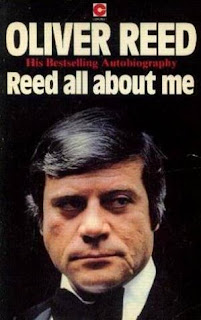
3. Reed all about me by Oliver Reed

I'm not normally a big fan of celebrity autobiographies but this is a coronet and come on, it's Oliver Reed.  I am not a huge fan, but have seen him in several of his earlier Hammers and The Devils.  I started out this book with low expectations and they fell even lower in the first chapter.  Like the bad title, it is full of bad puns and a particularly British male upper-class humour that is just annoying. Fortunately, it settles down into the actual narrative in the second chapter and his backgrounds is actually quite interesting.  He comes from an upper-class ancestry (his grandfather started the Royal Academy of Dramatic Arts) and his uncle was the director Carol Reed).  However, by the time he was born, his parents had been disconnected from any wealth so he was raised with a peculiar mix of upper class culture and working class means.  He also was dyslexic which didn't exist as a concept in British education at the time, so he failed out of school after school.

His narrative is of the self-made actor, who rejected formal training and the theatre for the school of life, learning, he claims, his skill in the army and at pubs, just watching people.  There is no doubt if you see him in anything that he is intensely charming and charismatic as well as quite a skilled actor (could do accents, all kinds of stunts and fights).  Hard to know how much of that was innate and how much from the aforesaid school of life.  He has the reputation of a wild man and heavy drinker, but it does seem that on set he was disciplined and hard-working and the length and output of his career seems to attest to that.

After we get through his background, he shares a lot of stories about other directors and stars, life on the set and his various hijinks.  One gets the sense that though a wild man, he genuinely seemed like a decent person.  He loved animals and ended up despite all kinds of mistresses being in 2 steady long-term relationships (including his second wife who was 26 years his junior).  The one area where he really is not good is his misogyny.  He doubled down constantly on the gross anti-feminism of this period. It sucks in the book and it sucks when he talked about it live.  He actually was generally decent to the women in his life, so it sucks that he was so ignorant and nasty when it came to women actually trying to fight for equality.  A gross stain on his otherwise well-earned reputation for being a great actor and character.