Friday, August 31, 2007

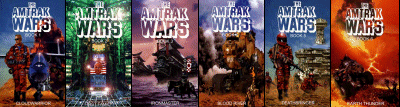
34-38. books 2-6 of the Amtrak Wars

Amtrak Series picture
Oooh, sneak attack! You weren't expecting that Carrot (though this didn't give me the lead I was hoping for, I am in the race still).

The mountain man of Mount Benson found the rest of the Amtrak War Series which I received as a very welcome surprise in the mail a couple months ago. I've been working my way through them (not much work really). I had devoured the first one and was really looking forward to continuing the series. In many ways, the set-up in the Amtrak Wars is my ideal post-apocalyptic setting. It's far in the future (1,000 years) but still has connections to the past. There is tons of unknown and mystery set up at the beginning that really hooks the fan of exploration of the unkown in me.

The themes underlying the series is also very 80s. It's the fascistic near-1984 society versus the primitive plainspeople, who are kind of rock and roll (with names named after rock bands and midwestern cities). Plus an entire post-apocalyptic feudal Japanese society that shuns electricity. It has a frank tone and pulls no punches, with the violence and sex. Sometimes this makes it feel a tad cheap, but more often it's entertaining and reminds you how precious and careful we have become with our genre writing.

Ultimately, the series moves more towards the conflict between the three major powers in this wasteland North America. The protaganists are heroes who have special powers and are clearly marked for world-changing destinies and their narrative path guides the political conflicts. I got into this, but after the third book, most of the mysteries of the world are revealed. They are pretty cool, but the series moves away from exploration, which I missed a bit.

Also, and this is pretty major, it never fully concludes. It ends very open-ended, either because the author deliberately wanted it that way (as a reader you have enough info to speculate on your own) or because he grew tired. I've heard he is a bit of a recluse now and doesn't want to talk about The Amtrak Wars. It's too bad, because I would definitely be buying the next books if he were to do them.

Overall, a fantastic find and full of tons of ideas that I'll be stealing for future gaming. This would have blown my mind if I'd read it in my adolesecent years. I'm amazed it never popped up until now.

Wednesday, August 22, 2007

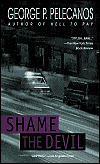
33. Shame the Devil by George P. Pelecanos

Shame the Devil pictureShame the Devil is the fourth book of the Washington Quartet. Here are my reviews of the first, second and third. I'll talk about this book on its own first and then briefly discuss the whole series. In Shame the Devil, the main protagonist, Dmitri Karras, is in his 40's, older and wiser and at the very beginning quite happy. This doesn't last long. I'm not going to tell you what happens, even though it's in the very first chapter, because if you start on the series, it will still be a spoiler for you. But his happiness is taken away from him and we fast forward a few years. The story now finds Dmitri slowly pulling his life back together when the cause of his downfall in the first place returns.
Shame the Devil weaves a semi-objective crime story, following the paths of two sociopathic, professional criminals, with a story of adulthood and recovery, with a tablespoon of revenge. Pelecanos books always move forward and his settings and characters are rich and engaging. Where the third book bogged down a bit, becoming too dark and too concerned with which song was being played or what kind of clothes people were wearing, here he seems to have found his balance again. It's a quick, entertaining and moving book. It redeemed the quartet in my eyes.

I think it's a bit erroneous to refer to these four books as "the Washington Quartet". I believe he has other books that take place in D.C. and characters here definitely show up in other lines of his. I believe that Nick Stefanos has his own series and he is one of the major characters here. I could be wrong. Nevertheless, the four books make a very satisfying story arc. They are realistic and the characters complex. And they definitely give me a great sense of a city that has abandoned its roots. I can see why Pelecanos got tapped to write for the Wire. This is good stuff and gives me some hope for our otherwise wasted generation.

Of the four, though, the first is still definitely my favorite.

Monday, July 30, 2007

32. Blood of the Gods and Other Stories by Robert E. Howard

Wreck of the Dumaru pictureThe little book troll of Mount Benson gave me this book (for my birthday, I think) a couple years ago. I have been slowly reading it one story at a time in between novels. Howard's short stories are so turgid and dense that you don't want to read one right after the other. It's best to take each story as a little novella on it's own and get right into it.
These are all short stories that take place in and around Afghanistan, during the period of Great Game. Most of the stories feature El Borak, a wild Texan who long ago adopted the ways of the desert and mountain people. He respects their culture and lives among them, but he also has to lay the beat down on them often when their naturally savage ways come to the fore. He delivers the same treatment to Europeans of weak moral fibre who come to this land to exploit and plunder.

The final story stars Kirby O'Donnel, whose exploits I had quite enjoyed in another paperback I found that were just about him. Those took place on the docks of pre-war Shanghai and he was mainly a boxer and dockman. Here, Kirby is in the desert as well, I guess just part of a world-jumping sailors many adventures.

Great stuff all around. There is a reason Howard is considered a master today. He always delivers and it is cool to read his fierce, adventuresome writing in a different context than Hyboria.

This collection was put together by Girasol Collectibles, who have been reprinting Howard's works (as have some other publishers). It is really great to be able to finally read Howard's work on its own as well as to find all these other lost gems that he produced.

Tuesday, July 03, 2007

31. The Wreck of the Dumaru by Lowell Thomas (actually Fritz Harmon)

Wreck of the Dumaru pictureI found this book at the local thrift store. The sub-title is "A Story of Cannibalism in an Open Boat" and it has real pictures of a cool old freighter as well as the old salts who were on her. It's an old book, yellowed pages, dust jacket long since gone, part of the "Lowell Thomas Adventure Library". I learned later that Lowell Thomas was a promoter, radio announcer and general publicity guy who was very well known in the 20s, 30s and 40s. He is credited for making famous the story of Lawrence of Arabia. I put this in context because it was weird to me that he is credited as the author of this story, considering that he only wrote the first chapter and the rest was written by Fred Harmon, the guy who actually lived the story. It's funny, because the first chapter is really floridly written and almost discouraged me from continuing. Fortunately, the rest of the book is really clear and direct. As Thomas (slightly patronizingly) says "an extraordinary simplicity and graphic power, with that strength and reality which a man unschooled to writing and to literary artifice can achieve when the impressions of some fearful crisis have graven themselves on his brain."
The story is about a poorly and quickly built merchant ship, during the First World War. Most of the men on it were forced to be there, there only alternative to going to the trenches or in some cases jail. Once on, they found out that it was carrying a load of dynamite. It got caught in a lightning storm just off of Guam and blew up. The bulk of the story is one of the three life boats (actually two life boats and a raft), which was carrying almost twice its capacity (because the first life raft deserted) and had only a tin of biscuits and two gallons of water. They got caught at the first day of the tradewinds, which pushed them away from shore and ended up floating in the sea for 24 days. It got rough. Some went mad, over half just died and in the end there definitely was some cannibalism.

It turned out to be a great read. The author is clearly a straightforward guy but an observer and he spends the first chapter detailing the boat and then all the crazy misfits and castoffs that manned her. When we finally get to the lifeboat, you already know a lot of the characters well and you dread how they are going to behave under the pressure of surival. The narrative goes through it all in an engrossing, enjoyable but dreadful detail. When they do finally resort to eating one of the bodies, you are truly horrified, but also relieved because it actually ends up prolonging their lives and giving them enough energy to push on. But it is really disturbing. They strip the meat (what was left of it) from one of the guys thighs just after he dies, as he is lying there with his legs straight out in front of him. And they cook it in a tiny metal biscuit tin. It freaks you out!

I don't know if this book is around in any form other than a lucky find. But I am glad I found it. A great slice of sea life and an amazing story of survival and human behaviour.

[In searching for the cover of the book I have, I noticed that this story was published in 4 parts in Argosy magazine.]

Monday, June 25, 2007

30. Last Call by Tim Powers

Last Call pictureI'm kind of surprised that I had never heard of Tim Powers before now. He's made his mark in sub-genres that interest me and yet his name hasn't come up until this year. It did come up because his books are considered to be one of the major inspirations for the tabletop RPG Unknown Armies. I've been playing in a campaign of this since the beginning of the year and was told that if I liked the setting, I should check out Tim Powers.
Last Call is a modern occult noir adventure. It takes place in the real world, but one in which not so far underneath the civilian surface, there is a world of powerful magic that is accessed and manipulated by gambling, consumption, drinking and a range of other very creative and bizarre ideas. I am not a big fan of "the occult" in fiction, generally because I find the aesthetic pretty limited. It's usually either brooding goth vampires, fruity new age suckers or post-hippy wiccans in loose fitting natural fibres. Last Call is totally the opposite. The people who practice the magic are criminals, low-lifes, alchoholic losers, the kind of characters you would expect to find in a Charles Willeford or Elmore Leonard book, except really weird. Actually, some of the characters in Carl Hiassen's book, minus the slight humour, would fit well in Tim Powers movies. But these guys are weird! There is an immensely fat man who is obsessed with maintaining the living vitality in his body, so he's constantly eating living things (like getting out of his car to munch an on aloe vera plant in the yard of the person he is spying on) and smearing his obese, tattooed body with ray-ban to keep the energy trapped inside of him. There are characters who have children and raise them just so they can take over their body when they get old. It's weird and dark.

The book opens with a boy who was destined to have his body taken over by his father (his older brother spent most of his time on their roof, acting as eyes for his father), but whose mother saves him at the last minute. We jump forward to the present, where the boy is now grown up and an alchoholic who the more he drinks, the more he is able to bring back a physical manifestation of his wife who died recently. However, crazy stuff starts happening to him and he learns that his father (whom he doesn't know and who is by now a very powerful practitioner) is gathering his magic to call all the bodies he controls (which he "bought" playing a special ancient card game at a certain time and date). After a certain point, the protagonist will lose control over himself and become another empty vessel that his father will use to extend his life. Things are much more complicated than that. There are many other important characters and wrinkles in the story line, but that is the central thread. It's actually quite epic in scale, ultimately, but the whole book is grounded in such a seedy, criminal world that it doesn't have an epic feel at all.

I really enjoyed Last Call. It had an anarchic feel in the pacing and behaviour of the characters. Powers comes up with some pretty amazing ideas and he is willing to push them to extreme ends. It took me a little while to get linked into to what exactly was going, just because there is so much detail to the magic and its effects, but once I got a sense of the structure of the world he is portraying, I really got into it. Cool stuff and I'll be keeping my open for other books by him.

Sunday, June 17, 2007

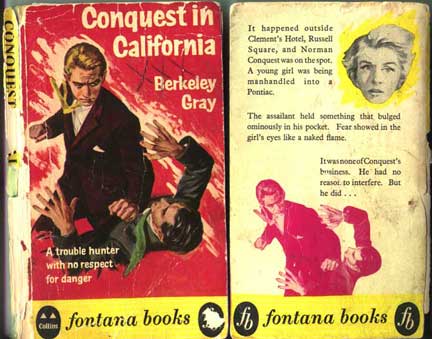
29. Conquest in California by Berkeley Gray

Conquest in California pictureMy reading consumption has dropped off considerably with the start of summer. Nice weather, gaming, weddings, etc. are making it hard for me to sit down and make good progress. Fortunately, I've had Conquest in California in my side pocket for the last couple weeks and have been stealing pages from it when I could.
I picked it up at an antiques store for a buck. As you can see, the cover alone is enough. I did a bit of internet research and discovered that Gray was a pseudonym for Edwy Searles Brooks, a journeyman British author who produced a massive amount of published work. Conquest was one of his later and more succesful series.

Norman Conquest (get it) is a young englishman of excellent character, wealthy and athletic. And fearless. He lives to get in scraps and have adventures. In this one, he rescues a young American girl (a blonde to which he is always attracted) from a threatening thug. This gets him caught up in a tale of small-town corruption in Clam City, California, where Conquest goes to show American thugs how its done and clean up the mess. There is a lot of not-so-subtle British pride here. I wouldn't go so far as to say it is anti-American, but you can tell that the writer and the intended audience have a bit of a chip on their shoulder. Lines like "Conquest swung his fist up with a short, outward jerk of the elbow and struck the American on the side of the jaw," give a good sense of where this book is coming from.

It was a fun read, particularly for the setting and the side characters. The plot is pretty straightforward and moves forward a bit too clunkily. There is a lot of repetition of exposition and a lot of the author telling us how awesome Norman Conquest is. Sometimes it is very effective, but generally you get the feeling that the whole thing could have been cut down a lot and the book would still have been entertaining.

I would check another one of these out if they come across my path. Check out these sweet covers!

Friday, May 25, 2007

28. Killing Mr. Griffin by Lois Duncan

Killing Mr. Griffin pictureI don't know if the name Lois Duncan rings a bell for you, but her books were all the rage when I was an adolescent back in the early 80s. She wrote teen horror novels that were genuinely freaky. I think they appealed to girls more and I have a vague memory of my sister getting them from the library and me reading them. She also wrote "I Know What You Did Last Summer" which got made into a series of teen horror flicks in the last few years.
Killing Mr. Griffin is about a group of high school students who get together to kidnap and scare a really severe english teacher. The tale is told mainly through the eyes of a square loser who gets coerced by the cool group because she won't be suspected. Of course, as suggested by the title, the plan goes too far and the teacher dies.

It's funny because before I started reading this book, I felt a bit cheap about it, like I shouldn't count it as one of my fifty because it wasn't that long and written for teens. But it actually took me a while to get into it. I'm just really not interested at all in the insecurities of teenages, especially girls. I wasn't when I was a teenager (not to say I didn't have them!) and I sure am not now. But once I got into the story, it went very quickly. It's well-written, clear and straightforward, though in a manner that one might associate with a book aimed at teenage girls (very direct emotional exposition). The characters are actually quite good. Each of the teens is slowly revealed, as well as the family around them. Their motivations make sense and nobody is really annoying or stupid. And the narrative moves forward. It's gripping. Though it all wraps up neatly, this almost seems like an afterthought, as everything really goes to shit in quite a nice way. You sense that Duncan prefers the chaos and impending doom to the happy ending.

What struck me most about this book is that it didn't pull any punches. The teens drink and smoke weed, without a big deal being made about it. Bad stuff happens and nobody is blamed. Duncan seems to be saying that bad shit can happen and it can be impossible to avoid. She doesn't waste any time moralizing or making her characters struggle with moral dilemmas. They make mistakes but you can see that it would have been almost impossible for them to do other wise. I have no idea what modern day realistic fiction teens are reading today, but I have this suspicion it is watered down and compromised with morals. I know that fantasy is back in a big way and it is too easy to avoid real harshness in that reality. Something about these teen books from the 70s were really hardcore, like Roger Cormack and SE Hinton (though she was really the one that started it all probably). I remember seeing them for order in those Arrow or whatever catalogues we used to get and feeling freaked out by their toughness and adulthood.

Monday, May 21, 2007

27. Shutter Island by Dennis Lehane

Shutter Island pictureI had heard about Dennis Lehane because he is also one of the writer's for the best television series ever "The Wire". The producers chose writers for that show from people who wrote succesful genre fiction local to the urban northeast. Dennis Lehane's area of expertise is Boston.
However, Shutter Island, actually takes place on a small island outside of Boston. So it doesn't draw too much on local flavour. The island is home to a prison for the criminally insane. It's 1948 and two U.S. Marshals have been sent to the island because one of the patients has escaped. Things are weird right from the start, particularly how nobody seems all that freaked out. They get much weirder.

I am not going to go into any detail because I would say this book is good enough to recommend and part of the pleasure of the read is figuring out what is going on. Sometimes when you don't know what kind of a book a book is, what boundaries are acceptable given the genre and setting, you can be critical while you are reading it and then realize 50 pages later that what was going on was actually quite cool. Now, I don't like a book where you finish and then look back and think that was actually kind of interesting (this is even worse with movies). I want to be entertained while I am reading it and if I am constantly critical then I am not being entertained.

Fortunately, this is not the case with Shutter Island. The characters are interesting, the dialogue gripping and the setting is fantastic. There is enough weirdness, action, intrigue and mystery to keep you hooked. There were some false spots and sometimes the writing was a bit too florid (a common problem even among the better American authors these days; sparsity, people, sparsity!). Overall, though, a great, quick read. Recommend it for the plane or the beach or a rainy day with nothing to do.

Friday, May 18, 2007

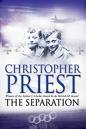
26. The Separation by Christopher Priest

The Separation pictureSince seeing The Prestige, I became aware that Christopher Priest's career is going stronger than ever. The library here actually had 4 hardback copies of The Separation and it seems to have gotten such rave reviews, yet it completely passed under the radar here in North America.
There is something about Priest's writing style that compells me and yet keeps me at a certain distance. I suspect that he is a very careful writer, crafting his sentences because his prose always has a slightly objective feel to it, as if the characters themselves are slightly removed from their own lives. I really like that because it avoids all the flowery adverbs and adjectives and excessive self-psychology of so many american authors (even good ones). On the other hand, it can sometimes make you feel not totally caught up in the book. Again, I suspect it is deliberate, because he is still very good at changing the voice when he changes narrators.

The Separation is a story where these kinds of details are very signficant, because not only does it jump around from narrator, it also appears to jump around in realities! The basic story is framed in a contemporary author who writes histories of the Second World War. He is researching an elusive individual who, from his research, appears to have been both a concientious objector and an RAF bomber pilot. The bulk of the book is then the narrative of these characters, who turn out to be twin brothers. We see their story through their eyes and through a few other characters around them, as well as some historical documents.

On the surface, they were both excellent athletes, who rowed for England in the 36 Olympics in Berlin and then fought over their differing positions on war. One became an objector and a Red Cross worker, the other an RAF bomber. Each gets involved in some way with the escape of Rudolph Hess in 1941 (who, in our world, split from Hitler and claimed he was trying to make peace with England and ended his life in prison in Nuremburg).

From what I've written so far, it all sounds very straightforward. What I haven't omitted is that the modern author is living in a time very different from our own. I won't go into any more detail because it is cool in the reading. And as you read the various narratives, things get even weirder. This is what makes this such a great book. The stories of the twins are absorbing and ultimately really moving, but it is also working at a much bigger level, where complex layers of alternating realities make the reader question what drives history forward and how certain decisions make change in the world. I don't know if I get entirely what Priest's goal was but this is a rich, complex and moral book that makes you question your own stand on war, without lacking entertainment.

It is also clear that Priest has done a great deal of research himself, both on the larger political developments of the Second World War as well as the more personal details of living under the blitz and piloting a bomber. This makes this book a great read for any WWII buffs as well as sci-fi fans. Probably the most impactful book I've read this year so far.

Tuesday, May 15, 2007

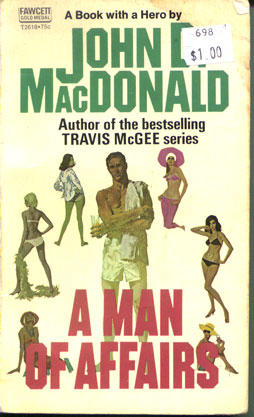
25. A Man of Affairs by John D. MacDonald

A Man of Affairs pictureThis is another of John D. MacDonald's non-Travis McGee books, dealing with business machinations and intrigue. I really enjoyed "A Key to the Suite" so I keep an eye open for these when they show up at used book stores. They are cheap, with cool covers and he has written quite a few. He does a good job of capturing the world of white male businessmen from the top to the bottom. And the corruption is there at every level. It takes different forms, but MacDonald does not hold back in showing that the evil and slime is inside the suit of the most sophisticated CEO as well as the tough who unloads the shrimp boat (and is handy with a gaff).

A Man of Affairs does not actually get so violent. It is more of a social drama. A group of people are invited to a private island in the Bahamas where they are being wooed to sell their shares to a shark-like investor (similar to the Gordon Gecko character, except 20 years earlier; just shows how little changes in the world of business). There are conflicts and sex and intrigue. It all centers around the one lower middle-class hardworking guy who has kept the company alive while its founder died. His ethical struggle, whether to accept the shark's tantalizing offer or fight him, is the center of the book.

Overall, this is good stuff and I am a big fan of MacDonald. But he loses me with the modern, romantic dialogue that goes on between the protagonist and his love interest. It's this really painful mix of early 60's white people lingo and what he considers post-feminism. So the women are frank, but coded, about sex in a way that is meant to be really adult and sophisticated but only reinforces the sexism of the period. And it is just annoying. This book has way, way too much of it. [insert quote here].

The ending was also all a bit pat. But it was still a good, quick airplane read with some great characters and descriptions and a bit of corporate tension.

Wednesday, May 09, 2007

24. The Dreaming Jewels by Theodore Sturgeon

The Dreaming Jewels pictureI actually read this book before the Jack Tatum autobiography. I somehow forgot it in my rush to get library books back on time. I found this one purely at random at the library. I have definitely heard the name Theodore Sturgeon before and I feel that somewhere it pops up in a Gilbert Shelton comic (can anyone verify this?).
The Dreaming Jewels is about an adopted boy who runs away from his totally abusive father. He hitches a ride with a bunch of midgets who happen to be a part of a carny. The only thing he brings with him is a jack-in-the-box doll (now smashed by his adopted father) with peculiar jewel eyes. As the story progresses, you see that the eyes and the boy are strangely connected. The narrative gets even deeper as the manager of the carny turns out to be a disgraced doctor who hates humanity and is obsessed with these strange jewels he once discovered.

This is a really interesting book, because it is a mix of two strong (and not well-respected) genres of the time it was written(1950): science fiction and crime. It is kind of half Charles Willeford half Andre Norton. There are seedy jazz clubs, carny love, corrupt local judges as well as telepathic powers, non-human intelligences and mad science. It's a combination that I really enjoyed, like my own personal genre peanut butter cup. Furthermore, this book went fast, the characters were interesting and well realized and there are some strong and moving themes about humanity and cruelty. I am definitely going to stay on the Theodore Sturgeon path.

23. They Call Me Assassin by Jack Tatum with Bill Kushner

The Call Me Assassin pictureI lived in Oakland, CA until I was 10 years old and I was a huge Raiders fan. John Matuszak actually lived up the block from us for a summer (these were very different times for professional athletes). I had the entire 1978 team in football cards and I went to the rally to keep the Raiders in Oakland. There I met many of the Raiders as well as the Raiderettes. My favorite player was the punter Ray Guy but I was pretty psyched to meet Jack Tatum, the infamous free safety. We shook my hands and I still remember how his huge hand completely enveloped mine. I was pretty psyched.
I found his book for fifty cents. Perfect plane reading. He talks a lot about his role on the team and his philosophy towards organized violence. Basically, he comes off as a very gentle, thoughtful person who knows his expertise and primary attributes are physical. So he uses them to the maximum within the rules allowed. He walks a thin line, sometimes sounding quite reasonable and other times quite scary. This contradiction is wrapped up quite nicely in this sentence: "I've used the word "kill" and when I'm hitting someone I really am trying to kill, but not like forever." The beginning and ending of the book go into this issue in some depth and ultimately, I kind of side with Tatum. You get the sense that the level of competition is so intense in the NFL that you have to be going for the kill or you'll lose your job.

The rest of the book follows his childhood in rural North Carolina and then urban (and rough) New Jersey, his college career and his first years with the Raiders. He also dedicates a chapter to rating his contemporaries, which brought back a lot of names and memories for me, particularily of that awesome Raiders team. They just don't build them like that anymore. Willie Brown, Fred Bilitnekoff, George Atkinson, Kenny Stabler, my man Cliff Branch.

There is one key passage that to me captures the old spirit of sports that seems totally lost today. In the last week of the 1976 season, the Raiders were guaranteed a spot in the playoffs. They had a final, meaningless to them, game against Cincinatti. The Bengals had been on a tear and if they won, they would make the playoffs and knock the Steelers out. The Steelers were Oakland's main rival, had knocked them out of the playoffs two years before and were still considered a much tougher opponent, despite losing control of their own regular season. Oakland could have let Cincinatti win and thus avoided the Steelers in the playoffs. Here is what Jack had to say about that:

When you honestly believe you are the best in any profession, you do not shy away from a challenge; you seek out the best of the competition to test your talents against. Sure, Cincinnati had the potential to "get lucky" and beat us, but it would be a most difficult task. As Oakland Raiders, my teammates and I had no need of any of the Steeler psychology to get us ready for the Bengals. To go on to win the Super Bowl without facing Pittsburgh again would have been a very shallow victory indeed. But to blast Cincinnati away and trample everyone who got in the way of our rush to become number one, well, that is what our motto "Pride and Poise" is all about. It's all a part of becoming a man and being called a professional. To hide from any player or team is cowardice. If I had felt the Raiders were going to lay down, I would have asked to sit this one out. Maybe I would have even asked to be traded. Never in my career have I ever approached a football game or anything with the thought of letting the other team win. When Monday night came along, I am proud to say that every member on the Raider team and staff went onto the field with a ruthless attitude toward the Bengals.

They ended up winning 34-21 and then went on to become Super Bowl champions.

Maybe the Mavs should have read that before tanking it against the Warriors in the final game of the regular season only to have the not-worthy Warriors slap them down and out in the first round.

Wednesday, May 02, 2007

22. Darwinia by Robert Charles Wilson

Darwinia picturePicked this one up on a total fluke. Meezly and I were in the sci-fi/fantasy section of la Bibliotheque Nationale (can you tell I am living well!:)) when this book caught her eye. She is a student of all things Darwinian (being highly evolved). She only glanced at it and put it back, but being in a very pulp/explorer phase right now I was intrigued by the cover, kept looking and decided to take it out. Plus, I had read The Chronoliths by the same author and was still interested in reading more of his work.
The whim was a good one as this turned out to be an excellent book. It follows the life of a young man born on the turn of the twentieth century. When he is 8 years old, he witnesses, as does the rest of the world, a strange light in the sky and the following total transformation of most of Europe into an entirely different ecology. The landmasses are the same, but the plant and animal life is totally alien and all the humans and their work is gone. The book then follows the protagonists exploration of this transformed continent and how the revelations of its origins change his life and the entire world.

It is, in effect, an alternate history. I was a little disappointed after the first half because I was hoping there would be more exploration and discovery of the crazy details of this alien world transposed upon earth. I was also hoping for more depth on the resurgence of creationism (because with such an obvious 'miracle' the theory of evolution becomes completely discounted but for a few heretics) and the conflicts that would arise from that. I suspect that this book would have been better served in a longer format, like a trilogy, because the questions it poses and the story possibilities it creates are vast.

On the other hand, I appreciated that the actual source of the transformation and the great story behind it is fully explained and justified. I won't say more beyond that it is big picture science fiction (reminded me a lot of some of Zelazny's ideas). I am actually glad that it was kept to one single book, even though I felt some things were skipped or rushed over. As I have said many times, I have neither the will nor the time to get into long series and trilogies, so Darwinia served me well.

A rich and satisfying read, with a gripping story and some very cool concepts. Recommended.

Tuesday, April 24, 2007

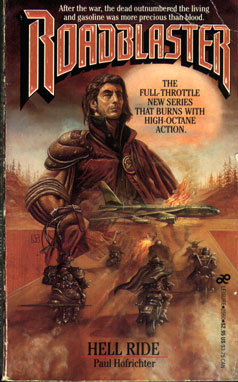
21. Roadblaster #1: Hell Ride by Paul Hofrichter

Roadblaster pictureI found this nugget of Reagan-era nuclear holocaust pulp literature at S.W. Welch's moving sale for a buck. It came out around the same time as the Outrider series and is clearly riffing off the Road Warrior. It's after the Nuclear War that everyone feared in the 80s and now the good and plucky must work together to fight against the savages that rise up in times of chaos.

I speak a bit disimissively of this book, as it is pretty junky in many ways. However, it also has some good stuff in it. The story follows an outdoor hobbyist, from New York, but on vacation camping and hunting in the Northern California mountains. It also jumps around to a B-52 crew who were on their way to nuke Siberia when they developed engine trouble, a gang of bikers and the citizens of the small town they decide to take over. All these characters converge in a fairly entertaining way.

Here's what's good: The opening scene, when the guy is at the top of a mountain looking out towards the coast and suddenly sees mushroom clouds blossoming all over the place is pretty cool. Following the air crew as well is quite cool. The author doees a decent job of describing how the civil infrastructure would respond to being nuked, but he keeps most of the action in the small towns, where that kind of thing is easier to handle as a writer. If you are a student of the genre, this book has some good stuff in it.

What's bad, however, is that it is saturated with pornographic descriptions of violence, explosions and rape. There are a couple scenes that minus their brutality could have come off the pages of Penthouse Forum (or at least what I would imagine those pages would read like ;) ) Every bullet wound, every knife stab is described in blow by blow detail with loving attention paid to the death rattle. It's the same with explosions. I guess that is what the audience of the time demanded, but it leaves a kind of sour taste in your mouth. The story is nasty enough without needing to go into that kind of detail. Though there is one pretty good over the top scene where the bikers have kidnapped the hero's proxy daughter and they are forcing her to perform oral sex on one of them. The hero sneaks up on them, armed and blows the guys dick off while it's in her mouth. With a rifle!

It doesn't have the same kind of crazy inventiveness as the Outrider books and lacks the fun, but there are some good grim details here that makes it rise above the Mack Bolan level of serialized fiction paperbacks. I'll keep my eye out for #2 and #3.

(note: the image above is an original scan because I couldn't find the cover anywhere on the net. Getting old school, boy!)

20. A Good School by Richard Yates

Richard Yates pictureI was looking for Revolutionary Road as it came recommended by a few people, but they didn't have it at the Bibliotheque Nationale, so I picked this one up. I am prety sure it is autobiographical. It's the story of a middle-class New York boy who gets sent off to a boarding school in New England in the early '40s. Though it has the fading remnants of a strong old school tradition, it is financially failing and looked down upon or not even considered at all by the other private schools.
There really isn't much of a storyline. More like a series of moments and vignettes that connect together to show the last couple years of this school and the narrator's development through it. He starts out as a real social loser, but shows some skill in writing and gets a position on the school paper, which by the end of the book he is basically running. He still has his social problems, but they are nowhere near as acute as in his first year and the reader gains some satisfaction in this.

Overall, I liked the book, but it had its real ups and downs for me. There is a lot of homoerotic behaviour and suggestion, both in what happens and in the writing (this boy was beautiful, this boy made the teacher blush). I went to a boarding school and maybe it was because it was in Canada or the west coast or this time period, but we were not holding weaker boys down and masturbating them, as goes on here. I was suspicious whether this was real stuff that happened, or a New York 70s writer embellishing to make things more sexy. I'm conservative in this way and I was reacting to all this fruitiness in the first quarter of the book. But the writing is good and seems real and as it moved forward, I could believe the collection of people and there perspective on the war (all of the boys were being sent off to fight upon graduation). So it won me over in the end. A nice little book, though I retain some suspicions.

Thursday, April 12, 2007

19. Haunted by Chuck Palahniuk

Haunted cover pictureI took this one out from the Library. It's a story about a group of people, each who has responded to an ad for a writer's retreat where they are promised to be taken out of their lives and given the chance to finally focus on writing. What actually happens is that they end up locked in a deserted old theatre with no way out. All the doorways and windows have been sealed in with brick. They have freeze-dried food to last several months, heating, running water and a place to sleep. However, instead of writing or trying to escape, they become obsessed with figuring out a way to turn what is happening to them into fame and fortune.

It's hard to say if it's because each character is so damaged and screwed in the first place or if it is Palahniuk's critique of modern society, but they begin to destroy each other and themselves in their efforts to be the one who suffered the most in this terrible crime. So they start poking holes in the food bags so the food will rot, destroying the plumbing, the heating and the washing machine, mutilating themselves.

The story is structured so that every third chapter is the progress of the narrative in the theatre. After that is a short poem about each character and after that is a short story by and about that character, revealing their pasts, what brought them to this writer's retreat. In effect, it is a short-story collection wrapped into a greater narrative. The stories themselves were for me the best part. There are some truly disturbing, crazy ideas here. The first story is so grotesque, so over the top that I was actually laughing hysterically out loud while reading it. It is far and away the most nuts masturbation story I have ever heard. There are several other moments in the book that were truly shocking. Yet somehow they don't seem to be shocking for shock's sake. They seem genuine. Nonetheless, still very disturbing.

I am not so positive about the overall narrative. Unlike Diary, there didn't seem to be an overarching explanation or revelation for what was going on or why. It was more thematic and metaphorical and I found that a bit unsatsifying. Also, there was no real development or arc for all the characters, once things got really rough. It's also a bit long. There are a lot of characters.

Still, this is probably the most disturbing and shocking thing I have read in a long time, which is saying something. Palahniuk doesn't pull any punches and he doesn't apologize. If that sort of thing appeals to you, I strongly recommend it. If you are looking for a more solid narrative, then maybe Diary might be a better choice. If you really want to be freaked out and not commit to the whole book, I recommend just reading the first short-story by Saint Gut Free, it's called "Guts". You could probably find it in the bookstore. It's short and really blew my mind.

Saturday, March 31, 2007

18. Terror's Cradle by Duncan Kyle

Terror's Cradle cover pictureI picked this one up for 50 cents at a bookstore on St. Catherine. I have always considered Duncan Kyle the poor man's Desmond Bagley. Both are Scottish and both wrote succesful solid, manly thrillers in the 60s and 70s. I think I should probably give Kyle a little more credit. He just didn't have the same publishing clout as Bagley, whose books are produced in nice consistent thematic runs, so they look really cool on your shelf. But Kyle is good, competent. Normal, british-tough, realistic men getting caught up in dangerous situations.
Terror's Cradle stars journalist John Sellers who gets caught up in a spy game when he goes after his missing co-worker and unrequited love. There is action and intrigue in Vegas, Gothenberg and finally the Shetland Islands. Good stuff.

Friday, March 16, 2007

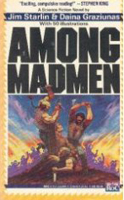
17. Among Madmen by Jim Starlin and Dana Graziunas

Among Madmen cover pictureI feel like this was a cool Post-apocalyptic find. S.W. Welch's, the stalwart used bookstore on the Main, right across the streets from Schwartz's is moving (sad days as the Main slowly transforms) and they had a big $1 sale. There really wasn't any real treasures, but I found a few neat things, including this little gem, a novel with illustrations ("A unique new form of novel" or something like that it says on the back).
The story takes place in a small town in the Catskills, holding out after the Troubles. The Troubles in this case is a plague that first and gradually starts turning people into shambling vegetables. They aren't threatening or anything, but as their numbers increase, they slowly become a massive social and logistical weight on society. I mean what do you do with them? Just when things are getting really ugly (vegetables being rounded up and shipped to islands, mass starvation, economic collapse) a new strain of the virus, starts turning others into total psycho beserkers. It's worse than just turning them violent, because they retain their intelligence and some of them plot and take their time before exacting their own specific form of sadistic cruelty. It's an intricate but well-thought out apocalypse and quite fun in the telling.

The hero is an ex-Vietnamen vet, ex-NYC cop who made his way to the Catskills. The town is fortified and there are enough competent people here (used to hunting and living in the forest) that it manages to hold on, despite the occassional veg-out or psycho transformation as well as bands of marauders and bandits.

The story is about the hero as he tries to protect the town and his relationship with his wife, who has turned into a psycho. The disease manifests itself differently in her, coming out only after she has had sex. The guy has the situation all planned out, where he locks her in a padded closet until after her good self returns. Of course, the town is not happy with his situation and this is a major source of conflict.

A lot of the book is about how people deal with their loved ones when they have gone psycho or veg. One woman cares for her husband, even though he shows up in town naked wandering around with his jaw hanging open every now and then. Another woman has her psycho son chained to the back porch. He lives in a doghouse and when he is calm, she spends time with him. It's cool because when she first does it, the kid, who was always a pudgy wimp, is so fat and harmless that the sheriff can't bring himself to shoot him and lets the lady keep him. However, after months of snarling and yanking on his chain and eating whatever raw meat the lady throws him, the kid starts getting thin and strong and starts to become a real problem. I thought that was a neat idea.

There is nothing super profound here, but it is a lot of fun and competently written. There isn't any excessive bullshit either and the setting follows its internal logic well. A good little find and I'm glad to add it to the PA collection.

Sunday, March 11, 2007

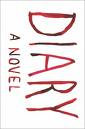
16. Diary: a novel by Chuck Palahniuk

Diary cover pictureI've had a few recommendations to read Chuck Palahniuk. It was the one that came after the 4th pitcher, along with the argument that he writes concisely, that convinced me to actually give him a try. The specific book (Lullaby) in question wasn't available at the library, so I took out Diary.
I had no real expectations. The story starts out sort of indirectly, written in a mix of third and second person, as if you are being spoken to. It narrates the life of a woman who is currently living on an old blue-blood island somewhere off the northeastern coast of the U.S. She was originally from a small trailer-trash town in the midwest, went to art school where she met this young boy from the island. She had dreams of becoming a great painter, but instead got pregnant, fat and ended up waiting tables at the island's only hotel. Her husband tried to kill himself and is now in a coma. But shit is getting weirder and it seems to be amping up. Her husband was a contractor for people's summer homes and now they are all calling her, in yuppy outrage, discovering that he had done some bizarre remodeling in their absence, such as sealing off entire rooms. Worse, when re-opened, the walls of the rooms are covered in crazy, violent graffitti.

Diary goes into a few interesting areas, critiquing art school and rich art students, attacking our consumerist society and it's endless appetite for new vacations spots to take over and destroy, there's even a bit of art theory. But the story keeps moving forward and the prose is entertaining. [sort of spoilers ahead]Because I had no expectations, I was concerned that the book was going to go into some weird places without actually concluding the story or revealing the mystery. It turns out to have a very solid backstory and a very cool one at that. The book is very much a classic horror tale. Ironically, in some ways I was almost dissapointed that it made so much sense at the end. Could it be that I am becoming more sophisticated? (highly doubtful). I think it was more that when the actual situation becomes clear it is done in such a blatant, obvious way that after the weirder, less direct prose of the first two-thirds, it's kind of jarring.

Cool book, though. I will definitely check out more of his work.

Thursday, March 08, 2007

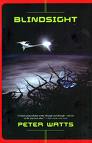
15. Blindsight by Peter Watts

Blindsight cover picture
Whew! This was a challenging book. It's a good book, too, but I can't say I really enjoyed it as I was reading it. It's too bad, because Peter Watts is an intelligent and interesting writer. I loved his first book, Starfish, and liked the follow-up to that Maelstrom. I still have two more books to read in that series, but the Mt. Benson Report got me Blindsight for xmas (much appreciated!) and it is a stand-alone book.

Blindsight takes place quite far in the future. You only get snatches and glimpses of what it is like on earth, but technology is advanced enough that it's considered deviant to have sex outside of the virtual world, terrorists use genetic bombs that can cause people's bodies to start growing a new skeleton (thus tearing them apart), and people's brains can be transferred to other bodie or connected directly to virtual realities where they spend their entire lives. One day, earth is surrounded by what looks like a giant meteor shower. A skyfall of exploding stars. Nothing beyond that happens, but the scientists of earth believe that our planet has just been photographed. This causes a great deal of concern. By the slightest chance, an anomaly is discovered outside of Jupiter. A ship is sent out to investigate.

The story of Blindsight takes place on the ship, whose captain is a vampire (literally; an actual other species living on earth) and whose crew includes a female military officer, who can control entire brigades of drone soldiers with her mind, an expert in languages and communications, who deliberately split her own personality into 5 separate ones, a scientist who is half diagnostic computer system and half human and finally, the protagonist, a sociopath (though this greatly simplifies his personality complex) responsible for observing the whole operation and reporting it neutrally back to earth. Of course, everybody else on the ship hates him, because they feel like he is always spying on them.

The anomaly is some kind of alien thing, but so profoundly different that they can barely understand even how to approach it. The story is divided between their stumbling attempts at contacting and learning about the alien presence and the psychological conflicts and developments on the ship. As you can see, it is a really cool setup, extremely well thought out. Though some of the concepts above might sound quite fantastical and over the top in my description, the book is without a doubt, hard sci-fi and all the conceptions are based on established scientific theory (and extremely well-researched; as usual the end of the book has pages of explanations, heavily footnoted and this was cut down from the original appendix, which you can find on the website).

Watts is no joke. He's an intense, intelligent, radical-thinking person. You can see that his personality is potentially quite combative in his notes and he doesn't pull his punches. He is also someone who doesn't shy away from difficult morality and the painful side of human psychology. I respect his writing for these things. But boy can it make for a lot of work! The book is not that long and moves quickly, it's not even that dense, but there is so much complexity, so much vocabulary and implied ideas that you really have to concentrate. On top of that, there is no happiness in his world. Humans are barely capable of perceiving anything outside of their own existence, let alone connect with another human. So it isn't a joyful ride! And there are some profoundly dark and disturbing moments, where you are just feeling, ugh and hesitant to continue forward. Watts addresses the human capacity for cruelty more directly than even Banks, I would argue, and it is not pretty.

Ultimately, the presentation of the alien being and the evolution of our technological world are convincing and fascinating. I got a lot to think of out of this. The book is a success. But it is a challenging one. I recommend it, but be prepared to work a bit. If you find most sci-fi way too fluffy and positive, then I would strongly recommend it. This is original and daring and in a sea of lame ideas, that alone is worth supporting. But beyond that, Blindsight is a dark and despairing look at the profound solitude that human existence can be, both at the personal and galactic level.