Friday, November 19, 2010

59. The Seventh by Richard Stark

Holy crap, that heist went really sour!

We're developing a little tradition here where my wife buys me some of the new University of Chicago Parker books each year on my birthday in January and I read them slowly throughout the year. I've already read the entire series at least twice before the U of C books were released, but this is a dedicated, focused reading in the wake of Westlake's death and with the full consciousness that the Parker series is a literary classic. It's been great. I don't know if I've changed but the re-reading of each novel this time around has come as a real surprise to me. Things I'd forgotten are exciting to re-discover and things I had never noticed before are popping up now. I'm getting both the pleasure of re-reading a great book and the pleasure of discovering something new.

[NOTE: SPOILERS START HERE. I AM GOING TO WRITE A PRETTY THOROUGH ANALYSIS OF THE SEVENTH WITH THE ASSUMPTION THAT YOU HAVE READ IT ALREADY. IF YOU HAVEN'T READ IT, GO GET ON IT AND COME BACK. THERE IS NO OTHER OPTION.]

Once again, with the Seventh, I had the feeling going in ahead of time that I knew what I was in for. I vaguely remembered this had something to do with a football game and that it was one of the books that was a standard heist, without any longer-term narrative complications for Parker. What I had completely forgotten is how brilliantly structured this book is. So far, it is the best heist followed by the worst fuck-up followed by the perfect denouement. The Seventh is also notable because it is the first time that Parker goes into the backstory of some of the other heisters in a bit of detail. You get hints of it in The Score, but here you really start to care. They are a much richer bunch then in The Score as well. The angry, flamboyantly-dressed dwarf is particularly cool.

The Seventh feels structured to me like an ever-narrowing tunnel. It starts off in a closed apartment, where Parker discovers the woman he had been shacking up with dead, pierced to the bed with an ornamental sword taken from the wall. Worse, all the money he had been holding from the recent and successful heist is gone. Parker goes hunting for the money and the book opens up. We learn of the heist, this college town, all the heisters as well as the local police. Much of the novel is Parker trying to find out who killed the woman and took the money while avoiding the enclosing investigation. Then in the last third, everything starts to constrict. The cops close in, his partners go down one way or another. Parkers pursuit becomes more and more focused. All he wants is "the amateur" who screwed everything up.

The final chapter is Parker stolidly climbing stairs in an empty high-rise under construction, in pursuit this panicking loser. The money, his colleagues, the investigation, the midget are all eliminated as storyline and it is just you the reader with a burning focus to get this amateur who caused so much trouble. It's a very intense ending. And satisfying. Westlake introduces so much tension and worry into the first two-thirds. It's so frustrating to have such a beautifully-executed heist go sour after it's over. You just know things are going to get worse and worse. And yet somehow, once everything is as bad as it can get, you as the reader only really care about Parker getting the amateur. The coda that makes the book so perfect (which I won't reveal here) is really only a cherry on top of a delicious ice-cream sunday. Not necessary, but oh so tasty. I laughed out loud.

Is this a love story?
Okay, get ready for some pretentious essay-writing, people. What struck me in the beginning of this book was the character of Ellie. She is the woman with whom Parker shacks up before and after the heist and whom he finds murdered when he returns after a quick errand for beer and cigarettes. What is remarkable about her character (and what I noticed for the first time during this reading) is that she is the perfect woman for Parker! As is well known, Parker is celibate leading up to the jobs and then satyr-like after. He is introduced to Ellie by Kifka, who is organizing the job, when he asks for a place to stay in town. I don't know if this is a period thing or just one of the perks of being a heister, but when you need a place to stay, you always have the option of getting a woman as well.
"It's been a long day. I need a place to stay while I'm here."
"With a woman or without?"
Parker hesitated and then said, "With." Not that he expected to want her, not just yet. Before a job he never had any interest in women, or in anything else but the job itself. But he would want her afterward, when he would make up for lost time.
The women that Parker stays with tend to be portrayed with some spirit and a bit of personality, but they are rarely anything more than their role as his woman. This is the case with Ellie. The difference is that she turns out to be the perfect Parker partner. Before the heist, she asks nothing of him, is mildly surprised that he doesn't want to get it on and leaves him alone.
Her style was very much like Parker's own, silent and self-contained. They spent hours in the same room without either saying a word. Parker was pleased by her. She didn't jabber away at him, and he never had to tell her anything twice. Kifka had done better than could have been expected.
Parker pleased!? I mean, wow, that never happens. And then after, when he is done. Whoo boy!
Seeing how lackadaisical Ellie was about everything else in life, Parker hadn't expected her to be more in bed than a receptacle, but she surprised him. He had found the one thing that made her pay attention. For three days and nights, they hardly left the bed at all, and the whole time she was nothing but stifled mumblings, and hard-muscled legs and hot breath and demanding arms and a sweat-slick pulsing belly. All the passion that had been dammed up inside Parker while his one-track mind had been concentrating on the robbery now burst forth in one long sustained silent explosion, and Ellie absorbed it all the way a soundproof room absorbs a shout.
[Feel free to go to your bunk now, I'll wait.] When Parker returns to find her impaled to the bedstand, he has no emotional reaction. Then the cops show up and he learns that the money is gone. Nowhere in the text does Parker ever display any sadness at Ellie's death. He needs to get the murderer because he needs to get the money back. And as things go to shit, he stays focused on the murderer because he is so angry about how this amateur was able to make such an ordered thing become so chaotic.
There was no profit in killing him, but Parker was going to kill him anyway. He was going to kill him because he couldn't possibly just walk away and leave the bastard alive.
But the fact remains that Parker does relentlessly pursue the guy even when it may not be the wisest choice. He also takes several dangerous risks and, one could argue (and the midget heister does), even makes a mistake. Should he have left the apartment in the first place without taking any precautions? Should he have braced the detective in his own home to get his list of suspects? In each of the situations, the choice seems reasonable, but when you look back at it, there is a certain aggressiveness in Parker's behaviour that is slightly out of character. One wouldn't say sloppy, but it's close. Parker always hates idiots who get in the way, but there is a certain extra vehemence directed against the amateur (who is the one character whose personality is only hinted at, thus making him more of a concept than a person), which I would argue may come from Parker's anger at losing a woman with such potential. I know I'm stretching a bit here, but there is a little something there. We'll see how Parker's future retalations compare (and there is at least one I can remember that is coming up).


Westlake's critique of progress

In some ways, Stark has a classically conservative inclination. Though he is the ultimate outsider, Parker also represents old-fashioned values of skilled manual labour, stability and fidelity. The other heisters that he meets are a more positive and fuller representation of this. Actually, representation isn't even the right word. Most of his partners are hard-working craftsmen. In The Seventh, it goes even farther, in that they are working people who were pushed into a life of crime by structural changes in the economy. One character ran a local movie theatre with love and care, but with the advent of television he fell into serious debt trying to keep it alive. Another is a highly-skilled carpenter whose work is too high quality and too expensive so that he slowly loses business, until two guys hire him to build a false compartment in the back of a truck and then he begins his life of crime (where he is properly remunerated for quality labour).

Except for the midget (and Parker himself), they are all portrayed as genial men. The planning sessions could be a bunch of factory workers planning a hunting trip in their buddy's basement. Violence is only a means to get the money and they use it sparingly. The machine guns purchased for the heist have a purely psychological function, to eliminate any opposition. Nobody actually wants to shoot them (though mainly because of the noise and mess they cause). These guys are motivated by doing a good job and earning some money in a society where doing a solid day's work no longer necessarily means you will earn some money.

This critique of the "progress" of the second-half of the twentieth century creeps into the descriptions as well. In the final chase, Stark lovingly details the rich nuances of the forest, going from the airy, needle-floored coniferous to the cluttered, multi-coloured decidous section. Suddenly, the forest ends and the chase spills out into a dirt wasteland, a construction site: "Later, when the building was done, landscape architects would come in with fresh earth and seed and hothouse plants and turn this moonscape back into something vaguely like the forest it had been, but with less clutter and liveliness." I posit that it is not just for visual effect that Stark describes the building as something fundamentally aberrant, broken:
It was over twenty stories high already, and from the confusion of cranes and pulleys atop the building—looking like unruly hair on the head of a Mongoloid idiot—it was apparently going to be even taller before they were done.
I found this final passage to be descriptively powerful. Westlake is such a good writer. I've been to that forest, I've walked along a bulldozed land site and I've clambered around inside a building under construction. Reading The Seventh put me back in those places. I'm probably imposing my own environmental melancholies to some degree, but I do think Westlake is channeling a lament for an America that he saw disappearing into today's world of mindless entertainment (the target of the heist is a football game) and cheaply-produced goods, where the complex, tactile natural world is bulldozed to make way for soulless apartment blocks. Parker is Stark's robot of vengeance, sent in to strike deeply into this new order and wreak as much havoc as possible using order and professionalism. He cannot succeed, but you cheer and rage for him along the way.

Now that all this pretentious twaddle is out of the way (and thank you for bearing with me this far, if any of you did), I'd like to just throw out two more side points:

1) There is a great passage where Stark describes the detective working on the case of the murdered girl. Parker has found out his home address and cased it out. His neighbourhood, his house, his car, all suggest that the guy is struggling economically. There is even a slight hint of contempt in the tone, though that is coming from Parker probably, as the passage is described as being seen through Parker's eyes. If you've read any Westlake, you just know something is up when he lays it on this heavily. And when we actually meet the guy, you get a classic moment of why the world of Parker is so awesome.
He waited a couple of minutes, and then Detective Dougherty himself came to the door. He was no more than thirty, but had all the style of fifty; dressed in his undershirt and trousers and a pair of brown slippers, carrying a rolled napkin in his left hand, walking with the male approximation of a woman in late pregnancy. He wasn't stout at all, but he gave an impression of soft overweight. His round face was gray with lack of sleep and the need of a shave, and his dry brown hair had already receded from his forehead.

But it was all crap. His eyes were slate gray, and all they did was watch. The way he held his right hand, his revolver was still on his hip somewhere.
Despite all the previous snide criticism of the guy's lifestyle, upon seeing him in person, Parker recognizes him instantly to be a serious opponent. Ultimately, it's about the man underneath. Game recognize game. That is great stuff!

2) The introduction to The Seventh is written by Luc Sante and is excellent. He must be of french origin as he read Parker originally in translation. He references several very interesting-sounding french crime authors whose works haven't been translated and he gives some solid, interesting analysis about the Parker series. There are some spoilers there about upcoming books, which I guess I'll excuse. I don't know who this guy is, but I will look into it, because this is finally an intro this series deserves.

3) Donald fucking Westlake.

Thursday, November 18, 2010

58. The Painswick Line by Henry Cecil

I can't even remember where I found this book, I think at the Spui bookmarket in Amsterdam. I remember thinking that it had a certain anglophile feel to it that appealled to me but that also I was getting into something unknown. With books that give me this kind of feeling, they need to be devoured quickly or they may get stuck on my on-deck shelf indefinitely. My pace is so good right now, I thought I should just knock it down. I was glad I did so. The Painswick Line is not a masterpiece and it's probably not even an author I will follow up with, but it was an enjoyable read and gave me a bit more insight into popular British reading in the second half of the 20th century. For you see, I have learned that Henry Cecil is the Richard Gordon of the Legal profession (Richard Gordon, if you didn't know, is the James Herriot of the medical field (James Herriot is, of course, the James Herriot of the veterinary field)).

I like to go into new novels fairly blind, with as little external information as possible. Though sorely tempted, I don't read the author blurbs or any of the quotations (I am definitely never tempted to read the book blurbs as they are almost always spoilers and should just be fucking banned). However, about halfway through the book, I started to get the idea that the main gist of this novel was to share funny anecdotes about the craziness of the world of law in Britain.

The base story is a vicar who reveals in court that he is able to accurately determine which horse will win the race. He has been doing it for years, but always purely as an intellectual exercise. He stayed true to his humble calling and never made a penny with his skill. But of course his skills do not go unnoticed and soon his small parish is hounded by punters and press and even the judge who presided over the trial where he revealed his ability. The judge's son is a scoundrel (though treated with the utmost respect by both his father and the author; very little moral judgement in this book either) and the father needs a large sum of money to keep him out of debt and thus jail. Though this plot seems sufficient for a humourous novel, it is actually resolved quite quickly and the book follows the son through several legal scams, some of which work and other that don't. The end of the book has the son of the judge (who has now since passed on) turning 84 and finally deciding to give up a life of crime so he can end his days at home with his always-loving wife (the daughter of the vicar).

So as you can see, this is not a tightly woven narrative. I didn't really mind the meandering structure, especially when it became apparent that the point of this book are all the little legal wrangles and boondoggles the son (and other people) get into. I think that this kind of book was really an enjoyable read for educated professionals in 50s and 60s Britain, especially lawyers. Some of the details went over my head and I did glaze over a bit when the language got a bit too industry-specific. However, it is a pleasant, non-judgemental read and didn't make me want to smash up the house as 30 seconds of network news or a single television commercial can. The back of the book had several other recommendations, including the Richard Gordon Doctor books, which look like they might be a lot of fun.

[Note: I have now broken my one-year record of total books read this year, at least as long as I have been keeping record. I'm happy, but with my new obsession of trying to get an average of 50 books a year, I am not satisfied. I've got less than 6 weeks to hit that average hard!]

Tuesday, November 16, 2010

57. A Classical Education by Richard Cobb


I discovered Richard Cobb while studying history in college. Among the hundreds and hundreds of pages of text that I struggled to consume on a weekly basis (my ability to read non-fiction is relatively poor compared to my consumption rates for fiction), Richard Cobb's rich and meandering pieces on french history stood out. He wrote about places and very specific moments in history, taking a little slice and then weaving these amazing descriptions around them until he had built up a very complete sense of the place in the reader's mind, which he then associated with the greater history. He would spend pages, for instance, talking about a single sidewalk and the cobblestones in it, where they came from originally, who walked on them and how and at what times, what the storeowners whose establishments faced that sidewalk saw and so on. Eventually, he would come around to revealing the info that this street was where a certain Jacobean minister had walked just before making a certain specific political move that had ramifications for the history of the french revolution. I'm making that last example up, because I can't actually remember any of the details, but I think that provides a decent idea. He had some of the longest sentences of any historians, but they were ones you could follow and enjoy.

He was also known to be a bit of a wild man, an old boy who worked hard in the archives but was no stranger to drink or shenanigans. Our french history professor told us that before his lectures, he would be found in a nearby bar having a glass of Apple Jack brandy. His great writing and his exemplary character and old boy credentials combined to make him a favourite for me. I later discovered that he had also written some autobiographies about his public school childhood. I thought that I had already read A Classic Education, but now I am not so sure. It's the story of one of his classmates and their relationship over the years. They bonded at Shrewsbury public school in their shared antagonism towards the administration and fear of the bullies, though they also had very different approaches. The pin that the whole narrative hangs on is that his classmate murdered his mother in Dublin in what was at the time a fairly sensational news story. The jacket blurbs try to sell the book as some kind of mystery or thriller, but it really isn't. It's a study of the man and boy as Cobb knew him, their own relationship and Cobb's connection to the murder. It's a wonderful read, absorbing, enriching and funny. Cobb is refreshingly removed and un-moralistic. That kind of dry distance, in today's histrionic and morally righteous world, would be considered offensive by modern readers. Even I was a bit surprised at how unsympathetic he was to the murdered mother (though she was a pretty horrible person) and how lightly he treated the whole affair. My surprise, I suspect, is more of a function of being surrounded by a world of self-righteousness and mushy-minded sentimentalism. The treacle sticks. Cobb's approach is a reminder that I need to distance myself from indulgent emoting and cheap sympathy.

A Classical Education is a short, engaging read. I started it on the morning of a day of travel and finished it before I put out the lights that night. I laughed out loud several times. He is such an educated person that there are many references that I didn't recognize, but they are not an impediment to becoming absorbed in the eccentric, complex characters and the crazy, real stories that are their lives. Strongly recommended.

Monday, November 15, 2010

56. Inspector West Leaves Town by John Creasey


John Creasey was an amazingly prolific British mystery writer. He had several series (including the Toff, one of which I read and reviewed here). I discovered him through the very enjoyable BBC radio plays of his Inspector West books. I was really excited to make the discovery, as I love the whole allure of Scotland Yard. I didn't love the Toff book and was expecting a bit more from this Inspector West book (great cover!), hoping that it might emphasize more the procedural side of things.

Unfortunately, it's a bit of a mess. I did a bit of reading and see that Creasey cranked his books out, going straight from his mind to typewriter and never revising. You can tell! It lacks cohesion and rhythm, so you don't really know why you are reading certain sections. A lot of time is spent on West's domestic life, which would be fine, but it doesn't seem to be in service of anything. There are moments and bits of dialogue that almost seem like you are reading a documentary of post-war British middle class life.

The real problem for me, though, was that the badguy is presented as incredibly powerful, almost invincible. Nothing wrong with that and he would have fit well into an American pulp novel. But it just seemed weird that a villain who is able to kidnap dozens of top British officials and prefaces all of his perfectly-timed exits with a specific concerto playing from nowhere is in the same book where one of the heroes has a badly injured hand for almost the entire story.

I get that he was cranking these things out and I am somewhat in favour of pushing the action forward rather than revising a zillion times to make the perfect novel, but in this case I just felt too unconvinced and mildly bored at times. I would not be surprised if there are superior books in this series. I also think they work better as radio plays, as the interplay between the characters is fairly enjoyable when delivered by BBC actors. If someone can recommend a particularly good Inspector West book, I'll definitely check it out. Otherwise, I probably won't be adding any more John Creasey books to my on-deck shelf in the near future.

Wednesday, November 10, 2010

55. The Enemy by Lee Child


I was at the local thrift store dropping off some old pants and household items and decided that I could risk taking a look at their book section, which has actually been quite fruitful in the last year or so. Some unknown volunteer has taken to organizing the books and they are doing a great job. Hats off to that person. So rare to find someone who actually makes an effort to organize things these days. Everybody seems to think that they can just leave everything in a big pile and have google sort it out for them or something. Anyways, I found an old Donald Hamilton. I also picked up this Lee Child book. I quite enjoyed Gone Tomorrow and was looking for something easy to digest that I could get sucked into. Well mission accomplished. I tore through this thick book.

This time we go a bit farther back into Reacher's career, where he is an MP, actually the head MP in a large army base in North Carolina in 1990. He had been in Panama dealing with the Noriega situation, but suddenly got moved. He's army all his life and used to simply following orders (though seems to have no problem breaking them as well). Furthermore, he has a philosophy of just living life as it is presented to him. It's part of what makes him such a compelling character. He is the fantasy rogue male with the skills to handle any situation, so he has no need to plan, put aside savings, worry about loneliness, etc.

The story starts out with a General found dead of a heart attack in a seedy hotel near the base. The investigation gets more and more complicated and ultimately reveals a massive conspiracy. Most of the book is on the ground investigation, detailed and enjoyable. But the overall plot is some big-picture, end of the cold war, internal military politics stuff. It's just on the right side of being implausible, but totally acceptable because of all the stuff that Reacher is dealing with is well thought out and engaging. This is detailed, manly stuff with sprinklings of gun and vehicle porn (and a two-page discussion on a custom-made crowbar that I took particular pleasure in). In Gone Tomorrow, Reacher is a civilian and most of the action takes place in NYC, where he has all kinds of urban skills, including all the tricks for staying for free in fancy hotels. Here, money is an issue and when he goes AWOL he has to count his pennies. I guess he continues to add to his skillset.

Most of the books in this market—the thick, manly books sold at airports, with abstract, embossed, mainly black covers—are crap these days. They tend to be overly written and basically unintelligent. They often feature excessive serial-killerism. Lee Child's Reacher novels (at least the two I have read so far) are an exception, good escapist stuff but not insulting to the reader's intelligence. They are sparsely written and the good stuff (the ass-kicking, the technical details, the wise-cracking superiority over lesser bosses) is dealt out in just the right proportions to keep this manly reader quite satisfied.

Monday, November 08, 2010

54. The King of Swords by Michael Moorcock


This is the third and final book in the Books of Corum series by Michael Moorcock. You can read my brief reviews of the first two here. In this third one, everything seems to be at peace, though we the readers know it cannot last as the final God of Chaos, the King of Swords is still mightily pissed at Corum for having destroyed his sister, the Queen of Swords and his brother the Knight of Swords.

The basic idea in Moorcock's world is that the gods mess with mortals indirectly, in this case through the Mabden or humans, a new lesser race who have been wrecking the world with their warlike ways. The main evil Mabden, who tortured Corum in the first book, poking out his eye and chopping off his hand, is in major retreat. But he still has strong connections with the Chaos gods and one broken Vanagh (the higher race of which Corum is one of the few remaining), whom he forces to create a powerful spell that causes everybody to hate each other. Soon Corum's pleasant world starts to fall apart in mutual aggression and violence.

So he has to go out and adventure again, gets sucked into all these different planes and even universes of existence. This is big, big picture stuff with some very trippy imagery. I'm kind of a geek, but not entirely and I think I draw the line at this kind of fantasy. I love it in principle and think that metal bands that base their entire aesthetic around it are really cool. But I don't really care. It's just all so removed. There was one exception and that was at the very end, when Corum learns that all that went on was part of a rare period of major change in the universe. After this, the gods power will diminish in the mortal realms. This theme is very common in fantasy (the classic is all the Elves leaving Middle Earth at the end of the Lord of the Rings) and it symbolizes the end of the imagination, adulthood, banality etc. I did find it touching and appreciated Moorcock's skill and desire to keep alive worlds where reason and "reality" are not actually prioritized.

One geeky element in this book that I also found mildly distracting (but probably would have sucked up when I was 15) is that this third book brings in a bunch of characters and concepts from other Moorcock books, particularly Elric, his most famous character. It made me feel like I needed to read a bunch of other books to fully appreciate what the hell was going on. I used to love this kind of cosmos building, but now it tires me slightly and honestly it did feel like it kind of deflated the impact of everything else that had led up to this point. You read a trilogy about a hero in a world and then in the last pages of the last book, it turns out that he needs to connect with another even bigger hero who has a special sword and an entire backstory himself that is only hinted at. To get really geeky and compare it to tabletop roleplaying, it's like when your character needs the assistance of the GMs special more powerful character to actually complete the quest. It takes the adventure out of your hands and that is kind of what I felt like as a reader.

Still, if you have a 15-year old who needs his mind blown, this may well be the way to go.

Thursday, November 04, 2010

53. A Sense of Survival by Kevin Casey


Man, I am really in the murky soup of British self-loathing and anguish! A Sense of Survival was way high up on the shelves in the mystery section of the American Book Exchange in Amsterdam and it's age and cover design attracted me. I was a bit desperate as I had been disappointed by the offerings at that store. The inside flap blurb (of which I only try to read the bare minimum as a rule) spoke of ex-pats in Morocco which was enough for me.

The story takes place in Casablanca and centers around a small boarding house run by a lonely and judgemental old spanish woman. The main characters, a new mother waiting for her husband, an Irish and morally loose journalist and an aging and pathetic remittance man all stay there. As well there are two non-present characters, the mother's husband, who has allegedly gone into the hills to study the natives for his academic work but who is 3 weeks late in coming back and a man called Traynor around whom some suspicion seems to linger.

The book isn't really a mystery, though there are several loose storylines that keep you hanging on. Where is Traynor? Where is the husband? What's the deal with the pathetic guy? Even when Traynor does come back and gets murdered (about halfway through the book), I realized the author was much more concerned about perusing deeply into the personalities of these various lost souls. Again, it's not badly written, though much more rife with constant excessive symbolism and referential language ("This was like the time that dragged through an illness, nothing happened, a contracted world, dust upon a broken chair, a bored reader"--okay I added that last phrase but you get the picture.) It reminded me of the last J.G. Ballard book I read, though a little less out there. In any case, most of it was unwelcome. But it does flow and you find the characters believable and complex. But who cares? Once again, it's a bunch of depressed, confused British people who need to get semi-interesting jobs (and in this case seem to have the means and situation to do that as opposed to the Beryl Brainbridge book) and a good dose of therapy. This is the 70s and you are in Casablanca for Christ's sake where a man can get into some trouble and adventure! Instead you sit around moping in some boarding house where the owner thinks you are a sinner and plaster crumbles from the ceiling.

What really turned me from mildly bored to fully annoyed is that the writer uses a poor animal to deliver some kind of symbolic narrative structure. The landlady has an old cat that is constantly appearing. It comes and goes and tension is built because the landlady claims the local boys (who also harrass the mother and generally follow people on the street menacingly; hey how about a kick in their ass? You think Parker would waist a second worrying about those fucking street urchins?) tried to light it on fire. There are several scenes where the cat is missing. And hey guess what? At the end of the book, when Traynor's murder is solved and everybody has a minor revelation about themselves (they are lame and aren't really going to change seems to sum it up for them all), the cat is discovered dead, strangled with a wire. And it is delivered as an afterthought by the journalist character. So fucking lame mr. 70s Irish writer. Why don't we have Evil Spock come in and Vulcan nerve pinch to death all the characters in this book? I think that would have made a much more poignant point about their lost lives and struggles for identity. Feh.

Wednesday, November 03, 2010

52. Anarchaos by Donald Westlake


Anarchaos is the legendary lone science fiction novel by Donald E. Westlake. It was originally published under the Curt Clark pseudonym (he also wrote several sci-fi short stories under that name as well). I had located a french version of this book at my local library, but was waiting to find the english one before I read it. I ran across a hardback first edition in Amsterdam and was all excited until I realized the author on the cover was "Donald Westlake", thus making it some kind of reprint. I don't even know if the Curt Clark version was released in hardback.

I had no idea what to expect. Parker in space? Dortmunder in space? One of his multi-character epics like Humans or High Adventure? It's the story of Rolf Malone, recently out of jail on earth, who travels to the violent and un-governed world of Anarchaos to find out why his brother died. It was an interesting premise and the science fiction stuff was quite well done. For instance, the planet doesn't rotate so there is a dark side and a light side. Westlake does a lot of interesting things with this concept, bringing out the coolness of the idea (which is an aspect of sci-fi) but also and more importantly making it an important part of the narrative.

Unfortunately, the book takes a weird turn at the halfway point. It becomes about the protagonist's understanding of himself and his motivation and thus really bogs down. He gets put into a slave camp where you are basically broken down into nothing and then spends the whole rest of the novel trying to figure out what he wants. It makes for an interesting encounter or two with the baddies when they aren't able to threaten him (he has become so existential that he welcomes their worst threat of a drug that will wipe out his memory). I as a reader also struggled with my own understanding of why I was continuing to read the book. Not terrible, but you just get the feeling Westlake ran out of a raison d'être for his main guy and instead of forcing one on him, just let him sort of dawdle until he slapped on a way too neat ending.

So not the greatest, but now I've read it. For Westlake completionists only.

Thursday, October 28, 2010

51. A Quiet Life by Beryl Bainbridge


I picked up this book in Amsterdam with the weird feeling that my wife might like it. I ended up reading it because it was thin and I've been enjoying the British writers a lot these days. Now I am not sure that I would recommend it to my wife. A Quiet Life is about a young adolescent growing up in a dysfunctional family in postwar Britain. It's very well-written, but wow is it unpleasant. I have a kind of mild crush on British culture. This book was like discovering your crush has genital warts. Man, I forgot how totally depressing and crushingly class-conscious the British were (and probably still are, though it seems to have improved significantly). The boy is 15. His father and mother are in a constant passive-aggressive battle. They once were quite rich and lost it all and she is obsessed with maintaining the two livable rooms in the small house completely clean so the family spends the whole time cramped into the back kitchen. The daughter is "creative", doesn't where shoes and goes out every night to meet a German POW. The son is trying to hold all this together, desperate to try and prevent his parents from getting into conflict, totally shamed by his sister's behaviour. He gets in a suppressed fury when she does anything that might call attention to him or the family.

In short, it is almost entirely depressing. There is one light moment when the parents laugh about something an unannounced guest said. It's so deftly done and well captured, that it made me smile. Bainbridge is clearly a talented writer. But other than that moment and a dark but enjoyable moment when the father flips out and decides to burn a chair that he is always bumping into, it's basically non-stop bourgeois angst of the most annoying kind. Even in the British kitchen sink genre, there is always at least a rebellious energy, a certain anarchy as well as an appreciation for the rich social culture of the working classes. Here it is just all blandness and suppression.

Even worse, as the book goes on you see that the most sympathetic character is the sister. She is revealed to be sort of creative and fun-loving. The whole book seems like an attack on the brother (who really is a pill, dude, just get over it!) and I see that Beryl Bainbridge actually did have a German POW lover, so I wonder if this book isn't her own angry woman attack. It sounds like her works matured and broadened in scope, but A Quiet Life just seemed like a lashing out and though well-written, I must condemn it.

50. The Roald Dahl Omnibus

As I have previously revealed, one of my techniques to keeping the numbers up in this 50 Books game is to have a book of short stories going, where you read a story in between novels. This was the case with the Roal Dahl Omnibus which I picked up at a moving sale of an acquaintance. However, Dahl has such an enjoyable prose style and his stories are so intriguing that I would often end up reading two or even three stories in a row before turning out the light.

These are dark and sometimes even nasty little stories, but the twists are often quite subtle, gently slid in to the reading so you don't even realize they are there until the story comes to an end. I think my own expectations played a role, because I often was waiting for some big twist or climactic ending, a feeling I think spurred by the intrigue of the stories' set-ups. However, once I realized that there wasn't going to be a big bang of a reveal, I settled down to enjoy the subtler stuff going on underneath.

A lot of the stories tend to deal with an individual who has some behaviour trait or assumed understanding of the world who has it turned around often for the worse. Revenge hovers throughout many of the stories and a certain cruelty, more often than not to women. It is difficult, though, to categorize these stories, as there is such a range of situations and subject matters (though they are all contemporary and in the civilized english speaking world, generally of the middle and upper classes). Many of the stories were published in mainstream manly magazines of their time like Playboy and Esquire.

A very enjoyable read. My favourite story is Royal Jelly. You should read that one alone if you can.

Saturday, October 23, 2010

49. When the Tripods Came

This was a nice little find, something I've been keeping my eyes out for a while. It's a prequel to John Christopher's well-loved and much-read Tripods trilogy. He wrote it in 1988, many years after the trilogy. I don't know if this is true, but I have read in two places that other science fiction authors, particularly Brian Aldiss, scoffed at the low-tech nature of the tripods and didn't believe that they would have been capable of taking over the world without even having infrared. A pretty annoyingly geeky critique, if it's true. The story goes that Christopher wrote When the Tripods Came in response. In your face, sci-fi geeks!

I'm glad I didn't know anything about that backstory when I started reading it. It opens with two boys on a camping trip, hiding in a farmer's barn, when they hear the thumps of an oncoming tripod. They watch as it snags and captures the fleeing farmer, whips the family dog into the ground and destroys the farmhouse. Then the military comes and quite easily destroys the tripod when it tries to lift the tank. Later, the boys learn that 3 other tripods had landed on the planet and they were all easily destroyed. The tripods become a bit of a laughingstock (emphasis is made on how awkward they look when they walk). There is even a TV show for children, which starts to become quite popular, even amongst adults.

Things start to get weird when the protagonist notices how angry his sister gets when he forgets to record an episode of the Trippy Show. She completely loses it. Soon the Trippy show starts spawning a social movement of people called Trippers. They start to migrate out of cities and gathering in large groups in the country (mimicking a hippy movement in some ways). Again, I stop going into any more detail, because the deliciousness of the book is how the Tripod conspiracy unfolds. Even in a fairly short young-adult novel, Christopher's very dark view of mankind comes through and he is extremely effective at creating the atmosphere of real dread when a previously open society starts to tighten things down.

It's a very quick and entertaining read and definitely worth it if you have read the original trilogy.

Hey also look what I discovered: The entire trilogy was serialized in comics form in Boys Life in the '80s. It's never been collected, but you can still find them on Google Books. Even better, this dude collected the scans in order on his blog here at the Haunted Closet blog. Nice work!

Wednesday, October 20, 2010

48. Whit by Iain Banks


The only other Iain Banks book I have read is The Wasp Factory and I liked it okay, but didn't love it. That was before I discovered the genius of Iain M. Banks, most of whose Culture novels I've read (though I am fast falling behind having not read his last two). It turned out that several of my international colleagues had quite good taste in books and several of them recommended Whit as one of the better Iain Banks books. I happened to find it at a used bookstore in Amsterdam (though I doubt this book is hard to find).

It's the story of a young girl, Isis (and a whole bunch of middle and surnames finally ending in Whit) who is a member of a peculiar but pretty happy-seeming sect in Scotland. They are kind of like the Amish, because they are forbidden to use technology, but they are also pretty mellow about sex and licentious behaviour. The heroine is actually a very important figure in the sect, as she, being born on a leap year and having the ability to heal is the next in line to be the leader when her grandfather, who is also the founder, dies.

The catalyst for the plot is that Isis's cousin, who is a successful concert performer sends a letter saying she is leaving the sect and won't return to perform for an important upcoming festival. Isis is sent out to London to find her and to try and bring her back. The first half of the book follows Isis, who is very capable and self-assured, but also utterly inexperienced with the modern world (naive is the word that comes to mind, but it wouldn't be right because she is well aware of the potential dangers and evils out there), on her journey. That story is interspersed with Isis slowly revealing how her sect works and its history.

As she gets closer to her cousin, she starts to learn strange things and the second half of the book follows her as she looks more closely at her sect and starts to unravel the truth behind its background and also strange things that have been going on there under her nose all this time. I'm being very vague because I really don't want to give anything away. It's a very engaging and fun book and you get caught up in both parts. In the first, it is just a great adventure of a headstrong fish-out-of-water character in modern Great Britain and she gets caught up in several quite fun situations and handles them in a very entertaining way. In the second part, you really want to know what is going on and you very much sympathize with Isis. It was a hard book to put down and I cranked through its 400+ pages in 3 days, even prioritizing work errands that I knew would have me waiting so I could finish it.

I'm not sure if Banks is saying anything too deep here. It's just a fun ride. The first half reminded me of Isabelle Allende, where adventure is found in the story of a normal but peculiar person in the normal world.

Amsterdam is for (book) lovers!

A happy used book nerd!

I had the good fortune of getting sent to Amsterdam for a work conference and I took advantage to stay another 5 days after doing the tourist thing with my wife. I was so busy leading up to the trip, that it didn't dawn on me that there could be some serious used book potential in this northern european city with many expats and lots of anglo traffic. My wife had already done some excellent research and asking some of my well-read colleagues who work in Amsterdam helped as well.

My first stop was The Spui (pronounced spow), which is pretty centrally located on the tram line (though that city is so labrynthine, that getting from the stop to the actual square a distance of maybe 100 metres is not obvious at all). It's a square and every Friday they have booksellers. There are also several large english-language bookstores right near there as well. The American Book Centre is almost entirely new stuff (and quite an excellent selection and layout) but they have a tiny shelf of used books that is really a treasure. Super cheap prices and some good stuff. I found a Duncan Kyle and a Sven Hassel, each for a Euro.

I was particularly excited by the stalls, though. The emphasis was more on art books and they did have way too many english classics (snoooze, like those are hard to find), but there were two stalls with a lot of good paperback genre fiction. One in particular was exactly what I was looking for: an older gentleman dressed sensibly and smartly, but slightly shabbily who totally knew his crime fiction. He told me that John Christopher was out of vogue now and it would be very hard to find anything but his young adult novels. We had a good discussion about C.S. Forester and Patrick O'Brian, which was joined by another book browser. They both agreed that Forester was the real deal, but the vendor drew the line at the browser's attempts to make O'Brian seem like a bit of an imposter. The vendor did have an entire series of naval fiction by some real impostor that he said he was ashamed to carry (but I guess they sold okay). I ended up getting Commander Hornblower and another WWII Forester book. He also strongly recommended me Ross Thomas (I was attracted by the cover) and he was definitely on point with that recommendation. Prices were kind of what one expects in this day and age except inflated by the high price of living in Europe, so like 4 Euros a book. A very satisfying start to my Amsterdam tourist experience!


The other good place to check out is the Book Exchange. A pretty classic looking used bookstore that had tons of promise. I was very psyched just walking in there.

Alluring, no?

Unfortunately, despite a decent mystery and sci-fi section, I found nothing in paperback that really interested me. I did find a shelf of hardbacks and found a nice edition of Anarchaos. It was some kind of reprint, because though it was a first edition, it had Donald Westlake as the author. Still, I am glad to have it finally. The guy working the desk was friendly, but a bit distant when it came to actual discussion about books. He was forthcoming about how they got books and the history of the store. As we were talking, I noticed three stacks of fruit boxes filled with books. On the top of one was a very promising box indeed. I could see several british paperbacks with the kinds of covers and paper that I know could spell quality and I really wanted to look through. Unfortunately, all the boxes were of books that had just been sold to someone else (another bookseller presumably). The guy was a bit cagey on this point (probably more out of motivation of avoiding adding any work to his life of standing behind the counter). I kept eyeing the box and seriously considered just stealing it. Maybe getting my wife to get the guy to help him in the back and then just grabbing the 40-box and running into the Amsterdam streets where I don't know my way at all. It just seemed crazy enough to work. I'm an ethical guy and would have found a way to pay the store back. As these thoughts were running through my mind, the guy started doing some re-arranging, moving the boxes around and put the one I was eyeing on the bottom of the pile! I guess I didn't case the joint subtly enough. I came back a couple days later and the boxes were all gone. Strike while the iron is hot, man! I could be on the lam now in Central Europe, trading rare paperbacks on the black market to buy some charred rat on a stick, clinging to the two Samuel Youd novels, refusing to give them up even though I desperately need some boots to make it through the snow to get around the checkpoint! Ah, lost opportunities.


When will this discrimination finally end!

Tuesday, October 19, 2010

47. Commodore Hornblower by C.S. Forester

I probably should not have read this book. The gentleman who sold it to me was very persuasive and said it was one of the best of the series. For those of you who don't know, C.S. Forester is Patrick O'Brian of his day and more. His Horatio Hornblower series are considered the true classics of British naval fiction and some may even consider O'Brian a bit of a pretender. I shouldn't have read Commodore Hornblower because it is quite far into the series and it makes a lot of references, both about stuff that actually happened and Hornblower's own change in perspective and outlook that I think would have been much more satisfying and rich had I arrived there along the same path as the main character himself.

Well blow me down, I just did a bit of perfunctory research and it turns out that the books are not written in chronological order of Hornblower's life and that Commodore Hornblower is in fact the 4th book (of 10 and a partially written one). So maybe I'm fine. Also, ten novels is a lot more digestible than the twenty of the Aubrey-Maturin series, so it is conceivable that I could read this entire series. Also, when I say digestible, I also felt that, at least in this one novel, the terminology was much lighter than in the O'Brian books. A lot of Commodore Hornblower takes place on land (they are stationed at Riga to defend a siege by Napoloenic forces), so perhaps the other books are harder to parse. I found the relations between the characters in the one Patrick O'Brian book I read to be much richer and more complex, but I also felt lost for a lot of the naval warfare stuff, which is something I actually do want to enjoy. With this book, I found it much easier to understand what was actually going on and there are some tricky miilitary maneuvers, including a cool long-distance mortaring of a trapped french cutter that normally would have been safe in a friendly harbour.

I didn't really mean to make this review a comparison between the two series, and it is specious at best since I've only read a single book from each. On its own, Commodore Hornblower was engaging, entertaining and a great read. It has excellent British mettle, great strategy, even a bit of sex and some rip-roaring adventure. Thoroughly satisfying. It has given me a taste for more.

Friday, October 08, 2010

46. First Blood by David Morrell

Looking back through the last month or so of books I've read, I realize that I have just read 3 books in a row from the early 70s (Syzygy from '73, The Porkchoppers from '72 and now First Blood from '73) and I just tore through all three of them. I'm starting to wonder if this isn't my wheelhouse of genre fiction. The Parker series by Richard Stark (who just crushed the crime genre landscape) comes to its brilliant conclusion in 1974 and I'm sure if I go through my past reads, I'll find some more. It's interesting, because I otherwise generally consider the popular culture in that period to be pretty frickin' terrible. The music sucked for the most part (it was the heigh of AOR FM radio rock), Hollywood was at its nadir (and I'm no fan of the supposed "auteur" cinema of that period either) and of course fashion, architecture and interior design were about as terrible as it will ever get (famous last words right there). So I wonder why the writing is so good for me?

When I first saw this paperback, the cover really grabbed me (how cool is that drawing of Rambo so small in the upper right hand corner above the stark letters of the title; great layout). But I assumed it was a novelization of the movie (which I actually only saw this year for the first time and really enjoyed). When it turned out to be an original novel, I decided to pick it up. Another solid move. My instincts have really been strong this year! (Not to give myself too much credit, as a teeny bit of internet research will show you that this book is quite well respected.)

What I enjoyed about the movie (and what I hadn't expected due to my impressions of the later Rambo character) was its counter-culture attitude. Rambo is basically a hippie in the first part of the movie, a drifter who wants to do his own thing but gets harrassed by the petty authority of a small town sheriff. It's very lefty for the first two-thirds until the bizarre deus ex machina pro-military ending (which presaged the next two jingoistic films).

The film coloured my reading of First Blood and though the basic set-up is the same, thematically it is very, very different, much subtler and much more nuanced. Rambo is a sympathetic character at the beginning, but so is the sheriff. Rambo is also kind of a cypher and you don't really understand (nor do you sympathize with him entirely) why he pushes back so hard against the sheriff, who is actually kind of doing him a favour when he drives him across town. He also does it in a fairly decent way at first. But Rambo keeps on pushing.

The other major difference is that Rambo really does kick some serious ass. He kills tons of people (and dogs and a fucking innocent owl for christ's sake!) in the book and does so coldly and brutally. By the end, he goes totally hogwild, making the movie look like Terms of Endearment. The novel is about a human trained for war who is let loose in a civiilian society that is not prepared to handle him. It is clearly a reaction to the returning vets from Vietnam and touches upon that theme in a much darker and more complex way than the movie (you could also make an argument that Rambo is a metaphor for American imperialism). It's so dark that at times it was almost unpleasant for me to read. But it is also an intense and exciting manhunt story with all kinds of cool techniques as well as great use of the landscape. I suspect that the famous mud wall scene from Rambo: First Blood II was taken from a scene in this book.

I found this awesome snippet from the wikipedia page on David Morell: "Morrell is a graduate of the National Outdoor Leadership School for wilderness survival as well as the G. Gordon Liddy Academy of Corporate Security". How do you get into that school?

45. The Porkchoppers by Ross Thomas


This was recommended to me by a bookseller at the Stui in Amsterdam where they have a book market every Friday (more on this visit when I get the picture from my wife's camera). He said that you always knew there is a real intelligence behind Ross Thomas' stories. It had a tough look to it and the opening sentence (which I always check when deciding on a book) was very strong indeed: "They were old hundred-dollar bills, a little limp now, even a little greasy, and one of them had a rip in it that somebody had neatly mended with a strip of Scotch tape."

The Porkchoppers is the story of a union election, told mostly through the eyes of its current president, though it has a big cast of characters and spends some time with each of them. This truly is a novel told in the omniscient voice, except for one small mystery that holds it all together. It almost felt a little removed to me, the way the perspective jumps from location to location, coldly (and richly, I must add) describing each character, their background, their hidden foibles, their own take on the situation. But it builds up a real momentum and the characters are all so engaging that its hard to put down. The president is a total alcoholic, barely able to make it past noon without being blotto, but he is still very charismatic and has a certain driving will. A lot of the action is him going from campaign stop to campaign stop, supported by his advisors, handlers, wife and son. These scenes paint a complex and entertaining picture of the big union machine of the early 70s, all the corruption and politics. Only adding to the cynicism are the scenes of the real power players who are competing in the background to pull the strings and make sure their money wins out. This goes all the way up to the White House and paints a very bleak picture.

I really enjoyed this book and am really appreciative of the Dutch bookseller with excellent taste who steered me to Ross Thomas. He is definitely on my list. Great stuff.

Tuesday, October 05, 2010

44. Syzygy by Michael G. Coney


I'm proud of finding this little book. I picked it up in Winnipeg two years ago (tempus fugit!) based solely on the neat cover, British heritage and publication date (1972). I was not disappointed. It takes place on a human colony that is mostly made up of water. I really enjoyed the setting, because the science fiction in it is subtle, it could almost be Australia, if it were settled in the 70s. The issues are more about how the settlers have adjusted to the new world after two generations, the conflicts between the people at the regions and the distant administrative center. The protagonist is a marine scientist who works at the local research station. There is a slight divide between the people from the station and the locals, whose economy is mostly based on fishing. Every 52 years, the six moons of the planet align and weird things happen. What actually happened the last time is mostly lost in history, but there were tales of people losing control, riots and murders. The human behaviour is somehow connected to the biology of the planet and the book is the story of the hero and others figuring this out while they also slowly deal with their own crazed behaviour. I don't want to give away too much, but it has to do with a slow awakening of a telepathy that allows one to feel the emotions and thoughts of others. The problem is that you don't realize you are reading their thoughts and their hidden feelings, especially their negative ones, come out to you so directly, you think you are hearing them. And it gets worse from there.

What made the book enjoyable for me is that the characters are all very well portrayed and you get a great sense of this claustrophobic community and how easily it could all go really ugly if everybody's worst thoughts were revealed and amplified. It does have a particularly 70s British pessimism to it that I love reading about but don't necessarily adhere to myself.

The internet tells me that Syzygy is an astronomical term referring to the alignment of three or more celestial bodies. It also tells me that Michael Coney was quite prolific and lived in Victoria, B.C. until his death in 2005. That means we were in the same town for 4 years! I'll keep an eye out for other works by him.

Thursday, September 30, 2010

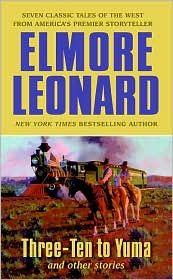
43. Three-Ten to Yuma and other stories by Elmore Leonard


If you want a good read with a strong moral backbone that will give you some feeling of righteous satisfaction, pick up any Elmore Leonard western. I snagged a bunch of his westerns last year and this sat on my on-deck shelf for a while before I finally took it with me on my trip to Amsterdam, thinking it would make for great plane reading. I had held off mainly because it was short stories and I tend not to like reading one after the other when I am at home. I was right about this being a great travel book, because I devoured it and even convinced my wife to read one of the stories (Jugged, in which a young kid gets thrown into a cell with a serious criminal), which she quite enjoyed.

Each of these stories was a little snippet of life in Elmore Leonard's wild west, where scary violent men are everywhere but someone with a bit of grit and courage and the will to do what they think is the right thing can sometimes just win out. Skills and training are also important here, almost to a heroic level, where one man can size up another and know he is an expert by how still he is. Really good stuff.

Monday, September 27, 2010

42. The Black Arrow by Robert Louis Stevenson


I picked up this book in the Eastern Townships at an antique shop among a mostly complete collection of Airmont Classics paperbacks. It was a beautiful collection in great shape, but this was the only one that interested me so I took it out from its brethren. It had been there for quite a while and I doubt a collector was going to pick up the entire thing. I hope not because I left the book at a bed & breakfast in Amsterdam for some other lucky reader to find.

As a kid I read and was read to Kidnapped and Treasure Island and loved them. The Black Arrow is an adventure that takes place during the War of the Roses. The hero is Richard Shelton, a young knight under the rapacious and immoral knight Sir Daniel Bracklely, who unbeknownst to Shelton was responsible for the murder of his father. The politics are confusing at first (especially since everybody keeps changing sides) and the language is written in I guess what is a 19th century american interpretation of 16th century British country jargon. It's very rich and fun to read, but much slower to read than what we are used to today. It makes me wonder if Kidnapped and Treasure Island are written in a more straightforward manner, because I remember having no trouble as a youth parsing the dialogue. It took me about a third of the book before I really caught the rhythm and style of the language, but then I really got into it. It makes for fun reading and also demonstrates how much we have lost in today's Orwellian and Strunk & Whitian straightforward style.

It really is a rip-roaring adventure with a moving romance at its heart. There is lots of great bow & arrow action, excellent woodsman skills and intriguing political machinations. This is just rock solid stuff that many of today's writers (especially of action screenplays) could benefit from. It's also motivated me to look up Kidnapped and Treasure Island and re-read them as an adult.

Sunday, September 19, 2010

41. Deluge by Richard Doyle


I picked this one up on a whim at S.W. Welch who was having a dollar sale. There were a few '70s disaster thrillers, many of them with an environmental theme, but this one had the best cover. I'm a huge fan of post-apocalyptic novels, so I should also like the disaster genre, but for some reason I'm wary. I guess I feel like the latter just don't take it far enough, but I could be basing that on my experience with the classic disaster movies of the 70s (Towering Inferno, Earthquake, The Swarm, etc.). I went through a phase of watching them and always found them enjoyable, but they were ultimately so soft and lame in the way that most '70s media was. As you can see, though, the cover here seems to take the flooding pretty over the top and that was enough to sell me on it.

It was a good choice. Deluge is a solid, entertaining disaster thriller in the mold of Desmond Bagley. Even better, it doesn't pull any punches. The main theme of the book is the inability of modern society to mobilize and prepare itself against potential disasters, with the short-term perspective of selfish politicians being the main individuals responsible. The protagonist is an engineer responsible for management of the Thames. Right at the beginning of the book, his project to put in a large breakwater at the head of the river is blocked by a municipal politician looking to get favour with a cost-conscious national government. That politician is a very nice character to hate and becomes especially hateful when he takes the call of the engineer's wife and tells her that the storm is already dying down and there is no reason for her not to go into the lower part of the city to her artist studio.

The first third of the book is a procedural build-up, describing in detail how the various municipal bodies work to inform and prepare the population against the potential of the Thames breaking its banks. They base their decisions on a massive storm in the north and growing reports of flooding, but because communications are inconsistent (due to the severity of the storm), they don't get the real data on how much the water has risen until it is too late.

At that point, the novel has already established several locations, including a subsidized apartment building, a metro train (with the hero's wife on board), a hospital, a construction site where a homeless man has gotten trapped and so on. The novel is well-paced and though the procedural section gets a bit confusing, you are pretty much caught up in the tension. It moves forward like the inevitable flood waters, if you will allow me the obvious metaphor.

When the flood finally comes, it really is some satisfying disaster porn. Shit gets seriously destroyed and tons of characters that you kind of thought Doyle was taking time on because they would eventually get rescued actually end up getting totally killed. One after the other. It's quite awesome. They recently made a movie out of this and it's a shame because it sounds like it totally sucked. It would make a great movie and you could do it today with all the CGI. But you would need some decent writers and smart producers and it doesn't sound like that was the case. Too bad.

In any case, a really enjoyable read and it has awakened me to the potential of the '70s disaster genre in written form. I'll have to try another one, perhaps even dare to read an American author.

40. A Rocket for the Toff by John Creasey


I'm a fan of old-time radio (or OTR as it is known among aficionados) and the Radio Detective Story Hour is a pretty good podcast to get a nice sampling of OTR shows. They played a 6-part BBC series called Inspector West at Bay that was an effective and entertaining Scotland Yard procedural right in my wheelhouse. I did a bit of research and found out that Inspector West was a popular series by John Creasey, who was one of the most prolific detective fiction writers in the 50s and 60s in the UK.

I found this Toff book at a garage sale right around the corner from my house and picked it up. The Toff is an upper class lad in London who is a fulltime amateur detective. He has trophies in his library of past victories over crime and an older manservant who is an expert fighter and driver among other things. The story begins with a girl at Heathrow waiting for her fiancé who is coming back from a two-year business trip to the States. She is attacked by a dog and gets knocked unconscious. When she comes to her, fiancé is nowhere to be found, even though his plane emptied. The airport doctor takes her to the Toff for help in finding her fiancé and figuring out what happened to her.

It's an intriguing story and it moves along at a steady clip with no shortage of action. Once you start to see the pieces to the puzzle, the mystery isn't all that interesting and there is a certain distance from the antagonist. He is cool and on top of everything, with a superior air, and it renders him opaque. Interestingly, some of the way the story was structured reminded me of the BBC radio play (Inspector West at Bay). Interesting because he was famous for writing such a wide spectrum within the crime genre and that even the tone of his books was different depending on the sub-genre.

I probably wouldn't read another Toff novel, but it wouldn't hurt if an opportunity arose and I'm glad I read this one. I have another Inspector West novel in book form this time and am looking forward to that.

Wednesday, September 08, 2010

39. Millenium People by J.G. Ballard


I've read quite a few of Ballard's books and I rank him very high, but I'm not such a big fan of his later works and don't totally get the hype around that period. For me, it's his early post-apocalyptic books, The Empire of the Sun and High Rise that really stand out. But the pundits seem to consider Crash the peak of his career. I picked up Millenium People because the premise was so appealing. It's about a revolt by a bunch of upper middle-class people in London. It was an interesting read, but it felt bogged down by the constant, and arguably repetitive imposition of its themes into the story. And the story, unfortunately, lacked the energy and fervour it needed to carry those heavy themes along. High Rise is a very similar theme, but that story had such ferocious and unbuckled savagery that its premise is driven home organically. Here, I felt like Ballard kept interrupting me to remind of what he is really talking about. Furthermore, he uses way too many metaphors that don't seem to serve much of a purpose: "I could still taste the smoke in the doomed auditorium, rolling above my head like a compulsive dream" and "Hungerford? The name flitted through my mind like a trapped moth as we drove back to London."

The thing is, he is a really good writer, so even some of the seemingly meaningless prose is still often enjoyable to read. He does a good job of poking fun at the upper middle class and there is some pretty classic Ballardian weirdness, particularly the story about the nurse who masturbated the severely handicapped children in her ward. But I would not recommend this book unless you are a serious Ballard completist.

On a publishing/marketing note, the end of the book had some neat additions, I guess an initiative the publisher (Harper Perennial) was doing at the time. There is an interview with Ballard, a good analysis of the book that actually made me like it a little better and some recommended readings. I usually find this kind of stuff distracting, but here it was quite nicely laid out, easily digestible with some real information. I hope it did well for them.

Thursday, August 26, 2010

38. The Jugger by Richard Stark


It has taken me a couple of weeks to sit down and write this review. As this is a blog, I reserve the right to be quick and sloppy about my reviews. However, I make an exception in the case of the Parker novels as that just wouldn't be respectful. Furthermore, each re-read gives me so much to think and write about that they must be treated seriously. Usually I am quite motivated to write my latest Parker review. This time, with the Jugger, I feel some strong trepidation. The Jugger was far better than I remembered it and I may be getting ready to argue that it might be the best book of the series, a potentially outrageous claim that may have fists banging on desks across the Parker-verse and leading ultimately to my expulsion from the Academy.

Before I read the Jugger on this go-around, my memory was that it was far from my favourite. I respected it, but it was just way too sombre and lacked a heist, so I couldn't really count it among the rest of the series. I realize now that I just wasn't old enough and hadn't read enough other noir and crime fiction when I last read it. Because to put it bluntly the Jugger is fucking awesome. Despite the lack of a heist, Westlake succeeds here in both revealing the profound potential for evil in the human soul and in delivering Parker as a cold angel of vengeance against that evil in a deeply satisfying, yet still ambivalent way.

The Parker series has cycles within it. Parker's cover gets blown and he has to deal with it. He deals with it and some of the fallout and then we get a few straight heist books. Then his cover gets threatened or blown again. For me, the deliciousness is in the heists. I love the planning, the preparation, the actual execution and the fallout. I used to feel that the transitional novels (the first book, The Hunter, definitely falls into that category and interestingly I didn't read it first) were a bit of a distraction from the true heist novels. In The Jugger, Parker goes to a small town in Nebraska because his old friend and contact-man, Joe Sheer has sent him a weird, desperate letter. Sheer is a retired safecracker, from the generation of heisters one before Parker. They worked together a lot until Sheer retired, where he now acts as a middleman for people looking for Parker. Joe makes sure the guy is cool and then gets in touch with Parker. With his knowledge, if he is compromised, Parker's fake identity could be blown.

So Parker shows up to this dry, baking hot small town and Joe Sheer is dead, a loser petty criminal that Parker knows is strangely in town and the local Sheriff, Captain Younger (once again, Westlake with the perfect names), is paying too much attention. Something is messed up and Parker simply by being there messes it up even more. In order to figure out what is going on and find out where he is compromised, he has to stick around the town and deal with all these losers.

Westlake is always tough and direct in the Parker books. In a few of them, he gets really tough with the reader and some nasty shit happens that leaves you with a nasty feeling in your stomach. However, it is usually a single sentence, just evocative enough to really freak you out. In The Jugger, he draws it out slowly and it is painful to read it as he unravels what went on: the psychological and physical torture of a poor old man who had finally found a restful way to end his days. It is brutal and you hate the guy responsible! And it just keeps getting worse and worse.

And while this backstory is being revealed to the reader, the pressure is also mounting on Parker. A smart and experienced FBI man comes to town and other random elements, possibly even more dangerous for Parker because of the difficulty in controlling them, start to appear on the scene. The reader is both agonizing over the fate of a good man and sweating Parker's future. However, very subtly, underneath that, Westlake is quietly revving up the Parker engine and deep down you know he is going to handle this situation.

Younger looked up, smiling his smug smile, tapping a finger against the list of names. "See that there? It wouldn't surprise me one bit if your name's down there. Don't think I ever bought that Willis name."

Parker looked at him, seeing him definitely for the first time as a dead man. "Let's get on with it," he said.

Younger's smile faded. Looking at Parker, his eyes began to get a little uncertain. He lowered his head, cleared his throat, and tapped the sheet of paper. "This is it, here," he said. "Never mind that other stuff, that doesn't matter. This is what matters."

Parker waited.


Right there, in the middle of your greatest anxiety as a reader, Westlake reminds us of the difference between a small-minded petty scumbag and a true badass. And we rejoice. (Or at least I did, pumping my fist and crying out "fuck yeah! Don't fuck with Parker!" and startling my wife in bed next to me.) Whenever Parker waits, somebody is going to get screwed.

The Jugger is also one of the stronger examples of what Westlake saw as true evil. It's not some mastermind in a cave full of slave-minions. Nor is it the big businessman or powerful politician. Rather, it is the small man who manages to rise just high enough in a small environment to get some authority. In the case of the Jugger, this is personified in the sheriff, the career military man who never did anything much but be in the right place, doing the right things and having a slightly clever mind. He is smart enough to take control of his surroundings but too stupid to have any sense of the bigger picture. Couple that with a lack of moral sense and you have a very dangerous and nasty man. This character appears often in the Parker books (Mal, from the Hunter being another prime example) but also in Westlake's other novels as well.

Furthermore, this evil functions best in a limited environment and the location in the Jugger presages the gangster-run town in Westlake's masterpiece, and the crescendo to the Parker series, Butcher's Moon. As an aside, I should mention how clear one can picture this town, the layout of the neighbourhoods, the way the streets look when viewed through the big picture windows, the still heat reflecting off the parked cars downtown. Westlake was one of the best at capturing a certain time and place in the American small town, one that exists in ever-shrinking pockets.

I suspect that there are a certain sub-set of noir fans for whom the Parker series is not the ultimate expression of crime fiction (shocking as that may sound to some of you). For those readers, The Jugger may well appeal to them much more than the rest of the series. It is probably the most purely noir of the Parker books, focusing more on the darkness of man's soul than the difficulty of switching trailers on a rig or dealing with Almas when planning a heist.

In any case, the Jugger is mandatory reading. Get on it.

Wednesday, August 04, 2010

37. H.M.S. Ulysses by Alistair Maclean

I respect Alistair Maclean, but I am not a huge fan. I always find his books a bit too realistic and straightforward, dealing often with espionage and management rather than the slightly over the top manly action that you get with a Desmond Bagley or Duncan Kyle. That is my impression anyhow, as I have never actually read any of his books until this one, which I picked up because it was just such a beautiful book and Nicholas Monsarrat's The Cruel Sea gave me a real taste for good WWII naval books.

Actually, Ulysses is very similar to the Cruel Sea, except that it details a single voyage, rather than a series. The Ulysses is the lead destroyer escorting a fleet of merchant ships from Scapa Flow to Russia at the height of the Nazi command of the sea. It is a brutal tale of attrition. The moment they get out into the open sea, they are battered by a harrowing winter storm. And from there it only gets worse, with constant Nazi sub and air attacks. The boat is sort of doomed from the start, as it suffered a mild mutiny and was forced out on this trip without rest as a punishment. So the men are already past the breaking point, except for the profound decency of their captain Valleray who holds them together and even manages to inspire them when they are at their lowest point.

If there can be said to be any kind of narrative in the book, beyond the voyage itself, the captain's role is probably it. But this book is more of a long series of anecdotes, giving us insight into the men at all levels of the ship. At times I lost track a bit of who was who and was even more lost by some of the nautical terms. But if it made it a less enjoyable read, I don't know, because I was just caught up in the brutal desperation of it all. War is hell and reading about life on those boats really brought it home. Just the constant cold (and really cold, making a Montreal winter look mellow) and total lack of sleep is hellish enough, let alone all the horror of war they had to face. I was reading this book during some uncomfortably humid moments here in Montreal and it really helped me to put the discomfort of the heat in perspective.

This is Maclean's first book and considered in some circles a classic tale of the merchant fleets in the North Sea during the Second World War. If that is of interest to you, then you should definitely read this book.

I also found some very cool historical flotsam among the pages, which gives some clues as to its history. It was in such good condition, I wonder if it had been purchased and not read or perhaps only read once?


You really need to click on the bookmark to see the bigger image of it. I guess it was a chain of bookstores in Montreal back in the 60s. [edit: a bit of research showed me that Classic Bookshops got bought up by W.H Smith which was then bought up by Chapters.) I love the cool 60s design, with the fingerprint. You can see the designer's name, Alan Harrison, in the upper left hand corner. I wonder what happens if I google him...

Judging by the receipt, the book was purchased at the airport, perhaps someone on their way back from a trip? (I bought the book at used bookstore here in Montreal). It was purchased weeks after I was born, along with what could be two other books. I wonder what they were?


Finally, there is a neat insert advertisement for a mortgage showing the classic 50s/60s suburban dream home.


Wednesday, July 21, 2010

36. Little Tales of Misogyny by Patricia Highsmith


My aunt gave this to me. It was the remnants of an art project/book giveaway. She said she didn't like it too much and I think that coloured my perception of it, as I started it and then found the short, impersonal parables to be too distancing. I was looking for an engaging narrative. Since I've been waiting in line at Fantasia, I picked it up again, thinking its structure would be good for short bursts of reading. Turns out that once I got into it, I couldn't stop! Ah, Patricia, how could I have ever doubted you?

Little Tales of Misogyny is exactly what the title states: a series of short vignettes, each one describing a different woman who encompasses a certain negative trait. There's the breeder, the slut, the perfectionist, the one who finds religion and so on. Each is told in Highsmith's cold, removed style and are quite damning. Though her style is distant, it manages to evoke emotion in the reader, though I imagine it depends on your political perspective. In my case, I found myself angered by the behaviour of many of the women in the stories, probably because they touched on bad characteristics of my own past girlfriends. Taken collectively, it truly is misogynist. Men are not portrayed positively either, but she paints them as fundamentally weak and passive and thus victimized by the females.

A great little find and another great read from Patricia Highsmith. I was hoping to move this book on, but it is slim and now will most likely get a place on the over-stuffed bookshelf.

Tuesday, July 06, 2010

35. The Black Mass of Brother Springer by Charles Willeford


I'm grateful to my friend John whose serendipitous discovery of my copy of this book and subsequent appreciation spurred me to re-read it. Back when Black Lizard was really doing its thing, I worked for a remainder book distribution company in Berkeley who had a connect with Barry Gifford. So we had almost the entire Black Lizard line in stock. During that period and after, which was my college years, I read a lot of the Black Lizard line, which opened my eyes to a very different world of the 50s than I had previously imagined.

I have a funny anecdote about Barry Gifford (who was the owner of Black Lizard press). Everybody at the warehouse hated him because supposedly he had come to drop-off a delivery of his books and somehow an altercation started, either with the boss or possibly the guys unloading the trucks. I suspect it was the former, as he wouldn't have been the first to have been royally pissed off by the management of that place. Anyways, the dint of it was that he supposedly started throwing boxes of his books at the workers who were unloading them into the warehouse. This was before my time there, but it was confirmed by a couple of guys. What was believable was that the Black Lizard books tended to be thin paperbacks and came in relatively small boxes (roughly a cubic foot or so) that you could throw at somebody.

True or not, Barry Gifford long redeemed himself in my eyes for bringing back to light so many great books and authors (I'm pretty sure Black Lizard deserves the credit for rightfully lifting Jim Thompson's literary reputation) and for one of my all-time favourite movie books "The Devil Thumbs a Ride and other unforgettable films" (pick it up if you ever find it).

So I had read The Black Mass of Brother Springer at least over 10, possibly 15 years ago and remembered it fondly, but had very little memory of anything that actually happened. It's a thin book and starts quickly. I was reminded how pleasurable it is to read these thin, quick-moving and intelligent books. In this story, Sam Springer is an accountant who has an itch to write. He succeeds in getting a book published, which allows him just enough money to quit his job, move to Florida and start writing full time. Unfortunately, he finds he isn't able to write with any productivity or financial success and soon his money starts to run out. Furthermore, his wife is not too happy in Florida (having left all her family and friends in Columbus). Quite early on in the book, he makes a series of snap decisions that culminate in him being the new minister of a small black church in western Florida.

I won't go too much more into the details of the narrative. More interesting is the protagonist himself. He starts out as an accountant with an itch for more but his behaviour is almost that of a seasoned con. He lies with ease, boldly manipulates complex social and political situations either for his own ends or just to stir shit up, he steals, he gets effectively physical when necessary and generally behaves like a mostly rational sociopath. Yet the dialogue in his head is almost as a passive observer to his own behaviour (and he explicitly talks about the power of his own voice and how it often seems to act of its own accord). It's a very strange juxtaposition, and one that was not uncommon to this generation of noir writers (Thompson, Goodis and a few others I'll need to re-read now). It also left me slightly removed from the narrative when I first read it. It just didn't seem believable to me. It still doesn't seem entirely believable to me. The protagonist is just too cold-blooded, too unafraid of the consequences of his actions (and they are serious). I can't tell if Willeford wants us to think he is a sociopath or if this is some kind of wish fulfillment fantasy. At the latter level, it really is quite effective. It's kind of an adventure book for the wannabe writer who would really wish to have the guts to live the kind of life he writes about.

What is funny is that the whole motivation for Springer to do everything he does is so that he can continue to write. But he doesn't write at all. When he does have the time to write, he can't get anything written because he has nothing to write about. When he does start living, he's too busy living to have any time to write. And the climax of the story is when his one published novel is basically revealed to be empty of any substance by an oracle-type character.

So though I still find a slight distance with the protagonist that puts the book one step from true immersion for me, at my advanced age, I really appreciate it much more. It's a rich, energetic book with a sympathetic but critical eye on humanity and a gentle, wry humour throughout. Definitely check this book out.