Thursday, May 05, 2011

29. The Gamekeeper by Barry Hines

What a great book! The Gamekeeper vaults to the top spot of the books I've read so far in 2011. I know its early days still, but it is going to take some competition to unseat this book. I would almost argue that, within its limited category (documentary fiction?), it is a masterpiece.

I can't even remember where I found it, but the price on the upper right corner says I only paid a dollar for it. It's been sitting on my shelf for a couple years now, tempting me. I was both strongly attracted to its subject matter but also quite nervous about its dangers. It's the story of a gamekeeper on a Duke's lands in Northern England in the '70s. I was quite excited about reading about the nature of the work, the setting and the social relations. My fears were that it would either be masochistically self-pitying throughout like some British works from that period or that it would have some terrible turn of events, such as a brutal and forced change of lifestyle for the worse for the protagonist or some terrible cruelty to animals. I'm sensitive about these things and generally won't read books where I know that the plot hinges on those elements. To me, it is a form of pornography for certain readers who get off on feeling others' pain. I have nothing against pornography, it's just my kind of literary pornography involves capable men dealing efficiently with difficult situations.

I actually had this trepidation throughout at least the first half of the book. It wasn't until I was very close to being done that I realized, with a great deal of satisfaction, that Hines was not going to pull any kind of narrative trick to force an emotional response. On the contrary, by simply telling the story of a year in the life of a gamekeeper, he elicits a powerful sympathy to the plight of the working man and lays bare the utter insanity of the hierarchical social system in England. Even that social argument is delivered subtly and really only comes out at the end. Most of the book is a beautifully written and detailed account of the life and work of a man whose responsibility is to raise pheasants and grouse in a privately-held forest in Northern England so that the owner of the land, the Duke, can come and shoot them once a year.

I would not recommend this book for everybody and I recognize that a part of my appreciation for it is that its subject matter touches on so many of my own personal interests (the pastoral countryside, self-sufficiency, British class relations). Nevertheless, I can definitely argue that this is an excellently-written book. The descriptions of the land, the sounds, the colours and the activities will take you away from whereever you are and put you right in that countryside. He also describes geography, interior layouts and technical procedures (how certain traps work, the different processes for hatching pheasant eggs, the cleaning and loading of a weapon) with a facility that makes it easy to picture and understand for the layman (as well as making it interesting and engaging even for someone who may not care about such details). The book has no chapters, with sections separated by double spaces, and it just flows from one activity to the next. The focus of each section is what the gamekeeper is doing, but it includes all the small side details and especially the human element.

George Purse, the gamekeeper in question, is stoic, hardworking and conscientious about his job almost to a fault. You learn that he took the lower-paying job to get out of the steel mills. He has an equally hard-working wife and two boys. They live in a small cottage on the property that isolates them socially from the families that live together in the council housing estates. His job is to raise as many pheasants as possible and to do this he captures them every year, mates them and oversees the hatching of their eggs. He also encourages wild propogation as well. He has to constantly battle against predators such as foxes, rats and crows and he goes after them with a cold efficiency and a nation's memory of tricks. He also has to fight against poachers, who hunt the birds to supplement their own meagre income or for their dinner table.

There is a lot of subtext about who has the right to the land. I don't know if the situation is still the same in England today (this was written in 1975), but it seems insane that there are huge tracts of country that are solely dedicated to the hunt. This argument, I suspect, is a big one in Britain and I will do some research into it later. On the other hand, these gamekeepers take very good care of the land (though in a very controlling way that emphasizes pheasant growth over all the other creatures), probably better than if nobody or private interests owned it. The contradiction of spending a year taking great care of these birds only to have them massacred is not lost on George either.

And the hunt itself really is weird. I've heard of beaters before, but I never realized how totally lame this entire method is. Basically, a bunch of aristocrats show up (these are called Guns). Each has a loader who has prepared their two guns. They go into a butt (a little hut) and wait. The beaters walk in a line, beating the ground and trees, driving all the birds forward so that they come out in a clearing and the Guns just start blasting away. Once they shoot, the loader hands them their second gun and re-loads the first. This goes on intensely for 45 minutes or so until the beaters come up to the butt. Then they take a break, pick up the hundreds of dead birds and start from the other side. There is some skill in aiming and firing steadily, but otherwise, for the Guns, this is not even something I could honestly call a hunt. It's really just a shooting gallery.

I note that there is an economic element. The Guns all get some birds to take home and the host cooks up a bunch for their meal, but the majority are sent to markets and restaurants all over Britain. I think there is a traditional day as well, the Twelfth, when people dine particularly on pheasant. The whole operation from beginning to end is so work-intensive and involves such a complex hierarchy of labour and money that it can only exist in a society that is firmly entrenched in its rigid social structures. You can see hints of these structures finally starting to break down in the book: the land that was once all owned by aristocrats is going over to industrialists, the beaters organize a minor strike for a raise, schoolboys tear down some butts (which is seen as an act of pure vandalism, but is actually misguided political will). And every now and then Hines will juxtapose the incredible wealth of the upper classes with that of the men that serve them. A single hunting shotgun is worth far more than several years of George's salary for instance. The shotgun was given to a landowner by his tenants as a gift for his 21st birthday during the height of the depression and massive strikes in Britain.

I did some reading on Hines and he is considered to be a part of the Angry Young Men movement of Britain in the 60s and 70s. It's not super obvious from The Gamekeeper, but you get hints of it. I suspect in his other novels the politics are much more apparent. His first is about a working class athlete who conflicts with the system (sounds a lot like The Sporting Life) and his best known about a working class boy who can only relate to a bird of prey he tames. Based on the total success of the Gamekeeper, I'm very curious to read more of Hines' work, but I'm a bit freaked out about the others being not as subtle as this one. If anybody else is familiar with his work and has some recommendations, I'd love to hear them. In any case, a great book.

Tuesday, May 03, 2011

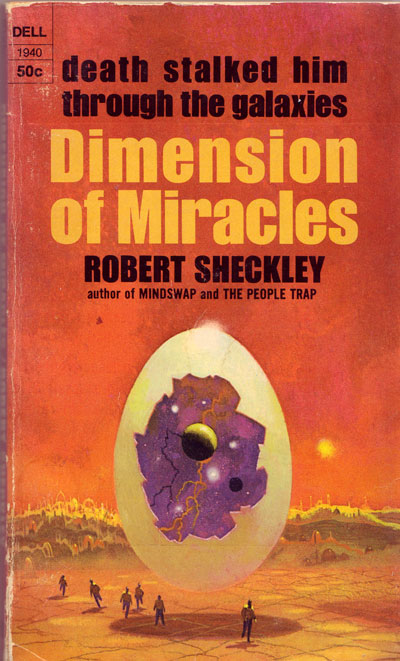
28. Dimension of Miracles by Robert Sheckley

This was the third and final book in the stash I found hidden away at my job. I have never read anything by Sheckley, but have since learned that he was a very successful, popular and critically-acclaimed science fiction author who eventually became the managing editor for Omni magazine. Dimension of Miracles was written in 1968 and while I respect this kind of science fiction, it really isn't my cup of tea. These guys wrote in a period when ideas were more important than story and they really do have a lot of cool ideas, but without a strong narrative, I find myself getting distracted often.

This book, for example, is ostensibly about a human from 1968 New York who is mistakenly given a galactic prize. The mistake is that only species who are able to travel about in space, time and dimensions are eligible to receive this prize. Tom Carmody, is thus left adrift in space time whatever where he received the prize having no idea of how to get back to his right place time and version. Furthermore, because of the universal law of predation, by being taken out of his own place in the hierarchy of eaten and eater, Carmody has now a predator on his tail whose sole raison d'ĂȘtre is to eat him.

It kind of sounds like fun and the back and front cover copy make you think of some kind of world-spanning chase. [As an aside, this is one thing I don't get about sci-fi publishers from this period. They always had the most abstract, trippy cover art that never had anything at all to do with the content of the book juxtaposed against the most blatant, lowest-common-denominator copy. Why were they willing to be all speculative and creative with the cover art, but completely pandering with the copy?] Instead, as I had expected, we get an excuse to put the protagonist in many different situations where ideas of philosophy and crazy science can be discussed. He meets a god who is the sole inhabitant of a planet and stuck in an existential crisis. There is a builder of worlds (who reminded me a lot of Slartibartfast), who built earth on God's request and wanted to apologize to him for cutting corners. We go to super-consumerized Manhattan where everybody talks in advertising jargons. We meet an intelligent city whose nagging personality has driven away all the citizens. And so on. Some of it was clever. This book reminded me a lot of Hitchhiker's Guide to the Galaxy in its tone.

But ultimately, it all kind of fizzles out because there is no real storyline and I'm not super concerned about the fate of the protagonist as it seems kind of random to me anyhow. It's not a bad read and it fired off some synapses in the lazier parts of my mind, if you enjoy this period of science fiction. It has helped me to get a better sense of what elements of that period I do and don't enjoy.

Monday, May 02, 2011

27. The Rare Coin Score by Richard Stark

Well what a delicious tonic that was! After the bummer that the last book I read was, I needed something to cleanse the palate and though I felt it may have been a bit too indulgent, I also knew the Stark would deliver, so I went right to the next Parker book on my list: The Rare Coin Score.

I have definitely read this one before, but I have never owned a copy, so it is possible I had only read it once before, because I barely remember any of it, which is a great thing! The Rare Coin Score is an important book in the series because it marks a significant transition in Parker's romantic life. He meets Claire. I have mixed feelings about Claire and the role she plays in Parker's life. Though early on in the story, I became worried about how Parker was behaving, this is nevertheless a great heist story, from beginning to end, arguably in the top 5 of the series (though I'll need to quantify such a claim at some point).

The book begins with Parker at loose ends, not financially, but psychologically. He has money and really should be laying low after all the heat generated by the heist of the gambling island of Cockaigne in The Score. But he's restless and nervy and wants to work. Bedding a series of different women in party towns does nothing to calm the restlessness either. So when he gets a call from an old colleague about a job to hit a rare coin collector's convention, he goes for it, even though the finger man is a complete amateur his contact is fresh out of the joint and too desperate. Even more out of character, Parker hooks up with the woman who is behind the finger man and keeps hooking up with her during the planning of the heist!

Stark justifies this change in Parker's traditional patterns through both Parker's own psychology and Claire's intrinsic qualities. It makes sense for me how Parker, as cold as he is, still has a need for an intimate partner in his life. But I remaink somewhat skeptical about Claire's character. First of all, she is kind of a cipher. All of Parker's interactions with women are filtered through the cultural mores of the mid to late 60s as well as Parker's own particular way of dealing with them (basically telling them what's up as bluntly as possible, waiting for them to come on to him and then accepting or rejecting as the case may be). So Claire doesn't get a whole lot to say and what she does say is made up of those weird curt little phrases that seemed to pass for relations between the sexes in the '60s. She does demonstrate a strong will when dealing with men she doesn't want and she knows her role and plays it cooly in the planning phase.
She was a good woman, good to look at and good to be with. Sensible and independent. Not full of foolishness. [page 72]


You don't get a whole lot more than that, but it's enough for me and for Parker. Where I get skeptical is when shit gets violent, Claire totally freaks out. She actually goes into a state of severe shock, first catatonic and then talking childish nonsense. The end result is that while she is ethically completely okay with Parker's method of supporting himself, she herself can't stand to be anywhere around it. I'm not quite sure exactly what it is, but I don't totally buy it. She understands from the beginning the implications of what she was getting into and is totally cool about it, but somehow the violence when it actually happens totally freaks her out. Wouldn't there be at least some trepidation about that beforehand? The extremes just strike me as being too far apart in the same person and that, coupled with their stilted conversations, result in me never really feeling like I have a grasp on who Claire is. I will investigate this further in the forthcoming books.

I would like to point out another staple of these books: Parker reading some new acquaintance and implicitly judging him (usually correctly). As the reader, you can almost always tell who is going to be competent and who incompetent by Parker's initial impression of their physical appearance. Here is new heister Jack French when the string is first introduced:
He thought French looked all right; lean and rawboned and self-contained, maybe thirty-five, with level eyes and an expressionless face. French said, "Good to know you," and sat down again.[page 15]
Among other things, it's the levelness that is important to Parker, both physical and mental. Not only is his body self-contained, but so is his speech. No need for a joke here or any other verbiage. Just a greeting and let's get down to business.

Same with Wemm, the black sign-painter working at the shady auto-body shop who has been given the job of doing the fake lettering on the side of the getaway truck:
He had the self-contained movements of a man about to be asked to show how good he is, a man who knows he is more than good enough. His hair was gray but he had the face of a young man. [page 62]
(note to self: spend week practicing being self-contained). I think the gray hair and young face is also an indicator of Stark's world view: the positive combination of physical youth and mental wisdom. First impressions do count and Park can judge a book by its cover.

Finally, I am going to share two more great Westlakian metaphors with you:

Billy was at his most nervous, looking around like a possum coming out of a hole. [page 72]

When he saw Claire, a surprised smile creased his face, looking strange there, as though it had been delivered to the wrong address. [page 73]


That's Ninja-level writing right there.

I have distracted you all with some side analysis because I don't really have a lot to say about the meat of the book, which is the heist, its planning and execution. I don't have a lot to say, not because there isn't a lot to say about it but because it really is just much better for you to go ahead and read it. I can talk about those beautiful ribs on the bbq, how the sauce was made, how long I smoked it for, and so on, but wouldn't you rather just dig in? This is a good one, that's all you need to know.

Friday, April 29, 2011

26. The Menorah Men by Lionel Davidson

Though the copy I found at Chainon had a very contemporary cover, the book was originally published in 1966 and was touted as being a classic action thriller in the mode of Deighton, LeCarré and Innes. Also, it was about a lost artifact and took place in the middle east. Right up my alley, so I took the risk. After having read it, I found that Lionel Davidson was quite succesful and though he only wrote around a half-dozen books, they were all big sellers and got excellent critical reviews.

So I don't know if the Menorah Men is a particularly bad example of his work or if his success was more a reflection of the time than any particular quality he may have had as a writer. Because this book was really not very good. From the very beginning, I struggled to get through the language, which was convoluted and overly clever. I couldn't even really figure out what the hell was going on there was so much innuendo and half-references. Just tell us that he is at a party and where and who the people are that he meets. I guess if you are a super pro, you can take your writing to that level, but Davidson was not there when he wrote this, that's for sure. I don't know if I got used to his "style" or if it toned down, but after the first 50 pages, I was able to actually get into it.

And the thing is, Davidson is actually a pretty good writer, when he stopped trying to be all 60s cool. His descriptions of the desert are quite evocative and there is a scene near the end, where two lawyers go at it, that was quite thrilling. But even if the whole book had been clearly written, it wouldn't have mattered, because the protagonist is such a prick. I mean I get the idea of the slighly boorish action hero or the normal guy in the wrong place surviving by his wits. But the hero here spends the whole book basically date-raping the hot Israeli soldier that is assigned to him (and of course she gives in and loves him by the end), being basically constantly drunk and even more so when an important military action has to go down and being completely disrespectful to the locals and religious people (barging into a synagogue on the sabbath and demanding some guy to open a store because he needs a map now which he could have waited for).

The story is about the search for a lost fabled Menorah that represented the spiritual wealth of the Jews after they were massacred by the the Romans. There is some neat history and the present day stuff is a cool set-up, with conflicts between archeologists and developers, Israelis and Jordanians at the border and artifact smugglers. The location is great. But the story meanders (the thrilling legal debate being the high point of the entire book is testimony to that) and when you don't hate the protagonist, you really don't give a shit.

Sorry, Lionel Davidson, maybe your other books kick ass, but I'm going to need someone whom I respect really argue that for me before I pick one up.

Sunday, April 24, 2011

25. Monsieur Monde Vanishes

The Simenon roman durs are everywhere! Monsieur Monde Vanishes, along with one other, was lent to me by my basketball-watching buddy. He's an intelligent fellow with quite specific tastes and we have a bit of a cultural exchange going on. Some things have worked and some haven't, but we definitely share an appreciation for Simenon's cold, distant gaze at humanity.

Monsieur Monde Vanishes, is, as the title explicitly states, about a man who decides to just leave his life. He is a successful industrialist with a distant wife and a distant son. One day, he just doesn't go home after work, instead taking out some cash from the bank, selling his tailor-made suit for an off the rack (gasp!) and wandering around Paris until he finds a dreary hotel. He seems to equate the working and lower-middle classes with some kind of freedom or at least with having something that he longs for. It's never explicitly stated what drives him, because even when he does succeed in truly leaving his old life behind, he still seems disconnected, at least from other people. Yet he gains some satisfaction from his adventure and there is some internal change in him. Whether it is for the better or the worst is hard to say. It ends on a very dark, inhuman note.

It's a quick and interesting read, with a rich immersion into some great Paris milieux, such as a casino and a poorer class of hotel where he lives. It makes you reflect on success and what it means to be alive and with other people, but perhaps not in the most optimistic way. I think that this novel could probably be correctly called existential. It lacks the intensity and focus of some of my more preferred romans durs and so didn't blow my mind, but it was still a good book.

The book is part of that very nice line of New York Review of Books Classics trade paperbacks. Normally, I don't like the trade paperback format, but these have a somber tone and nice spacing so that I quite enjoy their look despite the annoying size. However, in the case of this book, I find the cover image to be inappropriate. Monsieur Monde is described as stout, with an almost boyish body. The tall thin guy on the cover looks to much like what a North American would expect a french businessman to look like.

Saturday, April 23, 2011

Spring Bookshelf re-org


I don't know what got into me, but I was overtaken by a powerful compulsion to create a fifth shelf for my paperback collection. My quartet of Archives Canada solid maple bookshelves all had 4 levels on them and that does seem to be the amount they were designed for. I've known for a while that I could theoretically fit a fifth shelf and I have the boards already finished, but I was never quite sure that it would actually work. The issue being that the gradation between the little pegs that support the shelves is about an inch and I wasn't sure that if in actual practice 5 shelves would actually have enough space to fit books of a paperback size.

Unfortunately, I got so into the job that I completely forgot about taking any pictures until after I was done. As you can see, my theory was correct, unfortunately, I had to segregate out trade paperbacks. Only on the bottom shelf (where I just can't bear to separate my old Parker paperbacks from the new University of Chicago reprints), is there enough space for anything taller than a standard, classic paperback.

I also had to sacrifice my rolepaying games shelf, which was quite a tall one on the bottom. I was quite proud of that, but most of the books on that shelf are for games I'll most likely never play, so I am going to sell a bunch and then consolidated the rest with my (also tall) comic book shelf.

Here are the major advantages that have resulted in my work: 1) I have much more space to grow into, as you can see and 2) all my paperbacks are on the same shelf unit, as opposed to divided across two. So while I am very happy with the change, it isn't without some small regret. Sometimes you need to get tough in order to move forward!

Thursday, April 21, 2011

24. You'd Better Believe It by Bill James


I picked this up purely on a whim during a nasty, rainy evening that drove me into the warm interior of S.W. Welch's. The depressing weather spurred my consumer appetite and I bought this book and one other (a nice penguin Hornblower) despite my spreading on-deck shelf. I was drawn in by the thinness of the books, the setting of criminal urban england and the hard prose. My instincts were not off as Bill James is an excellent discovery. It turns out he is quite well known and respected in the U.K. for his various series of "Welsh Noir", this one being the first in the best known, Harpur & Iles, of which there are 22 books!

In You'd Better Believe It, detective Harpur is the main protagonist, a frazzled, but driven cop whose personal morality is revealed to be questionable at best in the first pages as he is portrayed making a play for one of his subordinate's wife. The plot centers around a tip-off about a big bank robbery that is supposed to go down. The job is delayed and during the wait, big time players come into Harpur's smaller seaside city and start ruthlessly killing informants ("grasses" as they are known in this milieu) and a police officer (the previously mentioned subordinate). Caught between a bureaucratic and politically-nervous administration and a poverty-stricken society, Harpur has to act often on his own.

The story is decent, seemingly quite realistic, but without a lot of suspense. The milieu is top-notch, as is the language. This is the hard, ruthless Britain where human culture is limited to dark humour, alchohol and a few good boots in. It's funny, because the plot and procedural elements were not dissimilar to the world of de Gier and Grijpstra, but the cultural level was just so different. Let's just say that I would much prefer to be a police detective in van der Wetering's Amsterdam than James' fictional Wales.

A great find. From what I've read, this series gets richer and I'm looking forward to seeing that happen. Though my on-deck shelf doesn't!

Tuesday, April 19, 2011

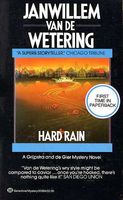
23. Hard Rain by Janwillem van der Wetering


Hard Rain is the fourth and last of the pile of Grijstra and de Gier procedurals a friend of mine with a child dumped on me. I found all four to be really enjoyable and it is a series that I would always be happy to return to, but at the same time, I am quite happy to have these four off of my on-deck shelf.

Hard Rain was published in 1989, but other than the use of a computer modem, things don't seem to have changed much in the world outside of the Amsterdam murder squad. Amsterdam is still a fairly rough-and-tumble city, with a lot of drug abuse and petty crime. However, inside the squad, serious corruption is taking hold. At the beginning of the book, the Commisarius, who is Grijpstra and de Gier's boss, is coming back from a "relaxing" vacation, when he learns that the director of a bank has killed himself. The principal shareholder of the bank is an old enemy of his. He also learns that this investigation, as well as several others, have been bungled or shut down by the commissioner in charge during his absence.

This time, the Commisarius, who is in really the main protagonist of this story (and for that matter, referring to these books as the "Grijpstra and de Gier Series" is inaccurate as the Commisarius and Constable Cardozo feature just as much as those two; it should really be called "the four cool and incorruptible guys in the Amsterdam murder squad series"), goes "off the reservation" with his team. Together, using unorthodox methods, they strive to take down the evil banker and the internal corruption. Along the way, there are the usual philosophical and slightly absurd conversations about life, work and art. There aren't quite as many interesting Amsterdam locales and locals in this one, but there is more focus on the Commisarius himself, which is pretty good as well.

Also, it's interesting that the Commisarius's first name is Jan and his main rival the banker's first name is Willem while the author's first name is Janwillem. Maybe this means nothing if you know a little something about Dutch nomenclature, but I noticed it, in any case.

One more good entry in a solid and enjoyable series.

Monday, April 18, 2011

22. Black Camelot by Duncan Kyle

In honour of Louis XIV's ascension to role of official Archivist for the British Library, I decided to go back into my own collection and re-read one of the few books that I have a first edition copy of (at least I think I do; I'm never quite sure of these things): Duncan Kyle's WWII espionage thriller Black Camelot.

[To stop being facetious for a moment, it really is a cool thing that the British Library found Existential Ennui and recognized it for the value it is providing. Nick Jones has been steadily posting about some great but relatively unrecognized genre authors of the 60s, 70s and 80s. He hunts down rare editions of the books, researches their publishing history with a special emphasis on their design and covers. These are books that never received the archival respect they deserve because of their commercial or genre-based nature but in hindsight, today we see a lot of art, culture and history in them. All of us genre fans always appreciated these works and recognize their contribution to culture. It is great to see that institutions like the British Library recognize that as well and it is thanks Nick's hard work that this information will be preserved and made accessible to more people.]

I have always enjoyed Duncan Kyle's work, but in my mind I always consider him a poor man's Desmond Bagley. Such a ranking is probably not just and I think that it's based more on Bagley being more consistent and prolific as well as having excellent marketing support during the height of his popularity. (Although reading this great post about him with layouts of all his Fontana covers suggests I may be wrong about the marketing part; perhaps it was only in Canada that he didn't receive the distribution of Bagley.) I had suspected for a while that I need to go back and re-read both Bagley and Kyle to re-assess how I think about them and this read of Black Camelot has helped reinforce that notion.

The cover of my book is awesome, showing as you see here, a nazi officer hanging from a rope surrounded by fire. This does happen in the book, but it takes such a long and circuitous route to get there that I was doubtful it would even happen at points. That route is quite enjoyable and shows Kyle's skill at weaving a rich narrative and his knowledge of espionage and crime. It also reveals a pretty hard cynicism that gives this book a dark edge.

Conway is an Irish reporter based in Stockholm in 1944. In neutral Denmark, he is able to get stories on the situation in Germany. One of his tricks is to wait for the flight from Berlin and get his hands on the German newspapers before his rivals do. He happens upon SS officer Franz Rasch, who has been sent by his superiors to deliver some papers that they hope will sow division between the British and the Russians. What Rasch doesn't know is that he is set up to be condemned as a traitor and deserter to make the story seem more authentic to the Brits and Russians. By fluke, Conway helps Rasch out, figuring out what is going on, they devise a blackmail scheme.

I don't want to give away anything more, so I'll skip out the details of the circuitous path, but the novel climaxes in an assault on the famous (and real) SS castle Wewelsburg, which Himmler created to be a spiritual center for Nazi mythology. According to the novel, it also contained a room full of Nazi intelligence files, both damning for the Allie as well as many leading Nazis (Heydrich, who assembled the documents, gained his political strength by having dirt on everybody). It's these documents that are the target of the raid.

This is a great book. It's got a little bit of everything you could want in a WWII thriller: espionage, nasty domestic crime, internal politics at the top level of both the Allies and the Nazis, awesome Nazi fanaticism and it is all topped off by an action-packed finale. The really strong points that made me raise Duncan Kyle in my ranking are a couple of asides where he describes the histories of two successful British businessmen and how they could have supported the Nazi movement. They were very realistic and rich, a few pages that encapsulated how easy it is for men to be sucked into evil. Their stories could easily take place today in slightly different contexts.

Wednesday, April 13, 2011

21. The Crystal Cave by Mary Stewart

It's so strange that I had never heard of this book until my friend Castaway, man of good taste and fruitful loins, blogged about it in his now defunct 50 books blog several years ago (having triplets is a good excuse to stop with the blog, I'd say). I say it's strange, because it was an extremely popular novel and one that would have appealed to my adolescent self for sure. And we were exposed much more to British reading trends in Canada. In any case, I'm glad I found it, because it really was an engrossing and entertaining read and informative as well. (Appropriately, it was part of the minor treasure haul of old books I found high up in a storage room at my job.)

I will explain the informative part immediately, just to make it clear that I recognize this is a work of fiction, based on the Arthurian myths. However, I am so ignorant of this period of history that even the broad lines (about the back and forth between the various British tribes and European tribes, notably the Saxons for control of the the island of Britain) were new to me and really interesting. It's a period I would like to learn more about.

But on to the fun! The Crystal Cave is about the life and rise to power of Merlin. He starts out in a royal house, the son of a queen, but neglected and threatened because he is a bastard, his father unknown, his mother refusing to reveal. In some ways, this is the classic story of the young underdog rising to become a hero. What makes this book so enjoyable is the twist in that classic setup. Merlin's growth to power is through the path of knowledge rather than physical prowess. Furthermore, his role is always to one side of the visible power, in support of the kings who will unite Britain and drive out the Saxons. As he faces challenges and encounters new situations, he learns. He learns medicine, engineering, history and many other practical subjects. Through practice and his own shrewd wit, he also learns politics and the manipulative strategies necessary to survive in these courts of intrigue. All this stuff in the book is immensely enjoyable (especially for the underdog nerds of the world, I can well imagine).

Another interesting aspect is the way magic is handled. It exists, but it is quite subtle and except for a few brief mentions of minor cantrips, is limited to "the sight" and entirely out of Merlin's hands. Partly through accident and later by manipulation, he uses the visions in combination with his own wiles to create the perception that he is a wizard of great power. What is interesting is that all the while, he himself is quite humble and almost passive. It makes for a strange hero. You definitely like him, but you also feel that he is almost a victim of fate at times. It makes for a strange hero.

The last third, until I made it to the very end, began to feel a bit episodic as well. The ending ties it altogether, but I felt it lost a bit of its overall narrative arc and became more about a series of historical advances made by the British against the Saxons and Merlin's role in them. They were nevertheless still quite entertaining and engaging episodes, but it wasn't until the end that it all made more sense in the greater narrative arc. Perhaps if one was already aware of the legend of King Arthur's origins (which this book leads up to and is neatly summarized in an afterword), it would have been clear to what end these episodes were directed.

Overall, a really enjoyable and absorbing read which brings to life this early period of British history, where a culture and civilization was rebuilding itself on top of the Roman ruins and in the face of the barbaric onslaughts from mainland Europe, onslaughts she would face time and time again, always displaying her mettle with that indomitable spirit the great island nation was built on (see what this book does to me!:)).

Friday, April 08, 2011

20. The Dying Earth by Jack Vance

I've been aware of Jack Vance for a long time, but never read anything by him or knew much beyond his influence on Dungeons & Dragons. The magic in earlier versions of D&D is often called "Vancian" in the sense that there are specific spells that have to discovered and learned and kept in spell books as opposed to other forms such as ritualistic or more free-flowing. There are adherents and opponents of this approach, but whatever your flavour, Vance's imagination had a lot of influence on the origins of fantasy roleplaying games.

We feed a stray tomcat on the back balcony and he tries to sneak into the house and leave his mark. He has hit us successfully a few times, the last being a quick blast on the bottom shelf of meezly's books. Bad scene, but she did a pretty good job of getting her books mostly rid of the cat pheremones, except for a paperback of The Dying Earth. I didn't even know she had it and considering her pretended abhorrence of roleplaying games (part of the secret unwritten chick code) it was quite ironic that she owned one of the classics of the genre and I hadn't even read it! I felt it was time to delve back into a bit of fantasy, so I picked it up.

As usual, these older paperback editions never represent the contents properly. This is one area where the world has improved. When you get a genre book these days, it is usually very clear from the publisher's info where the book fits in within the rest of the author's work and exactly what it is you are getting. Back in the 60s and 70s, it seemed like they always had to obfuscate and mislead, so you could never figure out what the order of anything was, which characters would be in it and so on. The Dying Earth appears to be a novel, but it is actually a collection of short stories, all but one loosely connected through characters but having no other greater narrative beyond that they all take place in some far future earth where the sun is a dying red giant.

There is both the remmants of great magic and great technology in this world. Everybody seems aware that the planet is dying and this allows for a certain melancholy and a certain decadence, which is a great mix for adventure. Many of the stories are quests, where a hero or magician learns of some lost knowledge and seeks it out. These frameworks than allow Vance to draw out wondrous locations and fantastic creatures. It almost feels a little bit like the original Star Trek series, in which each story brings us to a new cool milieu, sometimes even with a political parable. As one gets older, one becomes less interested in the fantastic and more concerned with the human, the character, the conflict. Vance's fantastic is pretty awesome though and I found myself enjoying it for its own sake. Little people that fly around on dragonflies, trading gossip and rumours for tiny bags of salt they hang from their mounts, a demon whose face is only able to penetrate into our world and attacks with his tongue and ghosts spouting from his nostrils, a wizard who shrinks his enemy and puts him in a maze with a tiny dragon as a form of endless torture. It's really cool stuff. Furthermore, the stories themselves are quite elegantly constructed, almost little fables, neatly constructed and just as satisfyingly concluded.

There are only three other books in the Dying Earth series, but most of the rest of his work is science fiction and mystery (which surprises me somewhat, considering his impact on D&D). I hope that at least one of them is an actual full-length novel, because I would love to see his talents in the form of a longer, more deeply engaging story. As it is, I wouldn't be averse to reading more of his short stories as well.

Tuesday, April 05, 2011

19. Murder over Dorval by David Montrose

Murder over Dorval is part of a new series of reprints called Ricochet Books put out by Véhicule Press, a Montreal publisher. Véhicule Press puts out a wide range of books associated with Montreal, including The Man who Killed Houdini, by my mother's cousin and Montreal chronicler, Donald Bell (which I'm ashamed to admit I stopped reading about halfway through; but I'll get to it!). The Ricochet Books are reprinting a line of Montreal pulp detective fiction from the '50s, which is just an awesome thing to do. These books are very hard, if not impossible, to find and they represent a tiny sub-genre of literature that should not be forgotten. They are also (at least judging by this one) pretty fun reads.

Murder over Dorval was an interesting book. On the surface, it's a pretty classic hard-boiled detective mystery, a bit derivative, a bit convoluted, but pretty fun with some hardcore badguys and a great set of locales. The language ranges from enjoyably rich to just too much ("her face was longer than a rainy weekend in the country"). To the fan of the genre, what will make Murder over Dorval distinct is the Montreal setting and the excessive drinking. The detective is basically wasted the entire book. What happened to Canada and alchohol? We still have great beer here, but good luck trying to get the proper drinks detective Russel Teed was putting back here. He's having a few beers for breakfast and just keeps going from there. Drinking and driving, drinking and detecting, drinking and getting his ass kicked. All in a day's work!

As a dual citizen, there was something else in this book that stood out for me, a kind of self-consciousness. It reminded me a lot of The Stringer in the way the protagonist is always telling us where he is going and who is there, trying almost too hard to assure us that things are happening here. At the same time, there is such a blind anglocentric perspective here that it makes for a weird mix. I always thought the anglo self-conscious that I encountered here was the result of being a minority, but I wonder if the Revolution Tranquille only influenced an existing solipsism. Again, it's all very subtle and such a reading could entirely be due to viewer bias, but it's a feeling I got.

I'm looking forward to the others in the series. The Body on Mont-Royal is out on shelves now and I'll be picking it up after I get through a few other books on my on-deck shelf. Brian Busby says it's the best of the bunch (how psyched would I be to find the original Harlequin version).

Oh yeah, physically, they did a really nice job with this book. A lovely full bleed cover with the original image and the ricochet logo nicely subtle. And though it goes against my environmental principles, I have to admit liking the quality feel of the paper and cover. It has heft for a paperbook. I'm also grateful that it is proper paperback size, not one of these lame "trade" paperbacks.

If you want it, you can buy it here.

Thursday, March 31, 2011

18. A Case of Exploding Mangoes by Mohammed Hanif

Another Chainon find. I had no idea about this book, being interested in it purely from its cover. But I did discern that this copy was originally published in Pakistan or India and that it was very popular in that region. I thought it was going to be a military thriller, which it partially is. It's not aimed at the genre audience, though, but rather at an educated reader who reads modern trade paperback literature. Nevertheless, a pretty interesting and mostly enjoyable read.

The book has two parallel storylines the ultimately run into one another. The first is about an air force cadet in the Pakistani military whose roommate disappears. He is blamed for it and sent into a process of investigations, imprisonment and even some torture. You know from the beginning that he was involved in some way in the explosion of the transport plane that killed the president of Pakistan Muhammad Zia-ul-Haq (an event that really happened and upon which this book is based). The last days of the president and his assassination make up the second storyline. Here you get a completely out of touch (both with his people and his administration) president succumbing to the paranoia of the world he has created, culminating inevitably in his death.

Though at times I found the book a bit slow and I was not so interested in the young cadet's storyline, overall I quite enjoyed the read. The president is surrounded by a great cast of characters (his jealous wife, his zealous paratrooper head of security, his scheming head of intel, etc.) and the mix of naive egotism and caprice that Hanif imagines going on in Zia's mind is quite humours, despite the dark reality behind it (that the author does a subtle job of maintaining). It also was educational and incited me to do a bit of history on this period. Pakistan played a crucial role in the support of the Mujahadin of Afghanistan in their fight against the Soviet Union and the U.S. had a big hand in supporting Zia's dictatorship. Some very interesting lessons for today's dynamic situation in North Africa, where the U.S. has to make some tough decisions about dictators they have been supporting.

A nice little find that I wouldn't foist it on anybody, but if you were interested in the period or found it at a beach house, you wouldn't be too bummed out.

Wednesday, March 23, 2011

17. The Spies of Warsaw by Alan Furst

There is a great little cordonnerie (cobbler) near my neighbourhood that also has a small wooden display on the counter of used books for sale. It tends towards "literature" trade paperbacks, though every now and then they have some genre stuff. The place also has a cleaning service, so I've been going there more regularily and realized that the stock changes. I asked the owner about it and he told me he has a deal with a guy who comes by every Thursday and changes all the books. He also keeps track of sales by checking the remaining inventory, so the owner of the store doesn't have to bother with any records. He just gets a cut of the sales. Last week, I found this Alan Furst novel. I swear I had read in one of the book blogs I follow a lukewarm review of a different novel of his, but now I can't find it. In any case, he has a reputation of being one of the better contemporary spy authors, with perhaps a bit of hyperbole attached as well.

Spies of Warsaw is about exactly what the title says it's about (which I appreciate). It takes place in Warsaw in 1937 as the Nazi threat is becoming a real possibility for war. It's an awesome period for espionage and an awesome location. Poland, being third in line in Hitler's plans for expansion, after Austria and czechoslovakia, is an important information depot for all the other european powers. The protagonist is Jean-Francois Mercier, an ex-soldier and now agent working for the French embassy in Warsaw. He is of the aristocracy, comes from a long line of soldiers, and has a sweet pad in Warsaw, a family apartment in Paris and an old farm in the French country. He is pretty into his job.

There is no single plot line here, but rather a semi-tangled web of operations that Mercier has to undertake: making regular pick-ups from a german engineer he has set up with a mistress, helping two Russian spies defect, getting together with a hot polish League of Nations lawyer, making contact with a hunted anti-Hitler Nazi and so on. All of it is compelling, rich with period detail and atmosphere. I've read that Furst is often compared to Patrick O'Brian, in that it is historical fiction. I'd say that is accurate, minus the rich language and profound human warmth. Furst sometimes errs in trying to be a bit too historically accurate and in context. References to Buster Keaton or an article by a leading Nazi seem slightly forced. At times, the language also seems contemporary (though how would I know)? But these are minor complaints. I studied this period in college and I still find it fascinating today and Furst does an excellent job of bringing it to life. Another thing that I enjoyed is that the narrative doesn't try to hard to force excitement on the reader. There were lots of points where I thought we were heading into a traditional action climax, but instead situations resolved themselves in a much more organic and realistic way, thus creating a more satisfying depth.

I did some reading around and a lot of people feel his work suffers in the later years. This was one of the more recent (2008) and it was pretty darned good. I'll definitely keep an eye out for the earlier books. There is one that takes place on a tramp steamer that looks right up my alley.

Friday, March 18, 2011

16. The Wars by Timothy Findley


I was told a few times that I should read this book, but now I think the actual book by Findley that was recommended to me was Not Wanted on the Voyage. The Wars is the story of a young upper-class Canadian from the Prairies who is sent off to World War I has terrible, growing stuff happen to him and then causes a scandal that ends up in his dishonor. The scandal itself is a mystery to the reader right up until the end and thank god for that because otherwise I am not sure I would have been able to finish this book.

Now let me preface my rant by saying that this is not a bad book, possibly even a great one and it has the reputation of being a Canadian classic. But it represents everything that I hate about Canada (and had pretty much forgotten), the cheapness, the self-pity, the protestant emphasis on suffering, the need to justify one's existence by constantly feeling that everything is a bummer. As much as I rail against the spoiled consumption of America and how that is poisoning our culture as well, I do greatly value the optimism of the United States and am glad we have gotten that here.

Here is the protagonist, Robert Ross: a very handsome, athletic young man from a wealthy family. But oh guess what he is too freaked out to talk to women. And his big sister whom he loves more than anything is hydrocephalic and spends her life in a wheelchair feeding her rabbits. But one day Robert neglects her and she falls over and dies. Guess what he was doing when he neglected her? That's right, wacking off for the first time! Oh the guilt and the shame! And oh guess what else his psycho alchoholic mom demands that all his sister's rabbits be killed and that he be the one to kill them. and on and on and on.

Look dude, I believe it sucked growing up in some upper-class family in the Prairies during the beginning of the century, but I don't want to read about it and I certainly don't want to revel in it. Why do I suspect that poor French-Canadian farmers, who had a much rougher situation back then, had a much richer, happier life. Sure there was tragedy and poverty and death and all that, but in between, why don't we have a drink and a laugh? Oh no, we can't because we are fucking uptight western Canadians who have to frown on fun and pleasure (and even then we can't go over the top about it like some good repressive catholics or fire and brimstone evangelicals).

And then on top of it, of course we have to have the constant sexuality, generally tending towards the homosexual and always causing guilt and freaking out. Every male is gay or not gay but in love with some other male. Zzzzzzz. And whenever people do have sex, it's always seen to be disturbing and violent.

It strikes me that this book is much more about the place and period when it was written (Toronto, 1997) than it is about its subject matter. That's not intrinsically a bad thing. It's just that it doesn't age well, especially not to my personal bias.

There are some neat moments, including an especially memorable one when the guy runs with a coyote on the prairie. That was awesome. But the rest of it brought me back to a Canada that I used to be trapped in and could not wait to get out of. Now that I am free of it and now that Canada herself seems be moving past that state, I really don't want to be reminded of it again.

Next!

Wednesday, March 16, 2011

15. Admiral Hornblower in the West Indies by C.S. Forester


Helping to feed the Age of Sail reading frenzy that is going on chez nous this Spring in anticipation of our extremely gradual but progressing forward Beat to Quarters game, meezly found a really neat old hardback copy of one of the last Hornblower books. These are the true classic adventure stories of the British Imperial Navy, pre-dating and most certainly influencing Patrick O'Brien's Aubrey and Maturin series by several decades. I have read one other Hornblower, Commodore Hornblower, which is also late in his career. Clinging desperately to the fact that the books were not originally written in chronological order, I have pretended to myself that I am abandoning any care about following Hornblower's career in order and avoiding spoilers and thus jumped right into this novel, which chronicles the end of Hornblower's career as he patrols the West Indies. To be honest, I wanted to read H.M.S. Surprise, the next in the Aubrey-Maturin series and I knew that meezly had a copy, but she kept it hidden from me and then started reading it herself. This was a fine consolation prize, however.

It's interesting from a historical perspective. It takes place in 1818-21, when the big sea wars were all over and Britain's naval dominance, especially in the new world, had receded dramatically. Though still a powerful diplomatic force in the West Indies, Hornblower's fleet is relatively small, with a frigate carrying 12-pounders as his biggest vessel. No more ships of the line here. Because of this, he is often outclassed either in firepower or speed and has to use his skill and wits to resolve situations. He is really more like a policeman here, hunting down pirates, smugglers and political criminals. The book is actually a series of short stories, two of which are connected. The whole thing does trace a complete narrative about this period of his career, his 3-year separation from his wife, but there is no single over-arching storyline. All the stories are excellent, with the final one being a real cracker, once again keeping me up past my bedtime and getting me over-stimulated.

It's cool, because when I was in high school and college, I didn't find this period all that interesting. I think I just couldn't relate to the goofs in their buckled shoes and restrictive manners. It's also so complicated. But now I am learning to realize how much there is to appreciate about this period, the revolutions against monarchy around the world, the burgeoning technologies of transport that were changing the face of the world, the crazy political intrigues. So much going on and so much opportunity for adventure!

(Note, the cover pictured here is the same cover that meezly found, but not an actual scan. Ours is a book club edition and had one rip in the upper middle and another smaller one where I stupidly picked at the glue after successfully getting the price sticker off.)

Thursday, March 10, 2011

14. Tunnel in the Sky by Robert A. Heinlein

The discovery of this book brightened my day. I was fighting the endless fight against other people's hoarding and trying to make some space in the storage area in our office. Going through boxes of files that haven't been touched in a decade, equipment bought, used once or never and then lost (but "keep that, we may need it"), over-ordered print jobs with obsolete content when I found two boxes that looked even too old for our office. They were full of books! Most were old textbooks, but I also found a couple of science fiction and fantasy paperbacks, including this one. The rest will go to the local thrift store, to be released back out into the wild and maybe read once again. This one, as well as two others, went to my on deck shelf.

The only other Heinlein I've read is Stranger in a Strange Land and I found it quite dated. He was prolific and I suspected that his earlier work might have been a bit more prosaic (read, better) and less philosophical. Tunnel in the Sky was written in 1955 and the storyline sounded much more like an enjoyable sci-fi adventure rather than an opportunity to wank about gender relations. It takes place in a future, resource-strapped earth where space-jumping gates offer an opportunity for struggling earthlings to migrate to remote planets.

The hero, Rod Walker, is a student in a school that trains students to survive in new planets. For the final exam, they are sent to an unknown land and must survive for 48 hours. This time, though, something goes wrong and the gate doesn't open again. The bulk of the story is about Rod surviving, meeting up with other surviving students, eventually building a community and then facing the internal challenges that a burgeoning community must face. This last part dipped a tad into some basic (and a bit trying to me) social theory and reminded me a lot of Earth Abides. Thankfully, the narrative moves forward briskly, moving the story forward and coming to a satisfying conclusion.

A pretty enjoyable adventure with some cool ideas.

Tuesday, March 08, 2011

13. Post Captain by Patrick O'Brian


In advance of an online Beat to Quarters game (and because it's been too long since I read the first one in the series), I decided to pick up the second book in the famous and much-loved Aubrey-Maturin series. Meezly was one step ahead of me and kept her copy of the book, so that made it even easier.

Once again, there is real pleasure in diving into these two remarkable men's relationship and the life of adventure they lead. Added to the enjoyment is the rich language of O'Brian and his great depictions of the world around them. One often thinks of this period in history as downtrodden and meagre, but O'Brian makes it a compelling fantasy world, with diverse charactes and intrigue and adventure at every turn. Just little things, like the poor alchoholic Gibbon monkey in the rigging of the Lively (and the struggle between two sailors for the heads of other monkeys that had died on board) make one want to ship off oneself, despite the privations and the fear of the cat and rope-ends!

I didn't consider this book to be a slog, as Meezly did. But I do agree that it goes on for too long. It seems that the story should end when Jack and Stephen's love conflict is resolved and Jack gets promoted to Post. Instead, there is a whole other storyline where he and his temporary command of the Lively joins a mission to steal some spanish gold. This feels like it should be in a different book.

In general, at least so far, these books are structured in a strangely dreamlike episodical way. He slips from scene to scene without any explicit transition. One moment, Jack is talking to Stephen about his worries for his meeting with the admiralty and the very next paragraph is him actually speaking to the Admiral. Other sections suddenly fast forward seasons in a single paragraph. It takes some getting used to. It made me think, in the beginning, that the division by books was an artificial one. By the end, however, I realized that it is the love triangle and Jack's need to get a Post position that unite this book. I'll have to see how this structure manifests itself in the next books.

The battle, though, before that, where the awkward Polychrest (a ship that had initially been designed to suppport a failed secret rocket weapon and then foisted on Jack by a spiteful Admiral) sneaks into a French bay and wreaks havocs on their parked ships is just awesome. This is the thing about this series, it is all wrapped up in rich language and social conflicts but when ships go broadside and cannons blast and men leap into other ships with pikes and swords, the shit really hits the fan. There is serious action in these books. Great, ripping stuff and I am so psyched that there are tons more books to go!

Tuesday, March 01, 2011

12. The Handle by Richard Stark

I have finally started on the next set of 3 University of Chicago Parker reprints that I got for my birthday this year. I think that it is possible that I had only read The Handle once before. It is one of the series that I have never owned, so I must have borrowed it from a friend. In any case, I remembered almost nothing about it beyond the basic premise: Parker is hired by the outfit to rip off and burn down a private casino island off the coast of Texas, but actually in Cuban territory.

The heist here is one of the better ones. The isolated island, filled with rich party-goers and yachters, is a great target. Westlake, as always, makes it come alive with detail (love the little cockfighting pit in the rear, put in place to further heighten the air of exoticism for the guests) and colour. He also clearly describes the layout so the reader is encouraged to start thinking of the best way to hit it as Parker is.

However, I'm going to have to say that this is possibly one of the more flawed episodes in the series. The complications are just a bit too large and preposterous. Parker is already working with the outfit, hired by Karns, the guy who got to the top because Parker took out his predecessor, which seems a little off. Their motivation is because the island is competition they can't touch and they want Parker to take it out. I just don't like to see Parker cooperating with the mob, even if he is ultimately going to screw them. But then the feds show up and they know everything about Parker and his crew. They also want the dude who runs the island and want to use Parker to that end as well.

Finally, we have Grofield. Now, I like Grofield, but he always seems out of place in a Parker book. He's just too fruity and goofy. I get the feeling that Westlake was struggling with some other literary desires whenever he put Grofield in a Parker book. You see these tears in the Stark fabric that shine the light of Dortmunder into Parker's world. I don't want the light! The ending is this slightly unreal helicopter pursuit in the Mexican desert that just didn't feel plausible or like Parker at all. He even ends up on a navy vessel! I am having a hard time understanding how he doesn't just get arrested after this given the info the feds have on him now (they know his current alias and all his past aliases and link him up with 8 other robberies). Maybe it gets explained in later books.

Also, the heist itself goes down awfully quickly. The owner of the island, an ex-nazi with a really rich and colourful past, is set up nicely and then ends up not really doing a whole lot. He also has a disturbing right-hand man who is offed all too easily. I think I would have been happier to have not had the feds in it at all and stick with the other complications.

Still and all, a great read. I had wanted to savour it and I am trying to go to bed on time, but once the heist started, I couldn't put it down and ended up with the head lamp on staying up a good 45 minutes after my bedtime. A slightly-flawed (in the eyes of a hardcore Parker nerd) Parker is still a work of fucking art. I mean there are sentences in here that I just had to read over again a few times, as well as a few moments of badassedness I noted down for future dealings with annoying people (like when Parker tells the slightly officious outfit manager "I don't even want to be reminded of you.").

Saturday, February 26, 2011

11. My Search for Patty Hearst by Steven Weed

I've always held an interest in the various phenomena that marked the end of the '60s, where the cultural movement got really dark. That whole period, sort of kicked off by Watergate, is just so fascinating, culturally and politically. The establishment was probably at its most retarded in the history of America, while the young radicals were also amazingly stupid. And right in the middle was Parker, kicking everyone's ass—oh no wait, I'm in the wrong review.

I picked up this book for a dollar because I thought it might be an interesting read. Steven Weed is the ur-cuckold, the rational, sensible young white professor whose pure heiress fiancée got kidnapped, brainwashed and eventually turned out by the ultimate revolutionary black cock. I admit to having a slightly prurient, almost mocking, interest in hearing his perspective. Surprisingly, the book far exceeded my expectations and turned out to be both a very thoughtful introspection on his psychology as well as a detailed and accurate history. I don't know if credit is to Steven Weed himself or his ghost writer Scott Swanson, but a real effort was made here to detail all the craziness that went down during the period between Patty's abduction and the shootout of most of the SLA 3 months later. It makes for a fascinating read.

I am not too aware of all the context surrounding the publication of this book, but it's clear that Weed was trying to defend his reputation. So it should be approached with some skepticism. The Hearsts ended up distancing themselves from him. He botched several media interviews. He published the book while Patty was still on the run and then added a bonus chapter after her trial, so it does look like an opportunity to cash in. That being said, he does an excellent job of portraying himself as a victim, but ultimately one who comes to terms with what happened, while not hiding over any of his flaws. You do feel sympathetic for him, but he doesn't milk it or seem to feel sorry for himself. You get the sense that he was more just blown away by what was going on. Imagine, your fiancée is brutally kidnapped from your house and you get the shit beaten out of you. You first think it's a simple hostage case after a break-in. Then you think it's for money because she is the heiress of a famous wealthy family. Then you get this communiqué from these freaky crimino-revolutionaries making these insane political demands. And then the final straw when she joins them and starts parroting their garbled revolutionary bullshit and claims you are a sexist, ageist pig. He was only 26 years old! I think it is a testimony to his basic stability that he didn't go completely bonkers. I'd be curious to hear another perspective, but I think another point in his favour also is that he seems to have completely disappeared from the limelight. The only thing I can find is that he is a real estate agent in the Bay Area.

But back to the book. One example of the detailed history that I hadn't expected was the recounting of the chaos that was the People In Need food drive. One of the SLA's demands was that the Hearst family donate $400 million worth of food to the poor. Instead, they donated $4 million and tried to create a system for buying, sorting and distributing to the food, hiring experienced administrators from Washington state and affiliating them with a wide range of local churches, political organizations, community groups, criminals and just everybody. Because the distant voice of DeFreeze in his political communiqués (sent via tape to the local media through a black church) was weirdly driving the whole thing, all these groups had a lot of power. Plus, it was the 60s in the Bay Area, which was just a total free-for-all when it came to these kinds of things. I mean you think PC thought can cripple getting things done today, you need to read this account. The first food drop turned into a total riot. By the end of the program, they did manage to get a lot of food out, but the waste, chaos and theft that went on in between is just a perfect demonstration of the vast gap between vague political ideals and actually getting something done. Steven Weed volunteered for four days during the last drive and you get a first-person eye view on it.

I know what I've written so far portrays the radical left as being profoundly naive and incompetent (or just criminal) and they were. But the undercurrent throughout the whole book is also the utter incompetence and disconnectedness of the establishment at the time. The FBI completely blew this case. They had absolutely nothing but bullshit and bluster. (Their rhetoric during this case sounds eerily similar to the garbage we get from Homeland Security about "terrorism" today, which should tell us something about how much they actually know.) Particularly hilarious is the part where they bring in an expert to interrogate Weed right after the kidnapping. He is an expert on "marijuana addiction" and asks if any of the attackers had a yellowish tinge, as that is a dead giveaway of said addiction. Straight out of a Freak Brothers comic. Patty's parents, especially her mother, were completely out to lunch. The cops, for the most part, seemed more concerned with harassing people and being dicks than actually investigating. The "establishment" just had absolutely no idea what they were dealing with on all levels.

I was a little kid in Oakland when all this was going down, completely oblivious. But my parents must have been following along, so I'm quite curious to hear their perspectives on the matter.

Wednesday, February 23, 2011

10. Eon by Greg Bear


I have a strange relationship with science fiction. Basically, it's awesome and I love it. But I am not quite enough of a true nerd to actually be able to fully jump into it and be the guy who in the theatre is furiously reading a 4-inch think paperback while waiting for Aliens to start (I saw this). I often approach science fiction novels with trepidation, with fear that they will be too long, have too much detail and visualisation that I won't be able to follow, that they will be part of some massive series that I'll have to follow to get the fully satisfying reading experience. One of my 50-books goals a few years back was to catch up on a bunch of sci-fi classics and I read quite a few, but since then, it's been few and far between, reading one when the mood really strikes me.

I've been interested in Greg Bear for a while. He has a reputation of being a "hard" science fiction writer. This vague distinction always adds a level of hesitation for me. But I saw a well-read paperback on the shelf at Chainon for a buck and just felt the urge. Not giving myself a chance to be intimidated (and to wash a bit of the PC-stench of The Suspect off my mind), I jumped right in.

Happily, it turned out to be a real page-turner and definitely worthy of its reputation as a sci-fi classic. I read the 500+ pages in a couple of days, staying up too late on school nights (be concerned, Mom!). It's the near-future, 2012, and a large asteroid has appeared, about the shape of a potato and 120 km long. Upon closer inspection, it has symmetrical bands along its length and other markings that appear to indicate the work of intelligence.

I also note that interestingly this is the third sci-fi classic that involves a vessel showing up in our solar system that turns out to be hollow and reveals great secrets, the other two being Rendezvous with Rama and Titan.

Eon was written in 1985 and Bear has pushed forward the cold war context to our present day. He also added in a limited nuclear exchange, called The Little Death.

The west has the advantage in space and NATO quickly claims control of the stone, as it is called (cleverly, the Russians call it the potato). The book's perspective comes mainly from a young theoretical physicist, Patricia Vasquez, as she is called up for reasons she doesn't know to participate in the exploration of the stone. The discoveries in the stone have been kept under tight wraps and all she knows are the rumours that it is hollow and that evidence of an intelligent civilization has been discovered. The first part of the book is her going there and slowly being introduced to what they have actually found. What they have found is pretty awesome and it's a big part of what keeps the pages turning. You want to find out more!

I won't reveal any more, suffice it to say that there are external conflicts from the jealous Soviets and internal conflicts from what they learn about the civilization that did the work. I guess it's called hard science because one of the things they find at the far end of the stone is a seemingly endless tunnel made of walls of anti-matter or something. The tunnel (called The Way) is a huge part of the book and some crazy spacey-physics stuff happens. I guess the whole thing is based on real physics or something, but it all seemed like pretty standard science fiction to me. It was really cool, but I'm not sure what is so "hard" about it. A scientist would probably understand the distinction, but my point is that for a simple-minded thrill-seeker like myself, the science was not a deterrant at all.

Also, though it sounds like an afterthought, the humans and their narratives are ultimately what keep the book moving through to the end and they are quite well done. How do people react when faced with such mind-blowing situations. There is also the theme of nuclear annhiliation, something that was much more in the cultural forefront when the book was written. It is still very meaningful and intense here.

Great book.

Sunday, February 20, 2011

9. The Suspect by Michael Robotham


Well here is the first stinker of 2011. Well, that's a bit harsh. It's not a terrible book. The basic mystery is pretty cool and the guy is a competent writer. The problem is that this is basically the slightly upmarket version of a Jeffrey Deaver, a book that is demographically targetted rather than actually written. And the target? The guilty pussified middle-aged white male of the 21st century. Okay, I'm getting ahead of myself. Before I go off on a rant, I'll give you the basic premise.

Joseph O'Loughlin is a clinical psychologist in London who gets involved in a case involving a young girl found murdered and tortured in a very specific way. Because he works with prostitutes as a side philanthropic effort, the investigating detective comes to him, thinking the victim was a prostitute. It turns out that not only is she not a prostitute, but an ex-patient of the protagonist's. As he digs deeper, more and more is revealed until he himself starts to become the principal suspect. Okay, pretty standard non-detective gets in too deep and has to become detective-like, using his real world skills, to prove himself innocent. It's not bad as these kinds of stories go, with some good twists and turns, rich characters and good locales in and outside of London.

The problem is that to get to that story, you have to dig through pages and pages of whiny, self-indulgent, narcissistic chaff. First of all, the psychologist has early Parkinson's. Bummer. Dick Francis often had characters with a single handicap like this (the wife in the iron lung, the paralysed hand, etc.) and they gnawed at the main character. But they didn't become a major part of the narrative with the guy being a total douche, constantly obsessing over it, not telling his wife and child, nor the detective who is investigating the case, nor none of his colleagues so they all think he is being even more suspicious when his face gets all blank, serial-killer like, and his hands are trembling and he drops things at crucial moments. Even lamer than this though is that the guy also has a way hotter wife than he deserves (but of course she loves him unquestioningly), so he has to fret all the time about the other more alpha males wanting and possibly getting her sexually (his best friend, the plumber, the visiting cops). Oh yeah and his father is a super successful medical doctor and contemptuous of his son for choosing psychology and he has to fret about that every single time he sees his parents even though they are basically quite pleasant.

Look, I agree that we should try to be psychologically aware of ourselves. But there is a point where that just becomes preening self-indulgence and the character in this book goes way over the line. Dude, man the fuck up! You have a hot wife. Good for you. Own it. You are a grown man. Time to move past your parents' disappointment. I think this book was semi-deliberately written this way in an attempt to appeal to female readers. And I think the author is one of those misguided guys who thinks this kind of sensitive shit gets you laid. Lesson to my younger male readers: it doesn't.

But here is the real capper. Along with all this pussified hand-wringing, we also get a super-nasty, titillating gang rape, ripped almost directly from Leaving Las Vegas (in between rounds, they cheered for Man U). This comes in part of the narrative behind the protagonist's ex-prostitute ally, with whom he gets to have an affair (but it's okay because it was just once after he had learned he has Parkinson's and can't talk to his wife about it for fear of showing weakness or some such bullshit), and of course the sex they have is super angelic the first time but then he "takes her" the second round. And of course even though she has been a prostitute since she was 13 at the lowest levels of the game, she is still so hot that when they go out at restaurants everyone stares at her. It's the worst kind of adolescent masculine fantasy dressed up as some kind of profound psychological analysis.

Also, the psychology in the book is actually really simplistic. One of his patients is scared of crossing bridges and comes to his office with a life buoy. And guess what his treatment is? To talk with her about all the stable bridges in the world and going over the safety statistics with her until she is a bit calmer.

I have to admit to being a bit taken in by the packaging. It looked like it would be kind of tough and cold, with a very sparse cover and glowing reviews from (what I mistakenly assume to be more critical) British newspapers like The Sunday Times or the Telegraph. But really, looking closer, which I should have done, I see the majority of those quotes are from Australian papers and even The Australian Women's Weekly, which should have rung some alarms.

The protagonist in this book is the kind of character Patricia Highsmith would have made fun of. Thank god I didn't buy the other book by this guy that was right next to it and also tempting for a dollar.

If you are one of the hordes of pussified males that don't take responsibility for anything and can't fix a flat tire or drive in the snow and you feel terribly guilty about being a white male but still think it makes sense that a super-hot ex-hooker would ultimately sympathize with your sensitivity because you lecture to prostitutes about their safety and you want to revel in your feelings of inadequacy and doubt and impotent frustration towards your parents, then you'll probably love this book.

Tuesday, February 15, 2011

8. How Like an Angel by Margaret Millar


Will 2011 be the year of Margaret Millar? How Like an Angel did not rock my world like Beast in View, but I am still blown away by how talented a writer Millar is. This is much more of a straightforward mystery, albeit an engaging and interesting one. Joe Quinn is a gambler and laid-off casino P.I. who gets dropped off in the middle of the desert after a binge at the tables. He wanders onto the property of a strange religious commune and from there gets mixed up in a mystery that involves bank embezzlement, small town real estate and, of course, murder.

Quinn meets an old woman in the commune who helps him out. In return, she asks him to find out the fate of one Patrick O'Gorman, who lived in the small nearby town of Chilcote. She doesn't say why and when he finds out that not only is O'Gorman missing and presumed dead, but that his mysterious disappearance 5 years ago caused a scandal that the town still hasn't gotten over. Intrigued, he starts to dig deeper.

What's great about this book are the excellent locations, especially the little fringe California town of Chilcote that was once primarily agricultural and since dominated by oil money. You can understand why so many writers lived or wrote about Southern California in the 20th century. It was a dynamic place, but also so atmospheric. She really captures the feel of a too-hot desert town. The cult is also quite neat, a precursor to the communes of the 60s.

What didn't quite work for me was the romantic angle, where the protagonist seems to all of a sudden fall in love with O'Gorman's widow. I mean yes she seemed like an admirable woman, but the falling in love came out of nowhere. Maybe that's how it worked back when you couldn't have pre-marital sex, but it seemed forced to me.

Margaret Millar was an amazing person. She was Canadian but moved to the States after marrying her husband, Ross MacDonald. She did a ton of conservation work and wrote kick-ass novels. I wonder if anyone has written a good biography of her? It's funny because she was quite succesful, both commercially and critically, and yet her name has sort of faded while everyone still knows who Ross MacDonald is. Is that simply the male bias of publishing and the crime genre or simply a testament to the longevity of having a single recurring detective?

Thursday, February 10, 2011

7. Les Sept Jours du talion by Patrick Senécal

[title translates to The Seven Days of Retaliation.]

Patrick Senécal is a very popular writer here in Quebec. Two of his earlier books (5150 rue des Ormes and Sur le Seuil) were made into movies (as was this one). I read Sur le Seuil, which was one of the first novels I read in french. It's the story of a psychologist investigating people who start suddenly going on killing sprees. It was quite gripping and I was particularly impressed with how extreme Senécal was willing to go with his plot (jusqu'ua bout!).

I was not interested in Les Sept Jours because I saw the trailer of the movie before even knowing about the book. And like so many trailers today, it gives away way too much. There really needs to be a law about that. And it looked like a harrowing, unpleasant subject matter and I closed my mind to it. Not that I'm against that stuff being in books and movies, but I just find it so difficult to watch or read about that I just avoid it. However, a friend of mine strongly recommended that I read the book, to the point of lending me his copy. It sat on my shelf haunting me, both because the subject matter looked rough and reading it in french makes it twice as hard for me.

The story is a simple one. A young girl is raped and murdered and the doctor father kidnaps the sex maniac responsible to get his revenge. He holes up in a cabin and tortures him for 7 days. You can see why I might have been reluctant to read this book. I'm definitely not a fan of torture porn. However, what that simple premise leaves out is the psychological depth of the book and the suspense. It's a real page-turner! Right from the first page, you are caught up in medias res with the doctor preparing to carry out his kidnapping. There is a lot of cool procedural stuff in flashback while he's waiting in the car outside the courthouse and you really want to find out what happens next.

Then when we do get to the cabin, the book is just as engrossing as you follow the police trying to find him, society's divided reaction to the doctor's actions, the affect on his wife and ultimately how the doctor himself starts to unravel. This is some dark, rich shit. It poses the question, what would you do in this situation and is it the right thing? It answers that question in a deep psychological way with a frisson of the supernatural. Very gripping and enjoyable read. What I like about Senécal, among other things, is that even his side characters are interesting. The team of cops, though playing a smaller role (except the main detective on the case) seem very real and kind of cool.

I also have to add that the things they guy does to his victim are pretty fucking harsh. I've seen some harshness in fiction (especially in the movies) and there are things that go on here that really had me quite freaked out. It's not only the excess or the twisted creativity, but also the way it is delivered to the reader and put into the psychological context.

It's also interesting to read this alongside Sur le Seuil. Sur le Seuil does it much more explicitly, but both suggest that there is a true evil in the world, but that it is something that is linked to our own psychology. We can access it and it can take us over, but we can also choose to fight against it. It is, however, a real thing out there (especially, it seems, in rural Quebec!) waiting for us to give it access.

Here is my question after reading this book. Why the fuck has it not been translated into english and properly marketed? Is this the fault of lame Toronto-centric publishing houses, trapped between their ignorance of the francophone market and their fear of anything "genre"? Is this the fault of navel-gazing Quebecers who can't imagine their written work would have any value in the rest of North America? Because this book seems highly marketable to me. It's a real page-turner and delivers the horror goods. There is a huge market in the States and anglo Canada for this kind of horror. Will somebody please sell it? Or if not, please explain why.

Thursday, February 03, 2011

6. This Sweet Sickness by Patricia Highsmith


This Sweet Sickness doesn't rank amongst my favourite of her works and at some point I even found it a bit trying. But it does pick up by the second half and ultimately she delivers a succesful tale of a man driven mad by his obsession with a woman. She is such a master at writing about what is going on inside the head of a crazy person. It's not just the internal dialogue, but subtle little clues, like sudden surges of energy or erroneous perceptions (that the reader is aware of).

I did have one exciting moment that sadly turned out to be not so exciting. The basic story is that a scientist, David Kelsey, pines after the woman he left behind in his town (to make money to be able to marry her). She ends up going out with another guy and then marrying him and the "protagonist" can't let go, to the point that he has bought another house and spends every weekend there, preparing for her eventual arrival in that home. He sends letters to her and eventually harrases her enough that her husband comes out to confront him. They get in a scuffle and the husband falls and hits his head on the concrete porch stairs and dies.

Kelsey drives to the police station and pretends he doesn't know the guy. And here is where I flipped out. "He [David Kelsey] said that the man had arrived at his house in a belligerent mood, addressed him as Parker or something like that, and eventually pulled a gun."

It sure seemed like a potential Highsmith/Westlake connection. I was actually jumping up and down and shouting at my wife "I think Patricia Highsmith may have read Parker!" I was under the impression that This Sweet Sickness was written in 1970 and I went on a flurry of google searching, which then made me realize that the paperback I was reading was released in 1970, but the book was originally written in 1960, years before The Hunter came out. :(

It sure does sound like a reference to Parker, though doesn't it? I mean isn't he always attracting beligerrent dudes with guns coming looking for him?

My wife did offer one appeasement to my disappointment. Perhaps Westlake had read This Sweet Sickness and the name had stuck in his head? The name Parker comes up twice more in that section as he continues to lie to the cops. Highsmith and Westlake were contemporaries. Can anybody find evidence that one may have read the other on the web?