Saturday, February 06, 2010

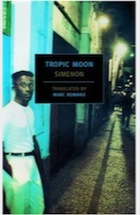
8. Tropic Moon by Georges Simenon


I've had this, one of Simenon's first Romans durs, sitting on my shelf for over a year. Buzby (whose book reviewing has been subsumed by two new little ones), who is a huge fan, lent it to me and I finally cracked it open. Buzby's review gives an excellent and much more detailed synopsis, so hop over there if you really want to know what happens. It's about a young upper middle-class french man who goes to colonial Gabon in the interwar period in the hopes of running a logging concession. Though he doesn't tell anybody this, the real reason he goes is because he has no real financial prospects back in France and like so many of the Europeans who went out to the colonies, he had the chance to maintain the aristocratic fantasy that was no longer possible at home. However, in this case, things go really bad for him.

This is an excellent book. An amazing portrayal of the utter degradation that was colonial Africa (focused particularly on the colonialists themselves, but with enough side glances at the natives and their treatment to evoke horror in the reader) as well as a spot-on portrayal of the ignorance, inexperience and emotional maturity of the male in his twenties. The character is so out of his league, so inexperienced and so utterly unable to control his emotions, that you almost feel pity for him. Usually, with a character like this, I'm tearing my hair out with frustration. But while I was certainly not very sympathetic with him, Simenon does such a good job of making it seem very real and understandable, that it's a fascinating and compelling read and you want to see how far it is going to go. Young males in their early twenties, for the most part, are perhaps at the least competent, most inept period of their lives. It makes sense that we try to keep them sequestered in university or send them off as soldiers. Simenon wrote this when he was 30, which is an astounding testimony to his writing. I'd say it is arguable that Tropic Moon addresses the themes of colonialism as well as Conrad in Heart of Darkness, but does it in a way more efficient and perhaps devastating way. Great book.

Monday, February 01, 2010

7. The Book Stops Here by Ian Ransom


I got this from my parents the xmas before last and finally cracked it open. [Why am I reading so much in January, you may well be asking. It's a combo of my usual January surge combined with our friggin' wireless router being on the fritz. You want to read 50 books in a year? Lose your internet connection and it's a cinch.] It's the story of a young man from London who has ended up in Northern Ireland working in a mobile library who gets involved in adventures. A neat premise (and this is the third in a series) but at least judging by this book, it seems to be more about the his own inner turmoil and the wacky people around him than any real misadventures.

In The Book Stops Here, he and his gruff, Irish partner Ted head back down to England to go to a mobile librarian's convention to look at getting a new van. Ted who has cared for the funky old van does not want to give it up and has never left Northern Ireland. Israel, the protagonist has an opportunity to visit his family and his girlfriend, whom it's quite clear to the reader is no longer really his girlfriend.

This sort of un-formed, loser male in his mid to late 20's seems to be the rage in England these days. The protagonist of this book seemed like the Simon Pegg character in Spaced (a series you should check out) or Shaun of the Dead, except way worse. At least the Simon Pegg characters are more or less happy with their lot except they can't get the girl. Israel just complains and seems bummed out and incapable of really doing anything. After a while, it gets a bit tiring. The only real development he made was to finally realize that his girlfriend had broken up with him. It was kind of depressing.

There is also a lot of quick back and forth dialogue with various colourful characters that most of the time (the new age hippy caravaners being one exception) didn't come off as funny to me. Maybe if you understand the regional distinctions better, but even then it was all very broad (like the seedy bar owner cousin who turns out to be gay) and not in aid of anything so you are kind of reading these long back and forths with lots of interruptions wondering what the point of it all is.

Not a terrible read and I did learn a little bit about the Northern Ireland character(at least that they consider themselves very distinct from Ireland proper) and the world of mobile libraries in Britain. I admit to being vaguely curious about the first two in the series, but I'll need to be convinced that the protagonist is at least somewhat effective before I'll pick them up. Too much competition out there.

Sunday, January 31, 2010

6. Les mardis de Béatrice de Francine Tougas


This year I am making an effort to improve my french. I get by, but have been stuck on a plateau. One of the challenges with reading here in Quebec is that a lot of the classes you take will recommend books by french authors, which can be great, but are often written in a much more complex form and use a wide range of vocabulary. The dialogue is also nothing like the way people speak in the world around you here in Quebec. So I have been looking around for books by Quebec authors which reflect the actual language of Quebec. One friend, recommended Les mardis de Béatrice, written by her mother! Francine Tougas is an actress and writer in the Quebec television and movie scene.

Les mardis de Béatrice is the story of a professional woman who is seeing a therapist. Each chapter is a session, basically dialogue between the two. She is feisty, resistant but suffering enough from inner anguish that she is driven to keep coming back. I'm of two minds on the subject of psychology. My mother is a professional psychologist and she has spent most of her career working with sexually abused children and disadvantaged adults. She believes strongly that there is an unhappy state and that people can through therapy find ways to get to a happy state. My father on the other hand is completely against most forms of self-improvement and thinks the world is what it is and you just handle it as it comes to you. I go back and forth, having seen the good of both approaches.

The first half of this book definitely made me fall to my father's side of the equation. All of this woman's problems seemed to be the result of living in a free and wealthy society where people suddenly have enough leisure time to start worrying about their problems. It was actually kind of maddening and I didn't know if I could make it through the book. Fortunately, in terms of the language, it was very much what I was looking for, with lots of dialogue written the way people speak here. So it was easier for me to get through, enjoyable to read (it sounded very much like what I hear around me so that is a compliment to the writer) and educational as I finally got to see in written form many of the phrases and modes of speaking that they never teach you in a french class.

(For instance, the word pantoute which means not at all and I believe is a mutation of pas-de-tout is used all the time here. Good luck finding it in a dictionary.)

So I kept plodding through and the book does become more interesting as Béatrice reveals some darker facts about her background that give substance to her lonely, defensive condition. The narrative never really takes off nor arrives at a revelatory climax. Rather the story arc is more concerned with whether or not she'll continue her therapy and her relationship with the therapist. There was some slightly weird father-daughter dialogue and a tiny bit of behaviour by the therapist at the end that seemed to cross the line that creeped me out just a tad.

I suspect that Les mardis de Béatrice is a fairly accurate reenactment of a real series of sessions between a modern woman and her therapist and if that is interesting to you, you'll probably enjoy the book and find lots to think about. But don't look for a stronger story beyond that.

Thursday, January 28, 2010

5. The Body Snatchers by Jack Finney


The Body Snatchers is the original novel, written in 1955, that the better-known movies "Invasion of the Body Snatchers" were based on. I was mildly surprised to see that it was written by the same author of Time and Again. I guess he has had a fairly long and varied writing career (and as I see in Wikipedia was considered a genre author).

The Body Snatchers is written from the perspective of the town doctor. He's a younger man, getting over a divorce, with deep roots in the small Norther California town. The first sign that something untoward is happening is when an old high school girlfriend comes to his office to tell him how worried she is about her best friend. The best friend is convinced that her uncle is not himself, even though he looks and acts exactly the same. After briefly investigating this, the doctor starts to get patients making similar claims about other friends or family members. They can't put their finger on it, but there is just something off about them.

This is an enjoyable and quickly paced book and the adventure takes off when a farmer living out of town tells him about a strange body he found in his basement. It's like a not-quite formed human. Skepticism is replaced with real fear as the doctor (now teamed up with his old flame and another couple) realizes that there is a real conspiracy going on.

I know the common interpretation of the movies is that the body-snatchers were a metaphor for the Red Scare of the period. I really didn't get that same sense from the book. The aliens are portrayed as so passionless, empty of any real ideology or values other than sheer survival. Finney puts a lot of emphasis on the small town and how it is decaying and I wonder if general modernity is more of the bugbear in the book than anything political. He really does a great job of describing the small town, all the good things about it coming out in relief in their absence as the protagonist sees the town of his upbringing being completely dangerous and fearful to him. There is a really freaky scene where he watches the entire town gather in the main square for some nefarious purpose, at first behaving normally (going shopping, doing their business) until the last bus drives out of town and then slowly starting to switch over to their real purpose.

Finney is a calm, almost mesmerizing writer. He likes to take his time to describe things, letting the reader's own eye wander over the landscape. Because of that tone, the book is not super stressful as one might expect. You do get a sense of the hopelessness the protagonists must feel as their town is taken over, but not the oppressive fear that such a situation would create (at least in me). He's also very peaceful and there is none of the revengeful violence that we see in today's species propaganda (or anti-propaganda as we see in Avatar).

I also appreciated that the strategy and operation of the aliens was well thought-out. Sure some of the science is pretty questionable, but it all fits together in its own internal logic and the reader isn't left with a lot of annoying questions about how things worked.

However, I did find the ending highly questionable. I appreciated the theme of it, but didn't find it believable at all. (scroll down for some spoilers where I explain myself better).

Still, a great read and deserves an important place in the history of alien invasion literature. I think I need to check out the film adaptations, as I've only seen the Donald Sutherland one and that was a long time ago.


[added after seeing the 1955 Don Siegel movie] Check this out from the wikipedia page on the original film adaptation of the movie:

Despite the general agreement among film critics regarding these political connotations of the film, lead actor Kevin McCarthy said in an interview included on the 1998 DVD release that he felt no political allegory was intended. The interviewer stated that he had spoken with the author of the original novel, Jack Finney, who also professed to have intended no specific political allegory in the work.[13]
In his autobiography, "I Thought We Were Making Movies, Not History," Walter Mirisch writes: "People began to read meanings into pictures that were never intended. The Invasion of the Body Snatchers is an example of that. I remember reading a magazine article arguing that the picture was intended as an allegory about the communist infiltration of America. From personal knowledge, neither Walter Wanger nor Don Siegel, who directed it, nor Dan Mainwaring, who wrote the script nor the original author Jack Finney, nor myself saw it as anything other than a thriller, pure and simple."[14]


And here are my thoughts on the movie itself, for posterity:
Inspired by having just read the book (which was originally published as a serial in Collier's), I downloaded the first Invasion of the Body Snatchers, directed by Don Siegel (they had a VSH copy at my local video store, but it was colorized!). Except for some minor changes and the ending, this is surprisingly faithful to the book and quite entertaining. It was shot on location in some real California small town in 1955 so it was quite pleasant to see all that brought to life. I still didn't see the strong Red Scare metaphor that gets attributed to this movie, except for two subtle cinematic touches (where the hero refers to the pod invasion as a "malignant disease spreading across America" text not found in the book and where he is running out in traffic trying to get someone to stop and he stares at the camera and screams "They're here already! You're next!"). It was a cool little movie and I'm looking forward to watching the '70s version next (with Donald Sutherland and a small role by Leonard Nimoy).

Here's a trailer for you, you can check out the screaming in traffic scene at the very end.


SPOILERS


Just when all seems lost, the aliens give up and send themselves out into space again. Their reasoning is that they realize that humans will fight them to the death and will not accept them taking over even though they (the humans) won't actually go away, they'll just have a parisitic host as part of their being. I kind of like the idea that we are the ultimate fighters who will never give up (and this isn't portrayed as entirely a good thing in the book), but I don't see why we wouldn't attribute that same quality to all life. And these aliens had behaved in such a way it seemed as if they expected resistance. They carried out their plan so well that they took over almost the entire town and were ready to spread throughout the rest of the world and then because there are a few resisters who don't allow themselves to be taken over, they give up the fight and head back into space? No, seems way too easy and I think the dark ending of the '70s version is probably a better interpretation.

Monday, January 25, 2010

4. Hard Rain Falling by Don Carpenter


Hard Rain Falling is Don Carpenter's first novel, which has been brought out of relative obscurity in a New York Review of Books reprint with a forward by George Pellecanos. I got it for xmas. I'd never heard of the author before, but after completing his first novel, I think an argument could be made that he is an important American writer. He wrote steadily in his life until shooting himself at the age of 65 in the '90s. He had several debilitating illnesses, though I have yet to see confirmed that that was the reason for the suicide. His books were published but not super successful and he made most of his living writing for Hollywood.

Hard Rain Falling is the story of a man's life, starting with a brief recounting of how he was born and orphaned in the '30s. The rest of the book follows his wildlife from the streets of Portland, Oregon to his time in reform schools and prisons and to a sort of rehabilitation and attempt at comprehending a normal life in San Francisco. At several points, you think it is going to be a certain type of narrative (a crime story, a prison story and so on), but after a while you realize that it really is just about this one guy's life.

I'd like to provide a thematic summary here, but it is kind of difficult as there isn't really one. It's what made me enjoy the book. A lot goes on and the main character is intriguing, intelligent and very challenged by his own background. There are many different themes that come up along the way: maturity, isolation, love, the changing times (the book ends in the early '60s). None of them dominate. Each section of the book is a look at this man as he is in that stage of his life. I guess you could say there is a consistent theme of Jack Levitt trying to figure out who he is and how he should respond to life.

And it is quite a life. Jack's philosophical musings and his struggles are compelling, but the real pleasure for me were Carpenter's descriptions of the petty criminals of Portland's pool halls, of the prisons and their tenants, of San Francisco's night life in the '50s. I can see why George Pellecanos loves this book so much (though did he have to give away over half the narrative in the intro, which I wisely did not read until the end?). I've read a lot of crime fiction, but you don't often get to see it at the quotidian level with such richness and subtlety. He really gets into the world of gambling in pool halls in particular and it's pretty cool stuff.

Great book. I'm glad I read it. It moved me at the end.

Tuesday, January 19, 2010

3. The Wolf's Hour by Robert McCammon


Doc favourably reviewed this book and kindly lent it to me when I expressed interest in it. It was disturbingly fat considering my poor reading progress last year, but I decided to jump in, recognizing that if done well, it should be a page-turner. I was a bit dismayed at the very beginning, because the prose was written in that American 80s best-seller style, which is just a bit too florid and obvious (it's the kind of book where every sexual encounter ends in a perfect simultaneous orgasm). Because it is trying to be British in style and the beginning takes place in Britain (towards whose genre writers I have a strong bias), this weakness was really pronounced. I was particularly dismayed to see someone driving a Ford around in northern Wales at the height of WWII.

Fortunately, there is a very strong story here and lots of good action and once it gets going, it really gets going. It has two storylines going on simultaneously, the hero's mission to find out a secret Nazi plot that will undermine D-Day and his own upbringing as a werewolf in a Russian forest. Both storylines are equally engaging and you can't wait to find out next. The WWII espionage story has the best Nazi badguys I've read in a while. It reminded me a lot of Inglorious Basterds, though perhaps even less subtle and with the werewolf element (a huge advantage if you ever have to go over enemy lines, believe me). The werewolf story is really cool as well, as the author put in a lot of thought about how such a tribe would survive and what they would be like. He portrays the werewolf behaviour using much more biology than we usually get, with them hunting, when in wolf form, small prey for food and pissing to mark their territory. He also uses his excellent scent in human form to help with his espionage, which is quite cool as well.

Very entertaining. I do agree with Doc that it went on a bit long near the end, but really it was such a fun read, with some cool ideas and kickass action, that I've utterly forgiven the florid prose and lack of subtlety. Had I read this when I was 15, I would have gone out and hunted down the rest of this guy's books for sure. As it is, I'll probably keep on the lookout.

Sunday, January 10, 2010

2. Uzumaki by Junji Ito


Uzumaki is a Japanese comic book ("manga" if you don't know by now) about a remoted, isolated town that suffers from a spiral curse. It manifests itself in many different ways, beginning with individuals obsessing with spirals and eventually getting into full blown craziness and destruction (I don't want to reveal any of the details because the fun is in finding them out). The english version is produced by Viz Comics and is in three elegantly small volumes, each of which contains 6 stories. At first the stories are isolated incidents, each built around some manifestation of the spiral curse but not really advancing the overall storyline beyond relating how weird this town is. These chapters reminded me a lot of the old EC comics, but viewed through the Japanese lens. Just weird (and sometimes quite disturbing) little episodes of horror that end with a clever twist. By the middle of the second volume, a greater narrative starts to pick up pace. In the last volume, the shit really hits the fan.

I wasn't expecting much with this, but I ended up really enjoying it. The horror here goes the distance and is quite creative as well. Though the ambience is really creepy, this is not the kind of J-horror which builds up tons of tension and then nothing ever happens. Shit really happens and it is gross and crazy. You can see a lot of the typical adolescenet sub-text and anxieties (obsessive boys, wanting to be popular, generational conflicts) but these themes are always secondary to the insanity so they don't become annoying. This is a quick fun read and there is some freaky crap in here. If you like horror and comics, I would strongly recommend Uzumaki. I know they made a movie which didn't manage to impress my wife too much, but now that I've read the comic, I may give it a second chance, just to see how they handle some of the crazy visuals.


I also note that when I remember Viz comics being the first company to start publishing english translations of Manga back during the black and white comics explosion of the '80s. It's great to see that they survived the ensuing crash and even appear to be thriving with the current manga boom. It sure seemed very marginal back then. What's also cool is that Uzumaki, and I guess a lot of the manga they publish, are organized to be read in the original Japanese order, from right to left, which takes some getting used to but is kind of cool.

Thursday, January 07, 2010

1. The Book of Basketball by Bill Simmons


I am a huge fan of Bill Simmons and a more reserved one of the NBA, so I obviously asked for the most highly-anticipated basketball books (actually, the only one) in my memory for xmas. And I got it! I am usually struggle with non-fiction, but I could barely put The Book of Basketball down during my vacation and finished all 700+ pages in under two weeks. Before I do a proper review of the book, I would like to talk about Bill Simmons himself a bit.

Bill Simmons is one of my heroes. In and of itself, this isn't all that special as I admire and respect many people in this world. What makes him stand out is that he is the only one who actually hails from my generation. After my brief stint working for Deja.com during the .com boom, I became profoundly disappointed with my people. We have pretty much failed in doing anything good for the world except making parts of it richer. We borrowed the worst parts of our baby boomer predecessors (their ambition and self-involvement) and left all the difficult, good stuff on the ground (their radicalism, their critique of authority). We're the worst kind of sheep, responsible for 8 years of Bush and the SUV stroller. We've somehow managed to combine the extremes of right-wing righteousness with left-wing political-correctness to create a world of excessive consumption and excessive caution. There really isn't much we've done that I'm very proud of.

I know with that set-up it sounds like Simmons is some kind of wild radical. He's not. Fundamentally, he's a sports writer. But there are three elements that make him stand out politically for me: he made his career on his own terms, he embraced technological change and he is highly critical. All of this is mostly limited to the world of sports, but it is significant nonetheless. Sports is a huge business, second probably only to Hollywood in terms of America's cultural and economic influence on the world. (Sports is also the last domain in North America where people argue critically and honestly with any intelligence, but that's another discussion.) Because of his success (due to his skill and hard, consistent work) he has influenced his peers and a generation of readers. With the former, we are already seeing a sea change in the discourse of sports journalism (there are clearly many other factors and invidivuals involved in this change, but Simmons is one of the most significant), where writers are finally starting to find some balls (do you think we'll see another elephant in the room like steroids in baseball during the '90s?). I'll break the elements mentioned above out using Simmons-style structure:

He made his career on his own terms: He started out briefly working at the very bottom of a Boston newspaper, then quit and partied for a bit and then started his own website (bostonsportsguy.com). He was way ahead of his time here (and ahead of me as well, as I didn't jump on the bandwagon until he got to espn) and the success of his website led to him being hired as a regular columnist at espn.com. His success at "The Worldwide Leader in Sports" coincided (and helped) the growth of the website and the web in general for sports information and allowed him a lot of creative freedom. He also gets his face on the front page now. My point here, though, is not that to vaunt his success, but to underline that he became successful following his ideals. He was frustrated at the limitations, both in terms of advancement and content in the traditional newspaper medium and so he went to the web and wrote what he wanted (those early days on his old site must have been a real blast to follow, except that I'm not much of a Boston sports fan*). On espn.com, he refused to pull punches and has come out extremely critical against some very powerful people and institutions. I'm sure there were some interesting conversations in the offices there during certain occassions (though we must give credit to espn for being so flexible and taking some risks, especially considering its size and power today).

He embraced technological change: I already mentioned how he jumped onto the web early, but the other arena that he has fully taken advantage of (and given me hours and hours of entertainment) is podcasting. His podcasts are generally relaxed, casual conversations with a few regular friends (Joe House with his gentle voice being my favorite), colleagues and sports pundits. They are the kinds of discussions you would either be having with your own friends or the ones you wished you could have with some of the great thinkers of sports. He isn't limited to just sports as he gets into reality shows and popular culture (including great back and forths with Chuck Klosterman). He has also gotten quite deep, including an awesome conversation about Obama with JA Adande (you have to scroll down to the 1/21 episode; it really is worth listening to, especially if you want to renew your enthusiasm and optimism now that we are on the verge of invading Yemen) and another one about The Wire (best TV show ever and constantly vaunted by Simmons) with Jason Whitlock that even my wife deigned to listen to.

Simmons recognized the potential of the podcast early on and he pushed hard for it. It took espn a while to appreciate the power of this new distribution form, but they are finally starting to get into it. A couple of podcasts ago, Bill Simmons said that once we get the internet regularily into cars and people can choose podcasts the way they choose radio stations, the medium will exploded and I suspect he is right). (Another podcast visionary, whom I also learned about from Bill Simmons, is Adam Carolla - definitely check his show out.)

He is highly critical: This trait is the one that seals the deal for me. I love following professional sports, especially the NBA but it is a love/hate relationship. I started following the league just as it really started to take off with cable television and Michael Jordan. Unfortunately, there is a constant struggle between the NBA that is the game and the NBA that is the marketing machine and for a while the latter was really winning out (to the point where refs, announcers and the league itself through scheduling and promotion would all work to ensure that a more marketable team or the team with the most marketable player would be more succesful). Simmons was one of the earlier and louder voices on the national stage who really started screaming bullshit at a lot of the stuff that went down. And as he has a legitimacy among the fans, the league and the machine surrounding it (including all the various media outlets) had to listen. I don't know if they've done much about it, but at least they listened and at least someone is screaming. In these times of capitalist supremacy where it's almost considered morally wrong to criticize a corporation or administration, I am grateful for the few voices who still are willing to take a stand. That Simmons has managed to do this and be wildly successful at the same time gives me some small hope for the world. At the very least, I'll get to read some honest and critical writing on a regular basis.

Re-reading the above arguments, I realize that I am ignoring the significance of the context Simmons is working in (the rise of the internet) and many other individuals who have contributed in their own way to these developments (AM sports radio in general, for instance, which has always been much more critical-minded than television or the print media and which had a big influence on Simmons). I am not a hardcore sports nerd, so I tend to read only the most popular writers. I'm sure there are a lot of people out there who would possibly argue that I am exaggerating Simmons influence and they may well be right. I'm absolutely sure that I have excluded a ton of influential figures, but I am not reviewing a book by any of them.

All these big-issue arguments aside, the main reason I am a big fan of Simmons is that his writing is entertaining, often laugh-out-loud funny but built on a foundation of solid research, well-constructed arguments and interesting ideas. He's writing about sports in an intelligent way but doesn't take himself too seriously.

So onto the book itself. It's huge and is basically a giant look at the entire league from the beginning to last year. He starts out with an intro explaining how he got into basketball and why he wanted to write the book. Then he writes a great broad history of the league (extremely informative). The bulk of the book is him ranking the top 64 players of all time. Simmons loves theoretical arguments (such as "what if player x from the '60s and player y from the '90s played on the same team?") and this section is one giant exploration of how all these players who played in such different eras stack up. The next section is ranking the best teams of all time and then he concludes with his Wine Cellar team, the players he would put together if martians came down and challenged us to a basketball game for the fate of planet earth (seriously; he has a tiny nerd streak that adds to my appreciation). There is a final chapter where goes and meets with Bill Walton which is very moving. I got teary-eyed.

I learned a lot from this book. He has a strong thesis and that is "The Secret", the idea that playing as a team trumps individual athletic prowess and leads to victory. This seems like a truism, but it is a constant struggle in professional sports and many great players have not been able to learn The Secret. I was also shocked (again) by the racism players in the '50s and '60s encountered and how some rose above it and others were taken down by it. Overall, though, The Book of Basketball is kind of like a giant, massive collection of Simmons' online columns, really well-organized and structured with a singular focus. It's not a transcendent work, but terrifically entertaining and highly informative. It's a book about the NBA. If you're not interested in the league or basketball, then I don't suggest you read this. If you are, I strongly recommend it.

(and here's a better review of the book from Slate's Josh Levin, though I disagree that the jokes got repetitive.)
Thursday, December 31, 2009

2009 end of year wrap-up


Well as far as reading quantity goes, 2009 was a bit of a shank. If I learned one thing is that I am not able to predict my own behaviour. I started off the year with a bang and was cruising through books, with no sign of stopping (read 11 books by February 24). And then it all came crashing down. My usual spring drop-off turned into a complete embargo. I have some explanations, but ultimately it boils down to a lack of will and focus. I got way too into gaming this year and as there was a lot of really interesting products this year, I spent a lot more time reading RPG books (which I tend not to read straight through or completely, so don't consider them as a book for counting purposes) and planning games than reading books. Life was busier as well. I got married in September (hooray!) and the planning took up a lot of time. My job became quite busy as well as we were leading up to the Copenhagen talks on climate change and had a lot to do (thanks for shitting the bed on that one, world leaders and especially you Harper and co. you shitheel scumbags).

Quantity aside, I enjoyed almost everything I read this year and was particularly happy to re-start the Parker books. I hope to get the next three in the series for my birthday this year and continue my longer analyses of Westlake's masterpiece.

We also did a couple of "book clubs" where most of the people on the list to the right chose a single book and all read it together. Those were quite fun and I wouldn't mind doing it again. I think the comments lacked a bit of energy because we all tend to have a similar opinion and those don't generate a lot of conflict. Maybe a more contentious pick this year if we decide to do it again?

I have a lot of goals and projects in my life this year, so I'll make no reading commitments for the '10 except one: to get a blog post written as soon as I finish the book. No more falling behind this year!

27. A Canticle for Leibowitz by Walter M. Miller jr.


A classic of the post-apocalyptic genre, A Canticle for Leibowitz has been on my stagnant on deck shelf for months. I figured it would be good to read during the pre-xmas vacations.

It's too strong to say that A Canticle for Leibowitz doesn't actually fit into the PA genre. But it does feel much more like classic sci-fi. It takes place far in the future, after a civilization and knowledge-destroying nuclear war that sets humanity back to the dark ages. I use the term Dark Ages precisely because the author deliberately sets it up so that the church is the last and only outpost for knowledge, where little bits of information are stored as relics and artifacts from a past age, both to be worshipped and copied. The book takes place in the three parts, covering three periods, each separated in time by several generations, as humanity slowly reclaims the knowledge it lost and starts to make the same mistakes again.

The book is well-written and despite the over-arching themes, each segment contains rich characters and their own compelling storyline so that you get quite caught up in the book. It has some nice touches of black humour as well. It ends up achieving a nice balance of lightness and heaviness while making you think about our relationship with knowledge and humanity's progress such that it deserves its reputation as an all-time science fiction classic.

Monday, November 23, 2009

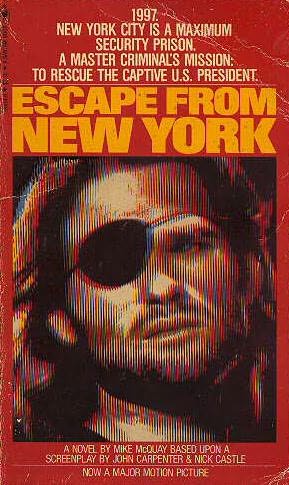
26. Escape from New York by Mike Maquay


The novelization of Escape from New York has long been respected as one of the few that actually lives up to the quality of the movie. The paperback is also quite rare. I saw a copy once in a movie memorabilia store in TO but it was selling for around $40 or something. Savvy bookhunter Lantzvillager of Mount Benson Report fame did find it though and lent it to me. I re-watched the movie with my wife in order to catch her up on the masterpiece that is the first half of John Carpenter's career. We were going to use the theme song (also composed by Carpenter) for the walk-in music for our wedding, but we couldn't find any sheet music for it. I did buy the musical album, which turned out to be friggin' awesome. I took the neighbour's dog for a walk the first time I listened to it and almost took out the entire park I got so psyched.

So all that is to say that I was motivated to read the book finally. Lantzvillager lent it to me. It was a quick and enjoyable read, giving lots of really cool depth to the world of the movie and Snake's background. There was a radical strain in the '80s that capitalism has almost entirely snuffed out today. It's in Carpenter's movies (the apex being They Live) and was definitely strong in the book. Escape from New York is about sticking it to the man, an attitude considered passé today sadly. Read it and remember.

Tuesday, October 20, 2009

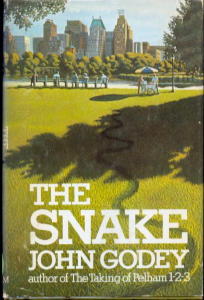
25. The Snake by John Godey


I found this in one of the many great used bookstores in Winnipeg. I picked it up because the small hardcover was so attractive and because it was written by the author of The Taking of Pelham 123. It turned out to be well worth the $7.00 I paid and will look great on my shelf as well. That Snake is based on a great concept that is fully thought out, both scientifically and the supposition about how New York City would react to a giant, deadly snake in Central Park. I don't know if it is me, as it confirms my existing bias, but this book seemed savagely critical of New Yorkers and humans in general. Hysteria and blind selfishness seem like the defining factors of most of the people but the snake and the protagonists. It all seemed quite realistic to me. Depressingly enjoyable.

Saturday, October 10, 2009

24. Sundog by Jim Harrison


This is the story of a dissolute journalist who goes to the wilds of northern Michigan (and they actually do sound quite wild) to interview an old engineer who worked on large-scale projects (dams and the like) in developing countries during his youth. It's a manly, richly-written that I enjoyed reading, but it's also one of those novels that doesn't really have a plot and my simple mind doesn't know what to make of it by the end. I think it's an exploration of living a life and the choices we make. It has an excellent attitude and is really well-written (and also has a good reputation) so I suggest you check it out as well.

Wednesday, September 09, 2009

23. The White Voyage by John Christopher

The Caves of Night picture
Man, John Christopher does it again! I always pick up a John Christopher novel when I find them, but I read so many last year that The White Voyage (in a beautiful hardback) stayed on my on deck shelf for almost this entire year. I pulled it out many times and then put it back, thinking it would be too much of the same too soon. I took this one on my honeymoon, knowing I would finally have some uninterrupted reading time (hmm, somehow that doesn't sound right! ;)) and ended up devouring it. Thoroughly enjoyable and a slight change of pace for Christopher. Though many of his classic themes were present, The White Voyage takes a more optimistic approach and the protaganist makes it through the book being the sexual victor for once!

It's about a strange and motley group (including a small circus and a bear) taking a ship through the north sea who get caught in a storm and stuck in the ice. They must survive the elements as well as their own conflicts. Great stuff, highly recommended.

The image above is not the edition I have (though it's quite nice as well). I'll scan mine in when I get a chance and replace the image above.

Thursday, September 03, 2009

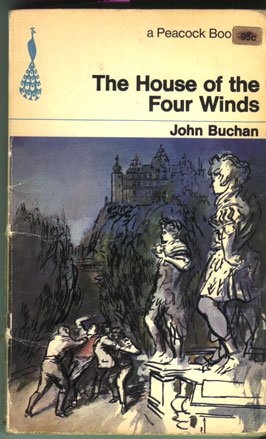
22. The House of the Four Winds by John Buchan


Ultimately, The House of the Four Winds was an enjoyable adventure, but through it, I learned that Buchan wrote several series of adventures using the same characters, characters who become slightly annoying in their British pluck over time and it makes me less interested in reading more of his books. I really enjoyed the 39 Steps for the real sense it creates of an individual getting over his head in trouble. I assumed that his other stories would have the same kind of energy and interesting sitatuions. And they do, except that being a part of a continuing series, they rely too much on returning characters showing up and having the appropriate and necessary resources for the situation. It seemed like most of the first half of The House of the Four Winds was arranging convoluted narratives to ensure that all the characters would end up in the same situation. And normally, I like the archetypical British hero of the first half of the twentieth century, but they start to get kind of annoying here in their assumption of certain class and even racial superiorities. The political set-up is quite complex and interesting (with older school monarchical supporters, a younger conservative movement and communists all vying for power in a small eastern european republic) and the second half of the book moves along as it should, but I would rather it was all done with new characters.

Wednesday, July 08, 2009

21. Lush Life by Richard Price


Meezly snagged this one quite wisely at our local thrift store. She was aware that Richard Price had been one of the principle writers on The Wire and recognized his name on the cover of the book. Good find! The pacing, situation and characters in this book are not those of the crime genre that I favour. It's very deliberate and consistent and much more of a character study (and a place study) than a mystery, suspense or action novel. That being said, it does what it wants to do extremely well, so that I was caught up in it and really didn't want to put it down. Even more in its favour, is that ultimately, Lush Life is a critique of the lower east side of New York city and the gentrification that has gone on there. It is particularily scathing towards the white, artistic hipsters that try to claim the culture their as their own. This I found very satisfying. You can see why Price was a good writer for The Wire. Check it out.

And check out Meezly's review for a more thorough explanation of the plot.

Saturday, June 20, 2009

20. The Man with the Getaway Face by Richard Stark


The Man with the Getaway Face is Richard Stark's second Parker novel. My memory of it was that it was good, but more of a transition book. I had forgotten how impactful it is and upon re-reading it, I realize it is perhaps one of the more important books in the series. After Parker gets his revenge on the man who double-crossed him, and strong-arms the outfit to force them to pay the money back that he lost, he realizes he needs to get truly lost so he can return to his life of heisting and hanging out in various resort hotels. To do so, he must get a new face.

Westlake originally wrote The Hunter with the idea that Parker would die at the end of the book. His genius editor said he'd buy the book only if Westlake would keep him alive and continue writing books about him. So The Man with the Getaway Face is Westlake figuring out how to do that. I think because of that the structure of the book is divided up into two stories that remain separated for the duration of the book, giving it a less cohesive feel, which is what led me to feel that it is more transitory.

There are two elements that are established here that become defining features of the series. The first is the Alma. In The Man with the Getaway Face, Alma is the finger. She's an embittered, older waitress at a truck stop where an armoured car makes a regular stop. She is sleeping with a guy who knows a guy who knows Parker and that's how the job gets put together. However, Alma whose been planning and scheming the job for all these years, waiting for the right man to come around, thinks she knows better than Parker. She's also obviously out for herself. A character in this form is present in almost every heist. Someone whose emotional flaws, be they greed, pride, bitterness or even an inability to just be patient, end up screwing up the heist and bringing complication to Parker's life. One of my favourite quotes, from The Green Eagle Score, expresses the Alma pretty explicitly.
Over the years, he'd come to accept the fact that the people involved in every heist were never as solid as you wanted them. They always had hang-ups one way or another, always had personal problems or quirks from their private lives that they couldn't keep from intruding into the job they were supposed to be doing. The only way to handle it was to watch them, know what the problems were, be ready for them to start screwing up. If he sat around and waited for the perfect string, cold and solid and professional, he'd never get anything done.

It's not that the people are inefficient or clumsy or somehow incapable. It's that they allow their emotions to intrude on the job. They cannot separate their own egos from the situation to realize that all would benefit if they could let go of their immediate needs. I think it is a complaint that is shared, unreasonably or not, by a certain mindset, the working man who does his job at work and has a personal life at home. There is also a generational idea here, of men who came out of World War 2 encountering a society where talking about your feelings and encounter groups and the explosion of therapy and personal growth in the '60s were invading all facets of life. I am of neither generation, but have felt a very similar complaint for most of my own work life. So these books resonate with me on this point as I'm sure they did with many crime readers when the Parker books were sitting new on drugstore racks.

The other element in the Man with the Getaway Face that I do not identify as well with, but consume with a sort of compulsive horror, is the brutal factuality of the writing. Acts of cruelty are done in the Parker books that are really tough to take. They aren't done for the sake of cruelty usually but with some other goal in mind and the cruelty is the only method that will apply given the circumstances. They are also not written sadistically, with the kind of prurient sexuality inherent in a lot of crime novels. They are just stated as facts. I apologize for the vagueness, but I don't want to give anything away. The situation that Westlake describes and the way he looks at it, by going into the head of the victim is so black. I think I had forgotten about it because I had sort of skimmed over it the first time I read it, not having quite the calcification around the heart that I have slightly accumulated at this point. Basically, Westlake doesn't pull any punches. You take it, though, because you know the payoff is going to be good.

And it is good. So while The Man with the Getaway Face isn't the best Parker novel, it lays important groundwork for what is to come. And what is to come is The Outfit, which is a giant fucking candy shop of heists. But you'll have to wait until my review is done, or you could just go out and buy it and get reading.

Tuesday, June 16, 2009

19. Make my Bed Soon by Jack Webb


It's a novel about a guy who gets mixed up with a gang of car thieves who work in and around Arizona and Mexico. It was an interesting look at a crime network, and I remember enjoying it, but I can't give you more than that as the details have faded into the mists of time, buried under the avalance of all the other media I've consumed since then.

Wednesday, June 10, 2009

18. Deep Powder and Steep Rock: the Life of Mountain Guide Hans Gmoser


If you're a ski geek, especially out in the west, you have almost for sure heard of Hans Gmoser. He is responsible for putting Canadian Rocky Mountain Skiing on the international map and arguably singlehandedly responsible for helicopter skiing in particular. He came out from Austria after the Second World War, already an avid lover of the mountains and outdoor adventure and ended up in Alberta, in Canmore and Banff, on the eastern edge of the Canadian Rockies. He is also the father of one of my best friends, which is why I ended up reading such a book (as many of you know I am part of a small but powerful cabal working on eliminating downhill skiing from the world).

Very briefly, Hans grew up in Austria and got into mountaineering as a young boy, through a Catholic priest who seemed more like a scout troop leader in that he led all kinds of mountain trips. Later, Hans became an electrician and as a young man, emigrated to Canada. He was a pioneer climber and led many first ascents of mountains that are famous today among the clmbing set. He also did a bunch of major treks and lots of skiing. Later, he really got into promoting skiing in Western Canada, driving all over North America and showing skiing films at local community centers. A friend of our family's who is a big skiier remembers when Hans would come into his town and all the ski geeks would get psyched to watch his films and here his talk. He was the first guy to attach a camera to his head and ski with it. Later, he set up a lodge and then got into sending people up into the mountains via helicopter which developed into a full blown heli-skiing empire, Canadian Mountain Holidays. Later, a truly evil empire, Inwest (responsible for the atrocity known as Whistler) bought CMH. That really is a brief, brief version as there is a lot of rich and interesting history behind all that.

As I said, that is a very broad outline of the history. If any of it is interesting to you, the book does a really solid job of portraying the stories and details of the history. Chic Scott gets the facts down and interviewed many of the people who were there, filling out the human side. There is a lot of climbing porn in the beginning, which if you are a climber will get you hard as some nice south-facing granite. As a non-climber, I was able to get through it without too much pain, while retaining a laymen's appreciation of the determination and skill these guys had, doing extremely hard climbs before climbing shoes were even invented. Overall, it's a really interesting story about one man's life as he makes his way from a young person to an outdoor fanatic, to a succesful businessman and finally settles down to being a loving family man, mellow and rightfully satisfied with his life.

I knew Hans first through the anecdotes of his two sons, with whom I went to boarding school. They were an excellent mix of crazy stories from his youth (like the time he was driving through a snowstorm and his defogger wasn't working, so he put on ski goggles and stuck his head out the window, driving through the snowstorm like that for several hours) and some of his more autocratic tendencies as a father. We were all pseudo-rebellious teenagers at the time and most of us bitched about our parents in some way or another and Hans didn't come off as all that bad. He was just particularily freaked out about trivial things like hairstyles, a button the older brother pushed during the new wave '80s. But he did come off as a bit of a hard ass. When I did actually meet him for the first time, he was quite pleasant and friendly. Later, as an adult, when I spent more time out in the mountains and Hans was basically retired, he was super warm and generous, really deep-down happy, great to hang out with and listen to his stories. He seemed so generally psyched and happy to be hanging with his sons, that I had a hard time reconciling the Hans I got to better know with the uptight dad of the teen years, but this book goes a long way in explaining that.

If you are a fan of Canadian history or the Rockies or skiing, I would recommend this book to you. It's an amazing story. For me, it filled in a lot of gaps about my friends' families past and was very informative for that as well as being entertaining. It's important to understand where people came from, especially people who travelled across the world before they were even fully formed to come to a new country and start a new life. It's a very different world today, much more stable for those of us in the first world and a lot of that is thanks to people like Hans who came to Canada with a lot of drive and saw a beautiful land where they could make a life.

Sadly, Hans Gmoser died a few years ago while riding his bike between Banff and Canmore, which is why this book got written when it did. Though Hans would never have been happy had he been in a situation where due to health he couldn't have been active, he was still pretty young and fit when he died, so it was a very sad loss for the community and especially for his family. Here's hoping he's somewhere climbing, skiing, hiking and biking in the most amazing places.

Monday, June 08, 2009

17. Supermanship by Stephen Potter

Supermanship pictureThis is, I believe, the last in the -upmanship series by Stephen Potter, which started with Gamesmanship (there may be one last one called Golfmanship, that I'd love to get my hands on). I was extremely psyched to spot a lovely old Penguin copy of this book sitting on the $1 table outside S.W. Welch's. It's nice to know that there are still quality collectibles that can slip through the fine net of the internet market.

Supermanship is fairly unfocused, being a collection of brief applications of oneupmanship in a wide range of situations, some correspondence and some brief (and fictional) history of some of the major players at the oneupmanship institute. It's the same kind of humour, tons of subtle techniques to make the other fellow doubt himself. I particuarly liked the section on lecturemanship, which dealt with academics and visiting lecturers. It gave strategies for both the host (like wearing a short sock and then crossing one leg over the other and raising your pant leg, revealing your white flesh, so the audience is constantly distracted by it) or the guest lecturer (like turning to the host, making a particularly obscure reference and capping it with "as Professor Gates-Willoughby will surely know").

Some of the humour went far over my head, being very British and very much of its time. But it's a quick read, organized into digestible gulps (great for the bathroom), which is all I'm capable of these days. I'd recommend Gamesmanship or Lifemanship before getting into this more advanced volume. I'm very pleased to have discovered that a friend of mine actually has a copy of Lifemanship, so that will be 3 out of 4 in my hands!