Monday, May 31, 2010

Thrift store score!

I know I'm supposed to be reducing my inventory of books, but I went along just for fun to our local thrift store with my wife yesterday. Lo and behold, what did I find there but a nice little collection of Desmond Bagleys! Not the rarest of finds, but definitely getting harder and harder to spot these days. I was quite happy to see The Tightrope Men, the Spoilers and Night of Error, but what really got me super psyched was this early Fontana paperback edition of his first novel The Golden Keel with a great illustrated cover!


Major score and a cover I'd never seen before.

My wife also made a major score, looking through the hardbacked section, she found this beautiful 1961 first edition of Appointment in Samarra by Harcourt, Brace and Company. $3.00 and in near-perfect condition. One of my all-time favourite non-genre novels so I am very happy to add such a lovely version to my library.

Wednesday, May 26, 2010

32. Gone Tomorrow by Lee Child


I was on vacation last week, visiting my sister's family who just had a new kid. I took the bus down and the train back and thought I would have plenty of time for reading, so ambitiously took 4 books from my on-deck shelf, all paperbacks that looked enjoyable but not worth hanging onto after having been read. My idea was to leave them where I finished them. I did get two books read, but my plans my overall goal of reducing the books on my on-deck shelf was waylaid by my generous friends and family who gave me a total of 3 books. So I left with an optimistic -4 reduction of books on my on-deck shelf, ended up reading 2 of them and gaining 3 new books, so the end result was a +1 to my on-deck shelf. One of the books I got, Gone Tomorrow by Lee Child, I almost read in its entirety on the train and just finished last night. So that puts me back at zero.

My friend Alex had expressly bought the book for me as we share an appreciation in high level ass-kicking and general badassedness. He deemed Lee Child's popular (I discovered) character Reacher to be worthy of our consumption. After having finished Gone Tomorrow, I have to agree. Reacher is the ultimate survivalist, except for his environment, at least in this novel, is not the jungle or the mountains or the arctic, rather it's the modern world. He seems to just go from place to place with a toothbrush, toothpaste, a passport and a bankcard in his jeans pockets. He knows how to bribe his way to cheap rooms in hotels. He can find a terrorist hideout in midtown Manhattan simply by a process of logical elimination. He has all kinds of combat skills. Gone Tomorrow is like the 15th in the series and I appreciate that the author doesn't spend too much time recounting all Reacher's past battles as sometimes happens in these kinds of books. Save that effort for loving explanations of the Spas-12 (my favourite automatic shotgun, which was a good sign when it showed up in the book, but unfortunately never got used) or the 13 signs that indicate someone is a suicide bomber.

And that's how the book starts out, with Reacher on the NYC subway heading somewhere after being at a jazz club and noticing the woman opposite him displaying all 13 signs. It's a great hook and leads off into a pretty engaging mystery. At times, the investigation and exposition got a bit flabby near the middle, but when the action did come it was quite excellent. And actually, the story itself was pretty well plotted and revealed itself in richer and richer layers, making a fairly plausible and interesting scenario for why both an up-and-coming politician and a terrorist group would want a single image eliminated.

This is manly, modern stuff, thick and embossed, walking an interesting political line. It's basically pro-military but just critical enough of blundering and fascistic federal agencies to appeal to us liberal-type dudes. For my taste, I'd prefer to see these kinds of books a lot thinner, maybe cutting out 100 pages of the hero going back and forth between DC and New York would have made for a tighter, faster book like its counterparts from the 70s, but considering that it is a best-seller in America today, it's pretty high quality. I'll be keeping an eye out for the others in the series.

Monday, May 24, 2010

31. Pity Him Afterwards by Donald Westlake


Pity Him Afterwards is an early and strong Westlake that has been sitting on my on-deck shelf for quite some time. The action starts through the eyes of a madman, on the run from an asylum. His perspective provides a certain amount of sympathy as we see his fear and anxiety, but his brutal actions counteract it. He kills an old couple and then a driver who picks him up, after having spent several hours listening to this loquacious actor. He decides to impersonate the actor and continue on to the summer theatre where he was engaged in a wealthy vacation community in New England.

And once again, I find myself in classic Westlake territory. At first, I was under the impression it was going to be all from the perspective of the madman, but then we get to hear the story of another actor, the local part-time police captain and several other less central characters. This rich ensemble comes together at the summer theatre in a book that is half classic whodunnit and half crime thriller. The mystery part comes because of a fun gimmick where the reader is not told which of the actual actors the madman is impersonating. Whenever the action is from the madman's perspective, his name is never used and no detail is revealed (except subtle clues).

The first three-quarters are rich and engaging. The ending is a bit stock and abrupt, with a hurried romance that I didn't care about much, but still definitely worth a read. If you are a true Westlake geek, you will want to read this just for a great climactic moment that resembles very closely the climax in The Stepfather, a great 80s thriller of which Westlake wrote the screenplay. Good stuff. I am happy.

Special cover bonus: The Sun King over at Existential Ennui blog has posted his beautiful original copy of Pity Him Afterwards, with a sweet picture of a young, bearded Donald Westlake on the back. Check it out.

Monday, May 17, 2010

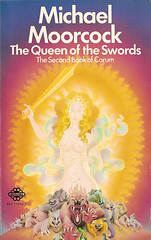
30. The Queen of the Sword: the Second Book of Corum by Michael Moorcock


The second book now finds the balance of power ever so slightly shifted in Law's favour. However, Corum's blow against the Knight of the Swords has alerted the chaos gods above him and they are accelerating their attempts to dominate the planes. The story continues in a similar vein, except with a slightly wider scope as Corum gains a more-permanent seeming sidekick, a dude with colourful clothes and a flying cat who hints that he and Corum have partnered together on many adventures in different times and dimensions throughout all of eternity, it's just that they don't always know it or remember.

Good stuff as per the first with a pretty cool psychedelic climax (though just a hint of the deus ex machina for the victory this time). I look forward to the battle against the Kind of the Swords.

(I keep having this juvenile reflex of telling one of my friends that "your favorite fantasy author is Michale More-Cock.")

Monday, May 03, 2010

29: The Knight of Swords: The First Book of Corum by Michael Moorcock


Ah back to some classic 70s sword & sorcery. I found this entire trilogy at our local thrift store and snatched it up based on the covers alone. What I particularly appreciate is the thinness of these volumes. Most of these kind of fantastic epics are super-thick by definition, thus the term "fat fantasy", I guess the geeks want to be absorbed into their world and never leave. I'm happy to say that, at least in the first volume, Moorcock delivers all the fantasy world, epic quests, short-lived adventuring companions, powerful relics and mad gods in 143 efficient pages.

The story is about Corum, the last of his ancient race, who due to their own complacency, but also the machinations of the gods got wiped out by the barbaric Mabden (humans). He discovers this reality in a quest to find another of his race's castle with whom he and his family had long lost touch and in doing so gets caught up in a quest of vengeance and god-driven world changing. Moorcock's cosmology concerns the balance between the gods of chaos and gods of order and in the Books of Corum, chaos, in the form of the Sword Gods, has upset the balance of power.

Corum's quest in this book is to find the heart of the Knight of Swords, which is hidden in his castle far to the north. There is much coincidence and strange encounters leading him there. There is a fantastic scene when he first discovers the god, in the form of a corpulent naked giant, his fetid body swarming with humans chewing at his scab, picking food out of his hair. It's the kind of image you read these books for and Moorcock delivers.

I only every now and then dip into fantasy, but this one has worked out quite well so far. I shall continue with the other two in the series and report back here.

Monday, April 26, 2010

28. The Great Pulp Heroes by Don Hutchison


Finally completed a non-fiction book! Though this one is basically a survey of the many stories that made up the pulp fiction wave in the '30s, each with a synopsis of the storyline, so it was kind of like reading a lot of fiction from a slightly removed perspective.

For whatever reasons, the term "pulp" seems to cause a lot of controversy and argument in the geek world. I guess there are some purists who feel that people mistakenly define the term based on more recent interpretations such as the Indian Jones movies or the Mummy franchise. In the gaming world, there are others who get all bent out of shape when people equate pulp with over-the-top action. Fundamentally, pulp refers to the cheap paper these fiction magazines were printed on. They were popular among men during the depression, being a cheap form of escapist entertainment for people who were having a tough time in the real world. Their influence stays with us today in well-known characters like The Shadow, Tarzan and Doc Savage. Many big name authors, like John D. MacDonald, Elmore Leonard and Louis L'Amour in the science fiction, western and crime genres got their start as pulp writers as well. With the increased cost of paper pulp and the real menace of World War II, the pulps fell out of favour and evolved into a darker, more realistic strain, hard-boiled noir detectives and super hero comic books.

This book is not a profound analysis of this development, though it lays it out pretty clearly at the beginning and end. Rather, it goes through all the various genres and details the popular characters and series, giving a nice synopsis and all the main characters. Quite an entertaining read and it really gives me the taste to try and hunt some of these down. These pulp stories really were over the top. My closest connection to them are the old time radio shows, but they are quite tame compared to the pulp novels, where entire cities are destroyed, invading hordes actually take over America and violence and super-science are a given. I'm particularly interested in Operator 5, where America is under control of an evil mongol empire from across the Pacific and the hero is part of an underground resistance movement (yes, the yellow peril is in full effect in the pulps).

If you want to get a broad overview of the wide range of pulp novels, then I would strongly recommend this book. If you are looking for a more in-depth analysis, either literary or social, this book only touches the surface. Nevertheless, it does reinforce how important and prevalent these novels were in their time and that is always a good reminder for the fan of story.

Sunday, April 25, 2010

27. The Lady or the Tiger by Frank Stockton


I picked up this paperback from 1968 in an antique store in the Eastern Townships here in Quebec. It was part of a complete set of Airmont Classics. I picked up a couple of others but most weren't interesting to me. I guess Frank Stockton and in particular the titular short story were quite popular back in the day (it was first published in 1882). Each of these stories had really intriguing premises and were written in a very pleasant way, with a kind of Americanized British syntax, which was probably a popular style around the turn of the century. The problem is that a lot of the stories don't really go anywhere. The promise of the premise is never fulfilled. They do often have a nice satisfying romantic conclusion, but I get the sense that was just to satisfy the demands of readers at the time. There is also a nice element of fantasy in some of them.

The Lady or the Tiger takes place in a kingdom with a unique legal system. When someone is accused of a heinous crime they are put into an arena to face two doors. Behind one door is a ferocious tiger that will eat them. Behind the other is a beautiful maiden who will marry the culprit. In the story, the culprit's crime is to fall in love with the king's daughter. At the time of the punishment, the king's daughter knows what is behind each door and she gives a signal to her lover. The question is, knowing that if he goes through one door he'll be killed or if he goes through the other, he'll have to marry some other maiden, which signal did she give him?

This question supposedly tantalized readers of the past. You can share their feelings by reading the actual story here.

Friday, April 23, 2010

26. Street Players by Donald Goines


Everybody needs to read at least one Donald Goines in their lives. I'll pick one up every couple of years or so and drop into his slightly romanticized, brutally violent and harsh world of pimps, gangsters and whores in 1970s black america. He has a blunt, almost naive writing style that is flashy and effective. His writing reminds a bit of the way his pimp characters dress themselves up and preen, considering themselves at the top of the world, but always knowing in some corner of their mind that a greater, darker force is always out there and is going to crush them one day. Goines himself was shot down with his wife at the age of 37. This is some dark, harsh shit, but with a lot of real passion and love flowing through it. The guy tells a story.

Street Players is not the first of his I'd recommend though. It's about a pimp whose shit slowly falls apart, not really through any fault of his own. The narrative is straightforward and rather uninteresting. The relationship between him and his whores is fascinating and actually quite moving. I really don't know how much of this pimping and turning out is real, but the picture he paints is a convincing one. It's a world with limited safety and economic options for black women and it makes sense that they would turn to the stability of a strong pimp, even if it means walking the streets and all that entails. And I guess it follows that they would be in love with their pimps, despite him having a harem and beating them (though Earl, the protagonist, is portrayed as a pimp who only beats his women as a last resort). The relationships are quite fascinating and following a pimp around in his day to day business dealings in all the dark and interesting little corners of the ghetto is compelling. But I'd recommend Daddy Cool if you've never read any Donald Goines before. I reiterate also, that his books are not for the squeamish.

Wednesday, April 21, 2010

25. The Glass Cage by Colin Wilson


Halfway baby! Well, so far I have lived up to my goal of not allowing a major drop-off in book reading in the spring. Specifically, I'm shooting for at 4 books a month for March, April and May and so far have done that. It is still a drop-off from the first part of the year, but that was an extreme case with my vacation and all. 50 books is hard! I'm not even a third of the way through the year and have already read 25 books. At this rate (I think to myself over-optimistically as usual) that I should be able to read 75 books this year. But when you really figure it out, that still leaves 50 books in 8 months, which is still 6+ books a month, which is not easy to do. I'll be happy reaching 50 again.

I picked up the Glass Cage a long time ago on the strength of Colin Wilson's awesome (but ultimately unsatisfying because it never concludes) Spider World series. It's been on my on-deck shelf for at least a couple years. I enjoyed it immensely. The language, the gentle behaviour of the characters and the setting all strongly appealed to me. I don't know what it is about Britain in the 60s and 70s, but everybody just seems so much more civil and educated. And the language, both the dialogue and the descriptions, is rich and involved without being overly complex. Ultimately, it is a quiet, psychological murder investigation without any real suspense. I wouldn't even necessarily strongly recommend. Just for me, it was really enjoyable and I read it quite quickly.

The protagonist is a young, hermetic Blake scholar who hears about a murderer in London who leaves Blake quotations near his dismembered victims. The scholar decides that he needs to go to London to try and solve the mystery. It's partly because the Blake quotations fascinate him but also because he needs to know if he is too disengaged from society. He studied at Oxford and still has several friends and aquaintances in London so has no trouble getting reconnected. His analysis and psychological deduction lead him to a very interesting man who may be the murderer. The study of this character is quite fascinating and the hero starts to make friends with him.

What is notable about the book is the amazingly humane way the characters talk about crime. It is seriously in play that the murderer may be capable of redemption and if so should be allowed to live his life. The concern is not that he should be punished for his past crimes, but that it be ensured that he won't do them again. I don't know if this is a reflection of the author's position or just the liberal mores of London at the time, but there are conversations that go on in the book that would be pretty upsetting even offensive to many angry North Americans today. Is this fantasy anger against criminals something that is relatively new to our society, something borne out of political discourse and commercial media in the last few decades?

The physical book itself that I found is beautifully put together. It's a paperback, but with pages so thick they are almost card stock. The binding is stitched in seven parts and then glued to the cover, so that you can look down on the top and see how many sevenths of the book you've read. Very nice to handle and read. I'm sorry to say that I didn't treat it as well as it deserved when I was reading it and rough handling took out the corner of the cover as you see in the scan above.

Monday, April 12, 2010

24. The Green Wound by Philip Atlee


Philip Atlee's Joe Gall series is quite well respected by fans of manly spy and crime fiction from the '60s and '70s. I read The Canadian Bomber Contract, which I took a little less seriously as the anachronisms and cultural assumptions hit a bit closer to home for me (it took place in Montreal). It was also later in the series and I think was getting a bit more over the top. Also, The Green Wound was recommended as one of the better in the series. For whatever reason, I approached this one a bit more seriously.

Atlee is a good writer with some great turns of phrase. He uses some colloquial language of the time but it rarely becomes so pervasive that it is annoying. Rather it fits in with the rest of his style and gives the book a slightly poetic prose that can be quite entertaining to read. He also has some great locations and situations. Here, the bulk of the book takes place in a small southern town that is basically under the control of one man and fairly stable. No problems really, but another plot thread leads the CIA to send Gall here to check some suspicious stuff out and he undercovers a plot to overthrow the power structure by secretly enfranchising the black population and voting in black leaders. A pretty neat idea and the way it goes down is quite cool. Of course, the actual power behind this move is not some civil rights organization, but an evil external force that wants to bring down the U.S. and this is just the beginning of a larger campaign of destabilization.

The problem with this book, though, is that the main plot, which I just described only makes up about 60% of the book. There is all this complex and unnecessary cruft of Joe Gall's past and the machinations of the intelligence organizations in the government and Washington and it's all very roundabout so you have no idea of where the book is going until about two-thirds of the way in. And then when you do have a better picture of what the main story is, the situation in the town is suddenly broadened into a much bigger conspiracy involving white slavery and the caribbean islands and the reader is jumping from place to place chasing after the big baddie. It all felt a bit disjointed and unsatisfying. I think maybe that readers of the time, especially ones who followed Gall in a series enjoyed that kind of stuff, but it was just distracting to me. I would have much preferred it focus on the story in the town and the local politics. The description of the black side of town and the way the power structures were laid out and the riot that followed the election were all really top-notch. Atlee has it in him, he just didn't seem to be motivated to focus his skills into a single superior story. But that may have been a factor of what the audience wanted at the time.

Not a terrible book by any means and if I were stuck in an airport or some remote hotel I could do a lot worse than have a Philip Atlee book at hand.

Tuesday, April 06, 2010

23. The Red Right Hand by Joel Townsley Rogers


I think that Mount Benson Report blogger HannibalChew gave me this book, mainly because of the cool cover, but it could have been for the book itself, which after having done some research, I see is fairly well known and respected by crime novel enthusiasts. The respect is well-deserved as this is an absorbing, unsettling and genuinely creepy book that manages to keep the reader guessing both in the fiction and at the meta-level, trying to determine if the author is messing with you or not.

Reading this book made me realize how much at times our expectations can inform our interpretation of a book. As a rule, I try to read as little as possible about a book once I've decided to read it, including (and often especially) the blurb on the back page or any business in the first couple pages. So I really had no idea what this book was going to be like. I did, though, have some assumptions based on the time it was written (1945) and the look of the cover. I thought it might lack sophistication, addressed to a simpler audience by a hack author. However, right from the beginning of the book, there is a strong suggestion of an unreliable narrator. There are a lot of hints that the narrator himself may be the murderer and while I was really enjoying the rich prose and the slow layering of plot (it keeps backtracking from the present, revealing more and more), I kept thinking to myself, 'either this book is really obvious and the narrator is the murderer and I'm going to be annoyed or there is something a lot more complex and interesting going on here.' It was my own built-in chronology = progress assumption that made me doubt the quality of the author. Fortunately, the characters, the situation and the narrative of the mystery, as well as the writing style, that my own hesitation only detracted from the pleasure of reading it at a couple moments.

The story is told from the point of view of a young surgeon, Dr. Riddle, whose car crapped out somewhere in Northern Connecticut. He stumbles upon a hysterical young woman who had driven up from New York City with her paramour to get married. Along the way, they had picked up a hobo who had then attacked the boyfriend, and failing to find the girl had stolen the car, with the boyfriend in it and gone on a bit of a crime spree, running over a local dog and a local resident. At the time you start reading the book, the county is alerted and there is clearly a lot more story and information yet to come. The doctor is at a country house with the passed-out girl. The authorities are out hunting down the hobo, but the doctor keeps dropping hints that there were other murder victims and other characters that the reader hopes to learn more about.

So the narrative structure follows this pattern of the doctor presenting a new contradiction or problem in the story and then going back in time to expand on that piece of the narrative. Sometimes, it seems to come from an omniscient perspective, the detail of someone else's story is so great, but he always reminds the reader that this is the doctor piecing everything together. But the doctor is weirdly connected to everything. He looks kind of like the hobo (whose almost clown-like appearance is lovingly and repeatedly described), the hobo's hat turns out to be an old one of his and his car was parked in a part of the road the hobo must have gone by with the stolen car and victim only the doctor never saw him. And he keeps referring to this headache. I'll leave explaining the story at that, because it is the unraveling of all the little pieces that is part of the fun for the reader. I'll risk a general spoiler in saying that the ending is satisfying and interesting. There is no obvious cop-out.

I was also quite surprised at the level of gore and violence. There are some harsh moments and descriptions here, including facial mutilation that would seem fitting in an episode of CSI:NY. Aside from being a really enjoyable read, The Red Right Hand is also a strong reminder for me not to make assumptions about the nature of a book based on when it was written. Shit was just as hardcore back in 1945 as it can be today.

Saturday, April 03, 2010

22. The Destroyer #106: White Water by Warren Murphy and Richard Sapir


You really never know what new world you are going to fall into in the used paperback game. I went up to the great S.W. Welch bookstore with my wife to sell some of our recently read books to clear some shelf space. We had the neighbour's dog in tow and I am on a strict no new books embargo, so I waited outside. They had the $1.00 book table out and I couldn't help but notice the cover you see here. I'm not a fan of most of these series of men's military action books that were produced in series, though I like to keep an eye on them and there are definitely some gems in there. I looked closer and seeing the lady with the 4 arms on the cover was just too much to resist. So I started skimming the book and lo and behold it is strongly centered around an environmental theme, the over-fishing of the ocean. I went to the back and saw that #107 is about plagues of insects attacking the world. Going against my embargo (and convincing myself that the book would be a quick read, especially with a train ride to Toronto for Easter weekend), I picked it up.

Well it turned out to be even wackier than the cover implied. The hero of the book Remo Williams (does that ring a bell to anyone in their '40s?) practices this super high level Korean martial art that allows him to run on water, smash people's teeth in with a flick of the finger and other pretty over-the-top stuff. I was quite pleased to see that they take this concept to the limit, with Remo trapped in the Atlantic and running out of the energy needed to maintain his body temperature, so he punches out a shark's teeth and rides it back to shore, but near the end of the trip, he rips open the shark's back and eats its meat raw in order to gain enough energy to make the trip! Colour me impressed. This was almost a send-up of these kinds of books.

So I did a little research and it turns out that this series has a strong following and was purposefully intended to be a bit of a humourous satire of the genre, but at the same time there was enough there that people kept buying them for over 100 books! This one sort of petered out at the end, and there is no way I'll read the whole series, but I'd dabble into some of the earlier ones. According to what I read online, books 1 and 2 are very straightforward and it isn't until the third that things really go in the new "neo-pulp" direction.

Wednesday, March 31, 2010

21. The War with the Newts by Karel ÄŒapek


Wow, what a cool book! Sometimes truly classic sci-fi can be a bit austere and difficult to get through (say, for instance, We or Flatland), but this was thoroughly enjoyable. It was written in 1937. At the time, Capek was a succesful playwrite and satirist. The War with the Newts is basically the story of what would happen if intelligent, industrious creatures were discovered that would do in the sea what we do on land, e.g. build and populate.

There is no real protagonist, nor a single storyline. The book is more like a fake collection of historical artifacts, with some fiction thrown in highlighting various episodes in the history. It starts off with the captain of a merchant ship who first discovers these 'devils' (as the natives call them) in an avoided lagoon on a south pacific island where the pearls are mostly harvested. Realizing that not only is their lagoon filled with oysters, but that the newts are capable of harvesting them extremely efficiently for the cheap price of some knives to fight off sharks, their natural predators, he sets about making friends with them.

The newt's 'intelligence' is a major issue in the book. They can learn and grow increasingly more sophisticated. But they never seem to develop any real culture or individual personality. A lot of the book is about the various human reactions to the existence of the newts, socially, intellectually and ultimately economically. When it is discovered that they are capable of great underwater engineering projects, they soon become turned into labour commodity, with giant newt farms and newt trading markets. A lot of this section really made me think of District 9, except this book actually takes the concept much further and it really does make you think, why weren't the prawns in District 9 exploited for labour?

The War with the Newts is funny, prescient and really enjoyable. This is true science fiction at its best, in that the author came up with a novel concept and then took it to its limit. In doing so, he also reflects a very critical mirror back on humanity and our own social and political limitations. Top notch and definitely deserving of its classic status.

Monday, March 22, 2010

20. The Stringer by F. F. Langan


I picked this one up at Chainon, our local thrift store (affiliated with a women's shelter) despite my personal embargo on buying new books until I get my on-deck shelf whittled down to a reasonable size. I bought it because it was set in 1960's Montreal and had an energetic writing style in the first few pages I read. Though it is not a great book, my instinct to pick it up was correct as it had the kind of information I was looking for. It's not a terrible book either and I had no trouble making it through to the end.

It's the story of Jack Devlin, an ambitious and self-centered young anglo journalist in Montreal working for CBC television (though the network is not named) and freelancing for Time Canada. Thanks to a bit of luck and a pretty aggressive journalistic instinct, he manages to get ahead of the curve on a series of interlocking stories involving separatist bombings and corruption and organized crime among the longshoreman's union. He is also constantly drinking and fucking, going to a series of different bars and restaurants throughout the day and juggling up to 4 different women. The bit of luck is that he wakes up to a bomb going off in the mailbox of the house of a wealthy friend of his where he has ended up after a night of partying. He happens to be the first on the scene and sees the dead body of an innocent french-canadian servant who was going to mail a letter in the booby-trapped mailbox. One clue leads to another and soon Devlin has leads on the head of the longshoreman's union (who may be funding the revolutionaries) and connections into MPs offices where the plan to use the War Measures Act in Quebec is brewing. He also is unknowingly being made a patsy of by the organized crime unit of the Montreal Police, who use his articles as bait to get criminals to come out of the woodwork.

The stringer is very baldly structured. Everything is told very deliberately and the point of view keeps changing, sometimes so quickly you aren't sure whose it is for a sentence or two. I'm not a big proponent of the "show, don't tell" dogma of storytelling, but here the telling is so blatant that the book lacks any elegance or flow. However, it keeps moving forward and doesn't try to get too tricky (well, actually it does, with a couple of unnecessary foreshadowings and false suspense, but they are so brief and badly done that you blow right by them), so that none of this is really annoying. And on the positive side, the stuff he does tell is really interesting. Clearly, Langan lived the world of crazy '60s Montreal journalism and he shares it all with the reader. I truly appreciated that, as it not only does a great job of capturing that time and place, it also (and I suspect this was not deliberate) catches a very specific perspective: that of the ignorant anglo right at the end of his time in power in Montreal.

It's tricky to explain this, because this book is quite cynical and really doesn't paint anybody in a good light. He doesn't try to defend or pull any punches about Jack's ignorance about French-Canadian culture. However, the book itself really does a terrible job with the depiction of the french-canadians. The revolutionary is particularily two-dimensional and annoying. If you didn't know anything about the situation (or were an anglo who already had certain biases about it), this book would make you think that the people behind the Quiet Revolution were just a bunch of stupid, dreamy upper-middle class intellectual university students. It ignores entirely the rich heritage of Quebec, of the truly shitty labour conditions for francophones of all class levels and the importance of language. For Langan, it seems that the revoluion is the aforementioned bourgeoisie and a bunch of corrupt longshoreman who are already getting paid triple-time.

And this reflects the attitude of a lot of anglo montrealers from that period. It's sort of understandable, as they were the losers in the whole affair. But it's not so good to see it deeply embedded in a book that was written in 2000. It is very interesting to read about it from the perspective of one who was there. What is also good is the portrayal of the way the news media worked back then (with television copying news stories from the newspapers!) and the general social life. Great side characters, including a gay British antique dealer who suddenly turns out to be a badass in the final scene, taking out a couple of longshoreman with a collectible brass-knuckle knife and a shovel (turns out he was in the army in Malaya; love that kidn of shit, really left me with a good feeling about the book at the end).

Montreal did seem pretty wild back then. And there is tons of sex in this book. Very explicit, too. I'm not really sure what Langan was going for when he decided to get all explicit. It's weird. He throws in a sex scene wherever he can, even side characters getting up in the morning, suddenly turn their wife over on her stomach, tuck a pillow under her and enter her from behind, all while mentioning that she still got him as hot as ever after 20 years of marriage. Hey, I don't mind, but what is the goal? It doesn't seem to fit in to the demographic that this book was aiming for.

So a weird little find, well worth the read, with some criticizable flaws that did nothing to lessen my enjoyment of it.

Friday, March 12, 2010

19. The Voyage of the Beagle by Charles Darwin


My wife has held a particular fondness and interest in Darwin, his works and his legacy and this, among other obvious reasons, spurred us to choose the Galapagos as our honeymoon voyage. I decided to inform myself better on the story behind Darwin's influential voyage there and was told by two different scientists that The Voyage of the Beagle was worth the read. It was very popular in England at the time, though it is more of a travel and science exploration journal than a theoretical work and only holds hints of the radical (for the time) theory of evolution that Darwin was later to espouse in his Origin of the Species (which came out 15 years after the Voyage of the Beagle).

It really was an enjoyable read, though there were some slow parts where he goes into length various observations about land formation and geology. His clear prose, the interesting places he goes and his love of discovery really give you the sense of a young, curious man seeing amazing new places. Here is a nice quote about his experiences in the Pampas of Argentina:
There is high enjoyment in the independence of the Gaucho life -- to be able at any moment to pull up your horse, and say, "Here we will pass the night." The death-like stillness of the plain, the dogs keeping watch, the gipsy-group of Gauchos making their beds round the fire, have left in my mind a strongly-marked picture of this first night, which will never be forgotten.


There is nothing personal in here and you miss his terrible seasickness (except for a couple of paragraphs at the end where he weighs the pros and cons of such a voyage), his ideological conflicts with Captain Fitz Roy (whom he still considered a friend, nevertheless). So it is a bit dry. But the writing and his joy overcome it and I ended up really happy to have read it. There is a book of his correspondance on the journey and that looks to fill in a lot of the personal blanks. They have it at the library and I'll probably read it in the future.

It is also informative and interesting to see the new world in the early days of colonialism, when native populations were still very present as forces to be dealt with rather than extinct (as in southern South America) or relegated to isolated reservation as in the rest of the world. Comparing the state of communities of European origin in South America, Tahiti, Australia and elsewhere in the 1830's gives a lot of insight into the current political situations of those places today. Darwin makes some fairly accurate predictions and judgements. (Although not always, there is a hilarious part where says "General Rosas intimated a wish to see me; a circumstance which I was afterwards very glad of. He is a man of an extraordinary character, and has a most predominant influence in the country, which it seems he will use to its prosperity and advancement." and then follows that up with this footnote: "This prophecy has turned out entirely and miserably wrong. 1845. " I'm going to have to do a bit of research on this General Rosas character.)

Here's a sweet map of his journey:

Wednesday, March 03, 2010

18. High Adventure by Donald Westlake

I found a beautiful first edition hard copy of this book at Confederate Books in Quito and despite trying to keep my luggage weight down, I had to buy it. It turned out to be a good move, because I did so much reading on the trip that I went through all my packed (and lighter paperback) books before we even got to the flight home. I actually finished High Adventure on the first leg and was almost faced with being forced to read The Lovely Bones (the critics quotes on the back cover and the dedication alone fueled several long rants my poor wife had to endure), the only book we had left between us that I hadn't read. Fortunately, there was a movie on the flight I wanted to see, so I dodged that bullet.

High Adventure is the story of a bunch of shenanigans around a faked Mayan temple and smuggled Mayan antiquities all taking place in Belize. The main characters are a bush pilot who bought a useless piece of land, the scheming minister and developer who sold it to him, an idealistic archeology grad student, a gay couple of antique collectors, a nerdy midwestern museum curator and a mellow tribe of Mayan indians. Westlake wrote a few of these ensemble cast novels, ones that tend to have a bigger scale and don't fall into either any of his series or a specific genre (Humans and Kahawa are two other examples). I get the feeling that he vacationed in Belize and found it so fascinating that he decided to write a book about it. A big part of this book is about life in Belize and even a bit of history. He clearly has a lot of admiration for it and pits the way Belize accepted indigenous refugees from the other Central American countries (particularly Guatemala) against the miserable treatment they received from their own countries.

The story itself is a lot of fun. It has a good mix of characters and lots of very funny moments. The whole thing has a light, party vibe ("high" adventure), even though the climax involves a village getting attacked by a Guatemalan death squad. I quite enjoyed it and would recommend it if you are looking for some nice light escapist reading and want to learn a little bit about Belize. I have trouble believing things are quite as hunky-dory today as they were back then, considering the massive growth in the hardcore drug trade in the ensuing period. But it still sounds like it would be a cool place to visit.

Sunday, February 28, 2010

17. The Engagement by Simenon


Buzby has been pushing the Romans Durs of Simenon on me for a long time (he actually lent me this book as well as Tropic Moon) and I am finally starting to see the light. The Engagement started out a bit slow for me and I was worried that it was going to have a lack of narrative and be more about a mood or a feeling than a real story. Instead, it subtly enveloped me into its world until by the end it absorbed me completely. Simenon paints a rich, dark and exposing portrait of lower middle-class outer Paris in the 30s so thoroughly that you feel that it is still existing in your mind's eye even after you close the book. At the same time, he delivers the life story of a single individual, a pathetic man, who is caught up in things beyond his ability to handle them.

A woman is brutally murdered and her body found in a vacant lot. The mean, frightened concierge tells the police that she suspects it is one of the tenants in her building, monsieur Hire, a fat loner who has always creeped her out. Once this is established, the reader enters into his world and though there is some doubt, you are basically quite sure he is totally innocent. The majority of the story is him going about his humble, slightly seedy existence (he sells paint by numbers kits through mail order based on "work from home" ads) trying to deal with the fact that everyone in his neighbourhood thinks he's a killer. The cops follow him and keep a man posted outside of his door. He's not a very likable person, but he is innocent and sympathetic, almost a naif and there is one moment which reveals his tough past as the son of a poor, Jewish tailor and the only fat kid, which is heart breaking.

And that's what is so amazing about this book. Almost the entire thing is physical, external observation. Simenon writes about what everyone does. Only in one moment does he go into m. Hire's thoughts and that is just a brief reflection of his past (in reflexive reaction to the way a police interrogator portrays his father as a petty criminal money-lender). Otherwise, the reader is more like a fly on the wall, watching everything go down. And somehow, through that, he creates a deeply human connection to the protagonist.

Behind this is this little street corner in some outer quartier in Paris. You go back and forth with M. Hire and some of the other characters, taking the tram, buying groceries and wood for the stove, dealing with the excessive rain, the cold. I don't have a big fascination and in fact feel a bit cold towards Paris, but this book really gave me a sense of the romantic version of that city that appealed to so many pseudo-intellectual North Americans.

And Simenon was 30 when he wrote this. He must have seen some shit or just had the natural soul of an old man, because The Engagement is unsparing, unsentimental. Makes Raymond Chandler look like Jude Deveraux. Maybe the best book I've read so far this year.

Saturday, February 27, 2010

16. The Lincoln Hunters by Wilson Tucker


I'm always hunting for Wilson Tucker's elusive "Wild Talent" which is considered one of the early if not first esp-empowered man novels. The Lincoln Hunters was a light and enjoyable read, but didn't blow my socks off. It takes place in a bland future where prolonged unemployment means a mandatory banishment to a work colony and early death. A monopoly controls time travel and goes back in the distant (and largely forgotten) past to pick up memorabilia or record events, mainly for business or entertainment reasons. The agents who go back in time are special people who don't quite fit in with the rest of society. It's a fun premise, but I never felt connected to the protagonist and so ultimately didn't care too much about his troubles. He goes back in time to attempt to record a famous lost speech by Lincoln and through some screw-up by the engineers and a wayward colleague, ends up racing to avoid a time paradox.

Part of my separation from the characters was again because of an excessive use of that late 50's early 60s slang. In this case, the agents were always quoting from Shakespeare it all just seemed forced and kind of annoying. It wasn't anywhere near as bad as Venus Plus X, but it was in a similar vein. I'm sure every period has its argot, but it should be used in the appropriate place, where there is a reason for it. Layering your very era-specific colloquial mode of speaking on a future society just seems like an obviously bad choice. I may have to take a break from science fiction for a while, until I can find some authors who know how to write dialogue a bit more naturally.

15. Wild Jack by John Christopher


Wild Jack is one of John Christopher's young adult novels, a rare stand-alone (most of his works in this genre are trilogies, including the tripods and the Sword of the Spirits series). It's the story of a post-apocalyptic world that has been rebuilt into walled city-states, generic and hierarchical, where young aristocrats live protected lives and fear the bogeymen of the wilderness on the other side of the walls (Wild Jack being the best known one outside London).

The young hero is highly ranked (his father is one of the leading city councilmen) and doesn't question the status quo. He is actually quite happy with things, as he got a new boat and is smitten with his hot cousin who has come to stay with him. He does overhear some rabble-rousing words by an older boy at a party, who defends the dignity of an older servant. At first this seems to be just a teaching moment for the protagonist, but it suddenly takes on a much more ominous light when he is pulled from his classroom and interrogated about it by some frightening investigators a type of which he'd never encountered before.

As the interrogation continues, and the hero starts to lose his insouciant superiority, they accuse him of being the speaker of the treasonous words. Before he can get in touch with his connected father, he is whisked off to an airship and sent to a prison island, a brutal place, led by cruel guards and populated with other boys who had committed actual crimes against the society. He begins to doubt all that is good in his world and adventure ensues.

It's a good, quick read, a rollicking adventure that I'm quite sure most boys of the appropriate age will enjoy. My only complaint was that the foundation of the story is complicated enough that this could have easily merited a trilogy as well. It feels all wrapped up a bit too quickly. Look at me, complaining about a book not being a trilogy!

It's interesting to posit John Christopher's young adult novels to his earlier adult ones. He seems to have dropped entirely the self-doubt and sexual ambiguity of the latter. Here, the boy is confident and young romance seems to blossom without too many internal or psychological problems. There is a lot of conflict between the boys, though, that I seem to remember from the Tripods as well. I think it wouldn't be too inaccurate or dismissive to say that Christopher had found a rough formula that worked at a large popular level where his earlier adult novels never did. Perhaps the male conflict, basically a rivalry but one that has serious consequences for the protagonist, is less fraught for the reader than intra-gender conflict, which always seemed so fraught with self-doubt for Christopher. Boys don't want to know about that stuff. I was sort of holding off on looking for Christopher's young adult fantasy double trilogy, The Sword of the Spirit series, but now I'm much more interested in checking it out.

Friday, February 26, 2010

14. Thanksgiving by Michael Dibdin


It's been a while since I read Michael Dibdin. His Aurelio Zen books are required reading for any contemporary mystery fans as he is one of the better writers in this genre in the last 20 years. Sadly, he passed away quite suddenly and too early at the age of 60 in 2007.

Thanksgiving isn't really a crime novel, but more like actual literature (gasp!). It's about a guy whose wife dies. He goes back to pick up some of the missing pieces of her past, ostensibly to deal with her estate, but as the book moves forward you see that he is more just driven by his grief and kind of moving around randomly. There is a death in the book, with which the protagonist is tangentially involved and suspected, but it's secondary (almost a distraction, I'd say) and is wiped off the slate in the last part of the book. It's here that I realized that once again I'd found another book that doesn't really have a story. It's much more a study of one man's grief and all the ways it affects him. It's actually quite touching and interesting and seemed very realistic, but I thirsted for story! He is such a good writer, that his portrayal of the various characters and especially the interesting locations (a desert trailer, a Marin county bar, a french country chalet in winter) are excellent and kept me engaged. A very good book if you like this sort of thing.