


Fun With Translation!
1 day ago
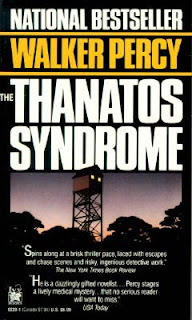
The plot, as it is, involves a doctor returning to his small Louisiana community after being in jail for 2 years. There are lots of oblique hints as to why he went to jail, leading the reader to believe a full and interesting backstory will be revealed. This never happens. He soon discovers that his few remaining patients have radically different behaviours and personalities. We eventually learn of a "conspiracy" to put some radiated sodium in the water that makes people less prone to criminal behaviour or something. The whole thing is preposterous and boring and somehow connected to a school of pedophiles, which gives Percy his excuse to describe it all. What's super fucking weird and creepy is that the abusers are all re-integrated into society and given jobs at the new institute for the dying (to replace the euthanasia centers; don't ask) which the protagonist puts together in the denouement.
The worst book I've read in a long time. Took me almost two weeks to get through. Feels like the editor said to him or herself "well this sucks but I can just stick Walker Percy on the front and we should sell enough." The reviewers who said shit like "laced with escapes and chase scenes and risky, ingenious detective work" need their license pulled.
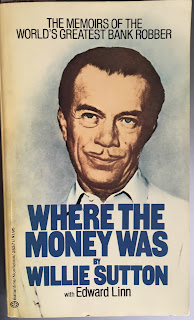
I'm happy to report that the book itself is an enjoyable read. It's surprisingly long. Sutton spent most of his life in jail so this book actually has more prison escapes than bank robberies. In the last third, as he gets older and sicker, he uses legal techniques to try and get out of jail. This part drags a bit but you are invested so much at this point, that you want to find out what happens. The best part for me are the bank robberies at the beginning. It does seem like Sutton was brought into this world to heist banks. He is like the Michael Jordan of bank robbery. Beyond the anti-authoritarian appeal of the bank robber, Sutton never used violence and was a charming and stylish guy so he became pretty famous (which helped to get him out of jail early).
The description of the prisons are very informative about the corruption and cruelty at that time and how easily the prison-guard relation can turn into (or maybe always is) abuse. It was just known that when you got arrested in Brooklyn, you were going to get a serious beating as part of your "interrogation". When Sutton finally gets arrested the beating is insane (the cops are extra mad because he made them look bad). Was painful to be reading the descriptions of the brutality in Attica and Sing Sing at the same time that Eric Adams just announced he is going to reinstate solitary in Ryker's.
As I say, I am more of a heist guy than prison escape guy, but the escapes in this book are wild. There is a failed one trying to find the exit of a sewer tunnel that had me almost nauseous with stress. Sutton just had no fear! He goes through a 38" wide tunnel that slowly gets higher and higher with shit and piss and medical waste naked carrying a flashlight and a metal pole. When there is only like a few inches of clearance and he still hasn't found the exit, so he ducks down and tries to swim for it!
This book needs a reprint. Still very relevant today for both fiction and non-fiction reasons.
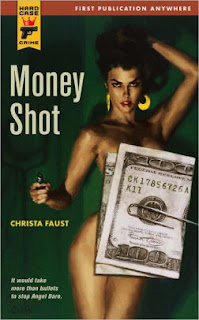
I am happy to report this is the kind of excellent updating of classic pulp that we are getting more and more of. It's basically a revenge story set in criminal L.A. except the protagonist, Angel Dare, is a woman, an ex-porn star and now talent manager. She gets suckered to come in to do a shoot as a favour to an old director friend, ends up getting sucker punched and thrown in a trunk. We start in the trunk. You keep turning the pages. I won't go into the plot any more than to say broadly that she has to figure out why this is happening to her, get out of it and then go hunt down the people responsible.
This book is pretty rough, with sex violence and sexual violence. Punches are not pulled. What I really enjoyed beyond the basic ass-kicking premise is that you get a realistic, non-moralistic insider's look at the porn industry. It turns the book from what would otherwise still be a pretty entertaining pulp read into an informative and interesting expose as well Lots of great (in the book, generally quite seedy and depressing in real life) locations, a wide range of colourful and often fucked-up characters all with realistic little details that lets you feel that Faust knows of what she writes.
I don't know what to say about what a book like this says about pulp and gender. A smarter person than me should do a side-by-side analysis with Megan Abbott's Queenpin. For me, it is just refreshing to read this kind of fiction from a female perspective where the women have agency and sexuality that is their own. Good stuff.
Oh snap, there's a sequel with the same character! I loved how this one ended, without a big explanation, but the nerdy part of me did want to find out how it all played out. Very happy to add Choke Hold to my shopping list.


It takes place on some planet (perhaps ours) that is fundamentally tectonically unstable, with earthquakes, rifts, volcanoes and other fun stuff happening all the time, sometimes enough to destroy almost everything. There are certain people with powers to control the earth's energy. Despite and because of their powers, they are feared and loathed, usually killed when discovered or often sold to The Fulcrum a special school for them where they are disciplined and trained and then used as weapons/tools to protect the land from the earth. There is a lot more going on that I won't get into here, entire histories of various peoples, other creatures and even giant crystal obelisks that hang in the sky.
The book is three narratives, following three different storylines that slowly weave together towards the end. Like Anne Leckie, this trilogy deals with contemporary issues such as slavery and colonialism (what I endearingly call "woke sci-fi") and integrates them skillfully into the setting and plot, so that you are thoroughly entertained while subtly questioning our own reality. This is what science fiction is supposed to do.
It's not perfect. The Syen character has that "angry" trait that I see with a lot of authors where they lean on simplistic anger to add conflict to situations where it doesn't feel natural. It starts to get annoying in the early and middle parts of the book, where she is always snapping and sarcastic even though anybody at that point would be more resigned and just live with the situation (of being with somebody they don't like). So much emphasis is put on this anger that when the expected evolution comes (she learns to like and even love the guy), albeit quite novel and interesting, it's not very satisfying or convincing.
All that being said, I still walked to the bookstore and bought the second book so I can find out what will happen next.

The protagonist is a New York professor who I guess has a knack for also solving mysteries. In this case, she is contacted by two men who are writing a biography of a feminist author and professor who killed herself at the lake of the private liberal arts college where she taught. There was some suspicion that she was murdered, because though she had written and talked of death (including her own), none of her close friends felt it made any sense that she would have done it then. So the detective/professor goes to Clare College (some conservative amalgam of Bard and one of the other new england women's colleges), ostensibly to head up a task force on whether or not they should have a gender studies program, but really to investigate.
The college set up is really fun. Though a woman's college, the school is deeply conservative and pretty damned sexist. Most of the other professors hated the victim because of her independence from the constraints of traditional roles for women. This book was written in 1984. I went to a liberal arts college a few years after that which was the peak of the wave of feminism that was the really suppressive anti-sex one. I was generally supportive of that movement and understood broadly the reasons for its expression. Reading this book, it really exposed how fucking awful even that late in the game, the patriarchal power structure was. The arguments against the gender studies program sound so similar to the same bullshit we hear being trotted out in response to the Black Lives Matter movement or climate change. People in unequal power making any convoluted argument no matter how illogical as long as they can find justification so they get to stay in unequal power.
Ultimately, the mystery part got all a bit crammed up at the end. It was kind of fun but we never really got to see the culprit enough to really hate them and thus didn't get much satisfaction at their comeuppance. This milieu is not really my jam, so I probably won't read any more, but if this one is any indication, it is a well-written and enjoyable series for people who appreciate American academic cozies.

He still had a day job at the time of the article, as the handyman at his wife's funeral parlor. The main character in Razorblade Tears is an ex-con who runs his own landscaping business. Cosby puts his knowledge to good use as yard tools and equipment feature heavily in the action. And there is a lot of action. It reminded me a lot of the Spenser books where he and Hawk have to go full commando. It's a great set-up. Ike Randolph's gay son (whom he rejected due to his own homophobia) and his husband are brutally murdered and he and the husband's white trash dad (who also has his own roughneck past) pair up to get revenge. They are a great buddy duo, both can fight and do crime and their banter is a mix of well-written repartee and heavier shit as they get to know and appreciate each other. The bad guys are also a great mix. He sets up a world that you don't want to end. I'd love a series with these two.
It's well constructed with an excellent forward pace and fun writing. I had one annoyance with a plot development where I felt the characters acted out of character and did something stupid (going to the burning house for those who have read it), but otherwise was thoroughly enjoying the ride. Cosby does a genius trick here by putting forth a classic masculine badass revenge story yet wrapping it around today's social reality. Homosexuality, homophobia and racism are big themes here, at times ever so slightly veering into the speechifying but otherwise essential elements to the narrative. He proves that shit can be woke and badass. The badass is really good, so that helps. Just some great, creative fight scenes.
Very pleased to see this kind of book coming out today.

It's a solid little thriller, with a setup that I particularily enjoy: the competent tough working urban detective who gets mixed up in politics and espionage that is supposedly out of his league. I realize now there is a class element here as well, along with the classic appeal of the underdog story. Sidney Kenyon is the said detective and though definitely on the side of order, also demonstrates a certain human sympathy for the criminals he catches. The book begins with a seemingly open and closed murder case of a pimp (called a "ponce" here) who murders his girlfriend when he finds out she was selling her services on the side. This is followed up by an irritating call where Kenyon has to humour an attractive, educate woman who is convinced she is being followed and that somebody broke into her nice apartment to search it. Kenyon is very cynical at first, but is also attracted to her. So against his better judgement, he starts digging and of course things get interesting.
It's written in a direct and economic style and keeps moving forward. Near the end, when we start to get the big picture, it expands into large-scale international politics to a point that was a bit fantastical to me compared to the street-level investigation that went on before. It never delivered the final bang of the working class cop taking it to the fancy boys at higher-level agencies. Nevertheless, it was a solid, enjoyable read.


Niall, Maria and Celia are raised by a famous dancer (mom) and a famous singer (mom). Both are parents to Celia and one each is a parent to older Niall and Maria. They are left to run wild as children, with the distant mom and the loving but distracted dad. They grow up accordingly with each inheriting a strong talent (Maria for acting, Niall for piano and Celia for drawing) as well as a deep malaise and inability to live in the world in a happy, positive way. The book is centered around Maria's aristocratic and old school husband finally getting sick of them (calling them parasites) which triggers reminiscences, sending the reader back in time so we see how they got that way.
It's mostly quite melancholy and kind of depressing. There are some bright moments, such as when the family first goes to the manor of Maria's new husband (named hilariously "Coldhammer") and commit all these hilarious faux pas. As I say, very well written, so if you like rich studies of broken, spoiled people, this will be for you.
Postscript: did a bit of reading and see that The Parasites is considered a bit of an outlier in her work and is broadly autobiographical (she had a clinging actor father and a distant mother). That makes a lot more sense as to the purpose of the book.


The narrator is Andy McClintock, office man for a Florida developer in the middle of building an ambitious suburb on a key. His boss is a strong, bullheaded self-made man who has been giving McClintock the run-around about a promised promotion to do actual on-site work. The boss's somewhat scrawny but also sexually alluring (of course) wife comes to McClintock and asks him to snoop around and try and find out what is wrong with her husband, as he has been suddenly distant. McClintock refuses but does decide to confront his boss about the promised promotion. Instead of stalling, the boss gives it to him and reveals a weird fatalism in doing so. Soon after, he commits suicide by shooting himself in the neck with McClintock's spear gun (that he finds later stolen from his garage).
So of course this leads to McClintock being accused of the murder (also having been spotted hanging out with the wife plus the new contract). It looked promising but we had several of JDM's weird asides about love and female sexuality. McClintock lives in a humble rented cabin and his neighbour is an attractive, huskily healthy midwestern divorcee. They respect and like each other, had a brief fling, but decided mutually to keep things in the friend zone. There is a very abrupt "plot twist" that felt unfair to the reader (which I've never experienced with JDM before) that sort of makes their relationship a major plot line. The bad guy turns out to be none of the characters established in the beginning, so there is no mystery for the reader to solve, though it appears to be set up as if there is. And there is a very unrealistic escape that allows McClintock to be the hero even though that all doesn't really make sense. It is somewhat redeemed by an incredible climax where he literally fishes the badguy off a boat. That was fun, but leading up to it I was pretty disappointed.
SPOILER ALERT (for my own future reference): The healthy midwestern girl gets murdered about halfway through the book, giving McClintock his revenge drive. He realizes that he loved her after all, that she was the one under his nose all this time and now she is dead. He does the detective work (and the details here are well done) to find the killer who is a wandering psychopath. The cops catch him and to get him to confess suddenly reveal that McClintock's love interest is not dead after all. They faked it the entire time to draw the killer out! It's weak on several levels, because it implies the fat, narrow-minded police chief actually wanted McClintock's meddling, which just didn't ring true given all their previous interactions. It also feels like a forced way to make a satisfying love triangle. Then the psycho escapes and manages to evade a vast dragnet, double back and of course catch McClintock and his new love in a vulnerable position, which does lead the incredible fishing revenge moment (which I will paste as an image below).


 |
| JDM would not have been a fan of PornHub |
 |
| I feel like he does a disservice to what is now a touchstone of American culture |

It takes place at the end of the 21st century, about a hundred years from the 1990s when it was written. The idea is that medical advancements have gotten humanity to be almost immortal. The world is run by the polity who maintains health and order. The idea is that the old people stay in control and the world cannot really evolve culturally anymore. It's a post-scarcity society but the young people all feel trapped and limited. I didn't really feel convinced by this. The protagonist is Mia an old civil servant who has always played it safe. She gets a radical new treatment that makes her young again and then decides to break free, flees to europe and joins various culture and fashion groups and does somewhat wild things.
So you learn about the dissatisfaction of the youth from her meetings with said youth, but you don't really get to see it. Mia's rebelliousness is also inconsistent. Part of it is that you don't know how much of her behaviour is because of the treatment and how much is just her. That is okay but none of it really amounted to anything. There is a lot of discussion about art. She becomes a hit fashion model, then tries to be a photographer. There is also a side story of a virtual castle that is bequeathed to her by an old boyfriend that doesn't really go anywhere. Now that I think about it, it feels like this book was more a collection of ideas and semi-stories that never got held together fully. I wonder which is the Bruce Sterling I should read?
Note to self: be wary of books with review blurbs using the words "haunting", "lyrical" and "triumph".

First, Perry Mason seems completely without morals and his legal ethics seem super questionable. In this book, he gets his client to hail the same taxi she took the night before (where the driver recognized her which would put her at the scene of the murder) which investigator Paul Drake tracked via radio and then take the exact same trip at the same cost but with a new outfit and a friend to later use that to make the taxi driver look unreliable on the stand. That can't be allowed, can it? And the crazy thing is at that time, Mason himself wasn't convinced that his client was innocent. It surprised me to see such a cynical take on legal procedure from the early 50s but I guess lawyers have been gaming the system since they were released on the world.
Second, Hamilton Burger, the prosecuting attorney and I guess regular foil for Mason is comically stupid and always and obviously two steps behind. Every objection he makes he uses the same phrase "objected to as incompetent, irrelevant and immaterial." Ultimately, Perry Mason does perform some clever tricks to expose the truth, but he is just so clearly superior to the opposition that it seems to steal any tension from the story. Maybe that was intended.
There was a dry patch before the trial started where I started to lose interest, but the initials set-up was enjoyable with some depressing sexual politics of the time thrown in. He is hired by a wife who knows her husband is having an affair. Instead of busting him, she wants Mason to help her with a scheme to turn the mistress from fantasy escape lover to annoying dependent, while she plays the positive one. It's actually probably a good strategy but depends on the woman accepting that she loves her husband or wants to keep the marriage no matter what. The ending was somewhat fun too and the solution to the murder more or less solid, though with some sketchy ballistics. I found this in a box on my street and there was another one so I'll read that at some point. It is unlikely I will make this series staple reading but glad to have finally been exposed to it.
On a sad note, in order to read this book I had to turn the pages, which separate them from the glue to the binding. It always pains me and I'll try everything to give a book a chance to get another read, but this may be one paperback whose life has come to an end.


The book itself was another solid murder mystery from Marsh. What made this one stand out was the nice (but sad because it was shattered by the murder) portrayal of the traveling theater company as well as the great look at New Zealand, Marsh's homeland. Inspector Alleyn is supposed to be on vacation but of course gets mixed up in a murder. On the boat to New Zealand, he falls in with a theatre company. There is a minor kerfluffle on the train when the co-owner is almost kicked off the viewing platform. His fate is sealed for good later when an elaborate birthday surprise for his wife and lead actress goes horribly wrong. He had intended to lower a giant bottle of champagne, but somebody removed the counterweight and it smashed his head in. Bonus points for the Fontana photo cover which actually shows this (right down to the jeroboam larger-size champagne bottle).
Marsh is just a great writer. I enjoyed this book more for the interactions and rich characters, especially the interesting insider writer writing as outsider visitor to New Zealand, than the mystery itself. The Maori doctor is really great. I almost wish he had a series of his own. Fun read.

The premise quite good. A small town nestled in the remote forests of Norther New Jersey is run entirely by computer. It does the maintenance, much of the security and manages all its own billing and paperwork. The protagonist, Ross MacLean is called there by his friend, who is starting to get paranoid that the town is out to get him. Quite soon after the arrival, the friend is indeed killed in a freak accident. I was hoping for some combination of The Demon Seed and The Corbin Affair but the book never really goes there. There is a lot of early '70s engineering nerdiry that seems specific enough to suggest the author knew what he was talking about, but any science specifics are undermined by the inconsistent plotting. It can't decide if it wants to be a thriller or a mystery and the one blocks the other, where we are guessing when it doesn't advance the story and everything is revealed too quickly and then we don't care. There is also a lot of really dumb sexism which I can usually accept as an artifact of the time. Here the author seems to want to make a point of how woman can only push buttons and not understand any theory. It's honestly offensive. He also has to make a weird point of heterosexuality. At one point, the town's elderly founder, a well-known theorist, invites Maclean to stay at his place, since he needs a place to stay and says "Don't worry, I'm heterosexual." WTF early 70s?
There is a little bit of mayhem at the end where the programming of a sex robot gets wire-crossed with the town alarm system while all hell is breaking loose that is fun. I also enjoyed learning about the Jackson Whites, but overall not a great book. Too bad, because it sure looks beautiful!
I have found that Lou Cameron was an extremely prolific pulp author and comic book artist, who wrote the Longarm series (basically sex-western series, that I learned about from Paperback Warrior).


I actually haven't read Gibson since I think Virtual Light, when it came out, though I have a vague memory of having also read All Tomorrow's Parties as well. Now that I have been re-introduced to him, I am going to have to keep an eye out for his other books. Spook Country is a moden-day spy story from 2007 where the tech is actually outdated today. Despite that, Gibson delivers all the tech theory stuff in a really interesting way that makes this book a marker of that time with some interesting thoughts for the present.
Ultimately, it's just a cool spy story, not particularily epic in nature, but the cool characters and intriguing set up keeps you turning the pages. It has 3 main characters, each their own storylines that will of course eventually collide. Milgrim is the educated addict kidnapped by a mysterious operative who makes him translate intercepted Russian text messages. Hollis is the ex-lead singer of a semi-popular '90s band turned journalist hunting down a virtual reality designer. Tito is the young member of a Cuban-Chinese espionage/crime family trained by Castro's KGB allies. The last is really cool, a migrant parkourist and expert in systema, the family's anti-surveillance technique, who is basically kept in the dark until his skills are needed.
It doesn't quite end as satisfyingly as one would like, given how compelling their set-ups are. The world and the characters are so enjoyable that you nevertheless don't want it to end and can forgive the mellow conclusion.

The book starts with Cardogan, a poet (clearly of the upper classes because though he struggles with money he somehow has a home and a servant) who feels like he wants adventure in his life. He also wants to avoid a poetry tour of America that his editor is pushing on him. He goes to Oxford but has to hitch a ride and then walk in late at night. Passing a toy store with a door ajar, he decides to go in. Upstairs, he discovers the body of a woman and is then knocked out. When he wakes up, he is in a closet at the back of the building, which no longer houses a toy store but a grocery shop and the proprietor and the cops think he may be suffering from delusions due to the concussion.
Enter Gervase Fen, literature professor and don. This begins a madcap adventure of deduction and college hijinks, much of which is quite funny. I will not seek out Crispons book, but I may well take the next one I stumble upon.

It is a bit hard to categorize this book. It's sort of a thriller but not really thrilling. The story is about, Cooper an academic living in Japan in the early 60s who has recently lost his wife and daughter in a fire. He now translates ancient documents for a brothel owner with a side business in trafficked antiquities. The brothel owner brings him a strange set of documents that were smuggled out of China and appear to be quite valuable. As Cooper digs into them, he discovers that they seem to be proof that Jesus Christ was just a charismatic rebel who died and was never resurrected. At the same time, he gets connected with an 11-year old girl who was sold into the brothel and then escaped.
So the existential theme here is can Cooper take the responsibility of verifying the document that disproves Christ, thus destroying Christianity. The more practical matter is protecting the girl. The two become opposed.
It's a very well-written book and I found myself absorbed in the narrative. The descriptions of Japan, including lots of train scenes and a ski lodge, were enjoyable and seemed to be fairly accurate. There is a lot of reflection by Cooper and the Pulitzer prize winning war journalist who has lost her mojo that he alllies with. I usually don't go for that kind of wanking but for some reason it worked here. Finally, the bad guy, the brothel owner is just a great character. Always super polite and verbose, while being weirdly clean and yet also somehow kind of disgusting.
The big reveal that resolves all the conflict felt a bit cheap, as the author breaks some basic premises established earlier in the book so you couldn't have figured it out yourself. Despite that, I put it down satisfied. Not a masterpiece or anything, but a nice obscure find and a good read.


Emotions aside, a graphic novel was an excellent way to enrich and remind me of the details of what went down. It also really captures the horror of what it must have like to first have your campus taken over by redneck soldiers led by armchair fascists and then to have them actually open fire and gun down fellow Americans. It is a period from which I have absorbed a lot of cultural and historical material, but now that we are living in a similar time of rupture, I realize that I had always treated it with some distance. It's very scary to see your society fall apart and this comic captures that well.


 Posts
All Comments
Posts
All Comments


