Friday, November 26, 2010

63. O.G.P.U. Prison by Sven Hassel


I had the good fortune as a young man to spend three weeks on a cattle ranch in Brazil, basically working with the cowboys (though more likely getting in their way). The manager of the farm was a crusty old Brit and he learned me three things: 1) how to shovel, 2) that two non-gay men cannot live together in close quarters for extended periods of time and 3) Sven Hassel wrote great books about war.

I found one of his books, Monte Casino, immediately after that. But for some reason it sat on my shelf for years and I never found the desire to open it up. My understanding was that Sven Hasssel's book were incessantly grim and violent. I have always been a bit squeamish, but I think the other thing that made me hesitate was the sheer width of the book and a language that didn't grab me. Eventually I got rid of Monte Casino, but when I was in Amsterdam, I found this one for a really cheap price and thought it was high time to introduce myself to Sven Hassel.

Unfortunately, I have since learned that O.G.P.U. Prison is one of his later books and veers more into the black comedy and less into the grimness and is perhaps not the best representation of the series. I say unfortunately, because I really do want to get a better understanding of the series, but this book was kind of a slog. A fascinating, crazy slog, but still quite long and repetitive.

I apologize for dancing around the actual description of the book, but it's hard! It's like the Threepenny Opera mixed with Sergeant Rock (as directed by Sam Peckinpah or one of those Japanese gore-masters) and starring the Marx Brothers. What makes Sven Hassel stand out is that his books are written from the German perspective. The heroes are utterly cynical, war-mad and basically criminals forced into being soldiers. But they are excellent soldiers, basically immortal and constantly killing (during the war scenes). But it's super goofy! The book opens in Berlin, where the heroes are ordered to transport some prisoners. They go into bar after bar and chaos ensues at each place. Then they are sent off to the front to try and take this Russian prison that sits strategically at the top of a hill. It's a total gorefest, but weirdly disjointed and lacking flow. Part of it could have been the translation, but as a reader you jump from violent war scene to violent war scene. At times it happens so abruptly that you don't even realize the heroes have moved to a new situation. A lot of the language is passive or just colourful descriptions of gore (soldiers missing heads, missing legs, legs only, guts hanging out). It goes on and on. It's basically gorewarporn, but all with this ultra-violent humour and ironic awareness of the insanity of war. It felt at times very similar to playing a video game.

It has a certain hypnotic flow and there is some truly crazy stuff in here. But there is so much of it and it is often quite goofy, that I just felt removed from the story most of the time. It also bothered me that the heroes seemed utterly impervious to damage. People are getting slaughtered all around them and the worse they get are scrapes or bullet holes that go straight through but do no real damage. They also always have time to make clever comments and jibes to each other back and forth. It's all very surreal.

If it was less goofy and flowed a bit better, I think it could have been really awesome, truly dark and destructive. I read in a few places that the earlier novels are a bit less crazy, but I wonder how much. I say it was a slog, but it also gave me a certain hankering. Maybe one day I will pick up one of the earlier novels and see how it goes.

Just to give you an idea of the goofiness I am talking about here, is a moment from a scene in a German planning session near the Russian front.

...One of the lamps hisses and crackles loudly.
The General looks at it wickedly.
'Make that lamp shut up,' he shouts, red in the face with rage.
A Signals Unteroffizier tries nervously to adjust the burner, but the lamp continues to splutter. It is as if it has decided to tease the general.
The Unteroffizier burns his fingers, but is wise enough not to show it.
'Take that lamp away! Out with it!' roars the General, in a hoarse voice.
The Unteroffizier grabs the lamp, and rushes out of the black-out tunnel.
At the same time comes the roar of exploding bombs. The Signal Unteroffizier and the lamp come flying back through the tunnel in a rain of glass shards, strips of flesh and brickwork.
'Damned mess,' snarls the General, angrily. 'Clean it up and let's get on with it!'
Planning for the grand attack is resumed immediately. The bombing and the dead Unteroffizier apparently of no interest whatsoever. A couple of soldiers rapidly clear up the remains.

Does that not seem like a very violent Marx Bros. movie? Now imagine that like three or four times per page.

Sven Hassel himself is also an interesting guy. He claims to have been an SS soldier and he was definitely around during the war, but there is another Danish journalist who has dedicated his life to proving that Hassel is a fraud. The war rages on the internet.

I think these book are interesting and that you should read at least one if you are a student of paperback books and manly fiction. I'd love to hear some other people's opinions, especially those who have read more of the books.

Wednesday, November 24, 2010

62. Murder Twice Told by Donald Hamilton

Snagged this little gem at Chainon, our local thrift store (which helps to support the larger organization, a women's shelter). Their used books section has really improved over the years.

This book is actually two novellas of Donald Hamilton, Deadfall and Black Cross. Both were initially published in magazines (Deadfall serialized in Collier's in 3 issues in September '49 and The Black Cross in The American Magazine in September '47; thanks to this website for that info). The paperback I read has a minimal colophon, saying only copyright Donald Hamilton 1948, 1949, 1950. I guess it must be some later printing of the paperback. On the inside of the back cover, the original owner wrote "acq. 22 sep. 1967 fin. 1 sep. 1967". That was cool to see. A gesture motivated by the same thing that motivates me to do this blog, I suspect. I also think it was a francophone based on the order of the dates and the use of acq (acquiré) and fin (fini), though both could have been abbreviations of english words, they don't seem that obvious choice.

I'm a bit wary of Donald Hamilton. Donald Westlake spoke of him as a big early influence and I found a couple of those novels and really enjoyed them. I then went and bought a bunch of his later novels, including some of the Matt Helm series. When I finally got around to reading them, I found them almost unreadable. They were clunky and obvious, not as truly terrible as some of that numbered paperback adventure fiction, but pretty uninteresting to me. This one looked promising, though, with minimal commitment (the two stories make up less than 200 pages). Plus, they were early on in his career.

And interestingly enough, the two stories perfectly encapsulated all that is good and all this bad about Donald Hamilton. Deadfall is the story of a chemist who is under suspicion by the FBI for having associated with a woman. It has some cool moments, but overall I found it kind of forced. Way too much time is spent on his feelings about this woman or that and whether or not he can trust them. It was obvious too me early on who was the real bad guy. There was some nice bitterness in the main character, but I just really didn't care about the story all that much. It's not bad, just not great.

The Black Cross, on the other hand, was superb. It was really dark and mature, with an excellent, unravelling plot that brings all its elements together at the end in a very satisfying way. It's the story of a young professor who is driving home with his tight wife after she made another scene at a party. They get in a terrible accident and she dies. Except he remembers seeing her still alive and the trucker beating her down with a black cross. Things get very interesting from there. I'll leave it at that because you should really try and track this little gem down. This is classic noir with a hard edge.

I need someone with similar taste to mine to sort all of Donald Hamilton's work into good and bad. The bad is really not terrible, just on the mediocre side and not to my liking. But the good is pretty hardcore and I want to read more of it!

61. The World Without Us by Alan Weisman


I am on such a tear of reading these days that I finally found the energy to actually read a non-fiction book. These things are often in hardback and wide and thus take up important inches on my on-deck shelf. If I can knock a few non-fiction books out before the end of the year, I can do some major clearing. I am extremely lazy-minded and have a hard time concentrating on reading when there is not an exciting storyline to keep me connected and wanting to know what happens next. However, I felt that with my current momentum, reading a non-fiction book was within my capabilities and possibly even enjoyable.

I got this book for xmas last year or even two years ago from my wife (I believe I requested it or at least was very interested in it) when there was a big wave of books and tv specials about what would happen if all the humans disappeared. It is a fascinating subject and a bit of a fantasy for people like me who lament humanity's impact on the planet. I'm also a big fan of the post-apocalyptic genre of which this book must be considered partially a member. Finally, I am going to be running a post-apocalyptic roleplaying game (Barbarians of the Aftermath is the actual game system I'll be using) starting next week with my gaming group and thought The World Without Us would provide lots of good imagination stimulation and concrete ideas.

It's a solid, interesting read, but it suffers a bit for me from two things: it's journalistic style and a greater proportion of information about the world today than the world without us. For reasons I won't get into here, I'm not a big fan of the fourth estate. I particularly dislike magazines. The articles so often follow the same structure and use the same techniques (clever hook, brief description of some dude who then gives some quotes, blah blah). The World Without Us evolved from a magazine and each chapter was basically structured in the same way. Not a deal breaker, but one of the reasons I have trouble concentrating on non-fiction. Nevertheless, it is thoroughly researched and mostly well-written (a teeny bit too florid for my tastes). I learned a lot in reading it about the state of the world today and long-term trends, both natural and man-made, that will affect what would happen to the planet were humans to disappear.

And there was a lot of that kind of information. I'd say more than two-thirds of the book was about current environmental situations on the planet. There was a ton of interesting (and depressing) stuff: agricultural research on elements in the soil going back centuries, shrinking pristine forests in Poland, the history of plastic and its proliferation (totally fucking scary) and so on. The problem for me is that I know a lot of this stuff already, especially the environmental issues and since that is a big part of my day job, indirectly (I'm the IT dude for an environmental NGO) and I find it hard to take as it is, I really don't want to be reading about how we are destroying the planet when I'm reading at home. My own personal difficulty with reading this stuff is not a criticism of the book and I would argue that if you are interested in the subject of a humanless planet but also want to get a good primer on a wide range of ecological impact going on, this is a great book for that. His information is built all around the science and conversations with scientists. It remains objective and never gets emotional. That being said, the parts where he does go into how things would degrade were much more enjoyable and interesting for me (he talks about New York City, works of art, farmlands, nuclear power plants, the Panama Canal) and I would have liked a greater proportion of that part than the current state of affairs. Though i do recognize you need some info on the current and past situation to explain what will happen when we leave (which I hope happens sometime soon).

So good stuff and I pat myself on the back for having read a non-fiction book this year. Hell, I kind of even enjoyed it and may do it again!

Tuesday, November 23, 2010

Guest post on The Violent World of Parker


I'm very pleased to announce that my review from last week of Richard Stark's The Seventh attracted the attention of Trent over at The Violent World of Parker and he offered to put it up as a guest post on his site.

You can re-read it here.

If you don't know, The Violent World of Parker is the site for Donald Westlake's masterpiece, the Parker series. The site has an excellent (and I think complete or very nearly so) cover gallery, a summary of each of the novels, a section on comics and Parker movie adaptations and a great blog that collects valuable info on all kinds of Parker-abilia (and some forays into the greater paperback crime world). Definitely a must on your blog reader if you are a fan of crime fiction.

The other thing that I respect about the site is that it has been around for a long time. Long before Parker became hip again (with the University of Chicago re-release and the Darwyn Cooke graphic novels), The Violent World of Parker was an old-school, html-based website which I used as a reference quite often or just visited when I need a Parker fix. This was back in the day when you could still find a Parker paperback for a couple bucks at some used bookstore (today, if you can find any, they will be plastic wrapped under the glass at the front and start at $20). Almost nobody was talking about Parker online except The Violent World of Parker.

So congrats to you Trent and thanks for your dedication. Keep up the good work. I hope my next review will earn another guest spot on your great site!

Sunday, November 21, 2010

60. The Road by Cormac McCarthy


Well I finally got the guts to read this book. My good friend, the Lantzvillager (whose production of reading has dropped with a recent production of a new human) lent this to me a long time ago and I have just been afraid that it would be too dark and depressing. Happily, my current reading frenzy overcame my trepidation. Even more happily, this is a quick read and a decent one, despite my misgivings about McCarthy (more directed at the media around him than the author himself).

I have mixed feelings about this book. At first, I was extremely annoyed. I can not stand McCarthy's stylistic pretension of not using quotation marks for dialogue. His reliance on incomplete sentences would be almost as annoying, but he is such a good writer that there is often an effective poetry or description there. However, in the beginning of the The Road there is some extremely pretentious blather that any 10th grade english teacher would have excised. Get on with it, Cormac!

Fortunately, the wasteland setting is truly effective. The situation of the boy and his father starts to seep into you and the pretentious useless sentences diminish in frequency. I do appreciate that he went for the full apocalypse. There is almost nothing left and the few remaining humans are either on the edge of death or scary murdering, raping cannibals. I loved the wagon train with the collared catamytes at the end. That was a pretty nice over the top touch that tells me that McCarthy still has a part in him that wants to entertain.

But fundamentally, The Road's bleak setting is a fake-out. Because it is ultimately a (relatively) happy story. It has a happy ending with a slight gleam of hope and may in the final analysis be a condemnation of the choices the father made. It is also so sappy and sentimental. The book spends a lot of time posturing and acting all tough and bleak while actually constantly tugging on your heartstrings with memories of the wife and the boy's pity for other humans. This latter struck me as being questionable. Would a child whose only knowledge was the world after the fall be so caring? Check out The Wire for a more accurate portrayal of how children adapt to their environment.

I will spare you a rant on the literary community and their snobbery against genre fiction (and how McCarthy has hoodwinked us all). I'll simply say that The Road is an enjoyable book, but ultimately its core is a bit too soft.

Friday, November 19, 2010

59. The Seventh by Richard Stark

Holy crap, that heist went really sour!

We're developing a little tradition here where my wife buys me some of the new University of Chicago Parker books each year on my birthday in January and I read them slowly throughout the year. I've already read the entire series at least twice before the U of C books were released, but this is a dedicated, focused reading in the wake of Westlake's death and with the full consciousness that the Parker series is a literary classic. It's been great. I don't know if I've changed but the re-reading of each novel this time around has come as a real surprise to me. Things I'd forgotten are exciting to re-discover and things I had never noticed before are popping up now. I'm getting both the pleasure of re-reading a great book and the pleasure of discovering something new.

[NOTE: SPOILERS START HERE. I AM GOING TO WRITE A PRETTY THOROUGH ANALYSIS OF THE SEVENTH WITH THE ASSUMPTION THAT YOU HAVE READ IT ALREADY. IF YOU HAVEN'T READ IT, GO GET ON IT AND COME BACK. THERE IS NO OTHER OPTION.]

Once again, with the Seventh, I had the feeling going in ahead of time that I knew what I was in for. I vaguely remembered this had something to do with a football game and that it was one of the books that was a standard heist, without any longer-term narrative complications for Parker. What I had completely forgotten is how brilliantly structured this book is. So far, it is the best heist followed by the worst fuck-up followed by the perfect denouement. The Seventh is also notable because it is the first time that Parker goes into the backstory of some of the other heisters in a bit of detail. You get hints of it in The Score, but here you really start to care. They are a much richer bunch then in The Score as well. The angry, flamboyantly-dressed dwarf is particularly cool.

The Seventh feels structured to me like an ever-narrowing tunnel. It starts off in a closed apartment, where Parker discovers the woman he had been shacking up with dead, pierced to the bed with an ornamental sword taken from the wall. Worse, all the money he had been holding from the recent and successful heist is gone. Parker goes hunting for the money and the book opens up. We learn of the heist, this college town, all the heisters as well as the local police. Much of the novel is Parker trying to find out who killed the woman and took the money while avoiding the enclosing investigation. Then in the last third, everything starts to constrict. The cops close in, his partners go down one way or another. Parkers pursuit becomes more and more focused. All he wants is "the amateur" who screwed everything up.

The final chapter is Parker stolidly climbing stairs in an empty high-rise under construction, in pursuit this panicking loser. The money, his colleagues, the investigation, the midget are all eliminated as storyline and it is just you the reader with a burning focus to get this amateur who caused so much trouble. It's a very intense ending. And satisfying. Westlake introduces so much tension and worry into the first two-thirds. It's so frustrating to have such a beautifully-executed heist go sour after it's over. You just know things are going to get worse and worse. And yet somehow, once everything is as bad as it can get, you as the reader only really care about Parker getting the amateur. The coda that makes the book so perfect (which I won't reveal here) is really only a cherry on top of a delicious ice-cream sunday. Not necessary, but oh so tasty. I laughed out loud.

Is this a love story?
Okay, get ready for some pretentious essay-writing, people. What struck me in the beginning of this book was the character of Ellie. She is the woman with whom Parker shacks up before and after the heist and whom he finds murdered when he returns after a quick errand for beer and cigarettes. What is remarkable about her character (and what I noticed for the first time during this reading) is that she is the perfect woman for Parker! As is well known, Parker is celibate leading up to the jobs and then satyr-like after. He is introduced to Ellie by Kifka, who is organizing the job, when he asks for a place to stay in town. I don't know if this is a period thing or just one of the perks of being a heister, but when you need a place to stay, you always have the option of getting a woman as well.
"It's been a long day. I need a place to stay while I'm here."
"With a woman or without?"
Parker hesitated and then said, "With." Not that he expected to want her, not just yet. Before a job he never had any interest in women, or in anything else but the job itself. But he would want her afterward, when he would make up for lost time.
The women that Parker stays with tend to be portrayed with some spirit and a bit of personality, but they are rarely anything more than their role as his woman. This is the case with Ellie. The difference is that she turns out to be the perfect Parker partner. Before the heist, she asks nothing of him, is mildly surprised that he doesn't want to get it on and leaves him alone.
Her style was very much like Parker's own, silent and self-contained. They spent hours in the same room without either saying a word. Parker was pleased by her. She didn't jabber away at him, and he never had to tell her anything twice. Kifka had done better than could have been expected.
Parker pleased!? I mean, wow, that never happens. And then after, when he is done. Whoo boy!
Seeing how lackadaisical Ellie was about everything else in life, Parker hadn't expected her to be more in bed than a receptacle, but she surprised him. He had found the one thing that made her pay attention. For three days and nights, they hardly left the bed at all, and the whole time she was nothing but stifled mumblings, and hard-muscled legs and hot breath and demanding arms and a sweat-slick pulsing belly. All the passion that had been dammed up inside Parker while his one-track mind had been concentrating on the robbery now burst forth in one long sustained silent explosion, and Ellie absorbed it all the way a soundproof room absorbs a shout.
[Feel free to go to your bunk now, I'll wait.] When Parker returns to find her impaled to the bedstand, he has no emotional reaction. Then the cops show up and he learns that the money is gone. Nowhere in the text does Parker ever display any sadness at Ellie's death. He needs to get the murderer because he needs to get the money back. And as things go to shit, he stays focused on the murderer because he is so angry about how this amateur was able to make such an ordered thing become so chaotic.
There was no profit in killing him, but Parker was going to kill him anyway. He was going to kill him because he couldn't possibly just walk away and leave the bastard alive.
But the fact remains that Parker does relentlessly pursue the guy even when it may not be the wisest choice. He also takes several dangerous risks and, one could argue (and the midget heister does), even makes a mistake. Should he have left the apartment in the first place without taking any precautions? Should he have braced the detective in his own home to get his list of suspects? In each of the situations, the choice seems reasonable, but when you look back at it, there is a certain aggressiveness in Parker's behaviour that is slightly out of character. One wouldn't say sloppy, but it's close. Parker always hates idiots who get in the way, but there is a certain extra vehemence directed against the amateur (who is the one character whose personality is only hinted at, thus making him more of a concept than a person), which I would argue may come from Parker's anger at losing a woman with such potential. I know I'm stretching a bit here, but there is a little something there. We'll see how Parker's future retalations compare (and there is at least one I can remember that is coming up).


Westlake's critique of progress

In some ways, Stark has a classically conservative inclination. Though he is the ultimate outsider, Parker also represents old-fashioned values of skilled manual labour, stability and fidelity. The other heisters that he meets are a more positive and fuller representation of this. Actually, representation isn't even the right word. Most of his partners are hard-working craftsmen. In The Seventh, it goes even farther, in that they are working people who were pushed into a life of crime by structural changes in the economy. One character ran a local movie theatre with love and care, but with the advent of television he fell into serious debt trying to keep it alive. Another is a highly-skilled carpenter whose work is too high quality and too expensive so that he slowly loses business, until two guys hire him to build a false compartment in the back of a truck and then he begins his life of crime (where he is properly remunerated for quality labour).

Except for the midget (and Parker himself), they are all portrayed as genial men. The planning sessions could be a bunch of factory workers planning a hunting trip in their buddy's basement. Violence is only a means to get the money and they use it sparingly. The machine guns purchased for the heist have a purely psychological function, to eliminate any opposition. Nobody actually wants to shoot them (though mainly because of the noise and mess they cause). These guys are motivated by doing a good job and earning some money in a society where doing a solid day's work no longer necessarily means you will earn some money.

This critique of the "progress" of the second-half of the twentieth century creeps into the descriptions as well. In the final chase, Stark lovingly details the rich nuances of the forest, going from the airy, needle-floored coniferous to the cluttered, multi-coloured decidous section. Suddenly, the forest ends and the chase spills out into a dirt wasteland, a construction site: "Later, when the building was done, landscape architects would come in with fresh earth and seed and hothouse plants and turn this moonscape back into something vaguely like the forest it had been, but with less clutter and liveliness." I posit that it is not just for visual effect that Stark describes the building as something fundamentally aberrant, broken:
It was over twenty stories high already, and from the confusion of cranes and pulleys atop the building—looking like unruly hair on the head of a Mongoloid idiot—it was apparently going to be even taller before they were done.
I found this final passage to be descriptively powerful. Westlake is such a good writer. I've been to that forest, I've walked along a bulldozed land site and I've clambered around inside a building under construction. Reading The Seventh put me back in those places. I'm probably imposing my own environmental melancholies to some degree, but I do think Westlake is channeling a lament for an America that he saw disappearing into today's world of mindless entertainment (the target of the heist is a football game) and cheaply-produced goods, where the complex, tactile natural world is bulldozed to make way for soulless apartment blocks. Parker is Stark's robot of vengeance, sent in to strike deeply into this new order and wreak as much havoc as possible using order and professionalism. He cannot succeed, but you cheer and rage for him along the way.

Now that all this pretentious twaddle is out of the way (and thank you for bearing with me this far, if any of you did), I'd like to just throw out two more side points:

1) There is a great passage where Stark describes the detective working on the case of the murdered girl. Parker has found out his home address and cased it out. His neighbourhood, his house, his car, all suggest that the guy is struggling economically. There is even a slight hint of contempt in the tone, though that is coming from Parker probably, as the passage is described as being seen through Parker's eyes. If you've read any Westlake, you just know something is up when he lays it on this heavily. And when we actually meet the guy, you get a classic moment of why the world of Parker is so awesome.
He waited a couple of minutes, and then Detective Dougherty himself came to the door. He was no more than thirty, but had all the style of fifty; dressed in his undershirt and trousers and a pair of brown slippers, carrying a rolled napkin in his left hand, walking with the male approximation of a woman in late pregnancy. He wasn't stout at all, but he gave an impression of soft overweight. His round face was gray with lack of sleep and the need of a shave, and his dry brown hair had already receded from his forehead.

But it was all crap. His eyes were slate gray, and all they did was watch. The way he held his right hand, his revolver was still on his hip somewhere.
Despite all the previous snide criticism of the guy's lifestyle, upon seeing him in person, Parker recognizes him instantly to be a serious opponent. Ultimately, it's about the man underneath. Game recognize game. That is great stuff!

2) The introduction to The Seventh is written by Luc Sante and is excellent. He must be of french origin as he read Parker originally in translation. He references several very interesting-sounding french crime authors whose works haven't been translated and he gives some solid, interesting analysis about the Parker series. There are some spoilers there about upcoming books, which I guess I'll excuse. I don't know who this guy is, but I will look into it, because this is finally an intro this series deserves.

3) Donald fucking Westlake.

Thursday, November 18, 2010

58. The Painswick Line by Henry Cecil

I can't even remember where I found this book, I think at the Spui bookmarket in Amsterdam. I remember thinking that it had a certain anglophile feel to it that appealled to me but that also I was getting into something unknown. With books that give me this kind of feeling, they need to be devoured quickly or they may get stuck on my on-deck shelf indefinitely. My pace is so good right now, I thought I should just knock it down. I was glad I did so. The Painswick Line is not a masterpiece and it's probably not even an author I will follow up with, but it was an enjoyable read and gave me a bit more insight into popular British reading in the second half of the 20th century. For you see, I have learned that Henry Cecil is the Richard Gordon of the Legal profession (Richard Gordon, if you didn't know, is the James Herriot of the medical field (James Herriot is, of course, the James Herriot of the veterinary field)).

I like to go into new novels fairly blind, with as little external information as possible. Though sorely tempted, I don't read the author blurbs or any of the quotations (I am definitely never tempted to read the book blurbs as they are almost always spoilers and should just be fucking banned). However, about halfway through the book, I started to get the idea that the main gist of this novel was to share funny anecdotes about the craziness of the world of law in Britain.

The base story is a vicar who reveals in court that he is able to accurately determine which horse will win the race. He has been doing it for years, but always purely as an intellectual exercise. He stayed true to his humble calling and never made a penny with his skill. But of course his skills do not go unnoticed and soon his small parish is hounded by punters and press and even the judge who presided over the trial where he revealed his ability. The judge's son is a scoundrel (though treated with the utmost respect by both his father and the author; very little moral judgement in this book either) and the father needs a large sum of money to keep him out of debt and thus jail. Though this plot seems sufficient for a humourous novel, it is actually resolved quite quickly and the book follows the son through several legal scams, some of which work and other that don't. The end of the book has the son of the judge (who has now since passed on) turning 84 and finally deciding to give up a life of crime so he can end his days at home with his always-loving wife (the daughter of the vicar).

So as you can see, this is not a tightly woven narrative. I didn't really mind the meandering structure, especially when it became apparent that the point of this book are all the little legal wrangles and boondoggles the son (and other people) get into. I think that this kind of book was really an enjoyable read for educated professionals in 50s and 60s Britain, especially lawyers. Some of the details went over my head and I did glaze over a bit when the language got a bit too industry-specific. However, it is a pleasant, non-judgemental read and didn't make me want to smash up the house as 30 seconds of network news or a single television commercial can. The back of the book had several other recommendations, including the Richard Gordon Doctor books, which look like they might be a lot of fun.

[Note: I have now broken my one-year record of total books read this year, at least as long as I have been keeping record. I'm happy, but with my new obsession of trying to get an average of 50 books a year, I am not satisfied. I've got less than 6 weeks to hit that average hard!]

Tuesday, November 16, 2010

57. A Classical Education by Richard Cobb


I discovered Richard Cobb while studying history in college. Among the hundreds and hundreds of pages of text that I struggled to consume on a weekly basis (my ability to read non-fiction is relatively poor compared to my consumption rates for fiction), Richard Cobb's rich and meandering pieces on french history stood out. He wrote about places and very specific moments in history, taking a little slice and then weaving these amazing descriptions around them until he had built up a very complete sense of the place in the reader's mind, which he then associated with the greater history. He would spend pages, for instance, talking about a single sidewalk and the cobblestones in it, where they came from originally, who walked on them and how and at what times, what the storeowners whose establishments faced that sidewalk saw and so on. Eventually, he would come around to revealing the info that this street was where a certain Jacobean minister had walked just before making a certain specific political move that had ramifications for the history of the french revolution. I'm making that last example up, because I can't actually remember any of the details, but I think that provides a decent idea. He had some of the longest sentences of any historians, but they were ones you could follow and enjoy.

He was also known to be a bit of a wild man, an old boy who worked hard in the archives but was no stranger to drink or shenanigans. Our french history professor told us that before his lectures, he would be found in a nearby bar having a glass of Apple Jack brandy. His great writing and his exemplary character and old boy credentials combined to make him a favourite for me. I later discovered that he had also written some autobiographies about his public school childhood. I thought that I had already read A Classic Education, but now I am not so sure. It's the story of one of his classmates and their relationship over the years. They bonded at Shrewsbury public school in their shared antagonism towards the administration and fear of the bullies, though they also had very different approaches. The pin that the whole narrative hangs on is that his classmate murdered his mother in Dublin in what was at the time a fairly sensational news story. The jacket blurbs try to sell the book as some kind of mystery or thriller, but it really isn't. It's a study of the man and boy as Cobb knew him, their own relationship and Cobb's connection to the murder. It's a wonderful read, absorbing, enriching and funny. Cobb is refreshingly removed and un-moralistic. That kind of dry distance, in today's histrionic and morally righteous world, would be considered offensive by modern readers. Even I was a bit surprised at how unsympathetic he was to the murdered mother (though she was a pretty horrible person) and how lightly he treated the whole affair. My surprise, I suspect, is more of a function of being surrounded by a world of self-righteousness and mushy-minded sentimentalism. The treacle sticks. Cobb's approach is a reminder that I need to distance myself from indulgent emoting and cheap sympathy.

A Classical Education is a short, engaging read. I started it on the morning of a day of travel and finished it before I put out the lights that night. I laughed out loud several times. He is such an educated person that there are many references that I didn't recognize, but they are not an impediment to becoming absorbed in the eccentric, complex characters and the crazy, real stories that are their lives. Strongly recommended.

Monday, November 15, 2010

56. Inspector West Leaves Town by John Creasey


John Creasey was an amazingly prolific British mystery writer. He had several series (including the Toff, one of which I read and reviewed here). I discovered him through the very enjoyable BBC radio plays of his Inspector West books. I was really excited to make the discovery, as I love the whole allure of Scotland Yard. I didn't love the Toff book and was expecting a bit more from this Inspector West book (great cover!), hoping that it might emphasize more the procedural side of things.

Unfortunately, it's a bit of a mess. I did a bit of reading and see that Creasey cranked his books out, going straight from his mind to typewriter and never revising. You can tell! It lacks cohesion and rhythm, so you don't really know why you are reading certain sections. A lot of time is spent on West's domestic life, which would be fine, but it doesn't seem to be in service of anything. There are moments and bits of dialogue that almost seem like you are reading a documentary of post-war British middle class life.

The real problem for me, though, was that the badguy is presented as incredibly powerful, almost invincible. Nothing wrong with that and he would have fit well into an American pulp novel. But it just seemed weird that a villain who is able to kidnap dozens of top British officials and prefaces all of his perfectly-timed exits with a specific concerto playing from nowhere is in the same book where one of the heroes has a badly injured hand for almost the entire story.

I get that he was cranking these things out and I am somewhat in favour of pushing the action forward rather than revising a zillion times to make the perfect novel, but in this case I just felt too unconvinced and mildly bored at times. I would not be surprised if there are superior books in this series. I also think they work better as radio plays, as the interplay between the characters is fairly enjoyable when delivered by BBC actors. If someone can recommend a particularly good Inspector West book, I'll definitely check it out. Otherwise, I probably won't be adding any more John Creasey books to my on-deck shelf in the near future.

Wednesday, November 10, 2010

55. The Enemy by Lee Child


I was at the local thrift store dropping off some old pants and household items and decided that I could risk taking a look at their book section, which has actually been quite fruitful in the last year or so. Some unknown volunteer has taken to organizing the books and they are doing a great job. Hats off to that person. So rare to find someone who actually makes an effort to organize things these days. Everybody seems to think that they can just leave everything in a big pile and have google sort it out for them or something. Anyways, I found an old Donald Hamilton. I also picked up this Lee Child book. I quite enjoyed Gone Tomorrow and was looking for something easy to digest that I could get sucked into. Well mission accomplished. I tore through this thick book.

This time we go a bit farther back into Reacher's career, where he is an MP, actually the head MP in a large army base in North Carolina in 1990. He had been in Panama dealing with the Noriega situation, but suddenly got moved. He's army all his life and used to simply following orders (though seems to have no problem breaking them as well). Furthermore, he has a philosophy of just living life as it is presented to him. It's part of what makes him such a compelling character. He is the fantasy rogue male with the skills to handle any situation, so he has no need to plan, put aside savings, worry about loneliness, etc.

The story starts out with a General found dead of a heart attack in a seedy hotel near the base. The investigation gets more and more complicated and ultimately reveals a massive conspiracy. Most of the book is on the ground investigation, detailed and enjoyable. But the overall plot is some big-picture, end of the cold war, internal military politics stuff. It's just on the right side of being implausible, but totally acceptable because of all the stuff that Reacher is dealing with is well thought out and engaging. This is detailed, manly stuff with sprinklings of gun and vehicle porn (and a two-page discussion on a custom-made crowbar that I took particular pleasure in). In Gone Tomorrow, Reacher is a civilian and most of the action takes place in NYC, where he has all kinds of urban skills, including all the tricks for staying for free in fancy hotels. Here, money is an issue and when he goes AWOL he has to count his pennies. I guess he continues to add to his skillset.

Most of the books in this market—the thick, manly books sold at airports, with abstract, embossed, mainly black covers—are crap these days. They tend to be overly written and basically unintelligent. They often feature excessive serial-killerism. Lee Child's Reacher novels (at least the two I have read so far) are an exception, good escapist stuff but not insulting to the reader's intelligence. They are sparsely written and the good stuff (the ass-kicking, the technical details, the wise-cracking superiority over lesser bosses) is dealt out in just the right proportions to keep this manly reader quite satisfied.

Monday, November 08, 2010

54. The King of Swords by Michael Moorcock


This is the third and final book in the Books of Corum series by Michael Moorcock. You can read my brief reviews of the first two here. In this third one, everything seems to be at peace, though we the readers know it cannot last as the final God of Chaos, the King of Swords is still mightily pissed at Corum for having destroyed his sister, the Queen of Swords and his brother the Knight of Swords.

The basic idea in Moorcock's world is that the gods mess with mortals indirectly, in this case through the Mabden or humans, a new lesser race who have been wrecking the world with their warlike ways. The main evil Mabden, who tortured Corum in the first book, poking out his eye and chopping off his hand, is in major retreat. But he still has strong connections with the Chaos gods and one broken Vanagh (the higher race of which Corum is one of the few remaining), whom he forces to create a powerful spell that causes everybody to hate each other. Soon Corum's pleasant world starts to fall apart in mutual aggression and violence.

So he has to go out and adventure again, gets sucked into all these different planes and even universes of existence. This is big, big picture stuff with some very trippy imagery. I'm kind of a geek, but not entirely and I think I draw the line at this kind of fantasy. I love it in principle and think that metal bands that base their entire aesthetic around it are really cool. But I don't really care. It's just all so removed. There was one exception and that was at the very end, when Corum learns that all that went on was part of a rare period of major change in the universe. After this, the gods power will diminish in the mortal realms. This theme is very common in fantasy (the classic is all the Elves leaving Middle Earth at the end of the Lord of the Rings) and it symbolizes the end of the imagination, adulthood, banality etc. I did find it touching and appreciated Moorcock's skill and desire to keep alive worlds where reason and "reality" are not actually prioritized.

One geeky element in this book that I also found mildly distracting (but probably would have sucked up when I was 15) is that this third book brings in a bunch of characters and concepts from other Moorcock books, particularly Elric, his most famous character. It made me feel like I needed to read a bunch of other books to fully appreciate what the hell was going on. I used to love this kind of cosmos building, but now it tires me slightly and honestly it did feel like it kind of deflated the impact of everything else that had led up to this point. You read a trilogy about a hero in a world and then in the last pages of the last book, it turns out that he needs to connect with another even bigger hero who has a special sword and an entire backstory himself that is only hinted at. To get really geeky and compare it to tabletop roleplaying, it's like when your character needs the assistance of the GMs special more powerful character to actually complete the quest. It takes the adventure out of your hands and that is kind of what I felt like as a reader.

Still, if you have a 15-year old who needs his mind blown, this may well be the way to go.

Thursday, November 04, 2010

53. A Sense of Survival by Kevin Casey


Man, I am really in the murky soup of British self-loathing and anguish! A Sense of Survival was way high up on the shelves in the mystery section of the American Book Exchange in Amsterdam and it's age and cover design attracted me. I was a bit desperate as I had been disappointed by the offerings at that store. The inside flap blurb (of which I only try to read the bare minimum as a rule) spoke of ex-pats in Morocco which was enough for me.

The story takes place in Casablanca and centers around a small boarding house run by a lonely and judgemental old spanish woman. The main characters, a new mother waiting for her husband, an Irish and morally loose journalist and an aging and pathetic remittance man all stay there. As well there are two non-present characters, the mother's husband, who has allegedly gone into the hills to study the natives for his academic work but who is 3 weeks late in coming back and a man called Traynor around whom some suspicion seems to linger.

The book isn't really a mystery, though there are several loose storylines that keep you hanging on. Where is Traynor? Where is the husband? What's the deal with the pathetic guy? Even when Traynor does come back and gets murdered (about halfway through the book), I realized the author was much more concerned about perusing deeply into the personalities of these various lost souls. Again, it's not badly written, though much more rife with constant excessive symbolism and referential language ("This was like the time that dragged through an illness, nothing happened, a contracted world, dust upon a broken chair, a bored reader"--okay I added that last phrase but you get the picture.) It reminded me of the last J.G. Ballard book I read, though a little less out there. In any case, most of it was unwelcome. But it does flow and you find the characters believable and complex. But who cares? Once again, it's a bunch of depressed, confused British people who need to get semi-interesting jobs (and in this case seem to have the means and situation to do that as opposed to the Beryl Brainbridge book) and a good dose of therapy. This is the 70s and you are in Casablanca for Christ's sake where a man can get into some trouble and adventure! Instead you sit around moping in some boarding house where the owner thinks you are a sinner and plaster crumbles from the ceiling.

What really turned me from mildly bored to fully annoyed is that the writer uses a poor animal to deliver some kind of symbolic narrative structure. The landlady has an old cat that is constantly appearing. It comes and goes and tension is built because the landlady claims the local boys (who also harrass the mother and generally follow people on the street menacingly; hey how about a kick in their ass? You think Parker would waist a second worrying about those fucking street urchins?) tried to light it on fire. There are several scenes where the cat is missing. And hey guess what? At the end of the book, when Traynor's murder is solved and everybody has a minor revelation about themselves (they are lame and aren't really going to change seems to sum it up for them all), the cat is discovered dead, strangled with a wire. And it is delivered as an afterthought by the journalist character. So fucking lame mr. 70s Irish writer. Why don't we have Evil Spock come in and Vulcan nerve pinch to death all the characters in this book? I think that would have made a much more poignant point about their lost lives and struggles for identity. Feh.

Wednesday, November 03, 2010

52. Anarchaos by Donald Westlake


Anarchaos is the legendary lone science fiction novel by Donald E. Westlake. It was originally published under the Curt Clark pseudonym (he also wrote several sci-fi short stories under that name as well). I had located a french version of this book at my local library, but was waiting to find the english one before I read it. I ran across a hardback first edition in Amsterdam and was all excited until I realized the author on the cover was "Donald Westlake", thus making it some kind of reprint. I don't even know if the Curt Clark version was released in hardback.

I had no idea what to expect. Parker in space? Dortmunder in space? One of his multi-character epics like Humans or High Adventure? It's the story of Rolf Malone, recently out of jail on earth, who travels to the violent and un-governed world of Anarchaos to find out why his brother died. It was an interesting premise and the science fiction stuff was quite well done. For instance, the planet doesn't rotate so there is a dark side and a light side. Westlake does a lot of interesting things with this concept, bringing out the coolness of the idea (which is an aspect of sci-fi) but also and more importantly making it an important part of the narrative.

Unfortunately, the book takes a weird turn at the halfway point. It becomes about the protagonist's understanding of himself and his motivation and thus really bogs down. He gets put into a slave camp where you are basically broken down into nothing and then spends the whole rest of the novel trying to figure out what he wants. It makes for an interesting encounter or two with the baddies when they aren't able to threaten him (he has become so existential that he welcomes their worst threat of a drug that will wipe out his memory). I as a reader also struggled with my own understanding of why I was continuing to read the book. Not terrible, but you just get the feeling Westlake ran out of a raison d'être for his main guy and instead of forcing one on him, just let him sort of dawdle until he slapped on a way too neat ending.

So not the greatest, but now I've read it. For Westlake completionists only.

Thursday, October 28, 2010

51. A Quiet Life by Beryl Bainbridge


I picked up this book in Amsterdam with the weird feeling that my wife might like it. I ended up reading it because it was thin and I've been enjoying the British writers a lot these days. Now I am not sure that I would recommend it to my wife. A Quiet Life is about a young adolescent growing up in a dysfunctional family in postwar Britain. It's very well-written, but wow is it unpleasant. I have a kind of mild crush on British culture. This book was like discovering your crush has genital warts. Man, I forgot how totally depressing and crushingly class-conscious the British were (and probably still are, though it seems to have improved significantly). The boy is 15. His father and mother are in a constant passive-aggressive battle. They once were quite rich and lost it all and she is obsessed with maintaining the two livable rooms in the small house completely clean so the family spends the whole time cramped into the back kitchen. The daughter is "creative", doesn't where shoes and goes out every night to meet a German POW. The son is trying to hold all this together, desperate to try and prevent his parents from getting into conflict, totally shamed by his sister's behaviour. He gets in a suppressed fury when she does anything that might call attention to him or the family.

In short, it is almost entirely depressing. There is one light moment when the parents laugh about something an unannounced guest said. It's so deftly done and well captured, that it made me smile. Bainbridge is clearly a talented writer. But other than that moment and a dark but enjoyable moment when the father flips out and decides to burn a chair that he is always bumping into, it's basically non-stop bourgeois angst of the most annoying kind. Even in the British kitchen sink genre, there is always at least a rebellious energy, a certain anarchy as well as an appreciation for the rich social culture of the working classes. Here it is just all blandness and suppression.

Even worse, as the book goes on you see that the most sympathetic character is the sister. She is revealed to be sort of creative and fun-loving. The whole book seems like an attack on the brother (who really is a pill, dude, just get over it!) and I see that Beryl Bainbridge actually did have a German POW lover, so I wonder if this book isn't her own angry woman attack. It sounds like her works matured and broadened in scope, but A Quiet Life just seemed like a lashing out and though well-written, I must condemn it.

50. The Roald Dahl Omnibus

As I have previously revealed, one of my techniques to keeping the numbers up in this 50 Books game is to have a book of short stories going, where you read a story in between novels. This was the case with the Roal Dahl Omnibus which I picked up at a moving sale of an acquaintance. However, Dahl has such an enjoyable prose style and his stories are so intriguing that I would often end up reading two or even three stories in a row before turning out the light.

These are dark and sometimes even nasty little stories, but the twists are often quite subtle, gently slid in to the reading so you don't even realize they are there until the story comes to an end. I think my own expectations played a role, because I often was waiting for some big twist or climactic ending, a feeling I think spurred by the intrigue of the stories' set-ups. However, once I realized that there wasn't going to be a big bang of a reveal, I settled down to enjoy the subtler stuff going on underneath.

A lot of the stories tend to deal with an individual who has some behaviour trait or assumed understanding of the world who has it turned around often for the worse. Revenge hovers throughout many of the stories and a certain cruelty, more often than not to women. It is difficult, though, to categorize these stories, as there is such a range of situations and subject matters (though they are all contemporary and in the civilized english speaking world, generally of the middle and upper classes). Many of the stories were published in mainstream manly magazines of their time like Playboy and Esquire.

A very enjoyable read. My favourite story is Royal Jelly. You should read that one alone if you can.

Saturday, October 23, 2010

49. When the Tripods Came

This was a nice little find, something I've been keeping my eyes out for a while. It's a prequel to John Christopher's well-loved and much-read Tripods trilogy. He wrote it in 1988, many years after the trilogy. I don't know if this is true, but I have read in two places that other science fiction authors, particularly Brian Aldiss, scoffed at the low-tech nature of the tripods and didn't believe that they would have been capable of taking over the world without even having infrared. A pretty annoyingly geeky critique, if it's true. The story goes that Christopher wrote When the Tripods Came in response. In your face, sci-fi geeks!

I'm glad I didn't know anything about that backstory when I started reading it. It opens with two boys on a camping trip, hiding in a farmer's barn, when they hear the thumps of an oncoming tripod. They watch as it snags and captures the fleeing farmer, whips the family dog into the ground and destroys the farmhouse. Then the military comes and quite easily destroys the tripod when it tries to lift the tank. Later, the boys learn that 3 other tripods had landed on the planet and they were all easily destroyed. The tripods become a bit of a laughingstock (emphasis is made on how awkward they look when they walk). There is even a TV show for children, which starts to become quite popular, even amongst adults.

Things start to get weird when the protagonist notices how angry his sister gets when he forgets to record an episode of the Trippy Show. She completely loses it. Soon the Trippy show starts spawning a social movement of people called Trippers. They start to migrate out of cities and gathering in large groups in the country (mimicking a hippy movement in some ways). Again, I stop going into any more detail, because the deliciousness of the book is how the Tripod conspiracy unfolds. Even in a fairly short young-adult novel, Christopher's very dark view of mankind comes through and he is extremely effective at creating the atmosphere of real dread when a previously open society starts to tighten things down.

It's a very quick and entertaining read and definitely worth it if you have read the original trilogy.

Hey also look what I discovered: The entire trilogy was serialized in comics form in Boys Life in the '80s. It's never been collected, but you can still find them on Google Books. Even better, this dude collected the scans in order on his blog here at the Haunted Closet blog. Nice work!

Wednesday, October 20, 2010

48. Whit by Iain Banks


The only other Iain Banks book I have read is The Wasp Factory and I liked it okay, but didn't love it. That was before I discovered the genius of Iain M. Banks, most of whose Culture novels I've read (though I am fast falling behind having not read his last two). It turned out that several of my international colleagues had quite good taste in books and several of them recommended Whit as one of the better Iain Banks books. I happened to find it at a used bookstore in Amsterdam (though I doubt this book is hard to find).

It's the story of a young girl, Isis (and a whole bunch of middle and surnames finally ending in Whit) who is a member of a peculiar but pretty happy-seeming sect in Scotland. They are kind of like the Amish, because they are forbidden to use technology, but they are also pretty mellow about sex and licentious behaviour. The heroine is actually a very important figure in the sect, as she, being born on a leap year and having the ability to heal is the next in line to be the leader when her grandfather, who is also the founder, dies.

The catalyst for the plot is that Isis's cousin, who is a successful concert performer sends a letter saying she is leaving the sect and won't return to perform for an important upcoming festival. Isis is sent out to London to find her and to try and bring her back. The first half of the book follows Isis, who is very capable and self-assured, but also utterly inexperienced with the modern world (naive is the word that comes to mind, but it wouldn't be right because she is well aware of the potential dangers and evils out there), on her journey. That story is interspersed with Isis slowly revealing how her sect works and its history.

As she gets closer to her cousin, she starts to learn strange things and the second half of the book follows her as she looks more closely at her sect and starts to unravel the truth behind its background and also strange things that have been going on there under her nose all this time. I'm being very vague because I really don't want to give anything away. It's a very engaging and fun book and you get caught up in both parts. In the first, it is just a great adventure of a headstrong fish-out-of-water character in modern Great Britain and she gets caught up in several quite fun situations and handles them in a very entertaining way. In the second part, you really want to know what is going on and you very much sympathize with Isis. It was a hard book to put down and I cranked through its 400+ pages in 3 days, even prioritizing work errands that I knew would have me waiting so I could finish it.

I'm not sure if Banks is saying anything too deep here. It's just a fun ride. The first half reminded me of Isabelle Allende, where adventure is found in the story of a normal but peculiar person in the normal world.

Amsterdam is for (book) lovers!

A happy used book nerd!

I had the good fortune of getting sent to Amsterdam for a work conference and I took advantage to stay another 5 days after doing the tourist thing with my wife. I was so busy leading up to the trip, that it didn't dawn on me that there could be some serious used book potential in this northern european city with many expats and lots of anglo traffic. My wife had already done some excellent research and asking some of my well-read colleagues who work in Amsterdam helped as well.

My first stop was The Spui (pronounced spow), which is pretty centrally located on the tram line (though that city is so labrynthine, that getting from the stop to the actual square a distance of maybe 100 metres is not obvious at all). It's a square and every Friday they have booksellers. There are also several large english-language bookstores right near there as well. The American Book Centre is almost entirely new stuff (and quite an excellent selection and layout) but they have a tiny shelf of used books that is really a treasure. Super cheap prices and some good stuff. I found a Duncan Kyle and a Sven Hassel, each for a Euro.

I was particularly excited by the stalls, though. The emphasis was more on art books and they did have way too many english classics (snoooze, like those are hard to find), but there were two stalls with a lot of good paperback genre fiction. One in particular was exactly what I was looking for: an older gentleman dressed sensibly and smartly, but slightly shabbily who totally knew his crime fiction. He told me that John Christopher was out of vogue now and it would be very hard to find anything but his young adult novels. We had a good discussion about C.S. Forester and Patrick O'Brian, which was joined by another book browser. They both agreed that Forester was the real deal, but the vendor drew the line at the browser's attempts to make O'Brian seem like a bit of an imposter. The vendor did have an entire series of naval fiction by some real impostor that he said he was ashamed to carry (but I guess they sold okay). I ended up getting Commander Hornblower and another WWII Forester book. He also strongly recommended me Ross Thomas (I was attracted by the cover) and he was definitely on point with that recommendation. Prices were kind of what one expects in this day and age except inflated by the high price of living in Europe, so like 4 Euros a book. A very satisfying start to my Amsterdam tourist experience!


The other good place to check out is the Book Exchange. A pretty classic looking used bookstore that had tons of promise. I was very psyched just walking in there.

Alluring, no?

Unfortunately, despite a decent mystery and sci-fi section, I found nothing in paperback that really interested me. I did find a shelf of hardbacks and found a nice edition of Anarchaos. It was some kind of reprint, because though it was a first edition, it had Donald Westlake as the author. Still, I am glad to have it finally. The guy working the desk was friendly, but a bit distant when it came to actual discussion about books. He was forthcoming about how they got books and the history of the store. As we were talking, I noticed three stacks of fruit boxes filled with books. On the top of one was a very promising box indeed. I could see several british paperbacks with the kinds of covers and paper that I know could spell quality and I really wanted to look through. Unfortunately, all the boxes were of books that had just been sold to someone else (another bookseller presumably). The guy was a bit cagey on this point (probably more out of motivation of avoiding adding any work to his life of standing behind the counter). I kept eyeing the box and seriously considered just stealing it. Maybe getting my wife to get the guy to help him in the back and then just grabbing the 40-box and running into the Amsterdam streets where I don't know my way at all. It just seemed crazy enough to work. I'm an ethical guy and would have found a way to pay the store back. As these thoughts were running through my mind, the guy started doing some re-arranging, moving the boxes around and put the one I was eyeing on the bottom of the pile! I guess I didn't case the joint subtly enough. I came back a couple days later and the boxes were all gone. Strike while the iron is hot, man! I could be on the lam now in Central Europe, trading rare paperbacks on the black market to buy some charred rat on a stick, clinging to the two Samuel Youd novels, refusing to give them up even though I desperately need some boots to make it through the snow to get around the checkpoint! Ah, lost opportunities.


When will this discrimination finally end!

Tuesday, October 19, 2010

47. Commodore Hornblower by C.S. Forester

I probably should not have read this book. The gentleman who sold it to me was very persuasive and said it was one of the best of the series. For those of you who don't know, C.S. Forester is Patrick O'Brian of his day and more. His Horatio Hornblower series are considered the true classics of British naval fiction and some may even consider O'Brian a bit of a pretender. I shouldn't have read Commodore Hornblower because it is quite far into the series and it makes a lot of references, both about stuff that actually happened and Hornblower's own change in perspective and outlook that I think would have been much more satisfying and rich had I arrived there along the same path as the main character himself.

Well blow me down, I just did a bit of perfunctory research and it turns out that the books are not written in chronological order of Hornblower's life and that Commodore Hornblower is in fact the 4th book (of 10 and a partially written one). So maybe I'm fine. Also, ten novels is a lot more digestible than the twenty of the Aubrey-Maturin series, so it is conceivable that I could read this entire series. Also, when I say digestible, I also felt that, at least in this one novel, the terminology was much lighter than in the O'Brian books. A lot of Commodore Hornblower takes place on land (they are stationed at Riga to defend a siege by Napoloenic forces), so perhaps the other books are harder to parse. I found the relations between the characters in the one Patrick O'Brian book I read to be much richer and more complex, but I also felt lost for a lot of the naval warfare stuff, which is something I actually do want to enjoy. With this book, I found it much easier to understand what was actually going on and there are some tricky miilitary maneuvers, including a cool long-distance mortaring of a trapped french cutter that normally would have been safe in a friendly harbour.

I didn't really mean to make this review a comparison between the two series, and it is specious at best since I've only read a single book from each. On its own, Commodore Hornblower was engaging, entertaining and a great read. It has excellent British mettle, great strategy, even a bit of sex and some rip-roaring adventure. Thoroughly satisfying. It has given me a taste for more.

Friday, October 08, 2010

46. First Blood by David Morrell

Looking back through the last month or so of books I've read, I realize that I have just read 3 books in a row from the early 70s (Syzygy from '73, The Porkchoppers from '72 and now First Blood from '73) and I just tore through all three of them. I'm starting to wonder if this isn't my wheelhouse of genre fiction. The Parker series by Richard Stark (who just crushed the crime genre landscape) comes to its brilliant conclusion in 1974 and I'm sure if I go through my past reads, I'll find some more. It's interesting, because I otherwise generally consider the popular culture in that period to be pretty frickin' terrible. The music sucked for the most part (it was the heigh of AOR FM radio rock), Hollywood was at its nadir (and I'm no fan of the supposed "auteur" cinema of that period either) and of course fashion, architecture and interior design were about as terrible as it will ever get (famous last words right there). So I wonder why the writing is so good for me?

When I first saw this paperback, the cover really grabbed me (how cool is that drawing of Rambo so small in the upper right hand corner above the stark letters of the title; great layout). But I assumed it was a novelization of the movie (which I actually only saw this year for the first time and really enjoyed). When it turned out to be an original novel, I decided to pick it up. Another solid move. My instincts have really been strong this year! (Not to give myself too much credit, as a teeny bit of internet research will show you that this book is quite well respected.)

What I enjoyed about the movie (and what I hadn't expected due to my impressions of the later Rambo character) was its counter-culture attitude. Rambo is basically a hippie in the first part of the movie, a drifter who wants to do his own thing but gets harrassed by the petty authority of a small town sheriff. It's very lefty for the first two-thirds until the bizarre deus ex machina pro-military ending (which presaged the next two jingoistic films).

The film coloured my reading of First Blood and though the basic set-up is the same, thematically it is very, very different, much subtler and much more nuanced. Rambo is a sympathetic character at the beginning, but so is the sheriff. Rambo is also kind of a cypher and you don't really understand (nor do you sympathize with him entirely) why he pushes back so hard against the sheriff, who is actually kind of doing him a favour when he drives him across town. He also does it in a fairly decent way at first. But Rambo keeps on pushing.

The other major difference is that Rambo really does kick some serious ass. He kills tons of people (and dogs and a fucking innocent owl for christ's sake!) in the book and does so coldly and brutally. By the end, he goes totally hogwild, making the movie look like Terms of Endearment. The novel is about a human trained for war who is let loose in a civiilian society that is not prepared to handle him. It is clearly a reaction to the returning vets from Vietnam and touches upon that theme in a much darker and more complex way than the movie (you could also make an argument that Rambo is a metaphor for American imperialism). It's so dark that at times it was almost unpleasant for me to read. But it is also an intense and exciting manhunt story with all kinds of cool techniques as well as great use of the landscape. I suspect that the famous mud wall scene from Rambo: First Blood II was taken from a scene in this book.

I found this awesome snippet from the wikipedia page on David Morell: "Morrell is a graduate of the National Outdoor Leadership School for wilderness survival as well as the G. Gordon Liddy Academy of Corporate Security". How do you get into that school?

45. The Porkchoppers by Ross Thomas


This was recommended to me by a bookseller at the Stui in Amsterdam where they have a book market every Friday (more on this visit when I get the picture from my wife's camera). He said that you always knew there is a real intelligence behind Ross Thomas' stories. It had a tough look to it and the opening sentence (which I always check when deciding on a book) was very strong indeed: "They were old hundred-dollar bills, a little limp now, even a little greasy, and one of them had a rip in it that somebody had neatly mended with a strip of Scotch tape."

The Porkchoppers is the story of a union election, told mostly through the eyes of its current president, though it has a big cast of characters and spends some time with each of them. This truly is a novel told in the omniscient voice, except for one small mystery that holds it all together. It almost felt a little removed to me, the way the perspective jumps from location to location, coldly (and richly, I must add) describing each character, their background, their hidden foibles, their own take on the situation. But it builds up a real momentum and the characters are all so engaging that its hard to put down. The president is a total alcoholic, barely able to make it past noon without being blotto, but he is still very charismatic and has a certain driving will. A lot of the action is him going from campaign stop to campaign stop, supported by his advisors, handlers, wife and son. These scenes paint a complex and entertaining picture of the big union machine of the early 70s, all the corruption and politics. Only adding to the cynicism are the scenes of the real power players who are competing in the background to pull the strings and make sure their money wins out. This goes all the way up to the White House and paints a very bleak picture.

I really enjoyed this book and am really appreciative of the Dutch bookseller with excellent taste who steered me to Ross Thomas. He is definitely on my list. Great stuff.

Tuesday, October 05, 2010

44. Syzygy by Michael G. Coney


I'm proud of finding this little book. I picked it up in Winnipeg two years ago (tempus fugit!) based solely on the neat cover, British heritage and publication date (1972). I was not disappointed. It takes place on a human colony that is mostly made up of water. I really enjoyed the setting, because the science fiction in it is subtle, it could almost be Australia, if it were settled in the 70s. The issues are more about how the settlers have adjusted to the new world after two generations, the conflicts between the people at the regions and the distant administrative center. The protagonist is a marine scientist who works at the local research station. There is a slight divide between the people from the station and the locals, whose economy is mostly based on fishing. Every 52 years, the six moons of the planet align and weird things happen. What actually happened the last time is mostly lost in history, but there were tales of people losing control, riots and murders. The human behaviour is somehow connected to the biology of the planet and the book is the story of the hero and others figuring this out while they also slowly deal with their own crazed behaviour. I don't want to give away too much, but it has to do with a slow awakening of a telepathy that allows one to feel the emotions and thoughts of others. The problem is that you don't realize you are reading their thoughts and their hidden feelings, especially their negative ones, come out to you so directly, you think you are hearing them. And it gets worse from there.

What made the book enjoyable for me is that the characters are all very well portrayed and you get a great sense of this claustrophobic community and how easily it could all go really ugly if everybody's worst thoughts were revealed and amplified. It does have a particularly 70s British pessimism to it that I love reading about but don't necessarily adhere to myself.

The internet tells me that Syzygy is an astronomical term referring to the alignment of three or more celestial bodies. It also tells me that Michael Coney was quite prolific and lived in Victoria, B.C. until his death in 2005. That means we were in the same town for 4 years! I'll keep an eye out for other works by him.

Thursday, September 30, 2010

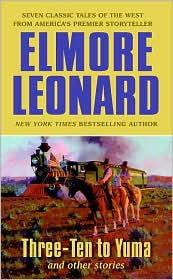
43. Three-Ten to Yuma and other stories by Elmore Leonard


If you want a good read with a strong moral backbone that will give you some feeling of righteous satisfaction, pick up any Elmore Leonard western. I snagged a bunch of his westerns last year and this sat on my on-deck shelf for a while before I finally took it with me on my trip to Amsterdam, thinking it would make for great plane reading. I had held off mainly because it was short stories and I tend not to like reading one after the other when I am at home. I was right about this being a great travel book, because I devoured it and even convinced my wife to read one of the stories (Jugged, in which a young kid gets thrown into a cell with a serious criminal), which she quite enjoyed.

Each of these stories was a little snippet of life in Elmore Leonard's wild west, where scary violent men are everywhere but someone with a bit of grit and courage and the will to do what they think is the right thing can sometimes just win out. Skills and training are also important here, almost to a heroic level, where one man can size up another and know he is an expert by how still he is. Really good stuff.

Monday, September 27, 2010

42. The Black Arrow by Robert Louis Stevenson


I picked up this book in the Eastern Townships at an antique shop among a mostly complete collection of Airmont Classics paperbacks. It was a beautiful collection in great shape, but this was the only one that interested me so I took it out from its brethren. It had been there for quite a while and I doubt a collector was going to pick up the entire thing. I hope not because I left the book at a bed & breakfast in Amsterdam for some other lucky reader to find.

As a kid I read and was read to Kidnapped and Treasure Island and loved them. The Black Arrow is an adventure that takes place during the War of the Roses. The hero is Richard Shelton, a young knight under the rapacious and immoral knight Sir Daniel Bracklely, who unbeknownst to Shelton was responsible for the murder of his father. The politics are confusing at first (especially since everybody keeps changing sides) and the language is written in I guess what is a 19th century american interpretation of 16th century British country jargon. It's very rich and fun to read, but much slower to read than what we are used to today. It makes me wonder if Kidnapped and Treasure Island are written in a more straightforward manner, because I remember having no trouble as a youth parsing the dialogue. It took me about a third of the book before I really caught the rhythm and style of the language, but then I really got into it. It makes for fun reading and also demonstrates how much we have lost in today's Orwellian and Strunk & Whitian straightforward style.

It really is a rip-roaring adventure with a moving romance at its heart. There is lots of great bow & arrow action, excellent woodsman skills and intriguing political machinations. This is just rock solid stuff that many of today's writers (especially of action screenplays) could benefit from. It's also motivated me to look up Kidnapped and Treasure Island and re-read them as an adult.