Friday, July 22, 2011

43. The Crocodile on the Sandbank by Elizabeth Peters

This was an okay mystery with a great premise that got undermined somewhat by the narrative.  The premise that is so great is the heroine, Amelia Peabody, a feisty and headstrong Victorian woman, who embodies all the values of the British Empire, but is somewhat restricted by doing so in a female form.  She is really a great character and you want to read a bunch of stories with her poking her parasol at men who don't behave like gentlemen or berating poor egyptian shopkeepers who try to get one over on her.  Even better, about a quarter of the way through the book, she befriends a younger, extremely beautiful "fallen" woman and for a while I thought we were going to have a sort of Aubrey-Maturin type series, but with women.

Unfortunately, the mystery they get involved in isn't all that interesting.  It's about sabotage that goes on at a dig for Egyptian relics.  It was okay, but not mindblowing, though the interplay of the various personalities was entertaining.  Even worse, the book ends with Lady Peabody and her new friends situations both being resolved with marriage.  The series does go on, but I guess it is now Peabody and her husband, which seems okay, but, to my mind, kind of undermined the vibrancy of the original premise.  It is a well-loved series and I would be curious to hear if my concerns are wrong.  I wouldn't say no to reading another one in the series.

Why do all of the books I read have to be in series?  It's endless!

Wednesday, July 20, 2011

42. The Hunger Games by Suzanne Collins

I happened upon the jacketless hardback copy of The Hunger Games at one of the bed & breakfasts we stayed at in PEI.  It was on a small shelf of books that other guests had left, which you could take or add to.  Such a great tradition.  I had been meaning to read a few of this new generation of post-apocalyptic youth fiction since reading a survey article in the New Yorker about it.  I guess the Hunger Games is one of the most popular series from this new wave and they are going to make a movie based on it, which is already getting some buzz.

This was a page turner and a really entertaining read that both me and my wife had a hell of a time putting down.  The only false note was the inner thoughts of the protagonist concerning the various boys in her life. They seemed muddled and unrealistic and at times were slightly annoying intrusions on what was otherwise a tight and exciting ride.

I'm not going to bother with a synopsis, as I suspect we will all be hearing about it when the movie comes out and many of you may have already read the book.  What struck me about it is how much it reminded me of John Christopher's young adult science fiction, in particular the Tripods series.  Both books are about adolescents in an authoritarian society who are forced at a certain age to participate in a competition run by the society's masters.  In Collins case, it is the Capitol.  In Christopher's, the tripods themselves.  In both cases, an exemplary adolescent, who is the protagonist, will end up being the key that will undo the tyranny that rules their world.  I wonder how much Collins is aware of Christopher's work and if we will get any comparisons in the popular media.

These books are short, with big type, so I'll most likely read the rest of the series.  It's possible, though, that with the amount of other reading I have head of me, I may just let someone tell me what happens.  In any case, I approve of these kinds of books being popular and being made into movies.  It suggests a renewed skepticism by the current generation, something the western world badly needs after the betrayal of my own generation X and the lameness that has since followed.

Tuesday, July 19, 2011

41. Anne of Green Gables by Lucy Maud Montgomery

Since we were in PEI and our next stop was Cavendish (the area upon which the Avonlea of the books is more or less based and now a major tourist center), I rushed through 20,000 Leauges and made sure I'd be reading Anne of Green Gables when I was there.  It turned out to be no problem to finish this book before we even left Cavendish, as it was a very enjoyable read that kept me turning the pages.

I can see why this book is so loved.  It really does grab you at the heart right from the beginning, when simple bachelor Matthew Cuthbert goes to the train station to pick up a male orphan to help with his farm chores and instead finds loquacious, imaginative Anne.  The rest of the book are short episodes of her slowly integrating into the community and the home of the Cuthberts, into their hears and of course into generations of readers.  What I really enjoyed about this book is how the uptight people are portrayed.  They aren't really all that uptight.  Usually, in western literature, whenever we have an overly artistic person in an uptight environment, the uptight people are super freaky and end up winning and we all have to feel tragic about it.  Here, the uptight people are actually okay in the end, but just a bit focused on practical matters due to their rough existence.  Ultimately, they are warm, accepting people and come to love Anne, sometimes despite and sometimes because of her foibles and differences when compared with the rest of the community.  I'm tempted to say that this element is what makes this book so Canadian.  It reminded me why I chose to lean on my Canadian side in life and politics, though I fear with the neo-con cultivation of selfish suburban values, that temperance and fair-mindedness is slowly being drained out of Canada.  We are being sickened by the same disease that is currently ripping America apart.  I recommend a re-read of Anne of Green Gables by every Ontarion that voted Conservative in the last election.

I can also totally understand the Japanese love for this world.  Anne's imagination is so animistic and colourful, where every living thing is actually some conscious creature, that it reminded me of a movie like Paprika or Spirited Away.

I will probably continue to read the series if the next one falls into my lap.  I'm tempted to watch the television series as well.

Sunday, July 17, 2011

40. 20,000 Leagues Under the Sea by Jules Verne

I have read that the popular english translations of Jules Verne's work were quite badly done, with large chunks taken out of them that were not deemed of interest to the english-speaking audience, or possibly even prejudicial.  Nonetheless, I couldn't resist picking up this beautiful old paperback version two summers ago at an antique shop (where I found also The Black Arrow amidst an entire set of these Airmont classics that I felt a bit guilty for splitting up).  It has sat on my shelf for a year and I finally thought our long vacation in the Maritimes would be a good time to read it.

The trip turned out to be perfect as 20,000 Leagues is extremely nautical, as are the Maritimes.  So while I was reading about a fantastical voyage through the world's oceans, I was also visiting seafaring museums, passing famous historical maritime locations and dragging my feet through beautiful tide pools of the southern Prince Edward Island shore.  You can see why Verne's books were so popular among the boys of his time and later. They are true speculative, escapist adventures, but based on what fact they had at the time and more or less reasonable theories of the way things might be.  20,000 Leagues is basically the answer to "what would it be like if we could explore the oceans of the world in an awesome submarine."  There are all kinds of cool explorations and neat little adventures.  They get stuck under the South Pole, get into a battle with giant squids.  They get to look at fantastic ranges of sealife and plants (these sections, done in that 19th century style of science that was mainly concerned with categorizing stuffs, are kind of tedious) as well as cool locations under the water.

There is a more psychological and political theme lurking under the surface of this colonialist adventure and that is Captain Nemo's fierce hatred for the rest of the world.  It frames the book, but is really only touched upon.  I wonder if some of that text is what was lost in these translations?  Ecology is also a bit of a muddle here, where sometimes Verne seems to delight in the wholesale slaughter of creatures and believes the earth's abundance is limitless and other times he laments man's excessive consumption of certain types of species.

I'm glad I've finally read some Verne.  I would like, at some point in the future, to read a proper translation of whatever is considered either his most interesting or most representative work.

Thursday, July 14, 2011

39. The Fourth Durango by Ross Thomas

This is my third Ross Thomas book now, after the masterpiece that is The Porkchoppers and the enjoyable but (for me, at least) slightly flawed The Fools in Town are on Our Side.  I'm very happy to report that while it is still not quite at the level of the Porkchoppers, The Fourth Durango is still a great read and renews my faith that future Ross Thomas books will deliver.

It's funny because for once, both the cover blurbs do a really good job of describing what you are going to get with this novel (and from what I've read Thomas's work in general).  The front cover says "a master of the arabesques of storytelling" (Washington Post) and, if I understand the word arabesque correctly, that is exactly what you get in this book.  The difficulty in describing the plot of a Ross Thomas novel is that it usually isn't delivered to the reader in its entirety until you are about halfway through the book.  He tends to go backward and forward in time, revealing more and more layers of the onion (and given the corruption and criminal histories of almost all of its characters, it definitely is a smelly, tear-inducing onion).  In the Fourth Durango, a once succesfuly state supreme court judge is released from prison after a bribing scandal that ruined him.  His lawyer and son-in-law meets him and they head to the small, forgotten coastal town of Durango, California.  There, through a complex set of shadowy connections (I believe this is an arabesque), they meet the mayor and the chief of police.  The town's economy is basically dead and the two town officials have a thing going where they hide people out for large chunks of cash, which is then pumped into town services.  The mayor has won three elections in a row.  Oh yeah, the ex-judge and his lawyer are clearly threatened due to loose ends left over from the bribery scandal that put the judge in jail in the first place.

The other blurb on the back says "Thomas' heroes are heroic without being good" (USA Today).  This holds very true in the Fourth Durango.  Nobody in Thomas' world is unaware of the corruption and realpolitik that is the reality of politics.  They all have rich backstories, which are quite often a combination of weird life twists and turns mixed with a certain toughness of character that allows them to take advantage of those twists and turns.  For instance, the mayor and the chief of police were actually part of a busload of young hippies who ran out of gas in Durango and decided to stay.  I'll let Ross Thomas fill you in on the rich and sordid details of how they got from that origin to their current positions of power.

An element that I really enjoyed in The Fourth Durango is how 80s it was.  Somehow, I considered Thomas to be more of a 60s and 70s guy and expected some of his perspective to be dated.  I probably should adjust that expectation, because this book, written in 1989, was quietly and convincingly of its time without being stuck in it.  A solid, enjoyable read for grown-ups who like their steak rare.

Monday, July 11, 2011

38. Meet Me at the Morgue by Ross MacDonald

So last week, I read a Margaret Millar book.  She is my new favourite discovery, but I feel I should give some time to her husband as well, Ross Macdonald.  I'm not quite sure how it all works today, but there was a while where Ross Macdonald was one of the biggest writers of detective fiction, often spoken of in the same breath as Raymond Chandler.  I have only read one of his books, that I can remember, and I can't remember that as well.

Meet Me at the Morgue takes place in a town a little ways north of San Diego.  The protagonist is Probation Officer Howard Cross.  He gets involved in a complex kidnapping because one of his clients, the driver for the family whose boy is taken, appears to be the kidnapper.  However, the driver was very close with the boy and the whole thing smells so Cross starts to dig deeper.  The plot is very complicated, but quite well constructed.  What I really enjoyed about the book was that Cross does some real detecting.  He just keeps poking away at people and things until a new path reveals itself and then he goes down that.  Slowly, a bigger picture starts to reveal itself, as well as Cross's competency and character.  He's quite a tough guy, presaging, I guess, Macdonald's famous Lew Archer character.  This is some hardboiled stuff and everybody is kind of flawed and rotten and California is hot and edgy and deadening.
The Neptune Hotel stood in the limbo of side streets between the neons of the business section and the dark waterfront. Its own sign, ROOM WITH BATH, $1.50, flickered and went out and came to life again like a palsied lust.
  I was actually really enjoying the straightforward language for the first third or so and feeling a bit that at times Chandler got excessive with his language, and then passages like the one above started popping up with greater frequency.  At times, it went just a teeny bit too far for my personal tastes.  Another big flaw for me was the forced love interest that develops between Cross and one of the suspects.  I felt like some editor pushed this on Macdonald (or he pushed it on his story in anticipation of the public or some editor).  It didn't ring true and was distracting.  Howard Cross, hard-boiled probation officer is just fine on his own melancholy driven self.  This diversion only took a few pages though and really doesn't damage what is a sordid, engaging tale.  This stuff is the real-deal, though, hard-edged, noir.  I'm definitely going to be reading more Ross Macdonald. 

Saturday, July 09, 2011

37. Banshee by Margaret Millar

I'm so happy to have discovered Margaret Millar.  She is a great writer with a dark side who enjoys going deep into the ugliness and weakness in people's personalities.  She isn't quite as relentlessly pessimistic as Patricia Highsmith and her explorations feel more colourful.  When she is looking at darkness, though, she really doesn't flinch, so though her style and content is more colourful, I really get the feeling they shared a very similar perspective on humanity.  It's too bad that I had to "discover" her, because in her time, she was a very popular and respected writer.  I wouldn't be surprised if she sold more books than Highsmith.  It's funny that Millar isn't getting the same kind of respect today.  She deserves a line of beautifully-designed reprints with fawning introductions.  I wonder if she had moved to Europe would she perhaps be getting the Highsmith treatment today.  Instead, she spent the last of her almost 80 years living happily with her husband Ross MacDonald (for whose success she was in a large part responsible) in Santa Barbara.  Oh yes, she is also Canadian.  So basically pretty awesome.

Banshee is the story of a young girl in a small, wealthy California community whose body is found in the forest near her house after having disappeared for several months.  The book begins with one short chapter that gives us a brief picture of the girl's life before she died, a happy one with two dogs, parents, grandfather and a maid who love her; an architecturally-designed playhouse and a big forest to explore with her older cousin.  The real story of the book begins with her funeral, where the minister, whose wavering faith was finally broken by the little girl's murder, decides to team up with her dad to finish the job the police could not.  There are two narratives here, the investigation and how all the characters around the girl are coping with her death.  There are a lot of damaged, flamboyant and weird characters in this world and some ugly relationships between them. We get to go in deep.  Part of Millar's skill was that she could really lay out a character in a subtle but satisfying way without a lot of text.  A hushed discussion between the well-groomed Mr. Cunningham and his alcoholic mother during the funeral takes two pages and uses a variety of techniques (dialogue, inner thoughts, other character's perspective on them) and the reader gets a lifetime of codependency, guilt and failed expectations.  Quite impressive!

Millar can be manipulative, but she never does it dishonestly or with trickery.  But she does parse out information in such a way that if you are trying to solve the mystery, you can start asking yourself meta-questions, like why she puts a certain piece of info about a certain character in a certain spot.  It makes the reading of the book quite enjoyable, because while you are engrossed in this rich cast of characters and wanting to learn more about their dark secrets, you are also trying to pick apart Millar's structural choices. I guess this is what makes a book like this much more of a mystery than a crime book.  Beast in View is still my favourite book of hers (and I would argue a masterpiece of psychosis), but Banshee is still really quite good and probably my next favourite so far.  Happily, I have several more of her books on my on-deck shelf!

Wednesday, July 06, 2011

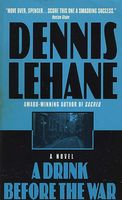
36. A Drink Before the War by Dennis Lehane

[Wow, is June ever going to look bad on my year-end graph! I was really on a tear there and then I slammed right into a brick wall known as the Grand Roludothon, a local tabletop gaming convention that was quite fun and got me all fired up for RPGs again. All the time I should have been working on my record-breaking 50 books year these last three weeks, I've been reading rich and interesting roleplaying game texts (especially in the sci-fi realm) and talking about them on the internet. It's good stuff, but I never read them from cover to cover so I can't really justify counting them in my 50 books challenge. I also was stuck on a C.S. Forester book of short stories that I thought was a novel at first. Plus, summer has come and one spends a lot more time outside, socializing and walking the neighbour's dog. So those are my excuses. Now back to your regular scheduled programming.]

I really enjoyed Shutter Island and since then have spent a lot of time keeping an eye open for Dennis Lehane's other books. I was wary, however, of his Kenzie-Genarro series. When I flipped through them, they seemed less focused somehow and more generic. I finally broke down when I found this one for a buck at the always fruitful Chainon thrift shop. Somehow in this current reading drought, its paperback best-seller design suggested to me that I wouldn't be struggling to read it and so I chose it from my now nearly full on-deck shelf to get me back on the virtuous path.

My instincts were correct in both sense. This was an enjoyable book, but not anywhere as special as Shutter Island. It reminded me very much of a lot of detective fiction that I read in the late 80s and early 90s (the Spenser books being probably the best example of that period). It was also very easy to digest and a page-turner.

The main detective is Patrick Kenzie. His partner, Angie Genarro, is hot and tough, but improbably married to an abusive husband. They both come from rough backgrounds and work in Boston. They are hired by a powerful state senator to track down an employee in another senator's office who left with some damaging material. Their investigation leads them quite quickly into the poor, black neighbourhoods of Boston and the criminal element thereof. There is a lot of pretty hardcore violence in this book, several shootouts with automatic weaponry, car chases, beatings. The story is good, with a nice range of places and characters. It lays the social issues on pretty thick. Most of the time, these critiques are woven into the narrative and descriptions, but in a few instances they become blatant and really take the story off its rails (such as when the white Kenzie and his black newspaper editor friend have a racially-charged argument; zzzzz). It was Lehane's first book, so I will forgive him. I assume things get subtler in future books.

The other slight flaw was the character of Bubba, who is sort of like the Hawk character from Spenser, except not intelligent and less central. What he is is a total simpleton badass who hates everybody except the two detectives and thus is able to protect them from any real threat for most of the book. It's a nice fantasy, but a bit too overblown in what is supposed to be a fairly realistic milieu.

But I'm nitpicking. It's an enjoyable read, fast-paced with enough intrigue and character that you definitely want to find out what happens. I'm not rushing to read the next in the series, but if they fall in my lap, I will not say no.

Tuesday, June 07, 2011

35. Dirty Tricks by Michael Dibdin

Well I tore through this book! A very clever and enjoyable black murder comedy that puts Dibdin back up to the top of my charts again (after the less enjoyable Thanksgiving). The book is written in the form of a confession by a British expat living in some unnamed banana republic pleading for his innocence to avoid extradition back to Britain for murder. His argument, convincingly told, is that while he is guilty of many crimes and ethical lapses, murder is not one of them.

His story is an enjoyable one, told by him with a joie-de-vivre and certain objectivity (that becomes more damning as the book goes one). He is a member of the educated, upper classes who spent too long not making practical decisions and ended up still living in a shared, rented flat ("digs") and teaching english as a second language part time. He ends up meeting a bourgeois couple with terrible taste and social ambitions and almost accidentally begins to have an affair with the wife. Things get more complicated, leading to the protagonist being the center of at least two murder scandals and having to find various convoluted ways to get out of the hot seat. In doing so, his true moral core slowly reveals itself to the reader. He starts out as a slacker, quickly shows himself to be a cad, then a bounder, eventually a sociopath and finally to really just be straight out evil at the very end. It is all quite subtly done and the reader is carried along, sympathizing with the protagonist quite far into his bad behaviour so that you catch yourself realizing, holy shit this guy is truly awful!

The major theme of the book and the justification for his behaviour is the massive cultural shift in England during the Thatcher regime. The protagonist spent a lot of his younger life in the 80s living and working abroad and when he came back, he found the traditions of English class hierarchy cast aside for a new, aggressive, capitalist society. Worse, he was now in last place in this society. The narrative arc is as much about the protagonist adapting to the new society and finding a shortcut to finding his proper place, first financially and the socially: "I wanted the lifestyle which other people of my age and education enjoyed but which I had forfeited because of the wayward direction given my life by the humanistic propaganda I was exposed to in my youth." That gives a pretty good sense of the tone.

This was a highly enjoyable read. Dibdin really was a skilled writer as well as having a great perspective on the world. Faced with the bleakness that is post-Thatcher England, he responded with humour. Great stuff.

Monday, June 06, 2011

34. Gridlinked by Neal Asher


I borrowed this from my brother-in-law, for whom reading science fiction is one of the few little pleasures my sister allows him. He tends towards the higher end of the spectrum, but every now and then will delve into the more populist fare, such as Gridlinked. I was looking for an easy and entertaining read and so I grabbed it. I was highly skeptical of the "Asher has lit up the sky of science fiction like a new sun" blurb on the front cover, but felt that I would get a fairly good cyberpunk bang for my buck here.

I'm being lazy, plus quite busy, so I'll quote the wikipedia page for the plot summary:

The novel follows the exploits of Earth Central Security agent Ian Cormac, as he attempts to discover who or what is behind the destruction of the Runcible on a remote colony. Cormac drops an investigation into Polity separatists on Cheyne III, and takes the starship Hubris to the ruined world of Samarkand to directly oversee the investigation there. Having been directly "gridlinked" to the Polity A.I. network for too long, Cormac has been slowly losing his humanity, and takes the opportunity of this particular mission to disconnect and solve the mystery the old-fashioned way.


My reading has finally slowed down, so it took me a week or two to get through this. I do blame the book a bit for this, as the plot tends to drag on a bit in the second half. The overall plot is not all that innovative either, being basically a military adventure. However, the trappings of the future galaxy and all its tech are really quite cool. I'm not even sure I would really call this cyberpunk, though it definitely has such elements. I particularly liked the portrayal of the AIs (that are basically the human government at this point) as well as the existence of miniminds in things like weapons.

It was an enjoyable read, but I felt could have used some tightening up. If you are hungry for this kind of super hi-tech sci-fi, Neal Asher is not a bad way to go at all. I suspect the series will get better and more interesting as it moves forward as well, so I would probably pick up the next book if I find it for cheap.

Tuesday, May 31, 2011

Old Time Radio interlude: The Voyage of the Scarlet Queen

I'm a big fan of Old Time Radio (OTR as it is known online), going way back to my childhood. When I was a kid growing up on Vancouver Island, I had an insatiable appetite for any kind of fantastic narrative. We did not have a television (which was probably a good move by my parents, looking back) so I read a lot and listened to the radio a lot. One of my favourite things was on Wednesday night on CFMI, an otherwise mediocre AOR light rock station, they had one hour of comedy followed by one hour of classic radio shows, usually two of a half-hour each. I don't know what was the impetus behind this programming, but I am grateful for it, as it gave me so much entertainment. I used to record the shows on cassette and still have a case of recorded cassettes in my parents basement. The Shadow, The Whistler, Suspense, Gunsmoke, Boston Blackie, X-1 were on regular rotation. Each episode (really even just the intro) pulled me into another world. I don't know if it is a function of the medium itself or nostalgia, but even today those shows have a power on me that goes far beyond even the most awesome 3-D movie spectacle, an ability to really make me feel like I am in another world.

I also mention the great CBC, which used to also play them on weekend afternoons from time to time. Sometimes we would listen to them together as a family while making lunch or just hanging out. I think it may have been part of The Mystery Project, but I'm not sure.

For the longest time, getting one's hands on OTR episodes was quite hard. You could buy cassettes of them, but they were really expensive. Later, when CDs were the standard, they still seemed hard to come by. I understand there was a whole network of people who used to trade them. Sometimes you could find used cassettes for more reasonable prices at used bookstores.

Enter the internet. In the last 10 years, everything has changed. You can find pretty well every existing old-time radio show online in .mp3 format. There are also several podcasts that will deliver them to you on a regular basis, sometimes with some great background info such as The Radio Detective Story Hour (though I wish the host, Jim Widner, would chill on the spoilers in his otherwise excellent and thorough introductions).

So I've really been in pig heaven when it comes to old-time radio shows. A friend gave me a DVD that had literally hundreds, including entire series and I went hogwild for a while. But I also listen to many different podcasts on the regular and they soon crowded out my OTR listening, except for the aforementioned Radio Detective Story Hour (and of course the top-notch Decoder Ring Theatre podcast, which is a show produced today, but done in the spirit of the old-time shows; highly, highly recommended).

Which brings me finally to the title of this blog: The Voyage of the Scarlet Queen. For some reason, I never came into contact with this great series until a few years ago, when I saw it mentioned on a game designer's blog. Checking around, I found it had an excellent reputation and the set-up certainly seemed right up my alley: it's the tale of a freighter ketch, the Scarlet Queen, and the adventures her crew gets in during their voyage around the South Seas and mysterious Orient. It was considered a big budget show at the time and was a big succcess, though considered a bit broad by the critics of the time. The show's producer and also the actor who played the lead character, captain Philip Carney was Elliott Lewis, a pretty succesful player in the radio game back in the day.

Each show begins with the captain's log, which is actually written after the events in the show, just as the boat was leaving that port, thus giving a hint to the adventure to come. Though each episode stood alone, it had an overarching plot. The Scarlet Queen was on hire to one entrepeneur Kang, who was in a race to find these ancient Chinese treasures worth $10 million. There was his evil counterpart, who was constantly working to undermine the Scarlet Queen's mission.

What inspired me to write about it, is that I have been listening to the 33-episode series slowly over the last year or so. I have to admit that around the 15th episode, they started to blur together a bit. But yesterday, while on a long walk with the dog, my interest was piqued again, as I listened to several episodes in a row and realized that they were actually wrapping up the overall narrative about the Chinese treasures. There was a three-episode arc (episodes 19-21) where they actually did that! It was very cool. I've never encountered a radio series that did that and I found it very satisfying. In the following episode, captain Carney goes on to his first mate how great it feels that they can now just go wherever, do whatever without any long-term guiding rules. I suspect this is exactly how the writers felt as well! I'm curious to see how it plays out in the next dozen episodes or so, if they will all simply be one-offs, if they will start on a new longer-term adventure or if the old one will come back again.

It's a great show, with excellent production values and rip-roaring adventure in farflung ports of the Pacific, rife with mystery and intrigue. If you like that sort of thing, I definitely recommend it. You can find them all here:

http://www.archive.org/details/VoyageOfTheScarletQueen

Also, here is a great website that contributed to my knowledge of the series and its production history:

http://www.digitaldeliftp.com/DigitalDeliToo/dd2jb-Voyage-Scarlet-Queen.html

Thursday, May 26, 2011

33. Arcadian Adventures with the Idle Rich by Stephen Leacock


Several years ago at my grandfather's funeral, I was admonished by a friend of the family's for not knowing who Stephen Leacock was. "He's Canada's greatest humourist!" And these were French-Canadians telling me this! So I've had his name in the back of my mind for a while now and was happy to put down a dollar for this slim volume, to at least get an introduction to his work and style.

I didn't realize quite how far in the past he is from and was suprised to see that this book was written in 1914. It is a fictional portrait of a small northeastern American city (though I later read that many think it was modelled after Montreal). It isn't a single narrative, but rather a series of loosely connected vignettes, each one poking satirical fun at the hypocrisy of the ruling classes. This isn't laugh out loud funny, but it is quite clever. There is lots of great dialogue with the wealthy and powerful speaking with complete earnestness about how they support the workers revolution, all the while lambasting the waiter for daring to bring the wine slightly off-temperature. The central theme of the book is that capital is all powerful, but must be guised in the rhetoric of social and spiritual welfare. In that, it certainly seems relevant today and reminds me that the struggle between private and public wealth is an old one indeed.

I was a bit disappointed that this book was not explicitly Canadian, but learned that he deliberately made that choice to expand his audience and that much of his other work, including the classic Sunshine Sketches of a Little Town, does take place in Canada. I shall keep my eyes open for that one for sure.

Wednesday, May 25, 2011

Spring bonus: my wife reviews Richard Stark's The Hunter

Though I am constantly ranting and raving about Richard Stark and Parker at home, I can honestly say that I never actually tried to encourage my wife to read any of the series. We also have a neat little tradition where she buys me 3 or 4 of the new University of Chicago Richard Stark reprints for my birthday in January, which I've been re-reading and blogging about here. So I was quite excited when she asked me one day if I thought she would be interested in reading one of them. She explains why she turned her head towards the best series of books ever in her own blog as well as giving a thoughtful review of the first book. You can read it here.

Now let's see if I can get her to read the entire series! ;)

Tuesday, May 24, 2011

32. Spectrum 3: a third anthology of science fiction selected and edited by Kingsley Amis and Robert Conquest

I tend to avoid short stories and anthologies in general, but I picked this one up because it has some classics in it and is edited by Kingsley Amis, whom I had learned not long before stumbling on this book was a big defender of science fiction in a time and place when it was truly treated with disdain by the literary set. The introduction to this book is pretty aggressive. Amis goes after a few named critics specifically for their ignorant and snobby derision of the science fiction genre. So as a small artifact of the early literary history of science fiction, this was a nice find. The stories themselves were also quite good, though suffering (at least for me) from some of the lack of depth that comes with the form. The stories range from 1945 to 1960 by the following authors: Theodore Sturgeon (it was his Killdozer! that really drew me to buy the book; it's about a bulldozer that gets taken over by malevolent energy and starts killing everybody), J.G. Ballard (meh), Poul Anderson, Mark Rose, Peter Phillips, Murray Leinster, Alfred Bester (his Exploration Team was my favourite, about an illegal settler with a team of three uplifted kodiak bears and an eagle eking out survival on a deadly planet) and Arthur C. Clarke.

If you are interested in some of the best names of classical sci-fi and want to get a good sampling, I would definitely recommend you pick this up (or any of the other Spectra, I suspect, that Amis and Conquest edited). Good stuff.

Tuesday, May 10, 2011

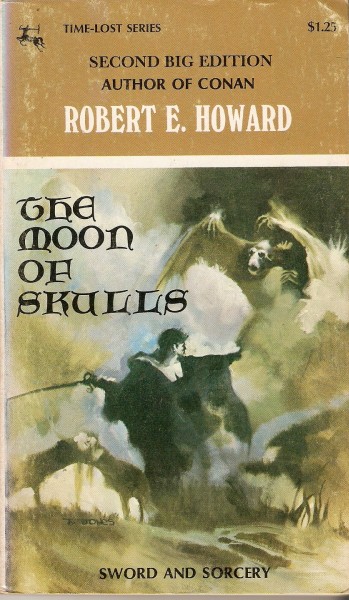
31. The Moon of Skulls by Robert E. Howard

I picked this up at a flea market in Oakland. I'm a big fan of Robert E. Howard, but most of his work is like maple syrup: you don't want a big bowl full. Most of his work are short stories, so I only tend to read a story at a time. The Moon of Skulls is a perfect set-up, with one long novella and two much shorter stories, featuring the 16th century Puritan warrior, Solomon Kane. Kane is english, but spends most of his life in dark, adventurous places like central africa, uncovering the occult remains of ancient civilizations while battling off evil and savagery.

What I notice about Kane is that he does a lot of walking. He's constantly moving forward, ignoring warnings about travelling through the swamps at night, climbing straight up mountains, charging through lines of slavers. He's very puritan about his forward momentum. The plots of the stories are quite minimal, the last one almost seeming like a vignette. It's the rich atmosphere and robust energy that makes Howards' writing so great. Kane seethes with fury at injustice and when captured, his hatred for his slaver captor is so potent that the sheikh physically recoils. Here is how tough he is:
Even when they had him stretched out and piled man-weight on him until he could no longer strike with fists or foot, his long lean fingers sank fiercely through a matted beard to lock about a corded throat in a grip that took the power of three strong men to break and left the victim gasping and green-faced.


When reading this, I really wonder how Howard's writing would have evolved had he not killed himself. He was a prodigious writer and had an imagination large even for the pulps. I suspect he would have kept on experimenting and done some really interesting work.

Monday, May 09, 2011

30. Curtains for the Copper by Thomas Polsky

I feel like The Lantzvillager gave me this book, but I can't rightly remember as it has been sitting on my on-deck shelf for the longest time. A combination of concern over the physical state of the book and a lack of anything particularly compelling in the mystery kept me putting it off until now.

It's a light, slightly implausible, story-heavy but kind of entertaining urban mystery set in a nameless town somewhere on the east coast. The protagonist is a sort of hero reporter who seems to have extremely high status such that he can order chiefs of police around (this is the unrealistic part) named Grid. A young, promising police officer on the beat is shot in a doorway in Night Town, the bad part of town. The murder is made to look like a suicide, but Grid knows different and starts to nose around, unravelling a complex situation involving graft, kidnapping, drug pushing and a pretty large cast of characters.

I'll say this, that while I felt the book went on a bit too long and took too many twists and turns, the mystery itself was rather well thought out and made logical sense within the world of the book, such that you the reader were challenged but actually had a decent shot at figuring most of it out. So I did respect the work that went into the book at the end. On the other hand, I also learned that despite my love of narrative, even for me there can be too much story. Things keep happening in this book but after a certain point, I just wanted it to be over. I didn't care all that much about the characters and though the setting was kind of neat, more things happening meant me waiting longer to find out what really happened.

It's a neat looking book with a beautiful illustrated cover. The icons in the background are continued on the inside first page, which makes for a nice touch. It also is one of those books that came with a map, which while not really necessary for solving the murder really helped me to understand the geography of Night Town, where most of the book takes place. More maps in books please! I've scanned those pages in if you are interested.


Thursday, May 05, 2011

29. The Gamekeeper by Barry Hines

What a great book! The Gamekeeper vaults to the top spot of the books I've read so far in 2011. I know its early days still, but it is going to take some competition to unseat this book. I would almost argue that, within its limited category (documentary fiction?), it is a masterpiece.

I can't even remember where I found it, but the price on the upper right corner says I only paid a dollar for it. It's been sitting on my shelf for a couple years now, tempting me. I was both strongly attracted to its subject matter but also quite nervous about its dangers. It's the story of a gamekeeper on a Duke's lands in Northern England in the '70s. I was quite excited about reading about the nature of the work, the setting and the social relations. My fears were that it would either be masochistically self-pitying throughout like some British works from that period or that it would have some terrible turn of events, such as a brutal and forced change of lifestyle for the worse for the protagonist or some terrible cruelty to animals. I'm sensitive about these things and generally won't read books where I know that the plot hinges on those elements. To me, it is a form of pornography for certain readers who get off on feeling others' pain. I have nothing against pornography, it's just my kind of literary pornography involves capable men dealing efficiently with difficult situations.

I actually had this trepidation throughout at least the first half of the book. It wasn't until I was very close to being done that I realized, with a great deal of satisfaction, that Hines was not going to pull any kind of narrative trick to force an emotional response. On the contrary, by simply telling the story of a year in the life of a gamekeeper, he elicits a powerful sympathy to the plight of the working man and lays bare the utter insanity of the hierarchical social system in England. Even that social argument is delivered subtly and really only comes out at the end. Most of the book is a beautifully written and detailed account of the life and work of a man whose responsibility is to raise pheasants and grouse in a privately-held forest in Northern England so that the owner of the land, the Duke, can come and shoot them once a year.

I would not recommend this book for everybody and I recognize that a part of my appreciation for it is that its subject matter touches on so many of my own personal interests (the pastoral countryside, self-sufficiency, British class relations). Nevertheless, I can definitely argue that this is an excellently-written book. The descriptions of the land, the sounds, the colours and the activities will take you away from whereever you are and put you right in that countryside. He also describes geography, interior layouts and technical procedures (how certain traps work, the different processes for hatching pheasant eggs, the cleaning and loading of a weapon) with a facility that makes it easy to picture and understand for the layman (as well as making it interesting and engaging even for someone who may not care about such details). The book has no chapters, with sections separated by double spaces, and it just flows from one activity to the next. The focus of each section is what the gamekeeper is doing, but it includes all the small side details and especially the human element.

George Purse, the gamekeeper in question, is stoic, hardworking and conscientious about his job almost to a fault. You learn that he took the lower-paying job to get out of the steel mills. He has an equally hard-working wife and two boys. They live in a small cottage on the property that isolates them socially from the families that live together in the council housing estates. His job is to raise as many pheasants as possible and to do this he captures them every year, mates them and oversees the hatching of their eggs. He also encourages wild propogation as well. He has to constantly battle against predators such as foxes, rats and crows and he goes after them with a cold efficiency and a nation's memory of tricks. He also has to fight against poachers, who hunt the birds to supplement their own meagre income or for their dinner table.

There is a lot of subtext about who has the right to the land. I don't know if the situation is still the same in England today (this was written in 1975), but it seems insane that there are huge tracts of country that are solely dedicated to the hunt. This argument, I suspect, is a big one in Britain and I will do some research into it later. On the other hand, these gamekeepers take very good care of the land (though in a very controlling way that emphasizes pheasant growth over all the other creatures), probably better than if nobody or private interests owned it. The contradiction of spending a year taking great care of these birds only to have them massacred is not lost on George either.

And the hunt itself really is weird. I've heard of beaters before, but I never realized how totally lame this entire method is. Basically, a bunch of aristocrats show up (these are called Guns). Each has a loader who has prepared their two guns. They go into a butt (a little hut) and wait. The beaters walk in a line, beating the ground and trees, driving all the birds forward so that they come out in a clearing and the Guns just start blasting away. Once they shoot, the loader hands them their second gun and re-loads the first. This goes on intensely for 45 minutes or so until the beaters come up to the butt. Then they take a break, pick up the hundreds of dead birds and start from the other side. There is some skill in aiming and firing steadily, but otherwise, for the Guns, this is not even something I could honestly call a hunt. It's really just a shooting gallery.

I note that there is an economic element. The Guns all get some birds to take home and the host cooks up a bunch for their meal, but the majority are sent to markets and restaurants all over Britain. I think there is a traditional day as well, the Twelfth, when people dine particularly on pheasant. The whole operation from beginning to end is so work-intensive and involves such a complex hierarchy of labour and money that it can only exist in a society that is firmly entrenched in its rigid social structures. You can see hints of these structures finally starting to break down in the book: the land that was once all owned by aristocrats is going over to industrialists, the beaters organize a minor strike for a raise, schoolboys tear down some butts (which is seen as an act of pure vandalism, but is actually misguided political will). And every now and then Hines will juxtapose the incredible wealth of the upper classes with that of the men that serve them. A single hunting shotgun is worth far more than several years of George's salary for instance. The shotgun was given to a landowner by his tenants as a gift for his 21st birthday during the height of the depression and massive strikes in Britain.

I did some reading on Hines and he is considered to be a part of the Angry Young Men movement of Britain in the 60s and 70s. It's not super obvious from The Gamekeeper, but you get hints of it. I suspect in his other novels the politics are much more apparent. His first is about a working class athlete who conflicts with the system (sounds a lot like The Sporting Life) and his best known about a working class boy who can only relate to a bird of prey he tames. Based on the total success of the Gamekeeper, I'm very curious to read more of Hines' work, but I'm a bit freaked out about the others being not as subtle as this one. If anybody else is familiar with his work and has some recommendations, I'd love to hear them. In any case, a great book.

Tuesday, May 03, 2011

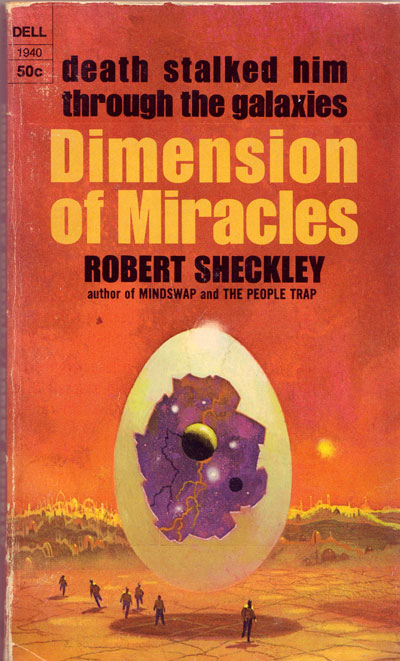
28. Dimension of Miracles by Robert Sheckley

This was the third and final book in the stash I found hidden away at my job. I have never read anything by Sheckley, but have since learned that he was a very successful, popular and critically-acclaimed science fiction author who eventually became the managing editor for Omni magazine. Dimension of Miracles was written in 1968 and while I respect this kind of science fiction, it really isn't my cup of tea. These guys wrote in a period when ideas were more important than story and they really do have a lot of cool ideas, but without a strong narrative, I find myself getting distracted often.

This book, for example, is ostensibly about a human from 1968 New York who is mistakenly given a galactic prize. The mistake is that only species who are able to travel about in space, time and dimensions are eligible to receive this prize. Tom Carmody, is thus left adrift in space time whatever where he received the prize having no idea of how to get back to his right place time and version. Furthermore, because of the universal law of predation, by being taken out of his own place in the hierarchy of eaten and eater, Carmody has now a predator on his tail whose sole raison d'être is to eat him.

It kind of sounds like fun and the back and front cover copy make you think of some kind of world-spanning chase. [As an aside, this is one thing I don't get about sci-fi publishers from this period. They always had the most abstract, trippy cover art that never had anything at all to do with the content of the book juxtaposed against the most blatant, lowest-common-denominator copy. Why were they willing to be all speculative and creative with the cover art, but completely pandering with the copy?] Instead, as I had expected, we get an excuse to put the protagonist in many different situations where ideas of philosophy and crazy science can be discussed. He meets a god who is the sole inhabitant of a planet and stuck in an existential crisis. There is a builder of worlds (who reminded me a lot of Slartibartfast), who built earth on God's request and wanted to apologize to him for cutting corners. We go to super-consumerized Manhattan where everybody talks in advertising jargons. We meet an intelligent city whose nagging personality has driven away all the citizens. And so on. Some of it was clever. This book reminded me a lot of Hitchhiker's Guide to the Galaxy in its tone.

But ultimately, it all kind of fizzles out because there is no real storyline and I'm not super concerned about the fate of the protagonist as it seems kind of random to me anyhow. It's not a bad read and it fired off some synapses in the lazier parts of my mind, if you enjoy this period of science fiction. It has helped me to get a better sense of what elements of that period I do and don't enjoy.

Monday, May 02, 2011

27. The Rare Coin Score by Richard Stark

Well what a delicious tonic that was! After the bummer that the last book I read was, I needed something to cleanse the palate and though I felt it may have been a bit too indulgent, I also knew the Stark would deliver, so I went right to the next Parker book on my list: The Rare Coin Score.

I have definitely read this one before, but I have never owned a copy, so it is possible I had only read it once before, because I barely remember any of it, which is a great thing! The Rare Coin Score is an important book in the series because it marks a significant transition in Parker's romantic life. He meets Claire. I have mixed feelings about Claire and the role she plays in Parker's life. Though early on in the story, I became worried about how Parker was behaving, this is nevertheless a great heist story, from beginning to end, arguably in the top 5 of the series (though I'll need to quantify such a claim at some point).

The book begins with Parker at loose ends, not financially, but psychologically. He has money and really should be laying low after all the heat generated by the heist of the gambling island of Cockaigne in The Score. But he's restless and nervy and wants to work. Bedding a series of different women in party towns does nothing to calm the restlessness either. So when he gets a call from an old colleague about a job to hit a rare coin collector's convention, he goes for it, even though the finger man is a complete amateur his contact is fresh out of the joint and too desperate. Even more out of character, Parker hooks up with the woman who is behind the finger man and keeps hooking up with her during the planning of the heist!

Stark justifies this change in Parker's traditional patterns through both Parker's own psychology and Claire's intrinsic qualities. It makes sense for me how Parker, as cold as he is, still has a need for an intimate partner in his life. But I remaink somewhat skeptical about Claire's character. First of all, she is kind of a cipher. All of Parker's interactions with women are filtered through the cultural mores of the mid to late 60s as well as Parker's own particular way of dealing with them (basically telling them what's up as bluntly as possible, waiting for them to come on to him and then accepting or rejecting as the case may be). So Claire doesn't get a whole lot to say and what she does say is made up of those weird curt little phrases that seemed to pass for relations between the sexes in the '60s. She does demonstrate a strong will when dealing with men she doesn't want and she knows her role and plays it cooly in the planning phase.
She was a good woman, good to look at and good to be with. Sensible and independent. Not full of foolishness. [page 72]


You don't get a whole lot more than that, but it's enough for me and for Parker. Where I get skeptical is when shit gets violent, Claire totally freaks out. She actually goes into a state of severe shock, first catatonic and then talking childish nonsense. The end result is that while she is ethically completely okay with Parker's method of supporting himself, she herself can't stand to be anywhere around it. I'm not quite sure exactly what it is, but I don't totally buy it. She understands from the beginning the implications of what she was getting into and is totally cool about it, but somehow the violence when it actually happens totally freaks her out. Wouldn't there be at least some trepidation about that beforehand? The extremes just strike me as being too far apart in the same person and that, coupled with their stilted conversations, result in me never really feeling like I have a grasp on who Claire is. I will investigate this further in the forthcoming books.

I would like to point out another staple of these books: Parker reading some new acquaintance and implicitly judging him (usually correctly). As the reader, you can almost always tell who is going to be competent and who incompetent by Parker's initial impression of their physical appearance. Here is new heister Jack French when the string is first introduced:
He thought French looked all right; lean and rawboned and self-contained, maybe thirty-five, with level eyes and an expressionless face. French said, "Good to know you," and sat down again.[page 15]
Among other things, it's the levelness that is important to Parker, both physical and mental. Not only is his body self-contained, but so is his speech. No need for a joke here or any other verbiage. Just a greeting and let's get down to business.

Same with Wemm, the black sign-painter working at the shady auto-body shop who has been given the job of doing the fake lettering on the side of the getaway truck:
He had the self-contained movements of a man about to be asked to show how good he is, a man who knows he is more than good enough. His hair was gray but he had the face of a young man. [page 62]
(note to self: spend week practicing being self-contained). I think the gray hair and young face is also an indicator of Stark's world view: the positive combination of physical youth and mental wisdom. First impressions do count and Park can judge a book by its cover.

Finally, I am going to share two more great Westlakian metaphors with you:

Billy was at his most nervous, looking around like a possum coming out of a hole. [page 72]

When he saw Claire, a surprised smile creased his face, looking strange there, as though it had been delivered to the wrong address. [page 73]


That's Ninja-level writing right there.

I have distracted you all with some side analysis because I don't really have a lot to say about the meat of the book, which is the heist, its planning and execution. I don't have a lot to say, not because there isn't a lot to say about it but because it really is just much better for you to go ahead and read it. I can talk about those beautiful ribs on the bbq, how the sauce was made, how long I smoked it for, and so on, but wouldn't you rather just dig in? This is a good one, that's all you need to know.

Friday, April 29, 2011

26. The Menorah Men by Lionel Davidson

Though the copy I found at Chainon had a very contemporary cover, the book was originally published in 1966 and was touted as being a classic action thriller in the mode of Deighton, LeCarré and Innes. Also, it was about a lost artifact and took place in the middle east. Right up my alley, so I took the risk. After having read it, I found that Lionel Davidson was quite succesful and though he only wrote around a half-dozen books, they were all big sellers and got excellent critical reviews.

So I don't know if the Menorah Men is a particularly bad example of his work or if his success was more a reflection of the time than any particular quality he may have had as a writer. Because this book was really not very good. From the very beginning, I struggled to get through the language, which was convoluted and overly clever. I couldn't even really figure out what the hell was going on there was so much innuendo and half-references. Just tell us that he is at a party and where and who the people are that he meets. I guess if you are a super pro, you can take your writing to that level, but Davidson was not there when he wrote this, that's for sure. I don't know if I got used to his "style" or if it toned down, but after the first 50 pages, I was able to actually get into it.

And the thing is, Davidson is actually a pretty good writer, when he stopped trying to be all 60s cool. His descriptions of the desert are quite evocative and there is a scene near the end, where two lawyers go at it, that was quite thrilling. But even if the whole book had been clearly written, it wouldn't have mattered, because the protagonist is such a prick. I mean I get the idea of the slighly boorish action hero or the normal guy in the wrong place surviving by his wits. But the hero here spends the whole book basically date-raping the hot Israeli soldier that is assigned to him (and of course she gives in and loves him by the end), being basically constantly drunk and even more so when an important military action has to go down and being completely disrespectful to the locals and religious people (barging into a synagogue on the sabbath and demanding some guy to open a store because he needs a map now which he could have waited for).

The story is about the search for a lost fabled Menorah that represented the spiritual wealth of the Jews after they were massacred by the the Romans. There is some neat history and the present day stuff is a cool set-up, with conflicts between archeologists and developers, Israelis and Jordanians at the border and artifact smugglers. The location is great. But the story meanders (the thrilling legal debate being the high point of the entire book is testimony to that) and when you don't hate the protagonist, you really don't give a shit.

Sorry, Lionel Davidson, maybe your other books kick ass, but I'm going to need someone whom I respect really argue that for me before I pick one up.

Sunday, April 24, 2011

25. Monsieur Monde Vanishes

The Simenon roman durs are everywhere! Monsieur Monde Vanishes, along with one other, was lent to me by my basketball-watching buddy. He's an intelligent fellow with quite specific tastes and we have a bit of a cultural exchange going on. Some things have worked and some haven't, but we definitely share an appreciation for Simenon's cold, distant gaze at humanity.

Monsieur Monde Vanishes, is, as the title explicitly states, about a man who decides to just leave his life. He is a successful industrialist with a distant wife and a distant son. One day, he just doesn't go home after work, instead taking out some cash from the bank, selling his tailor-made suit for an off the rack (gasp!) and wandering around Paris until he finds a dreary hotel. He seems to equate the working and lower-middle classes with some kind of freedom or at least with having something that he longs for. It's never explicitly stated what drives him, because even when he does succeed in truly leaving his old life behind, he still seems disconnected, at least from other people. Yet he gains some satisfaction from his adventure and there is some internal change in him. Whether it is for the better or the worst is hard to say. It ends on a very dark, inhuman note.

It's a quick and interesting read, with a rich immersion into some great Paris milieux, such as a casino and a poorer class of hotel where he lives. It makes you reflect on success and what it means to be alive and with other people, but perhaps not in the most optimistic way. I think that this novel could probably be correctly called existential. It lacks the intensity and focus of some of my more preferred romans durs and so didn't blow my mind, but it was still a good book.

The book is part of that very nice line of New York Review of Books Classics trade paperbacks. Normally, I don't like the trade paperback format, but these have a somber tone and nice spacing so that I quite enjoy their look despite the annoying size. However, in the case of this book, I find the cover image to be inappropriate. Monsieur Monde is described as stout, with an almost boyish body. The tall thin guy on the cover looks to much like what a North American would expect a french businessman to look like.

Saturday, April 23, 2011

Spring Bookshelf re-org


I don't know what got into me, but I was overtaken by a powerful compulsion to create a fifth shelf for my paperback collection. My quartet of Archives Canada solid maple bookshelves all had 4 levels on them and that does seem to be the amount they were designed for. I've known for a while that I could theoretically fit a fifth shelf and I have the boards already finished, but I was never quite sure that it would actually work. The issue being that the gradation between the little pegs that support the shelves is about an inch and I wasn't sure that if in actual practice 5 shelves would actually have enough space to fit books of a paperback size.

Unfortunately, I got so into the job that I completely forgot about taking any pictures until after I was done. As you can see, my theory was correct, unfortunately, I had to segregate out trade paperbacks. Only on the bottom shelf (where I just can't bear to separate my old Parker paperbacks from the new University of Chicago reprints), is there enough space for anything taller than a standard, classic paperback.

I also had to sacrifice my rolepaying games shelf, which was quite a tall one on the bottom. I was quite proud of that, but most of the books on that shelf are for games I'll most likely never play, so I am going to sell a bunch and then consolidated the rest with my (also tall) comic book shelf.

Here are the major advantages that have resulted in my work: 1) I have much more space to grow into, as you can see and 2) all my paperbacks are on the same shelf unit, as opposed to divided across two. So while I am very happy with the change, it isn't without some small regret. Sometimes you need to get tough in order to move forward!

Thursday, April 21, 2011

24. You'd Better Believe It by Bill James


I picked this up purely on a whim during a nasty, rainy evening that drove me into the warm interior of S.W. Welch's. The depressing weather spurred my consumer appetite and I bought this book and one other (a nice penguin Hornblower) despite my spreading on-deck shelf. I was drawn in by the thinness of the books, the setting of criminal urban england and the hard prose. My instincts were not off as Bill James is an excellent discovery. It turns out he is quite well known and respected in the U.K. for his various series of "Welsh Noir", this one being the first in the best known, Harpur & Iles, of which there are 22 books!

In You'd Better Believe It, detective Harpur is the main protagonist, a frazzled, but driven cop whose personal morality is revealed to be questionable at best in the first pages as he is portrayed making a play for one of his subordinate's wife. The plot centers around a tip-off about a big bank robbery that is supposed to go down. The job is delayed and during the wait, big time players come into Harpur's smaller seaside city and start ruthlessly killing informants ("grasses" as they are known in this milieu) and a police officer (the previously mentioned subordinate). Caught between a bureaucratic and politically-nervous administration and a poverty-stricken society, Harpur has to act often on his own.

The story is decent, seemingly quite realistic, but without a lot of suspense. The milieu is top-notch, as is the language. This is the hard, ruthless Britain where human culture is limited to dark humour, alchohol and a few good boots in. It's funny, because the plot and procedural elements were not dissimilar to the world of de Gier and Grijpstra, but the cultural level was just so different. Let's just say that I would much prefer to be a police detective in van der Wetering's Amsterdam than James' fictional Wales.

A great find. From what I've read, this series gets richer and I'm looking forward to seeing that happen. Though my on-deck shelf doesn't!

Tuesday, April 19, 2011

23. Hard Rain by Janwillem van der Wetering


Hard Rain is the fourth and last of the pile of Grijstra and de Gier procedurals a friend of mine with a child dumped on me. I found all four to be really enjoyable and it is a series that I would always be happy to return to, but at the same time, I am quite happy to have these four off of my on-deck shelf.

Hard Rain was published in 1989, but other than the use of a computer modem, things don't seem to have changed much in the world outside of the Amsterdam murder squad. Amsterdam is still a fairly rough-and-tumble city, with a lot of drug abuse and petty crime. However, inside the squad, serious corruption is taking hold. At the beginning of the book, the Commisarius, who is Grijpstra and de Gier's boss, is coming back from a "relaxing" vacation, when he learns that the director of a bank has killed himself. The principal shareholder of the bank is an old enemy of his. He also learns that this investigation, as well as several others, have been bungled or shut down by the commissioner in charge during his absence.

This time, the Commisarius, who is in really the main protagonist of this story (and for that matter, referring to these books as the "Grijpstra and de Gier Series" is inaccurate as the Commisarius and Constable Cardozo feature just as much as those two; it should really be called "the four cool and incorruptible guys in the Amsterdam murder squad series"), goes "off the reservation" with his team. Together, using unorthodox methods, they strive to take down the evil banker and the internal corruption. Along the way, there are the usual philosophical and slightly absurd conversations about life, work and art. There aren't quite as many interesting Amsterdam locales and locals in this one, but there is more focus on the Commisarius himself, which is pretty good as well.

Also, it's interesting that the Commisarius's first name is Jan and his main rival the banker's first name is Willem while the author's first name is Janwillem. Maybe this means nothing if you know a little something about Dutch nomenclature, but I noticed it, in any case.

One more good entry in a solid and enjoyable series.

Monday, April 18, 2011

22. Black Camelot by Duncan Kyle

In honour of Louis XIV's ascension to role of official Archivist for the British Library, I decided to go back into my own collection and re-read one of the few books that I have a first edition copy of (at least I think I do; I'm never quite sure of these things): Duncan Kyle's WWII espionage thriller Black Camelot.

[To stop being facetious for a moment, it really is a cool thing that the British Library found Existential Ennui and recognized it for the value it is providing. Nick Jones has been steadily posting about some great but relatively unrecognized genre authors of the 60s, 70s and 80s. He hunts down rare editions of the books, researches their publishing history with a special emphasis on their design and covers. These are books that never received the archival respect they deserve because of their commercial or genre-based nature but in hindsight, today we see a lot of art, culture and history in them. All of us genre fans always appreciated these works and recognize their contribution to culture. It is great to see that institutions like the British Library recognize that as well and it is thanks Nick's hard work that this information will be preserved and made accessible to more people.]

I have always enjoyed Duncan Kyle's work, but in my mind I always consider him a poor man's Desmond Bagley. Such a ranking is probably not just and I think that it's based more on Bagley being more consistent and prolific as well as having excellent marketing support during the height of his popularity. (Although reading this great post about him with layouts of all his Fontana covers suggests I may be wrong about the marketing part; perhaps it was only in Canada that he didn't receive the distribution of Bagley.) I had suspected for a while that I need to go back and re-read both Bagley and Kyle to re-assess how I think about them and this read of Black Camelot has helped reinforce that notion.

The cover of my book is awesome, showing as you see here, a nazi officer hanging from a rope surrounded by fire. This does happen in the book, but it takes such a long and circuitous route to get there that I was doubtful it would even happen at points. That route is quite enjoyable and shows Kyle's skill at weaving a rich narrative and his knowledge of espionage and crime. It also reveals a pretty hard cynicism that gives this book a dark edge.

Conway is an Irish reporter based in Stockholm in 1944. In neutral Denmark, he is able to get stories on the situation in Germany. One of his tricks is to wait for the flight from Berlin and get his hands on the German newspapers before his rivals do. He happens upon SS officer Franz Rasch, who has been sent by his superiors to deliver some papers that they hope will sow division between the British and the Russians. What Rasch doesn't know is that he is set up to be condemned as a traitor and deserter to make the story seem more authentic to the Brits and Russians. By fluke, Conway helps Rasch out, figuring out what is going on, they devise a blackmail scheme.

I don't want to give away anything more, so I'll skip out the details of the circuitous path, but the novel climaxes in an assault on the famous (and real) SS castle Wewelsburg, which Himmler created to be a spiritual center for Nazi mythology. According to the novel, it also contained a room full of Nazi intelligence files, both damning for the Allie as well as many leading Nazis (Heydrich, who assembled the documents, gained his political strength by having dirt on everybody). It's these documents that are the target of the raid.

This is a great book. It's got a little bit of everything you could want in a WWII thriller: espionage, nasty domestic crime, internal politics at the top level of both the Allies and the Nazis, awesome Nazi fanaticism and it is all topped off by an action-packed finale. The really strong points that made me raise Duncan Kyle in my ranking are a couple of asides where he describes the histories of two successful British businessmen and how they could have supported the Nazi movement. They were very realistic and rich, a few pages that encapsulated how easy it is for men to be sucked into evil. Their stories could easily take place today in slightly different contexts.

Wednesday, April 13, 2011

21. The Crystal Cave by Mary Stewart

It's so strange that I had never heard of this book until my friend Castaway, man of good taste and fruitful loins, blogged about it in his now defunct 50 books blog several years ago (having triplets is a good excuse to stop with the blog, I'd say). I say it's strange, because it was an extremely popular novel and one that would have appealed to my adolescent self for sure. And we were exposed much more to British reading trends in Canada. In any case, I'm glad I found it, because it really was an engrossing and entertaining read and informative as well. (Appropriately, it was part of the minor treasure haul of old books I found high up in a storage room at my job.)

I will explain the informative part immediately, just to make it clear that I recognize this is a work of fiction, based on the Arthurian myths. However, I am so ignorant of this period of history that even the broad lines (about the back and forth between the various British tribes and European tribes, notably the Saxons for control of the the island of Britain) were new to me and really interesting. It's a period I would like to learn more about.

But on to the fun! The Crystal Cave is about the life and rise to power of Merlin. He starts out in a royal house, the son of a queen, but neglected and threatened because he is a bastard, his father unknown, his mother refusing to reveal. In some ways, this is the classic story of the young underdog rising to become a hero. What makes this book so enjoyable is the twist in that classic setup. Merlin's growth to power is through the path of knowledge rather than physical prowess. Furthermore, his role is always to one side of the visible power, in support of the kings who will unite Britain and drive out the Saxons. As he faces challenges and encounters new situations, he learns. He learns medicine, engineering, history and many other practical subjects. Through practice and his own shrewd wit, he also learns politics and the manipulative strategies necessary to survive in these courts of intrigue. All this stuff in the book is immensely enjoyable (especially for the underdog nerds of the world, I can well imagine).

Another interesting aspect is the way magic is handled. It exists, but it is quite subtle and except for a few brief mentions of minor cantrips, is limited to "the sight" and entirely out of Merlin's hands. Partly through accident and later by manipulation, he uses the visions in combination with his own wiles to create the perception that he is a wizard of great power. What is interesting is that all the while, he himself is quite humble and almost passive. It makes for a strange hero. You definitely like him, but you also feel that he is almost a victim of fate at times. It makes for a strange hero.

The last third, until I made it to the very end, began to feel a bit episodic as well. The ending ties it altogether, but I felt it lost a bit of its overall narrative arc and became more about a series of historical advances made by the British against the Saxons and Merlin's role in them. They were nevertheless still quite entertaining and engaging episodes, but it wasn't until the end that it all made more sense in the greater narrative arc. Perhaps if one was already aware of the legend of King Arthur's origins (which this book leads up to and is neatly summarized in an afterword), it would have been clear to what end these episodes were directed.

Overall, a really enjoyable and absorbing read which brings to life this early period of British history, where a culture and civilization was rebuilding itself on top of the Roman ruins and in the face of the barbaric onslaughts from mainland Europe, onslaughts she would face time and time again, always displaying her mettle with that indomitable spirit the great island nation was built on (see what this book does to me!:)).

Friday, April 08, 2011

20. The Dying Earth by Jack Vance

I've been aware of Jack Vance for a long time, but never read anything by him or knew much beyond his influence on Dungeons & Dragons. The magic in earlier versions of D&D is often called "Vancian" in the sense that there are specific spells that have to discovered and learned and kept in spell books as opposed to other forms such as ritualistic or more free-flowing. There are adherents and opponents of this approach, but whatever your flavour, Vance's imagination had a lot of influence on the origins of fantasy roleplaying games.

We feed a stray tomcat on the back balcony and he tries to sneak into the house and leave his mark. He has hit us successfully a few times, the last being a quick blast on the bottom shelf of meezly's books. Bad scene, but she did a pretty good job of getting her books mostly rid of the cat pheremones, except for a paperback of The Dying Earth. I didn't even know she had it and considering her pretended abhorrence of roleplaying games (part of the secret unwritten chick code) it was quite ironic that she owned one of the classics of the genre and I hadn't even read it! I felt it was time to delve back into a bit of fantasy, so I picked it up.

As usual, these older paperback editions never represent the contents properly. This is one area where the world has improved. When you get a genre book these days, it is usually very clear from the publisher's info where the book fits in within the rest of the author's work and exactly what it is you are getting. Back in the 60s and 70s, it seemed like they always had to obfuscate and mislead, so you could never figure out what the order of anything was, which characters would be in it and so on. The Dying Earth appears to be a novel, but it is actually a collection of short stories, all but one loosely connected through characters but having no other greater narrative beyond that they all take place in some far future earth where the sun is a dying red giant.

There is both the remmants of great magic and great technology in this world. Everybody seems aware that the planet is dying and this allows for a certain melancholy and a certain decadence, which is a great mix for adventure. Many of the stories are quests, where a hero or magician learns of some lost knowledge and seeks it out. These frameworks than allow Vance to draw out wondrous locations and fantastic creatures. It almost feels a little bit like the original Star Trek series, in which each story brings us to a new cool milieu, sometimes even with a political parable. As one gets older, one becomes less interested in the fantastic and more concerned with the human, the character, the conflict. Vance's fantastic is pretty awesome though and I found myself enjoying it for its own sake. Little people that fly around on dragonflies, trading gossip and rumours for tiny bags of salt they hang from their mounts, a demon whose face is only able to penetrate into our world and attacks with his tongue and ghosts spouting from his nostrils, a wizard who shrinks his enemy and puts him in a maze with a tiny dragon as a form of endless torture. It's really cool stuff. Furthermore, the stories themselves are quite elegantly constructed, almost little fables, neatly constructed and just as satisfyingly concluded.

There are only three other books in the Dying Earth series, but most of the rest of his work is science fiction and mystery (which surprises me somewhat, considering his impact on D&D). I hope that at least one of them is an actual full-length novel, because I would love to see his talents in the form of a longer, more deeply engaging story. As it is, I wouldn't be averse to reading more of his short stories as well.

Tuesday, April 05, 2011

19. Murder over Dorval by David Montrose

Murder over Dorval is part of a new series of reprints called Ricochet Books put out by Véhicule Press, a Montreal publisher. Véhicule Press puts out a wide range of books associated with Montreal, including The Man who Killed Houdini, by my mother's cousin and Montreal chronicler, Donald Bell (which I'm ashamed to admit I stopped reading about halfway through; but I'll get to it!). The Ricochet Books are reprinting a line of Montreal pulp detective fiction from the '50s, which is just an awesome thing to do. These books are very hard, if not impossible, to find and they represent a tiny sub-genre of literature that should not be forgotten. They are also (at least judging by this one) pretty fun reads.

Murder over Dorval was an interesting book. On the surface, it's a pretty classic hard-boiled detective mystery, a bit derivative, a bit convoluted, but pretty fun with some hardcore badguys and a great set of locales. The language ranges from enjoyably rich to just too much ("her face was longer than a rainy weekend in the country"). To the fan of the genre, what will make Murder over Dorval distinct is the Montreal setting and the excessive drinking. The detective is basically wasted the entire book. What happened to Canada and alchohol? We still have great beer here, but good luck trying to get the proper drinks detective Russel Teed was putting back here. He's having a few beers for breakfast and just keeps going from there. Drinking and driving, drinking and detecting, drinking and getting his ass kicked. All in a day's work!

As a dual citizen, there was something else in this book that stood out for me, a kind of self-consciousness. It reminded me a lot of The Stringer in the way the protagonist is always telling us where he is going and who is there, trying almost too hard to assure us that things are happening here. At the same time, there is such a blind anglocentric perspective here that it makes for a weird mix. I always thought the anglo self-conscious that I encountered here was the result of being a minority, but I wonder if the Revolution Tranquille only influenced an existing solipsism. Again, it's all very subtle and such a reading could entirely be due to viewer bias, but it's a feeling I got.

I'm looking forward to the others in the series. The Body on Mont-Royal is out on shelves now and I'll be picking it up after I get through a few other books on my on-deck shelf. Brian Busby says it's the best of the bunch (how psyched would I be to find the original Harlequin version).

Oh yeah, physically, they did a really nice job with this book. A lovely full bleed cover with the original image and the ricochet logo nicely subtle. And though it goes against my environmental principles, I have to admit liking the quality feel of the paper and cover. It has heft for a paperbook. I'm also grateful that it is proper paperback size, not one of these lame "trade" paperbacks.

If you want it, you can buy it here.