Tuesday, March 14, 2023

24. The Dream Walker by Charlotte Armstrong

Charlotte Armstrong is another of those semi-forgotten and very good female mystery/thriller writers from the post WWII-era.  This is the last of her books that I had on my on-deck shelf after a concerted hunting effort.  I had been saving it but my 2023 focus is to reduce my on-deck shelf to zero if possible and to clear out books that have been sitting there for years (so I can buy more books!).

The Dream Walker has a novel approach.  It's not really a mystery, though there is a murder, as you know pretty much what happened in the opening pages.  The narrator Olivia, who announces herself unreliable due to the state of her health, is from a good family and an acting teacher at a girls school.  Her story is about a conspiracy to discredit her wealthy and influential uncle. The concept is relevant to today's world of disinformation.  A dissolute failson gets mixed up with a commie spy ring and it is the uncle who tips off the authorities.  By pure chance, the failson runs into a failed theatre director and together they cook up a plot with the help of two actresses to get revenge.  The idea is that one actress in New York will start passing out and having visions of herself in another place, speaking to a person in that place.  The second actress, disguised to look like the first one, actually is in that place and speaks to the person.  It is done subtly and cleverly so that it attracts little attention at first, but soon grows. The mystery that keeps you reading is exactly how this will involve the uncle.  The relevant idea is that even though many people will dismiss it as faked, it is enough to cause debate and controversy and thus doubt.

Alongside the conspiracy, there is a romantic angle, as Olivia's cousin (though not really as it is by marriage) is also investigating the visions.  This narrative I found less enjoyable and subtle as the mystery.  The cousins are always bickering and Olivia has this annoying mode of being constantly vexed by the cousin. You guess quite early on that they are supposed to fall in love and the bickering just seems odd.  I don't know, I wasn't feeling it. Her emotional insecurity contradicted her courage and cleverness in dealing with the mystery.  The climax was quite fun, with Olivia using her acting skills to turn the table on the manipulative playwright in an OTR/Suspense style that was quite fun.

So a bit of a mixed bag, but I'll give it a thumbs up for the innovative structure.


Friday, March 10, 2023

23. The Naked City by Stirling Silliphant

This was a fun, little read.  I started off thinking I was going to love it, as it had a sparse prose style, great NYC location (and love for the city) and a strong lead-in to the two main cops (the young recently promoted detective getting paired up with the hardcore but soulful vet).  It veered a little too sentimental as it went on and as it is basically the episodes written in short story format, it lacked the depth to make it truly fulfilling.  Nevertheless a quick enjoyable read that led me to the classic old school Hollywood career of Stirling Siliphant and some of his TV shows (including The Naked City which also started out as a noir feature that I want to see).

My favourite story here was SUsequehanna 7-8367 about one of the many young girls who came (and probably still come) to NYC to seek their fortune.  She installs a telephone, a big exciting step and the first thing she gets is a call from a girl asking for Larry who is then threatened and presumably murdered.  The cops believe her but don't make much of an effort to help her, so she goes out and starts investigating on her own.  It's a nice combo of cool legwork (she hunts down the telephone installer) and a spunky character.  It all ends a bit abruptly, but was fun nonetheless.  

I didn't know about Stirling Silliphant and actually have not seen very much of his large body of television and movie work.  But when you read his bio and credits, you can see how he significantly impacted much of the content I grew up on (he wrote for the Mickey Mouse Club which always had these weird adventure stories) and enjoy today.  He was from the elevated perspective on the common man school of writing and loved genre.  He was a friend of Bruce Lee and a big supporter of his career. One of those manly, cool 20th century hardcore writers.


Wednesday, March 08, 2023

22. Emergence by David R. Palmer

This was a real find.  I can't even remember where I first heard about it.  It had been on my hunting list for a long time until I found it at the excellent Fireside Books in Parksville, B.C. (well worth a visit; a huge and varied stock with many paperbacks and incredibly well-organized).   Emergence is a lost and well-regarded semi-YA post-apocalyptic novel from 1985.

I probably would have loved this book if I had known about it in my adolescence.  I still quite enjoyed it as an adult but some of the plot elements and an unwanted theme of sexuality were too apparent for me to appreciate it as some still do.  Nevertheless, it's a lot of fun, with some cool ideas packaged in a novel format.  11 year-old Candida is the narrator (for most of the book), writing in a journal in Pittman shorthand.  This gives it a clipped style, generally without the subject article, which is not pleasant at first, but you get used to it.  Furthermore, she is a prodigy, which I guess Palmer equates with being a nerd, because she has this very nerdy extreme logic approach to her life.  This is kind of cool, but also in light of the heel turn that nerds took with the internet, also feels unpleasantly tech-bro.

The tech-bro stuff gets really icky and creepy with the weird need for her to think about her sexuality.  It shows up briefly in her own thoughts, but then gets disturbing when she is propositioned by almost every male character she encounters.  These propositions come in these weird, pseudo-rational offers which is supposed to be justified because these are all this new super race of post Homo sapiens, so they are all hyper intelligent.  Today this reads as the horrible new nerd-reworking of classic mysogyny.  It would be bad enough if it were just the dudes doing it (the main one being this dude in his 40s) but the Candida character herself seriously contemplates negatively and positively in this weird "rational" manner which even moral issues aside, just seemed completely out of place for an 11 year-old, not matter how intelligent.  It felt like this was some kind of fantasy of the author to meet this hyper-intelligent, soon to be hot, 11 year old ass-kicker and want to have a romantic relationship but would of course respect her wishes (which she would rationally consider).  Gross.

Getting that unfortunate business out of the way, I can say that the rest of the book was quite fun.  The apocalypse was quite clever: a lurking disease bioweapon that is only triggered by low-level radiation so that it requires bombs to be detonated above the target which do no damage, leave minimal radiation but get everywhere so there is no escape.  The concept of a new species of human was cool as well and generally an elite highly-trained 11 year old girl driving around empty North America looking for other survivors was a lot of fun.

Saturday, March 04, 2023

21. The Case of the Sun Bather's Diary by Erle Stanley Gardner

I can't remember where I found this and it is somewhat beat-up, with a nice warp to it.  This curvature and the silver pocket book edge on the binding side, made me not appreciate the cover until I was about halfway through.  It's a great, classic 50s babe on the beach painting with really fun typography, as the title is the sun and I assume hand-done as well. 

The story starts out fun, with a woman phoning Perry Mason from a phone on the 17th hole of a private golf course.  She is completely naked and needs rescuing.  How she got in that situation is soon revealed: she lived in a trailer in a hidden area in the forest behind the golf course and enjoys nude sunbathing.  While out getting a tan, somebody stole her trailer and her car.  Well things get much more complicated quickly when we learn that her father is in prison for stealing $300,000 from an armoured car transfer.  She is convinced he is innocent, as there is only circumstantial evidence in what seems like an impossible theft, given all the security protocols (the package that arrived at the destination bank contained old cheques; somehow the money had been swapped out along the way or beforehand).  Oddly, she is quite flush as her car and trailer were both new and good quality and she has ready cash to pay Mason.  And she refuses to reveal where her money comes from.

It's a neat set-up as Mason (using Paul Drake) is trying to find out the whole story at the same time as the cops and perhaps one other party while the woman keeps disappearing and being involved in suspicious situations that seem to suggest her dad did steal the money.  Halfway through, one of the suspects of the original theft is murdered and Mason and his client are both potential suspects.

It was a fun read, though the middle with a lot of Mason asking Drake questions was a bit too tell-y rather than show-y.  Also, Perry Mason himself was kind of annoying with his letter and not spirit of the law tactics to bamboozle fiery D.A. Hamilton Burger.  It almost bordered on unethical.


Wednesday, March 01, 2023

20. Accordéon by Kaie Kellough

This is generally not my genre, but I thought I should get some local canlit read in my life.  This is an experimental "novel" (I think "book" may be more accurate) that is ostensibly about the appearance of the flying canoe in modern-day Montreal.  It is structured in sections of texts, each of which is no more than a page, some even being a single short paragraph.  The text is written by the "author" who is unreliable and whose identity keeps changing.  Next to most of the texts are notes by three editors from the Ministry of Culture who comment on the text and interact with each other.  They represent that benevolent bureaucracy from 20th century Canada with helpful interpretations but also suggesting some authority and rules.

The texts themselves are first person pastiches of all things anglo Montreal.  Reading them was kind of like taking all my quotidien Montreal experiences (including the people I see on the street and in stores and restaurants), blending them all up and re-ordering them into stream of consciousness rants from some guy in front of a Jean Coutu.  There is also the added idea of the Ministry, a department that is attempting to categorize and manage every aspect of Quebec culture.  This was a neat concept, but unfortunately for me, there was no real narrative and after a while I didn't see anything more happening than what was in the first quarter of the book.  Artistically, Accordéon does capture a time and place quite well, this weird limbo we anglophone expats in Montreal inhabit as well as the hauntings of the old Canadian federal bureaucracy.  However, I'm not sure to what end all this was done.

Monday, February 27, 2023

19. Hijack by Edward Wellen

I got this as a gift from a friend who hits up a neat comic and collectible store he discovered in the old garment district in Montreal North.  They have a small shelf of paperbacks which I've checked once.  It was curated with mainly fantasy and movie tie-ins; not much in the mystery genre. Worth keeping an eye on.

Hijack was a quick read, somewhat thin with a really great premise.  The language used was a little stylistic and at times it was unclear what was actually going on.  I realized afterwards that this had originally been a short story and you can tell.  There isn't enough depth of character for us to care about them enough so that I was turning the pages mainly to find out what happens (because the premise was good), but had little emotional investment.

It takes about a third of the book before the premise is revealed.  This is another flaw, because during the first third the author takes us through all these criminal machinations that are only somewhat interesting and kind of nerdy.  The mafia has a stake in a large electronics company that turns out to be furnishing equipment for a government space project.  The protagonist, a high-level mafia but not at the top, starts investigating.  We finally learn that they government has discovered that the sun will go nova within months and destroy the solar system, so they are hastily building a long-distance space station to take the leaders and their families to find a new planet.  The mafia decides to hijack the project and put their own people on it.  This is a great idea and it is kind of fun as they plan and actually do hijack it.  There is also a great twist that I saw coming (you may be able to as well).  So the last half was entertaining, but undermined by the lack of character depth and also that they didn't really push the premise to its limit.


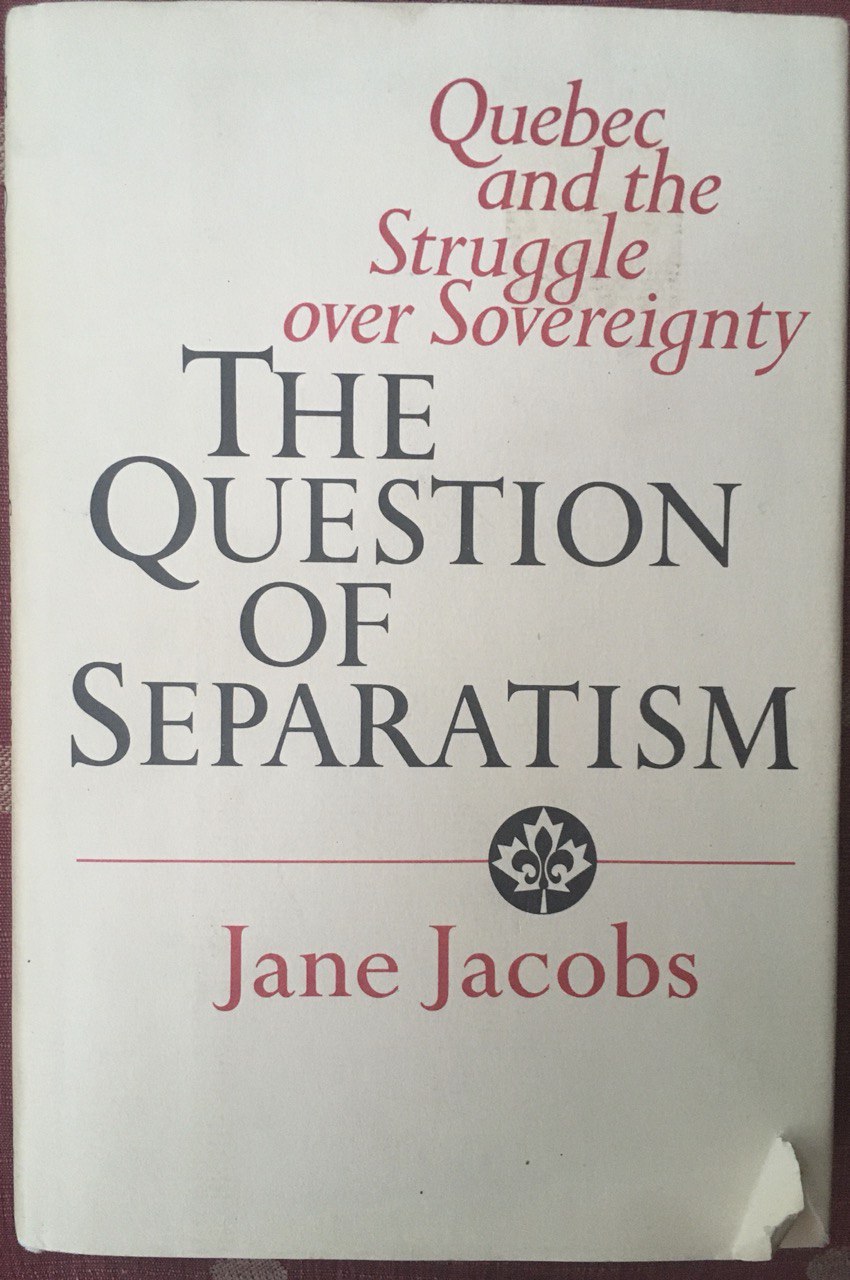
18. The Question of Separatism by Jane Jacobs

My sister brought me this book (a beautiful first edition hardcover) as she thought I would find it interesting. I approached it very defensively, I have to admit.  I am like every right-thinking person a huge fan of Jacobs work on cities.  I was concerned, though, that as a Toronto-ite who had as far as I knew had little experience with Montreal or Quebec, she would just be one more pundit weighing in on Quebec who had never actually lived in French Quebec.  Happily and to my surprise she sidesteps this issue entirely.  This book is basically an economic analysis of all the risks and opportunities to Canada and Quebec if Quebec were to separate. Her conclusion is that while there would be some potentially difficult areas, a true separation would benefit both countries.

The initial chapter is basically a call for rationality and to remove emotion from the discussion.  She calls out both sides, though is sympathetic and understanding, for making completely unrealistic arguments and statements.  She then makes a really interesting historical argument, demonstrating that Toronto had actually started outgrowing Montreal as the major economic hub of Canada decades before the Quiet Revolution.  This was a real revelation to me as the conventional wisdom is that the french took control, started imposing language laws and all the big companies fled, thus flipping Montreal and Toronto's status. Jacobs demonstrates how mining growth in Ontario and its investment in Toronto pushed the TSX past the Montreal exchange and started to move money from the big banks in Montreal to those in Toronto. 

She then goes into the history of Norway and its peaceful separation from Sweden in the 19th century.  This chapter was really interesting as well.  I didn't know any of it, particularly that Norway had neither its own true language nor a self-identified Norwegian culture until this period.  The next chapter she argues convincingly that big or small are not definers of an economy's strength and quietly and gently rips into Canada for using it's population size as an argument for why it's economy is so fragile.  She calls it a "colonial economy", dependent on resource extraction with minimal effort in developing domestic manufacturing and small and medium-sized enterprises.  This situation has improved somewhat since 1980 when this book was written, but not much.  This is why Canada is still so keen on fossil fuels and a relatively large emitter of fossil fuels.  Also why Canada, despite some positive examples like the videogame industry (in Montreal), is still lacking in innovation.  It's really kind of depressing how we lag behind small countries like Norway when we have all the same advantages and more.  The one thing we have that they don't is a culture of small-minded penny-pinching fear of change and a powerful cabal that works to ensure they have all the money.

Anyhow, it was quite a surprise to read that Jacobs was a proponent of separation.  But when you get to the end, she makes a strong argument for diversity and then it makes sense that she would support a separate Quebec.  She argues that despite the inherent limitations of our colonial economy, a separate Quebec would create an economic diversity (layering on the existing diversity of culture and language) that would benefit both countries.  This aligns with her arguments about mixed spaces in cities.  I wonder if this book was ever translated into french and how it was received in Quebec.  According to my sister, it was not that well received in english and that in general Jacobs post-Cities works, as is typical, were poo-pooed by the Canadian literary establishment.


Sunday, February 26, 2023

17. There's Always a Price Tag by James Hadley Chase

I am not a huge James Hadley Chase fan, though always on the lookout for different editions of his famous No Orchids for Miss Blandish.  I found a small set (I think 3) of these great Corgi super 70s photo covers with the excellent big font of his name and I had to have them.  So far his books are always entertaining, but also slightly mechanical and derivative, so I have been parsing them out slowly.  I'm on a reading roll this early 2023 and working on cutting down my on-deck shelf, so it was time.

The story here is told from the perspective of Glyn Nash, a smart, good-looking guy down on his luck in a dead-end advertising job in L.A.  He is sitting in a bar when he sees a guy stumble out and blindly walk into traffic.  Nash saves him from getting hit by a car and then offers to drive him home.  The man turns out to be Erle Dester, a famous once-successful movie producer who is on the verge of drinking himself to ruin.  He offers Nash a job as his chauffeur and dogsbody for quite a good sum. Nash is reluctant until he meets smouldering hot Mrs. Dexter.  Against his better judgement, he takes the job.  He soon learns why the house has no other servants, why most of the rooms are closed off and covered in dust clothes and why Mr. Dester is drinking himself to a stupour.  Mrs. Dexter, as soon as she learned that her husband had taken out a massive life insurance policy on himself in her name, became "frigid".  And now Nash strongly suspects she is waiting for him to die.  Even more against his better judgement, he decides to try and team up with her.

This is a very procedural and more complicated take on Double Indemnity.  We have the super smart, relentless insurance investigator, but he only really comes around late in the game when everything is already going to shit.  This isn't really a morality play and if there is any kind of deep theme it's that planning an insurance scam that involves murder (even if in this case, it doesn't actually involve murder) is incredibly complex and almost certainly will fail.  The enjoyment of this book is following Nash in his planning and then stressing along with him as little things keep going wrong here and there, each not enough to totally derail the plan, so that he keeps going along with it until things of course finally do not work out at all.  The fun part is that one of the crucial elements in the plan is to put Dester's body into a deep freezer so they can take it out later and fake the actual time of death.  There is a lot that is preposterous about this plan, but it is still quite enjoyably goofy.

The ending petered out a bit as he basically just gets caught (no spoilers because he foreshadows it at the beginning) though there is a minor ironic twist a little before the very ending.  

Also, I am not sure if it is me or if Chase was relaxing his American cover a bit by this time (written in 1958) but it felt more english in style to me.  First of all, I don't think anybody was called "Glyn" in America (nor "Erle") but mainly there was a "should" instead of a "would" in the first page.


Thursday, February 23, 2023

16. The Inconvenient Indian by Thomas King

I found this in a free box here in Montreal in beautiful brand new non-fiction trade paperback format.  I consider myself broadly but not deeply well-informed on indigenous issues.  My work engages with many First Nations and Inuit communites and though I am not on the front lines, I have benefited from several trainings.  More importantly, I grew up on Vancouver Island and my friend's dad was a fisherman who was really close with several First Nations communities, so I was exposed to their reality early on.  I also had a buddy in elementary school from the Reserve, though sadly he did not continue with his education.  My mother was the psychologist at the Nanaimo General and would come home and talk about how racist towards the First Nations they were there. All that to say that I didn't need to read this book to know how much we in Canada fucked and are continuing to fuck the indigenous peoples here and how deep and ongoing (and often sickeningly normalized) the racism towards them is here.

The other weird thing was that just after I picked this book up, there was some news item about how Thomas King had been revealed to not be a Cherokee after all.  That put me off from reading the book, but when I went to research it, it seemed to all go away quite quietly, though his bio makes it clear that he is "not tribally recognized".  This is a very tricky subject, but just look at the guy.  I'm not going to opine too long, as if there is a sin here it is if he somehow benefited from his being or claiming Indian to get a job that another Native American might have gotten.  There are probably deeper post-modern issues as well, but I suspect the guy's dad really was Cherokee but he was raised basically as a normal white kid while knowing about his dad's background (he was raised by his mother).  Anyhow, the point is that from what I can tell his work has done a lot of good in raising awareness at least.

I was also at first a bit annoyed by the breezy tone of the book, especially all the first person and references to his wife.  But once it gets rolling, that breezy tone makes the book (and its important info) very easy to digest and sometimes quite clever and funny.  He is an older guy and wrote mainly fiction, so I totally sympathize with his struggles writing this book.  I hate to say it, but I would have to use the term "important".  It delivers a solid and brutal list of all the various mutating ways the American and Canadian governments have systematically attempted to "Kill the Indian" since the European colonists first arrived.  What's clever about the book is that it frames it in the broader argument that it is basically all about getting the land (and the resources therein) and basically trying to eliminate the Indian as an annoying (inconvenient) problem blocking progress.  So you see all the various phases of government policy with different names and tactics but all basically boiling down to the same end goal.  His tone is light throughout and thank the Gods because even with that, it is some brutal and infuriating reading.

He does end on a somewhat positive note (though with many qualifiers), discussing the Alaska and Nunavut treaties.  As I read this, I can hear the pro-oil and logging fucks going on about the economy and jobs.  At what point do we take capitalism's cock out of our mouth and find a way to live on this planet without consuming every last molecule so we can have two cars and get likes on instagram?  This book is a strong reminder that we can create a world where our priority is well-being and not profit and a huge part of that is truly redressing the wrongs of colonialism giving power back to the indigenous people of the land here.

Tuesday, February 21, 2023

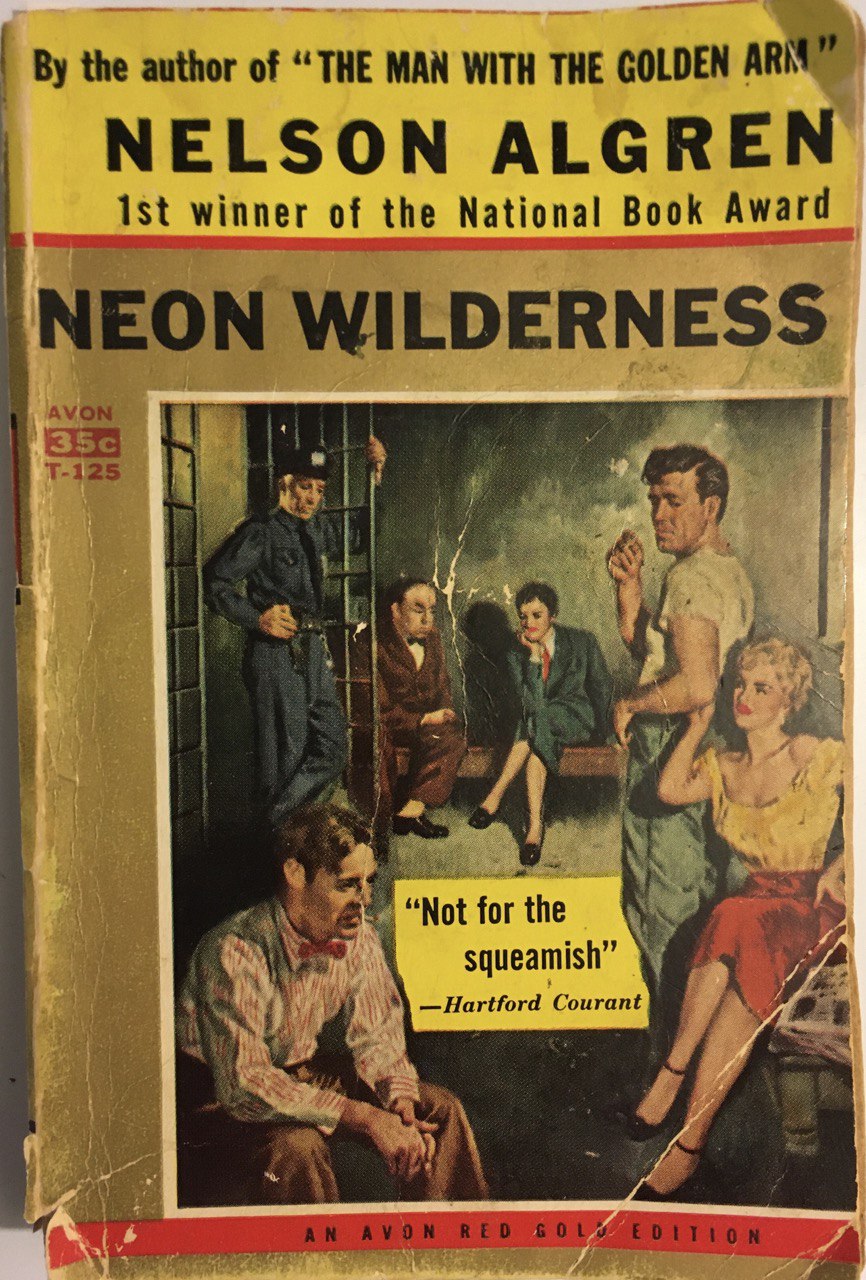
15. Neon Wilderness by Nelson Algren

I have mixed feelings about this book.  My first concern was that I was surprised to discover that it is a collection of short stories, not a novel.  My second concern is that though it is about criminals and the underworld (mostly urban) of the 30s and 40s, it is a bit too literary for me.  It doesn't read like someone telling stories, but rather someone trying to get some ideas and feelings off about downtrodden people or something. It's just not my jam.

On the positive side, Algren is a great writer.  The locations and situations of the petty criminals and losers of Chicago are rich and well told.  There is lots of drinking and fighting (his boxing scenes are really good; detailed and punishing). Prostitution at the lowest levels is standard work for most of the women characters.  The men are all stealing or up to some kind of scam.  Everything is quite depressing.  There are few scenes of redemption or happiness and they are of the humblest sort, such as the boxer who loses the fight he was supposed to throw even though he doesn't want to and learns that his girl bet all of his payout on him.  They lost it all, but are happy because they still love each other.  Most of the stories are just sad.

I think what bugged me was that deep down underneath all these stories, though they are portraying a reality that didn't tend to get written about in literary journals, are basically moralistic.  Nobody is going to get out of their situation and it kind of feels like they aren't supposed to.  They definitely aren't supposed to get any pleasure out of their lot.  I wasn't around in Chicago's poorest neighbourhoods in the thirties and forties and glad I wasn't but I do feel despite the poverty, there were probably moments of happiness and joy for the people lived there.  You wouldn't get that from Neon Wilderness.


Friday, February 17, 2023

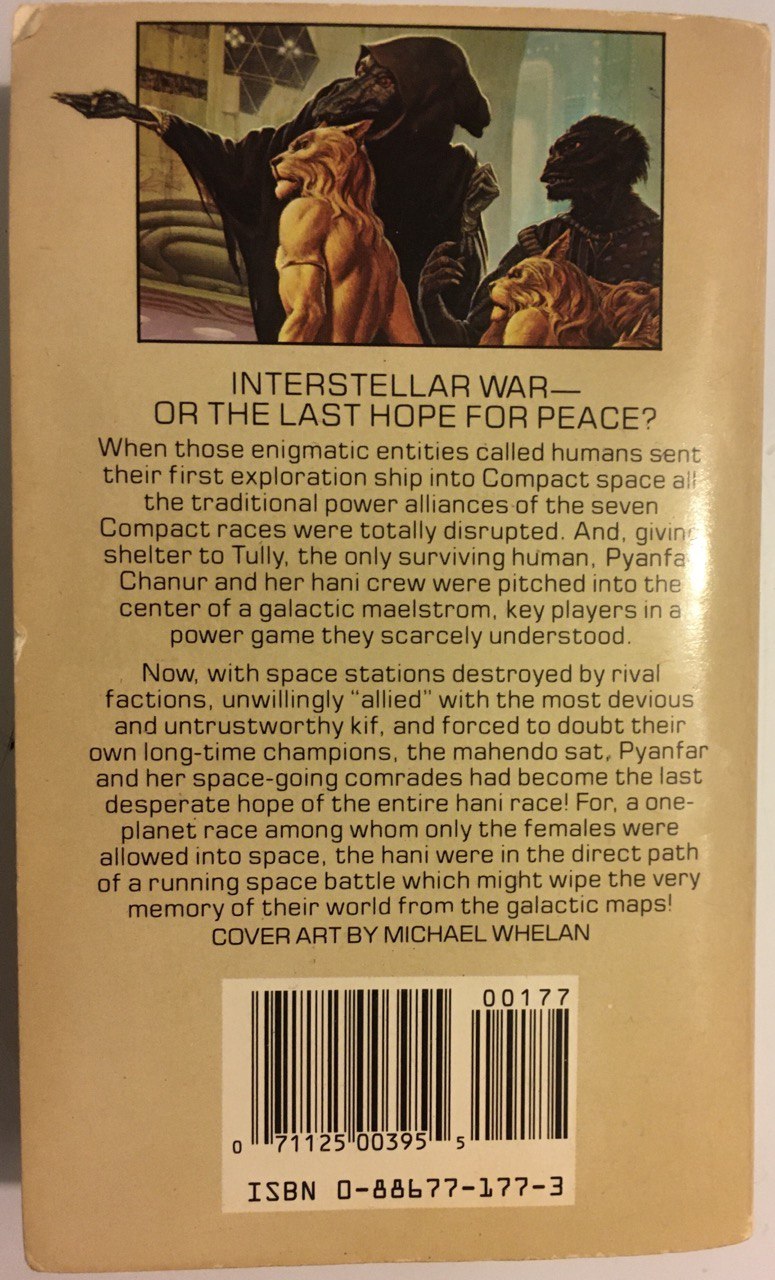
14. Chanur's Homecoming by C.J. Cherryh

This is the fourth (and penultimate) book in the Chanur series, which I found in quite good condition at Pulp Fiction Books in Vancouver.  Unfortunately, as usual, I didn't treat it so well as I carried it from Montreal to Berkeley to Austin and especially on the plane dinged up the cover and edges pulling it in and out of an over-stuffed backpack.

I really could not remember where we had left off from The Kif Strikes Back, but there is an excellent summary chapter at the beginning that not only lays out the previous storyline, but also gives good summaries of the various characters and species.  Still, it took me a good 80 pages of the first 400 to really get caught up with who is who and what was going on.  This series is complicated!  You have 4 oxygen-breathing species who though can be thought of as sort of animal-equivalent (the feline Hani, the simian mahendo-sat, the insect-like Kif and the avian-ish Shtsho) are each complex enough in their depiction and language that that simplification isn't too helpful.  Also, humans get added to the mix, though we never get their point-of-view nor a clear understanding of what their space empire is actually like beyond that there are 3 warring governments and they may have some relatively high tech for space travel.  There are also 3 mysterious methane-breathing species, hard to know because their language is almost unintelligible for the protagonist Hani and one, the knnn, that nobody seems to know anything about other than they are super powerful and just show up and take stuff and leave other stuff behind (which is better than just destroying everything by taking it apart which they did before).

I'm sort of impressed with myself that I got all the above without referencing it on the internet.  It's also a testament to Cherryh's writing skills that she can get this to the reader while delivering the narrative.  She does it with very little exposition, though does rely heavily on Captain Pyanfar Chanur's inner monologue.  All these species are fighting/negotiating/scheming/allying with each other while also having their own internal political struggles.  Language and culture are also major factors so you have not only representatives of each species trying to interact with each other for their various ends, but they also can't understand each other or misinterpret behaviours.  We as readers are not given any omniscience, so we also are trying to parse the limited pidgin of the mahendo'sat or the hissing menace of the kfff and even the maybe 2 dozen human words the Hani interpreter software can badly translate.  It makes for a tough read, but it feels very real.  If you want a rich setting with multi-species space politics as it might play out in a "realistic" way given the limitations of cultures and languages, this book delivers.  Even though it was written in the late 80s, it does not feel anachronistic or coming out of that period.  Likewise with the actual space travel and hyperspace jumps (though the mechanicalness of it all might be a bit 80s).

The basic plot here is that it turns out the mahendo'sat have been playing two warring factions of the kfff against each other while secretly allying themselves with the humans (who turn out to be much more powerful than previously though).  Their big play involves driving the kff towards the Hani homeworlds to hem them in, but also putting those homeworlds at risk.  Pyanfar has to figure this out by playing a delicate game of diplomacy and then by a brutal race of hyperspace get back to protect her homeworld while also dealing with another Hani backstabber and her people's own worldbound and conservative politics whose rigidity may doom them all.

I struggled with the political shiftings as I couldn't always figure out what Pyanfar herself was figuring out. Likewise, the science of the hyperspace jumps with their "V"s and their nadirs confused me.  Nevertheless, it was a real page-turner and quite stressful.  It was actually a bit too stressful and anxiety-ridden at times for me with so much internal monologue, constant fretting and exhaustion.  You are wrung out but satisfied by the end.  I'm still skipping several other layers of nuance, like Pyanfar's husband the first male in space being on the ship and her having a kff on the ship with her and its dinner strange little rodent things escaping into the ship and causing damage.  There is a lot!  The coda, where a young male spacer gets lost and accidentally encounters his hero (because thanks to her male Hani are allowed in space now) was just great.

This stuff is for real sci-fi nerds, and if you are one, I think it is fair to call it a classic.


Wednesday, February 15, 2023

13. Captain Blood by Rafael Sabatini

Mine didn't have the slipcover
I found this in a Berkeley free box, an old Library of Berkeley discard with an inscription to somebody's grandmother.  I had finished the small books I brought for this trip and was looking for something I wouldn't want to take back with me, so this was perfect.  Plus, these Sabatini books had been huge favourites of my mother and uncle when they were young, so much so that they fought bitterly over them, and she asked that I leave it behind.  The only problem was that I ran out of time and had just finished the penultimate chapter when my ride to the airport arrived.  Fortunately, Captain Blood has been in the public domain for some time and was easily found on Project Gutenberg.  So I read the satisfying final chapter on my laptop in the airport.

It's funny because this is the second book this month where a decent man gets kidnapped and thrown on a boat to the new world.  In Captain Blood, the politics are forefront.  In treating a wounded nobleman who fought in the failed rebellion against Catholic King James, Blood is arrested for treason.  Instead of being hanged, the set of prisoners with which he is charged are sent to the new world colonies as slaves.  The brutality is notable.  This book was considered a populist entertainment of the time.  The treatment of the slaves, in this context, is a harsh reminder of how the "civilized" world used to be, even to their own race. 

Fortunately, for Peter Blood, his skill as a doctor (and his far superior bedside manner) slowly gets him excused from the killing toil of the rest of the slaves.  Here we meet the nemesis of the book, the cruel bastard plantation owner Colonel Bishop, as well as the love interest, his niece Arabella.  Blood, with the interested help of the other two doctors (who are envious of his success) escapes with a bunch of slaves and begins a life of piracy.  The narrative is a serial of piratic battles and adventures that would make a great TV series.  Eventually, it all circles back to Colonel Bishop (with a middle interlude defeating a Spanish admiral) with a most satisfying conclusion.  All these adventures are fun, though at times some of the story felt a bit eluded.  I will keep Sabatini on my hunting list.

Monday, February 06, 2023

12. The Asphalt Jungle by W.S. Burnett

A small note that I put inside this book says that I purchased it at The Monkey's Paw bookstore in Toronto in August '12!  I feel that has to be a mistake on my part as I do remember finding this there and buying it but it can't have been over ten years ago.  I have no record on my blog of the purchase that I can find from that year.  I'm starting to think that I may have transposed the numbers and it was actually the summer of 2021 when I got it (and I was in Toronto then).  

Anyhow, on to the book.  I actually was going to read this phat phantasy novel that I had bought for my brother-in-law for xmas and which he had rejected because he couldn't get into the prose.  I too found it a terrible slog and had to abandon it about 50 pages in.  I have not done that in ages, if ever!  Very discouraging.  So I was very happy to jump into The Asphalt Jungle, which begins with a pretty clear situation and solid prose.  A large midwestern city (which I assumed to be Chicago but then one of the characters runs away to Chicago later in the book) is rife with corruption and has just brought on a new, no-nonsense commissioner who is going to clean it up. The framing device is an old, cynical journalist who decides to give the commissioner a chance. Soon, though, we zoom in to the real story.  An unassuming, German-American, master criminal has just been released from jail with a promising big heist already planned.  He just needs a string and a sponsor.  

Burnett does a fantastic job of bringing us into the milieu and the people of the criminal underworld (and not so "under" with most of the cops on the take and semi-legitimate bookies operating almost in the open).  The hub is a little greasy spoon counter and magazine stall run by Gus, a tough, connected well-respected hunchback (and driver when needed).  He leads Riemenschneider to a great cast of characters, Louis the tool guy trying to go legit, Cobby the money man who is also connected to a big-time defense lawyer Emmerich who has the real money and finally Dix Hendley, the hard southern hick tough who is wavering about his career and his feelings for Doll, the aging nightclub girl.

The entire middle of the book is just clean, efficient criminal machinations as they plan the heist and execute it.  It's great.  Of course, it goes pear-shaped for a variety of reasons and we watch as each character meets their fate.  The bigger idea is that each guy had a flaw that brought them down, but what actually happens is a bit more complex and therefore more interesting. Ultimately, the main thread is competent Dix who really just wants to get back to his family's farm.  This gets a bit heavy and maudlin at the end, but still moved me.  


Saturday, February 04, 2023

11. Sackett's Land by Louis L'Amour

I have never read a Louis L'Amour book but always felt I should.  I am just not that into westerns, so when I heard the Paperback Warrior podcast's Eric vote Sackett's Land as his #1 book for 2020, I thought that would be a good entry point and added it to my hunting list.  I found a nice paperback somewhere (maybe another freebox in Berkeley?) and devoured it in a day.

This one is not a western, so perhaps not indicative of L'Amour's style.  It's a bit preposterous, somewhat light but mainly a lot of fun.  I prefer my adventure books to have a bit more subtlety and be slightly harder on the hero than what we have here. Sackett's land is basically an empowerment fantasy.  The hero, Barnabas Sackett is a poor man of the fens (these cool marshes) who is seemingly at the very bottom of the pecking order of life (and England).  Yet, he is incredibly strong (can wrestle two men), skilled in hunting, fishing, fighting with sword, gun and bow and sailing.  Furthermore, though of the lowest class, his father was a soldier who saved the life of a nobleman and though Barnabas never met the nobleman, he is looking out for him and wants him to be his heir.  So he even cheats class restrictions.

Despite his layers of privilege, Barnabas starts out in a bad way, having accidentally insulted a dick Earl who is now out for his death.  Despite my critiques above, there is a ton of cool adventuring in this book. I especially enjoyed the description of the cultural and geography of the labyrinthine fens in the beginning.  He meets a diverse case (except all male but one the love interest) of cool other adventurers, all down in their luck but ready to latch on to a strong leader.  We get a moor, a continental soldier, an Italian and my favourite, Jeremy Ring, a sailor looking for work.  All are good men, chafing under the oppression of English class hierarchy and criminal scoundrels.

The bulk of the story takes place in the new world, involving a battle between the good ship and the bad ship (which the evil earl has also paid to get rid of Sackett).  Everything moves quickly, a bit too easily despite many battles and setbacks (like these guys are good at making bows and arrows!) and yet somehow all very satisfying and moving.  I'm definitely putting the next book in the Sackett series (To the Blue Mountains) on my list. 


cool insert offer for books by mail


Friday, February 03, 2023

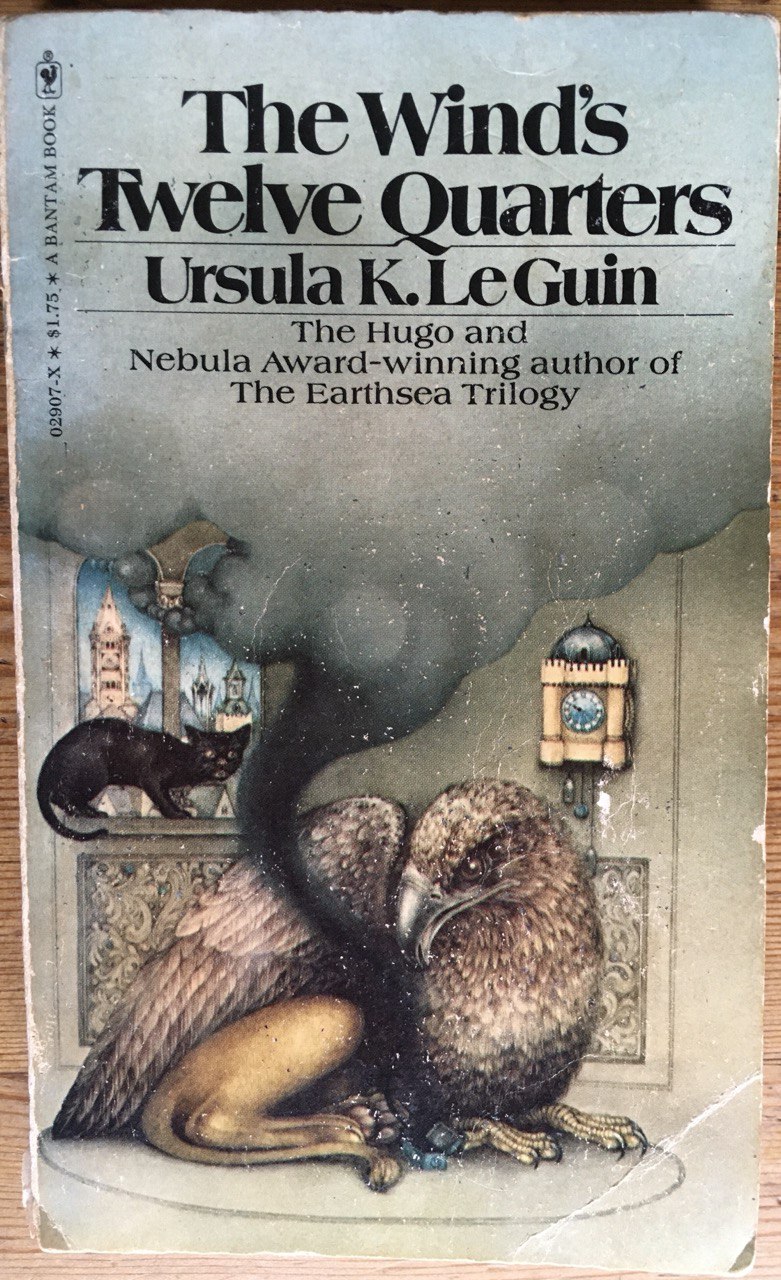
10. The Wind's Twelve Quarters by Ursula K. Legion

I am not a fan of short stories.  Either they don't really work or I want more.  I also find they slow down my reading because I need time to transition from one book to the next.  My plan here was to read a few at a time, but I ended up plowing through.  I have written specific notes about each story below.

Overall, these stories reminded me of what a great writer Le Guin is.  Among other things, she is a master of setting and evocative details that pull you in.  Unfortunately for me, she is also to smart and too driven by real issues to leave it at that.  I wish she would write a simple adventure book with wizards fighting each other, but her stuff always goes deeper and way darker which is why I take a long time between books.  In this collection we get both the fun and the deep, with a few misses along the way to remind us that she is indeed human.

Each story has a nice little intro by Le Guin, which helps to put them in context and get a sense of playful personality (as a writer at least) in 1975.

Semley's Necklace - interesting study of alien life forms, time passing too long

April in Paris - time travel via an old apt in Paris

The Masters - intolerance of science in a post "Firefall" world where everything is done by rote and a builder starts to figure out how numbers and algebra work and gets his hands smashed in punishment

Darkness Box - neat story about a magical world where time is stopped - one brother with a hypogriff goes and fights his invading brother on the beach over and over --  and a little boy gives a box of darkness that starts time.

The Word of Unbinding - really cool in the Earthsea archipelago world, a wizard is attacked from behind and imprisoned from some rumoured invading and destroying wizard and he uses all his magic to get out and defeat him.

The Rule of Names - another really cool won in the Earthsea archipelago world about an island with a kind of weird, incompetent wizard (every island should have one) who turns out to be a powerful dragon on the dl.  These two stories remind me of how good LeGuin is at fantasy world building and details and how great Earthsea is before it gets so dark.

Winter King - from the same universe as The Left Hand of Darkness, a cool mini-saga about a good young king (a she) who is kidnapped and mindmolded so that she will become a tyrant, her only choice is to abegnate and leave the kingdom to her son.  Wish it had been expanded into a novel.

The Good Trip - ambiguous and not very good description of an acid trip that wasn't or maybe it was.  Had an unconvincing back story of a wife lost to depression.

Nine Lives - very cool story about a team of ten elite clones on a distant planet working with two normal, flawed humans on a mining project.  When nine of the clones are killed in an accident, how does the tenth now respond?

A Trip to the Head - a surreal experiment, I guess that helped her to break through writer's block but it's a mess and not enjoyable. LeGuin says in the intro that the only drug she has done is tobacco and I believe her because whenever she tries to go trippy, it's bad.

Vaster than Empires and More Slow - a really cool story about a group of deep space explorers all with various mental issues (because nobody else would volunteer for a program where they come back hundreds of years later) who land on a planet that is all grasses and plants.  One of the members, Osden is an extreme empath who is a total asshole.  As his behaviour starts to make the rest of the team fall back into their own various pathologies, he is sent out to explore on his own.  He is attacked and the group all start to fear that something is out there, though their instruments show no sentient life.  This is a really neat examination of isolation versus connection and how knowing everyone else's feelings could create negatively spiralling resonances. 

The Stars Below - an astronomer is burnt out of his home and observatory for heresy and is hidden in an abandoned mine by a sympathetic noble.  There he discovers a small group of ex-miners who befriend him and he learns to look downward for the stars.  A neat, tight little tale that highlights one of Le Guin's many strengths: her ability to elicit rage in the reader at the forces of social repression.  Fuck those priests!

The Field of Vision - A trio of astronauts return from a trip to Mars where the discovery of some rooms appear to have killed on, rendered another deaf and unresponsive and blinded a third (though sort of the opposite; everything is too bright).  It seems that they have seen god, the room was a kind of proselytizing space.

Direction of the Road - another really innovative and tight piece told from the perspective of a tree. The conceit is that it believes it is moving towards and away all the things that come to it.  Very anti-car.  I like.

The Ones who Walk Away from Omelas - a political parable (that she calls a psychomyth) about a near utopian society whose happiness and existence is dependent on an abused child kept in a locked room.  Definitely a critique of liberal complacency and moves neatly into the last story...

The Day before the Revolution - kind of an origin story of the world of The Dispossessed, it looks into the final days of Odo who was the leader of the Revolution that led to the anarchic world of Odo.  It's more about getting old but neat to see some of the ideas that are more fully fleshed out in the novel.


Monday, January 30, 2023

9. Nightmare Alley by William Lindsay Gresham

This is the one I found
I have had Gresham on my hunting list for a long time to no avail.  Though this movie tie-in edition is really quite unattractive and a terrible size, I do appreciate its existence both because I found it in a free box and because it is uncensored which I gather a lot of later editions were.  I saw the original movie and quite enjoyed it and was excited for the del Toro remake but the reviews deflated my enthusiasm so I haven't seen it yet.  My patience and interest in movies has really dried up in recent years.  All I seem to be able to watch these days are Indian action blockbusters and old 80s episodic series like The Equalizer.  Anyhow, people rave about this book so I was pretty excited to get into it.

It lives up to the hype.  I really wish I had read it before seeing the movie.  I suspect that the inevitable ending would have revealed itself to me anyways, but since I knew what was going to happen to our carny turned con artist spiritualist preacher friend it informed my reading especially near the end and made me somewhat conscious of the plot and pages left.  I think if you come at this book for the first time, with its original plotting and excellent twist (which totally threw me in the movie), you would be pretty blown away.

The story is about the rise and fall of charismatic runaway Stanton Carlisle who joins a travelling carnival and starts to learn the tricks of the trade.  He has a few magic skills, but soon realizes his potential for charm and fast-talking as well as a sharp mind to memorize codes to use as you take questions from the crowd for the medium.  His lack of morality is apparent early on as he gives alcohol to the geek husband of Zeema to get him out of the way so they can get it on.  He doesn't realize it, but it's wood alcohol and this kills him. His stress at the guilt is soon masked by his burning ambition and he absconds with a younger, more attractive woman to the big city to start plying a trade as a spiritualist to rich widows.  The narrative is a struggle between building up to his biggest scam and his own internal stresses and this race leads him to one of the greatest femme fatale characters in the history of noir, psychologist Lilith Ritter.  She takes Carlisle under her wing was they work together to con a rich industrialist, whose guilt over the abortion death of a girlfriend in his youth is the key they use to catch him up.

This is definitely adult material and while the original movie gets pretty dark, it eludes and even cuts out the harshest stuff, especially around sex.  I was reading this on the plane and gasped aloud when Lilith explains what role Molly (the pretty young one Stan took from the carny) will play in their con.  Great stuff.

This one's going for $150!


Sunday, January 29, 2023

8. Sing Down the Moon by Scott O'Dell

My daughter chose this as the next one for her bedtime reading.  The Island of the Blue Dolphins was subtly sad, only really if you understood the context and read the afterword which she refused to do (though the attack on her people at the beginning by the Aleuts was pretty rough).  This one was brutal!  I feel like it may be better appreciated by an older child of maybe 12 or 13.  Nevertheless, my 10-year old got a pretty direct lesson in the horrors of colonialism.  To top it off, my father had died on the night that we read the harshest chapter where the shitfuck white man drives the Navajo off their land and destroys  their crops and homes.  We were both pretty bummed but it led to a good discussion of whether it is better or worse to read something as dark from history as this while you have your own sadness in life.

This is another fictional retelling of the real history of what is known as The Long Walk, where white settlers drove several tribes of indigenous people from their lands to what is now known as the four corners in the middle of the country.  It is told from the perspective of a young girl who is just taking on the responsibility of shepherding the family's sheep.  The first section is about her getting kidnapped by a Spanish soldier and then her escape, where the reader gets a brief break from the sadness before "the long knives" as they call the settler soldiers come and force them to march from their home lands in Arizona to eastern New Mexico, where their descendants live today.  I don't know what the Navajo people feel about a white settler descendant writing about their history, but this book is straightforward and very affecting.  


Friday, January 27, 2023

7. Poets and Murder by Robert van Gulik

I had heard about Judge Dee over the years, but assumed it was a kind of mystery Charlie Chan series.  I did see at least one of the Tsui Hark Judge Dee movies, which was tons of fun.  However, recently I saw some pulp mystery fans on social media speaking highly of Judge Dee and then found this in a free box in Berkeley. It was surprisingly good!  I appreciate that it is an extreme case of what I believe is called "Orientalism" and I was happy that the portrayal of Tang dynasty China seemed respectful and well researched (there is an afterward where van Gulik explains the setting and the research he did).  More importantly, the story itself was really cool. It had an enjoyable mix of interesting characters in a rich setting with a touch of mysticism (the overall theme was fox spirits).  Judge Dee's style and methodology were particularily good.  He does a lot of research via the empire's bureaucracy and culture of record-taking.  I guess this may seem boring but I found it to be a neat twist on procedural investigation.  I also enjoyed the culture of politeness that makes Judge Dee very careful in how he approaches people and works on his investigation.  Finally, there was a humanity to the entire proceeding that I enjoyed.  I hope Poets and Murder is indicative of the series because if so I will keep an eye out for others.


Monday, January 23, 2023

6. A Stranger in my Grave by Margaret Millar

Again, I have the ghostly feeling that I have read this book before, pre-Fifty Book Challenge.  It's worth a reread (and now I own it in paperback), so no harm done just wish I could confirm it.  This is a rich thriller with multiple layers of narrative and theme going on, all of which get unraveled at an increased pace.  The surface plot is about Daisy Harkin, a young married woman who lives with her successful husband and mother.  From the beginning, she is clearly unhappy, though putting on a smile each morning to keep her husband and mother from worrying about her.  This does not last long as she has a vivid dream about seeing her own gravestone with a specific date from four years earlier.  Convinced that she herself may have died, she starts to obsess about it, not being helped by her supportively denying husband and mother.  We learn that her father ran off years ago only communicating via letter from time to time when he needs money.  He comes back into town again, calling her to pay off a bail bondsman who is also a detective.  This man, Stevens Perata, is also a detective and she hires him to investigate the date on the gravestone in her dream.

At first, she really seems neurotic, although quite firm and clear in her communications with Perata and her mother and husband.  The main plot seems to be about the difficulty of investigating a day in the past (especially pre-computers).  However, some articles from the newspapers microfiche article triggers a denial in Daisy and Perata starts to suspect she isn't just a neurotic housewife with too much time on her hands.  

The plotting in this book is quite a trick as several really interesting and eccentric characters' (Daisy's romantic, con artist dad; Juanita the promiscuous mother of 6; her strict and religious mother, Perata himself) stories start to gradually reveal their connections.  We don't see them all until the final page, literally the last words of the book.  I won't say anymore because the enjoyment is in finding out, but it gets deep and touches on some progressive social themes that are still relevant today.

Here is a review that captures the qualities of this book better than I can.


Friday, January 20, 2023

5. A Law for the Lion by Louis Auchincloss

My sister gave this quite beat up copy as a gift for xmas.  She and her son had both read it and thought I might enjoy it.  We discussed whether this type of novel was part of a genre, which would also include books like The Best People (which I passed on to her because of the real estate angle).  I think generally these books are what we call today (and perhaps in the past?) "literary fiction", meaning it isn't lofty enough to make it as "literature" but not so low to fall into the gutter of "genre" such as crime and romance.  I like the term "social fiction" in that the story, conflicts and satisfactory resolution take place in the realm of humans interacting socially, especially around class and status.

This is quite an early one, having been written in 1949.  The protagonist is Eloise, a good wife of a successful and climbing lawyer, whose uncle is the even more successful senior partner of their firm.  The initial conflict is the return from Europe of Eloise's wayward and much divorced mother, Irene, who gave up her daughter at a young age to live with her uncle.  She drinks excessively, speaks directly, has "European" values and is constantly at the risk of creating a scandal in this white-shoed New York City, summer house on Long Island community.

Irene only causes a minor scandal but her presence triggers Eloise to examine her own life more aggressively which leads to a friendship with a young author, at first platonic.  We also get a side narrative of her adult stepdaughter, Hilda, as rigid and proper as her father who falls for a charming but too festive lawyer.  It all leads to conflict and then resolution, centered around Eloise taking a stand against her role and the social mores that confine her.  I have to say that I found it very satisfying, with a gentle balance of things going bad and then righting themselves that I was caught up but rarely stressed. There is one harsh but brief scene of adultery exposed by private detectives.  Other than that, everything is dialogue and inner thoughts.

My mother remembered the author's name, so I guess he was fairly well known back in the day.


Wednesday, January 18, 2023

4. Blacktop Wasteland by S.A. Cosby

I read Cosby's second book, Razorblade Tears, last year and given his success, knew I would run across a copy of his first book eventually.  I found the paperback in a free shelf in Berkeley.  I loved the first one, where Cosby manages to make a hardcore yet work hard-boiled crime book.  Really impressive.  Blacktop Wasteland was equally enjoyable, though more straightforward as a crime novel.  It still gets innovation credit for being from a modern African-American perspective (though I know there is a significant literary community of Black crime writers who are read mainly by other Black people; so maybe I should qualify Cosby's innovation as having succeeded in poking into the mainstream, white reading crime-reading public).  

The story here is about Beauregard "Bug"  Montage, a father and husband in Virginia who runs a struggling garage with financial pressure all around him.  He wants to be legit, but his past in the Life becomes his only option.  He is also a really good driver and has a bad ass souped up duster.  Against his better judgement, he takes on an escape job for a diamond heist at a local jewelry store.  Of course, shit goes pear-shaped (why would a strip mall jewelry store be holding millions in uncut diamonds?) and Bug has to bring all his skills to save himself and his family.  

At first, I was questioning my enjoyment of these kinds of books.  I was so sympathetic with Bug and stressed about how it was going to go bad for him, that I couldn't really enjoy the heist.  One of Cosby's skills, though, is developing the American criminal milieu in the globalist era.  Once the heist goes down, we start to see all the machinations behind the jewelry store and get a bunch of scary higher-level bad guys up to all kinds of shenanigans.  This is fun.  Furthermore, like a getaway car, the story keeps accelerating.  I stayed up way past my bed time finishing the book. 

Sunday, January 15, 2023

3. Pale Grey for Guilt by John D. MacDonald

I am pretty sure I have read this one, but it would have been before the Olman's Fifty era, so I couldn't find it listed.  I generally avoid the Travis McGee's because they tend to have too much of JDM's run-on sentencing philosophizing about love.  They really feel like a big part of their selling point was as escapist fantasy for Mad Men era middle managers and suburban dads who want to read about swinging girls on houseboats.  I get it, but it's really not my fantasy at all and the lamenting about the super hot but silently troubled beach babes gets me down.  There is much of that in this one, as well as a financial pigeon drop revenge plot whose accounting details were too complicated for me.  I was hoping for some pure fun after the history of the world but found this more of a slog to get through.

The plot here is that McGee's old high school buddy who runs a houseboat rental gets squeezed by developers on either side of him, squeezed so much that he supposedly kills himself by dropping an engine block on his head.  It stinks to McGee and he starts poking around, uncovering an all-too common scheme between local government, small-time scammers and big-time developer scammers.  McGee fucks all their shit up.

Thursday, January 12, 2023

2. Masters Of Deceit: The Story Of Communism In America And How To Fight It

I found a copy of the original paperback at a free book box in Berkeley in quite decent condition.  Unfortunately, I damaged it somewhat in reading.  I can't imagine it is worth too much but as a cultural artifact, I consider it a lucky find.  Jesus what a fucking douchebag was J. Edgar.  I took this just to keep and perhaps give as an ironic gift, but then felt I should actually read it.  I really went through a range of emotions getting to the end of this book: smug contempt, ridicule, a lot of boredom but ultimately a growing sense of horror.  

Let me be straight, I am no fan of the USSR and while I consider myself progressive on many issues and I fucking hate this version of late-stage consumer capitalism we are in, I'm doubtful even a "good" form of communism would be an effective way to govern human society.  I have always been critical of those leftists who slavishly looked to Russia and their communism for leadership (I mean some of these people were still defending it even after the reality of Stalin's terror was fully revealed).  I also recognize that the U.S.S.R. was up to constant shenanigans worldwide and in the U.S. and Canada with a destructive espionage regime.  Fuck those commie spies.  Putin today is continuing a long, long tradition of Russian authoritarianism and imperialism.

As bad and dangerous as the Russkies were, the red scare of the fifties was clearly exaggerated and blown out of such proportion that its excesses got the US to be almost as bad as the communist regime it so feared.  Furthermore, fear of communism was ultimately a propaganda tool to attempt to maintain suppression of labour and black people.  Reading this book strongly reinforces that theory.  Hoover takes great pains to talk about "good" labour and civil rights organizations but basically lays out an argument that any movement that is critical of the government was already infiltrated by communism and therefore it was acceptable for the FBI to go after them.  It's a sinister model and one that has been used by governments over the years to suppress dissent.  It's particularly egregious and hypocritical here because the whole point of America is freedom.  A good example in this book is here the way her refers to the Rosa Lee Ingram case as a woman murdering her neighbour and not a Black woman who had been sexually harassed and assaulted repeatedly by her neighbour finally defending herself.  Read her real story in the link and then compare that to the propaganda from Hoover below:


what a giant shitbag

There are many points in the book where Hoover uses an example of Commie infiltration and then you do a bit of wikipedia research and see how people's rights and liberties were trampled, their lives destroyed, labour unions and civil rights initiatives ruined.

There is entertainment here, especially at the beginning, before you you get sick of Hoover's paranoia.  He relies on anonymous anecdotes telling crazy stories of safe houses and families ripped apart.  One of his favourites is when the party orders members to sell their house or divorce their wife for the cause. None of it is substantiated.  I'd love to read a thoroughly researched critique of Hoover's claims of communist party behaviour in America. He loves describing women's clothes in great details in stories about a member dodging a tail or going underground.  There is some good material here for a period thriller.  Unfortunately it all deteriorates in repetition after a while.

What's really crazy or rather just depressing is that there are still many people alive today who still believe this shit.  Really, once you read this, the anti-vaxxer movement doesn't seem that surprising any more.  People with a strong ideological agenda to defend their perception of the world will quickly and easily move to finding a fake enemy and using that to further their agenda.  I think the part that would have Hoover twisting in his grave (next to his longtime male lover, btw) would be where these "Freedom" fucks are pro-Russia.  Strange times.

Look at this asshole on the phone


Friday, January 06, 2023

1. The Penguin History of the World (third edition) by J. M. Roberts

Whew!  For those of you wondering (i.e. nobody) where I have been for the last two months with no books reported except ones I read with my daughter, I can now tell you: deep in the 1,109 pages of the history of the world.  Please let me know if you have any questions about the history of the world, as I now know everything about it. :)  I picked this up at the thrift store on Gilford.  It's mostly french books but every now and then you can find some decent english language used books there.  I have long wanted to better understand how we got from ancient Greece and Rome to the Middle Ages.  Honestly, though, I bought this book on a bit of a whim (and probably need to satisfy consumerist impulses) with no real intention or belief that I would actually read it.  When I had surpassed 50 books and was feeling tired of all the genres of fiction awaiting me on the on-deck shelf and still had two months left in the year, I thought why the hell not?

It was a good choice, though I really wished I had been able to finish it before the xmas holidays as it became quite a slog at a time with lots of family interaction and domestic holiday labour when I would have preferred a nice easy detective novel or escapist sci-fi or fantasy book.  Reading this book was extremely rewarding on two fronts.  First, it gave me a good overview of what actually happened in the world since the beginning of civilization.  Though I will (and have already) forget a lot of the details, I do now have a broad overview on the thread of the growth of human society on this planet.  I went to a very academic and intellectual liberal arts college and majored in history.  I learned a lot, but I always felt there was a snobbish (and typically rigid academic post-modern hatred of "objectivity") and deliberate exclusion of taking the time to just go through what actually happened before delving into the theory and arguments and all that.  Reading this book filled all that in nicely.  Second, reading history like this at such a high level, where major events like the Russian Revolution are summarized in a few pages genuinely provides the reader with a calming sense of perspective on current events.  It certainly doesn't make you any less pessimistic, but it does turn down some of the hysteria that the news media amp up and one internalizes while reading about the resurgence of pseudo-populous fascism in democratic countries. Understanding the roots of American democracy makes one realize that the current conflicts in congress are all part of a conflict that existed from the very beginning and not necessarily the signs of the end.

There is probably a ton of stuff to freak out about in this book from a more leftist perspective.  I broadly commend its approach and mostly agree with it.  His biggest thesis is that the history of the world is ultimately dominated and guided by the history of Europe and  the social principles that evolved out of that history.  I think that broadly speaking that is mostly true.  And though Roberts is mostly neutral about it (e.g. he's not saying European culture is better or superior, just that they were technologically advanced and their ideas had ways of sticking onto their conquests), it still feels like he is arguing that the very nature of capitalism and democracy are somehow fundamentally European.  It's an existential argument at this point, but I would have liked to see more information on non-European trends in thinking and backgrounds that we are today seeing start to seep into the west via consumer culture.  

Another big takeaway from me from the early part of the book, which just confirms my existing bias, is how much Christianity was just such a huge bummer.  Putting aside the atrocities committed under its aegis, it is also just super boring.  I still don't understand how it came to dominate and spread within the Roman empire (not a fault of the book as I am pretty sure there is an entire area of history just devoted to figuring the spread of Christianity out and arguing about it) but I do know it took a very rich and adventurous era with diverse civilizations and cultures and lots of cool exploring and adventure and somehow morphed it into centuries of boring doctrinal rigidity, religious semi-homogeneity (that got more and more homogenous as its power advanced, despite the splits between the Catholic churches and later the Reformation) and boring stupid wars between one stupid monolithic religion and another.  And it is still plaguing us to this day.  So boring!

The book ends roughly in 1990 and he starts to get things wrong at the end, understandably.  He sees space exploration as a huge inflection point, completely missing the turn inward to the internet (though he does recognize the potential danger of it in one brief phrase).  He also missses the resurgence of Chinese power and the challenges of globalization, being a little bit stuck in the self-satisfaction of the 90s.  This is nitpicking and not fair on my part, but am sharing it because it did make me think that the beginning of the twentieth century may well indeed be seen as an inflection point.  I also give him points for his strong emphasis on cares about the environment being a major historical trend at the end of the twentieth.  Anyhow, epic read.  It has definitely returned my appetite for fiction, but I also now have several branches of non-fiction and history into which I would like to delve.  Read on!