I found this in one of the many great used bookstores in Winnipeg. I picked it up because the small hardcover was so attractive and because it was written by the author of The Taking of Pelham 123. It turned out to be well worth the $7.00 I paid and will look great on my shelf as well. That Snake is based on a great concept that is fully thought out, both scientifically and the supposition about how New York City would react to a giant, deadly snake in Central Park. I don't know if it is me, as it confirms my existing bias, but this book seemed savagely critical of New Yorkers and humans in general. Hysteria and blind selfishness seem like the defining factors of most of the people but the snake and the protagonists. It all seemed quite realistic to me. Depressingly enjoyable.
Tuesday, October 20, 2009
25. The Snake by John Godey
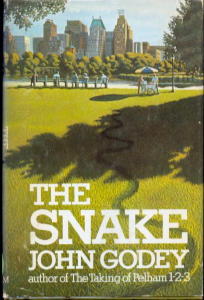
I found this in one of the many great used bookstores in Winnipeg. I picked it up because the small hardcover was so attractive and because it was written by the author of The Taking of Pelham 123. It turned out to be well worth the $7.00 I paid and will look great on my shelf as well. That Snake is based on a great concept that is fully thought out, both scientifically and the supposition about how New York City would react to a giant, deadly snake in Central Park. I don't know if it is me, as it confirms my existing bias, but this book seemed savagely critical of New Yorkers and humans in general. Hysteria and blind selfishness seem like the defining factors of most of the people but the snake and the protagonists. It all seemed quite realistic to me. Depressingly enjoyable.
Saturday, October 10, 2009
24. Sundog by Jim Harrison
This is the story of a dissolute journalist who goes to the wilds of northern Michigan (and they actually do sound quite wild) to interview an old engineer who worked on large-scale projects (dams and the like) in developing countries during his youth. It's a manly, richly-written that I enjoyed reading, but it's also one of those novels that doesn't really have a plot and my simple mind doesn't know what to make of it by the end. I think it's an exploration of living a life and the choices we make. It has an excellent attitude and is really well-written (and also has a good reputation) so I suggest you check it out as well.
Wednesday, September 09, 2009
23. The White Voyage by John Christopher
Man, John Christopher does it again! I always pick up a John Christopher novel when I find them, but I read so many last year that The White Voyage (in a beautiful hardback) stayed on my on deck shelf for almost this entire year. I pulled it out many times and then put it back, thinking it would be too much of the same too soon. I took this one on my honeymoon, knowing I would finally have some uninterrupted reading time (hmm, somehow that doesn't sound right! ;)) and ended up devouring it. Thoroughly enjoyable and a slight change of pace for Christopher. Though many of his classic themes were present, The White Voyage takes a more optimistic approach and the protaganist makes it through the book being the sexual victor for once!
It's about a strange and motley group (including a small circus and a bear) taking a ship through the north sea who get caught in a storm and stuck in the ice. They must survive the elements as well as their own conflicts. Great stuff, highly recommended.
The image above is not the edition I have (though it's quite nice as well). I'll scan mine in when I get a chance and replace the image above.
Thursday, September 03, 2009
22. The House of the Four Winds by John Buchan
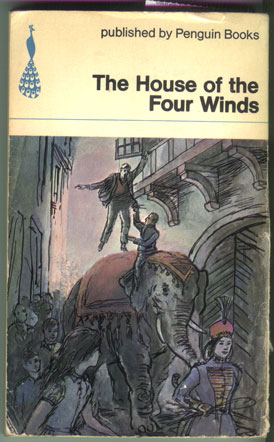
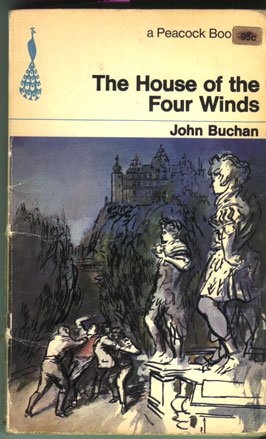
Ultimately, The House of the Four Winds was an enjoyable adventure, but through it, I learned that Buchan wrote several series of adventures using the same characters, characters who become slightly annoying in their British pluck over time and it makes me less interested in reading more of his books. I really enjoyed the 39 Steps for the real sense it creates of an individual getting over his head in trouble. I assumed that his other stories would have the same kind of energy and interesting sitatuions. And they do, except that being a part of a continuing series, they rely too much on returning characters showing up and having the appropriate and necessary resources for the situation. It seemed like most of the first half of The House of the Four Winds was arranging convoluted narratives to ensure that all the characters would end up in the same situation. And normally, I like the archetypical British hero of the first half of the twentieth century, but they start to get kind of annoying here in their assumption of certain class and even racial superiorities. The political set-up is quite complex and interesting (with older school monarchical supporters, a younger conservative movement and communists all vying for power in a small eastern european republic) and the second half of the book moves along as it should, but I would rather it was all done with new characters.
Wednesday, July 08, 2009
21. Lush Life by Richard Price

Meezly snagged this one quite wisely at our local thrift store. She was aware that Richard Price had been one of the principle writers on The Wire and recognized his name on the cover of the book. Good find! The pacing, situation and characters in this book are not those of the crime genre that I favour. It's very deliberate and consistent and much more of a character study (and a place study) than a mystery, suspense or action novel. That being said, it does what it wants to do extremely well, so that I was caught up in it and really didn't want to put it down. Even more in its favour, is that ultimately, Lush Life is a critique of the lower east side of New York city and the gentrification that has gone on there. It is particularily scathing towards the white, artistic hipsters that try to claim the culture their as their own. This I found very satisfying. You can see why Price was a good writer for The Wire. Check it out.
And check out Meezly's review for a more thorough explanation of the plot.
Saturday, June 20, 2009
20. The Man with the Getaway Face by Richard Stark

The Man with the Getaway Face is Richard Stark's second Parker novel. My memory of it was that it was good, but more of a transition book. I had forgotten how impactful it is and upon re-reading it, I realize it is perhaps one of the more important books in the series. After Parker gets his revenge on the man who double-crossed him, and strong-arms the outfit to force them to pay the money back that he lost, he realizes he needs to get truly lost so he can return to his life of heisting and hanging out in various resort hotels. To do so, he must get a new face.
Westlake originally wrote The Hunter with the idea that Parker would die at the end of the book. His genius editor said he'd buy the book only if Westlake would keep him alive and continue writing books about him. So The Man with the Getaway Face is Westlake figuring out how to do that. I think because of that the structure of the book is divided up into two stories that remain separated for the duration of the book, giving it a less cohesive feel, which is what led me to feel that it is more transitory.
There are two elements that are established here that become defining features of the series. The first is the Alma. In The Man with the Getaway Face, Alma is the finger. She's an embittered, older waitress at a truck stop where an armoured car makes a regular stop. She is sleeping with a guy who knows a guy who knows Parker and that's how the job gets put together. However, Alma whose been planning and scheming the job for all these years, waiting for the right man to come around, thinks she knows better than Parker. She's also obviously out for herself. A character in this form is present in almost every heist. Someone whose emotional flaws, be they greed, pride, bitterness or even an inability to just be patient, end up screwing up the heist and bringing complication to Parker's life. One of my favourite quotes, from The Green Eagle Score, expresses the Alma pretty explicitly.
Over the years, he'd come to accept the fact that the people involved in every heist were never as solid as you wanted them. They always had hang-ups one way or another, always had personal problems or quirks from their private lives that they couldn't keep from intruding into the job they were supposed to be doing. The only way to handle it was to watch them, know what the problems were, be ready for them to start screwing up. If he sat around and waited for the perfect string, cold and solid and professional, he'd never get anything done.
It's not that the people are inefficient or clumsy or somehow incapable. It's that they allow their emotions to intrude on the job. They cannot separate their own egos from the situation to realize that all would benefit if they could let go of their immediate needs. I think it is a complaint that is shared, unreasonably or not, by a certain mindset, the working man who does his job at work and has a personal life at home. There is also a generational idea here, of men who came out of World War 2 encountering a society where talking about your feelings and encounter groups and the explosion of therapy and personal growth in the '60s were invading all facets of life. I am of neither generation, but have felt a very similar complaint for most of my own work life. So these books resonate with me on this point as I'm sure they did with many crime readers when the Parker books were sitting new on drugstore racks.
The other element in the Man with the Getaway Face that I do not identify as well with, but consume with a sort of compulsive horror, is the brutal factuality of the writing. Acts of cruelty are done in the Parker books that are really tough to take. They aren't done for the sake of cruelty usually but with some other goal in mind and the cruelty is the only method that will apply given the circumstances. They are also not written sadistically, with the kind of prurient sexuality inherent in a lot of crime novels. They are just stated as facts. I apologize for the vagueness, but I don't want to give anything away. The situation that Westlake describes and the way he looks at it, by going into the head of the victim is so black. I think I had forgotten about it because I had sort of skimmed over it the first time I read it, not having quite the calcification around the heart that I have slightly accumulated at this point. Basically, Westlake doesn't pull any punches. You take it, though, because you know the payoff is going to be good.
And it is good. So while The Man with the Getaway Face isn't the best Parker novel, it lays important groundwork for what is to come. And what is to come is The Outfit, which is a giant fucking candy shop of heists. But you'll have to wait until my review is done, or you could just go out and buy it and get reading.
Tuesday, June 16, 2009
19. Make my Bed Soon by Jack Webb

It's a novel about a guy who gets mixed up with a gang of car thieves who work in and around Arizona and Mexico. It was an interesting look at a crime network, and I remember enjoying it, but I can't give you more than that as the details have faded into the mists of time, buried under the avalance of all the other media I've consumed since then.
Wednesday, June 10, 2009
18. Deep Powder and Steep Rock: the Life of Mountain Guide Hans Gmoser
If you're a ski geek, especially out in the west, you have almost for sure heard of Hans Gmoser. He is responsible for putting Canadian Rocky Mountain Skiing on the international map and arguably singlehandedly responsible for helicopter skiing in particular. He came out from Austria after the Second World War, already an avid lover of the mountains and outdoor adventure and ended up in Alberta, in Canmore and Banff, on the eastern edge of the Canadian Rockies. He is also the father of one of my best friends, which is why I ended up reading such a book (as many of you know I am part of a small but powerful cabal working on eliminating downhill skiing from the world).
Very briefly, Hans grew up in Austria and got into mountaineering as a young boy, through a Catholic priest who seemed more like a scout troop leader in that he led all kinds of mountain trips. Later, Hans became an electrician and as a young man, emigrated to Canada. He was a pioneer climber and led many first ascents of mountains that are famous today among the clmbing set. He also did a bunch of major treks and lots of skiing. Later, he really got into promoting skiing in Western Canada, driving all over North America and showing skiing films at local community centers. A friend of our family's who is a big skiier remembers when Hans would come into his town and all the ski geeks would get psyched to watch his films and here his talk. He was the first guy to attach a camera to his head and ski with it. Later, he set up a lodge and then got into sending people up into the mountains via helicopter which developed into a full blown heli-skiing empire, Canadian Mountain Holidays. Later, a truly evil empire, Inwest (responsible for the atrocity known as Whistler) bought CMH. That really is a brief, brief version as there is a lot of rich and interesting history behind all that.
As I said, that is a very broad outline of the history. If any of it is interesting to you, the book does a really solid job of portraying the stories and details of the history. Chic Scott gets the facts down and interviewed many of the people who were there, filling out the human side. There is a lot of climbing porn in the beginning, which if you are a climber will get you hard as some nice south-facing granite. As a non-climber, I was able to get through it without too much pain, while retaining a laymen's appreciation of the determination and skill these guys had, doing extremely hard climbs before climbing shoes were even invented. Overall, it's a really interesting story about one man's life as he makes his way from a young person to an outdoor fanatic, to a succesful businessman and finally settles down to being a loving family man, mellow and rightfully satisfied with his life.
I knew Hans first through the anecdotes of his two sons, with whom I went to boarding school. They were an excellent mix of crazy stories from his youth (like the time he was driving through a snowstorm and his defogger wasn't working, so he put on ski goggles and stuck his head out the window, driving through the snowstorm like that for several hours) and some of his more autocratic tendencies as a father. We were all pseudo-rebellious teenagers at the time and most of us bitched about our parents in some way or another and Hans didn't come off as all that bad. He was just particularily freaked out about trivial things like hairstyles, a button the older brother pushed during the new wave '80s. But he did come off as a bit of a hard ass. When I did actually meet him for the first time, he was quite pleasant and friendly. Later, as an adult, when I spent more time out in the mountains and Hans was basically retired, he was super warm and generous, really deep-down happy, great to hang out with and listen to his stories. He seemed so generally psyched and happy to be hanging with his sons, that I had a hard time reconciling the Hans I got to better know with the uptight dad of the teen years, but this book goes a long way in explaining that.
If you are a fan of Canadian history or the Rockies or skiing, I would recommend this book to you. It's an amazing story. For me, it filled in a lot of gaps about my friends' families past and was very informative for that as well as being entertaining. It's important to understand where people came from, especially people who travelled across the world before they were even fully formed to come to a new country and start a new life. It's a very different world today, much more stable for those of us in the first world and a lot of that is thanks to people like Hans who came to Canada with a lot of drive and saw a beautiful land where they could make a life.
Sadly, Hans Gmoser died a few years ago while riding his bike between Banff and Canmore, which is why this book got written when it did. Though Hans would never have been happy had he been in a situation where due to health he couldn't have been active, he was still pretty young and fit when he died, so it was a very sad loss for the community and especially for his family. Here's hoping he's somewhere climbing, skiing, hiking and biking in the most amazing places.
Monday, June 08, 2009
17. Supermanship by Stephen Potter
Supermanship is fairly unfocused, being a collection of brief applications of oneupmanship in a wide range of situations, some correspondence and some brief (and fictional) history of some of the major players at the oneupmanship institute. It's the same kind of humour, tons of subtle techniques to make the other fellow doubt himself. I particuarly liked the section on lecturemanship, which dealt with academics and visiting lecturers. It gave strategies for both the host (like wearing a short sock and then crossing one leg over the other and raising your pant leg, revealing your white flesh, so the audience is constantly distracted by it) or the guest lecturer (like turning to the host, making a particularly obscure reference and capping it with "as Professor Gates-Willoughby will surely know").
Some of the humour went far over my head, being very British and very much of its time. But it's a quick read, organized into digestible gulps (great for the bathroom), which is all I'm capable of these days. I'd recommend Gamesmanship or Lifemanship before getting into this more advanced volume. I'm very pleased to have discovered that a friend of mine actually has a copy of Lifemanship, so that will be 3 out of 4 in my hands!
Monday, May 18, 2009
16. In the Country of Last Things by Paul Auster
I was supposed to have read this for another 50 book club shared read, but I didn't get done in time to join in the discussion, which you can find over at the Mount Benson Report.
I was very hesitant going into this book. I recognize that Paul Auster is a very talented writer, with interesting ideas and situations. But everything of his that I have read always seems to have that slight distance from the narrative that renders his work very attractive to pretentious college students. I'm pretty basic in my literary needs and I like a strong story, well-grounded into some setting. Auster seems to like ideas.
The idea of this book, I think, is hope and despair and the collapse of modern civilization. He does a good job of capturing the feel of a society without laws or goods, but still held together by the bare bones of its original infrastructure. He also comes up with a lot of cool and weird situations, like the scholars all barricaded in the library and the competitive world of the scavengers. But ultimately, it is not connected to anything real. There's no actual nation, no real city name given, no history. And it gives me this suspicion that he's trying to tell me something and I'm supposed to figure out. Like what is the role of the Jews in the book. So while I actually enjoyed most of the book, I never really got caught up in it because I kept wondering what was the point of this and the point of that. I left that kind of practice for the Lit majors back in college.
Not a bad read, but not really for me.
Saturday, April 25, 2009
15. Branded Woman by Wade Miller
She (and the reader) soon find out that there is a lot going on in and around this Mexican town. As she digs deeper, she meets a rich range of sleazy characters. The plot is complicated, but the narrative is driven straight by Cay's intense personality and desire for revenge. She really is a great character, tough and ruthless, but conflicted and unhappy. She uses all her feminine wiles to achieve her goals, but she is never hesitant to throw down. There are some great fight scenes. Wade Miller is the pseudonym for a couple and the passages that describe Cay's outfits and the effect she intends with them seem to come from a woman's perspective. Revealing stuff!
The descriptions of the hot, seaside town and its lively culture are also really well done. You get a strong sense of being there. This is the same couple that wrote Touch of Evil, a movie that captures that feeling as well. An excellent pulp.
Sunday, April 05, 2009
Aside: Reading Habits Analysis
As I mentioned in my last post, I am starting to suspect that there has been some consistency in my reading behaviour year after year. I decided to graph it out. Thanks to blogger's archive links on the right hand side, it is very easy to see the quantity of books I've read per month. Here is the result going back to 2005 (so 4 years plus the first three months of this year):

Quite interesting! It's not tons of data, but I think it's pretty safe to say that I have consistently experienced a big dropoff in the spring. I wonder why? There is a similar trend in the fall as well, with a surge at the end of the year. I think the one big lesson I can take out of this is to push hard to be very consistent across the summer. Those dropoffs in spring and fall seem to be some kind of profound psychological issues that will take a lot of deep therapy to overcome and thus not so easy to change. But if you look at the years where I did really well (2005 and 2008), I was strong throughout the summer. The year where I blew it, I had a very unproductive summer. I need to go back and figure out what happened that summer. It seems that the summer is a period where I have some control over my character and thus the outcome of my 50-book challenge.
This is like the Moneyball of 50 books! Improving performance through advanced statistical analysis.
Quite interesting! It's not tons of data, but I think it's pretty safe to say that I have consistently experienced a big dropoff in the spring. I wonder why? There is a similar trend in the fall as well, with a surge at the end of the year. I think the one big lesson I can take out of this is to push hard to be very consistent across the summer. Those dropoffs in spring and fall seem to be some kind of profound psychological issues that will take a lot of deep therapy to overcome and thus not so easy to change. But if you look at the years where I did really well (2005 and 2008), I was strong throughout the summer. The year where I blew it, I had a very unproductive summer. I need to go back and figure out what happened that summer. It seems that the summer is a period where I have some control over my character and thus the outcome of my 50-book challenge.
This is like the Moneyball of 50 books! Improving performance through advanced statistical analysis.
Saturday, April 04, 2009
14. Battles of the Boer War by W. Baring Pemberton
I found this book for a quarter and the cover and the name of the author just forced me to buy it. That is a very cool looking paperback and you can hear the title and the author's name being pronounced in a super pompous British accent. It's actually part of a penguin series on military history that looks like it has some other interesting titles in it. I knew nothing about the Boer war beyond that some characters in Sherlock Holmes stories had had experiences there. I realize now it is a very significant war on many levels, marking the period between traditional "gentleman's" warfare of the 19th century and the mechanicstic, modern warfare of the 20th. It also is a significant part of the history of South Africa and laid the groundwork for a lot of the ferocity and culture of violence that is still there today.
Battles of the Boer War concentrates on 4 battles, early ones where the British first encountered the Afrikaaner guerrilla tactics and suffered setbacks that cost them a lot of men and resources and a great uproar on the home front. A long chapter is devoted to each battle and Pemberton goes into some detail. His tactical thesis is to demonstrate which leaders were at fault for their various blunders. Most of the military mistakes he blames on the character of the individual leaders. Ultimately, he argues that the real blame for the losses is to be laid at the feet of the British government and the lack of will there to engage in war. He traces this back to Britain's self-image as a benevolent colonial power. Not an uncommon thesis from someone writing not so long after World War II, but interesting to see it applied to this period of British history.
I am usually very impatient with detailed military histories. I'm a visual thinker and need to constantly refer to the map. I'd love to read books like this on some future version of the kindle, where you would have animated maps showing the progress of the battle as you read the text. Despite my lack of attention span, I was able to follow the battles and got quite into it. It was very interesting to learn of the Afrikaaner tactics and skill. They were a purely voluntary organization, made up of the men from the regional farms and knew the veldt profoundly. They also were expert marksmen with rifles that had longer ranges than had ever been used in a military engagement. They were also not afraid to retreat, a difficult tactic for Britain's disciplined formations. So the Afrikaaners would hide out in small groups, pick off the approaching soldiers and then run away. It was early guerilla warfare.
I'd love to explore the Boer War in a bit more historical depth. It was where Winston Churchill made his name. Though the British won, there was extended guerilla warfare and eventually concentration camps and some serious atrocities. All of it was spurred by the discovery of gold and diamonds in the interior parts of South Africa where the British had previously left the Dutch settlers alone. Lots of interesting stuff to discover there. I'm very glad I picked this book up.
Sunday, March 15, 2009
13. The Light of Men by Andrew Salmon
[Here is the Mount Benson Report review.
Here is the review at the University of Crumbolst.
Here is Redwing's review at The June 23rd Project.]
I am therefore going to review this book in two parts. The first part will be the standard kind of review I would have normally done for a book I read: a general overview, with no spoilers and a final recommendation. In the second part, I'll discuss specific issues that came up in the book and there will definitely be spoilers. This is the type of book where it is better to go in ignorant of what happens, so I strongly encourage you not to read the second part unless you are sure you aren't going to read the book. I'll say that The Light of Men is a really good book, but there are certain people for whom the genre doesn't really do much and I'll make that clear.
Standard non-spoiler review
The Light of Men takes place in a concentration camp in Germany in the last months of the Second World War. A new prisoner arrives who is healthier and more aware than the rest. He also seems to have a certain psychological remove from the horrors going on around him. He is on a mission to try and find a specific prisoner in the camp and goes about manipulating the internal politics of the camp to do so. The story is written with a limited omniscient perspective, so although Aaron is the protagonist, the author doesn't totally let you into his head, nor does he give you any more than subtle hints that he is somehow different. I'm going to stop all discussion here of any more of the narrative, because a lot of the enjoyment of this book is trying to figure out what is going on.
I was concerned going in that a story of this type taking place in a concentration camp could have some very inappropriate results. The opening scene, where the trains first show up and the new arrivals are separated from their belongings and each other by older prisoners overseen by the SS, are brutal without being either exploitative or sentimental. It went a long way towards assuaging my concerns. Salmon has done his research and the opening scenes where the horrors of the camp are slowly laid out to the newcomer had the unpleasant but important effect of shocking my mind into realizing once again that this actually happened.
As the book progresses, one becomes used to the constant horrors of the camp. The story takes precedence. I'm torn as to whether the narrative overshadows the horrors unrealistically (and perhaps too easily) or if that is a reflection of the human ability to adapt. It's been a while since I read Primo Levi's Survival in Auschwitz, but I remember that book had a similar effect at points of making the camps seem like really tough prisons rather than soul-destroying nightmares from which nobody wakes up. I guess that's the point. If you were lucky and tough enough to physically survive, it was those people whose minds could absorb the understanding of what humans really are who without snapping could come out the other side with any shred of life will left.
The Light of Men is an absorbing and entertaining read, a novel blend of history and science fiction, mixed with a light enough touch that the true horror of its subject, the holocaust, is emphasized. The story is gripping, a real page-turner. It did lose a bit of steam with me at the end, but ultimately redeemed itself. I'll discuss that more in the spoiler section below. The Light of Men is a small-press publication, available on Amazon but probably hard to find in a retail bookstore. I think the Light of Men would appeal to a wider audience than just science fiction readers, but it might be a little bit cold and removed for some non-geek readers out there. It definitely deserves wide, commercial distribution. A great read.
Part 2 - deeper analysis for book club discussion
SPOILER ALERT!
I think the biggest difficulty I had with the book was the ending and the transformation of the main character. Partly because you spend so long not knowing who he really is that when he suddenly starts changing, you don't really have a base to change from. Furthermore, his internal logic didn't really make sense to me. I guess you could read it as a random result of an error, but it felt a bit like we needed and excuse to have a big action scene. Now, I quite enjoyed the action scene and the minor catharsis that went along with it, so I'm not complaining too much, but it just left me feeling a bit less absorbed into the story. He also never actually confirms whether Liebman is dead or not. As a reader, I felt something had been left out and it bothered me.
One other criticism is that, though really quite magnificently horrific, the scene with the camp Kommandant and all the women veered into exploitation territory for me. It just went a little too far into the details that it felt like it was possibly trying to throw a little titillation (really not the right word because the scene was so horrific) into the mix.
Ultimately, though, the way the book ended, where Aaron's involvement ultimately did nothing significant to change history, saved the book for me. I think the author succeeded in delivering a story without disrespecting the reality of the holocaust and its sufferers. It's a delicate balancing act, though!
So I guess I don't have too much deeper to add than that, but I'll throw out some questions as I'm very curious to hear what other's positions and perspectives were on these things.
Did anyone feel that it is simply inappropriate to have this kind of story take place in a concentration camp? Are there naive elements of revenge fantasy in The Light of Men that are disrespectful of the weight of the history of the holocaust?
Was there a moral message in the book? When Aaron's logic couldn't handle his predicament and he flipped out, was that an argument to act against evil, whatever damage it may do?
Did any of you learn anything from the portrayal of the camp?
Thursday, March 12, 2009
12. Strike Force 7 by Ian MacAlister
It's a minor quibble. The book is straightforward and enjoyable. The description of Morocco's crazy markets is captivating and the tracking through the desert and mountains gripping. There is little time wasted with sentiment or stupid behaviour and no unecessary morality to clutter up the proceedings. This is how these kind of books are supposed to be written. On the other hand, there wasn't anything remarkable or mind-blowing, so I recommend this book primarily if you are a fan of the genre.
August West has a nice review here, with a bit more background on the author.
Tuesday, February 24, 2009
11. Time and Again by Jack Finney
Meezly recommended this novel to me. It was one of her favourites coming out of university and motivated her to make a trip directly to photograph the Dakota building when she first came to visit me in New York. It's the story of a young man in contemporary New York (contemporary being the '70s as that is when it was written) who gets hired to participate in a scientific experiment to go back in time. Ostensibly, this sounds like a pretty classic science fiction plot, and it is, but the book itself falls mostly outside of the genre. Finney's goal is to capture that feeling you get when you look for a long time at an old photograph, to make the reader feel as if they were actually in the photograph. The experiment itself is very much not hard sci-fi. It is based on the theory that if you can get an individual to convince themselves that they are in another time, they will actually go there. This is done by hiring people who are creative and open-minded. In a giant warehouse in the Bronx, they recreate certain locations and have the subjects spend a lot of time there.
The protagonist turns out to be one of the best-suited for the experiment. His time to go back to is late 19th century New York. They find a room in the Dakota (a beautiful old apartment building on the west side of Central Park; I think John Lennon lived there) which looks out onto a part of Central Park that has no signs of modern times. The room itself is entirely refurnished in the way it would have been in the 1880's. After several months of training, Si Morley, finally is able to go into the room at the Dakota, put himself into a state of hypnosis, go to bed and wake up in the past.
I am trying not to go through the storyline, but it is difficult, because there is no real storyline until this point, and this is a long ways into the book. We spend a lot of time with the protagonist. Finney writes in a pleasant, personable way and it is a pleasant, thoughtful journey. But I'm a man of action, of narrative and I got a bit distracted.
Once in the past, the style remains the same, with a lot more detail. I think Finney's strategy is to lull the reader into his protagonist's world, to really set a convincing foundation so that when he goes into the past, you share his experiences in a deeper way. It's cool. It kind of works. He creates a strong visual, physical and social sense of what it would be like to be living in 19th century New York. Personally, if I were to go to different times, this is not one (nor the place) that would be on the top of my list. I'm pretty much done with New York as a fictional entity. Nevertheless, the execution is quite well done and I felt a sense of immersion in this world of the past. Finney uses photographs and illustrations to augment this.
Eventually, there is a plot and it's quite a good one. It's a decent thriller, a mystery of the present that must be solved by someone going in the past and finding out what happened. There is even some pretty good action and romance. The last third of the book moves fast and it is here that the Finney's themes become apparent. The horrors and excesses of modernity were just finding their footing in the late 19th century. By the '70s, they are full blown and seen in comparison, humanity does not come off well at all. It's a light and enjoyable book, but ultimately has a very dark heart. Kind of like me. Good stuff.
Tuesday, February 17, 2009
10. The Cruel Sea by Nicholas Monsarrat
I'm glad it did. This is an amazing book. It's ostensibly fictional, but I'm pretty sure it's mostly autobiographical. It's the story of the volunteer navy who manned the corvettes that protected the shipping convoys going across the Atlantic during World War II. Most of it is told from the perspective of the Captain and the First Mate, but there are many other characters and little moments of their existence are displayed as well. It is divided into sections, by year and then into chapters. Each chapter is made up of little snippets, some entire stories, some just little slices of life aboard the ship or on land, some studies of the men as they react and grow to their situation. All of it is well-written and enjoyable, sometimes deliciously so.
The real impact of this book, though, is to remind us modern readers about World War II. We see it today in the gloss of history and myth (and marketing). You almost get the sense compared to the portrayal of the Vietnam War that WW II was somehow cleaner and easier. You also forget that there was a long period, especially in Europe, where there was a real chance that they would lose. The Cruel Sea will re-educate you quickly on these erroneous notions. This was some fucked-up shit! Convoys would go across the ocean, ships of civilians and goods, protected by smaller corvettes with depth charges and one gun. Often there wouldn't be a real battleship with the convoy. They were hunted by "wolf packs" of German U-boats, who would torpedo as much as they could. When a ship was torpedoed, most passengers died and those survivors, who made it out of the wreck without being sucked down, or burnt by the flaming surface oil, would never be rescued. It puts the significance of current U.S. war myths like Blackhawk Down in perspective.
Furthermore, until the U.S. joined the war and the British had gotten their war production properly amped up, the British ships were pretty threadbare. They were uncomfortable and crowded, with minimal safety equipment. Riding through storms that lasted days, they would just lash all the furniture in the wardroom to one side and eat standing up when they could. Men would learn to sleep with one arm wrapped around the bedpost. The depictions of these storms sound almost worse than getting blown up.
In the last third of the book, the tone changes, as did the war. The tide is finally turned against the Germans in the Atlantic in late 1943 and more U-boats start to go down than convoy ships. The equpment gets better. The main characters move to a frigate. The war becomes more professional, less human. It's a bittersweet development, because you know the good guys are going to win, but something is lost in the process. There is a real camarederie in the old corvettes, a family atmosphere despite the strict formality. The management of the war became a game of numbers and production and this is reflected in the culture of the ships in the last two years of the war.
There is a final coda where the ship takes a two-month leave in New York City. The sailors are surprised by both the abundance of goods and the relaxed, but welcoming attitudes of the Americans. There is certainly some resentment there, as their efforts are dismissed offhand (though not totally unappreciated). Reading this book, you get a powerful sense of the difference the 3 years it took the U.S. to join the fight made. You also get a sense that American self-importance and media exaggeration are nothing new:
"The newspapers play it up of course, now that America's started fighting: everything's a disaster, everything's the biggest victory since Bunker Hill, everyone's a hero, even if he just puts on a dirty-looking pink uniform and bullies a lot of mess-waiters at the nearest canteen. I wonder what would happen if they had a real air raid on New York? All the reserves of bravery have been expended already on waving goodbye to Joe when he leaves for basic training; and as for the papers, they haven't any adjectives left to use... They're not a great nation at all. There are just a lot of them."Prescient words.
We've lived in relative peace and military dominance for so long that it has become almost impossible to imagine what it would be like to live without constant material and psychological suasion, impossible to imagine total individual sacrifice for a greater social cause. The Cruel Sea will remind you a little bit. It's also an excellent read. Strongly recommended.
Saturday, February 07, 2009
9. Valdez is Coming by Elmore Leonard

This is the second Elmore Leonard western I have read and was the original one I was looking for after reading about it in Vintage Hardboiled Reads (come back, August!). I'll quote the synopsis here and you should go over and read his review, because it's quite good, though I disagree with him somewhat about the ending.
Powerful Frank Tanner and his men have a suspected Army deserter and his Apache wife trapped in a shack. Seems this deserter killed a friend of Tanner's six months earlier, and he wants him dead. It's turning into a big spectacle as humble Bob Valdez, a part-time constable from the Mexican side of town, arrives at the scene. Valdez goes down to talk the man into giving himself up. Tanner's men start firing and Valdez is forced to kill the man to protect himself. The man turns out not to be the one Tanner was after. Later, Valdez wants to take up a collection for the widowed Apache wife, but gets plenty of hostility from Frank Tanner on that idea. On one trip to see Tanner about the money, Valdez is ridiculed, humiliated, and left to wander and die bound to a wooden crosspole. But Valdez survives, and when he comes back he comes back as a different Bob Valdez. A Valdez from the past...
Valdez is Coming has a similar intensity to The Hunter, but it suffers being read right after it. It's laden with a strong morality (the simple, honest man who does good against all odds) and though compelling, it burdens the read a bit. Though I think this morality stands out more when put up against the starkness of Richard Stark's world. I think it's also a question of taste. Because it really is a great read. It's smoldering the whole way through and you get caught up in it.
The main character and his slowly revealed backstory is excellent as well. In both of the novels that I read there is a strong underdog theme, where the natives and Mexicans are portrayed as good, strong and silent victims whose moral and practical superiority ends up winning the day. I see what Lantzvillager was talking about when he said that Leonard's westerns are "a re-imagining of the style". These books seem a little '70s PC. It's not a bad thing, since kickass mexicans with apache blood and training are pretty fucking cool, whether they really one out against the white man or not!
I did have some trouble with the ending.
Wednesday, February 04, 2009
8. The Hunter by Richard Stark (Parker #1)

When a fresh-faced guy in a Chevy offered him a lift, Parker told him to go to hell.
And so begins the best series of crime novels ever written. In honour of Donald Westlake's recent passing and to support the re-release of the Parker series by the University of Chicago Press, I'll be re-reading and reviewing each of these as they come out, in order. The first three were released at the end of last year (pure coincidence that it happened so close to Westlake's death) and Meezly gave them to me for my birthday.
Donald Westlake wrote the 20 Parker books under the pseudonym Richard Stark, starting with The Hunter in 1962 and culminating in the ferocious masterpiece Butcher's Moon in 1973. He picked the series up again in the late '90s writing 6 more before he died.
The story goes that Westlake presented the manuscript of The Hunter to the editor Bucklyn Moon. In this iteration, Parker dies at the end.
I liked him, but I killed him off. He was, after all, a villain, and he killed people, and I wanted somebody to publish the book. In 1962, Hayes office mentality was still very strong throughout the popular arts; bad guys didn’t get away with it. The most one could hope for was an “ironic” comeuppance. So at the end of the book, Parker got shot down by the cops.
(From the Gregg Press edition, copyright 1981 -- read the full interview here)
Moon told him that he liked the book, but he requested that he would only publish if Westlake would keep Parker alive at the end and be able to write a series, continuing the existence of the character, at the rate of 3 books a year. If you ever wonder about the role editors play in the publishing process, remember this anecdote and be grateful! Thanks to this collaboration, Parker is born. (In another interview, Westlake mentions that Bucklyn Moon also discovered Chester Himes; he is an unsung hero of crime fiction for sure if that is the case.)
The Parker books have a consistent structure and theme. A heist is planned and executed. At some point, something goes sour, always as a result of human flaws. The narrative stops and jumps back in time, switching perspective to one of the side characters, usually the ones responsible for the screw-up. We meet back up at the point of error, with a fully understanding of everything that was going on in the background. Conflicts ensue and Parker has to clean up the mess and try and get away with the money and his freedom.
The Hunter is slightly different, in that it is a revenge story. Parker has come back from the dead to hunt down his wife and the man who betrayed him in his last heist. I don't know if Westlake went back and re-wrote these parts after he knew the book was going to be a series, but he remarks several times that this situation was an aberration from Parker's normal routine and his main goal, once the revenge is complete, is to return to his practice of knocking off a bank, payroll or armoured car once or twice a year and then spend the rest of his life living in hotels in warm climates, taking it easy.
Despite the different goal, The Hunter establishes the elements that make the series so powerful. I had forgotten how hard this novel was. I'd had the sense, in my memory, that it was slightly more florid than the later novels, with Parker being a bit more human and emotional. Barely. Even the fury of his revenge is more about setting things right than actual sense of betrayal. A deal was set and things were supposed to be arranged in a certain way. They weren't and Parker works to put things back into the place they should be, particularly the money that should be back in his hands. His logic is impenetrable, relentless, as is he as he drives to his goal.
It's interesting that Parker is motivated by such order, because it is a certain kind of authoritarian order that he targets with particular zest. This takes the form of the syndicate. The man who betrayed Parker works for them now, having used his take from the heist to pay his way into a middle-ranking position in the mob. To get to his target, he must get through them. Westlake's portrayal of the mob is a brilliant invention, a perfect combination of immorality and bland bureaucracy. They are organized, hierarchical and infinitely confident in their own power. Not unlike the phone company. And that is why it is such a pleasure to read about one ruthless, unstoppable man taking them down.
Ultimately, personal liberty is what the Parker books are about. Parker is an individual, a free radical, attached to no institution, organization, woman or job. The bulk of the series focuses on the individual jobs, the complications therein and the work that Parker needs to do to maintain such an idiosyncratic lifestyle. But the overarching theme of the entire series is what happens when institutions try to restrict Parker's freedom. The Hunter sets the stage for this conflict and it is revisited directly in several of the future books and finally comes to an ultimate conclusion in Butcher's Moon.
I realize I have talked more about the series than this book specifically. Really, you either read it or you don't. I can tell you this that I haven't read a harder, tougher book in a long time. I was shocked at some of the scenes, to the point where I would definitely not recommend this book for someone who hasn't been exposed a bit already to some of the darker aspects of our human existence. There is no fluff here, no moralizing, no glee, no pornographic satisfaction in the revenge. It's like a short, direct punch to the gut that nobody else in the crowd notices until the guy crumples to his knees, gasping for breath.
The office women looked at him and shivered. They knew he was a bastard, they knew his big hands were born to slap with, they knew his face would never break into a smile when he looked at a woman. They knew what he was, they thanked God for their husbands, and still they shivered. Because they knew how he would fall on a woman in the night. Like a tree.
[The Violent World of Parker, a site that was the only place on the net representing Parker back in the day, has a great cover gallery of all the various editions of The Hunter.]
Monday, February 02, 2009
7. A Suspension of Mercy by Patricia Highsmith

Ah, Patricia Highsmith, does she ever fail to deliver? I have to pace myself with her for two reasons. One is that she is so precise and cold in the way she views humans that it could make you a little crazy if you read too much of her (or at least depressed). Two is just that they are each so good and there are a finite amount of them, so I like to savour them.
A Suspension of Mercy is about a young couple living in the British countryside. He is a struggling writer. She paints, but not professionally. They each get a little bit of money monthly from inheritances, she a bit more than he. They seem to have a pleasant, bohemian existence, counting their pennies, having friends from London over from time to time. There are hints of tension. He broods about his lack of success at writing. She snipes at him from time to time, offhand remarks but quite cutting. Highsmith is a master at slowly peeling away the layers so that by the time the wife decides to take some days off and go to Brighton by herself, the reader is well aware that there is a lot of trouble in this marriage.
Another thing that Highsmith is a master of is making a totally banal situation seem full of dread and mystery and then of having the flaws of her characters turn the situation into a truly frightening one. The basic plot is that the wife takes off again for a second time, this time for longer. She really wants to get away and asks her husband to tell her friends she is staying with her parents. She has done this several times before and he respects her wishes. He is a writer of crime television scripts and takes advantage of the situation to pretend what it would be like if he had actually murdered her. He even goes so far as to take an old carpet out before dawn, load it rolled up into his truck, drive to the woods and bury it there. The nice old lady across the lane, up early birdwatching, sees this.
The wife stays away longer for this time and soon her family, then her friends, then the police start getting worried. The husband is very blasé the whole time, not realizing or deliberately ignoring that he is looking more and more like a true crime suspect. The wife, now shown to lack some serious sense, keeps hidden, not realizing or deliberately ignoring the stress she is causing everyone. There is a very real plot reason for this that I don't want to give away, but more importantly it is really her lack of judgment and egotism that motivates her.
The situation gets worse and worse, crazier and crazier. It moves forward in Highsmith's deliberate, constant pace, viewed through her cold, objective lens. You really have to take a step back to realize how nuts the situation has become because you get so caught up in the minutiae of the situation and she does such a good job of thinking like the characters.
And while their behaviour is frustrating at times, it's never unrealistic. The woman in particular is a cruelly accurate portrayal of a certain slightly artistic, emotionally unrealistic young woman. She reminded me so much of an ex of mine, who flew to Canada to meet me during vacation once carrying $30 and a voter registration card (in a lunch pail). She was held over at customs and we had to come and claim her. As much as I hate the extortionists at Canada Customs, I had to agree with their actions in this case and was really astounded that she had managed to survive this long in the world.
A tense, entertaining read, uncluttered by false morality yet somehow morally very satisfying.
Subscribe to:
Posts (Atom)