Tuesday, August 30, 2022
45. The Warrior's Apprentice by Lois McMaster Bujold (#3 in the Vorkosigan saga)
Saturday, August 27, 2022
44. Public Enemy Number One: The Alvin Karpis story by with Bill Trent
What struck me about this book was how regional the United States was in the 1930's. It seemed you really could drive for a few days a couple states over after robbing a bank and the cops and FBI did not have a way of tracking you or communicating quickly enough so that you could then rob a bank in the next state. Eventually, it all did catch up with him. His capture spelled the end of the wild Depression-era criminals. This book covers his childhood briefly but mostly deals with the period of his life as a criminal. We really don't learn at all what his 35 years in prison (the longest serving inmate in Alcatraz) were like and the narrative sort of jumps around. It makes it less rich than Sutton's biography, though perhaps even more wild. Similar to Sutton, Karpis was methodical and liked to plan, but he really took some crazy risks and had some bonkers shootouts compared to Sutton.
What stood out for me in the book is his critique of the FBI and particularly J. Edgar Hoover. We all know he was a scumbag today, but when the book was published in 1970, it was probably an eye-opener for people to learn that he totally lied about arresting Karpis (Hoover claimed he arrested him in his car, stopping Karpis from reaching for a rifle in the back seat; Karpis said Hoover only came out after many other G-men had him surrounded and it is a fact that he was in a two-seater with no backseat). Hoover also spread the story about Ma Barker (who was the mother of Freddie Barker, Karpis' partner in the Karpis-Barker Gang) being this evil old lady mastermind. Karpis (and others since) shredded that lie used to justify gunning down an old lady, showing that while she was generally aware her sons were criminals, she was mostly kept in the dark and basically a simple hillbilly woman.
![]() |
| Come on. Cover painting by Andy Donato |
43. Kill All the Judges by William Deverell
It started out a bit too meta for me, with Vancouver lawyer Brian Pomeroy losing it, descending into a drug-fuelled breakdown while writing a novel and taking on the case of a working class poet accused of throwing a judge off his own balcony during a literary party. The drug use and the breakdown was darkly funny and very well-written, but also interspersed with the novel which mixed reality and fiction and I was worried I was going to be confused. I started to get the jist, but then that storyline got abandoned as Pomeroy gets put in an institution and we switch the narrative of (whom I now know to be) Deverell's series character, retired lawyer Arthur Beauchamp. This was immediately fun as he lives on a made-up Gulf Island (called Garibaldi, but could be Pender, Gabriola, etc.). The cast of island characters, various fuck-ups and weirdos was spot on and quite funny. There are a lot of plotlines on the island and Beauchamp's personal life: his wife is running for the Green party, his brooding adolescent grandson has been dumped by his absentee son-in-law, a neighbour sculptor is busted for weed, his truck keeps not being returned by the flakey mechanic. All this is going on while Beauchamp tries to avoid taking on the poet's case (who also lives on the island).
This is one of those very entertaining, page-turning modern detective novels with quite funny dialogue, lots of interesting characters and a nice, dark look at the scummy world of politics and law. Deverell clearly knows his stuff, from the law to island life to excessive drug use. I'll be picking his books up in the future for sure.
Tuesday, August 23, 2022
42. Deathworld 2 by Harry Harrison
In the second book, he is immediately kidnapped from Pyrran by Mikah, a self-righteous activist from the planet where Jason won the money that started his trip to Deathworld. Mikah is a caricature of the puritan. He represents a minority group that wants to stop the gambling on his homeworld by putting Jason on trial and exposing the fraud of the gambling syndicates who are using him for advertising (because he won so much money). Jason breaks free and sabotages the ship and they crash on a super-primitive slave world. They get caught by a slaver whose sole existence is walking a group of slaves back and forth through the desert, digging up these roots for food. The rest of the narrative is Jason making his way up the food chain, first by might and then later by his knowledge of technology. He ends up as the main advisor to the tribe that controls a very primitive form of electricity. His goal is to find a space port and failing that, signalling into space in the hopes of getting rescued. There is a lot of fun as he impresses the tribes with his knowledge, fights a lot and keeps not killing Mikah who keeps self-righteously ratting him out.
Underneath the fun are themes of technology and transparency of ideas, puritanism vs. relativism and morality. Sometimes it is a bit heavy handed, which was the norm for sci fi of these times. The primitive society's biggest flaw is that they hide their technology from each other and the most annoying character is rigid Mikah. It's all writ fairly obviously but its okay because there is so much fun along the way.
Sunday, August 21, 2022
41. From the Mixed-up Files of Mrs. Basil E. Frankweiler by E.L. Konigsburg
I also didn't quite understand the main theme of Claudia running away and not wanting to return until she had achieved something. I mean I got the part that she ran away to be special, but the idea of her having a secret and that satisfying her was too subtle for my simple brain. I will be taking my daughter to the Museum of Natural History at some point, so we'll see if she remembers anything from the book.
40. Theirs Was the Kingdom by R.F. Delderfield
The family takes up the bulk of the book and to be accurate, because of that, the main character is really his wife, Henrietta Swann. I think that Delderfield made an effort to amplify feminine narratives, even to the point at times of anachronism. A big chunk of the first book, and of the theme of their marriage, is that Henrietta ran his business for a year when he was out after a bad train crash. Here, she manages the family and the various conflicts and crises that arise, mainly around the children finding marriage partners. The first and biggest one is the eldest daughter hastily marrying into class (though rich, because Adam is in "trade" he still is outside the society of the landed gentry). This episode was almost funny and telling in Delderfield's clear disdain for the inbred and deteriorating aristocracy of 19th century England. Her weak-lipped bridegroom brings her to his dusty and ill-cared estate, where he focuses only on his games (billiards and horse-racing; the only source of active income the family has left), drinking and his super close buddy Ponsonby. She soon discovers the reality that her husband will never consummate their marriage and worse that his creepy dad wants to do that in his place, to produce children and hush up any scandal. There was some homophobia in the portrayal of their gay relationship, that I think went beyond the mores of the time. They are portrayed as quite nasty and prancy, though how much of that is Delderfield critiquing the British gentry isn't entirely clear.
We follow all the children in their various adventures and growth. These are often interwoven with real historical events and trends, such as Victoria's jubilee, social reforms around prostitution, even bicycles. I found this book very engaging and easy to read, but at times it was all a bit too easy for the children. Other than Stella's adventure, which had the real risk of a ruined reputation and legal conflict with a neighbouring family, none of the stakes seeemed all that high, even when the stepdaughter Deborah goes deep into Belgium to expose sex trafficking. Everything works out in the end for the Swann's. Ultimately, I appreciate that and I think that's what readers of this kind of book look for. Regular readers will know my own dislike of the dogma of necessity of conflict in fiction. It was just at times it all felt so easy for the Swann's, especially when they have absolutely financial troubles while also getting to be just progressive enough to never be bothered by any social ills, it does all seem a bit fantastic. There is a third book to come, so this direction could reverse significantly as the British empire heads into the Twentieth Century and the beginning of its end.
It really is an escapist fantasy. By the end of the book, Adam Swann has retired from his business and let his son take over. He then gets to spend the last few pages of the book completely re-landscaping his big property and decorating the interior with all the cool things he has accumulated after years of shipping goods all over Britain. It did make me regret that I haven't spent my years amassing wealth and a huge estate so that I could spend my dotage planting cool gardens and building lakes surrounded by exotic trees to go and feel peaceful in.
Tuesday, August 09, 2022
39. Deathworld by Harry Harrison
I have to applaud again the now mostly outdated practice of the shorter fantasy or sci-fi book. I do enjoy the depth of detail and absorption of a thousand-page per book trilogy but authors like Harry Harrison show that you can deliver epic scope and cool characters in 150 pages. The hero is Jason dinAlt, an itinerant gambler/cheater whom we learn has a psionic ability to read and manipulate objects of chance. Kerk, the ambassador from the planet Pyrrus hires him to turn a 17 million credit front into 3 billion dollars. Jason succeeds and he and Kirk barely escape the casino security. Jason learns that Kirk has a deal to use the money to buy a ton of armaments to take back to his planet, which is so deadly that the small group of colonists who live there spend all their lives just fighting it to survive. Jason, intrigued, convinces Kerk to let him come and visit. In order to survive, he is forced to join the training program with the six year-olds.
At first, it seems like most of the book will just be about exploring this super deadly planet, but we quickly get into a greater plot, where Jason suspects there is more going on than just a hyper-dangerous environment. His investigation leads to some pretty big ideas about man vs. the environment and conflicting types of society. It goes quickly and therefore seems a bit too easy and simplistic, but we appreciate this is a function of the speed of the book. It also ends nicely with an option for greater adventure (which I will explore in Deathworld 2). Good stuff. I am glad to be rediscovering Harry Harrison.
Sunday, August 07, 2022
38. The Stone Sky (book 3 of the Broken Earth trilogy) by N.K. Jemisin
My complaint is that there is at times what feels to me like a forced conflict in Essun's (the mother) relationship/feelings about herself and her daughter. I find at times in post-colonial sci-fi there tends to be a self-criticism that feels forced and rings false. She blames herself for things she did or did not do that are completely outside of her power. There is a lot of "I am a failed mother because I couldn't protect my daughter" when there was absolutely no way to protect her and the earth being ripped in half separated them. It was lightly applied enough that it only got in the way of the story a few times. However, at the end it really threw me off. The mother and daughter finally meet and if they had just shared a few sentences with each other, a lot of fake conflict would have been avoided. Instead, the daughter goes storming off. I'm sorry, no matter how tough the mom had been with her, after two years and all they had gone through, there would have been some greeting and interaction before they started blasting each other with their magic power. It just felt forced.
Maybe I am too much of a male doofus to get the subtleties. As I say, this was a minor flaw in what was otherwise a really cool epic journey that pretty much did everything you want an epic fantasy book to do.
Monday, August 01, 2022
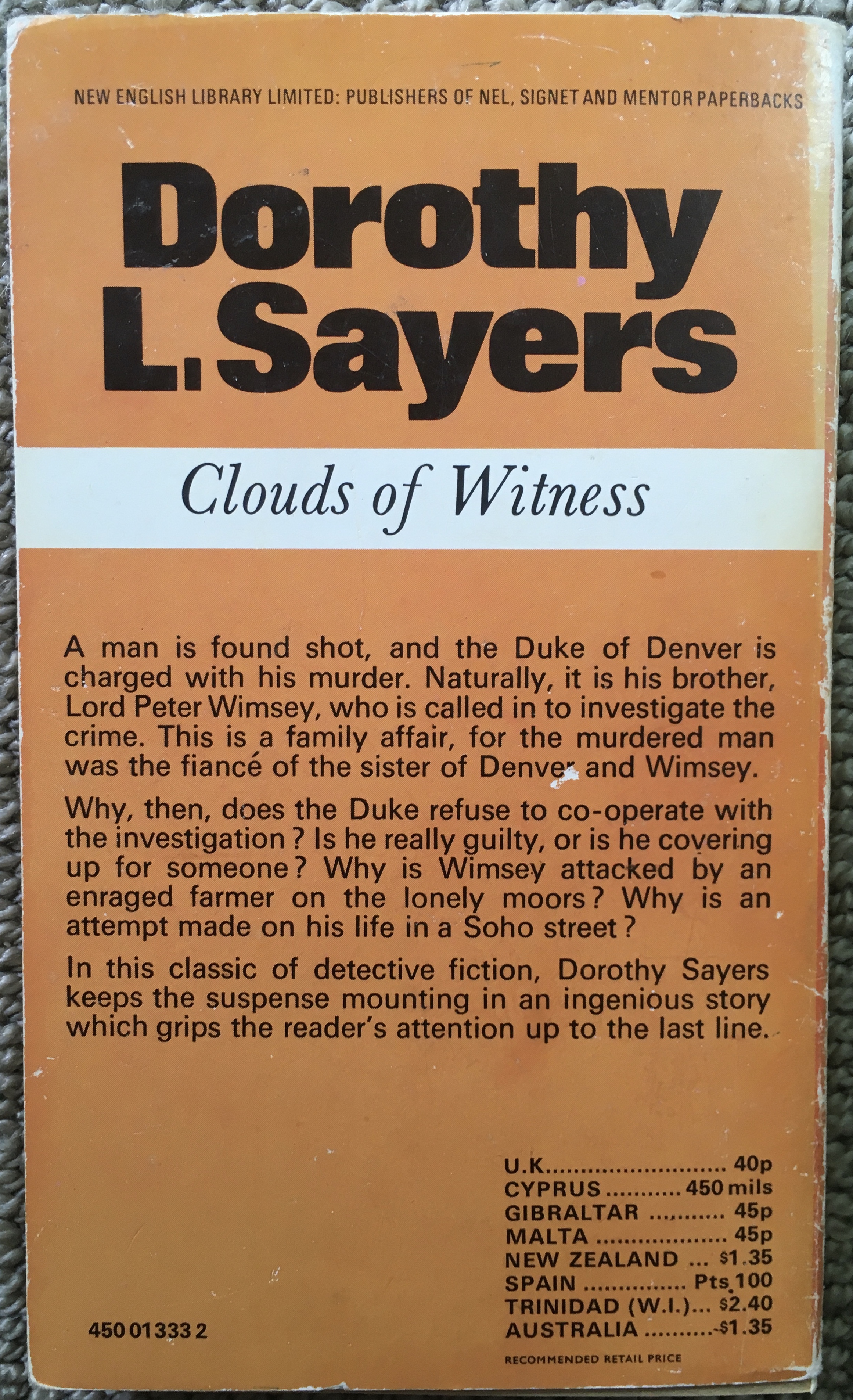
37. Clouds of Witness by Dorothy L. Sayers
A big part of the charm of these mysteries is reading the lifestyles and interaction of the aristocracy. Clouds of Witness is rich with these elements as the murder takes place in (or rather just outside) a house the family is leasing for shooting and Wimsey's elder brother, the Duke of Denver, is the accused. I don't know how much of his history and family play a role in the rest of the books. Here, though it is his older brother, Wimsey displays British "business as usual" and adds no extra emotion to his detecting (we also learn that he doesn't really like his brother all that much, which is later affirmed in a biographical note added to the end written by their uncle).
The mystery here wasn't too tricky and I appreciated that it seemed more of a vehicle to get Wimsey, his man Bunter and his confederate in the police Parker to have adventures and interact. Really, the crime is complicated by a series of coincidences. Basically, his sister's fiance is found dead, shot in the heart. The brother discovers the body and is bending over just as the sister comes downstairs and she thinks her brother shot him. Both of them are also hiding something. And it has come out that the fiance was a cheat at cards and the elder brother had found out.
It's sort of hard for me to distinguish between the styles of Ngaio Marsh and Sayers at this point, as both have aristocratic detectives with a backstory and I've only read one of the latter. Sayers has a slight lead for now in that the one book I did read was not so fiendishly complex and obsessed with the revelation of the crime.
Wednesday, July 27, 2022
36. Harvest Home by Thomas Tryon
It is a great premise. A young family leaves the rat race after stumbling upon an idyllic town that seems almost out of time in the New England countryside. Though very old-fashioned and while not unfriendly not necessarily welcoming either, the family eventually starts to make a home for themselves in the community. The economy is based around corn and they are way into it, including having a big harvest festival and all kinds of other weird old traditions. There are, of course, hints of darkness underneath the pastoral simplicity.
Now, having grown up in a small town, I do have a great fear of the countryside. Not because of some weird, potentially murderous rituals, but rather because of the ignorant, angry redneck shitbirds that these places seem to grow. This book comes from a more innocent time and perspective, where we don't have facebook-fuelled conspiracy tards in the countryside but just really old school, hard-working types who don't want to change their ways but really aren't hating unless you actually try to change their ways. And all things considered, except for a few minor sacrifices, their ways aren't all that bad.
It's what makes this book interesting. The protagonist is the husband, who starts to uncover what's actually going on. The mystery is fun to follow, but he is also kind of a dunderhead and also kind of a dick. Near the end, it's hard to sympathize with him. He is way too righteous and thinks that his discovery of one crimes entitles him to completely fuck everything up.
It's a well-written book, with a thoroughly thought out town and history that Tryon slowly unravels for you in a way that keeps the pages turning. I didn't ever find it that scary, though there are a couple of pretty freaky scenes with Missy the girl with the vision. The aesthetics of the magic and the ritual are really cool as well.
MAJOR SPOILER ALERT!
<spoiler select to see>What's hilarious about this book is that the final climactic horror in the end is basically a classic Penthouse fantasy: the husband is forced to watch while his wife gets plowed (pun intended) by the super well-endowed Harvest Lord.</spoiler>
Wednesday, July 20, 2022
35. Eternity Road by Jack McDevitt
It takes place thousands of years after the collapse of our own civilization, seemingly from a sudden plague. Society is very low-tech and achieving some level of political stability after a period of warring regions has led to an alliance. With the constant reminder of the failed "Roadbuilders" most people are not really into exploring the past and consider the ruins to be dangerous and even haunted. There is enough wealth and stability now for there to be learning centers and Eternity Road begins with a scholar returning from a failed attempt to find "Haven", a rumoured place where the Roadbuilders have still survived and maintained their knowledge. This is all really the prologue as when the scholar dies, he triggers a new gang to head out and trace his path by leaving a single copy of a Mark Twain book to the sister of one of the vicitms of the original party.
What I particularly enjoyed about this book is that it takes its story and narrative drive from the quest and the interplay of characters. There are so many possibilities where you could have a strong antagonist (small-minded locals trying to stop the journey; bad characters joining the party to undermine, etc.) and it just doesn't happen. Everybody in the party is a real person, well-rounded and there for various reasons that don't always jibe but there is none of this unnecessary artificial conflict of one guy spazzing out or stupid power conflicts. The journey is the pleasure for the reader. There are real dangers and bad stuff happens, but it never made me feel anxious. I just really enjoyed the depiction of the world, the clues about what happened to the past and some really cool interactions with ancient/modern tech (the bank robbery was a particularly neat and clever scene).
I did have a couple of minor quibbles. It felt like the language and shared awareness seemed to expand in the latter half of the book, where characters talked about things too easily that they didn't even understand before. I also didn't quite get the behaviour of the survivor of the original journey to Haven. I understand why he was bitter, but to deprive everybody else of so much knowledge because of his accident seemed a bit extreme. But I guess without it we wouldn't have had this book, which was quite enjoyable and satisfying.
Tuesday, July 12, 2022
34. Death at the Bar by Ngaio Marsh
Death at the Bar takes place in a cool-sounding small town (accessible only through a precarious tunnel cut into the hillside) on the Devon coast of England where a trio of gentlemen have come to vacation. One is a painter, one an actor and the third a prosecuting lawyer (barrister? K.P.? Who the fuck can figure out the weird British legal system). The lawyer has a minor fender-bender on his way in and then encounters again the other driver at the bar. This leads to a weird, subtle conflict which ends in a dart contest which ends in the lawyer getting pricked by a dart and then collapsing and dying from ostensibly cyanide poisoning. A classic, complex whodunnit where everyone at the bar could have done and at least three ways the poison could have been applied (the dart, the brandy he was given afterwards and the iodine used to treat the dart wound).
I really enjoyed the setting, the characters and the interplay between Marsh's detective Alleyn, his sidekick Sergeant Fox and the suspects. I actually ended up staying up way too late the night before an early flight because I wanted to find out who dunned it. Unfortunately, I ended up not being super satisfied. The last section spends the entire time on going over in great detail all the possibilities and suspects and eliminating them until the mystery is finally revealed. The solution is clever, but for me, I realize I actually do not have the patience and focus to care about these details. It all feels too nerdy for me. I think I may not be a true mystery lover at that level where you can actually think through the details of the crime and try and figure it out and I realize that is what Marsh excels at (similar level of detail in the other book of hers that I read). I'm there more for the setting and interplay of characters. I suspect that real mystery buffs may have been somewhat underwhelmed at the solution to this one as it turns out to be the most obvious suspect (after he had been sort of eliminated, so a clever twist by Marsh but still leaves you feeling like you didn't get the big reveal).
Thursday, July 07, 2022
33. Ancillary Mercy by Ann Leckie
So while I quite enjoyed it, it was mainly because we were still in the really cool universe that Leckie has created and less then because the narrative satisfied me. It felt like a bit more of a whimper than a Big Bang when Fleet Captain Breq and her team finally prevail against one of the clones of the Radch emperor Anaander that is fighting with itself and tearing apart the Radch empire. It is cool to see how this vast colonizing space empire starts to break apart and how this will manifest itself. The massive change that Breq initiates is giving self-determination to the AIs that allowed the Radch to so dominate. We only get a little taste of it (as it is granted to two ships and a space station) so it would be cool to see future book or series that deals with how this change will impact the universe.
Another really cool element, the alien Presger, are further expanded upon here and it is quite fun. Well we don't actually get to meet the Presger themselves, just a somewhat human being that was created by them to act as "translator". There is a running gag about fish sauce that was funny but also did give you a sense of something truly alien.
So I enjoyed reading it, but I wished that it had expanded outwards more. There also is a lot of interpersonal conflict among various characters on the crew that felt somewhat trivial and overblown. I think Leckie could be accused of a bit of moralizing driving the narrative. The big conflict involves a character from an upper class background doing micro aggressions and not apologizing when called upon it; feels very contemporary and a bit didactic but worse you just don't really care all that much.
Friday, July 01, 2022
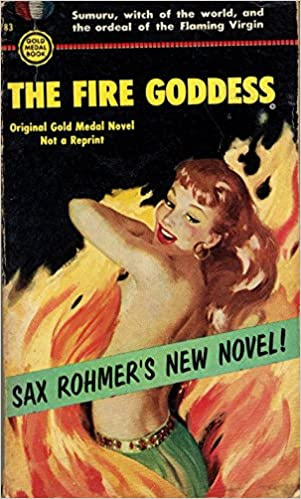
32. The Fire Goddess by Sax Rohmer
The story is revealed in layers, with quite a few characters and plot lines going on at first, so you don't get the main gist right away. Basically, the eponymous Fire Goddess is an insanely beautiful exotic woman who is often taking baths or lounging around in silky transparent robes flanked by two black pumas. She is returning to Jamaica, where she has one of her many luxurious and high-security homes, to prevent the exploration and exploitation (either for a dam project or a bauxite mining operation) of a valley where she does an important fire initiation ritual ceremony. There is a detective who is sent from England to follow up on death threats to the minister who is pushing for the dam project. There is also a handsome young man who works for the bauxite company whose old childhood crush is now the grown up and beautiful secretary to the threatened minister. There is also a Dexter character, who is working for but also in thrall to the Fire Goddess and he gets his own storyline of trying to break free.
So there is a lot going on and it was actually kind of fun to read and figure out where it was all headed. There is some good adventuring and exploring and lots of cool locations and side characters. I get why these books were so popular at the time. Unfortunately, I read that this series was kind of a copy of the Fu Manchu where the Fire Goddess basically replaces the Fu Manchu character. So maybe I should go back and find one of those to get a better idea.
Wednesday, June 29, 2022
31. The Westing Game by Ellen Raskin
The situation and the characters are all quite interesting and engaging. It is a nice capture of a certain American progressive mentality that was in many ways more mainstream back in the 70s and 80s where labour was not demonized and there was a simplistic but positive acceptance of the concept of diversity. It also has a nice confidence about the behaviour and thinking of the young characters. The protagonist ultimately is the youngest, the financially savvy but socially neglected 12 year old girl. My biggest issue was that the mystery didn't really resolve itself for me in a satisfying way. It was all just so oblique and the clues so arbitrary that by the time it was revealed, I was kind of lost as to why any of it was being done. The dead guy was supposedly getting revenge for the death of his daughter by suicide, but in the end there was no revenge and no real explanation of what the point of the complex puzzle will was. Maybe I just missed it.
Still not sure if this was the book I was looking for. It may be that I am conflating more than one book and this was part of it. Let me know if any of you can remember a young adult book from the 70s and 80s about a group of people who come to a mansion for a will that is a puzzle.
Wednesday, June 22, 2022
30. Partisans by Alistair Maclean
![]() |
| Don't judge a book by its cover |
The main problem is that despite a great setting (Italy and Yugoslavia in the height of WWII), nothing really happens. Maclean puts a bunch of mainly uninteresting characters together and I guess thought that was enough to keep the reader interested. Ostensibly, elite Yugoslavian soldier spy guy Peter Petersen gets the assignment to escort a spoiled and naive brother and sister radio operators and their equipment to some unkown place in the Yugoslav mountains. It's not clear why and right from the beginning there is all this distrust and doubletalk which I think was supposed to be suspense and spycraft, but was just confusing and boring. It's all made worse by having all the good guys act like British public school boys despite supposedly being Yugoslavian and the women all portrayed as righteous, erroneously moralistic spazzes.
The main character is particularly annoying as he seems to already know everything and we keep either getting him, the other characters or the author himself pointing out how smart and great he is (often to undercut the women's outrage that he has duped them once again). I am fine with the elite male protagonist kicking ass, but in Partisans he doesn't actually do anything all that cool. It's all tell and no show.
In the end, there is some big reveal that we all saw coming a mile away (spoiler, the protagonists are not actually German-allied royalists but partisans!!!). Just really not great.
Wednesday, June 15, 2022
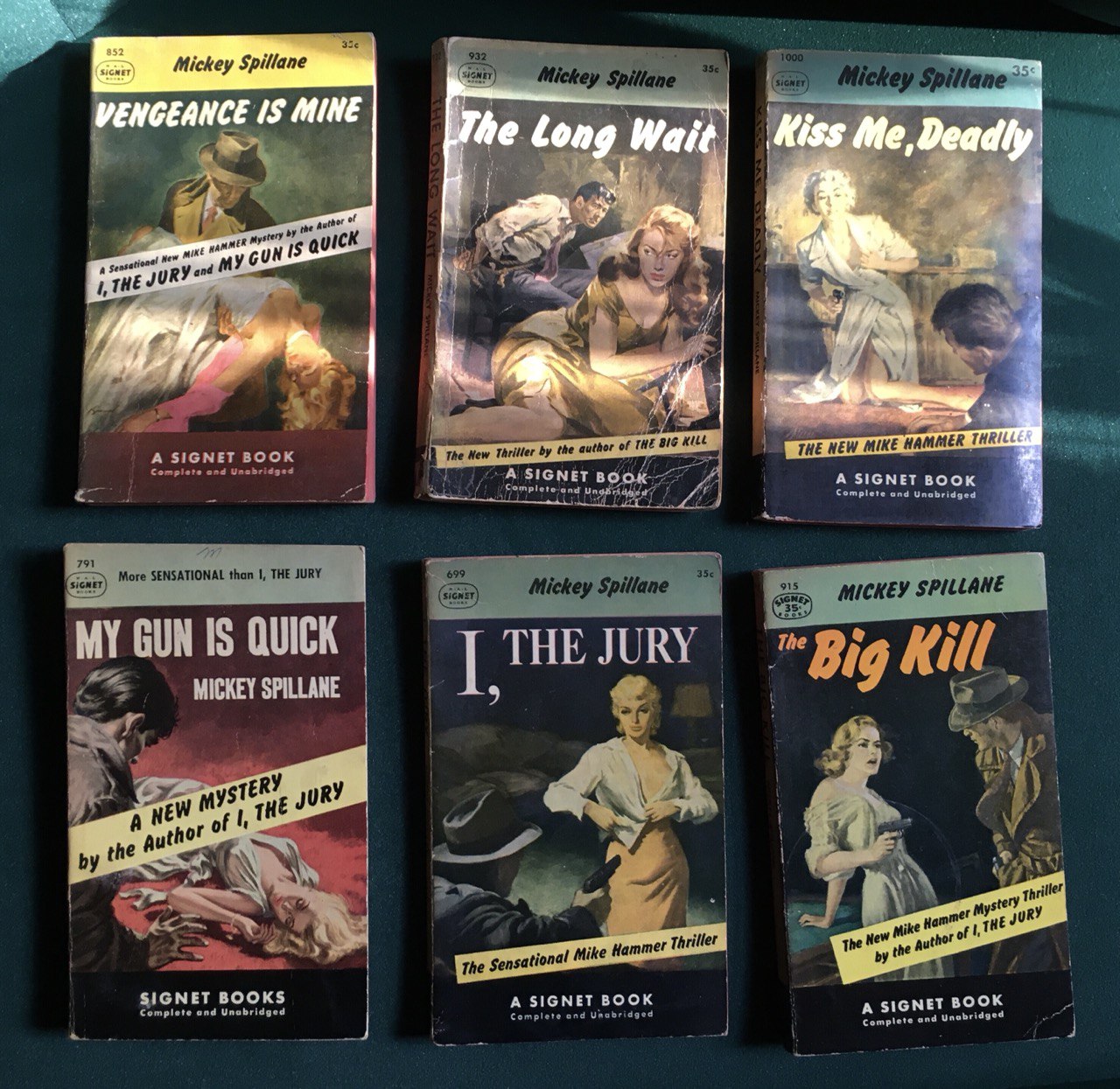
29. I, the Jury by Mickey Spillane
I am aware that there is already a lot of infighting about Spillane's work both from the literary and political perspective. I would say it is fair to critique the Mike Hammer books as fascistic, but I can handle a little fascism in my manly adventure books. Unfortunately, as a mystery and detective thriller, I, the Jury is just not great. Again, I want to be respectful and also remain mindful of how new this book was at the time it came out (and how I have a legacy of hardboiled detective and crime fiction in my own brain that owes much to Spillane while also skewing my perspective). It's just that there are so many flaws that I was kind of rolling my eyes throughout and somewhat distanced.
First, the tone is very inconsistent. It starts out with a super intense anger as Hammer stands over the gutshot body of his war buddy as he fantasizes about revenge. I'm a big fan of righteous revenge. I suspected that the white-hot intensity of the opening could not be sustained and the book loses much of its driving energy as the investigation gets underway and maintains a more mechanical pace with no solution to the mystery, nothing to generate emotion in the reader. We get further removed with a bizarre falling in love with the hot psychiatrist. There are also several three stooges level goofy asides, where Hammer bonks two wiseguys heads together at a bar for saying "hey hey" to his girl and dumps a pitcher of water from his upper story bedroom window on a couple of hair pulling "faeries". These moments are actually kind of funny and suggest that Spillane wasn't entirely taking himself too seriously. He just doesn't manage to balance these tone shifts in a way that kept me engaged.
SPOILER ALERT
Finally, the biggest flaw is that the plot itself has no real mystery or suspense because it was immediately obvious who the killer would be about a third of the way through the book. And not because of any easy clue since there is no actual way for the reader to put anything together. It's just you can guess by the stupid, simplistic mores of the book and the bizarre way sex and love are handled that it just had to be the femme fatale. I guess in 1947 it was the peak of this misogynist trope or maybe Spillane took it to the next level, I don't know but it reeks to me of laziness and pandering to the readers at the time. The finale where he finally gets his revenge is so rich with sex and woman fear that it must have been analyzed thousands of times by literary types.
Despite my negativity, the book was not unenjoyable. I like the locations, characters and some of the crime backgrounds, though fantastic were imaginative (the procurer for brothels who enrolled at a different university each semester to seduce, impregnate and then drive these sinning women to vice was kind of a wacky twist on the pimp). It's pretty fast moving and has some fun writing. I hope that Spillane honed his craft in later books and I will try to find out which is considered his best.
Sunday, June 12, 2022
28. Hammett: A Life on the Edge by William F. Nolan
On the positive side, this was a well-researched and easily readable, thorough walkthrough of Hammett's life and work. He had a really interesting life and it was enjoyable and sometimes moving to read about it. I hadn't known that he was hounded by McCarthy and his fuckstick anti-communist dicks in the 50s nor how resistant he was to their bullshit. I also didn't realize the full extent of his fame while he was still alive. I knew he partied pretty hard but didn't realize how much of it was as part of the Hollywood elite. Damn, they drank!
Unfortunately, this biography is also once again a hagiography and it really harms the material. Nolan is just too keen to reinforce and remind us how Hammett was both a superior writer and a superior person, even though at times for the latter his actual behaviour actively contradicts such a characterization. He did do a lot of good and did seem to have a very strong will and idealism that is impressive and respectable. But he also was a terrible drunk who did a lot of damage to himself and at times to the people around him.
There is a nerdy trope in the crime fiction world that bugged me the first time I encountered it and still bugs me today, though I sort of agree with it more than I did initially: the Hammett is a real hard-boiled writer while Chandler is a flowery romantic. Nolan just has to throw that one in this book and it's just nerdy and lame. He also does a drive-by against the guy who is considered the first hard-boiled detective writer (now totally forgotten), simply it seems to ensure that though this guy's stories were there first, Hammett's are the real ones. It's annoying as hell.
Wednesday, June 08, 2022
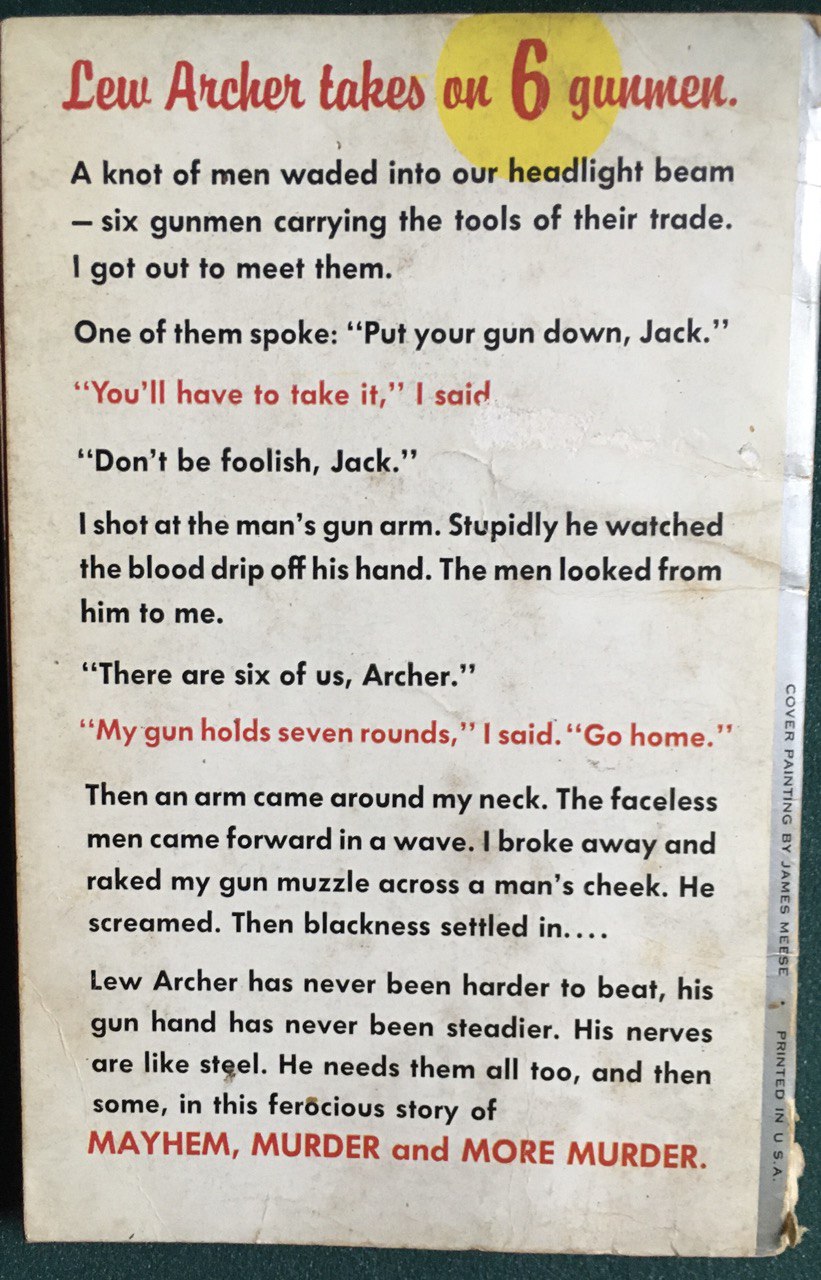
27. The Drowning Pool by John Ross MacDonald (and major paperback haul!)
Monday, June 06, 2022
26. Fer-de-Lance by Rex Stout
Friday, June 03, 2022
25. The League of Frightened Men by Rex Stout
It did not disappoint. I get why this series is considered classic. I have listened to many of the Old Time Radio plays of Nero Wolfe and enjoyed the banter, but the language and interplay between Wolfe and Archie Goodwin in the books is a richer and more pure delight. There is something about two men of extremely different personalities, united and perhaps trapped by work, who can be wittily candid about each other's perceived failings that is enjoyable to read. It helps that Stout really is great with character and language. Furthermore, the dressing around their relationship (Fritz, the elite french chef; the various helper detectives that Goodwin bosses around, New York City and environs) contribute to make this book a true escapist fantasy for a certain kind of reader.
My interest in the mystery itself waxed and waned, though the conclusion was quite satisfying. A group of Harvard graduates come to Wolfe because two of their number have been murdered and they are receiving threatening letters from the person they know did it. In their college days, a hazing prank went wrong and they crippled a freshmen. They had tried their best to make it up to him, paying for his care, supporting him to the point that he became a successful writer and befriending him but they all suspected that he still secretly hates them and, without incriminating himself, he makes it clear that he does. As a group of clients, they are challenging as some of them still feel guilt for what they did and don't want him punished. He comes off as twisted psychologically (perhaps even before the accident), kind of a psychotic mastermind against which Wolfe must pit his own genius.
Lots of fun. I am looking forward to reading the first one.
Monday, May 30, 2022
24. The Feud by Thomas Berger
![]() |
| Kudos to a cover that shows an actual scene from the book |
Wednesday, May 25, 2022
23. The Protector by David Morrell
Morrell seems to have made a niche for himself as extreme researcher of cool ass shit. In this case, he goes deep on the elite protection industry. Cavanaugh is an ex-Navy Seal who runs a small team that protects and hides people under extreme threat. Here, he is hired to protect a scientist who is already holed up in a warehouse hideout. When he goes there, the shit hits the fan and Cavanaugh learns that the guy discovered the ultimate drug (instantly addictive) and that the cartel is after him. There are several twists that weren't too hard to predict (even too easy, at a couple of points I found Cavanaugh to be stupid to not cotton to what was going on), that of course lead to Cavanaugh on his own, on the run.
There was another early plot point error that surprised me, where they sent the client out to get his fake ID created before the plastic surgery they were planning and I was off on the wrong foot. Once we get into the main plot, it's pretty cool. Morrell's research comes into play and we get lots of cool techniques for going undercover on the lam, armouring vehicles (and how to knock other vehicles off the road), making fake wounds and all kinds of cool little details. The bad guy is a real hateful prick too. A bit shakey at the beginning but ended up being as I had expected a quick fun read.
Monday, May 23, 2022
22. Understanding Korean Politics: an Introduction edited by Soong Hoom Kil and Chung-in Moon
I think it is probably worth studying why Korea has remained so quiet in the west, considering that it's history is quite wild. Not only did it have a miraculous economic growth, it did so through three dictatorships and some serious political craziness (including the president being assassinated by the head of the Korean CIA in 1987!). Why does Korea get so little play in the west? This book did not go into that, but it was a solid and sometimes interesting overview of Korea's political history, coming out of WWII being basically occupied by the US and USSR, getting split after the Korean War and then developing from a US-dependent military dictatorship to an independent, democratic economic powerhouse.
Though a bit dry and basically undergrad poli-sci with some of the nonsense that brings (academics still struggle with arguing over which theoretical lens is best and then concluding oh yeah we can use many), this book was divided into digestible chapters, all of which were really well-researched and directly presented. What I found particularly interesting is how the dictatorships had such control until, in each case, they went too far and popular protest ended up bringing them down. I'm over-simplifying but there seems to be something in 20th century Korean history where the people are unified enough (and having the threat of North Korea is a major factor here) that they can exist with a dictatorship and yet also bring it down. It bums me out that in their last election, they chose a populist asshole (though barely, but isn't that how these fucks get in power everywhere?). I hope Korean cultural and political unity can withstand the dividing power of today's internet.
Monday, May 16, 2022
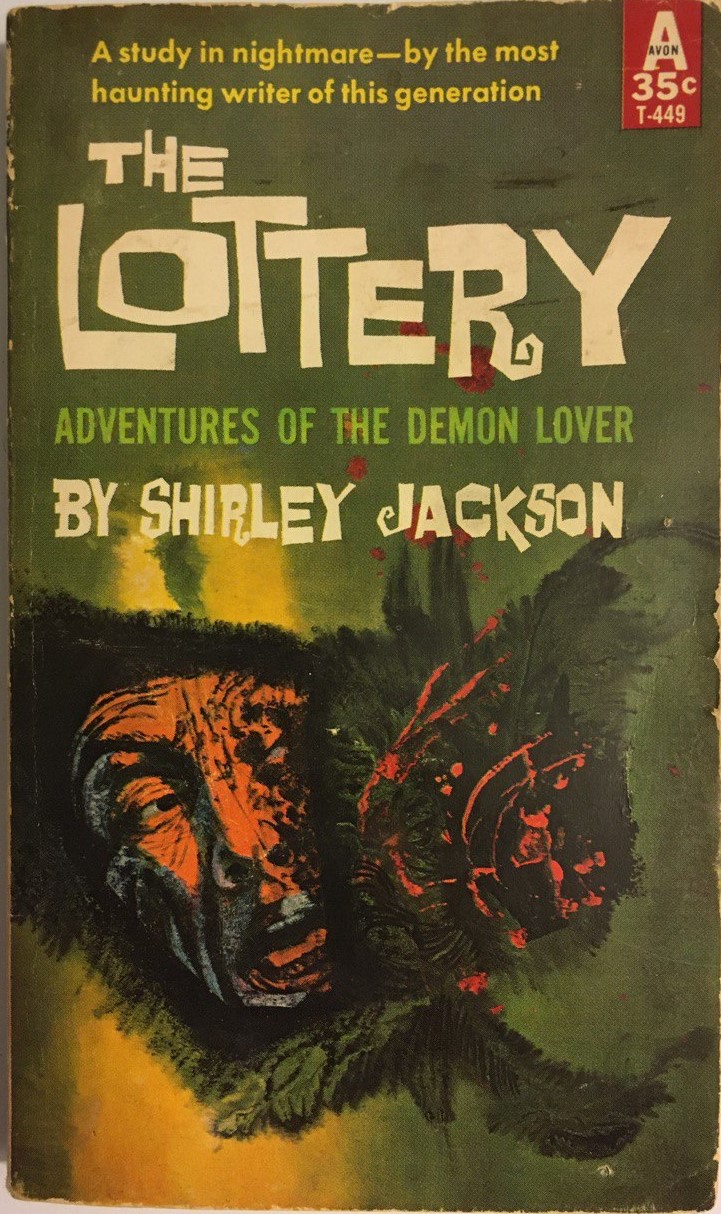
21. The Lottery: Adventures of the Daemon Lover by Shirley Jackson
An aside, reading this book did just give me a clear notion of the definition of "genre". This is my own way of understanding it (and may well be utterly not original and probably thought over with much more depth by much smarter and more patient people). Basically, in genre fiction, the primary objective is to tell a story. Ideas and concepts are delivered with the story, but tend to not be the main focus. Literary fiction can be story-driven but generally it is the ideas and concepts that are the main objective. Obviously there is a spectrum and lots of exceptions but broadly speaking this is why I personally prefer genre fiction.
The above notion crystallized in me while reading these short stories because many of them have only the most minimal story structure. At first, I was mildly annoyed, because despite my objective tone above, I am really not down with the New Yorker/liberal arts university creative writing course mode of trying to impart a feeling or some shit. However, Jackson is such a skilled writer and the stories so tight and short (and effective) that I got over my irritation. Many of the stories deal with the anxiety of women in this time period in the northeast, usually with an absent or oblivious husband and a contrast between the city and the country. There are a couple of stories here that really capture the fear that New Yorkers have of the country and close proximity to the rural working class. This has been going on for a long time!
My favourite story is The Dummy about two catty women who see a ventriloquist show and react to the dummy. Really, nothing much happens, almost the small incident one might see going out in NYC that would be a funny anecdote, but it made me laugh and she captures the women's dialogue so well.
I'm glad I read this (and later read up on Jackson's life) because I had only read The Haunting of Hill House, which is good but doesn't give you a good sense of where she is coming from. I will have a better appreciation of her work now.
Friday, May 13, 2022
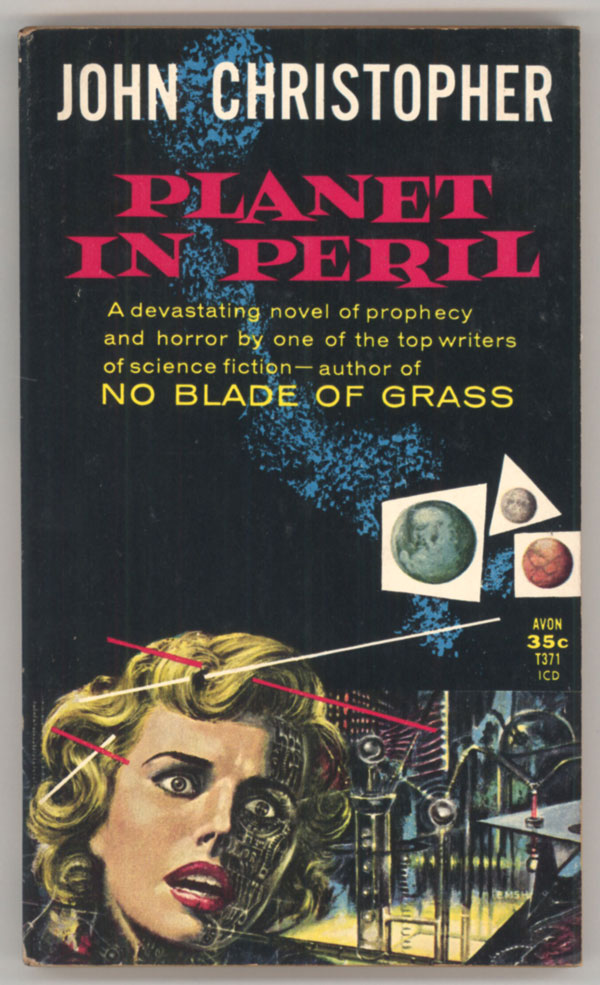
20. Planet in Peril by John Christopher
The story is that the hero after years working quietly in the same lab, suddenly gets transferred and promoted to a location where his predecessor disappeared in a sailing accident. When he gets to the new office, he meets the resentful assistant, who is also attractive and they hit it off. Then there is a lot of intrigue that you really don't care about, culminating in the possibility of Siraq invading the rest of the world with flying soldiers using heat rays generated from a new diamond energy that only the protagonist was somehow capable of inventing (except the Siraqis already invented).
There were a couple of good bits, such as the airspheres, giant bubbles you can fly around in the clouds, which was very well described and enjoyable to visualize. There are nice, subtle descriptive moments that remind you what a good writer Youd was. Overall, though, a dud.
Friday, May 06, 2022
19. The Big Brokers by Irving Shulman
The premise is great. Three young toughs (and one's moll) are sent by their boss to take over a failed resort and casino investment in Las Vegas. They proved themselves well on the streets to their boss, kindly but tough and scheming Itzik Yanowitz (a great character!) but it is a bit of a stretch and a risk to ask them to take over a hotel where the previous scrammed with the money and left to ruin. The book has an interesting pattern of weaving between sections of great detail, focusing on getting the casino set up for instance, then accelerating ahead to the next phases and challenges in their existence. It makes it somewhat uneven in feeling. Is it a procedural or an epic? In the end, it goes for the latter and I have to say does also succeed in giving us a lot of really entertaining procedure, both with how the criminals work and how a resort casino was run in that period.
Another element that makes the book somewhat uneven is the writing style. It's not bad, actually quite readable and the content is so rich that I found myself easily turning the pages. Shulman jumps around from perspective, not just from the characters' minds but going from a detailed description of the muscles on their faces to their thoughts and then to a more objective perspective. It also gets a bit melodramatic and maudlin at times. He really bears down on the stress and anxiety and the generally unpleasant price one pays to avoid the rat race and live large as a gangster. It gets rough at times too, there are two particularly brutal beatings that are hard to read.
It's interesting to read this book written in 1959, written 10 years before The Godfather and yet containing so much material that is now considered the sole domain of Scorsese. I wonder if he read this book, because half of Casino is in here. This one is going on the book shelf.