Wednesday, April 26, 2023

42. The Bamboo Blonde by Dorothy B. Hughes

Wow was this ever a disappointment.  I was pretty excited to find an original Pocket book of one of Hughe's early works, both as a collector and to read it.  After finally getting through this one, I have but faint hope that it is a nice collector's edition that I got a deal on.  I consider Hughes to be one of the best and most influential noir/hardboiled authors (of course semi-erased today because woman writer), so would really like to understand her motivations and goals in writing this book.  It's really a disaster.

There several problems with The Bamboo Blonde and they are apparent right from the beginning.  First and foremost, the protagonist, Griselda, is so disempowered and weak that it almost seems a parody.  She is on honeymoon in Long Beach with Con. It's their second marriage and already he is walking out on her with other women in bars, not listening to her, constantly drinking excessively against her wishes.  He is a well-known radio reporter and announcer but also has a history of espionage work and Griselda is deathly afraid he is actually there on a mission.  He just seems like a total dick and the more dickish he is, the more she wants to sacrifice herself for him. He puts her in truly dangerous positions constantly all the while telling her nothing because he doesn't want her to get involved and put herself at risk.  I was hoping right up until the end that she would start to show some pluck and turn the tables on him.  This book is like the negative Bechtel test.  Con is barely in it and yet her entire internal monologue (which is a lot of the text) is all about Con.  The only actual active behaviour that Griselda manifests is calling her colleagues in Hollywood to get info. She is a costume designer and there are tiny hints that she is well-respected in her business milieu, but that is the extent of it.

It's also just super boring.  The bulk of the action is all the various characters meeting over dinners and lunches and speculating about who did what.  Nobody has any information, least of all Griselda, so you are basically in the dark about everything.  There are things happening, but I would be being generous to call it a plot.  A woman is murdered.  There is an evil British colonel who is evil because Griselda can feel it right away (of course Con exposes her to him at every opportunity).  There is a maguffin about a missing radio engineer who is working on a Pan-American network or something that is causing all these people to gather at Long Beach but nobody knows who is doing or knowing which stuff.  It just goes on and on and then at the end we get endless pages where they all explain to each other what they did and why they did it but at that point you really don't care at all.

There are a few genuinely creepy passages when Griselda is all alone at their beach house and some of the characters, like the one-legged sheriff and his candy-eating son, are fun.  I learned that this was a sequel or follow-up to The So Blue Marble which I also disliked, though not as ferociously.  Good to know that writers can improve!


Friday, April 21, 2023

41. Stalking Point by Duncan Kyle

It's always a pleasure to find a new Duncan Kyle in the wild.  This one came with the Plattsburgh book haul.  It's not fair, but I like to refer to him as the poor man's Desmond Bagley.  He wasn't as consistently successful and his books are a bit more varied in subject matter which I think made him less marketable.  Personally, I find his writing to be somewhat more clinical and less visceral than Bagley.  Nonetheless, he is a solid writer with inventive adventure situations and well-structured plots.

Stalking Point starts out with a backstory at the end of WWI where a young German pilot, Ernst Noll, just avoids execution for cowardice (he freaked out his first flight when surprised by British fighters, abandoned his formation and left his decorated commander to get shot down).  He is shunned by his family, especially his patriotic father and pregnant wife and so makes his way to South America to start anew.  

Decades later, he is a new man, Ernie Miller, and we are in the middle of a new war. It's 1941 and America is still neutral.  The narrative dances around here and gets complex and interesting.  Alexander Ross, expert pilot but too old to fight is sent to Los Angeles to work on a secret mission to be the pilot for some new sub-detecting equipment.  He hires Ernie, who has mistakenly exposed himself to a keen, patriotic secretary at the German consulate in San Francisco.  She drags him into a plot by her boss, a bitter ex-pilot sent to work the bureaucracy because of a limp, to suicide bomb the secret meeting between Roosevelt and Churchill.

There is a lot going on in the first half of the book and the pages keep turning as we follow several storylines, including real high-ranking historical figures (Canaris, Donitz and others).  It's a lot of fun with a couple of neat little asides (particularily memorable is when two spies get pulled over by a zealous polish-American small town sheriff who rightly guesses they are up to shenanigans and almost has them but takes a contemptuous swipe at an explosive package).  The last quarter involves a long range airplane pursuit across Quebec to Newfoundland and while cool, it was also kind of a downer and the ending a bit of an anti-climax.  I appreciated its efficiency but there wasn't even a denouement so it felt a bit empty and sad.  It's still a solid read, though I would have to put in the lower ranks of Kyle's works.


Tuesday, April 18, 2023

40. Pride and Prejudice by Jane Austen

Lives up to the hype.  Masterly crafted.  I teared up.  My only complaint is that there is only the briefest mention of the work on the estate.  I would have much appreciated a few chapters on management of the fields and gamekeeping as well as Mr. Darcy's relations with his tenants which had earned him such a good reputation.  Otherwised, no notes.  I may try to watch the 1995 BBC mini-series which seems to be the general consensus for the best adaptation.

Monday, April 17, 2023

39. A Princess of Mars by Edgar Rice Burroughs

I've been looking for this for a while and found it at The Corner Stone Bookshop in Plattsburgh, NY.  It was part of a set of the Ballantine Books Mars series going up to #6, except #2 was missing, which is probably fortunate for me as I might have purchased them all.  I enjoyed the first one, but it didn't suck me in so I probably won't be reading the others.  So I'm glad I don't have that burden on my on-deck shelf.  

I think had I found these when I was 13, I might have gotten really into them.  They are quite fun and wild, with some crazy science fiction (or I guess "science fantasy" if you are going to be really nerdy) concepts about the environment, tech and societies on Mars.  The world-building is a lot of fun.  However, the storytelling is kind of clunky and there are some ridiculous coincidences to move the plot along.  These are not deal-breakers, especially for a book that was serialized and is basically the progenitor of the genre.  It just made the reading a bit slow-going for me at this age.  I feel like if I had to choose between continuing with the Tarzan or the Mars series, I would go for the former most likely.


Monday, April 10, 2023

38. An Everlasting Meal by Tamar Adler

It's a first for Olman's Fifty, a cookbook!  Good friends gave this to me for my birthday years ago.  I am not a natural cook and have never had much interest in cooking but have been forced into it by circumstance.  Personally, I have very simple tastes and can eat the same thing every day (I literally lived on rice from a rice cooker, a can of goya beans with cheese shredded on top as my dinner for most nights or years as a bachelor).  Unfortunately, others around me have more varied needs without the means or will to provide it for themselves, so it falls on me.  Many of my friends are hardcore foodies and I know a couple of incredible cooks, so I have also benefited from their delicious skills and good taste and have over the time developed a pretty sophisticated pallet in some areas (I have become kind of a BBQ snob for instance).  My mother is also an excellent cook and while I only really started paying conscious attention to her techniques in recent years, I realize that I did absorb some fundamental principles at an early stage.  

I started An Everlasting Meal when I first got it, but it is so dense with practical advice, that I had to put it down.  The plan was to read a little bit at a time and try her techniques as they came along, but instead it just gathered dust. I decided instead to read it almost straight through and then go back to it and try the various recipes and techniques and perhaps (horror!) mark it up with notes and stickies.  

First off, the philosophy and techniques in this book are excellent.  So many people in this fear and gadget-addicted age are obsessed with sterility and wellness but think that healthy and organic means individually wrapped in plastic and throw away anything that doesn't make their perfect instagram image.  This book will teach you how to use all the food and where to find real flavour in your food.  This is pretty much how I grew up with jars of weird liquids filling the fridge, the crisper being full of random weird single vegetables, my mom cutting off the moldy bits on cheese.  It is validating to see these techniques not only in print but applauded by all the hipster food media outlets.

My one caveat is the tone.  I went to a liberal arts college and there was a certain type of woman that I met there, the crafty earth mother.  They were amazingly competent and weirdly grown-up.  They weren't smug or righteous because they were too inherently caring to go that far, but there was a certain firmness and lack of humour in their demeanour that did not make for a lot of fun.  The kind of person who didn't watch cartoons as a kid and would say things like "why is there so much yelling in sports?" You can't tell if they are putting on a role or if they are genuinely that pure in their vision.    It feels like Tamar Adler was this type.  She's always saying things like "stale bread must be ground up into crumbs" like it's some universal goddess rule she is handing down. One gets used to it, but it is mildly annoying.

Still a great book if you want to expand your cooking game and more, change your entire perspective on food.  I will be going back to it over time.

Sunday, April 09, 2023

37. Some Dames are Deadly (Red Gardenias) by Jonathan Latimer

My quest for Paperback Warrior's #1 book of 2020 Solomon's Graveyard continues, but the clues along the way have provided a lot of pleasure.  Some Dames are Deadly (stupid title compared to the original "Red Gardenias" which is crucial to the plot original title) was one of two Latimer scores that I found recently in the now-famous Plattsburgh Corner Stone Bookshop haul.  I was a bit disappointed by Latimer's last book, but now I think I get his style and am starting to have a lot of fun with his books.  They should rebrand them something like "William Crane, Partying Detective" or "William Crane, Drunken Detective".  He really gets wasted constantly and it's part of his method.  Once you realize that not only is he drunk but he is also somewhat of a self-consciously unreliable narrator about his own drinking (he starts to feel grand, confident, steady on his feet as he crashes into a waiter, etc.) it makes the books much easier to digest and enjoy.

Here Crane is sent undercover to upstate town Marchton with his boss's niece, Ann who is also a detective, to pose as a married couple.  Crane has allegedly been hired as a copywriter with furniture magnet and patriarch Simeon March.  March's son and nephew have both had fatal carbon monoxide accidents within the last year and he suspect's his nephew's wife the super-hot Carmel March (who always wears perfume that smells of Gardenias).  There are two broad narratives that run through this book:  the mystery itself and the attraction/conflict between Bill Crane and Ann, who clearly have feelings for one another.

The mystery is fun, though gets a bit confusing.  I was almost tempted to write out all the characters with a relationship chart, but I eventually got it mostly figured out in my detail-averse brain.  As well as the various members of the March family (two recent widows who hate each other, the remaining brother and cousin) we also get hangers-on, nightclub performers and even local gangsters with names like Lefty, Frenchy and Slats. There is a lot of action, too.  Right from the get-go, the posing couple awaken to a burglar in the house they are staying in. We get a car chase, attempted assassination during a duck hunt, cat fight in the tennis club, a hospital shoot-out.  It's not boring! Latimer has a clipped, straight-ahead style that seems to elide how crazy the actual happenings are but in a weird way it makes them more exciting.  Oh shit, these women are really going at it, she just bit her to the bone!  The revelation is held out to almost the very last page, which kept me up way past my bedtime.

I don't know yet how many William Crane books there are nor if they have an ongoing and developing storyline, but here Latimer seems to be introducing a longer-term relationship with Ann.  What I appreciated about her other than that she is competent and courageous and quite witty is that she is constantly giving Crane shit about his alcoholism.  In the other books, everybody is drinking with him all day and it seems almost insane.  Here we finally see that there are people who don't drink constantly and are aware that it may actually be harmful.  Crane himself even grudgingly admits it.  It is helpful for the reader.  I'm not anti-alchohol, actually somewhat of a fan, but the drinking in the other books was so constant and extreme that it didn't even seem real.  Here, we are more grounded and as I said above now that I get that his drinking is a thing, it makes the behaviour easier to pursue.  

This is a sexist and racist era.  Most of the racism is in erasure (except the band of course), but there are also some really awful vocabulary that was just the norm for the time.  The sexism is more interesting as though the women's roles within the world are clearly defined, there is an equality in how they are used as characters that is refreshing.  Ann is fully independent and goes off on her own, fairly regularily one-upping Crane in her detection results.  She does end up getting captured and "rescued", but it feels almost perfunctory like she is just one of the guys.  Also, there is weed-smoking and it is simply noted just in passing as a thing the band does behind the country club.  This book was written in 1939 and it's a reminder that a lot of the anti-drug hysteria and puritanism in America was ramped up after WWII and not something always at such insane levels in our culture.

The copy I found was actually printed in 1939.  It's pretty ragged as you can see and the cover held together with tape.  It's an interesting format, bigger than a traditional paperback (thinner too) and much bigger than those small pocket books from that era.  Not sure how it will fit into my bookshelf.  Maybe better to find a true collector's home for it.  Readable anyways and I didn't do much more damage to it, which is rare for me.
 

Friday, April 07, 2023

Plattsburgh Haul at the Corner Stone Bookshop

I had to drive to the border to do an interview to get a Nexus card.  My original plan was just to do the interview and come back, but for some reason all the employees at the Border protection office for some reason all had barbecue.  It was some kind of celebration.  They didn't offer me any which was lame (it's a weird scene there) and the smells triggered a pavlovian response in me so I did a google search and then drove a half-hour out of my way to a decent BBQ spot in upstate NY.  Once there, I thought I might as well see if there are any used bookstores in nearby Plattsburgh.  I found two.  Sadly one is now empty but the second one, The Corner Stone Bookshop, turned out be an excellent store.  It's right downtown, which like a lot of these older northeastern cities looks to be struggling.  It was clearly a well-run store, clean and organized, with good sized mystery and sci-fi sections and lots of non-fiction categories.  I had high hopes which started to sag as I literally found nothing in either section.  However, there was a basement and going underground revealed a rich vein of paperback mysteries.  Some great finds here!  I left quite a few on the shelf that I might have picked up had they been the only one in the store, but my pickings were so rich I could afford to be discerning.  I believe most of these titles speak for themselves.  And the entire thing cost me $27.50.  I'll need to find an excuse to come back here someday. 

I've been looking for the first Mars book forever.  It's weird that it is so hard to find as there must be quite a few copies and versions.  They actually had the first 5 but missing #2 so I didn't think it would be so bad to just get the first one.  A new Duncan Kyle is always welcome, as his are hard to find in North America.  I wish I had a pre-movie Get Carter, but I'll take the movie tie-in as it's the writing that counts.  I had just realized that Haggard wrote his Charles Russel stories right up into the 80s so it was cool that I found these two.  Finally, All the King's Men is not a hard find but something on my list and since it's not in the categories I usually search in, I never find it.  This time I asked the helpful and informed woman working the desk and she found me two copies right away.

Here are the real scores!  It's crazy that you have to go back to original paperbacks to find some Dorothy Hughes.  Her stuff should be reprinted as much as "the big three".  Two more Latimers also a nice find (yet Solomon's Graveyard remains ever elusive) and finally a Charles Williams!  Yes!

with the jury-rigged crossbow!

High Citadel I've already read several times, it's arguably one of my all-time faves, so I couldn't resist this Fontana beauty. It's in good condition but the glue is dried and cracked when I opened it, so this will go right on the shelf, maybe even bagged.  I'm not a big collector guy, but there are plenty of copies of High Citadel that can be read so I'm happy to make a museum piece of this beauty.

I've worked hard to reduce my on-deck shelf.  My original goal was to empty it of all but books for which I need the one before (I have several part 2's of series there), but there is more than enough space to fit these beauties.  One has to be flexible with one's goals when opportunity arise.  

Thanks Corner Stone Bookshop!


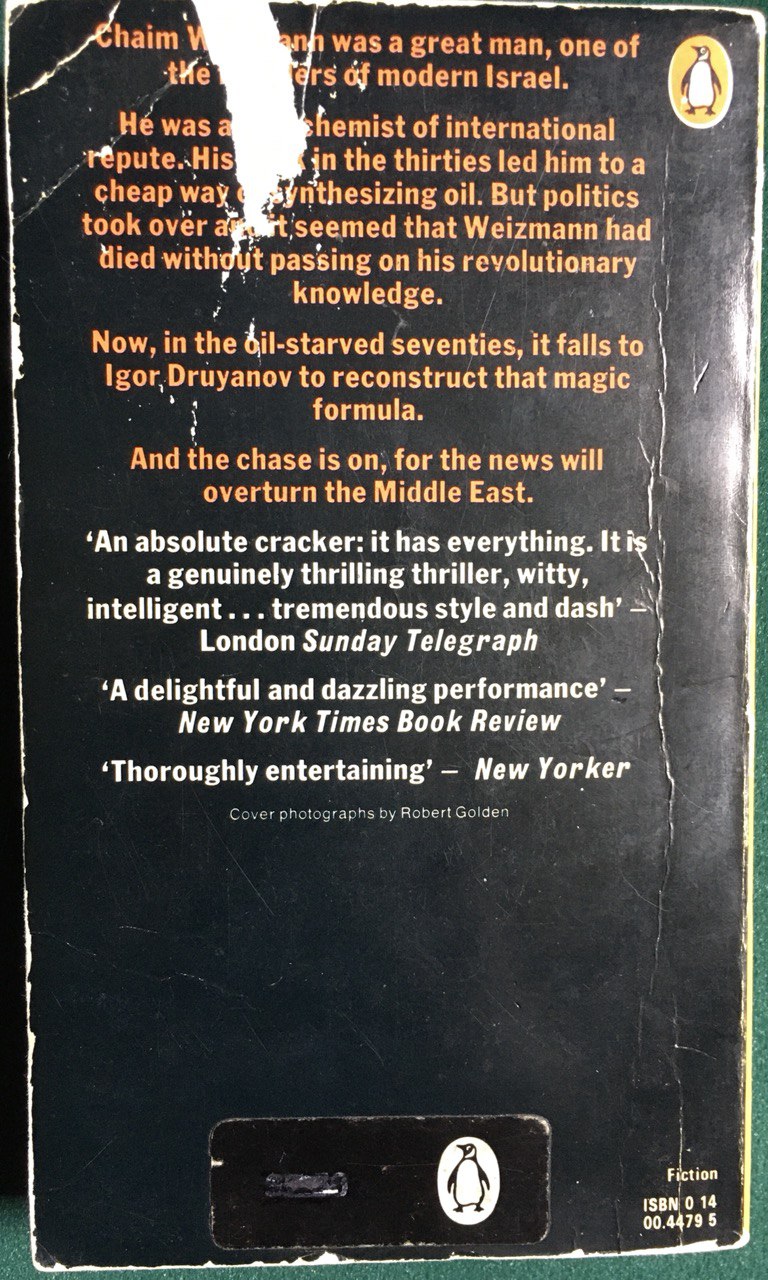
36. The Sun Chemist by Lionel Davidson

Phew, this was a tough one, set my recent furious reading pace way back.  It's deceptively long too.  I thought it was a slim paperback but I have recently realized that page width can make a huge difference in the apparent length of the book.  Two paperbacks of the same page count can be as much as twice the difference in physical width.  The Sun Chemist came in at a laborious 284 pages.  I think this will probably be my last Lionel Davidson book.

It's actually not a bad book, with a strong premise, cool locations, a good structure and as always excellent writing.  It's just not all that exciting.  Worse, Davidson has this cool style where he throws you into the situation and the head of the protagonist as if you have already been part of his life.  Context and background clues are therefore extremely subtle.  Maybe smarter readers than me get absorbed by this approach, but I find myself at a distance and not really knowing who any of the characters are.  As an example, the protagonist is an academic from a Russian background who seems to get laid fairly easily (has a long-running affair with a colleague's wife, hooks up regularily with his research assistants) but you never even get his age until he is referred to as "young" about halfway through the book.  I thought he was an old man.  He avoids any physical altercation and only at the very end do you learn he's not a good swimmer but nowhere does Davidson ever tell us what his body type is like, what shape he is in, etc.  You are supposed to infer it.

So I am already disconnected from the protagonist and all the many characters around him who are barely introduced and come and go.  Then from this batch of somewhat indistinguishable players, we are supposed to figure out which one could be a traitor.  I just really didn't care.

The plot is about the hero, Igor Druyanov who has been contracted to write a specific section on a giant biography on the life of Chaim Weizmann a chemist and founder of modern Israel.  I didn't know about Weizmann, so that element was informative.  Druyanov is a scholar of the 30s and is tasked to go deeply into those years of Weizmann's life, where he stumbles upon a potential chemical solution that Weizmann had found to producing cheap oil and food. The setup is neat and early on there are hints of menacing forces hovering around trying to prevent the discovery of this formula.  The problem is that the first 90% of the book and much of the "suspense" is just Druyanov trying to decode Weizmann's margin scribbles, hunting down old correspondence, seeking indirect colleagues.  It's well put together and clever but boring.

Finally, the climactic ending involves a lot of chasing with lots of complex geography, first in a house, then on a construction site, then in some ruins and finally in the water, all of which I was thoroughly confused by spacially so had no real care as to who was where.  There are also two very obviously telegraphed "twists" that further bummed me out.  Druyanov is carrying the formula in a case that he has obsessively and carefully protected and hidden for hours and then gets duped by a fat lady falling over his feet in the airport waiting room and puts the case down so it gets switched.  This is presented as a big shock, but it is so obvious when it happens. Likewise, a visiting Indian professor Patel is seen as the antagonist when any reader knows almost immediately that he is a red herring, but it goes on and on for pages of frustration.  I'm glad I am through with this one.


Friday, March 31, 2023

35. Cry Tough! by Irving Shulman

Cry Tough! is Irving's sequel to his huge juvenile delinquency hit The Amboy Dukes.  I found this beautiful but moldy and cracking Avon second printing at the record store on Roy that I have to go back to.  I would not have considered it such an exciting find, had I not already read The Big Brokers, the third in the Amboy Dukes saga, which I really enjoyed. Shulman wrote and published the first 3 in succession from 1949-51 and then wrote a fourth book with the same character, The Devil's Knee, in 1973, his last book.  That is on my list.

Cry Tough is a transition novel.  The main character is Mitch Wolf, who was a secondary character in The Amboy Dukes, as were Larry (the boss) and Bull (the muscle).  Mitch gets out of reformatory after almost two years, and the reader gets a quick reminder of what happened in the first book.  Mitch is mixed-up now, having no clear idea of what he wants to do.  This ambivalence evolves into the classic two paths, where he can go legit, become an apprentice cutter thanks to his dad's connections in the garment trade or try to find some angles and make the big money.  Even that latter, though, is no sure or quick ride as Mitch perceives he would most likely be in the employ of someone making real money while he takes all the risks.  There are a lot of great scenes of Mitch's family, his parents dialogue though very real reminds us of George Costanza's parents, with the arguing and old world diction.  Mitch's sister is engaged to a cop, whom Mitch refuses to acknowledge and this causes the initial stress in the family.

Ironically, it is in the garment trade where Mitch makes his real connection, as he luckily gets invited by his boss to go to dinner with Itzik Yanowitz the gangster who "protects" the Lucky Doll Clothing company.   Here he meets Joyce, the beautiful young prostitute, who will become a key player in the Big Brokers.  As Mitch moves up in Yanowitz's confidence, gets in deeper with Joyce, while dating good girl (and cousin to his sister's cop beau) Dorothy, his own internal tensions work harder on him.  The stress and anxiety that ends up destroying Mitch in The Big Brokers gets its birth here.

Much of the success of these novels, I suspect, comes from the legitimacy that was bestowed upon them by various moralists who gave the book a stamp of approval.  It's not exploitative, but it's pretty rough and I think a lot of law-abiding citizens who wouldn't be caught dead reading Swamp Girl thought they could get away with going into the sewer with Shulman. Honestly, after the first one, I don't find these books that moralizing at all.  They just feel realistic.  Cry Tough! has an ambivalent ending, though painful in that he separates from his family. It doesn't feel, though, that if Mitch had made the "right" choice, he would have been that much happier either.

The book ends with him, Joyce, Larry and Bull heading out to Las Vegas to take over the club that will be the main storyline in the Big Brokers.  I kind of wish I had read them in order, as after finishing this one, I now want to re-read the next one.


Wednesday, March 29, 2023

34. Watcher in the Woods by Geoffrey Household

Household really had a specific niche in the men's adventure fiction genre:  manhunting and tracking in the forest, particularly agricultural regions of England.  Maybe I need to read more of his books but of the three I have read, all of them had extensive tracking and stalking scenes involving pages and pages of minute detail about moving around a small area, playing a cat and mouse game with ones hunter.  I enjoy his books but don't love them as the human element is always kept at a cool distance and his badass characters so steeped in oldboy humility and reserve that it tends to lose its excitement.

I found this one at a free book box in Oakland on the way to the Temescal pool.  It's a nice hardback from Thrift books.  The story here is about a now-British of aristocratic Hungarian background who worked for the British OSS in the Second World War.  The story starts with a postman getting blown up just outside the hero's door.  At first he thinks it was a mistaken address or some terrible accident, but after some prying by his Aunt (with whom he lives), he starts to move past the denial and realize that he was most likely the target of the bomb.  We then learn that as part of his war service, he went undercover to work for the Gestapo and was stationed in Buchenwald.  This is an example of where the humanity just seems gone from Household's work.  The hero has shame and regret about that work, but those feelings are never really addressed with any passion or energy.  Though he used his role to save some important women from the death chambers, you would still think that anybody working at a concentration camp would have some serious issues and at least acknowledge the atrocity that he had experienced.  Here it is brushed off as a dark stain on his reputation and sense of self-worth.

Once he realizes that he is being hunted, he heads out to the country where he feels he will have an advantage, both because of his training (as an observer of small animals!) and because it will be harder to surprise him.  Here we get the bulk of the book which is him using different tricks that involve hiding in the forest for long periods of time or going for long walks or rides in the countryside to slowly draw out his hunter and reveal him.  This eventually works and the final climax is an endless night time stalking conflict with each having limited bullets and not wanting to fire because it would waste bullets and give away their position.  I wouldn't call it gripping, but it was kind of cool and interesting.  Maybe if you are someone who has done a lot of old school waiting hunting this stuff would seem quite realistic and technical and therefore exciting, but I really need maps to figure out what is going on so it all becomes sort of abstract.

Of course, his hunter is also a "gentleman" and by the end, each understands the other that it is almost a romance.  The last line of the book is literally them holding hands.  Though there is a real female love interest, the passion isn't quite the same level as between two gentlemen who each deeply respects the rules of the game hunting for one another.


33. One Small Step by P. B. Kerr

Jack from Dark Carnival had recommended this book to me for an xmas present for my 12 year-old nephew but it turned out he had already read it.  My nephew also strongly recommended it so I decided to hang on to it and read it to my daughter.

It's the story of a 12-year old Scott Macleod in the late 60s who turns out to be a flying prodigy.  His father, a decorated and heroic pilot and Air Force instructor, and mother, newspaper fact checker and anti-war protestor, are separated.  After a spectacular rescue landing in a jet, Scott gets tagged by NASA for a super secret space project.  It turns out they have a project to send chimps on the moon before the humans and one of them has become uncooperative, they don't have time to train another and since Scott is small and already shows the potential to be an astronaut, they want him to replace the chimp.

One Small Step is a boy who loves to fly fulfillment fantasy, as well as being an introduction to the world of flying and space and the historical period of the late 60s from an American adolescent male's perspective.  I would say it was a bit too fact-based around airplanes and how to fly them for my daughter, as she glazed over those sections.  However, the various points of drama and excitement were quite gripping. It starts out with the accident (where a goose crashes through the cockpit of the jet and knocks Scott's dad out when they are flying together) and then goes back in time and we were both quite anxious to find out what happened.

The empowerment fantasy continues as Scott is quite willful and also more ethical and caring than they scientists and doctors around him.  He takes a strong stand in protecting the chimps that is cool and later pulls an even stronger power play against the authorities.  Scott embodies the best of America, both its pride and work ethic in striving to achieve but also its disdain for authority.  We get both those poles reflected in Scott's mother and father, though the latter's impact is more apparent in the story.  His mother's strong morality we see more through Scott's actions as her actual role is sadly more restrictive and perhaps a negative stereotype of the worried mother.  The book also gets kind of spiritual and trippy by the end in a nice, subtle way that keeps you thinking.  


Sunday, March 26, 2023

32. Mindswap by Robert Sheckley

I took this book, I'll admit, purely for the cover (and it is a banger).  I wasn't even going to read it, but felt a need for a science fiction palette cleanser as I crush through my on-deck shelf of mostly mystery and thrillers.  Mindswap is of that New Wave science fiction age where the priority was on ideas over narrative, which I respect but recognize is just not to my taste.  I would add a sub-genre of "Irreverent Sci-Fi" of which I think Sheckley was one of the big players if not originator.  Elements of Irreverent Sci-Fi include tongue-in-cheek and self-referential humour, a nerdy, bemused distance from horrible things.  Hitchhiker's Guide to the Galaxy and Discworld would probably be two big giants.

The story here takes place in a future where you can swap minds.  Our hero, Marvin Flynn, lives in upstate New York and really wants to travel so he does a mindswap but once in the martian body and on Mars, he learns that the martian he did a swap with is a scammer and has taken off with his body while another being is owed the body he is in.  Due to legal and bureaucratic rigidity, Flynn has 6 hours to find another body before he has to return the one he is in (and effectively die).  This begins an adventure that takes us to many weird worlds, including indentured egg-hunting, a trek through the Mexican mountains, a high fantasy rebellion and eventually coming full circle.

There are some genuinely funny moments, especially the language he uses in the high fantasy one where they are always going on about their various clothing.  It's just that we basically lose track of the overall story and even worse with any semblance of worldbuilding consistency so that Sheckley can explore various "ideas" and the characters can have side discussions full of logical fallacies and nerdy constructions that are probably stimulating to some readers, but not to this one.  I'm kind of dull and structured and like my books to have a solid narrative and situational framework.  Still, I have to appreciate that Sheckley is a really good writer, his satirical representations of various genres are quite spot-on and even small situations would sometimes get me caught up (and thus disappointed since they end up having no weight or stake).  I also recognize that when this book came out in 1966 stuff like this was pretty wild and fresh for readers of the time.  We are drowning in irreverence today, so I speak from a place of privileged glut.


Friday, March 24, 2023

31. The Hot Spot by Charles Williams

Williams is not being removed from my hunting list.  This book was great.  It started out solid, well-written though the set-up seemed a pretty classic situation of the loner guy new in town who gets caught up in bad things in the town.  The main theme also seemed a bit simplistic and blatant as well; the guy is caught between the world of crime and sin that his bad side led him to and the safe legit world opportunity that the town presented to him.  However, as the story moves on, the complexity of the situation and the deeper and deeper shit he gets himself into and the really unexpected yet darker ending than I expected took this book into the upper echelon of noir fiction.

Madox is a bit of a drifter, not a super-bad guy but not great either.  After leaving the navy, he gets in a brawl in Houston so hits the road and ends up in a small town in Texas where he finds a job selling cars.  He's definitely disgruntled, arguing with his boss and spending his nights tossing and turning in his way too hot boarding house room.  Right off the bat, things get a bit weird, when he is sent with the attractive and nice young lady, Gloria, from the loan business across the street (owned also by his boss at the car lot) to go repossess a car.  The guy who bought the car is a roughneck, working as a security guard near an oil rig in the forest.  Here we get a great game-recognize-game moment and an example of some of Williams' great hard-boiled prose:

He was a big man, around six feet and heavy all the way up, and walked with a peculiar short stride which some people might have called mincing but wasn't. It was the flat-footed shuffle of a bear or a heavyweight fighter, and men who move that way are balanced and hard to push off their feet.

Sutton behaves with nasty and smug contempt towards Gloria, like he has something over her.  This is the biggest mystery of the book, but slips to the background as Madox begins to dig his hole.

First, he has an affair with the ripe, near spoiling, wife of his boss.  She is a fantastic character, coming off at first as just a bored, stupid sexpot but revealing layers of deceit and nastiness as the book goes on.  She is super hot and sexy and Madox at first can't resist and then when he can, she has the leverage on him and starts to apply it:

"I love talking to you," she said, smiling. "We understand each other so well.  You know, in a lot of ways we're just alike."

"Isn't that nice?" I said.

"Yes, I think so.  Now kiss me like a good boy, and tell me you like me better than that skinny little owl."

There was no way to kiss her like a good boy.  You could start out that way, but you always ended up on the other side of the tracks. If you hated her, it didn't make any difference; it worked just the same.

Such a great line!  Then, by chance, when there is a fire in town, he goes into the bank and finds it empty but for one old man, which sets him thinking of how he can rob the place, which he does.  This is an incredibly tense and creative scene, as the only thing that goes wrong is Mort, the old blind African-American who sells pencils on Main street, walks in and senses something wrong.  He can hear Madox's breathing and tracks him as he tries silently to sneak out of the bank. Such a great idea for the thing to screw up the robbery.  Nevertheless, Madox succeeds but then his hole only gets deeper.

He starts to actually fall in love with Gloria, and she back.  But she cleary has some twisted connection to Sutton and Madox keeps trying and failing to stop fucking his boss's wife. Everything just gets worse and worse, of course, while Gloria and Madox's love gets more and more real.  It's a great contrast of highs and lows as you read it.  The simplicity of the theme, rather than becoming obvious, gets more and more mired in the craziness of the situation.  Life keeps handing Madox opportunities to lead a great, legit life with Gloria, but he is already in so deep with all his crimes and lies that you know he's fucked.

Great book.

Addendum: I just did a bit of internet research on the movie and it looks quite good.  The casting of Don Johnson, Virginia Madsen and Jennifer Connelly seems quite good and it was directed by Dennis Hopper.  I'm going to check it out.  I'm a big fan of those '90s noir/thrillers anyways.  I also notice that the original title of the book appears to be "Hell Hath No Fury" which is way better.  Some idiot producer high on coke probably changed the title and Black Lizard then changed the book to get some movie sales.


SPOILER ALERT  HONESTLY READ THIS BOOK THE SPOILER IS FOR MY OWN REFERENCE


<spoiler select to see>This is what makes the ending so great.  Williams totally flips the traditional noir ending, so that while Madox lives and even gets away with it, he gets completely trapped by Dolores and is forced to marry her, take over the car and loan business and go totally legit, all the while working with his love (that Dolores forced him to reject).  He even succeeds in work and life, thinking about running for town council but he is miserable and must keep his wife alive for as long as he can because if she dies, she will expose him.  Just the worst.</spoiler>

Wednesday, March 22, 2023

30. The Schoolgirl Murder Case by Colin Wilson

Colin Wilson is an interesting and talented writer.  When I read a book like this one I am reminded at how skilled he was at producing a solid to excellent thriller in the conventional police genre.  I hesitated on this one because the last books of his that I read (or at least that I remember) were not so focused.  I was worried this one was going to be a bit of a rambling mess like The Philosopher's Stone.  I was glad to be wrong, as I tore through this one.  It is a very readable, straightforward and engaging procedural mystery that gets connected to black magic social circles but only the subtlest hints of any real supernatural.

The opening scene is the police at a murder scene.  A young woman has been raped and strangled and left in some trees between two houses in Hampstead.  The investigating officer on the scene Chief-Inspector Gregory Saltfleet (odd name) is the protagonist, an experienced, humane and competent detective.  He figures out a day late that what they assumed was a schoolgirl was actually a prostitute in her 20s who was dressed up as a schoolgirl.  They also check the empty house near the body the next day and discover another dead person, this time a middle-aged male, nude and half under a bed, no obvious signs of death but a look of terror on his face.  The house appears to be wiped clean of prints.  

The second victim is quickly identified, the wealthy and dissolute nephew of the owner of the house, whom we soon learn was quite a pervert and also recently interested in black magic.  Saltfleet competently and calmly starts poking around the world of the occult and local sex trafficking, centered around an occult bookstore.  The mystery itself is not super interesting but all the locations and the steady work of the police kept me engaged.  Things stay very grounded and we also get a lot of nice details of other side cases going on.  Felt like Wilson did some real research into Scotland Yard and wanted to share it with us. There is a hint of real magic, as Saltfleet meets a patron of the bookstore, a witch who does horoscopes and things get slightly freaky (and possibly sexual) back at her apartment when she has a powerful vision that leads him to a clue.  Later we learn that she had a more concrete connection to the murder, but Wilson doesn't dismiss his protagonist's spiritual connection with the witch.

I was also relieved that this book wasn't actually about murdered schoolgirls, but focused on this single case.  A solid read. I wonder if Wilson ever used Saltfleet in any other books?


29. Girl Gangs, Biker Boys, and Real Cool Cats: Pulp Fiction and Youth Culture, 1950 to 1980 edited by Iain McIntyre and Andrew Nette

No I did not read this book in a single day.  I've been reading it for at least a year maybe two, reading sections in between other complete books.  Surveys like this about books I am into are very challenging for me to read.  They can get repetitive and the content doesn't stick with me if I read them straight-through.  The real danger, though, is that they make me aware of all these other books I need to find and read. My overburdened hunting list and on-deck shelf (though I have cut into that this year) can not take the pressure.

I follow Andrew Nette on twitter who so often has cool recommendations and just shares great ephemera about old paperbacks and movies.  I admit to being envious to his many nice paperback finds in Australia.  They have a very different publishing world and had a much stricter censorship regime post-WWII so that there were fewer pulp books there.  Yet somehow the second-hand book stores seem much more fruitful than those we have in Canada today.  Anyhow, he is a serious student of the genre and has put together several books like this one.

Girl Gangs, Biker Boys, and Real Cool Cats is organized chronologically with each broad period of paperback fiction being given an essay or two, excerpts from the books, sometimes an interview with the author and most importantly, tons and tons of beautiful full-colour images of the covers.  The essays vary in quality, some are more factually-based histories of the various writers and the genre's impact on society (and vice-versa), whereas some try for social analysis.  There were too many and too spread out for me to remember any qualities aside sadly from one negative reaction to an essay on female and youth sexuality that was just bizarre and so wrong in its simplistic political assumptions that I almost wonder if it was done deliberately in a bad attempt at tongue-in-cheek humour.  Very questionable that it was included at all. 

Don't let that minor stain colour one's impression of the overall work, which is thorough and excellent.  This is kind of a must-have for anyone with an interest in paperbacks and will fill in many gaps for collectors. I also appreciated that it had a more Australian and British perspective, which was informative for me coming from North America.

In some ways, my favourite part was the very end where they got into the social issues books that came out in the 70s and early 80s of young adults and were often sold in schools.  Books like Dinky Hocker Shoots Smack and The Chocolate War.  These were very present in my childhood, though I think I was a bit young to read them but they always represented a kind of cool, older world.  I particularly liked the work of Molly Gratton (though they were short) and will check out her blog, Lost Classics of Teen Lit: 1939-1989.

You can buy this book in North America at PM Press.  You should!

Tuesday, March 21, 2023

28. Enter the Dragon by Mike Roote

This was another neat gift from my friend who can't stop going to the collectible store.  It's a pretty cool little collectible it turns out and I was proud to share it on twitter when somebody else had a different version.  I wasn't too keen to actually read it, though.  Enter the Dragon is one of my all-time favourite movies.  My mom took me and my friend Mike Tanaka to see it a special double bill with The Big Brawl at the Woodgrove theatre .  We were totally into martial arts and used to practice our moves on his trampoline.  We actually had to wait about a half-hour between the two movies while they drove the reels for Enter the Dragon over from Parksville where they had been screening it earlier.  It was a truly memorable cinematic experience and I was totally into Bruce Lee for years (still am).  I had an awesome poster in my bedroom of him with the 3 cuts across his stomach from Han's bladed hand.  Enter the Dragon holds up today on so many levels. It's so tragic that Bruce Lee died before it was released because it was the success he had dreamed of and can be considered probably the most important and influential martials arts movie for western action cinema.  

So anyhow, I wasn't too keen to read a movie adaptation, until I stumbled across this article about the author, who is actually a woman named Leonore Fletcher who wrote the book from the screenplay while on speed over a weekend.  She actually had quite a successful career doing movie tie-ins which were big business back in the day (this one was a bestseller). It's really worth reading the article.  I thought I should read the book as well.

It's a fast read and is basically a scene by scene copy of the movie.  There are some changes (Bolo is Turkish and the bully on the boat is Korean and no fight in the hall of mirrors, among others) and a little bit of suggested backstory thrown in, but honestly it lacked depth which I think would have made it much richer.  I mean why not throw in some more backstory for Lee and the connection between the Brits and the Shaolin temple in past espionage work?  It kind of felt like I was reading the movie for the most part (and some of the dialogue, especially that of Williams and Han is quite good on the page too) so not all that enjoyable.  But I guess pre-VCR this was all most fans could hope for to be reminded of the movie.

There was one big difference that was quite interesting.  In the fight scene between Han and Oharra, which is one of the greatest moments in cinema history on the screen, they just have a long fight and then Oharra pulls a blade from the crowd.  Lee forces him to stab himself with it.  The movie is very different, does an excellent and creative job of demonstrating both Lee's superiority and his fury.  I wonder if that choreography came from Bruce Lee himself?   It's also way more intense and dramatic.  Jesus this all makes me want to watch the movie again.

RIP Bruce Lee.


Monday, March 20, 2023

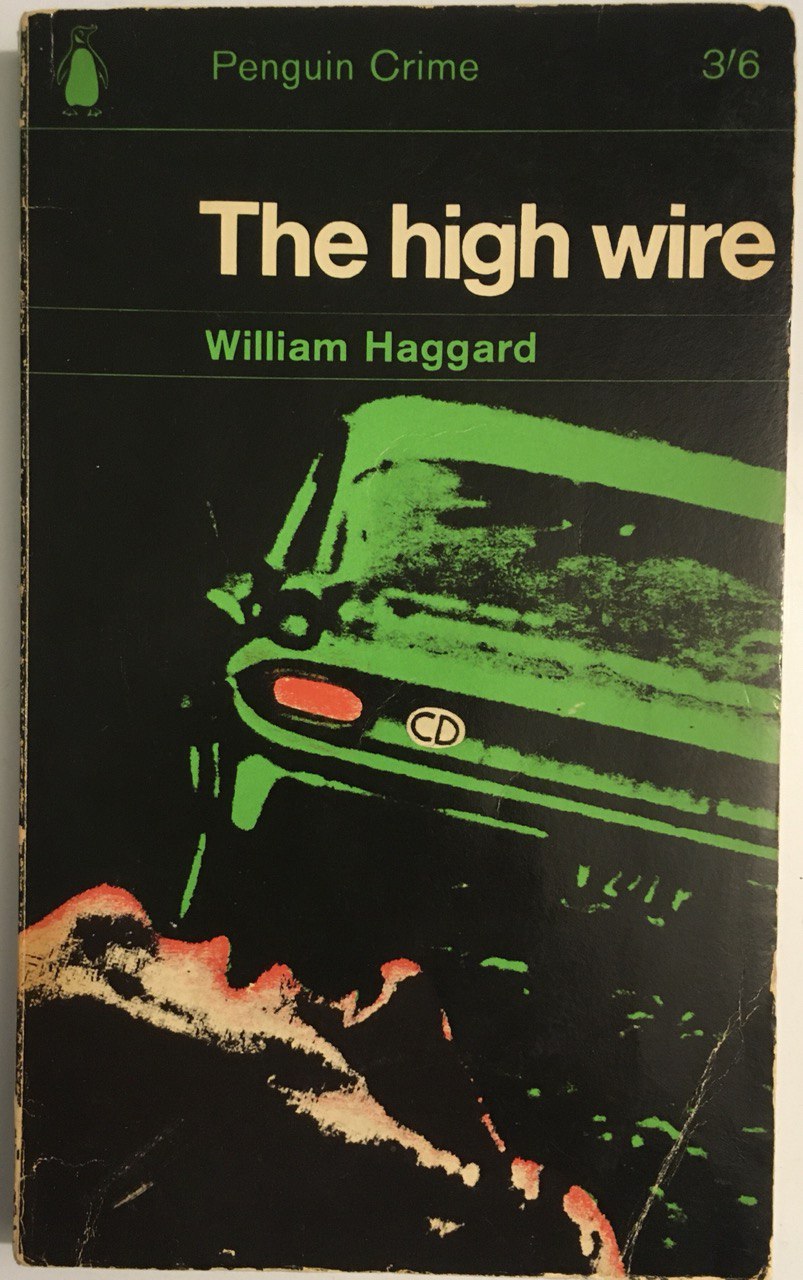
27. The High Wire by William Haggard

This is something like the 5th or 6th Haggard I have read.  What a great discovery.  It's odd, because the only books of his I have found are these gorgeous green penguins from the 50s and 60s.  However, it turns out Haggard wrote almost 30 books going right into 1990, but I never see those later books.  I wonder if they didn't sell as well.

I would say The High Wire is one of the lesser of his books that I have read.  I kind of get the feeling he is trying for a love story as that is the narrative thread that holds together a somewhat disjointed plot.  The main actor here is Rex Hadley, recently divorced from a difficult woman (whose behaviour somehow held him back from fulfilling his full career potential as a managing engineer) is now promoted to take over the nationally important "Project A".  He is first given a week's vacation to settle down post-divorce and goes to Sestriere, a ski resort in the Italian alps.  There he meets a charming and louche aristocratic with an attractive woman who wine and dine him and he accidentally lets slip that he is now the boss of Project A.

He realizes his error the next day, and also sees the slip as a reminder that he has to tighten up his game.  However, it is enough for the aristocrat who then gets assigned to the British embassy where he sets up a blackmail play.  At the same time, his boss, Victor head of the secret service back in the enemy country (never named and not Russia) also is working with more direct action to get Hadley to talk.  Project A is only in its nascent stage, but the rumours are that it is based on a new concept that could revolutionize conventional warfare and tip the balance of power to the west.  Victor's boss is putting heavy pressure on him to find out what it is.

I say it is disjointed, but it's more that the book flows pretty evenly for the first two-thirds, seems to conclude and then has a new final act which involves Hadley now engaged to the woman he first met with the aristocrat back in Sestriere and though Victor and the aristocrats moves have been blocked, Victor comes himself for a final desperate play.  It involves commandeering a gondola (thus the title) to torture Hadley and get his info. I can't remember if Victor was a character in any of the earlier books and maybe that's why he gets this final chapter, but it felt tacked on.  There was more action than usual in this book including an attempted kidnapping via helicopter on english soil, with dogs attacking and a shootout. That was fun. So not my favourite Haggard but will look great next to the other green penguins on my shelf!


Saturday, March 18, 2023

26. Duke by Hal Ellson

There is a lot to be suspicious about here: a novel that will "awaken" you, the middle-aged white people on the cover (the protagonist is black) and the back especially that says this is a "book of proven merit".  Even wilder, I read elsewhere that there are several editions of this book with a foreword from Dr. Fredric Wertham of Seduction of the Innocent fame.  This edition had a prefatory note from the author that appeased my fears somewhat, only in that he clearly is trying to show us the lives of the adolescents he is writing about in an honest way and that he is genuinely sympathetic with them.  He was a social worker at a psychiatric hospital in NYC and his stories came from the stories he heard from his patients.  Still, I was dreading a Cross & Switchblade situation heading in.

Duke is an odd book in its style and structure.  The narrative is repetitive.  Duke is the leader of his gang and there is a cycle of war and peace between them and their rivals from the next neighbourhood. Duke also runs weed for a spanish dealer, making deliveries via subway and foot all over the city, especially Brooklyn.  The book is an ongoing series of these incidents without much of a larger narrative.  It's kind of a summer in the life of a kid in Harlem.  He tries to write it in the slang (it's first person), which may be authentic but feels forced and artificial (not helped by the extensive glossary at the beginning) at first.  As it goes on, though, there is a rhythm to the book.  It starts to feel almost like a poem.  You do feel for Duke and his stressful, tiring life.  

The sympathy is reinforced by the growing prominence his psychology takes as the narrative goes on.  Duke struggles with fears and anxieties.  These are quite interesting.  He hears his name being called on the streets and nobody is there.  He fears his hands are shrinking.  He sees the face of the spanish girl Gigi that he loved and whose father moved her away because he was black.  He sees a one-legged man who looks at him funny and scares him.  All these neuroses are much more terrifying to Duke than the undercover cops that are really tailing him.  At first it feels a bit simplistically Freudian, but it gets weirder and weird and he even has a full breakdown where he runs away and sleeps in the basement of a house he breaks into and then ends up with some hoboes.  His recovery is so sudden that it really does seem like he is suffering from schizophrenia that is only going to get worse.

So I hate to admit it but Duke is sort of an "awakening" book, but not in a cloying pushy way.  I would rather read this book actually written by a young black kid from Harlem for many reasons but for a white guy from 1950, this book does give you a compelling and sympathetic look into such a person's life.


Thursday, March 16, 2023

25. Marshworld by A. R. Lloyd

look at these evil mofos!
This one has been on my list almost as long as the elusive Colin Dann but I finally found it somewhere last year.  As many of you may know from years of following this blog, I am a fan and student of the sub-subgenre of intelligent farmland animal adventure fiction.  I am very pleased to find that Marshland is an excellent addition, possibly one of my favourites so far.  It's the story of Kine, the bold (and perhaps arrogant) weasel in the pastoral river valley (in the afterword we learn this is between Kent and Essex).  The only other humans are the farmer and his daughter and Poacher, the lone neighbour who knows everything about the land.  Weasel's dominance and indeed his very existence is soon threatened by a gang of nasty mink, led by their truly evil leader and den mom, Gru.

Mink are nasty!  Though (again the afterword) Lloyd explains that mink aren't actually as voracious and destructive as portrayed in the story.  They were imported from North America for their pelts and those that escaped survived and even dominated in the english landscape.  But they tend to live fairly solitary lives and hunt and protect their territory in a reasonably balanced way.  In Marshland, they are like true human colonists, slaughtering simply for the slaughter.  They massacre frogs, birds, fish and in the most brutal part, Kine's awesome mate Kia and his loving new brood of weasel kittens!  It's rough.  This book is almost like a weasel Death Wish. There is also a secondary plot about Poacher with hints of his past in the Second World War and the farmer's daughter who helps take care of him as he gets sick and old (he showed her the ways of the woods when she was young).

My one challenge with these books is that the author's are almost always english flora and fauna nerds.  They tend to go overboard with the descriptive writing and the specific species of plants, birds, insects and animals.  The latter I can generally picture but so many of the plants I have no image of at all, that it just goes right over my head.  This is the kind of book that would do well with some cool ebook where you could just put your finger on the word and it would show an image of that kind of plant. Actually, this holds true for the powered pump drainage system that I guess takes excess water from the marsh and puts it into the river. It was a crucial plot point, but I couldn't figure out how it was supposed to work so had trouble visualizing its dangers.

Despite those minor concerns, it's an absorbing and exciting book.  I am happy to learn that it is the first in a trilogy, so A. R. Lloyd stays on the list!


Tuesday, March 14, 2023

24. The Dream Walker by Charlotte Armstrong

Charlotte Armstrong is another of those semi-forgotten and very good female mystery/thriller writers from the post WWII-era.  This is the last of her books that I had on my on-deck shelf after a concerted hunting effort.  I had been saving it but my 2023 focus is to reduce my on-deck shelf to zero if possible and to clear out books that have been sitting there for years (so I can buy more books!).

The Dream Walker has a novel approach.  It's not really a mystery, though there is a murder, as you know pretty much what happened in the opening pages.  The narrator Olivia, who announces herself unreliable due to the state of her health, is from a good family and an acting teacher at a girls school.  Her story is about a conspiracy to discredit her wealthy and influential uncle. The concept is relevant to today's world of disinformation.  A dissolute failson gets mixed up with a commie spy ring and it is the uncle who tips off the authorities.  By pure chance, the failson runs into a failed theatre director and together they cook up a plot with the help of two actresses to get revenge.  The idea is that one actress in New York will start passing out and having visions of herself in another place, speaking to a person in that place.  The second actress, disguised to look like the first one, actually is in that place and speaks to the person.  It is done subtly and cleverly so that it attracts little attention at first, but soon grows. The mystery that keeps you reading is exactly how this will involve the uncle.  The relevant idea is that even though many people will dismiss it as faked, it is enough to cause debate and controversy and thus doubt.

Alongside the conspiracy, there is a romantic angle, as Olivia's cousin (though not really as it is by marriage) is also investigating the visions.  This narrative I found less enjoyable and subtle as the mystery.  The cousins are always bickering and Olivia has this annoying mode of being constantly vexed by the cousin. You guess quite early on that they are supposed to fall in love and the bickering just seems odd.  I don't know, I wasn't feeling it. Her emotional insecurity contradicted her courage and cleverness in dealing with the mystery.  The climax was quite fun, with Olivia using her acting skills to turn the table on the manipulative playwright in an OTR/Suspense style that was quite fun.

So a bit of a mixed bag, but I'll give it a thumbs up for the innovative structure.